
Lecture 13 Tables from Arrays of Objects Exploding

* Lecture 13 Tables from Arrays of Objects Exploding Strings * Course logo spider web photograph from Morguefile openstock photograph by Gabor Karpati, Hungary.
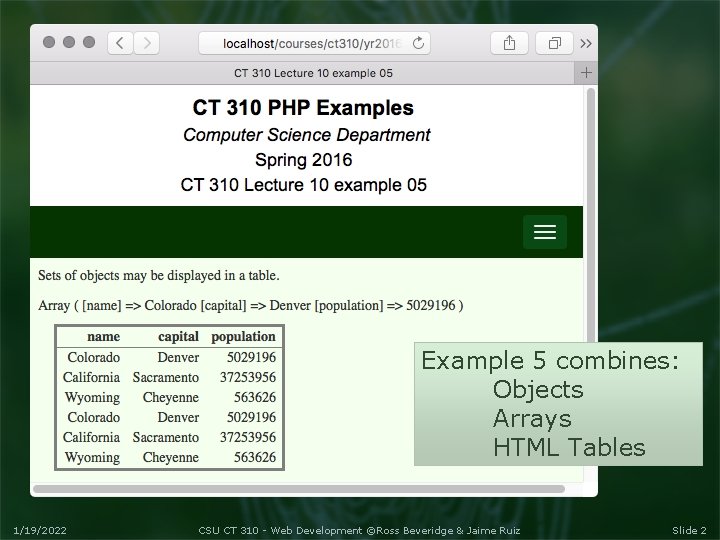
Example 5 combines: Objects Arrays HTML Tables 1/19/2022 CSU CT 310 - Web Development ©Ross Beveridge & Jaime Ruiz Slide 2
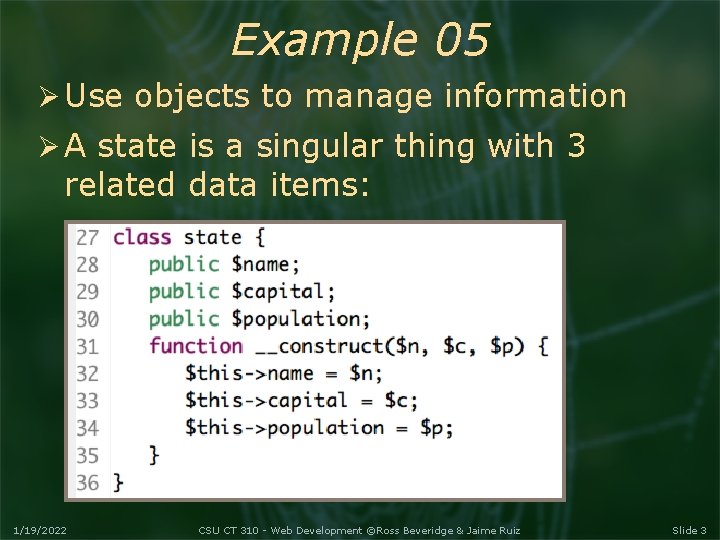
Example 05 Use objects to manage information A state is a singular thing with 3 related data items: 1/19/2022 CSU CT 310 - Web Development ©Ross Beveridge & Jaime Ruiz Slide 3
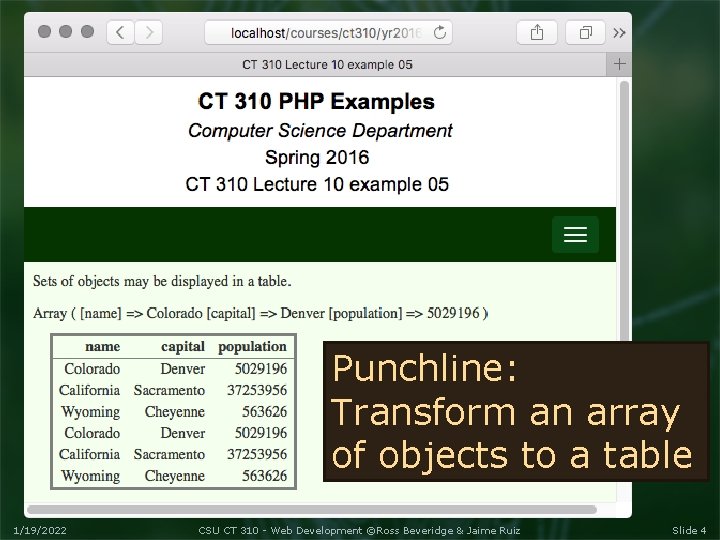
Punchline: Transform an array of objects to a table 1/19/2022 CSU CT 310 - Web Development ©Ross Beveridge & Jaime Ruiz Slide 4
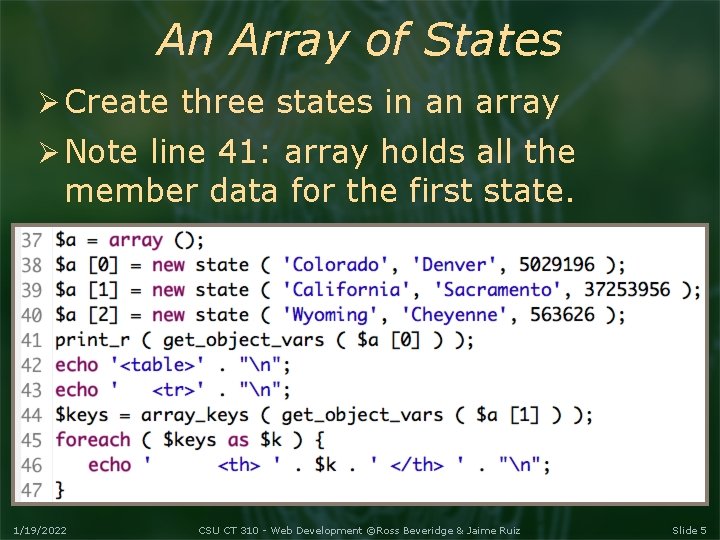
An Array of States Create three states in an array Note line 41: array holds all the member data for the first state. 1/19/2022 CSU CT 310 - Web Development ©Ross Beveridge & Jaime Ruiz Slide 5
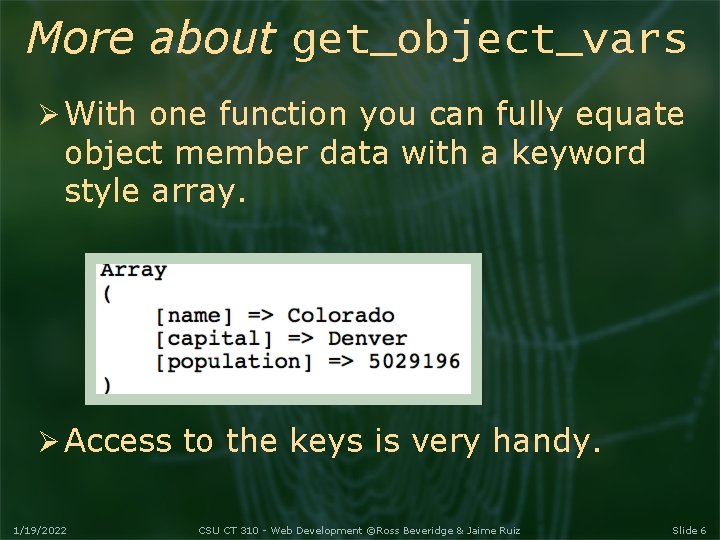
More about get_object_vars With one function you can fully equate object member data with a keyword style array. Access to the keys is very handy. 1/19/2022 CSU CT 310 - Web Development ©Ross Beveridge & Jaime Ruiz Slide 6
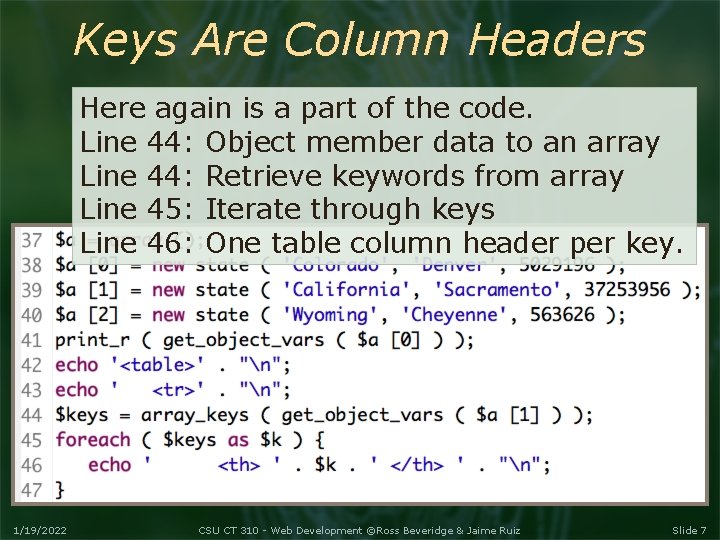
Keys Are Column Headers Here again is a part of the code. Line 44: Object member data to an array Line 44: Retrieve keywords from array Line 45: Iterate through keys Line 46: One table column header per key. 1/19/2022 CSU CT 310 - Web Development ©Ross Beveridge & Jaime Ruiz Slide 7
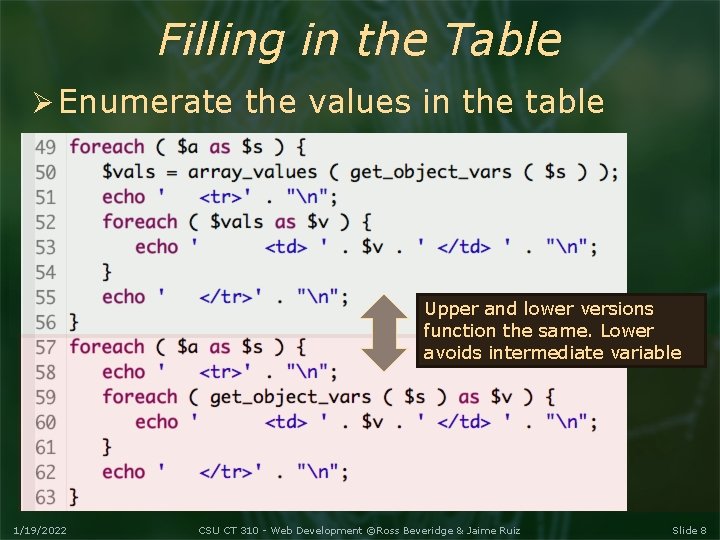
Filling in the Table Enumerate the values in the table Upper and lower versions function the same. Lower avoids intermediate variable 1/19/2022 CSU CT 310 - Web Development ©Ross Beveridge & Jaime Ruiz Slide 8
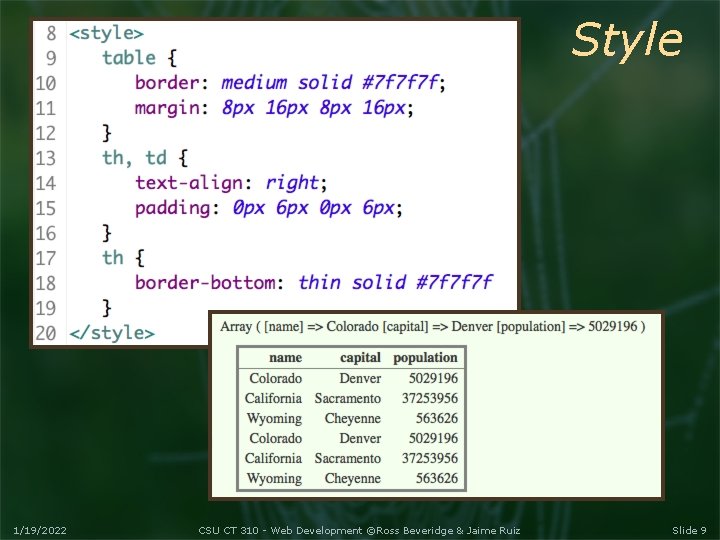
Style 1/19/2022 CSU CT 310 - Web Development ©Ross Beveridge & Jaime Ruiz Slide 9
Now Without Loops Same goal, build a table from an array of objects. But, no loops, just array reduction Nested array reduction at that. Many ways this could be done. In this example, table header and table data rows first built as strings. Then sent to the client, i. e. a succinct echo command inside table tags. 1/19/2022 CSU CT 310 - Web Development ©Ross Beveridge & Jaime Ruiz Slide 10
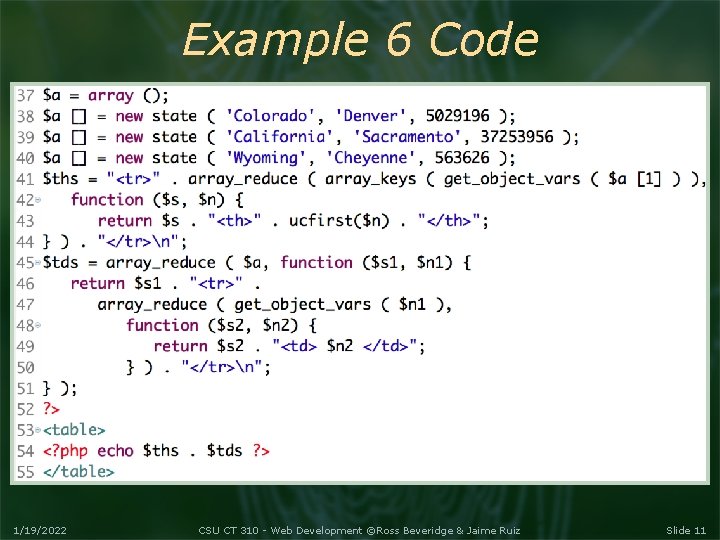
Example 6 Code 1/19/2022 CSU CT 310 - Web Development ©Ross Beveridge & Jaime Ruiz Slide 11
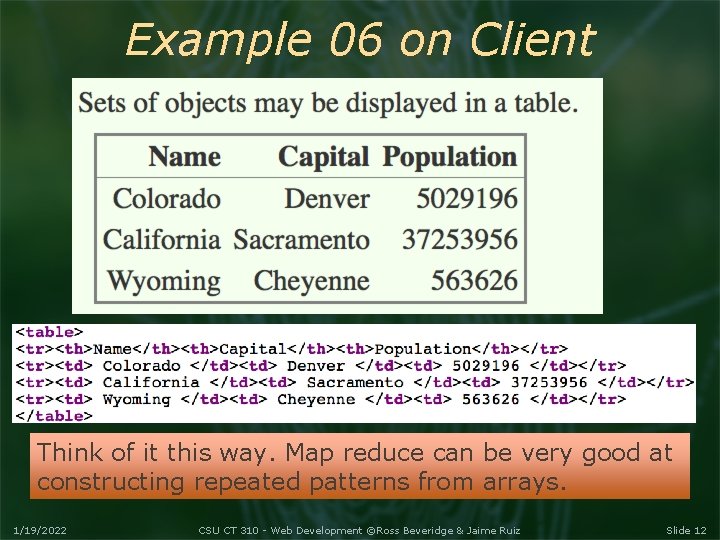
Example 06 on Client Think of it this way. Map reduce can be very good at constructing repeated patterns from arrays. 1/19/2022 CSU CT 310 - Web Development ©Ross Beveridge & Jaime Ruiz Slide 12
Example 06 Observations Example 06 may be a bit extreme OK to ask, who finds this more readable? On the plus side Highly functional limits side-effects. Internal function easy to modify. Punchline for CT 310 1. Study and understand Example 06! 2. For now avoid loops when you can. 3. Once you master both styles, then you will be able to make informed choices. 1/19/2022 CSU CT 310 - Web Development ©Ross Beveridge & Jaime Ruiz Slide 13
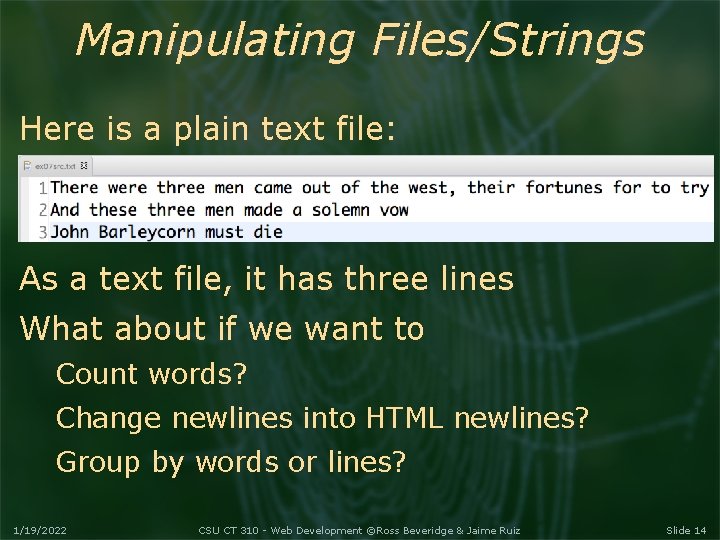
Manipulating Files/Strings Here is a plain text file: As a text file, it has three lines What about if we want to Count words? Change newlines into HTML newlines? Group by words or lines? 1/19/2022 CSU CT 310 - Web Development ©Ross Beveridge & Jaime Ruiz Slide 14
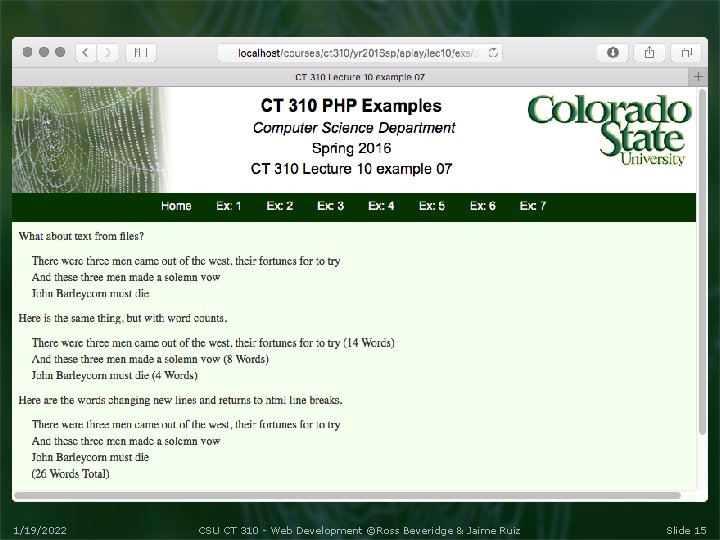
1/19/2022 CSU CT 310 - Web Development ©Ross Beveridge & Jaime Ruiz Slide 15
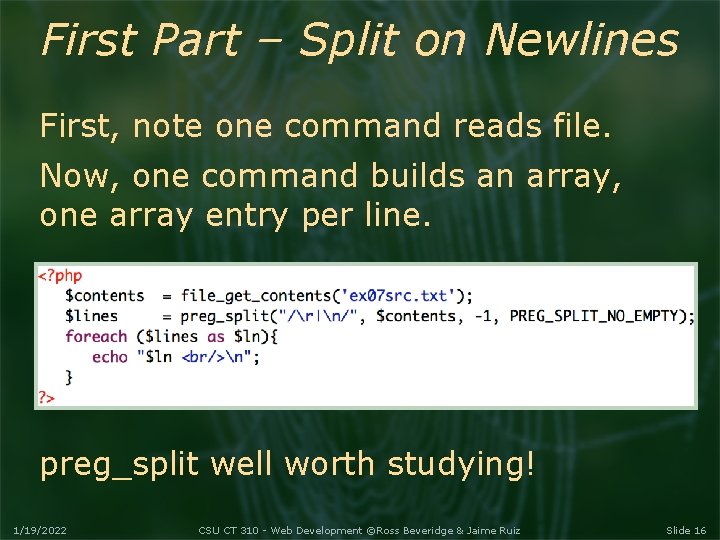
First Part – Split on Newlines First, note one command reads file. Now, one command builds an array, one array entry per line. preg_split well worth studying! 1/19/2022 CSU CT 310 - Web Development ©Ross Beveridge & Jaime Ruiz Slide 16
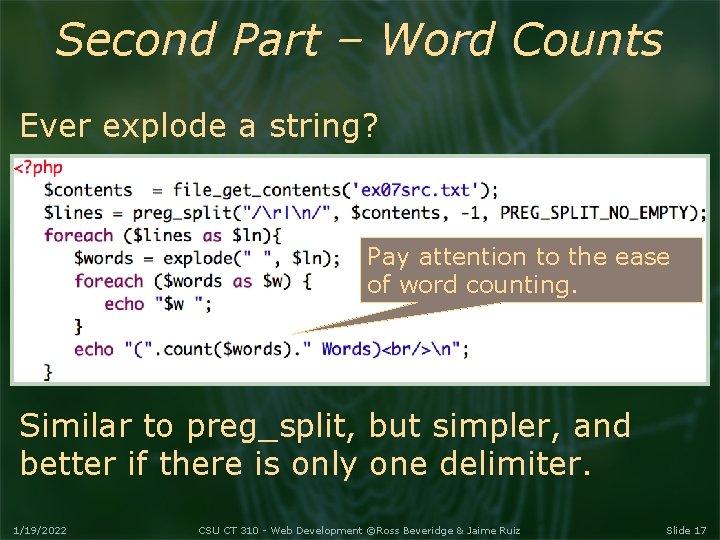
Second Part – Word Counts Ever explode a string? Pay attention to the ease of word counting. Similar to preg_split, but simpler, and better if there is only one delimiter. 1/19/2022 CSU CT 310 - Web Development ©Ross Beveridge & Jaime Ruiz Slide 17
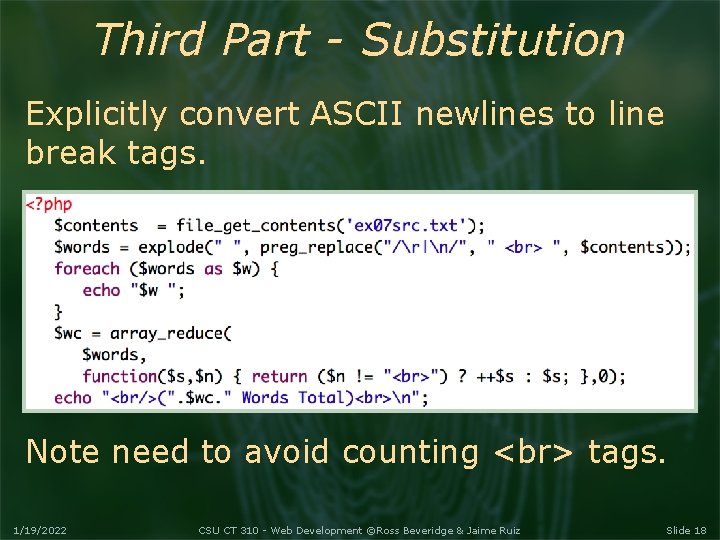
Third Part - Substitution Explicitly convert ASCII newlines to line break tags. Note need to avoid counting tags. 1/19/2022 CSU CT 310 - Web Development ©Ross Beveridge & Jaime Ruiz Slide 18
- Slides: 18