
Lecture 13 Programming by Contract Copyright W Howden
Lecture 13: Programming by Contract Copyright W. Howden 1
Pre. Conditions and Post. Conditions • Pre. Condition – what you assume to be true before an operation or process • Post. Condition – what you assert to be true after an operation or process • Contract: If Preconditions hold before, then Postconditions will hold afterwards Copyright W. Howden 2
Pre. Conditions and Data Validation • • • Precondition client’s responsibility Input validation is not required Documented so it does not slip through the cracks Clarifies when and where data needs to be checked Redundant checks lead to – decreased performance – less clarity – increased opportunity for errors Copyright W. Howden 3
Kinds of Postconditions • Low level – Conditions and relationships on variable values – Return value properties • Higher level – Objects created or deleted – Associations formed or deleted Copyright W. Howden 4
Applications • Low level – Algorithms – Classes • class and method properties • Higher level – Use case assumptions and results – System and subsystem operations identified during requirements analysis and elaboration Copyright W. Howden 5
Algorithms and Pre/Post. Conditions • Formal specifications • Proofs of correctness of algorithms – verification, formal verification Copyright W. Howden 6
Assertions • Assertion: Condition that should be true at an associated location in the algorithm • Pre. Condition= input assertion • Post. Condition = output assertion • Intermediate assertion – intermediate state of system/program • Loop invariant = assertion about state at some location in a loop Copyright W. Howden 7
Algorithms and Verification • Suppose that A 1 is the precondition for an algorithm A and An is the postcondition. • Correctness: A is correct if it is partially correct and it always terminates • Partial correctness of A – if A 1 is true at the beginning of A and if A is executed and terminates, then An will be true at the end of the execution Copyright W. Howden 8
Proof Technique • Add intermediate assertions Ai to the algorithm. Make sure that each loop has at least one intermediate assertion • For each pair of assertions (X, Y) where there is a subpath p from X to Y, which has no other assertions on it, prove that if Control is at the location of X and X is true, and if control flows along p to Y, then Y will be true Copyright W. Howden 9
Proof Method Validity • Assume that we prove validity for each assertion pair (X, Y) joined by a subpath p • For any execution of the algorithm, a path P will be followed from the precondition to the postcondition • The path P can be broken up into subpaths p between assertion pairs (X, Y) • Proofs for the subpaths p implies correctness for whole path P Copyright W. Howden 10
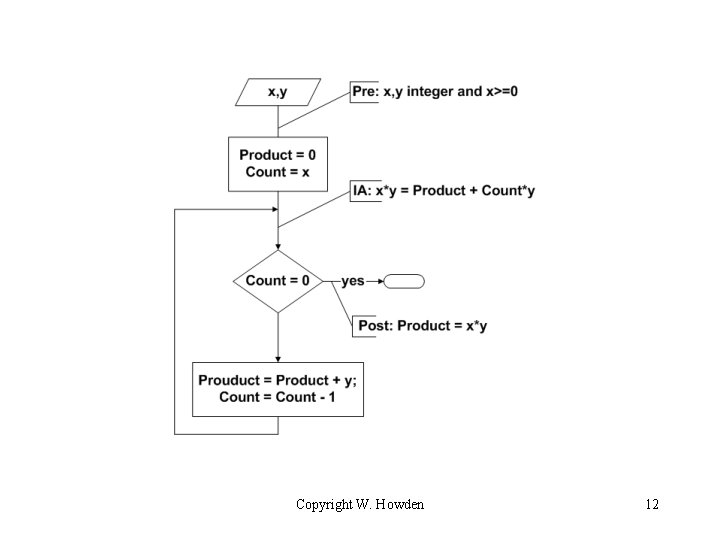
Sample Algorithm • Multiplies two numbers x and y by adding up y x times • Input (precondition) assertion Pre, output (postcondition) assertion Post, intermediate loop invariant assertion IA Copyright W. Howden 11
Copyright W. Howden 12
Verification Conditions for Sample Algorithm • Prove that – if Pre is true then IA will be true – if IA is true and Count = 0 then Post will be true – If IA is true and Count 0 then IA will be true Copyright W. Howden 13
Termination Proof? • Termination proof – Count initialized to x >=0 – Loop terminates if Count == 0 – For each iteration Count is decremented by 1 so loop must terminate • Note: if Precondition x>=0 is removed and input is negative, algorithm will not always terminate but is still partially correct Copyright W. Howden 14
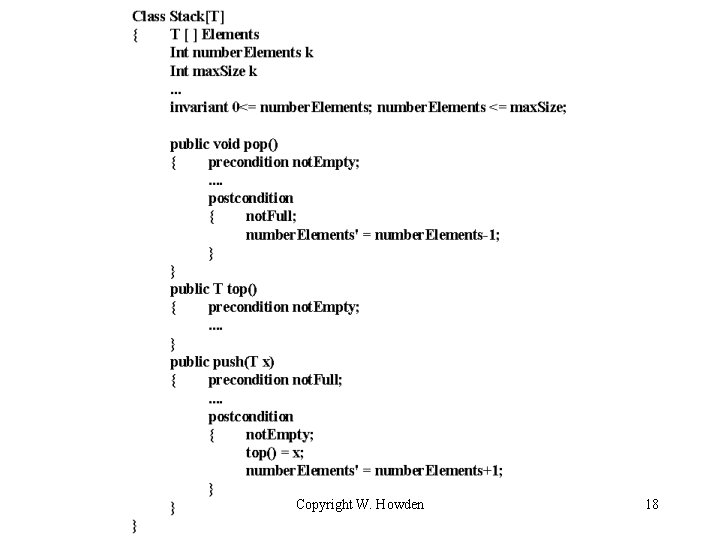
Classes and Pre/Post Conditions • Method Pre and Post conditions – algorithm input/output conditions – state changes for object • Class invariants – true after constructor, and true before and after each method application – could also document as pre and post conditions for each method to ensure compliance Copyright W. Howden 15
Sample Class Invariants • e. g. Log. On object created by Domain. Logic when someone logs on to DS • Has a class variable called name which is never null-valued after Log. On is constructed. i. e. it is initialized in the constructor class invariant: {this. log. On null} Copyright W. Howden 16
Sample Class • Stack Class (parameterized) • Written in a language with • class invariant statement • precondition and postcondition statements for methods Copyright W. Howden 17
Copyright W. Howden 18
Use Cases and Pre/Post Conditions • Use case is a story that may contain a number of system operations • Use case pre/postconditions – for whole story Copyright W. Howden 19
DS Example - Precondition • Use Case: user changing his/her data in the DS data base • Assume that the use case does not include the log on subtask, which will always be performed before this use case and which will have confirmed that the user was a member before this use case began • Pre. Condition: User is a member of the Dating System and has a member record in the Data Base Copyright W. Howden 20
DS Example – Postcondition • Use Case: user changing his/her data in the DS data base • Suppose that m is the current user record for U in the data base, and c specifies changes to the data. Let m’ = change(m, c), the result of making changes c to m. • Postcondition: User record for U == m’ Copyright W. Howden 21
Systems/subsystems and Pre/Postconditions • Operations determined during requirements analysis and elaboration • Systems and subsystem events correspond to actor actions or messages received • Events are responded to by system/subsystem operators • Pre and post conditions describe required operator functionality Copyright W. Howden 22
Operator Pre and Postconditions • High level, more informal than algorithm and method conditions • More object oriented e. g. – Objects created and deleted – Associations between instances of classes created and deleted – Attributes of objects altered Copyright W. Howden 23
DS Examples – 1 Subsystem: GUI Operation: Create(Domain. Logic Dl) Preconditions: Domain Logic object is created Postconditions: GUI object is created Copyright W. Howden 24

DS Examples - 2 • • Subsystem: GUI Operation: name entered during Logon Precondition: Logon is visible Postconditions: – Log. On is not visible – Appropriate user options dialog (member, admin, unauthorized) created and visible Copyright W. Howden 25
DS Examples – 3 • Subsystem: GUI • Operation: Enter. Member. Data option is chosen from member options dialog • Preconditions: member options dialog is visible • Postconditions: Enter. Member. Data Dialog is visible Copyright W. Howden 26
DS Examples – 4 • Subsystem: DL • Operation: log. On • Preconditions: Data. Base is associated with DL • Postconditions: – Log. On object created and associated with DL – Log. On user. Name and user. Type attributes are set Copyright W. Howden 27
DS Examples – 5 • Sub. System: DL • Operation: add. Member(String name) • Preconditions: Data. Base is associated with DL • Postcondition: (none for DL, i. e. no changes for DL) /* Recall: postcondition will only refer to object/subsystem under consideration */ Copyright W. Howden 28
DS Examples – 6 • • Subsystem: DL Operation: delete. Member(String name) Pre. Condition: Data. Base is associated with DL Post. Condition: /* in the design and implementation a value is returned by the method for this operation which would be in a more detailed postcondition */ Copyright W. Howden 29
DS Examples – 7 • Subsystem: Data. Base • Operation: Create (File file) • Precondition: file exists and contains member records in expected format • Post. Condition: the Member. Data[] object associated with Data. Base will be filled with the member records from the file Copyright W. Howden 30
DS Examples – 8 • Subsystem: Data. Base • Operation: get. Member. Data(String name) • Precondition: • Postcondition /* no changes to Data. Base object. Obviously there is a return value from the operation */ Copyright W. Howden 31
DS Examples – 9 • Subsystem: Data Base • Operation: add. Member(String name) • Precondition: Data. Base has a Member. Data[] collection object associated with it • Postcondition: the Member. Data[] object is altered to include a new Member. Data instance with this name Copyright W. Howden 32
- Slides: 32