
Lecture 13 Population Consumption and the Environment Consumption
- Slides: 26
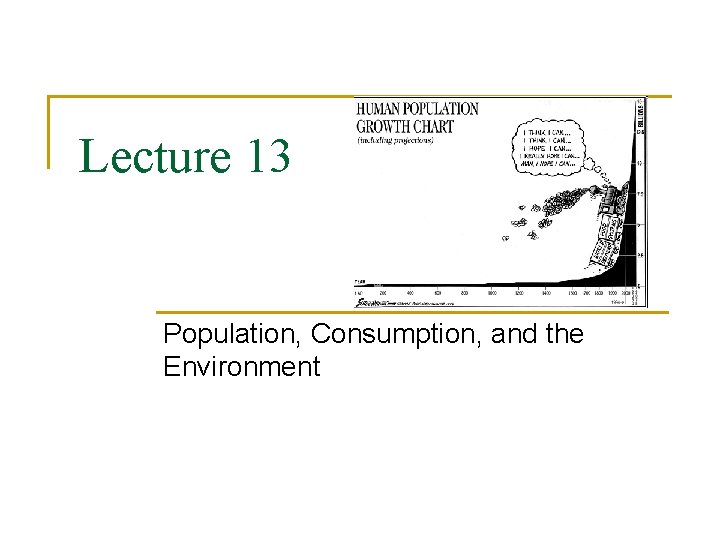
Lecture 13 Population, Consumption, and the Environment
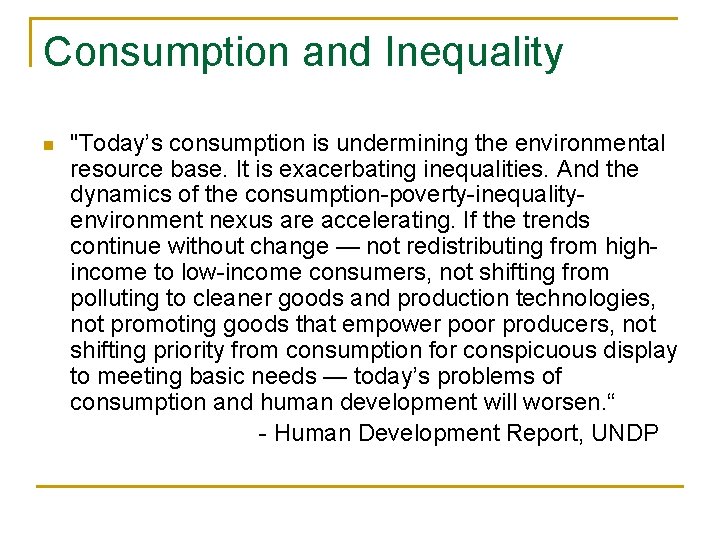
Consumption and Inequality n "Today’s consumption is undermining the environmental resource base. It is exacerbating inequalities. And the dynamics of the consumption-poverty-inequalityenvironment nexus are accelerating. If the trends continue without change — not redistributing from highincome to low-income consumers, not shifting from polluting to cleaner goods and production technologies, not promoting goods that empower poor producers, not shifting priority from consumption for conspicuous display to meeting basic needs — today’s problems of consumption and human development will worsen. “ - Human Development Report, UNDP
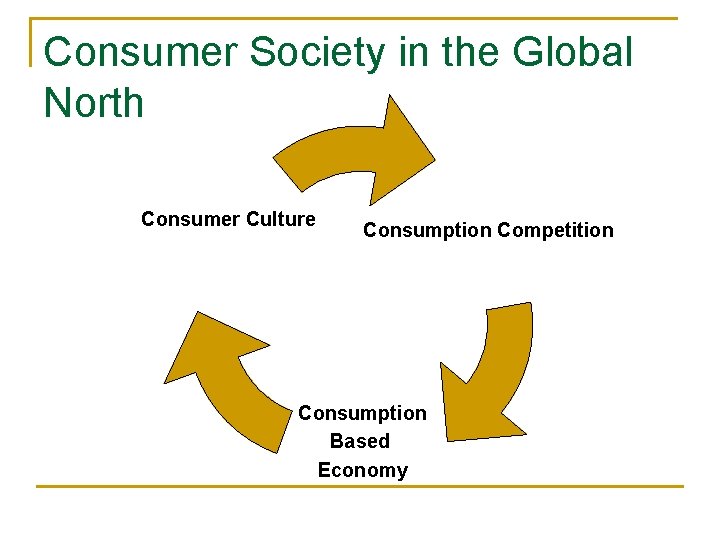
Consumer Society in the Global North Consumer Culture Consumption Competition Consumption Based Economy
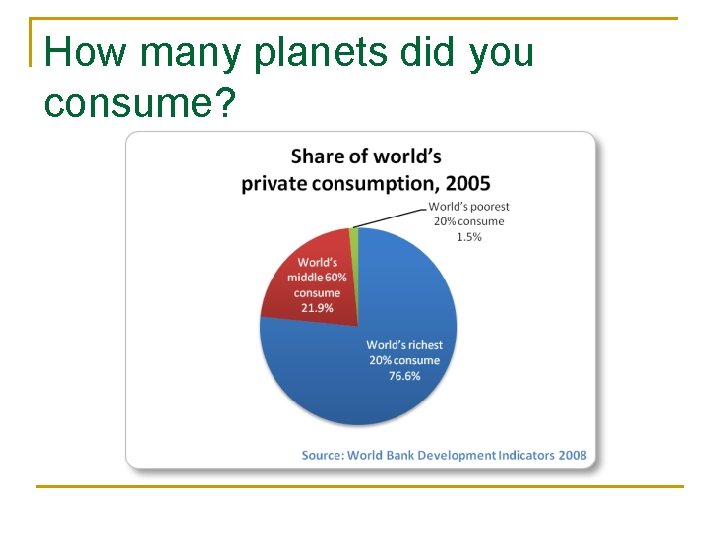
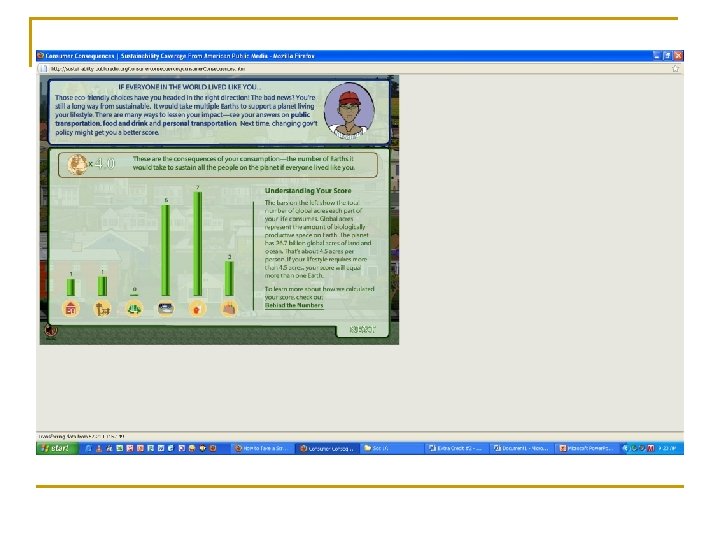
How many planets did you consume?
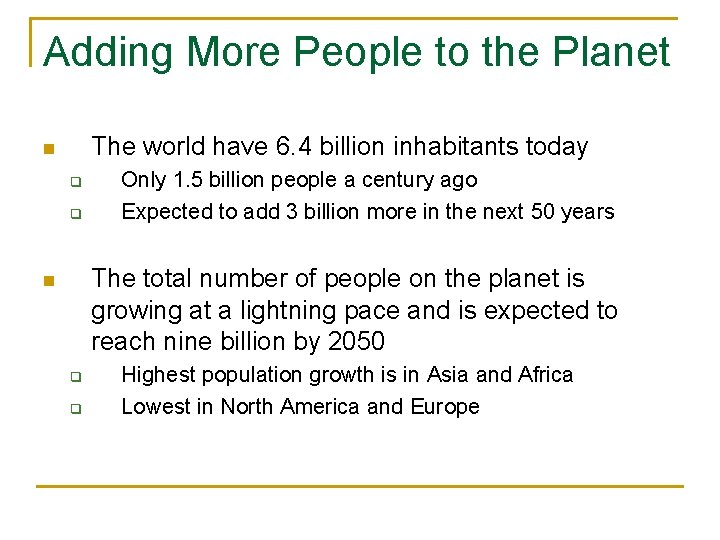
Adding More People to the Planet The world have 6. 4 billion inhabitants today n q q Only 1. 5 billion people a century ago Expected to add 3 billion more in the next 50 years The total number of people on the planet is growing at a lightning pace and is expected to reach nine billion by 2050 n q q Highest population growth is in Asia and Africa Lowest in North America and Europe
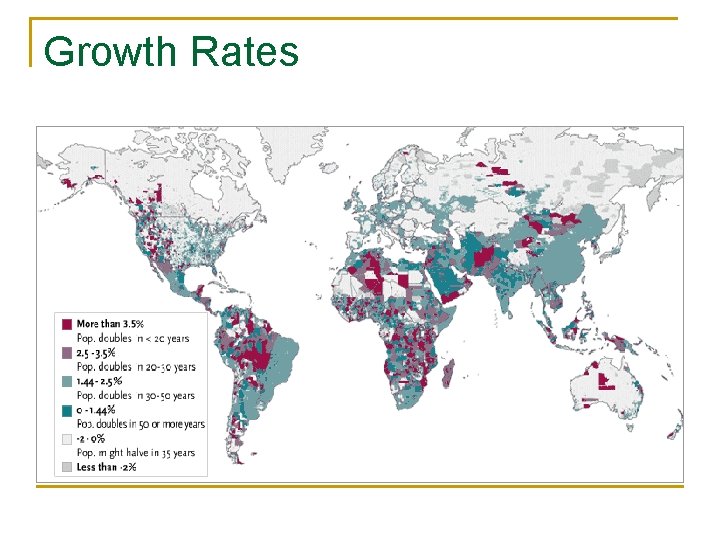
Growth Rates
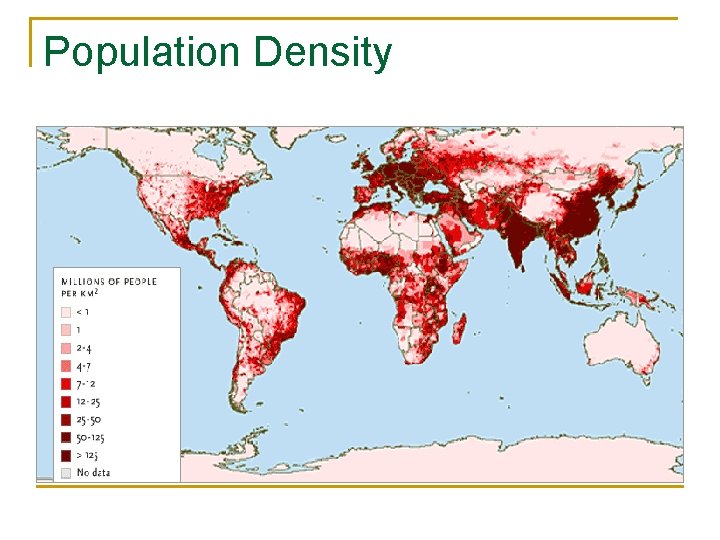
Population Density
Too many people, too little food? n Malthus Theorem: population will always outpace food supply and produce human misery q q Negative checks: abortion, infanticide, prostitution Positive checks: war and famine n The solution: “moral restraint” n New Malthusians: fewer resources will lead to large scale misery and war over q q q Water Land Oil
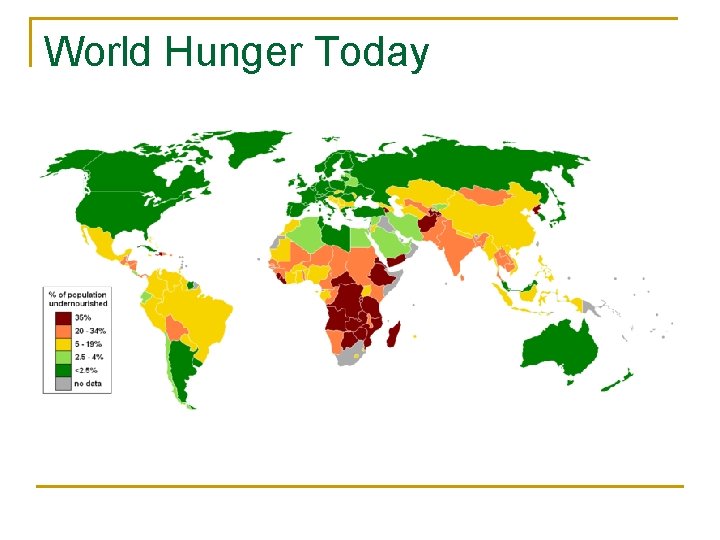
World Hunger Today
Food in an Unequal World n India (212 mill) and China (150 mill) have the highest # of undernourished people q n US: 38 million suffer from hunger, up 43% in the last five years Consistent World Hunger can be attributed to q q Inequitable ownership of resources Destruction of traditional food production Environmental decline Import/Export Imbalance
Hunger in the USA n About 14% of people are food insecure in the USA q According the USDA, food security for a household means access by all members at all times to enough food for an active, healthy life. n n n Ready availability of nutritionally adequate and safe foods, and Assured ability to acquire acceptable foods in socially acceptable ways, such as without resorting to emergency food supplies Food stamps now feed 1 in 8 adults and 1 in 4 children q In Santa Clara county food stamp use has increased 27% since 2007 and today 4% of adults and 11% of children use food stamps
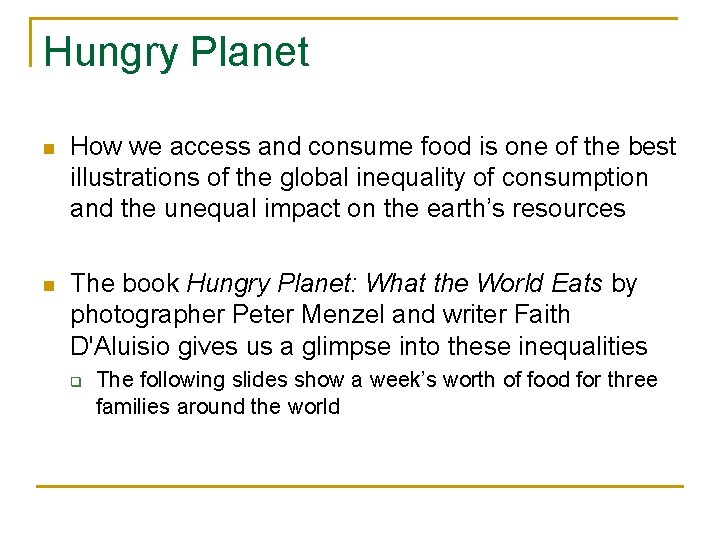
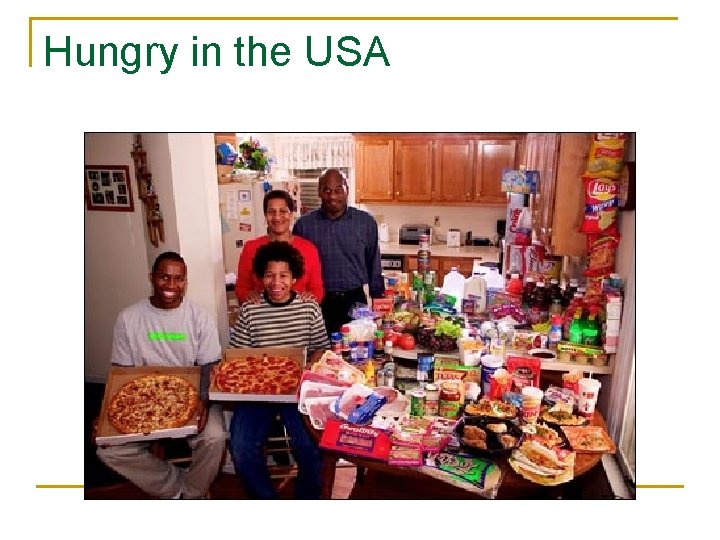
Hungry Planet n How we access and consume food is one of the best illustrations of the global inequality of consumption and the unequal impact on the earth’s resources n The book Hungry Planet: What the World Eats by photographer Peter Menzel and writer Faith D'Aluisio gives us a glimpse into these inequalities q The following slides show a week’s worth of food for three families around the world
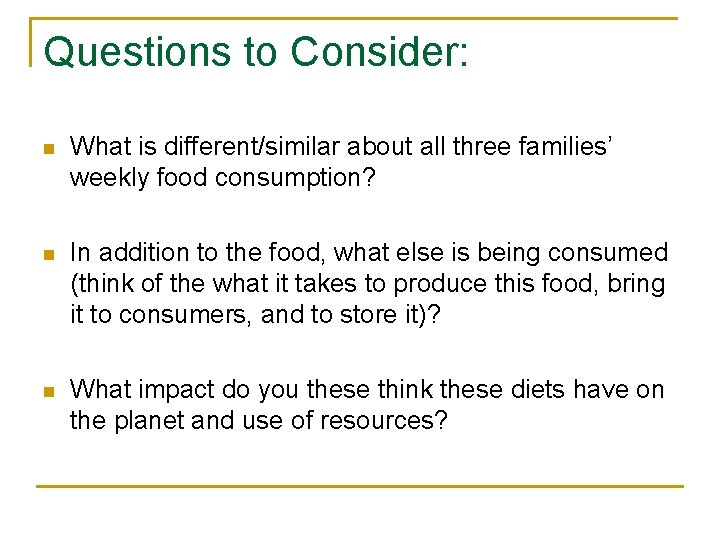
Questions to Consider: n What is different/similar about all three families’ weekly food consumption? n In addition to the food, what else is being consumed (think of the what it takes to produce this food, bring it to consumers, and to store it)? n What impact do you these think these diets have on the planet and use of resources?
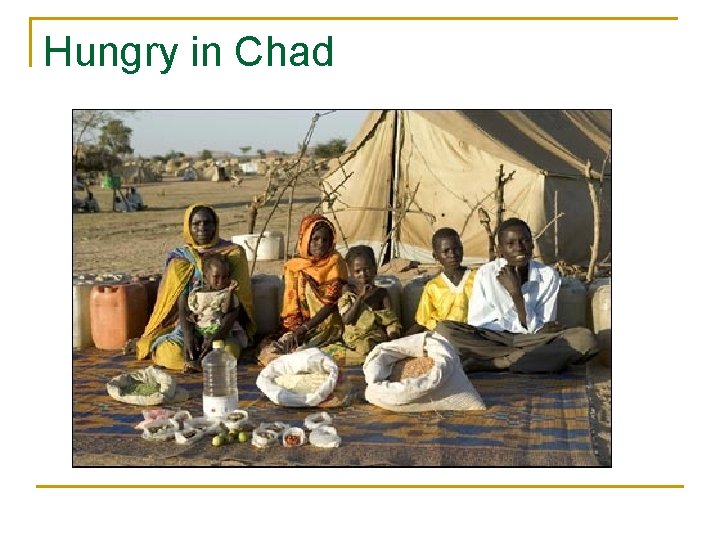
Hungry in Chad
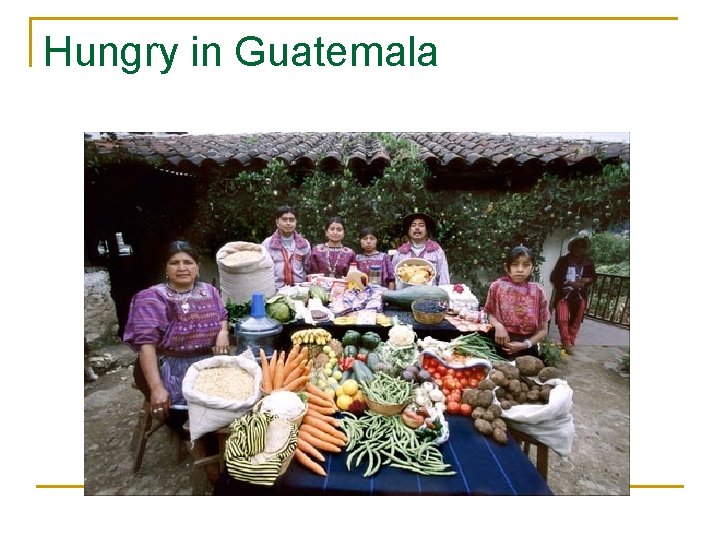
Hungry in Guatemala
Hungry in the USA
Questions to Consider: n What is different/similar about all three families’ weekly food consumption? n In addition to the food, what else is being consumed (think of the what it takes to produce this food, bring it to consumers, and to store it)? n What impact do you these think these diets have on the planet and use of resources?
Growing Consumption n With a growing population of new consumers in areas like China and India, there are growing demands on the environment with the increase desire for consumer goods of Western lifestyle and “consumer culture” q With growing incomes around the world there has been growth in the demand for meat consumption, processed food, and other aspects of a “Western Diet”
Western Diet The Standard American Diet (SAD) is characterized by: n q q q Animal products Processed foods Eating out Americans get 60% of their energy from two nutrients n q q Fat: generally from oil from soybeans Sugar: generally from high fructose corn syrup
American Meat n “Americans eat about the same amount of meat as we have for some time, about eight ounces a day, roughly twice the global average. At about 5 percent of the world’s population, we “process” (that is, grow and kill) nearly 10 billion animals a year, more than 15 percent of the world’s total. ”
Effects of the Western Diet n The Western Diet requires a large number of resources: q q q 36 % percent of the world's grain goes to feed livestock 1 calorie of meat takes 11 -17 calories of grain 8 oz of beef take 660 gallons of water 70% of antibiotics used worldwide are used for livestock production 33% more fossil fuel is used to produce meat than grain
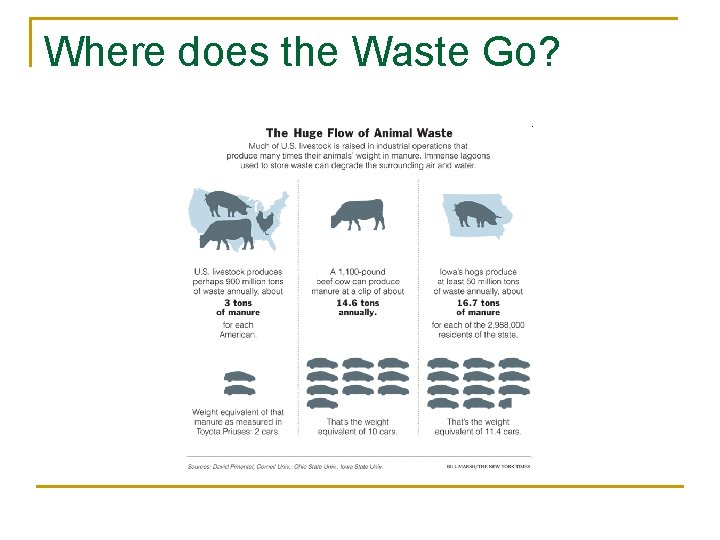
Affects on the Environment? n We share the Earth's natural resources with nearly 1 billion pigs, 1. 3 billion cows, 1. 8 billion sheep and goats, and 13. 5 billion chickens n In the United States, where the waste generated by livestock is 130 times that produced by humans n World's livestock herds account for roughly 25 percent of anthropogenic greenhouse gases - more than driving our cars
Where does the Waste Go?
Global Polarization of Nutritional Health n Another consequence of the unequal distribution resources around the world is the polarization of nutritional health n Diseases of over-consumption plague consumer societies q q n Heart disease, diabetes, obesity One recent study shows that there are now more overweight than under-weight people in the world Diseases of under-consumption plague societies with low levels of consumption q Hunger lowers immunity as is closes related to many diseases such malaria, diarrhea, loss of vision, etc.
Linking the Social and the Environmental n When we look at consumption of the world’s resources we see significant inequalities in consumption patterns around the world q n “The richest 20 percent of the world’s population accounts for 86 percent of private consumption expenditures, whereas the poorest 20 percent account for only 1. 3 percent. ” The environment is a sociological issue because environmental sustainability requires both social and technological changes. q Consumption patterns around the world are closely linked to environmental problems, and therefore, are linked to the solutions.