
Lecture 13 Error and uncertainty Outline terminology types
- Slides: 36
Lecture 13 Error and uncertainty • Outline – terminology, types and sources – why is it important? – handling error and uncertainty Week 16 GEOG 2750 – Earth Observation and GIS of the Physical 1
Introduction • GIS, great tool but what about error? – – – data quality, error and uncertainty? error propagation? confidence in GIS outputs? • NCGIA Initiative I-1 – – major research initiative? dropped because too hard? • Be careful, be aware, be upfront. . . Week 16 GEOG 2750 – Earth Observation and GIS of the Physical 2
Terminology • Various (often confused terms) in use: – error – uncertainty – accuracy – precision – data quality Week 16 GEOG 2750 – Earth Observation and GIS of the Physical 3
Error and uncertainty • Error – wrong or mistaken – degree of inaccuracy in a calculation Ø e. g. 2% error • Uncertainty – lack of knowledge about level of error – unreliable Week 16 GEOG 2750 – Earth Observation and GIS of the Physical 4
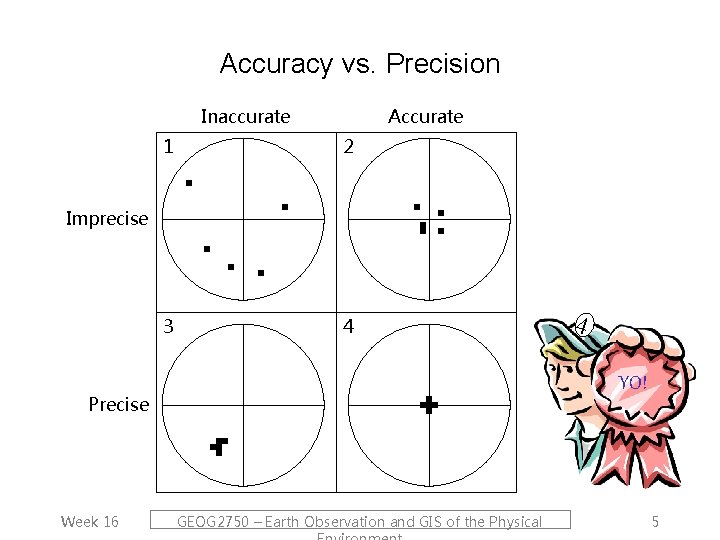
Accuracy vs. Precision Inaccurate Accurate 1 2 3 4 Imprecise YO! Precise Week 16 4 GEOG 2750 – Earth Observation and GIS of the Physical 5
Question… • What does accuracy and precision mean for GIS co-ordinate systems? Week 16 GEOG 2750 – Earth Observation and GIS of the Physical 6
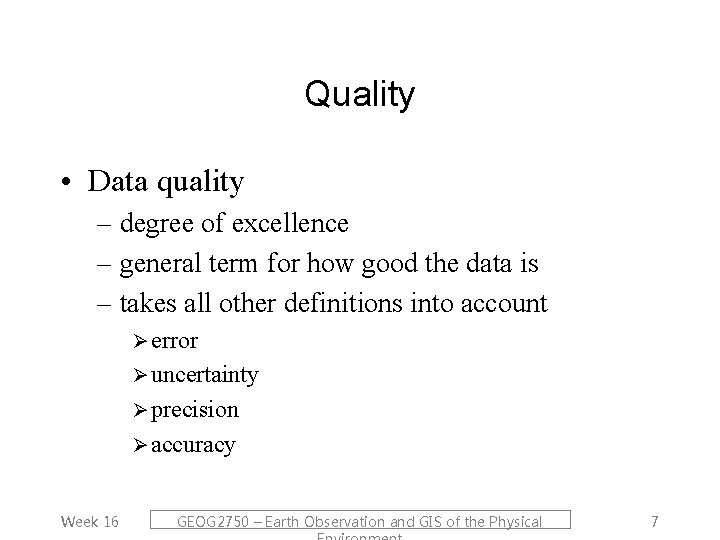
Quality • Data quality – degree of excellence – general term for how good the data is – takes all other definitions into account Ø error Ø uncertainty Ø precision Ø accuracy Week 16 GEOG 2750 – Earth Observation and GIS of the Physical 7
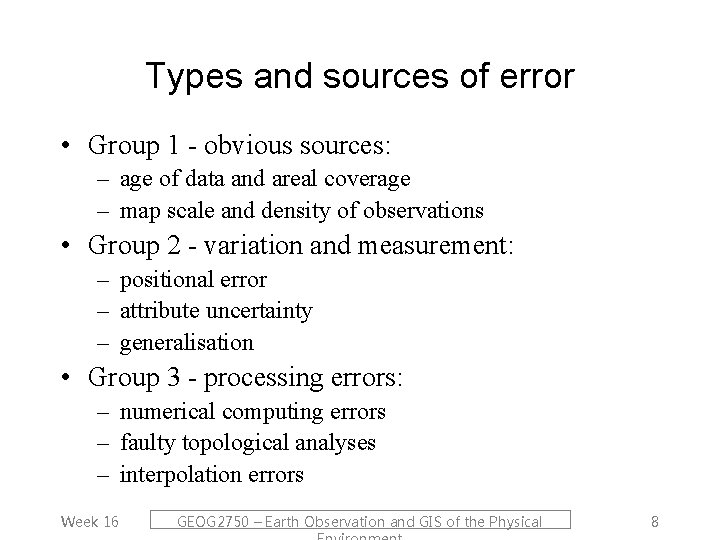
Types and sources of error • Group 1 - obvious sources: – age of data and areal coverage – map scale and density of observations • Group 2 - variation and measurement: – positional error – attribute uncertainty – generalisation • Group 3 - processing errors: – numerical computing errors – faulty topological analyses – interpolation errors Week 16 GEOG 2750 – Earth Observation and GIS of the Physical 8
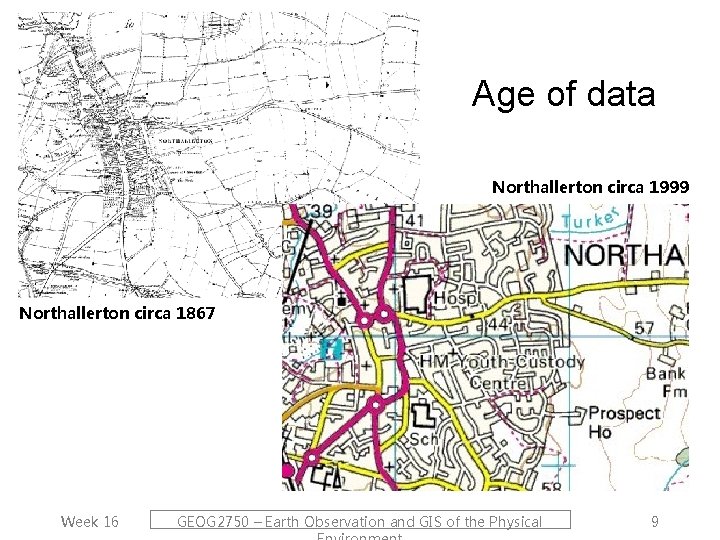
Age of data Northallerton circa 1999 Northallerton circa 1867 Week 16 GEOG 2750 – Earth Observation and GIS of the Physical 9
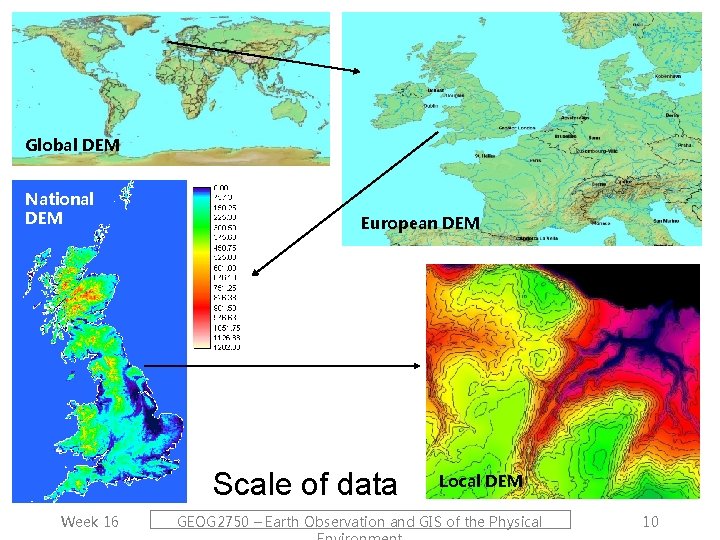
Global DEM National DEM European DEM Scale of data Week 16 Local DEM GEOG 2750 – Earth Observation and GIS of the Physical 10
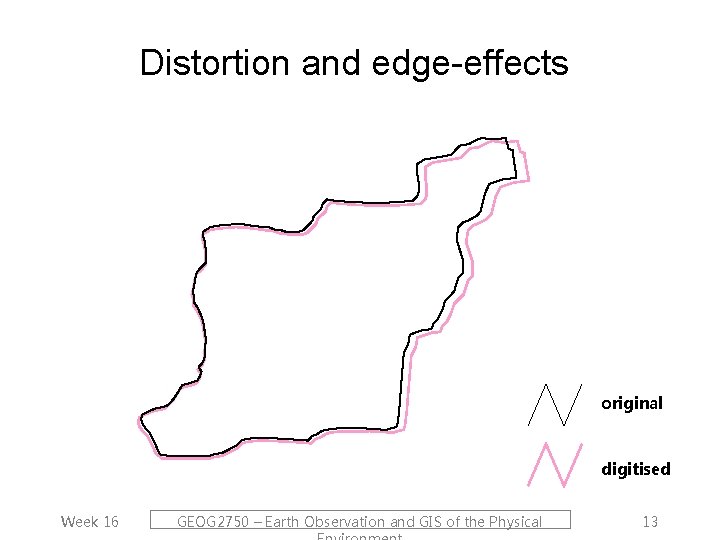
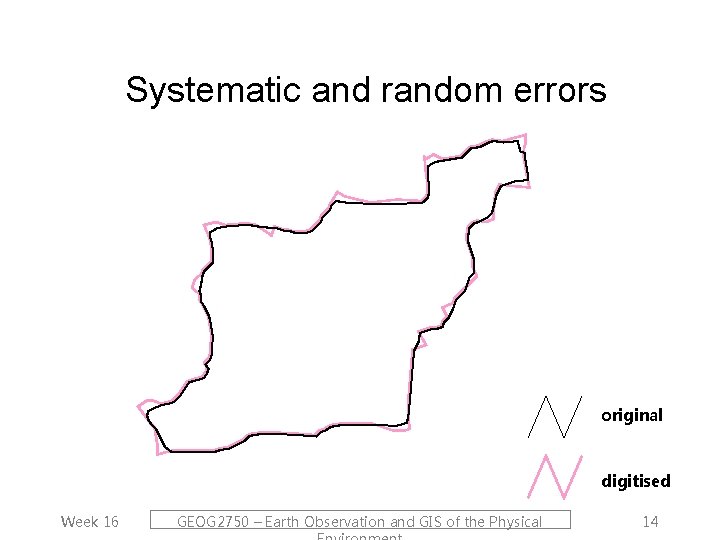
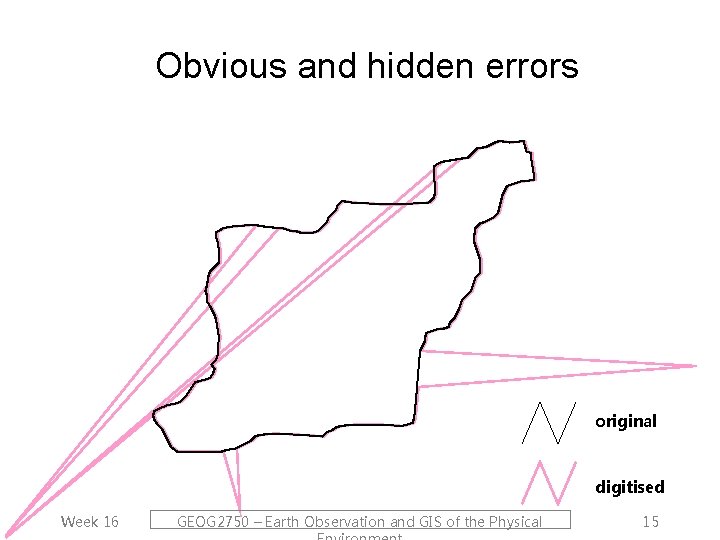
Digitiser error • Manual digitising – significant source of positional error • Source map error – scale related generalisation – line thickness • Operator error – under/overshoot – time related boredom factor Week 16 GEOG 2750 – Earth Observation and GIS of the Physical 11
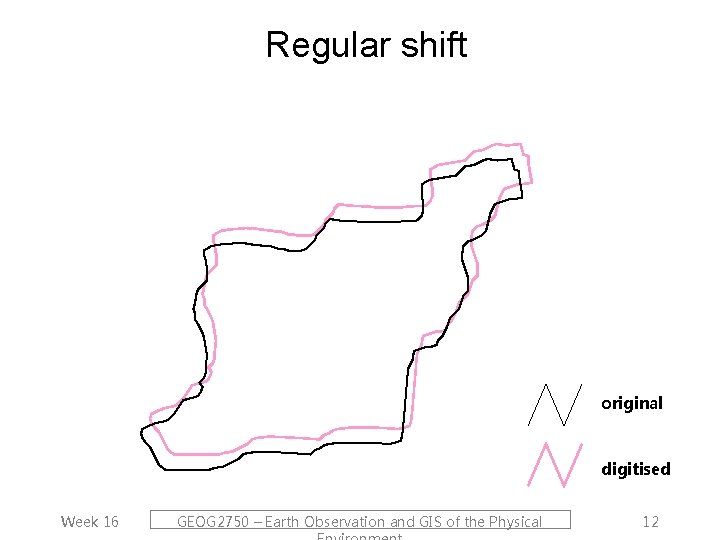
Regular shift original digitised Week 16 GEOG 2750 – Earth Observation and GIS of the Physical 12
Distortion and edge-effects original digitised Week 16 GEOG 2750 – Earth Observation and GIS of the Physical 13
Systematic and random errors original digitised Week 16 GEOG 2750 – Earth Observation and GIS of the Physical 14
Obvious and hidden errors original digitised Week 16 GEOG 2750 – Earth Observation and GIS of the Physical 15
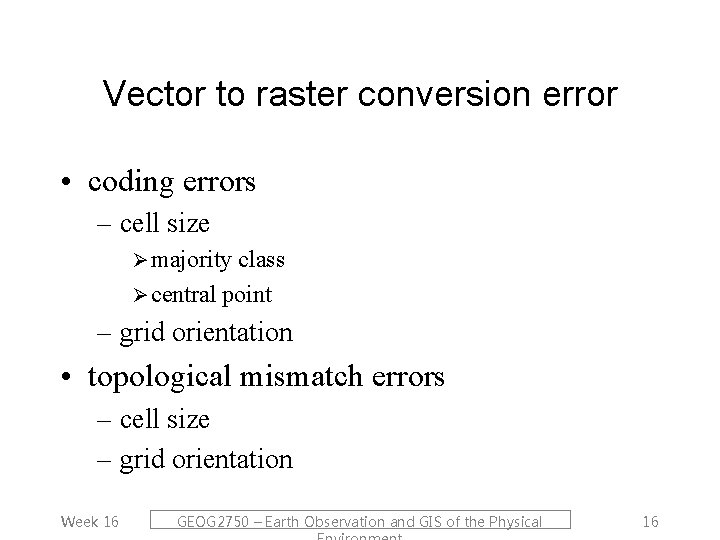
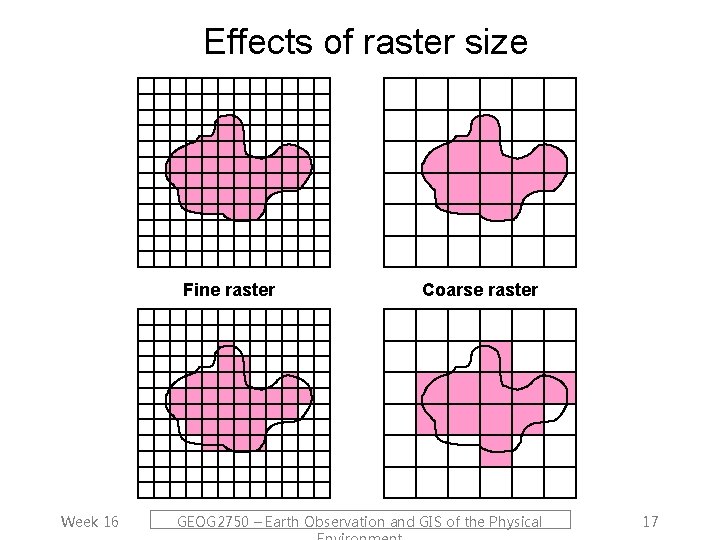
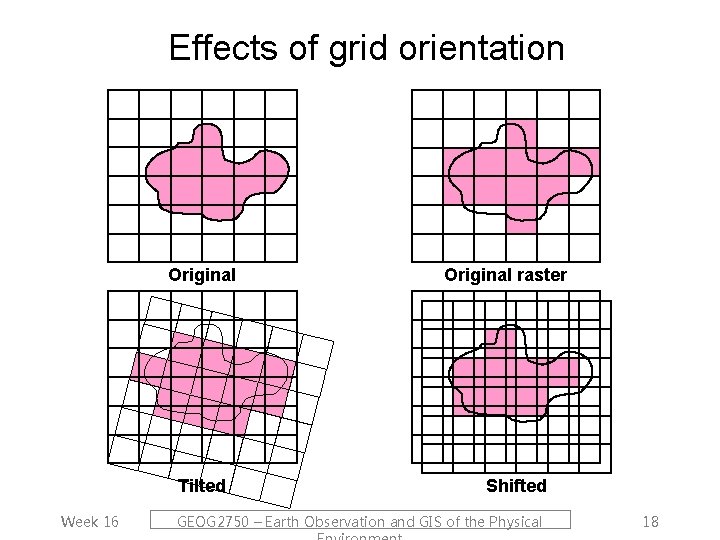
Vector to raster conversion error • coding errors – cell size Ø majority class Ø central point – grid orientation • topological mismatch errors – cell size – grid orientation Week 16 GEOG 2750 – Earth Observation and GIS of the Physical 16
Effects of raster size Fine raster Week 16 Coarse raster GEOG 2750 – Earth Observation and GIS of the Physical 17
Effects of grid orientation Original Tilted Week 16 Original raster Shifted GEOG 2750 – Earth Observation and GIS of the Physical 18
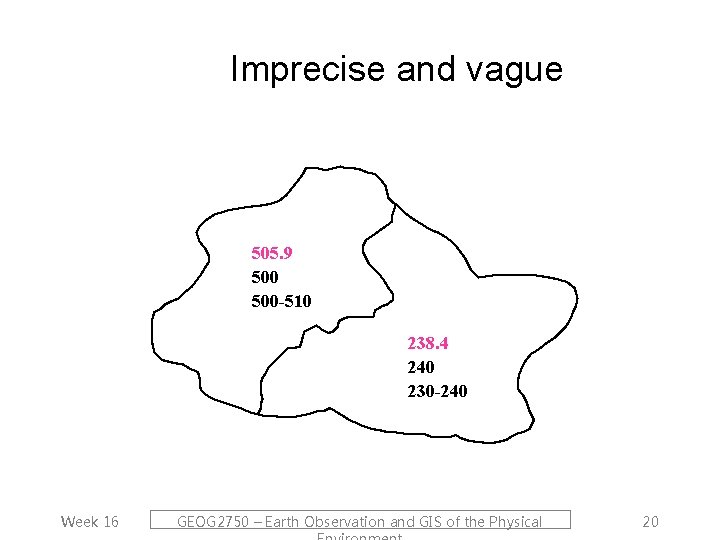
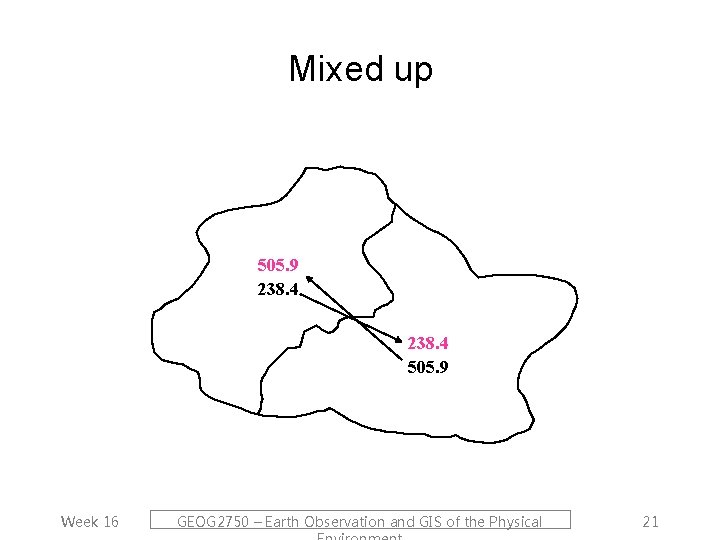
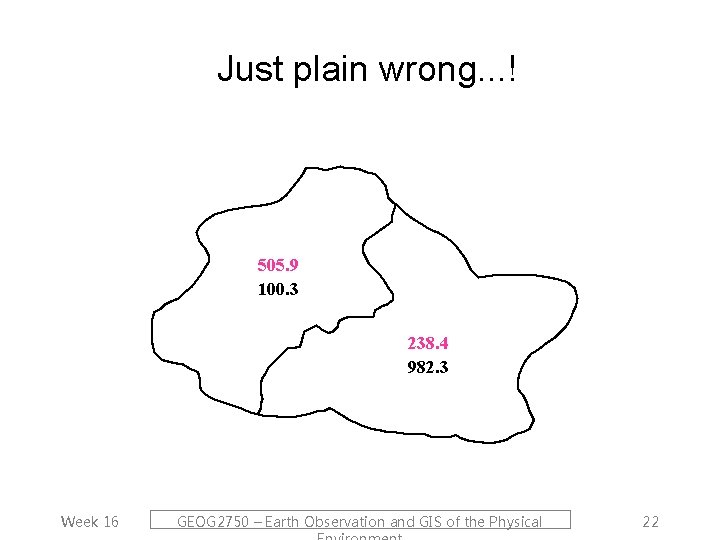
Attribute uncertainty • • Uncertainty regarding characteristics (descriptors, attributes, etc. ) of geographical entities Types: – – – • imprecise (numeric) or vague (descriptive) mixed up plain wrong! Sources: – – – Week 16 source document misinterpretation (human error) database error GEOG 2750 – Earth Observation and GIS of the Physical 19
Imprecise and vague 505. 9 500 -510 238. 4 240 230 -240 Week 16 GEOG 2750 – Earth Observation and GIS of the Physical 20
Mixed up 505. 9 238. 4 505. 9 Week 16 GEOG 2750 – Earth Observation and GIS of the Physical 21
Just plain wrong. . . ! 505. 9 100. 3 238. 4 982. 3 Week 16 GEOG 2750 – Earth Observation and GIS of the Physical 22
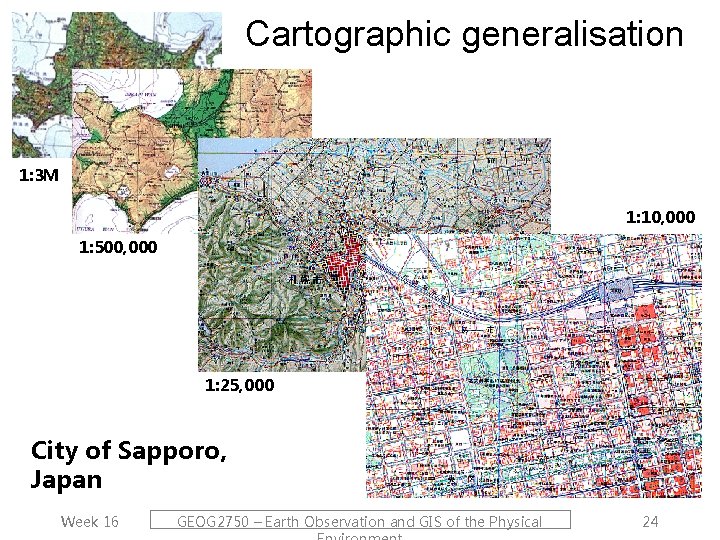
Generalisation • Scale-related cartographic generalisation – simplification of reality by cartographer to meet restrictions of: Ø map scale and physical size Ø effective communication and message – can result in: Ø reduction, alteration, omission and simplification of map elements Ø passed on to GIS through digitising Week 16 GEOG 2750 – Earth Observation and GIS of the Physical 23
Cartographic generalisation 1: 3 M 1: 10, 000 1: 500, 000 1: 25, 000 City of Sapporo, Japan Week 16 GEOG 2750 – Earth Observation and GIS of the Physical 24
Question… • An appreciation of error and uncertainty is important because… Week 16 GEOG 2750 – Earth Observation and GIS of the Physical 25
Handling error and uncertainty • Must learn to cope with error and uncertainty in GIS applications – minimise risk of erroneous results – minimise risk to life/property/environment • More research needed: – – – Week 16 mathematical models procedures for handling data error and propagation empirical investigation of data error and effects procedures for using output data uncertainty estimates incorporation as standard GIS tools GEOG 2750 – Earth Observation and GIS of the Physical 26
Question… • What error handling facilities are their in proprietary GIS packages like Arc. GIS? Week 16 GEOG 2750 – Earth Observation and GIS of the Physical 27
Basic error handling • Awareness – knowledge of types, sources and effects • Minimisation – use of best available data – correct choices of data model/method • Communication – to end user! Week 16 GEOG 2750 – Earth Observation and GIS of the Physical 28
Question… • How can error be communicated to end users? Week 16 GEOG 2750 – Earth Observation and GIS of the Physical 29
Quantifying error • Sensitivity analyses – Jacknifing Ø leave-one-out analysis Ø repeat analysis leaving out one data layer Ø test for the significance of each data layer – Bootstrapping Ø Monte Carlo simulation Ø adds random noise to data layers Ø Simulates the effect error/uncertainty Week 16 GEOG 2750 – Earth Observation and GIS of the Physical 30
Conclusions • Many types and sources of error that we need to be aware of • Environmental data is particularly prone because of high spatio-temporal variability • Few GIS tools for handling error and uncertainty… and fewer still in proprietary packages • Need to communicate potential error and uncertainty to end users Week 16 GEOG 2750 – Earth Observation and GIS of the Physical 31
Practical • Error in off-the-shelf datasets • Task: Assess the error in land cover data • Data: The following datasets are provided for the Leeds area… – Streets and buildings (1: 10, 000 OS Land. Line data) – 25 m resolution land cover data (ITE LCM 90) Week 16 GEOG 2750 – Earth Observation and GIS of the Physical 32
Practical • Steps: 1. Display OS Land. Line data over ITE LCM 90 data using Arc. Map. You can also add the OS 1: 50, 000 colour raster image and set transparency = 70%. 2. From your knowledge of the area identify areas of erroneous classification 3. What might these errors be due to? Week 16 GEOG 2750 – Earth Observation and GIS of the Physical 33
Learning outcomes • Familiarity with error in classified satellite imagery • Familiarity with ITE land cover map 1990 (LCM 90) data • Experience with new GRID functions Week 16 GEOG 2750 – Earth Observation and GIS of the Physical 34
Useful web links • The Geographer’s Craft – lecture on error – http: //www. colorado. edu/geography/gcraft/notes/error/e rror_f. html • GIGO – http: //www. geoplace. com/gw/2000/1000 gar. asp • Disaster waiting to happen – http: //www. osmose. com/utilities/articles_press_releases /data_quality/ Week 16 GEOG 2750 – Earth Observation and GIS of the Physical 35
Next week… • Interpolating environmental datasets – creating surfaces from points – interpolation basics – interpolation methods – common problems • Practical: Interpolating surfaces from point data Week 16 GEOG 2750 – Earth Observation and GIS of the Physical 36