
Lecture 13 Animal Nervous Systems 1 Key Concepts







- Slides: 97
Lecture #13 – Animal Nervous Systems 1
Key Concepts: • Evolution of organization in nervous systems • Neuron structure and function • Neuron communication at synapses • Organization of the vertebrate nervous systems • Brain structure and function • The cerebral cortex • Nervous system injuries and diseases? ? ? 2
All animals except sponges have some kind of nervous system • Increasing complexity accompanied increasingly complex motion and activities • Nets of neurons bundles of neurons cephalization 3
First split was tissues; next was body symmetry; echinoderms “went back” to radial symmetry 4
Derived radial symmetry and nerve network 5
Cephalization • The development of a brain • Associated with the development of bilateral symmetry • Complex, cephalized nervous systems are usually divided into 2 sections ØCentral nervous system (CNS) integrates information, exerts most control ØPeripheral nervous system (PNS) connects CNS to the rest of the body 6
7
Critical Thinking • What is the functional advantage of cephalization? ? ? 8
Critical Thinking • What is the functional advantage of cephalization? ? ? • All the sensory, processing, eating and many feeding structures are located at the advancing end of the animal 9
Cephalization • The development of a brain • Associated with the development of bilateral symmetry • Complex, cephalized nervous systems are usually divided into 2 sections ØCentral nervous system (CNS) integrates information, exerts most control ØPeripheral nervous system (PNS) connects CNS to the rest of the body 10
PNS CNS PNS 11
Specialized neurons support different sections • Sensory ØTransmit information from the sensory structures that detect the both external and internal conditions • Interneurons ØAnalyze and interpret sensory information, formulate response • Motor ØTransmit information to effector cells – the muscle or endocrine cells that respond to input 12
Critical Thinking • Which type of neuron would have the most branched structure? ? ? ØSensory neurons ØInterneurons ØMotor neurons 13
Critical Thinking • Which type of neuron would have the most branched structure? ? ? ØSensory neurons ØInterneurons ØMotor neurons • Interneurons have the most connections of all neurons • They make “all the connections” 14
Neuron structure is complex 100 billion nerve cells in the human brain! 15
16
17
Basic Neuron Structure • Cell body • Dendrites • Axons • Axon hillock • Myelin sheath • Synaptic terminal 18
Cell Body • Contains most cytoplasm and organelles • Extensions branch off cell body 19
Dendrites • Highly branched extensions • Receive signals from other neurons 20
Axons • Usually longer extension, unbranched til end • Transmits signals to other cells 21
Axon Hillock • Enlarged region at base of axon • Site where axon signals are generated ØSignal is sent after summation 22
Myelin Sheath • Insulating sheath around axon • Also speeds up signal transmission 23
Synaptic Terminal • End of axon branches • Each branch ends in a synaptic terminal ØActual site of between-cell signal generation 24
Synapse • Site of signal transmission between cells • More later… 25
Supporting Cells - Glia • Maintain structural integrity and function of neurons • 10 – 50 x more glia than neurons in mammals • Major categories ØAstrocytes ØRadial glia ØOligodendrocytes and Schwann cells 26
Glia – Astrocytes • Structural support for neurons • Regulate extracellular ion and neurotransmitter concentrations • Facilitate synaptic transfers • Induce the formation of the blood-brain barrier ØTight junctions in capillaries allow more control over the extracellular chemical environment in the brain and spinal cord 27
Glia – Radial Glia • Function mostly during embryonic development • Form tracks to guide new neurons out from the neural tube (neural tube develops into the CNS) • Can also function as stem cells to replace glia and neurons (so can astrocytes) ØThis function is limited in nature; major line of research 28
Glia – Oligodendrocytes (CNS) and Schwann Cells (PNS) • Form the myelin sheath around axons • Cells are rectangular and tile-shaped, wrapped spirally around the axons • High lipid content insulates the axon – prevents electrical signals from escaping • Gaps between the cells (Nodes of Ranvier) speed up signal transmission 29
The nerve signal is electrical! • To understand signaling process, must understand the difference between resting potential and action potential 30
Resting Potential • All cells have a resting potential ØElectrical potential energy – the separation of opposite charges ØDue to the unequal distribution of anions and cations on opposite sides of the membrane ØMaintained by selectively permeable membranes and by active membrane pumps ØCharge difference = one component of the electrochemical gradient that drives the diffusion of all ions across cell membranes 31
Neuron Function – Resting Potential • Neuron resting potential is ~ -70 m. V ØAt resting potential the neuron is NOT actively transmitting signals ØMaintained largely because cell membranes are more permeable to K+ than to Na+; more K+ leaves the cell than Na+ enters ØAn ATP powered K+/Na+ pump continually restores the concentration gradients; this also helps to maintain the charge gradient 32
Resting Potential Ion Concentrations 1. Cell membranes are more permeable to K+ than to Na+ 2. There is more K+ inside the cell than outside 3. There is more Na+ outside the cell than inside • Both ions follow their [diffusion] gradients 33
Critical Thinking • If both ions follow their diffusion gradients, what is the predictable consequence? ? ? 34
Critical Thinking • If both ions follow their diffusion gradients, what is the predictable consequence? ? ? • A dynamic equilibrium where both charge and concentration were balanced 35
Resting Potential Ion Concentrations • A dynamic equilibrium is predictable, but is prevented by an ATP powered K+/Na+ pump 36
Neuron Function – Resting Potential • Neuron resting potential is ~ -70 m. V ØAt resting potential the neuron is NOT actively transmitting signals ØMaintained largely because cell membranes are more permeable to K+ than to Na+; more K+ leaves the cell than Na+ enters ØAn ATP powered K+/Na+ pump continually restores the concentration gradients; this also helps to maintain the charge gradient 37
Resting Potential Ion Concentrations • ATP powered pump continually transfers 3 Na+ ions out of the cytoplasm for every 2 K+ ions it moves back in to the cytoplasm • This means that there is a net transfer of + charge OUT of the cell 38
Resting Potential Ion Concentrations • Thus, the membrane potential is maintained • Cl- and large anions also contribute to the net negative charge inside the cell 39
REVIEW Neuron Function – Resting Potential • Neuron resting potential is ~ -70 m. V ØAt resting potential the neuron is NOT actively transmitting signals ØMaintained largely because cell membranes are more permeable to K+ than to Na+; more K+ leaves the cell than Na+ enters ØAn ATP powered K+/Na+ pump continually restores the concentration gradients; this also helps to maintain the charge gradient ØCl-, other anions, and Ca++ also affect resting potential 40
Gated Ion Channels Why Neurons are Different • All cells have a membrane potential • Neurons can change their membrane potential in response to a stimulus • The ability of neurons to open and close ion gates allows them to send electrical signals along the extensions (dendrites and axons) ØGates open and close in response to stimuli Only neurons can do this! 41
Gated Ion Channels Why Neurons are Different • Gated ion channels manage membrane potential ØStretch gates – respond when membrane is stretched ØLigand gates – respond when a molecule binds (eg: a neurotransmitter) ØVoltage gates – respond when membrane potential changes 42
Gated Ion Channels Why Neurons are Different • Hyperpolarization = inside of neuron becomes more negative • Depolarization = inside of neuron becomes more positive ØEither can occur, depending on stimulus ØEither can be graded – more stimulus = more change in membrane potential • Depolarization eventually triggers an action potential = NOT graded 43
Depolarization eventually triggers an action potential – action potentials are NOT graded 44
Action Potentials ARE the Nerve Signal • Triggered whenever depolarization reaches a set threshold potential • Action potentials are all-or-none responses of a fixed magnitude ØOnce triggered, they can’t be stopped ØThere is no gradation once an action potential is triggered • Action potentials are brief depolarizations Ø 1 – 2 milliseconds • Voltage gated ion channels control signal 45
Critical Thinking • If the action potential is of a fixed magnitude, how do we sense different levels of a stimulus? ? ? 46
Critical Thinking • If the action potential is of a fixed magnitude, how do we sense different levels of a stimulus? ? ? • They can occur with varying frequency ØFrequency is part of the information • They can occur from a large number of nearby neurons 47
Action Potentials ARE the Nerve Signal • Triggered whenever depolarization reaches a set threshold potential • Action potentials are all-or-none responses of a fixed magnitude ØOnce triggered, they can’t be stopped ØThere is no gradation once an action potential is triggered • Action potentials are brief depolarizations Ø 1 – 2 milliseconds • Voltage gated ion channels control signal 48
Fig. 48. 13; p. 1019, 7 th Ed. 49
Voltage Gate Activity 1. Resting Potential – Na+ and K+ activation gates closed; Na+ inactivation gate open on most channels 2. Depolarization – Na+ activation gates begin to open – Na+ begins to enter cell 3. Rising Phase – threshold is crossed, Na+ floods into the cell, raising the membrane potential to ~ +35 m. V 50
51
1. Resting Potential – Na+ and K+ activation gates closed; Na+ inactivation gate open on most channels 52
Voltage Gate Activity 1. Resting Potential – Na+ and K+ activation gates closed; Na+ inactivation gate open on most channels 2. Depolarization – Na+ activation gates begin to open – Na+ begins to enter cell 3. Rising Phase – threshold is crossed, Na+ floods into the cell, raising the membrane potential to ~ +35 m. V 53
54
2. Depolarization – Na+ activation gates begin to open – Na+ begins to enter cell 55
Voltage Gate Activity 1. Resting Potential – Na+ and K+ activation gates closed; Na+ inactivation gate open on most channels 2. Depolarization – Na+ activation gates begin to open – Na+ begins to enter cell 3. Rising Phase – threshold is crossed, Na+ floods into the cell, raising the membrane potential to ~ +35 m. V 56
57
3. Rising Phase – threshold is crossed, Na+ floods into the cell, raising the membrane potential to ~ +35 m. V 58
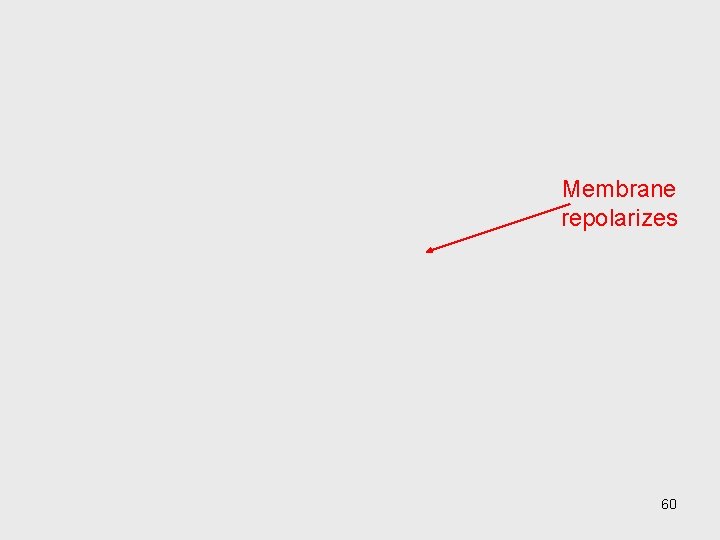
Voltage Gate Activity 4. Falling Phase – Na+ inactivation gates close, K+ activation gates open – Na+ influx stops, K+ efflux is rapid 5. Undershoot – K+ activation gates close, but not until membrane potential has gone a little bit below resting potential 6. Refractory Period – the Na+ inactivation gates remain closed during stages 4 and 5, limiting the maximum frequency of 59 action potentials
Membrane repolarizes 60
4. Falling Phase – Na+ inactivation gates close, K+ activation gates open – Na+ influx stops, K+ efflux is rapid 61
Voltage Gate Activity 4. Falling Phase – Na+ inactivation gates close, K+ activation gates open – Na+ influx stops, K+ efflux is rapid 5. Undershoot – K+ activation gates close, but not until membrane potential has gone a little bit below resting potential 6. Refractory Period – the Na+ inactivation gates remain closed during stages 4 and 5, limiting the maximum frequency of 62 action potentials
63
5. Undershoot – K+ activation gates close, but not until membrane potential has gone a little bit below resting potential 64
Voltage Gate Activity 4. Falling Phase – Na+ inactivation gates close, K+ activation gates open – Na+ influx stops, K+ efflux is rapid 5. Undershoot – K+ activation gates close, but not until membrane potential has gone a little bit below resting potential 6. Refractory Period – the Na+ inactivation gates remain closed during stages 4 and 5, limiting the maximum frequency of 65 action potentials
6. Refractory Period – the Na+ inactivation gates remain closed during stages 4 and 5, limiting the maximum frequency of action potentials 66
67 Fig. 48. 13, 7 th Ed.
Conduction of Action Potential • Electrical signal moves along the axon by depolarizing adjacent regions of the membrane past the threshold • The depolarization effect is NOT directional – the cytoplasm becomes more + in both directions 68
Critical Thinking • If the depolarizing effect is bilateral, why does the signal travel in one direction only? ? ? 69
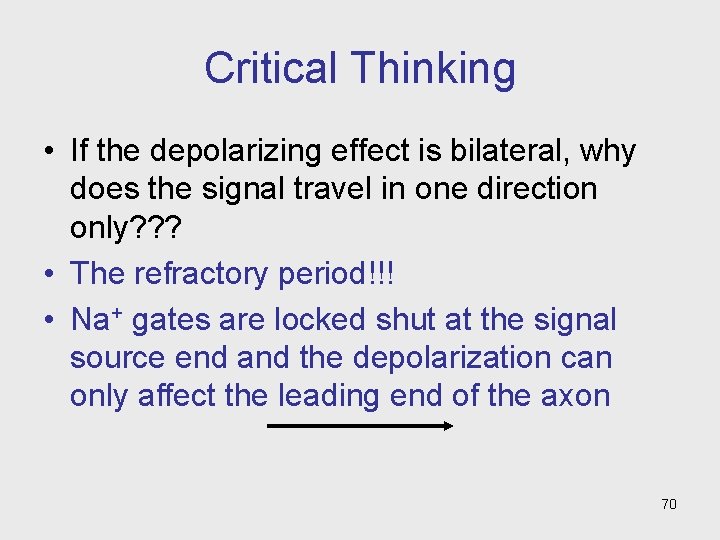
Critical Thinking • If the depolarizing effect is bilateral, why does the signal travel in one direction only? ? ? • The refractory period!!! • Na+ gates are locked shut at the signal source end and the depolarization can only affect the leading end of the axon 70
Conduction of Action Potential • Electrical signal moves along the axon by depolarizing adjacent regions of the membrane past the threshold • Depolarization zone travels in one direction only due to the refractory period (Na+ gates locked) 71
Speed! • Diameter of axon ØLarger = less resistance faster signal ØFound in invertebrates ØMax speed ~ 100 m/second • Nodes of Ranvier ØSignal jumps from node to node ØFound in vertebrates ØSaves space – 2, 000 myelinated axons can fit in the same space as one giant axon ØMax speed ~ 120 m/second 72
Synapses – the gaps between cells • Electrical synapses occur at gap junctions ØAction potential is transmitted directly from cell to cell ØEspecially important in rapid responses such as escape movements Ø Also with controlling heart beat (but with specialized muscle tissue) • Most synapses are chemical ØThe signal is converted from electrical chemical electrical ØNeurotransmitters cross the synapse and carry 73 the signal to the receiving cell
Chemical Synapses • A multi-stage process ØNeurons synthesize neurotransmitters, isolated into synaptic vesicles located at the synaptic terminal ØThe action potential triggers the release of neurotransmitters into the synapse ØNeurotransmitters diffuse across the synapse ØNeurotransmitter binds to a receptor, stimulating a response (more later) 74
Chemical Synapses 1. Action potential depolarizes membrane at synaptic terminal 2. Depolarization in this region opens Ca++ channels 3. Influx of Ca++ stimulates synaptic vesicles to fuse with neuron cell membrane 4. Neurotransmitters are released by exocytosis 5. Neurotransmitters bind to the receiving cell 75 membrane
Chemical Synapses 76
Chemical Synapses REVIEW 1. Action potential depolarizes membrane at synaptic terminal 2. Depolarization in this region opens Ca++ channels 3. Influx of stimulates synaptic vesicles to fuse with neuron cell membrane 4. Neurotransmitters are released by exocytosis 5. Neurotransmitters bind to the receiving cell 77 membrane
Chemical Synapses • Direct synaptic transmission ØNeurotransmitter binds directly to ligand-gated channels ØChannel opens for Na+, K+ or both • Indirect synaptic transmission ØNeurotransmitter binds to a receptor on the membrane (not to a channel protein) ØSignal transduction pathway is initiated ØSecond messengers eventually open channels ØSlower but amplified response 78
Chemical synapses allow more complicated signals • Electrical signals pass unmodified at electrical synapses • Chemical signals are modified during transmission ØType of neurotransmitter varies ØAmount of neurotransmitter released varies ØSome receptors promote depolarization; some promote hyperpolarization ØSignals are summed over both time and space ØRemember that many, many neurons are 79 responding to any given stimulus
Chemical synapses allow more complicated signals • Responses are summed at the axon hillock ØAction potential is generated and sent down axon; or not 80
Chemical synapses allow more complicated signals • Summation is over both time and space • Excitory and inhibitory signals can “cancel” each other 81
Neurotransmitters – review text and table, but don’t memorize Table 48. 1, 7 th ed. 82
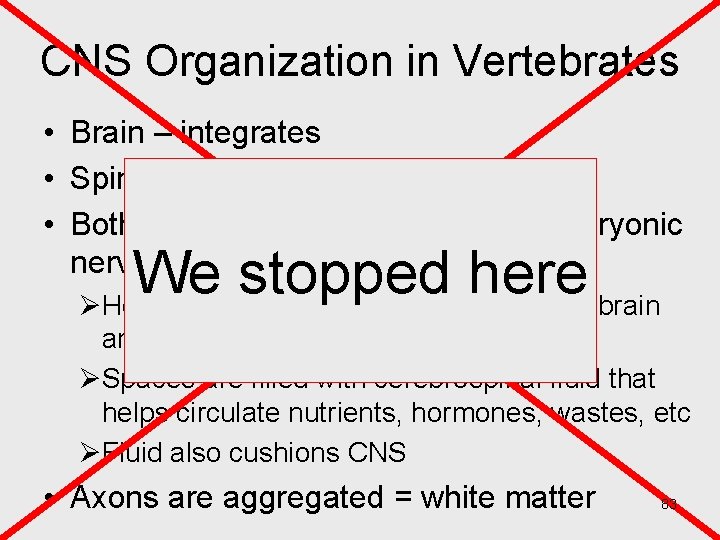
CNS Organization in Vertebrates • Brain – integrates • Spinal cord – 1 o transmits • Both derived from hollow, dorsal embryonic nerve cord We stopped here ØHollow remnants remain in ventricles of brain and central canal of spinal cord ØSpaces are filled with cerebrospinal fluid that helps circulate nutrients, hormones, wastes, etc ØFluid also cushions CNS • Axons are aggregated = white matter 83
84
PNS Organization in Vertebrates • Major role – transmitting information from sensory structures to the CNS; and from the CNS to effector structures ØNerves always in left/right pairs that serve both sides of the body 85
PNS Organization in Vertebrates • Cranial nerves originate in brain and connect to the head and upper body ØSome have only sensory neurons (eyes, nose) • Spinal nerves originate in spinal cord and connect to the rest of the body ØContain both sensory and motor neurons 86
Critical Thinking • Can the eyes do anything besides see? ? ? • Can the nose do anything besides smell? ? ? • Can the ears do anything besides hear? ? ? 87
Critical Thinking • • Can the eyes do anything besides see? ? ? Can the nose do anything besides smell? ? ? Can the ears do anything besides hear? ? ? Not really – all other functions are controlled by muscles (blinking, eye motions, nose twitching…. ) 88
PNS Organization in Vertebrates • Cranial nerves originate in brain and connect to the head and upper body ØSome have only sensory neurons (eyes, nose) • Spinal nerves originate in spinal cord and connect to the rest of the body ØContain both sensory and motor neurons 89
PNS – Sub-divisions All work together to maintain homeostasis and respond to external stimuli 90
PNS - Somatic • Nerves that transmit signals to and from skeletal muscles • Respond primarily to external stimuli • Largely under voluntary control 91
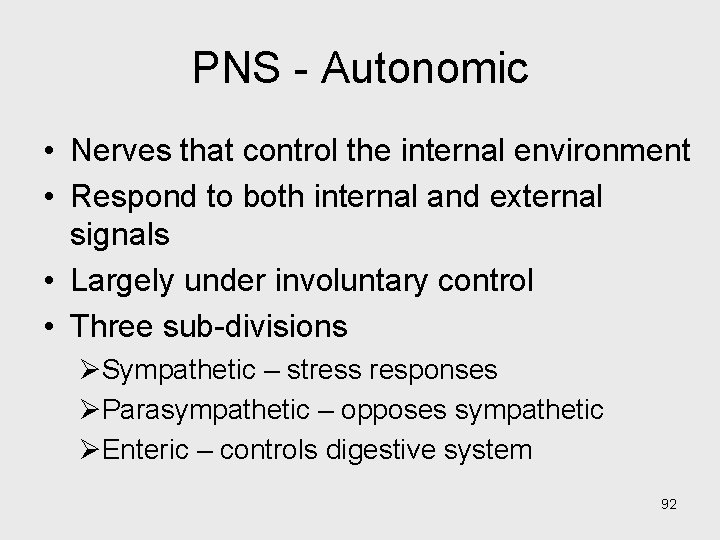
PNS - Autonomic • Nerves that control the internal environment • Respond to both internal and external signals • Largely under involuntary control • Three sub-divisions ØSympathetic – stress responses ØParasympathetic – opposes sympathetic ØEnteric – controls digestive system 92
PNS – Autonomic 93
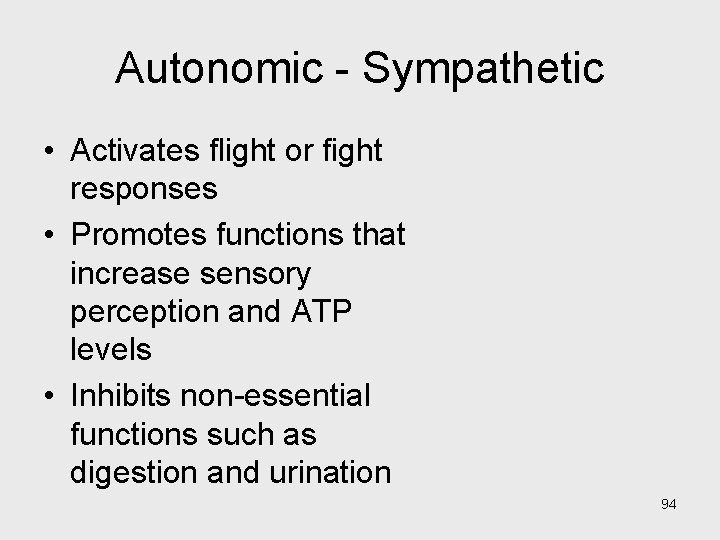
Autonomic - Sympathetic • Activates flight or fight responses • Promotes functions that increase sensory perception and ATP levels • Inhibits non-essential functions such as digestion and urination 94
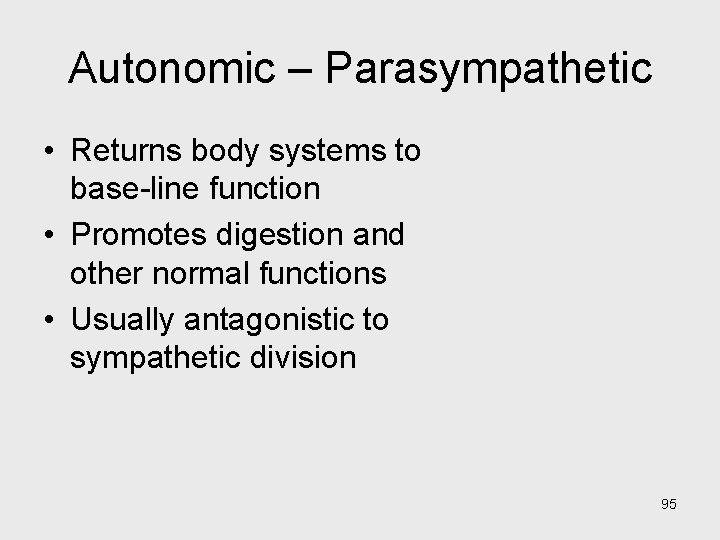
Autonomic – Parasympathetic • Returns body systems to base-line function • Promotes digestion and other normal functions • Usually antagonistic to sympathetic division 95
Autonomic – Enteric • Specifically controls the digestive system • Regulated by both the sympathetic and parasympathetic divisions 96
Brain Development 97