
Lecture 12 The Shortrun Tradeoff Between Inflation and
Lecture 12 The Short-run Tradeoff Between Inflation and Unemployment Prof. Samuel Moon Jung
In this chapter, look for the answers to these questions: • How are inflation and unemployment related in the short run? In the long run? • What factors alter this relationship? • What is the short-run cost of reducing inflation? • Why were U. S. inflation and unemployment both so low in the 1990 s?
Introduction § In the long run, inflation & unemployment are unrelated: § The inflation rate depends mainly on growth in the money supply. § Unemployment (the “natural rate”) depends on the minimum wage, the market power of unions, efficiency wages, and the process of job search. § One of the Ten Principles: In the short run, society faces a trade-off between inflation and unemployment.
The Phillips Curve § Phillips curve: shows the short-run trade-off between inflation and unemployment § 1958: A. W. Phillips showed that nominal wage growth was negatively correlated with unemployment in the U. K. § 1960: Paul Samuelson & Robert Solow found a negative correlation between U. S. inflation & unemployment, named it “the Phillips Curve. ”
Deriving the Phillips Curve § Suppose P = 100 this year. § The following graphs show two possible outcomes for next year: A. Agg demand low, small increase in P (i. e. , low inflation), low output, high unemployment. B. Agg demand high, big increase in P (i. e. , high inflation), high output, low unemployment.
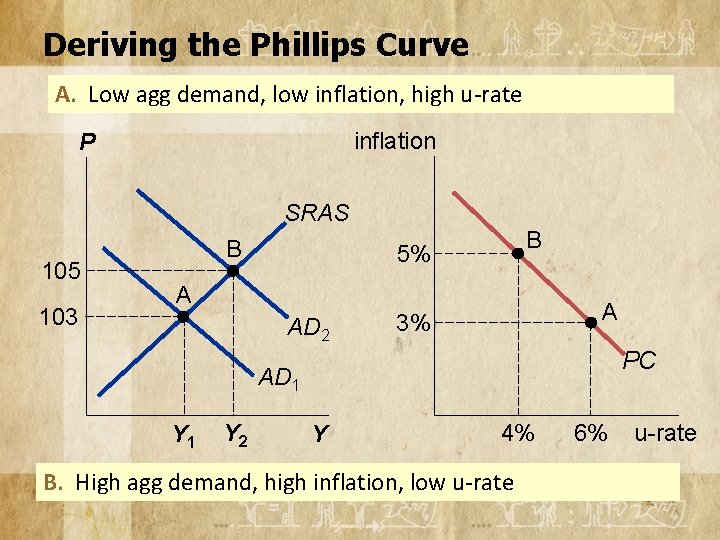
Deriving the Phillips Curve A. Low agg demand, low inflation, high u-rate inflation P SRAS 105 103 B B 5% A AD 2 A 3% PC AD 1 Y 2 Y 4% B. High agg demand, high inflation, low u-rate 6% u-rate
The Phillips Curve: A Policy Menu? § Since fiscal and mon policy affect agg demand, the PC appeared to offer policymakers a menu of choices: § low unemployment with high inflation § low inflation with high unemployment § anything in between § 1960 s: U. S. data supported the Phillips curve. Many believed the PC was stable and reliable.
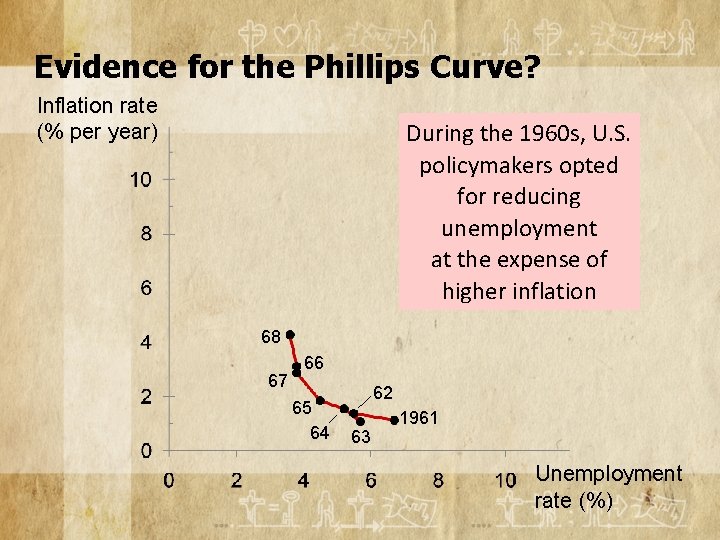
Evidence for the Phillips Curve? Inflation rate (% per year) During the 1960 s, U. S. policymakers opted for reducing unemployment at the expense of higher inflation 68 67 66 65 64 62 63 1961 Unemployment rate (%)
The Vertical Long-Run Phillips Curve § 1968: Milton Friedman and Edmund Phelps argued that the tradeoff was temporary. § Natural-rate hypothesis: the claim that unemployment eventually returns to its normal or “natural” rate, regardless of the inflation rate § Based on the classical dichotomy and the vertical LRAS curve (chapters 12 and 17)
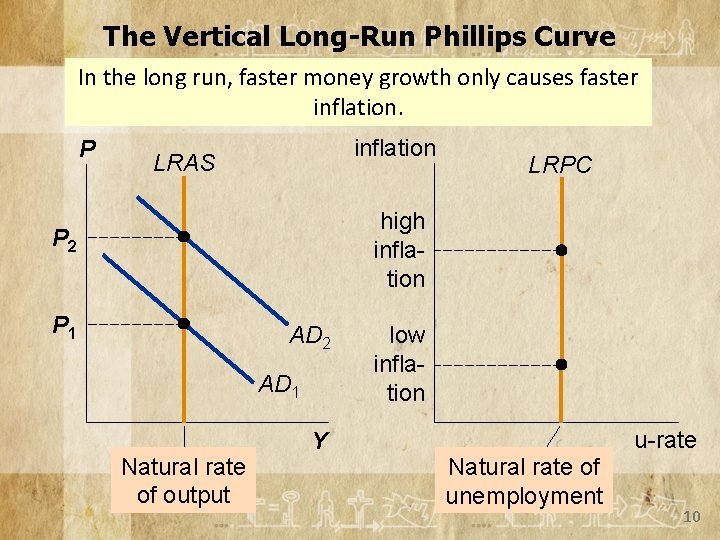
The Vertical Long-Run Phillips Curve In the long run, faster money growth only causes faster inflation. P inflation LRAS LRPC high inflation P 2 P 1 AD 2 AD 1 Natural rate of output Y low inflation Natural rate of unemployment u-rate 10
Reconciling Theory and Evidence § Evidence (from ’ 60 s): PC slopes downward. § Theory (Friedman and Phelps): PC is vertical in the long run. § To bridge the gap between theory and evidence, Friedman and Phelps introduced a new variable: expected inflation – a measure of how much people expect the price level to change.
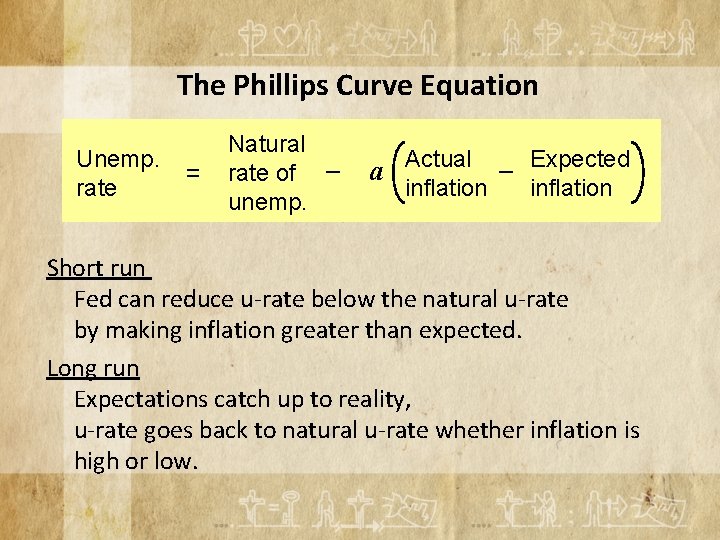
The Phillips Curve Equation Unemp. rate = Natural rate of – unemp. Actual Expected – a inflation Short run Fed can reduce u-rate below the natural u-rate by making inflation greater than expected. Long run Expectations catch up to reality, u-rate goes back to natural u-rate whether inflation is high or low.
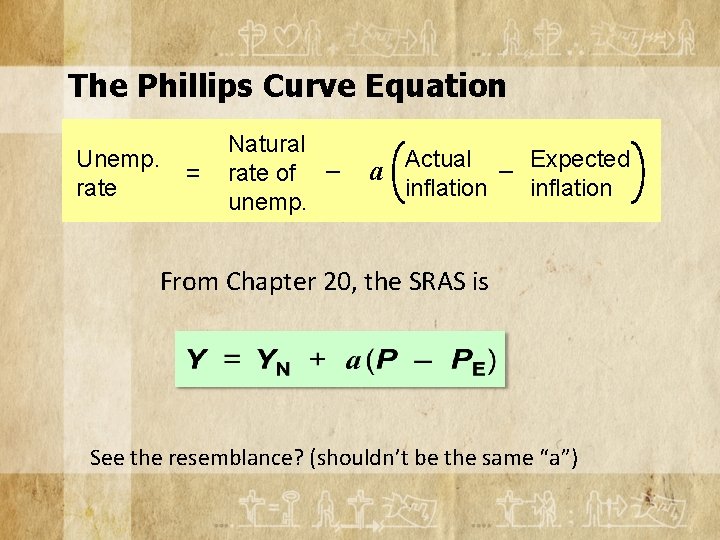
The Phillips Curve Equation Unemp. rate = Natural rate of – unemp. Actual Expected – a inflation From Chapter 20, the SRAS is See the resemblance? (shouldn’t be the same “a”)
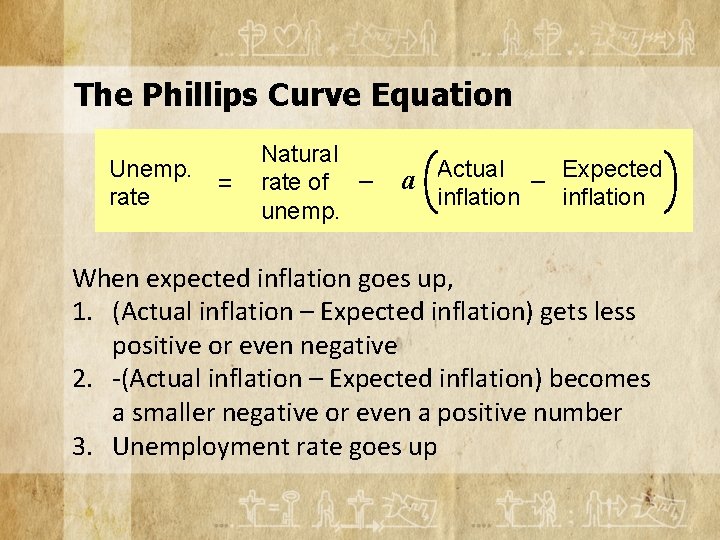
The Phillips Curve Equation Unemp. rate = Natural rate of – unemp. a Actual – Expected inflation When expected inflation goes up, 1. (Actual inflation – Expected inflation) gets less positive or even negative 2. -(Actual inflation – Expected inflation) becomes a smaller negative or even a positive number 3. Unemployment rate goes up
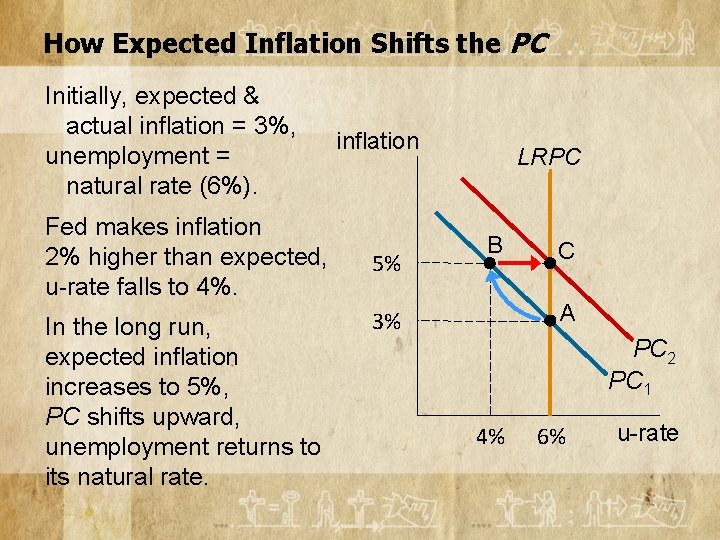
How Expected Inflation Shifts the PC Initially, expected & actual inflation = 3%, unemployment = natural rate (6%). Fed makes inflation 2% higher than expected, u-rate falls to 4%. In the long run, expected inflation increases to 5%, PC shifts upward, unemployment returns to its natural rate. inflation 5% LRPC B C A 3% PC 2 PC 1 4% 6% u-rate
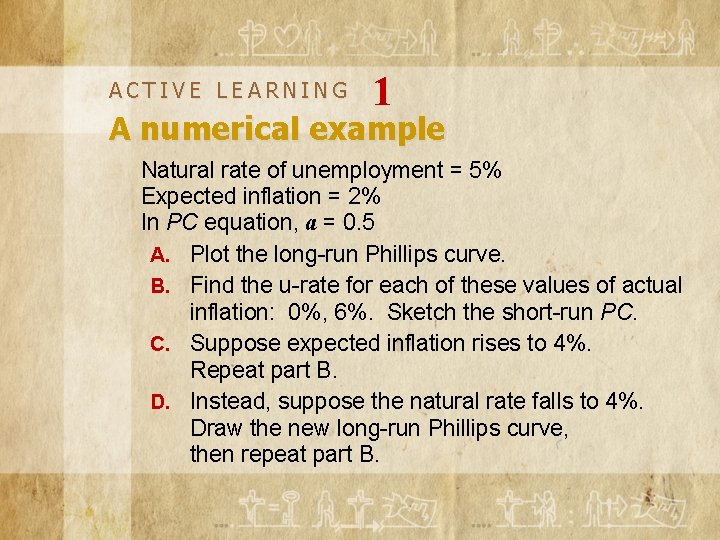
ACTIVE LEARNING 1 A numerical example Natural rate of unemployment = 5% Expected inflation = 2% In PC equation, a = 0. 5 A. Plot the long-run Phillips curve. B. Find the u-rate for each of these values of actual inflation: 0%, 6%. Sketch the short-run PC. C. Suppose expected inflation rises to 4%. Repeat part B. D. Instead, suppose the natural rate falls to 4%. Draw the new long-run Phillips curve, then repeat part B.
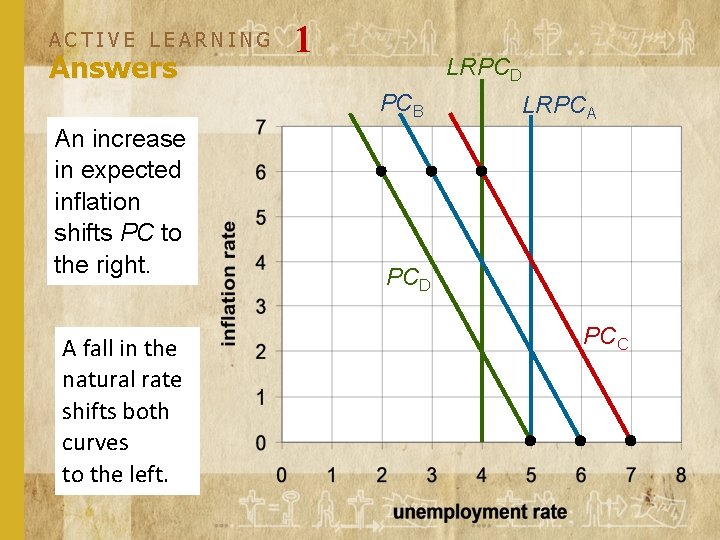
ACTIVE LEARNING Answers 1 LRPCD PCB An increase in expected inflation shifts PC to the right. A fall in the natural rate shifts both curves to the left. LRPCA PCD PCC
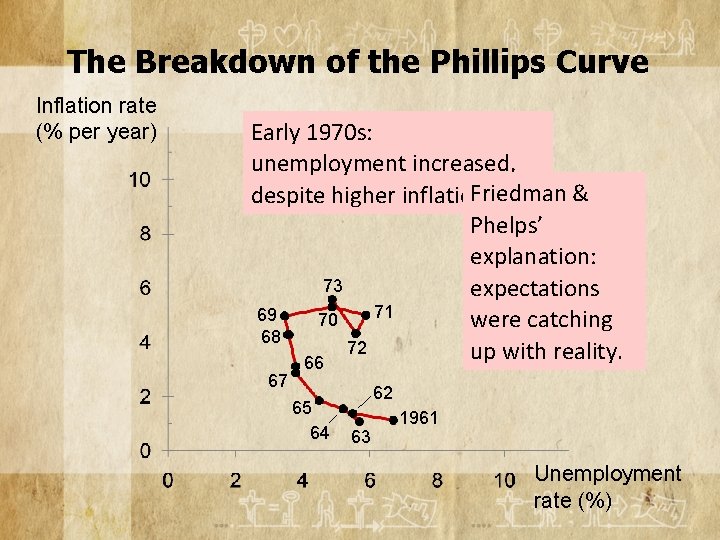
The Breakdown of the Phillips Curve Inflation rate (% per year) Early 1970 s: unemployment increased, Friedman & despite higher inflation. Phelps’ explanation: 73 expectations 71 69 70 were catching 68 72 up with reality. 66 67 65 64 62 63 1961 Unemployment rate (%)
Another PC Shifter: Supply Shocks § Supply shock: an event that directly alters firms’ costs and prices, shifting the AS and PC curves § Example: large increase in oil prices
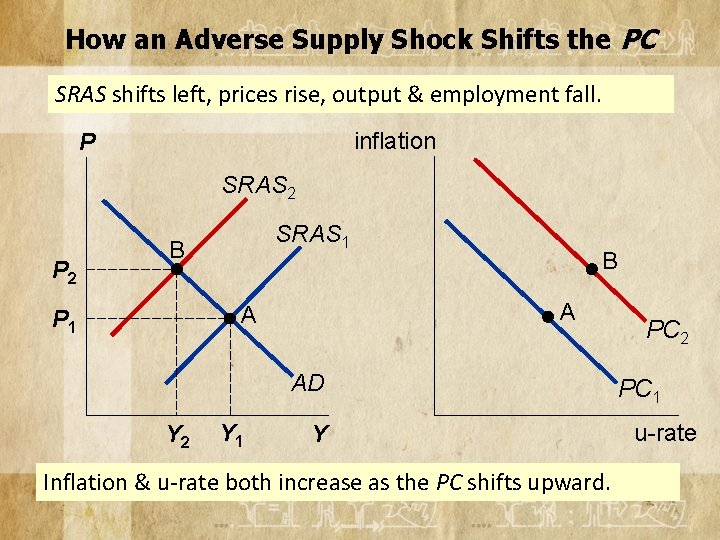
How an Adverse Supply Shock Shifts the PC SRAS shifts left, prices rise, output & employment fall. inflation P SRAS 2 P 2 SRAS 1 B A A P 1 B AD Y 2 Y 1 Y Inflation & u-rate both increase as the PC shifts upward. PC 2 PC 1 u-rate
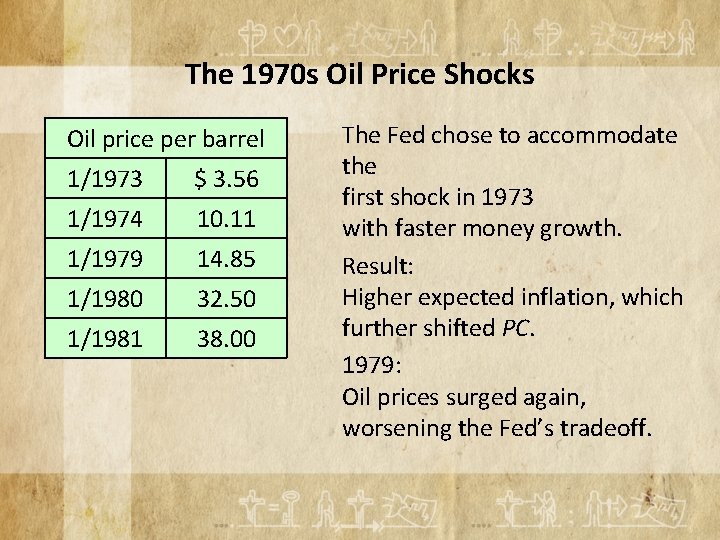
The 1970 s Oil Price Shocks Oil price per barrel 1/1973 $ 3. 56 1/1974 10. 11 1/1979 14. 85 1/1980 32. 50 1/1981 38. 00 The Fed chose to accommodate the first shock in 1973 with faster money growth. Result: Higher expected inflation, which further shifted PC. 1979: Oil prices surged again, worsening the Fed’s tradeoff.
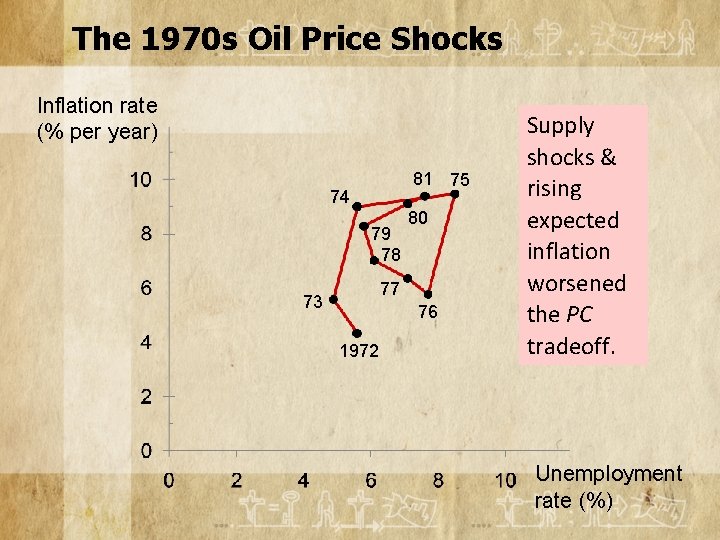
The 1970 s Oil Price Shocks Inflation rate (% per year) 81 75 74 79 78 80 77 73 76 1972 Supply shocks & rising expected inflation worsened the PC tradeoff. Unemployment rate (%)
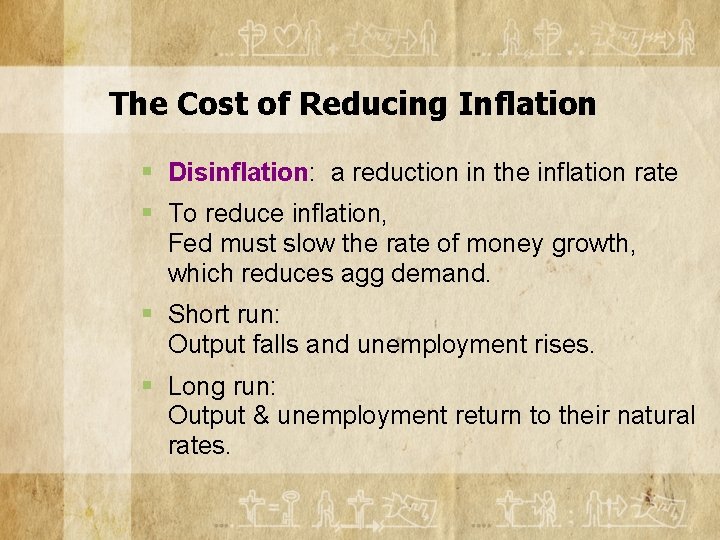
The Cost of Reducing Inflation § Disinflation: a reduction in the inflation rate § To reduce inflation, Fed must slow the rate of money growth, which reduces agg demand. § Short run: Output falls and unemployment rises. § Long run: Output & unemployment return to their natural rates.
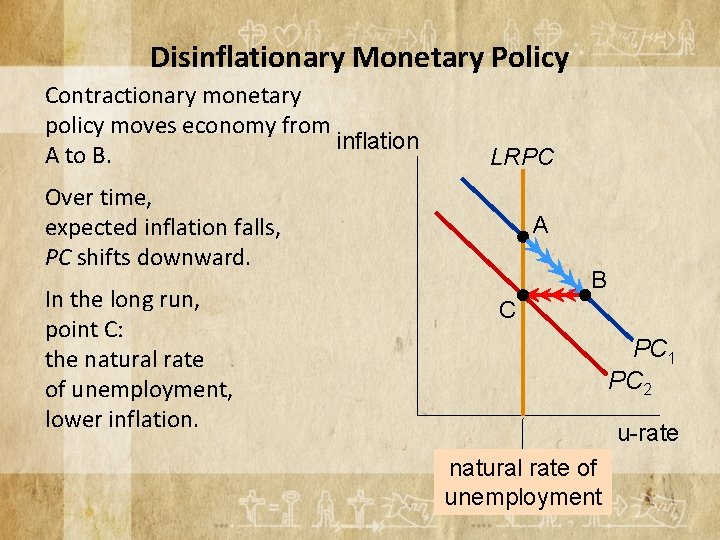
Disinflationary Monetary Policy Contractionary monetary policy moves economy from inflation A to B. LRPC Over time, expected inflation falls, PC shifts downward. In the long run, point C: the natural rate of unemployment, lower inflation. A B C PC 1 PC 2 u-rate natural rate of unemployment
The Cost of Reducing Inflation § Disinflation requires enduring a period of high unemployment and low output. § Sacrifice ratio: percentage points of annual output lost per 1 percentage point reduction in inflation § Typical estimate of the sacrifice ratio: 5 § To reduce inflation rate 1%, must sacrifice 5% of a year’s output. § Can spread cost over time, e. g. To reduce inflation by 6%, can either § sacrifice 30% of GDP for one year § sacrifice 10% of GDP for three years
Rational Expectations, Costless Disinflation? § Rational expectations: a theory according to which people optimally use all the information they have, including info about govt policies, when forecasting the future § Early proponents: Robert Lucas, Thomas Sargent, Robert Barro § Implied that disinflation could be much less costly…
Rational Expectations, Costless Disinflation? § Suppose the Fed convinces everyone it is committed to reducing inflation. § Then, expected inflation falls, the short-run PC shifts downward. § Result: Disinflations can cause less unemployment than the traditional sacrifice ratio predicts.
The Volcker Disinflation Fed Chairman Paul Volcker § Appointed in late 1979 under high inflation & unemployment § Changed Fed policy to disinflation 1981– 1984: § Fiscal policy was expansionary, so Fed policy had to be very contractionary to reduce inflation. § Success: Inflation fell from 10% to 4%, but at the cost of high unemployment…
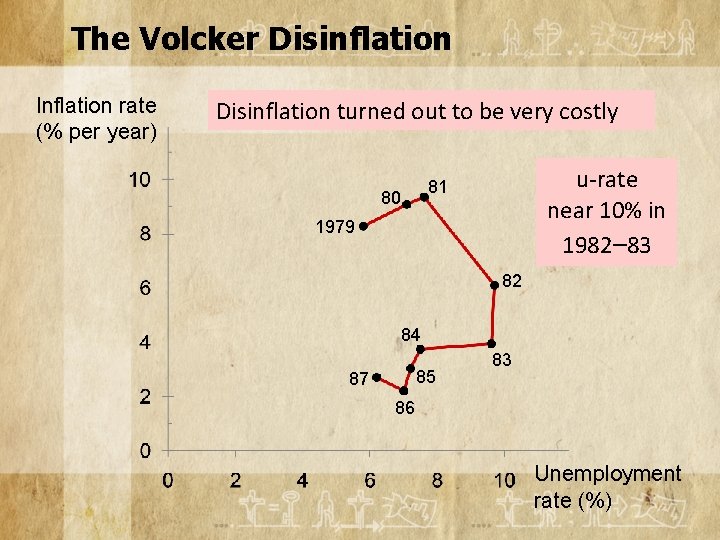
The Volcker Disinflation Inflation rate (% per year) Disinflation turned out to be very costly u-rate near 10% in 1982– 83 81 80 1979 82 84 85 87 83 86 Unemployment rate (%)
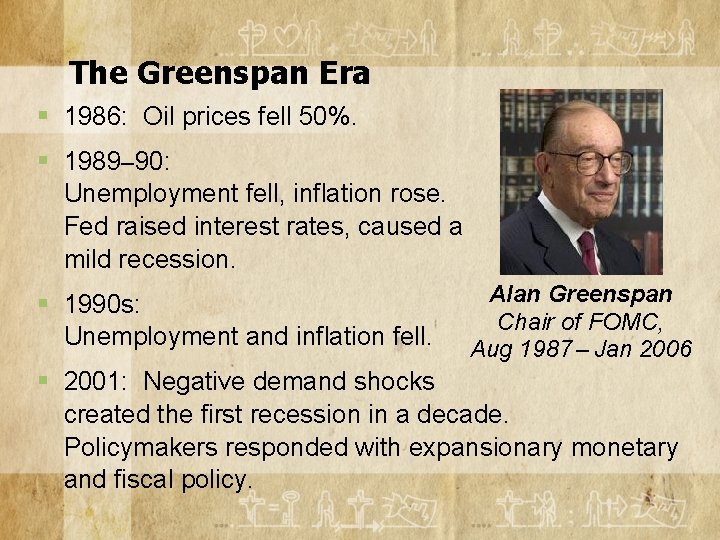
The Greenspan Era § 1986: Oil prices fell 50%. § 1989– 90: Unemployment fell, inflation rose. Fed raised interest rates, caused a mild recession. § 1990 s: Unemployment and inflation fell. Alan Greenspan Chair of FOMC, Aug 1987 – Jan 2006 § 2001: Negative demand shocks created the first recession in a decade. Policymakers responded with expansionary monetary and fiscal policy.
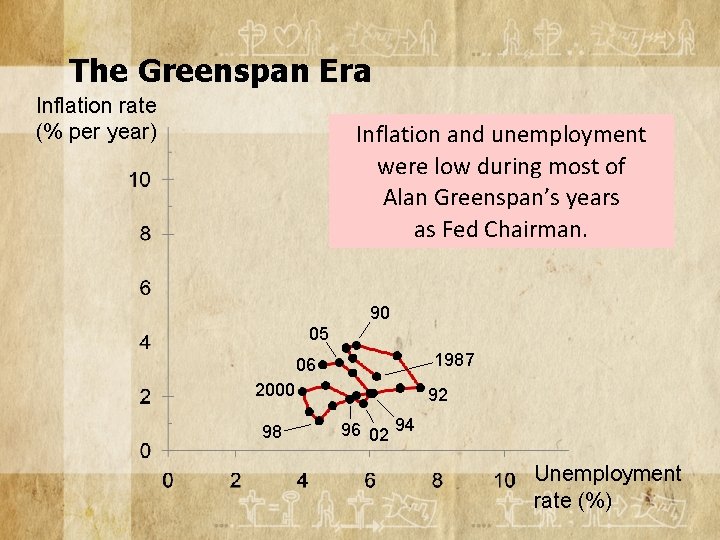
The Greenspan Era Inflation rate (% per year) Inflation and unemployment were low during most of Alan Greenspan’s years as Fed Chairman. 90 05 1987 06 2000 98 92 96 02 94 Unemployment rate (%)
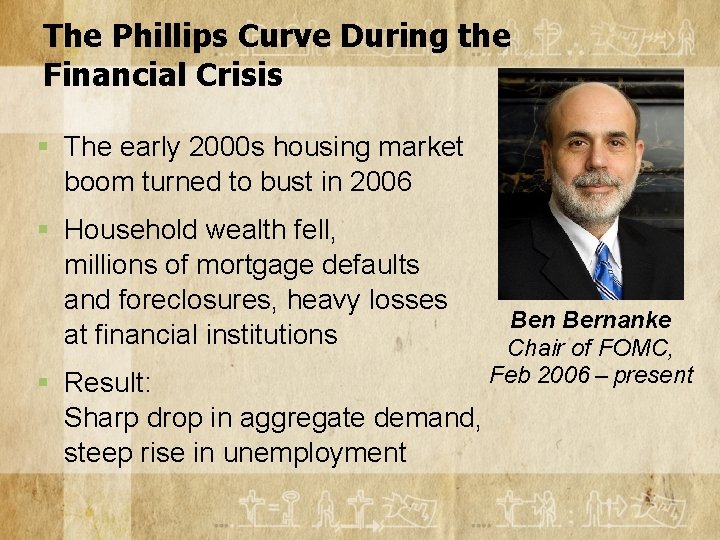
The Phillips Curve During the Financial Crisis § The early 2000 s housing market boom turned to bust in 2006 § Household wealth fell, millions of mortgage defaults and foreclosures, heavy losses at financial institutions § Result: Sharp drop in aggregate demand, steep rise in unemployment Ben Bernanke Chair of FOMC, Feb 2006 – present
FINAL CLICKER QUESTION!!!!! Who is better looking? A. Alan Greenspan B. Ben Bernanke C. Prof. Zax D. None of the above
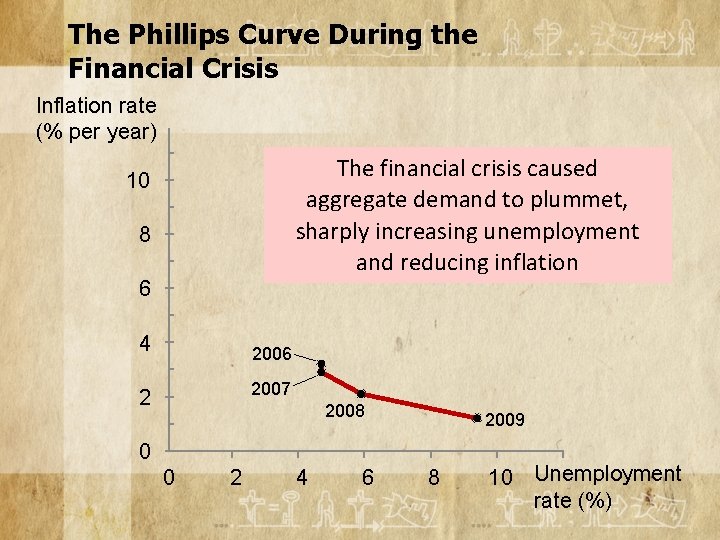
The Phillips Curve During the Financial Crisis Inflation rate (% per year) The financial crisis caused aggregate demand to plummet, sharply increasing unemployment and reducing inflation 10 8 6 4 2006 2007 2 2008 2009 0 0 2 4 6 8 10 Unemployment rate (%)
CONCLUSION § The theories in this chapter come from some of the greatest economists of the 20 th century. § They teach us that inflation and unemployment are § unrelated in the long run § negatively related in the short run § affected by expectations, which play an important role in the economy’s adjustment from the short-run to the long run
SUMMARY • The Phillips curve describes the short-run tradeoff between inflation and unemployment. • In the long run, there is no tradeoff: inflation is determined by money growth, while unemployment equals its natural rate. • Supply shocks and changes in expected inflation shift the short-run Phillips curve, making the tradeoff more or less favorable.
SUMMARY • The Fed can reduce inflation by contracting • the money supply, which moves the economy along its short-run Phillips curve and raises unemployment. In the long run, though, expectations adjust and unemployment returns to its natural rate. Some economists argue that a credible commitment to reducing inflation can lower the costs of disinflation by inducing a rapid adjustment of expectations.
- Slides: 37