
Lecture 12 The noun Grammatical Categories The Use
- Slides: 17
Lecture 12 The noun. Grammatical Categories. The Use of Cases
Epigraph “Without knowing the original structure of the nouns in the language we can hardly explain the exceptions in the present-day words”. Plan 1. Categories of Noun 2. Classifications of Old E Noun 3. Noun in ME 4. Noun in Early Mn. E
• The OE noun had two grammatical or morphological categories: number and case. • In addition, nouns distinguished three genders, but this distinction was not a grammatical category; it was merely a classifying feature accounting, alongside other features, for the division of nouns into morphological classes.
ü Nouns used to denote males are normally masculine - mann, faeder, brodor, abbod (man, father, brother, abbot). ü Naturally, those denoting females should be all feminine - modor, sweostor, cwene, abbudissa (mother, sister, queen, abbess). ü Yet there are curious exceptions, such words as magden (maid), wif (wife) are neuter. And wifrnan (woman) is masculine, because the second element of the compound is masculine.
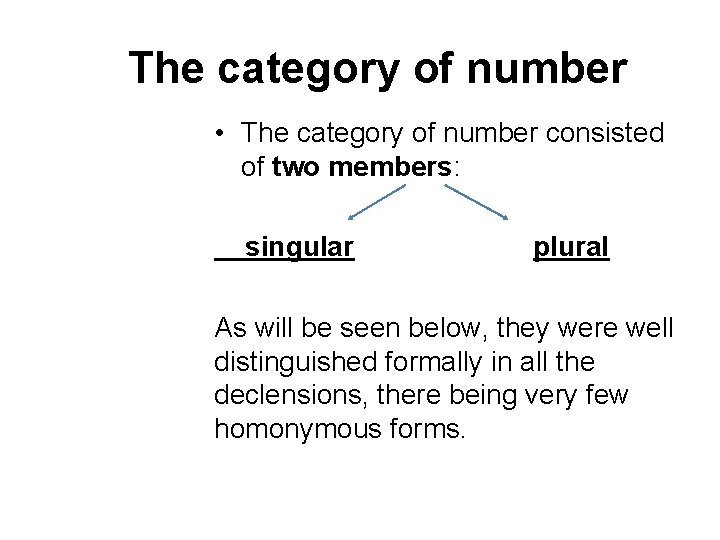
The category of number • The category of number consisted of two members: singular plural As will be seen below, they were well distinguished formally in all the declensions, there being very few homonymous forms.
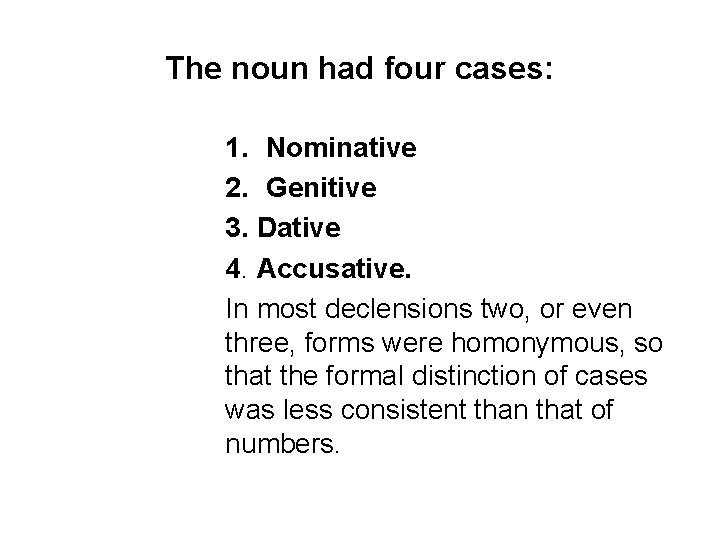
The noun had four cases: 1. Nominative 2. Genitive 3. Dative 4. Accusative. In most declensions two, or even three, forms were homonymous, so that the formal distinction of cases was less consistent than that of numbers.
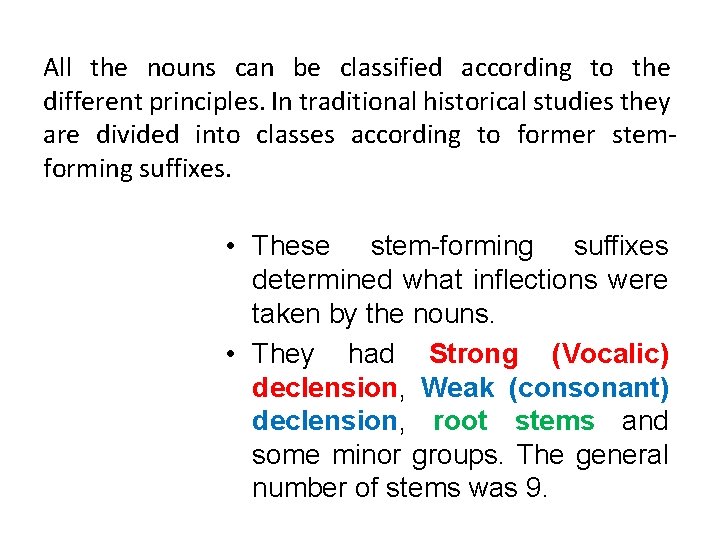
All the nouns can be classified according to the different principles. In traditional historical studies they are divided into classes according to former stemforming suffixes. • These stem-forming suffixes determined what inflections were taken by the nouns. • They had Strong (Vocalic) declension, Weak (consonant) declension, root stems and some minor groups. The general number of stems was 9.
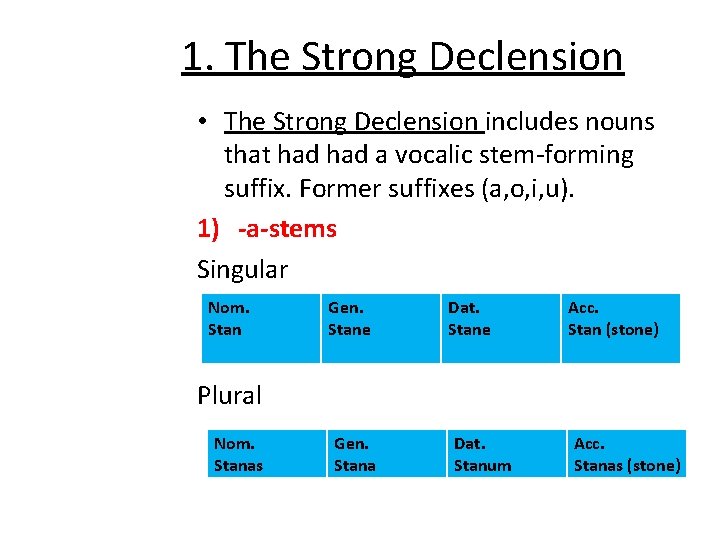
1. The Strong Declension • The Strong Declension includes nouns that had a voсalic stem-forming suffix. Former suffixes (a, o, i, u). 1) -a-stems Singular Nom. Stan Gen. Stane Dat. Stane Acc. Stan (stone) Plural Nom. Stanas Gen. Stana Dat. Stanum Acc. Stanas (stone)
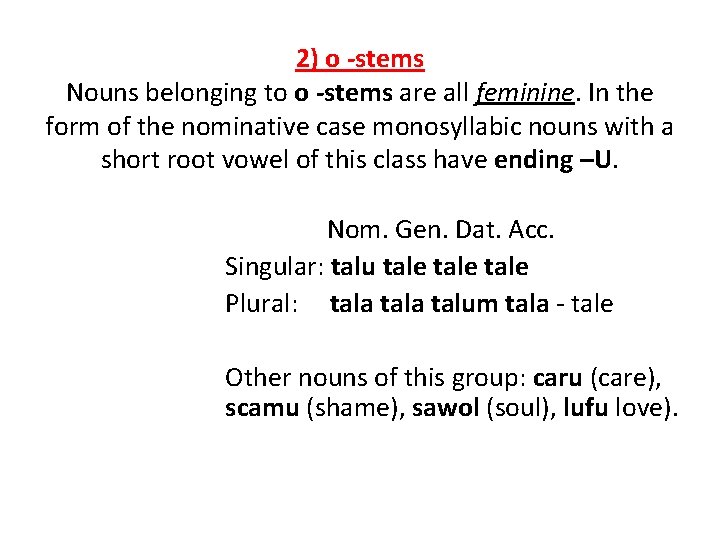
2) о -stems Nouns belonging to о -stems are all feminine. In the form of the nominative case monosyllabic nouns with a short root vowel of this class have ending –U. Nom. Gen. Dat. Acc. Singular: talu tale Plural: tala talum tala - tale Other nouns of this group: caru (care), scamu (shame), sawol (soul), lufu love).
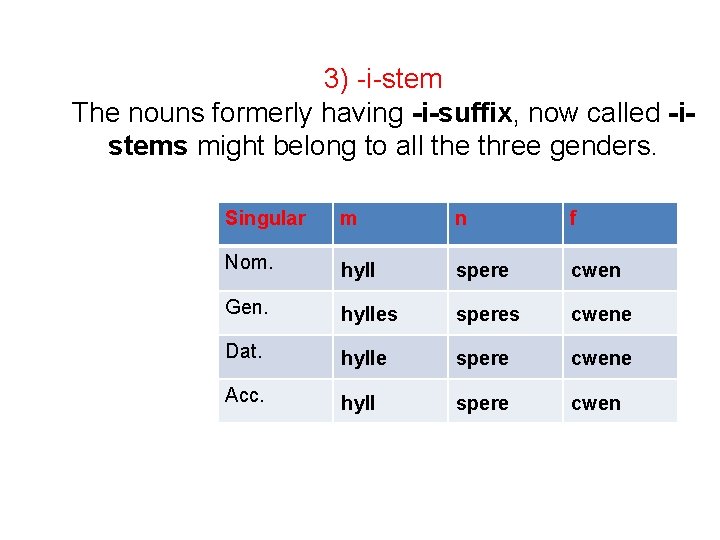
3) -i-stem The nouns formerly having -i-suffix, now called -istems might belong to all the three genders. Singular m n f Nom. hyll spere cwen Gen. hylles speres cwene Dat. hylle spere cwene Acc. hyll spere cwen
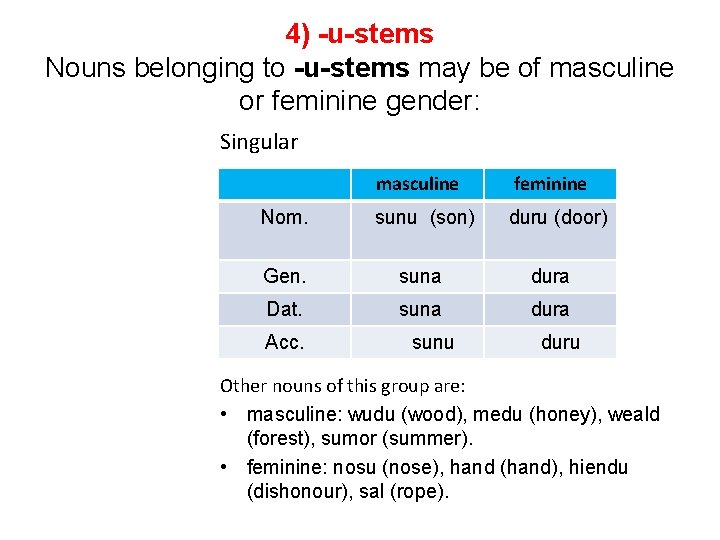
4) -u-stems Nouns belonging to -u-stems may be of masculine or feminine gender: Singular masculine feminine Nom. sunu (son) duru (door) Gen. suna dura Dat. suna dura Acc. sunu duru Other nouns of this group are: • masculine: wudu (wood), medu (honey), weald (forest), sumor (summer). • feminine: nosu (nose), hand (hand), hiendu (dishonour), sal (rope).
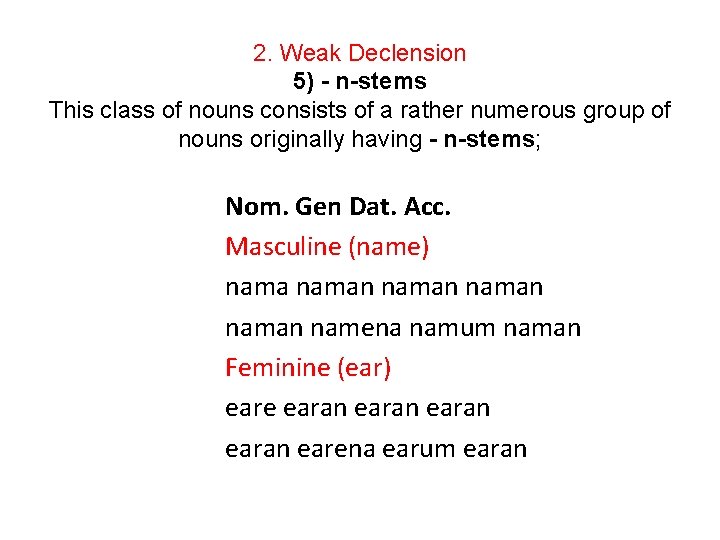
2. Weak Declension 5) - n-stems This class of nouns consists of a rather numerous group of nouns originally having - n-stems; Nom. Gen Dat. Acc. Masculine (name) naman naman namena namum naman Feminine (ear) eare earan earena earum earan
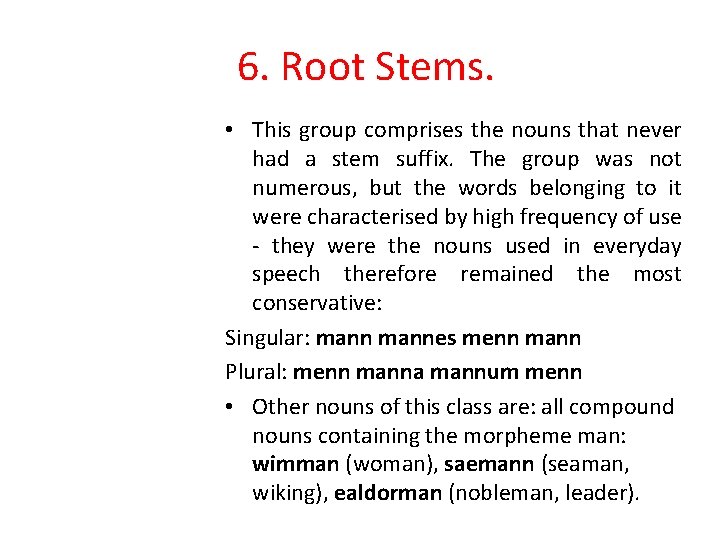
6. Root Stems. • This group comprises the nouns that never had a stem suffix. The group was not numerous, but the words belonging to it were characterised by high frequency of use - they were the nouns used in everyday speech therefore remained the most conservative: Singular: mannes menn mann Plural: menn manna mannum menn • Other nouns of this class are: all compound nouns containing the morpheme man: wimman (woman), saemann (seaman, wiking), ealdorman (nobleman, leader).
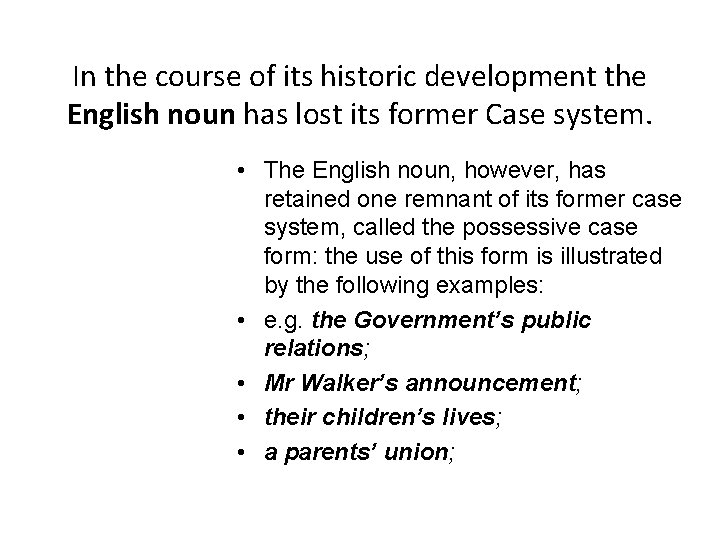
In the course of its historic development the English noun has lost its former Case system. • The English noun, however, has retained one remnant of its former case system, called the possessive case form: the use of this form is illustrated by the following examples: • e. g. the Government’s public relations; • Mr Walker’s announcement; • their children’s lives; • a parents’ union;
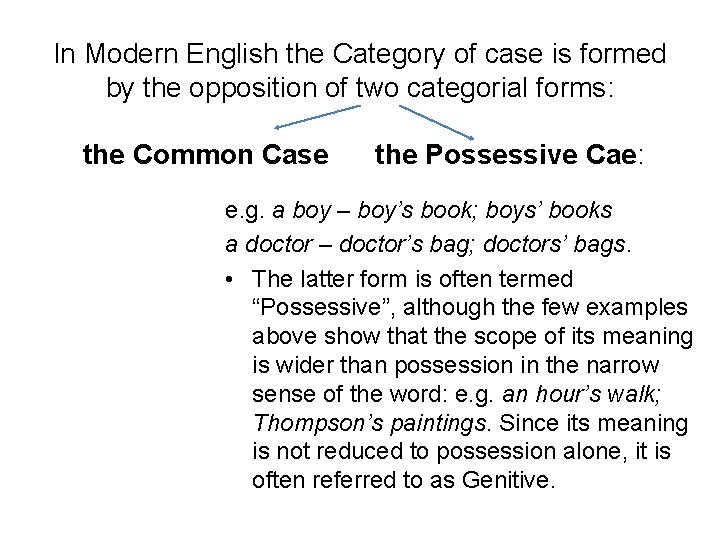
In Modern English the Category of case is formed by the opposition of two categorial forms: the Common Case the Possessive Cae: e. g. a boy – boy’s book; boys’ books a doctor – doctor’s bag; doctors’ bags. • The latter form is often termed “Possessive”, although the few examples above show that the scope of its meaning is wider than possession in the narrow sense of the word: e. g. an hour’s walk; Thompson’s paintings. Since its meaning is not reduced to possession alone, it is often referred to as Genitive.
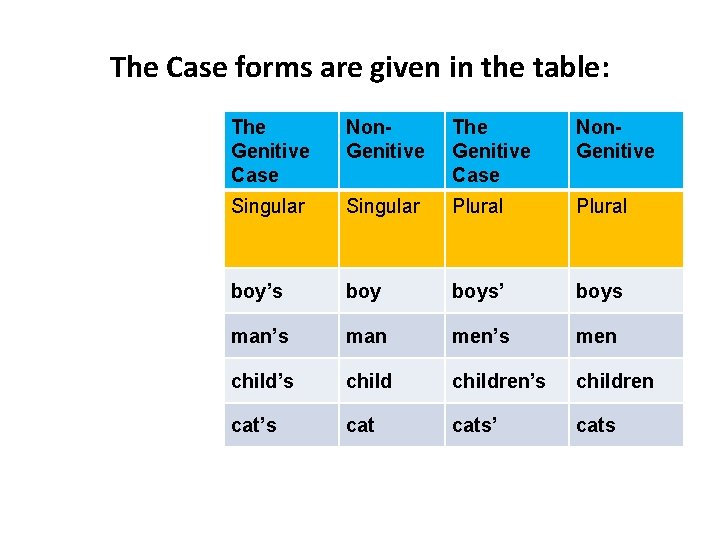
The Case forms are given in the table: The Genitive Case Non. Genitive Singular Plural boy’s boys’ boys man’s man men’s men child’s children’s children cat’s cats’ cats
• Case forms are inflexional noun forms. Since there is only one positive inflexional morpheme { -‘s} in English, expressing its syntactical function in the sentence, there are reasons to admit a two-member case system in Modern English, represented by the zero morpheme (the Common Case) / the { -‘s} morpheme (the Genitive Case). Thus, the category of Case in English is constituted by the two categorial forms: the strong member (marked) with the ‘s – the Genitive Case : : the weak member (unmarked) – the Non-Genitive Case form (the Common Case).