
Lecture 12 PreProgrammed Reactions EMG Voluntary reaction Perturbation
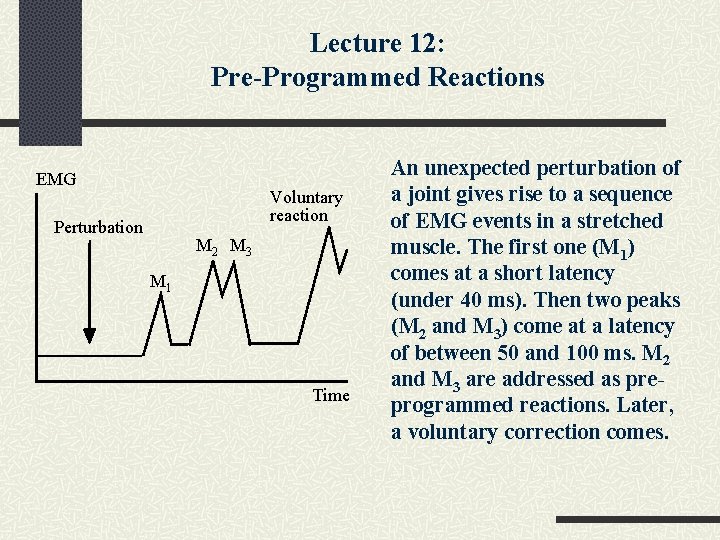
Lecture 12: Pre-Programmed Reactions EMG Voluntary reaction Perturbation M 2 M 3 M 1 Time An unexpected perturbation of a joint gives rise to a sequence of EMG events in a stretched muscle. The first one (M 1) comes at a short latency (under 40 ms). Then two peaks (M 2 and M 3) come at a latency of between 50 and 100 ms. M 2 and M 3 are addressed as preprogrammed reactions. Later, a voluntary correction comes.

Effect of Instruction on Muscle Reactions to a Perturbation EMG Voluntary reaction Perturbation M 2 M 3 M 1 React Let go Time Pre-programmed reactions demonstrate a strong dependence on the instruction. If the subject is instructed to resist perturbations, the preprogrammed reactions are large (solid lines). If the subject is asked to let the limb move, the pre-programmed reactions are much smaller (dashed lines). Note that the M 1 reaction is the same.

Pre-Programmed Reactions § Also called triggered reactions, M 2–M 3, functional stretch reflex, transcortical reflex, long-loop reflex § Come at an intermediate latency (40– 100 ms) § Are involuntary in nature but can be modified by instruction § Can be triggered by stimuli of virtually any modality § Generate a quick, crude compensation for the perturbation § Are followed by voluntary corrections

A Possible Scheme Central command ∆C Tonic stretch reflex mechanism Afferents Muscle A subject is holding a position in a joint against a load with a central command to a muscle. If the subject knows that a perturbation can occur, he/she can prepare an addition to the central command that would compensate for the predicted perturbation. The preprogrammed command (∆C) is triggered by peripheral signals generated by the perturbation and attenuates the mechanical effects of the perturbation.
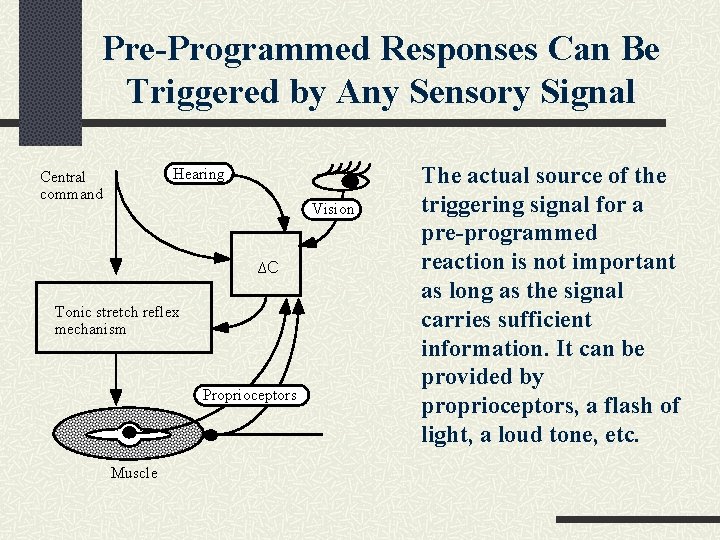
Pre-Programmed Responses Can Be Triggered by Any Sensory Signal Hearing Central command Vision ∆C Tonic stretch reflex mechanism Proprioceptors Muscle The actual source of the triggering signal for a pre-programmed reaction is not important as long as the signal carries sufficient information. It can be provided by proprioceptors, a flash of light, a loud tone, etc.
Effects of a Perturbation Applied During a Fast Movement If a perturbation occurs during a fast voluntary movement, EMG changes are seen at a characteristic for the pre-programmed reactions latency. Generally, they involve an increase in the activity of a muscle that acts against the perturbation, and a decrease in the activity of a muscle that is assisted by the perturbation (bold lines).
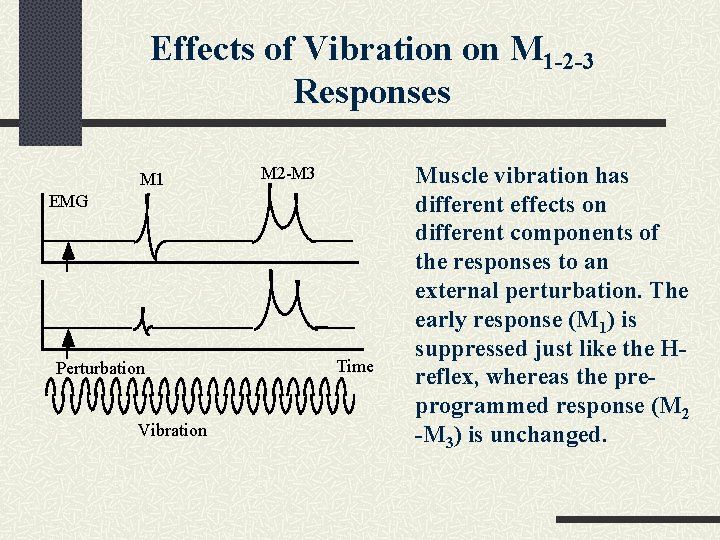
Effects of Vibration on M 1 -2 -3 Responses M 1 M 2 -M 3 EMG Perturbation Vibration Time Muscle vibration has different effects on different components of the responses to an external perturbation. The early response (M 1) is suppressed just like the Hreflex, whereas the preprogrammed response (M 2 -M 3) is unchanged.
Examples of Pre-Programmed Reactions § The “waiter’s response” § Grasp adjustments § Two-hand object holding § Reactions to postural perturbations (ankle and hip strategies) § Corrective stumbling reaction

Effects of Intention on Quick Muscle Reactions Pre-programmed postural corrections to a perturbation created by platform movement are context-dependent. If the cup is loaded with play dough, the corrections will be different than if the cup is full of hot tea.

Corrective Stumbling Reaction A B Stim Surface A mechanical or electrical stimulation of the paw during locomotion induces different reactions in the swing and the stance phases. In the swing phase (A), there is a flexor reaction, so that the leg steps over a fictitious obstacle. In the stance phase (B), there is an extensor reaction, leading to the shortening of the stance phase for this limb.
- Slides: 10