
Lecture 12 Permutations and Combinations CSCI 1900 Mathematics
Lecture 12 Permutations and Combinations CSCI – 1900 Mathematics for Computer Science Fall 2014 Bill Pine
Lecture Introduction • Reading – Rosen - Section 6. 1 • Learning to count sequences under four situations: – Order matters, duplicates allowed – Order matters, no duplicates allowed – Any order, duplicates allowed CSCI 1900 Lecture 12 - 2
Sequences Derived from a Set • Assume we have a set A containing n items • Examples include alphabet, decimal digits, playing cards, … • We can produce sequences from each of these sets • Example – R, a, g, l, a, n, , R, o, a, d – A♣, A♠, 8♣, 8♠, Q♣ CSCI 1900 Lecture 12 - 3
Types of Sequences from a Set • If we classify by order and duplications, 4 cases: – Order matters, duplicates allowed – Order matters, duplicates not allowed – Order doesn’t matter, duplicates allowed CSCI 1900 Lecture 12 - 4
Classifying Real-World Sequences Determine the set, size of set, and classify each of the following as one of the previously listed types of sequences • Blackjack Hands • Phone numbers • Lottery numbers • Binary numbers • Windows XP CD Key • Votes in a presidential election • Selecting from a limited menu for awards dinner CSCI 1900 Lecture 12 - 5
Order Matters Duplicates Are Allowed CSCI 1900 Lecture 12 - 6
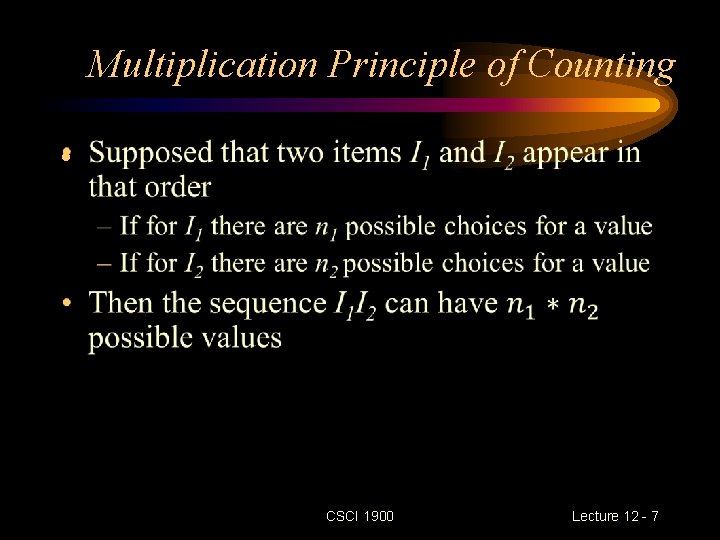
Multiplication Principle of Counting • CSCI 1900 Lecture 12 - 7
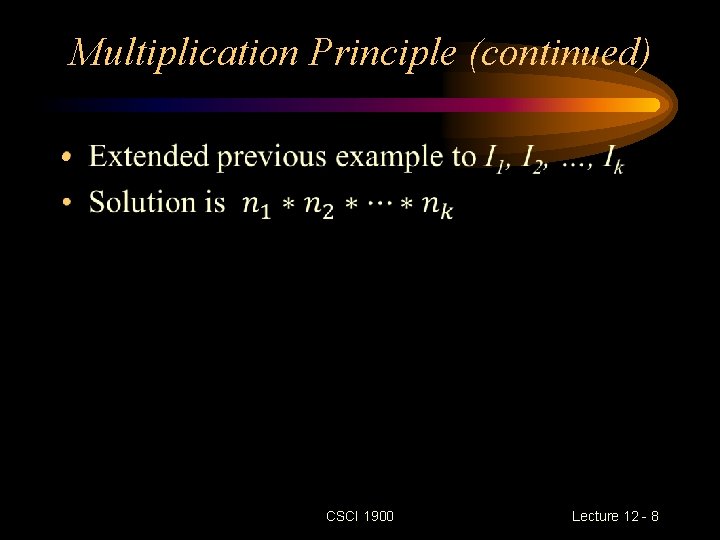
Multiplication Principle (continued) • CSCI 1900 Lecture 12 - 8
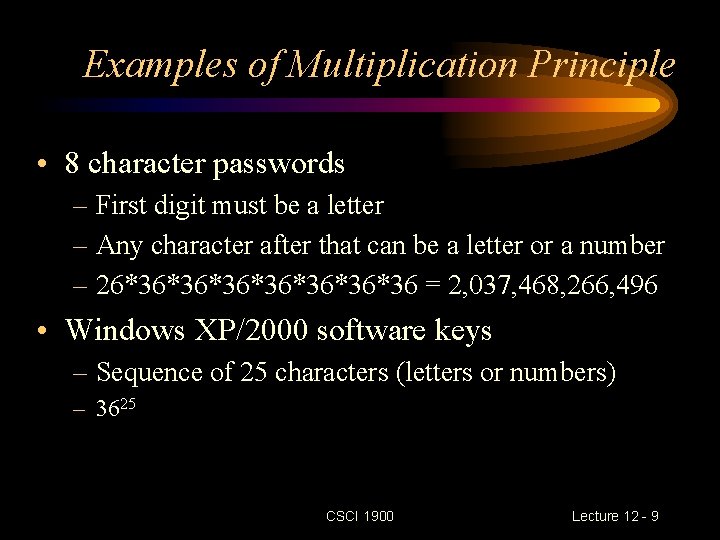
Examples of Multiplication Principle • 8 character passwords – First digit must be a letter – Any character after that can be a letter or a number – 26*36*36*36*36 = 2, 037, 468, 266, 496 • Windows XP/2000 software keys – Sequence of 25 characters (letters or numbers) – 3625 CSCI 1900 Lecture 12 - 9
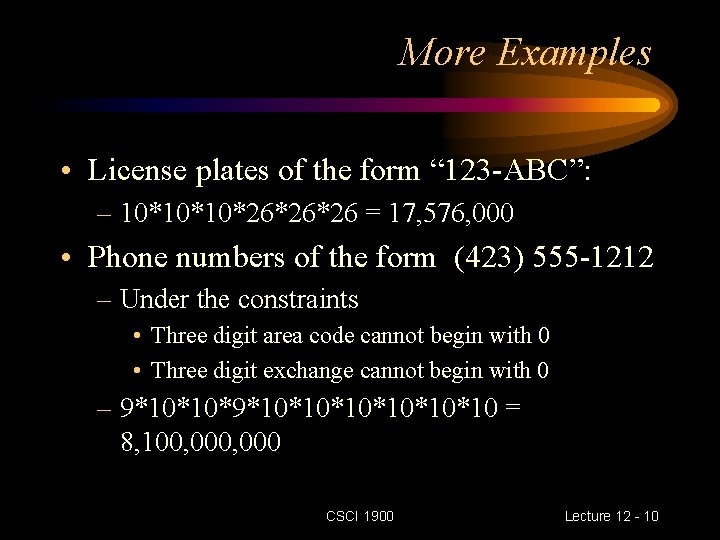
More Examples • License plates of the form “ 123 -ABC”: – 10*10*10*26*26*26 = 17, 576, 000 • Phone numbers of the form (423) 555 -1212 – Under the constraints • Three digit area code cannot begin with 0 • Three digit exchange cannot begin with 0 – 9*10*10*10*10*10*10 = 8, 100, 000 CSCI 1900 Lecture 12 - 10
Order Matters Duplicates Are Not Allowed CSCI 1900 Lecture 12 - 11
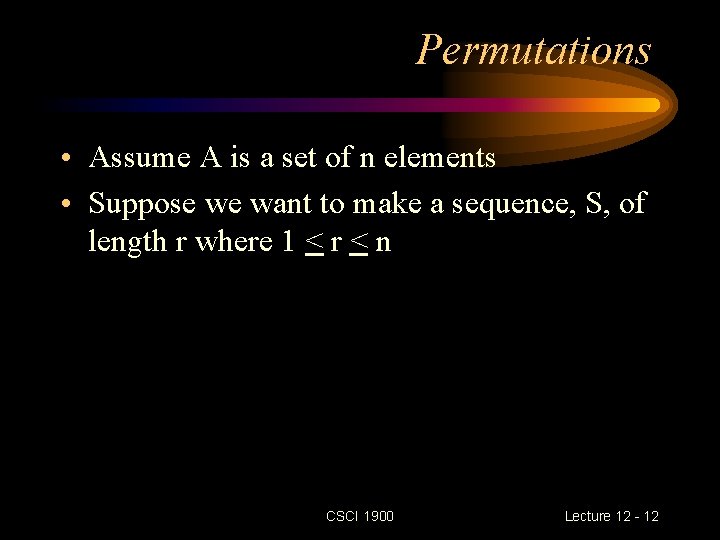
Permutations • Assume A is a set of n elements • Suppose we want to make a sequence, S, of length r where 1 < r < n CSCI 1900 Lecture 12 - 12
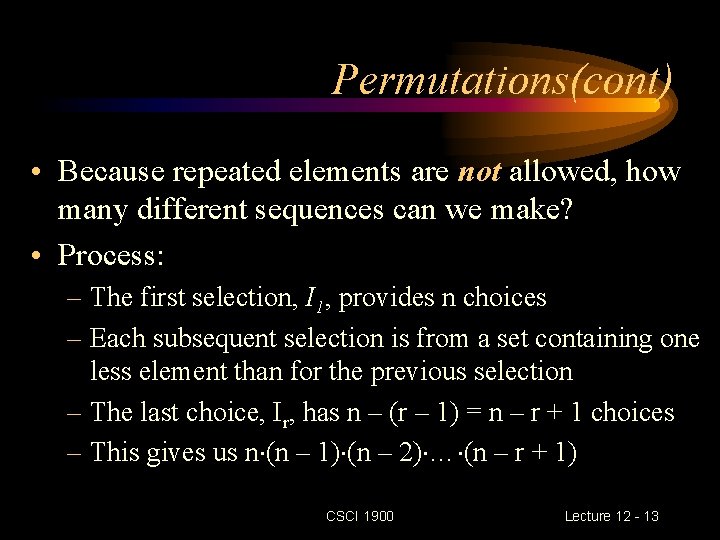
Permutations(cont) • Because repeated elements are not allowed, how many different sequences can we make? • Process: – The first selection, I 1, provides n choices – Each subsequent selection is from a set containing one less element than for the previous selection – The last choice, Ir, has n – (r – 1) = n – r + 1 choices – This gives us n (n – 1) (n – 2) … (n – r + 1) CSCI 1900 Lecture 12 - 13
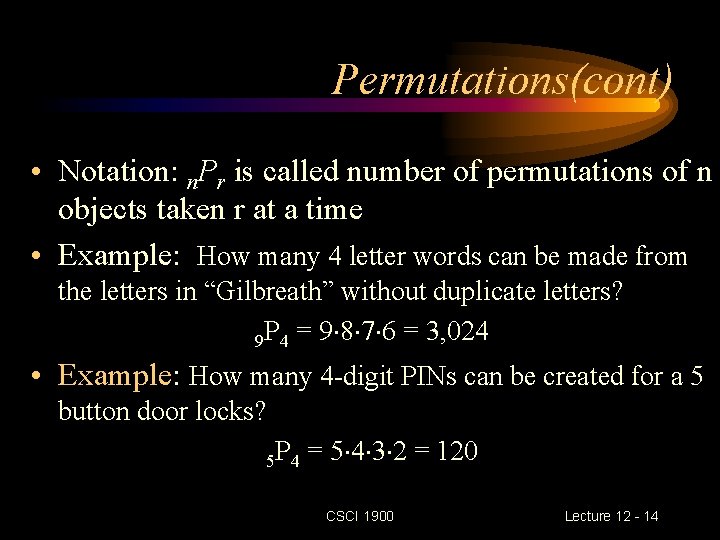
Permutations(cont) • Notation: n. Pr is called number of permutations of n objects taken r at a time • Example: How many 4 letter words can be made from the letters in “Gilbreath” without duplicate letters? 9 P 4 = 9 8 7 6 = 3, 024 • Example: How many 4 -digit PINs can be created for a 5 button door locks? 5 P 4 = 5 4 3 2 = 120 CSCI 1900 Lecture 12 - 14
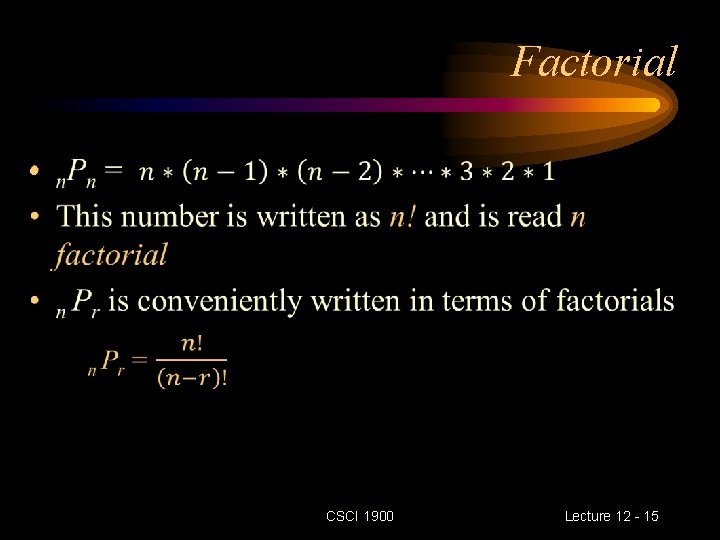
Factorial • CSCI 1900 Lecture 12 - 15
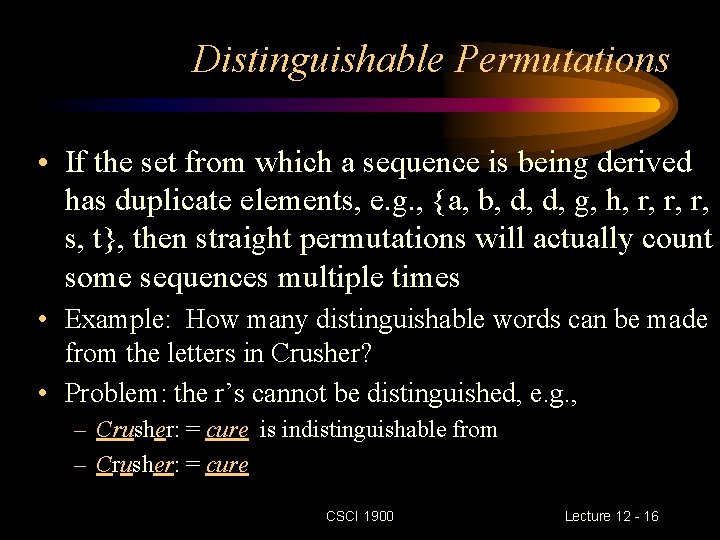
Distinguishable Permutations • If the set from which a sequence is being derived has duplicate elements, e. g. , {a, b, d, d, g, h, r, r, r, s, t}, then straight permutations will actually count some sequences multiple times • Example: How many distinguishable words can be made from the letters in Crusher? • Problem: the r’s cannot be distinguished, e. g. , – Crusher: = cure is indistinguishable from – Crusher: = cure CSCI 1900 Lecture 12 - 16
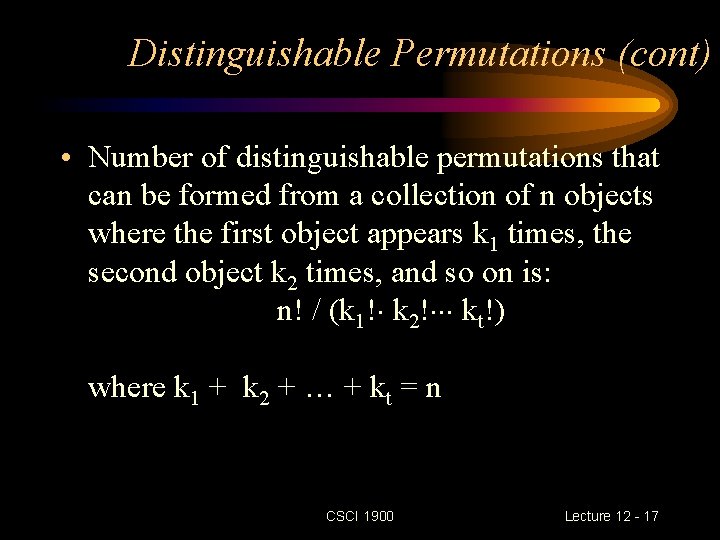
Distinguishable Permutations (cont) • Number of distinguishable permutations that can be formed from a collection of n objects where the first object appears k 1 times, the second object k 2 times, and so on is: n! / (k 1! k 2! kt!) where k 1 + k 2 + … + kt = n CSCI 1900 Lecture 12 - 17
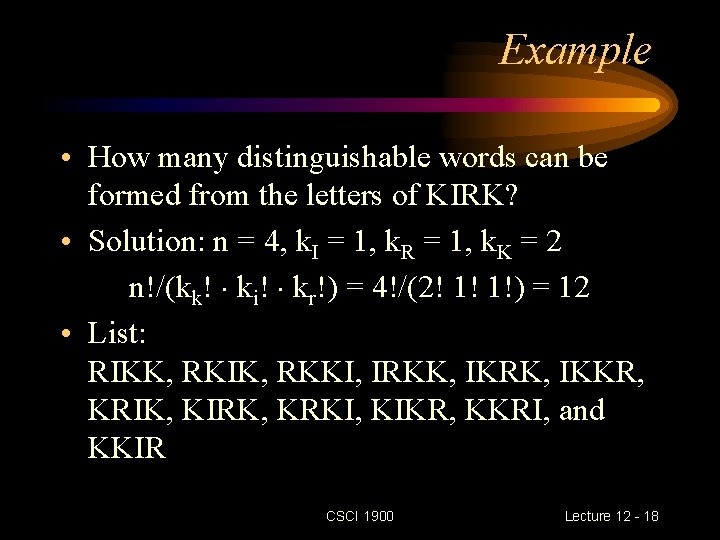
Example • How many distinguishable words can be formed from the letters of KIRK? • Solution: n = 4, k. I = 1, k. R = 1, k. K = 2 n!/(kk! ki! kr!) = 4!/(2! 1! 1!) = 12 • List: RIKK, RKIK, RKKI, IRKK, IKRK, IKKR, KRIK, KIRK, KRKI, KIKR, KKRI, and KKIR CSCI 1900 Lecture 12 - 18
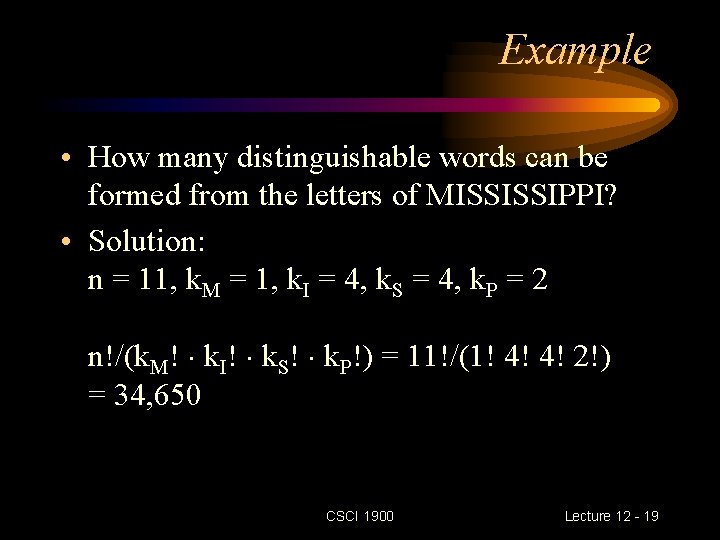
Example • How many distinguishable words can be formed from the letters of MISSISSIPPI? • Solution: n = 11, k. M = 1, k. I = 4, k. S = 4, k. P = 2 n!/(k. M! k. I! k. S! k. P!) = 11!/(1! 4! 4! 2!) = 34, 650 CSCI 1900 Lecture 12 - 19
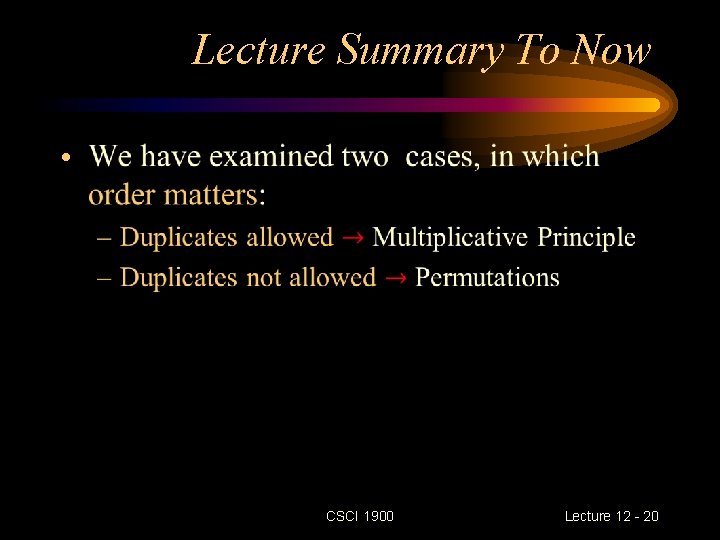
Lecture Summary To Now • CSCI 1900 Lecture 12 - 20
Order Doesn’t Matters Duplicates Are Not Allowed CSCI 1900 Lecture 12 - 21
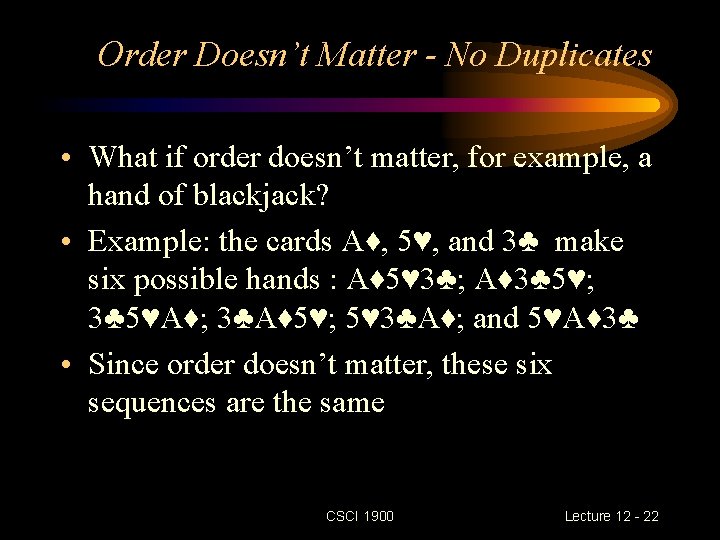
Order Doesn’t Matter - No Duplicates • What if order doesn’t matter, for example, a hand of blackjack? • Example: the cards A♦, 5♥, and 3♣ make six possible hands : A♦ 5♥ 3♣; A♦ 3♣ 5♥; 3♣ 5♥A♦; 3♣A♦ 5♥; 5♥ 3♣A♦; and 5♥A♦ 3♣ • Since order doesn’t matter, these six sequences are the same CSCI 1900 Lecture 12 - 22
![Combinations • For this situation, use n. Cr = n!/[r! (n – r)!] –](http://slidetodoc.com/presentation_image_h/08c1d2ad5f06fae25690d1b0d98fe279/image-23.jpg "Combinations • For this situation, use n. Cr = n!/[r! (n – r)!] –")
Combinations • For this situation, use n. Cr = n!/[r! (n – r)!] – Nota Bene – the purpose of the r! term in the denominator is to remove duplicates from the count • Notation: n. Cr is called number of combinations of n objects taken r at a time – n. Cr is also called the choose function CSCI 1900 Lecture 12 - 23
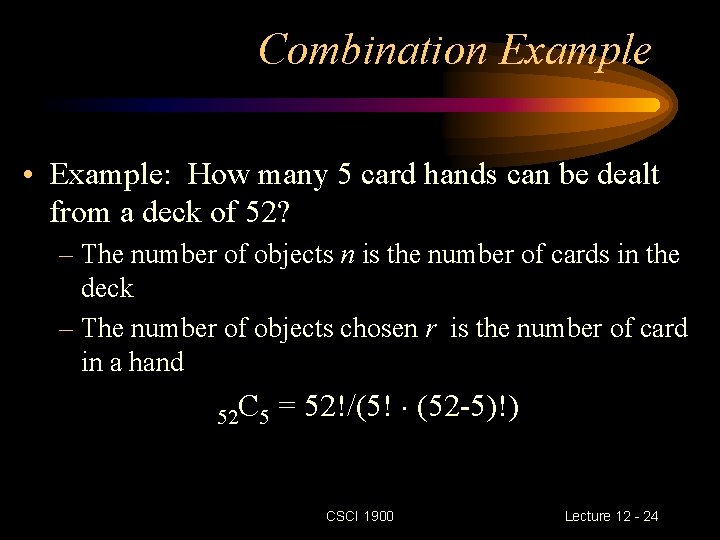
Combination Example • Example: How many 5 card hands can be dealt from a deck of 52? – The number of objects n is the number of cards in the deck – The number of objects chosen r is the number of card in a hand 52 C 5 = 52!/(5! (52 -5)!) CSCI 1900 Lecture 12 - 24
Order Doesn’t Matters Duplicates Are Allowed CSCI 1900 Lecture 12 - 25
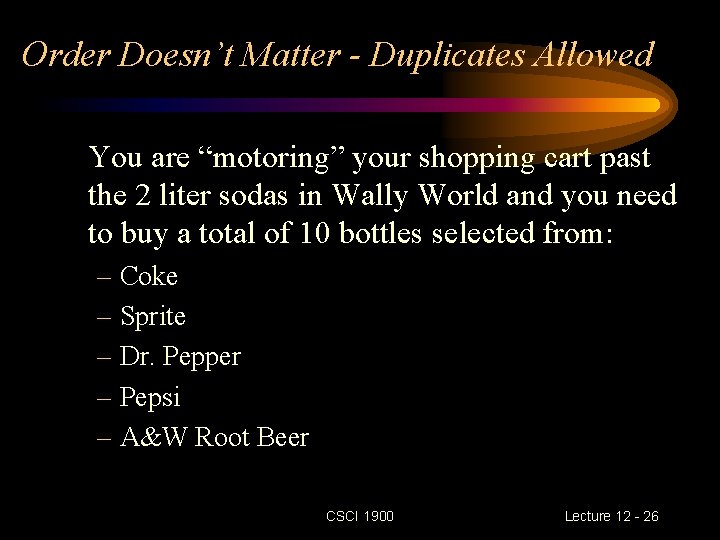
Order Doesn’t Matter - Duplicates Allowed You are “motoring” your shopping cart past the 2 liter sodas in Wally World and you need to buy a total of 10 bottles selected from: – Coke – Sprite – Dr. Pepper – Pepsi – A&W Root Beer CSCI 1900 Lecture 12 - 26
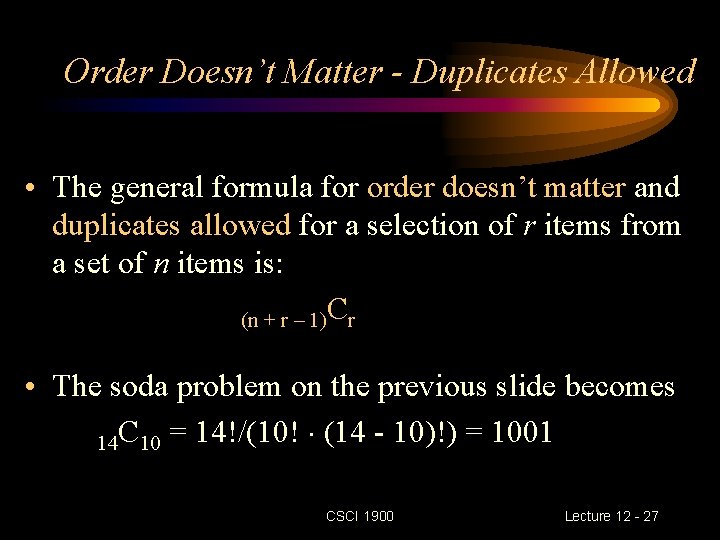
Order Doesn’t Matter - Duplicates Allowed • The general formula for order doesn’t matter and duplicates allowed for a selection of r items from a set of n items is: (n + r – 1)Cr • The soda problem on the previous slide becomes 14 C 10 = 14!/(10! (14 - 10)!) = 1001 CSCI 1900 Lecture 12 - 27
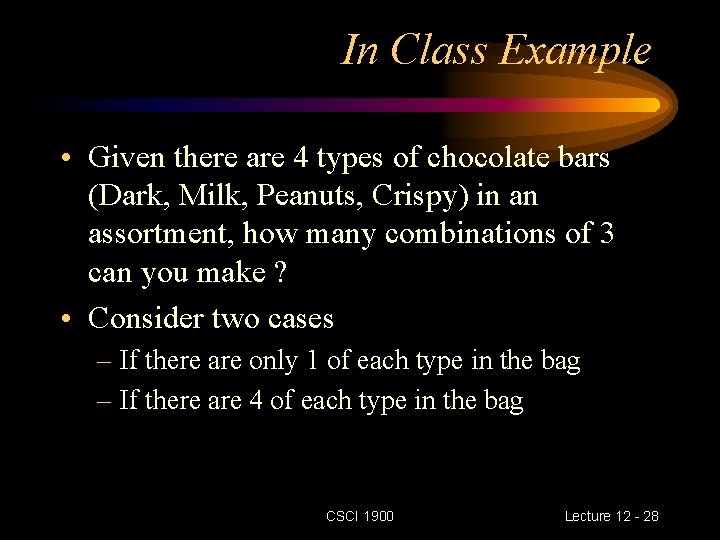
In Class Example • Given there are 4 types of chocolate bars (Dark, Milk, Peanuts, Crispy) in an assortment, how many combinations of 3 can you make ? • Consider two cases – If there are only 1 of each type in the bag – If there are 4 of each type in the bag CSCI 1900 Lecture 12 - 28
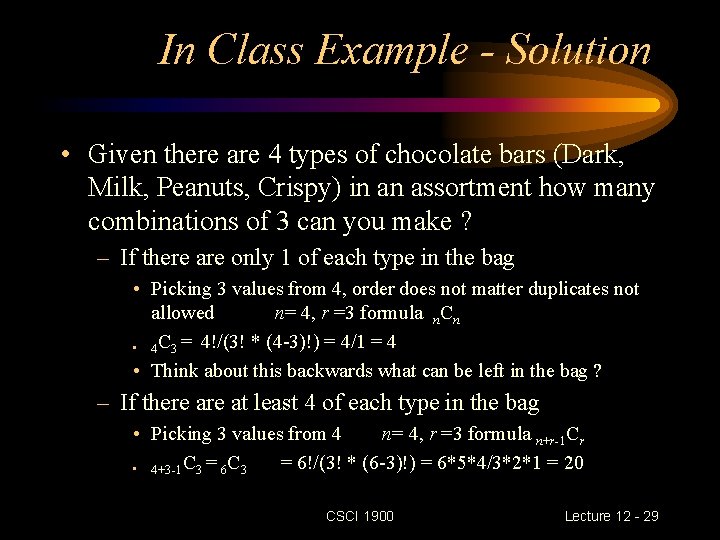
In Class Example - Solution • Given there are 4 types of chocolate bars (Dark, Milk, Peanuts, Crispy) in an assortment how many combinations of 3 can you make ? – If there are only 1 of each type in the bag • Picking 3 values from 4, order does not matter duplicates not allowed n= 4, r =3 formula n. Cn • 4 C 3 = 4!/(3! * (4 -3)!) = 4/1 = 4 • Think about this backwards what can be left in the bag ? – If there at least 4 of each type in the bag • Picking 3 values from 4 n= 4, r =3 formula n+r-1 Cr = 6!/(3! * (6 -3)!) = 6*5*4/3*2*1 = 20 • 4+3 -1 C 3 = 6 C 3 CSCI 1900 Lecture 12 - 29
Key Concepts Summary • Learned to count sequences where – Any order, duplicates allowed – Any order, no duplicates allowed – Order matters, no duplicates allowed CSCI 1900 Lecture 12 - 30
- Slides: 30