
Lecture 12 Markets for factor inputs Main questions


- Slides: 19
Lecture 12 Markets for factor inputs
Main questions 1. Competitive factor markets 1. 1. The Demand for Inputs 1. 2. Supply of Inputs 2. Equilibrium in a Market for Inputs 2. 1. Labour market 2. 2. Land market 2. 3. Capital market
Key Words n derived demand – похідний попит n value of marginal product (VMP) or the marginal revenue product (MRP) вартість граничного продукту
The factor markets allocate the factors of production among the various producers/sellers. In a market economy, the inputs (land (R), labour (L), capital (K) and entrepreneurial ability) are owned by individual agents who make decisions about the amount of each input they want to supply. The decisions of the producers determine the demand for the inputs.
Тhe demand for factors of production n is a "derived demand" – that is, it is derived from the demand for the consumer goods. For these factors of production are demanded in order to use them in producing consumer goods
The price elasticity of demand for a resource depends on: - the price elasticity of demand for the final product; - this resource share of the firm’s total costs - close substitutes for the resource - time period is considered
Determinants of resource demand: n the price of the final product rises n the productivity of the resource n the number of buyers n the price of a substitute resource n the price of a complementary resource
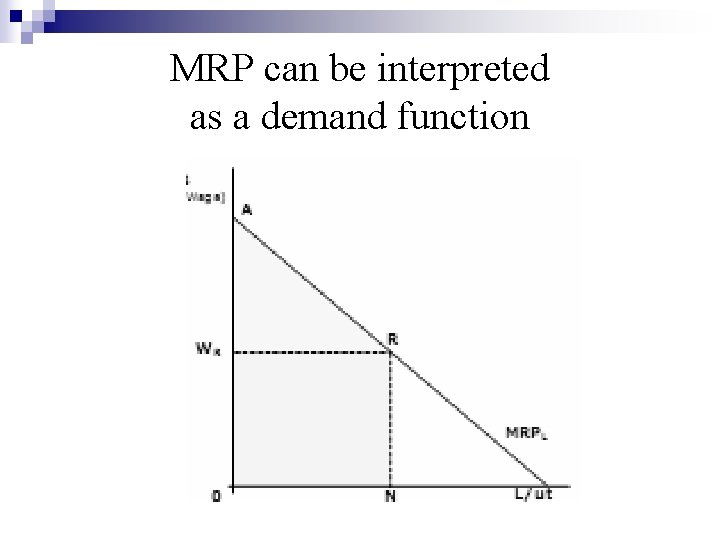
The demand for an input n can be derived by using the production function (the MP for an input) and the price of the good. n That is MPF multiply by Price of the good. This value called the value of marginal product (VMP) or the marginal revenue product (MRP).
The marginal revenue product n is a measure of the value of the output that is attributable to each unit of the input. The MRP of each unit of input is the maximum an employer would be willing to pay each unit of input.
MRP can be interpreted as a demand function
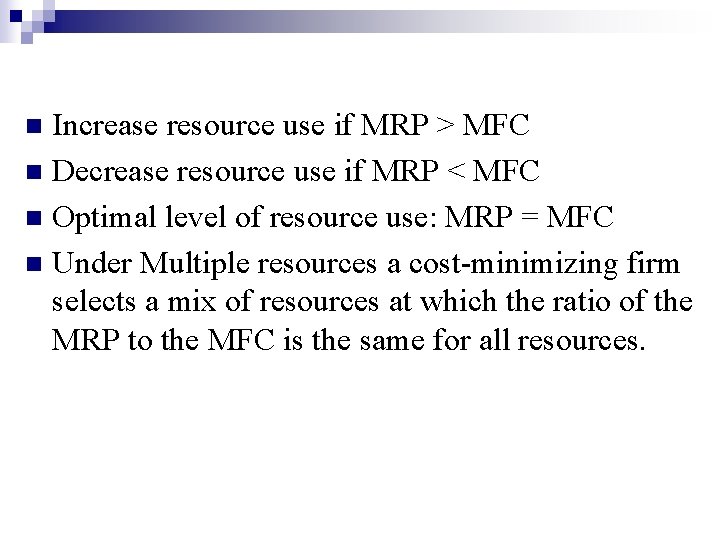
Increase resource use if MRP > MFC n Decrease resource use if MRP < MFC n Optimal level of resource use: MRP = MFC n Under Multiple resources a cost-minimizing firm selects a mix of resources at which the ratio of the MRP to the MFC is the same for all resources. n
Supply of Inputs The individual agent who owns the input will decide how much of a factor they want to offer for sale at each price offered for the input
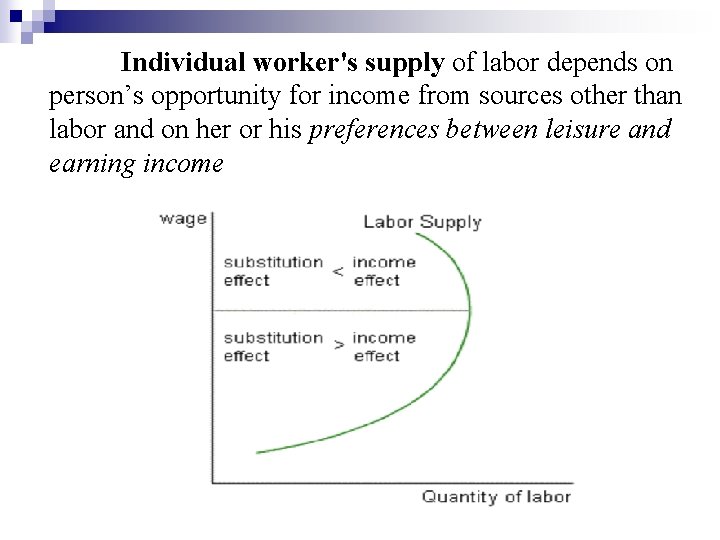
Individual worker's supply of labor depends on person’s opportunity for income from sources other than labor and on her or his preferences between leisure and earning income
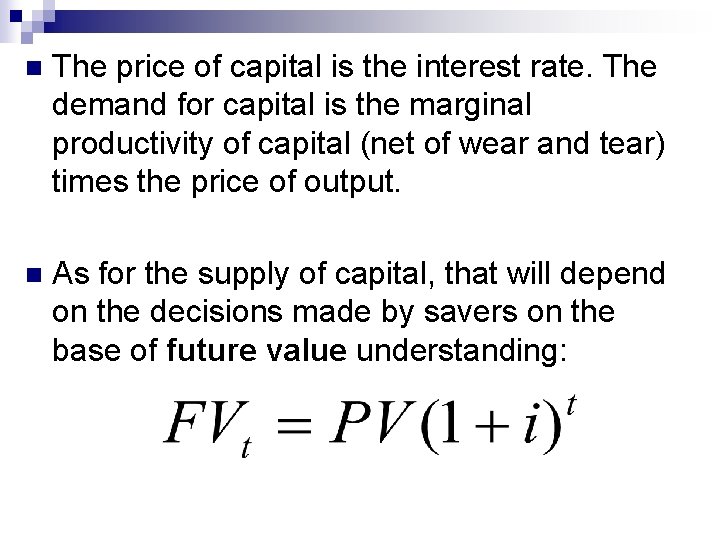
n The price of capital is the interest rate. The demand for capital is the marginal productivity of capital (net of wear and tear) times the price of output. n As for the supply of capital, that will depend on the decisions made by savers on the base of future value understanding:
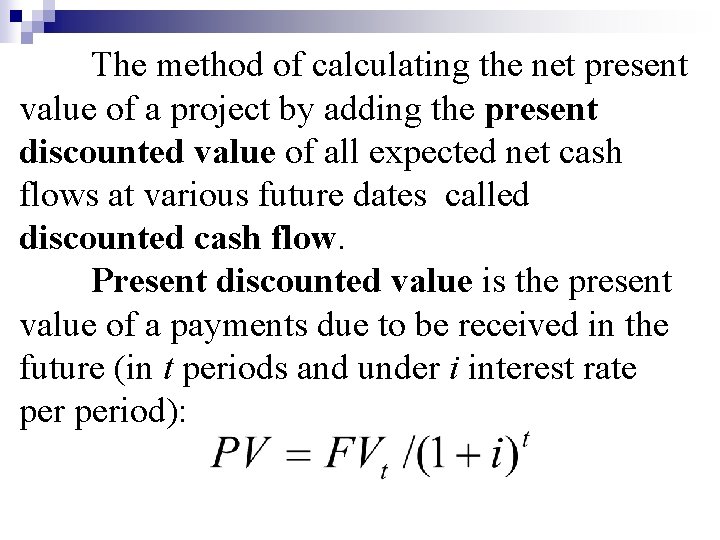
The method of calculating the net present value of a project by adding the present discounted value of all expected net cash flows at various future dates called discounted cash flow. Present discounted value is the present value of a payments due to be received in the future (in t periods and under i interest rate period):
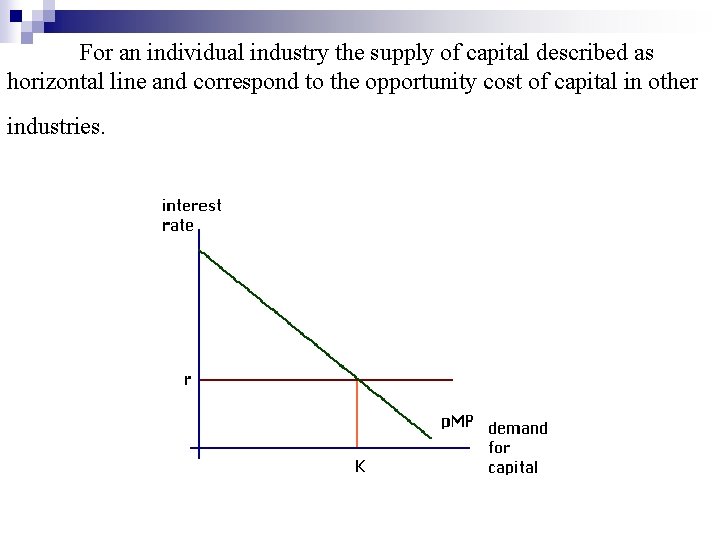
For an individual industry the supply of capital described as horizontal line and correspond to the opportunity cost of capital in other industries.
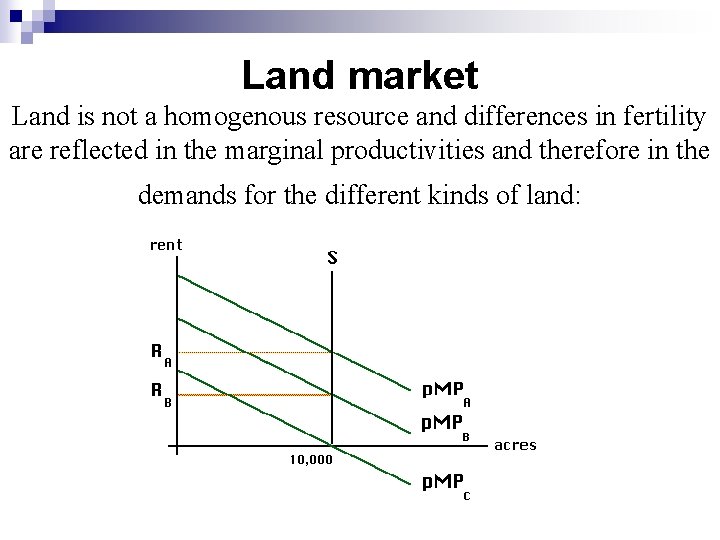
Land market Land is not a homogenous resource and differences in fertility are reflected in the marginal productivities and therefore in the demands for the different kinds of land:
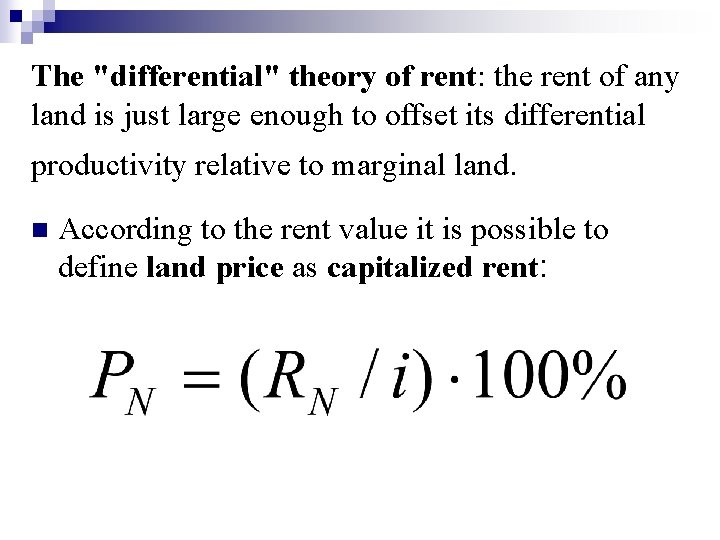
The "differential" theory of rent: the rent of any land is just large enough to offset its differential productivity relative to marginal land. n According to the rent value it is possible to define land price as capitalized rent:
The end Thank you for attention