
Lecture 12 Introduction to Bayesian Networks Tuesday 08
Lecture 12 Introduction to Bayesian Networks Tuesday 08 October 2002 William H. Hsu Department of Computing and Information Sciences, KSU http: //www. kddresearch. org http: //www. cis. ksu. edu/~bhsu Readings: Section 6. 11, Mitchell Chapter 15, Russell and Norvig “Bayesian Networks Without Tears”, Charniak CIS 732: Machine Learning and Pattern Recognition Kansas State University Department of Computing and Information Sciences

Lecture Outline • Readings: 6. 11, Mitchell; Chapter 15, Russell and Norvig; Charniak Tutorial • Suggested Exercises: 6. 6, Mitchell; 15. 2 Russell and Norvig • This Week’s Review: “A Theory of Inferred Causation”, Pearl and Verma • Graphical Models of Probability – Bayesian networks: introduction • Definition and basic principles • Conditional independence and causal Markovity – Inference and learning using Bayesian networks • Acquiring and applying distributions (conditional probability tables) • Learning tree dependent distributions and polytrees • Learning Distributions for Networks with Specified Structure – Gradient learning – Maximum weight spanning tree (MWST) algorithm for tree-structured networks • Reasoning under Uncertainty: Applications and Augmented Models • Next Lecture: (More on) Learning Bayesian Network Structure CIS 732: Machine Learning and Pattern Recognition Kansas State University Department of Computing and Information Sciences
Graphical Models of Probability Distributions • Idea – Want: model that can be used to perform inference – Desired properties • Ability to represent functional, logical, stochastic relationships • Express uncertainty • Observe the laws of probability • Tractable inference when possible • Can be learned from data • Additional Desiderata – Ability to incorporate knowledge • Knowledge acquisition and elicitation: in format familiar to domain experts • Language of subjective probabilities and relative probabilities – Support decision making • Represent utilities (cost or value of information, state) • Probability theory + utility theory = decision theory – Ability to reason over time (temporal models) CIS 732: Machine Learning and Pattern Recognition Kansas State University Department of Computing and Information Sciences
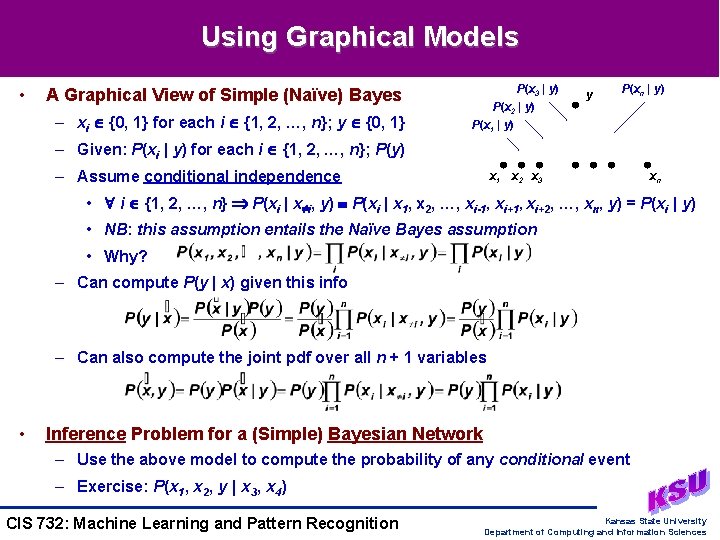
Using Graphical Models • A Graphical View of Simple (Naïve) Bayes – xi {0, 1} for each i {1, 2, …, n}; y {0, 1} P(x 3 | y) P(x 2 | y) P(x 1 | y) y P(xn | y) – Given: P(xi | y) for each i {1, 2, …, n}; P(y) – Assume conditional independence x 1 x 2 x 3 xn • i {1, 2, …, n} P(xi | x i, y) P(xi | x 1, x 2, …, xi-1, xi+2, …, xn, y) = P(xi | y) • NB: this assumption entails the Naïve Bayes assumption • Why? – Can compute P(y | x) given this info – Can also compute the joint pdf over all n + 1 variables • Inference Problem for a (Simple) Bayesian Network – Use the above model to compute the probability of any conditional event – Exercise: P(x 1, x 2, y | x 3, x 4) CIS 732: Machine Learning and Pattern Recognition Kansas State University Department of Computing and Information Sciences
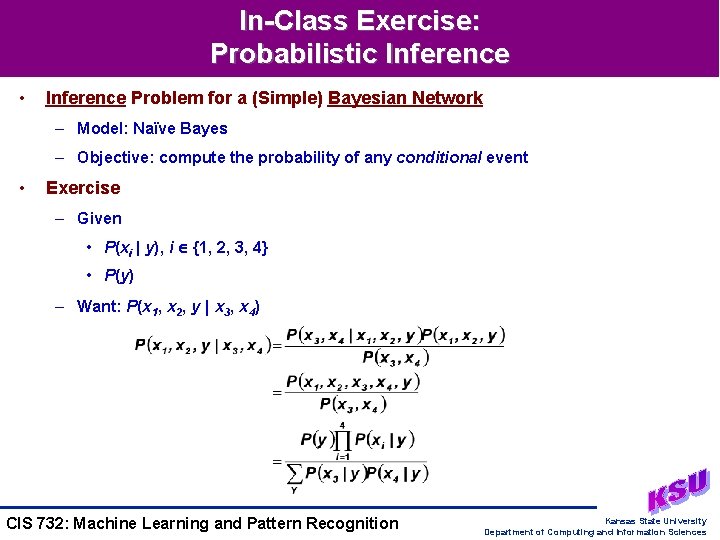
In-Class Exercise: Probabilistic Inference • Inference Problem for a (Simple) Bayesian Network – Model: Naïve Bayes – Objective: compute the probability of any conditional event • Exercise – Given • P(xi | y), i {1, 2, 3, 4} • P(y) – Want: P(x 1, x 2, y | x 3, x 4) CIS 732: Machine Learning and Pattern Recognition Kansas State University Department of Computing and Information Sciences
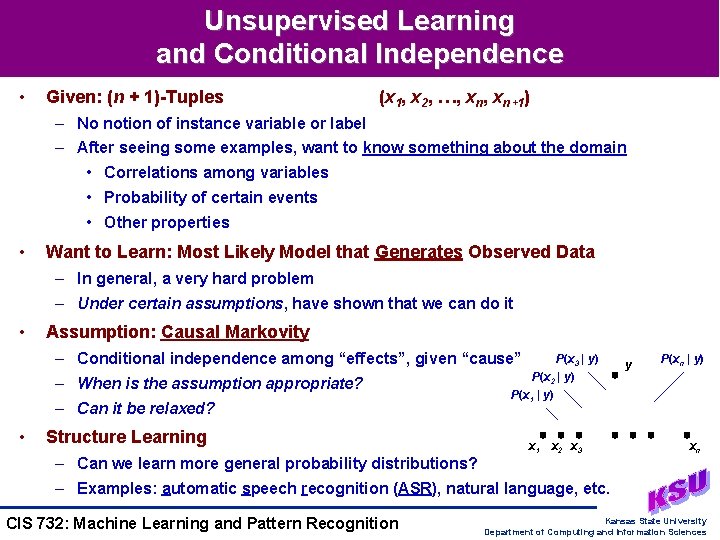
Unsupervised Learning and Conditional Independence • Given: (n + 1)-Tuples (x 1, x 2, …, xn+1) – No notion of instance variable or label – After seeing some examples, want to know something about the domain • Correlations among variables • Probability of certain events • Other properties • Want to Learn: Most Likely Model that Generates Observed Data – In general, a very hard problem – Under certain assumptions, have shown that we can do it • Assumption: Causal Markovity – Conditional independence among “effects”, given “cause” – When is the assumption appropriate? – Can it be relaxed? • Structure Learning – Can we learn more general probability distributions? P(x 3 | y) P(x 2 | y) P(x 1 | y) x 1 x 2 x 3 y P(xn | y) xn – Examples: automatic speech recognition (ASR), natural language, etc. CIS 732: Machine Learning and Pattern Recognition Kansas State University Department of Computing and Information Sciences
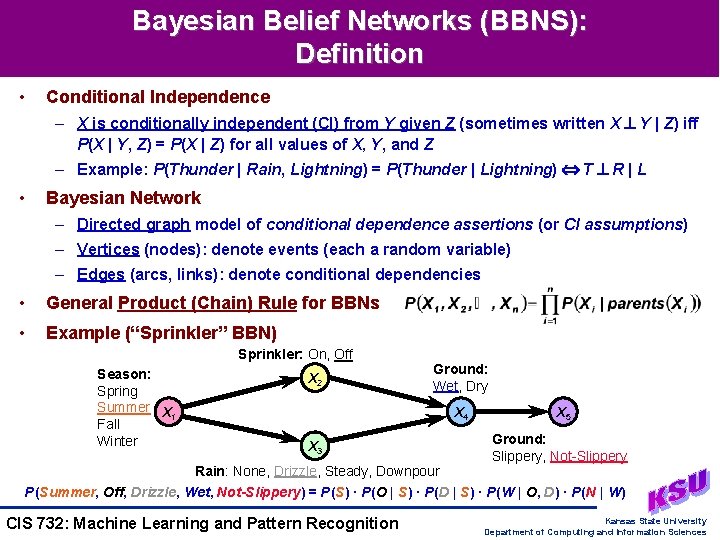
Bayesian Belief Networks (BBNS): Definition • Conditional Independence – X is conditionally independent (CI) from Y given Z (sometimes written X Y | Z) iff P(X | Y, Z) = P(X | Z) for all values of X, Y, and Z – Example: P(Thunder | Rain, Lightning) = P(Thunder | Lightning) T R | L • Bayesian Network – Directed graph model of conditional dependence assertions (or CI assumptions) – Vertices (nodes): denote events (each a random variable) – Edges (arcs, links): denote conditional dependencies • General Product (Chain) Rule for BBNs • Example (“Sprinkler” BBN) Sprinkler: On, Off Season: Spring Summer X 1 Fall Winter X 2 Ground: Wet, Dry X 4 X 3 Rain: None, Drizzle, Steady, Downpour X 5 Ground: Slippery, Not-Slippery P(Summer, Off, Drizzle, Wet, Not-Slippery) = P(S) · P(O | S) · P(D | S) · P(W | O, D) · P(N | W) CIS 732: Machine Learning and Pattern Recognition Kansas State University Department of Computing and Information Sciences
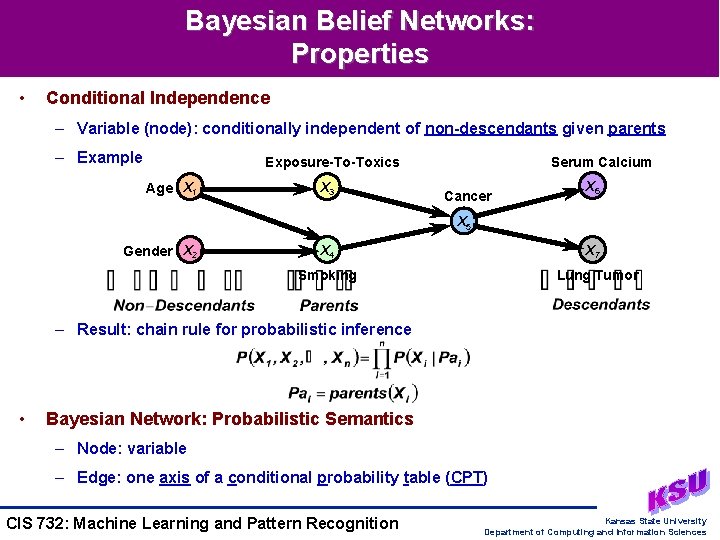
Bayesian Belief Networks: Properties • Conditional Independence – Variable (node): conditionally independent of non-descendants given parents – Example Exposure-To-Toxics Age X 1 X 3 Serum Calcium Cancer X 6 X 5 Gender X 2 X 4 X 7 Smoking Lung Tumor – Result: chain rule for probabilistic inference • Bayesian Network: Probabilistic Semantics – Node: variable – Edge: one axis of a conditional probability table (CPT) CIS 732: Machine Learning and Pattern Recognition Kansas State University Department of Computing and Information Sciences
Bayesian Belief Networks: Inference • Problem Definition – Given • Bayesian network with specified CPTs • Observed values for some nodes in network – Return: inferred (probabilities of) values for query node(s) • Implementation – Bayesian network contains all information needed for this inference • If only one variable with unknown value, easy to infer it • In general case, problem is intractable (NP-hard: reduction to 3 -CNF-SAT) – In practice, can succeed in many cases using different methods • Exact inference: work well for some network structures • Monte Carlo: “simulate” network to randomly calculate approximate solutions – Key machine learning issues • Feasible to elicit this information or learn it from data? • How to learn structure that makes inference more tractable? CIS 732: Machine Learning and Pattern Recognition Kansas State University Department of Computing and Information Sciences
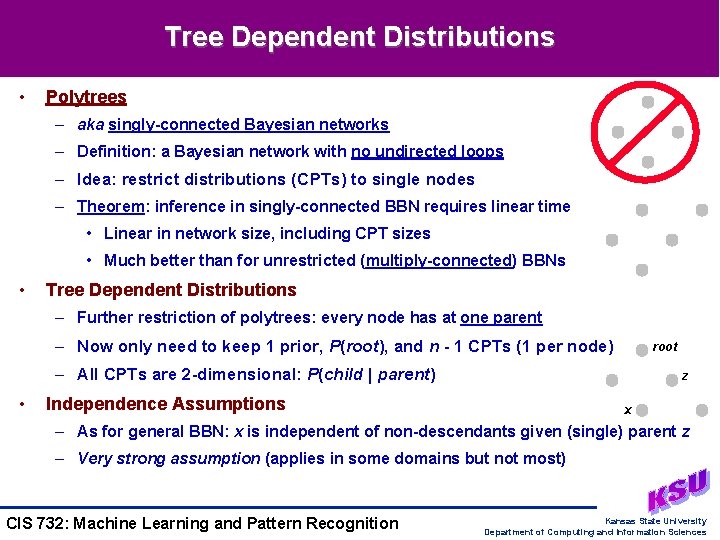
Tree Dependent Distributions • Polytrees – aka singly-connected Bayesian networks – Definition: a Bayesian network with no undirected loops – Idea: restrict distributions (CPTs) to single nodes – Theorem: inference in singly-connected BBN requires linear time • Linear in network size, including CPT sizes • Much better than for unrestricted (multiply-connected) BBNs • Tree Dependent Distributions – Further restriction of polytrees: every node has at one parent – Now only need to keep 1 prior, P(root), and n - 1 CPTs (1 per node) root – All CPTs are 2 -dimensional: P(child | parent) • z Independence Assumptions x – As for general BBN: x is independent of non-descendants given (single) parent z – Very strong assumption (applies in some domains but not most) CIS 732: Machine Learning and Pattern Recognition Kansas State University Department of Computing and Information Sciences
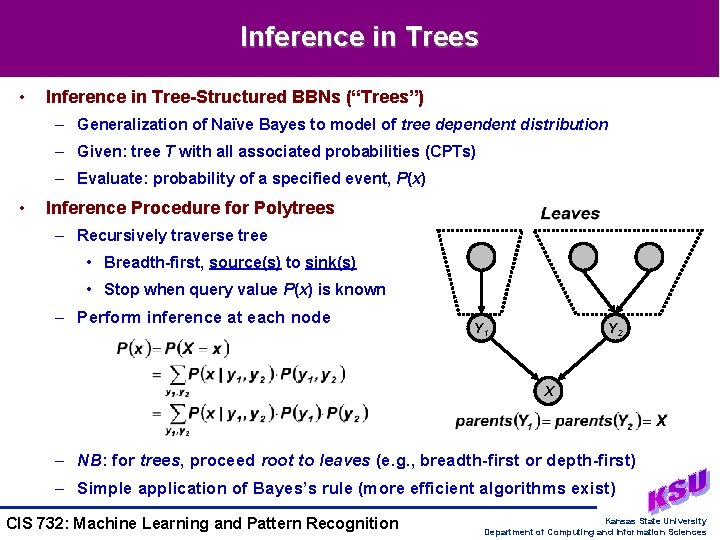
Inference in Trees • Inference in Tree-Structured BBNs (“Trees”) – Generalization of Naïve Bayes to model of tree dependent distribution – Given: tree T with all associated probabilities (CPTs) – Evaluate: probability of a specified event, P(x) • Inference Procedure for Polytrees – Recursively traverse tree • Breadth-first, source(s) to sink(s) • Stop when query value P(x) is known – Perform inference at each node Y 1 Y 2 X – NB: for trees, proceed root to leaves (e. g. , breadth-first or depth-first) – Simple application of Bayes’s rule (more efficient algorithms exist) CIS 732: Machine Learning and Pattern Recognition Kansas State University Department of Computing and Information Sciences
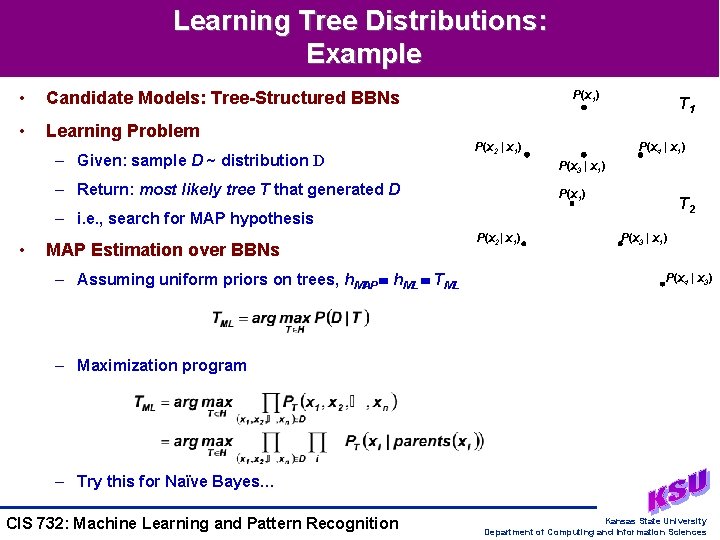
Learning Tree Distributions: Example • Candidate Models: Tree-Structured BBNs • Learning Problem – Given: sample D ~ distribution D P(x 1) P(x 2 | x 1) T 1 P(x 4 | x 1) P(x 3 | x 1) – Return: most likely tree T that generated D P(x 1) T 2 – i. e. , search for MAP hypothesis • MAP Estimation over BBNs – Assuming uniform priors on trees, h. MAP h. ML TML P(x 2| x 1) P(x 3 | x 1) P(x 4 | x 3) – Maximization program – Try this for Naïve Bayes… CIS 732: Machine Learning and Pattern Recognition Kansas State University Department of Computing and Information Sciences
![In-Class Exercise: Learning Distributions [1] • Input: D {1011, 1001, 0100} ~ D •](http://slidetodoc.com/presentation_image_h/227e8f580ee7ecb8e46bfbd88cb4e7db/image-13.jpg "In-Class Exercise: Learning Distributions [1] • Input: D {1011, 1001, 0100} ~ D •")
In-Class Exercise: Learning Distributions [1] • Input: D {1011, 1001, 0100} ~ D • CPT for P 1 P(x 1) P(x 2 | x 1) T P(x 4 | x 1) P(x 3 | x 1) • CPT for P 2 • CPT for P 3 • Candidate Models (Trees): h 1 P 1, h 2 T(P 2), h 3 T(P 3) • Tree-Structured BBN Learning CIS 732: Machine Learning and Pattern Recognition Kansas State University Department of Computing and Information Sciences
![In-Class Exercise: Learning Tree Distributions [2] • Input Data: D {1011, 1001, 0100} •](http://slidetodoc.com/presentation_image_h/227e8f580ee7ecb8e46bfbd88cb4e7db/image-14.jpg "In-Class Exercise: Learning Tree Distributions [2] • Input Data: D {1011, 1001, 0100} •")
In-Class Exercise: Learning Tree Distributions [2] • Input Data: D {1011, 1001, 0100} • Candidate Models: CPTs for Table (T 1), T 2, T 3 • Results: Likelihood Estimation – P(D | T 1) = P(1011 | T 1) · P(1011 | T 1) = 0. 0 · 0. 1 = 0. 0 – P(D | T 2) = P(1011 | T 2) · P(1001 | T 2) · P(0100 | T 2) • P(1011 | T 2) = P(x 4 = 1) · P(x 1 = 1 | x 4 = 1) · P(x 2 = 0 | x 4 = 1) · P(xe = 1 | x 4 = 1) = 1/2 · 1/3 · 5/6 = 5/72 • P(1001 | T 2) = 1/2 · 2/3 · 5/6 = 10/72 • P(0100 | T 2) = 1/2 · 2/3 · 5/6 = 10/72 • P(D | T 2) = 500 / 373248 0. 0013 – P(D | T 3) = 1/27 – Likelihood (T 1) < Likelihood (T 2) < Likelihood (T 3) • Notes – Conclusion: of candidate models, T 3 is most likely to have produced D – Looked at 3 fixed distributions (NB and T, a tree with fixed structure) CIS 732: Machine Learning and Pattern Recognition Kansas State University Department of Computing and Information Sciences
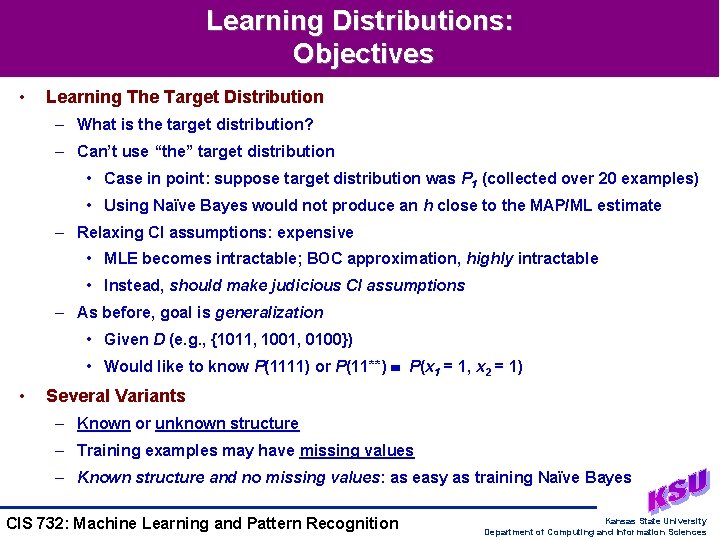
Learning Distributions: Objectives • Learning The Target Distribution – What is the target distribution? – Can’t use “the” target distribution • Case in point: suppose target distribution was P 1 (collected over 20 examples) • Using Naïve Bayes would not produce an h close to the MAP/ML estimate – Relaxing CI assumptions: expensive • MLE becomes intractable; BOC approximation, highly intractable • Instead, should make judicious CI assumptions – As before, goal is generalization • Given D (e. g. , {1011, 1001, 0100}) • Would like to know P(1111) or P(11**) P(x 1 = 1, x 2 = 1) • Several Variants – Known or unknown structure – Training examples may have missing values – Known structure and no missing values: as easy as training Naïve Bayes CIS 732: Machine Learning and Pattern Recognition Kansas State University Department of Computing and Information Sciences
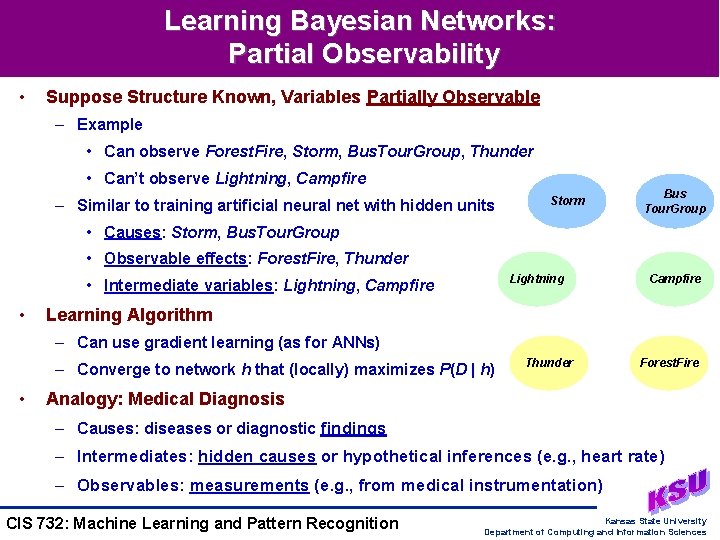
Learning Bayesian Networks: Partial Observability • Suppose Structure Known, Variables Partially Observable – Example • Can observe Forest. Fire, Storm, Bus. Tour. Group, Thunder • Can’t observe Lightning, Campfire – Similar to training artificial neural net with hidden units Storm Bus Tour. Group • Causes: Storm, Bus. Tour. Group • Observable effects: Forest. Fire, Thunder Lightning • Intermediate variables: Lightning, Campfire • Campfire Learning Algorithm – Can use gradient learning (as for ANNs) – Converge to network h that (locally) maximizes P(D | h) • Thunder Forest. Fire Analogy: Medical Diagnosis – Causes: diseases or diagnostic findings – Intermediates: hidden causes or hypothetical inferences (e. g. , heart rate) – Observables: measurements (e. g. , from medical instrumentation) CIS 732: Machine Learning and Pattern Recognition Kansas State University Department of Computing and Information Sciences
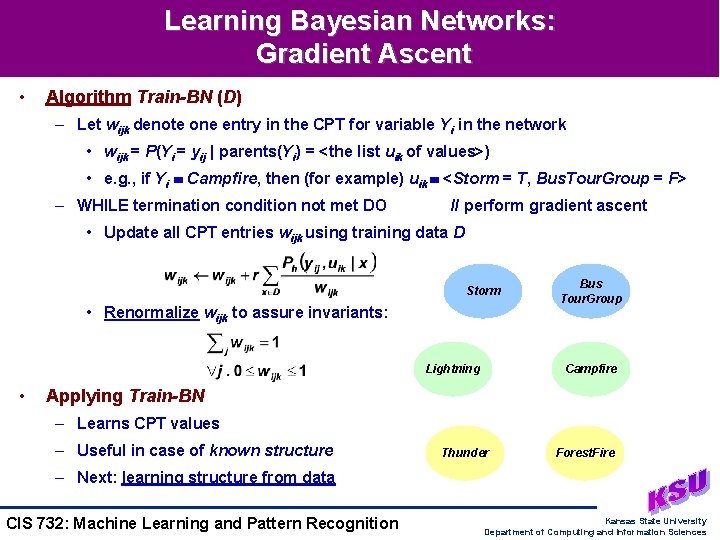
Learning Bayesian Networks: Gradient Ascent • Algorithm Train-BN (D) – Let wijk denote one entry in the CPT for variable Yi in the network • wijk = P(Yi = yij | parents(Yi) = <the list uik of values>) • e. g. , if Yi Campfire, then (for example) uik <Storm = T, Bus. Tour. Group = F> – WHILE termination condition not met DO // perform gradient ascent • Update all CPT entries wijk using training data D Storm • Renormalize wijk to assure invariants: Lightning • Bus Tour. Group Campfire Applying Train-BN – Learns CPT values – Useful in case of known structure Thunder Forest. Fire – Next: learning structure from data CIS 732: Machine Learning and Pattern Recognition Kansas State University Department of Computing and Information Sciences
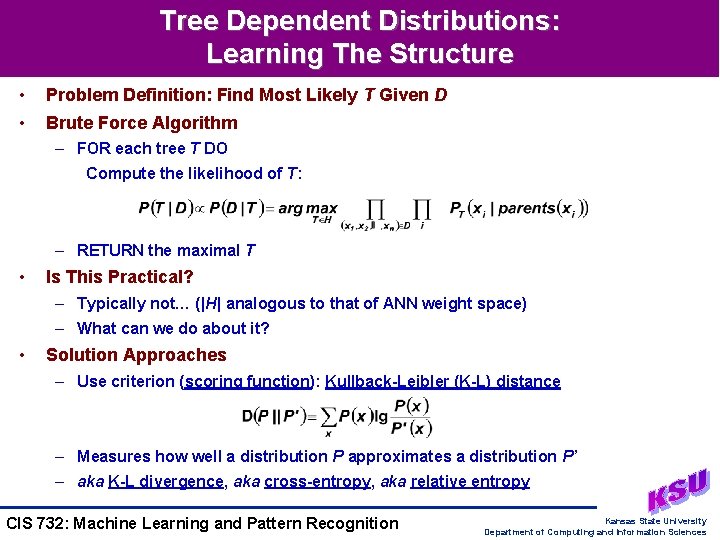
Tree Dependent Distributions: Learning The Structure • Problem Definition: Find Most Likely T Given D • Brute Force Algorithm – FOR each tree T DO Compute the likelihood of T: – RETURN the maximal T • Is This Practical? – Typically not… (|H| analogous to that of ANN weight space) – What can we do about it? • Solution Approaches – Use criterion (scoring function): Kullback-Leibler (K-L) distance – Measures how well a distribution P approximates a distribution P’ – aka K-L divergence, aka cross-entropy, aka relative entropy CIS 732: Machine Learning and Pattern Recognition Kansas State University Department of Computing and Information Sciences
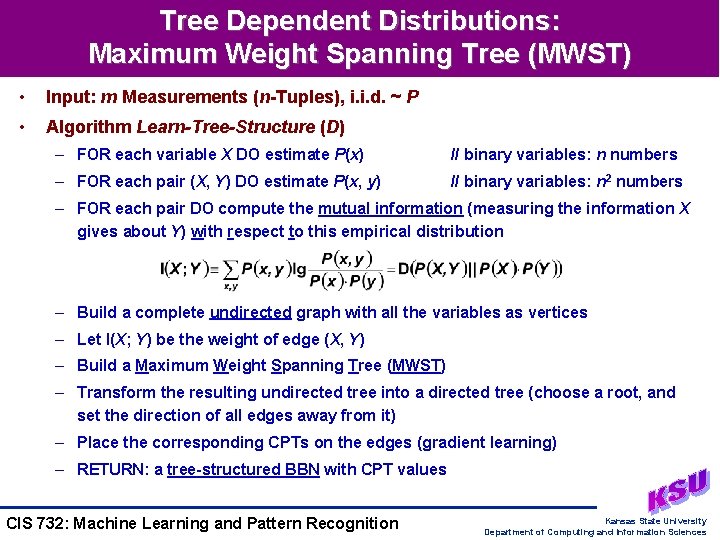
Tree Dependent Distributions: Maximum Weight Spanning Tree (MWST) • Input: m Measurements (n-Tuples), i. i. d. ~ P • Algorithm Learn-Tree-Structure (D) – FOR each variable X DO estimate P(x) // binary variables: n numbers – FOR each pair (X, Y) DO estimate P(x, y) // binary variables: n 2 numbers – FOR each pair DO compute the mutual information (measuring the information X gives about Y) with respect to this empirical distribution – Build a complete undirected graph with all the variables as vertices – Let I(X; Y) be the weight of edge (X, Y) – Build a Maximum Weight Spanning Tree (MWST) – Transform the resulting undirected tree into a directed tree (choose a root, and set the direction of all edges away from it) – Place the corresponding CPTs on the edges (gradient learning) – RETURN: a tree-structured BBN with CPT values CIS 732: Machine Learning and Pattern Recognition Kansas State University Department of Computing and Information Sciences
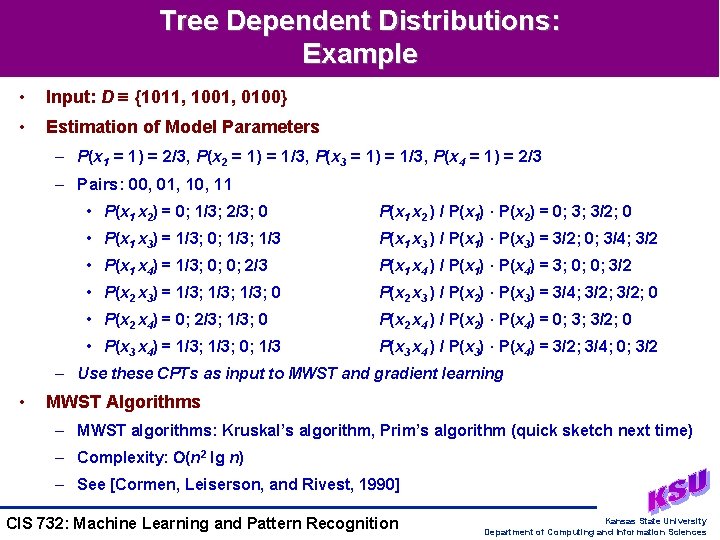
Tree Dependent Distributions: Example • Input: D {1011, 1001, 0100} • Estimation of Model Parameters – P(x 1 = 1) = 2/3, P(x 2 = 1) = 1/3, P(x 3 = 1) = 1/3, P(x 4 = 1) = 2/3 – Pairs: 00, 01, 10, 11 • P(x 1 x 2) = 0; 1/3; 2/3; 0 P(x 1 x 2 ) / P(x 1) · P(x 2) = 0; 3; 3/2; 0 • P(x 1 x 3) = 1/3; 0; 1/3 P(x 1 x 3 ) / P(x 1) · P(x 3) = 3/2; 0; 3/4; 3/2 • P(x 1 x 4) = 1/3; 0; 0; 2/3 P(x 1 x 4 ) / P(x 1) · P(x 4) = 3; 0; 0; 3/2 • P(x 2 x 3) = 1/3; 0 P(x 2 x 3 ) / P(x 2) · P(x 3) = 3/4; 3/2; 0 • P(x 2 x 4) = 0; 2/3; 1/3; 0 P(x 2 x 4 ) / P(x 2) · P(x 4) = 0; 3; 3/2; 0 • P(x 3 x 4) = 1/3; 0; 1/3 P(x 3 x 4 ) / P(x 3) · P(x 4) = 3/2; 3/4; 0; 3/2 – Use these CPTs as input to MWST and gradient learning • MWST Algorithms – MWST algorithms: Kruskal’s algorithm, Prim’s algorithm (quick sketch next time) – Complexity: (n 2 lg n) – See [Cormen, Leiserson, and Rivest, 1990] CIS 732: Machine Learning and Pattern Recognition Kansas State University Department of Computing and Information Sciences
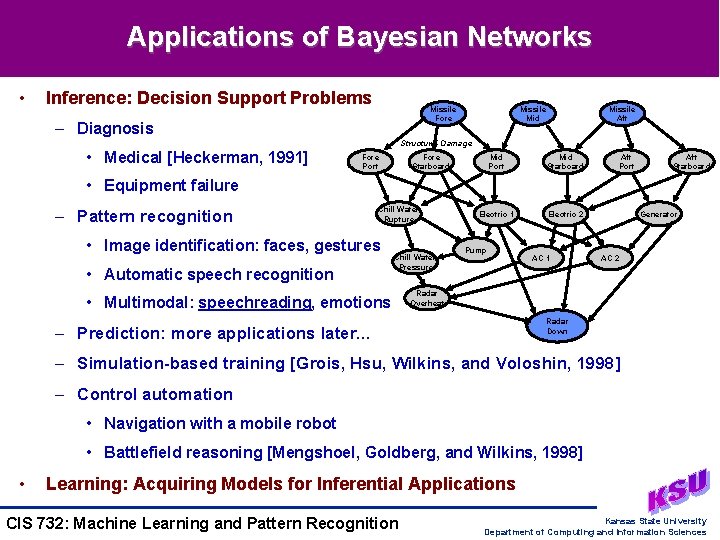
Applications of Bayesian Networks • Inference: Decision Support Problems Missile Fore – Diagnosis Missile Mid Missile Aft Structural Damage • Medical [Heckerman, 1991] Fore Port Fore Starboard Mid Port Mid Starboard Electric 1 Electric 2 Aft Port Aft Starboard • Equipment failure – Pattern recognition Chill Water Rupture • Image identification: faces, gestures • Automatic speech recognition Chill Water Pressure • Multimodal: speechreading, emotions Pump AC 1 Generator AC 2 Radar Overheat Radar Down – Prediction: more applications later… – Simulation-based training [Grois, Hsu, Wilkins, and Voloshin, 1998] – Control automation • Navigation with a mobile robot • Battlefield reasoning [Mengshoel, Goldberg, and Wilkins, 1998] • Learning: Acquiring Models for Inferential Applications CIS 732: Machine Learning and Pattern Recognition Kansas State University Department of Computing and Information Sciences
Related Work in Bayesian Networks • BBN Variants, Issues Not Covered Yet – Temporal models • Markov Decision Processes (MDPs) • Partially Observable Markov Decision Processes (POMDPs) • Useful in reinforcement learning – Influence diagrams • Decision theoretic model • Augments BBN with utility values and decision nodes – Unsupervised learning (EM, Auto. Class) – Feature (subset) selection: finding relevant attributes • Current Research Topics Not Addressed in This Course – Hidden variables (introduction of new variables not observed in data) – Incremental BBN learning: modifying network structure online (“on the fly”) – Structure learning for stochastic processes – Noisy-OR Bayesian networks: another simplifying restriction CIS 732: Machine Learning and Pattern Recognition Kansas State University Department of Computing and Information Sciences
Terminology • Graphical Models of Probability – Bayesian belief networks (BBNs) aka belief networks aka causal networks – Conditional independence, causal Markovity – Inference and learning using Bayesian networks • Representation of distributions: conditional probability tables (CPTs) • Learning polytrees (singly-connected BBNs) and tree-structured BBNs (trees) • BBN Inference – Type of probabilistic reasoning – Finds answer to query about P(x) - aka QA • Gradient Learning in BBNs – Known structure – Partial observability • Structure Learning for Trees – Kullback-Leibler distance (K-L divergence, cross-entropy, relative entropy) – Maximum weight spanning tree (MWST) algorithm CIS 732: Machine Learning and Pattern Recognition Kansas State University Department of Computing and Information Sciences
Summary Points • Graphical Models of Probability – Bayesian networks: introduction • Definition and basic principles • Conditional independence (causal Markovity) assumptions, tradeoffs – Inference and learning using Bayesian networks • Acquiring and applying CPTs • Searching the space of trees: max likelihood • Examples: Sprinkler, Cancer, Forest-Fire, generic tree learning • CPT Learning: Gradient Algorithm Train-BN • Structure Learning in Trees: MWST Algorithm Learn-Tree-Structure • Reasoning under Uncertainty: Applications and Augmented Models • Some Material From: http: //robotics. Stanford. EDU/~koller • Next Lecture: Read Heckerman Tutorial CIS 732: Machine Learning and Pattern Recognition Kansas State University Department of Computing and Information Sciences
- Slides: 24