
LECTURE 12 CONVERSATIONAL MAXIMS The condition of successful
- Slides: 14
LECTURE 12. CONVERSATIONAL MAXIMS
The condition of successful communication is the desire of its participants to communicate (inclination to cooperation). If there is no inclination and cooperation there may appear conflict communicative behavior. That’s why cooperation is the basic principle of communication. Here we follow the cooperative principle of Paul Grice says that when we communicate we assume, without realizing it, that we, and the people we are talking to, will be conversationally cooperative - we will cooperate to achieve mutual conversational ends. This conversational cooperation even works when we are not being cooperative socially. So, for example, we can be arguing with one another angrily and yet we will still cooperate quite a lot conversationally to achieve the argeement. This conversational cooperation manifests itself, according to Grice, in a number of conversational MAXIMS. These maxims look at first sight like rules, but they appear to be broken more often than grammatical or phonological rules are, for example, as we will see later, and this is why Grice uses the term ’maxim’ rather than ’rule’. Here are the four maxims (there may well be more) which Grice says we all try to adhere to in conversation.
CONVERSATIONAL MAXIMS Maxim of quantity (quantity of information) Give the most helpful amount of information. This maxim is a bit like: - not too much, not too little, but just right!
Maxim of quality (quality of information) Do not say what you believe to be false. It may seem at first sight that it would be simpler for this maxim to be ’Tell the truth’. But it is often difficult to be sure about what is true, and so Grice formulates this maxim in a way that, although it looks more complicated, is actually easier to follow.
Maxim of relation. Be relevant. Note that if you join a conversation you can't just begin to talk about whatever you like. You have to connect what you want to say (make it relevant) to what is already being talked about. For example, if everyone else is talking about their holidays and you want to talk about Spain, you'll need to connect the two topics together with a remark like 'I went on holiday to Spain last year. . . ' By the way, if, in an exam, you write an essay on a topic slightly different from the question asked you are likely to lose marks.
Maxim of manner Put what you say in the clearest, briefest, and most orderly manner. Good evidence for this maxim is what you get penalized for when you write essays. v. If you are vague or ambiguous (i. e. not clear) you can lose marks; vif you are overwordy you can lose marks (readers don't like having to read extra words when they don't have to); vif you do not present what you say in the most sensible order for your argument you can lose marks.
BREAKING THE MAXIMS We can VIOLATE them This means that we break the maxims surreptitiously, or covertly, so that other people do not know. If we violate the maxim of quality, we lie. If we violate the maxim of quantity, we do not give enough information Violating the maxims amounts to breaking them 'illegally', just as people who steal are guilty of laws concerning theft. As with laws, some maxim violations can be more serious than others. Lying in a court of law is disapproved, but 'white lies', small lies to keep the social peace, are often thought as acceptable.
We can FLOUT them If we FLOUT a maxim, we break it in such a way, so that it is obvious to all concerned that it has been broken (we do it intentionally to be disclosed). If this happens, then it is clear that the speaker is intending the hearer to infer some extra meaning over and above what is said (evidence for this is that people often say things like 'He said he was happy, but the way he said it implied he wasn't really'. Grice distinguishes what he calls 'utterer's meaning' and he refers to an utterer's meaning as an IMPLICATURE. So the implicature is what speakers have been referring to. To understand it a recipient should be able to read between lines. Essentially maxim-flouting is conversationally cooperative because all the participants in the conversation can see that a maxim has been broken on purpose by the speaker or writer in order to create an extra layer of meaning.
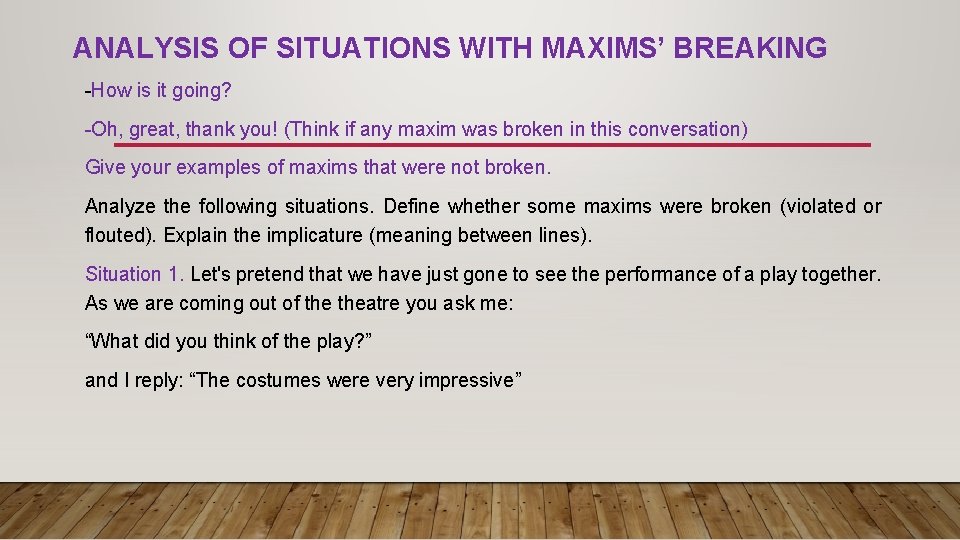
ANALYSIS OF SITUATIONS WITH MAXIMS’ BREAKING -How is it going? -Oh, great, thank you! (Think if any maxim was broken in this conversation) Give your examples of maxims that were not broken. Analyze the following situations. Define whether some maxims were broken (violated or flouted). Explain the implicature (meaning between lines). Situation 1. Let's pretend that we have just gone to see the performance of a play together. As we are coming out of theatre you ask me: “What did you think of the play? ” and I reply: “The costumes were very impressive”
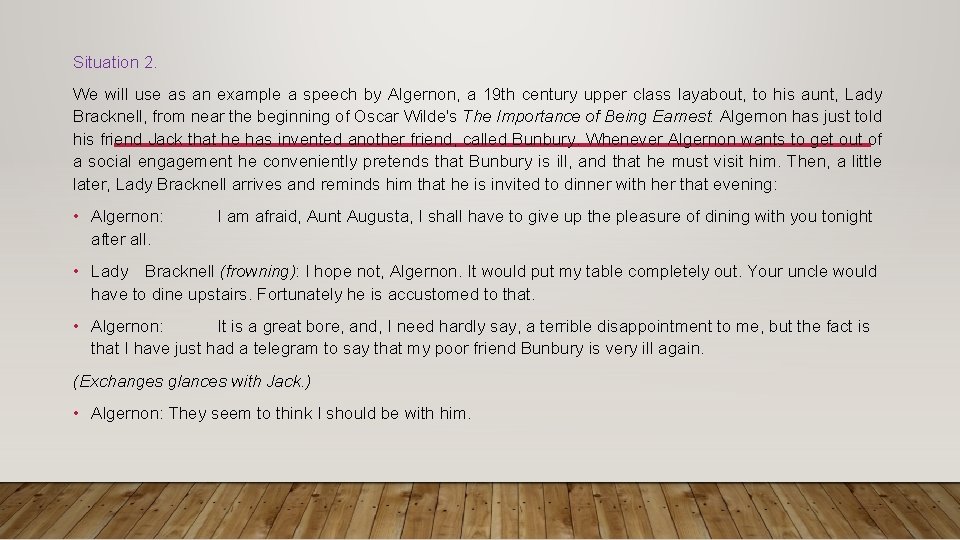
Situation 2. We will use as an example a speech by Algernon, a 19 th century upper class layabout, to his aunt, Lady Bracknell, from near the beginning of Oscar Wilde's The Importance of Being Earnest. Algernon has just told his friend Jack that he has invented another friend, called Bunbury. Whenever Algernon wants to get out of a social engagement he conveniently pretends that Bunbury is ill, and that he must visit him. Then, a little later, Lady Bracknell arrives and reminds him that he is invited to dinner with her that evening: • Algernon: after all. I am afraid, Aunt Augusta, I shall have to give up the pleasure of dining with you tonight • Lady Bracknell (frowning): I hope not, Algernon. It would put my table completely out. Your uncle would have to dine upstairs. Fortunately he is accustomed to that. • Algernon: It is a great bore, and, I need hardly say, a terrible disappointment to me, but the fact is that I have just had a telegram to say that my poor friend Bunbury is very ill again. (Exchanges glances with Jack. ) • Algernon: They seem to think I should be with him.
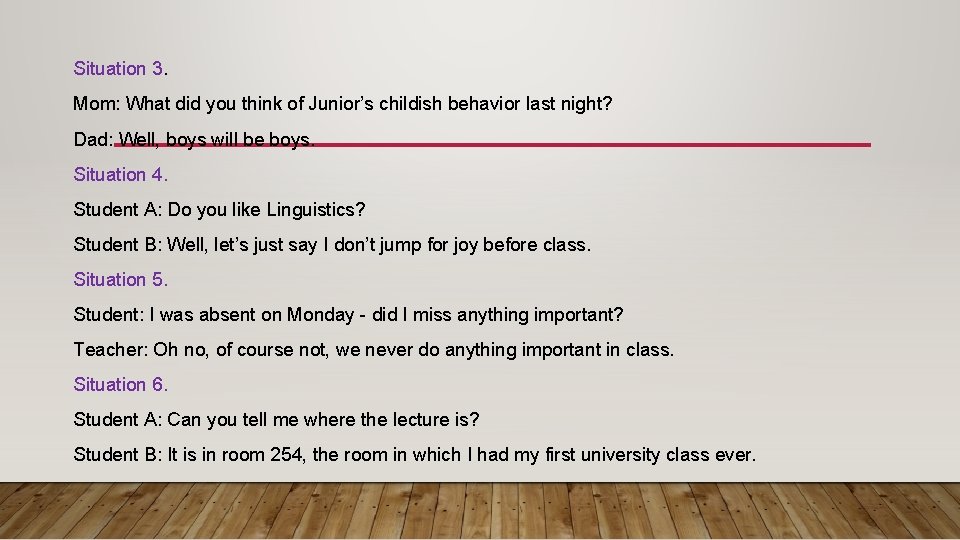
Situation 3. Mom: What did you think of Junior’s childish behavior last night? Dad: Well, boys will be boys. Situation 4. Student A: Do you like Linguistics? Student B: Well, let’s just say I don’t jump for joy before class. Situation 5. Student: I was absent on Monday - did I miss anything important? Teacher: Oh no, of course not, we never do anything important in class. Situation 6. Student A: Can you tell me where the lecture is? Student B: It is in room 254, the room in which I had my first university class ever.
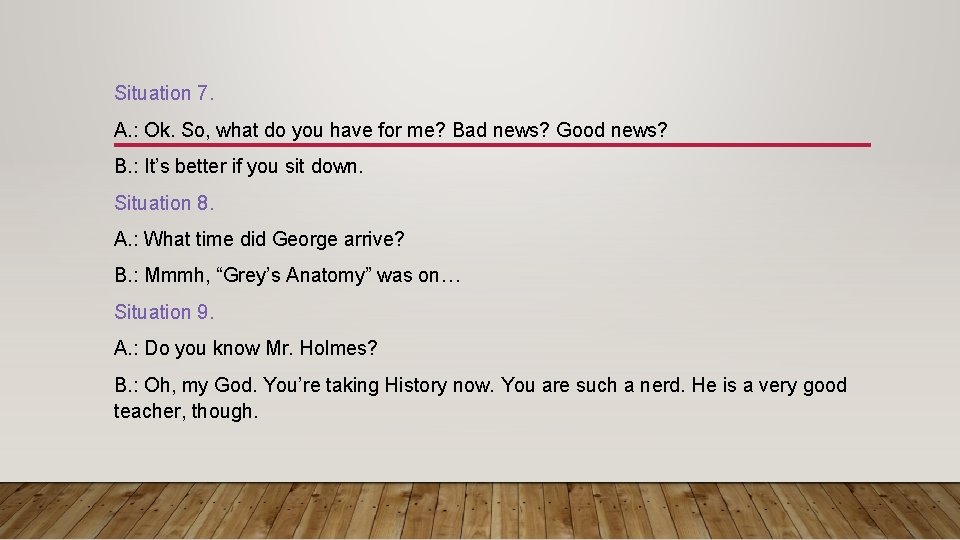
Situation 7. A. : Ok. So, what do you have for me? Bad news? Good news? B. : It’s better if you sit down. Situation 8. A. : What time did George arrive? B. : Mmmh, “Grey’s Anatomy” was on… Situation 9. A. : Do you know Mr. Holmes? B. : Oh, my God. You’re taking History now. You are such a nerd. He is a very good teacher, though.
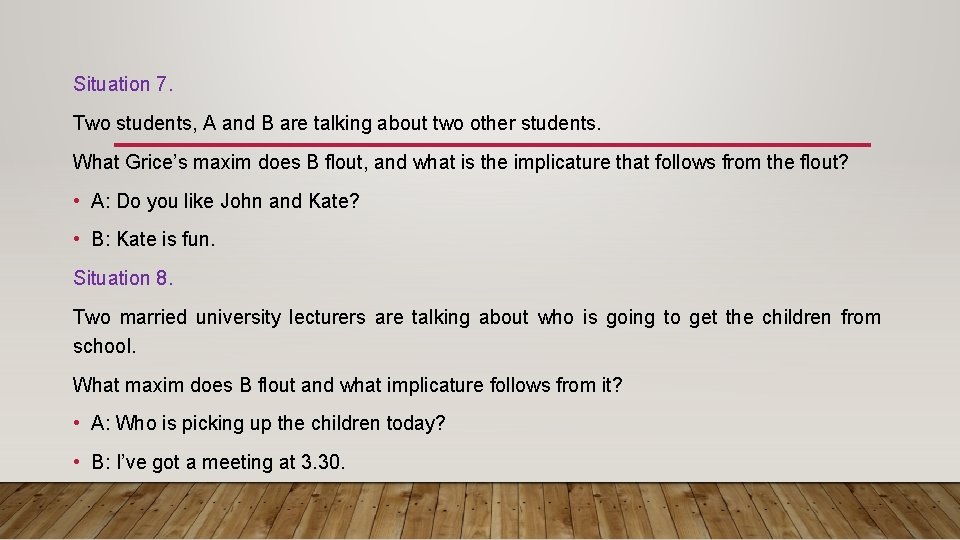
Situation 7. Two students, A and B are talking about two other students. What Grice’s maxim does B flout, and what is the implicature that follows from the flout? • A: Do you like John and Kate? • B: Kate is fun. Situation 8. Two married university lecturers are talking about who is going to get the children from school. What maxim does B flout and what implicature follows from it? • A: Who is picking up the children today? • B: I’ve got a meeting at 3. 30.
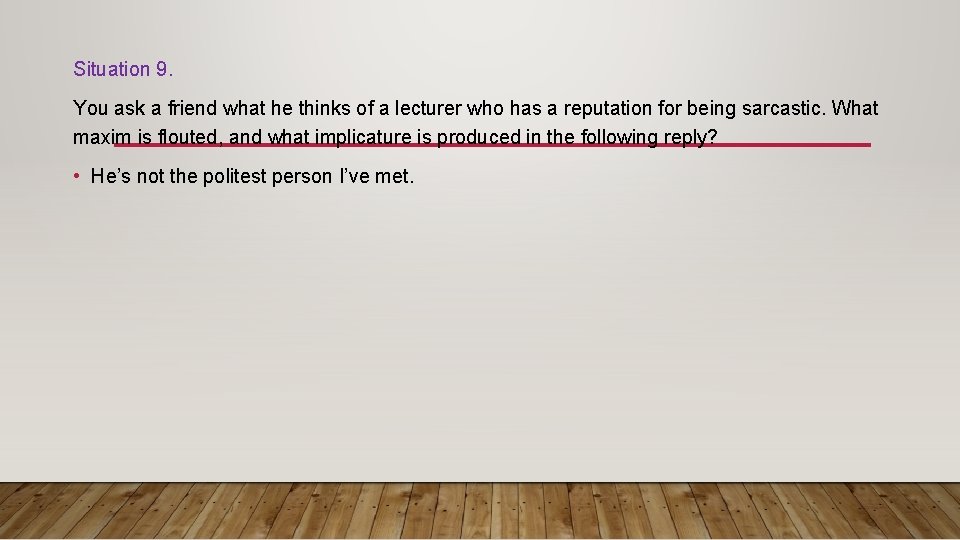
Situation 9. You ask a friend what he thinks of a lecturer who has a reputation for being sarcastic. What maxim is flouted, and what implicature is produced in the following reply? • He’s not the politest person I’ve met.