
Lecture 12 b Ferrocene I Ferrocene It was

Lecture 12 b
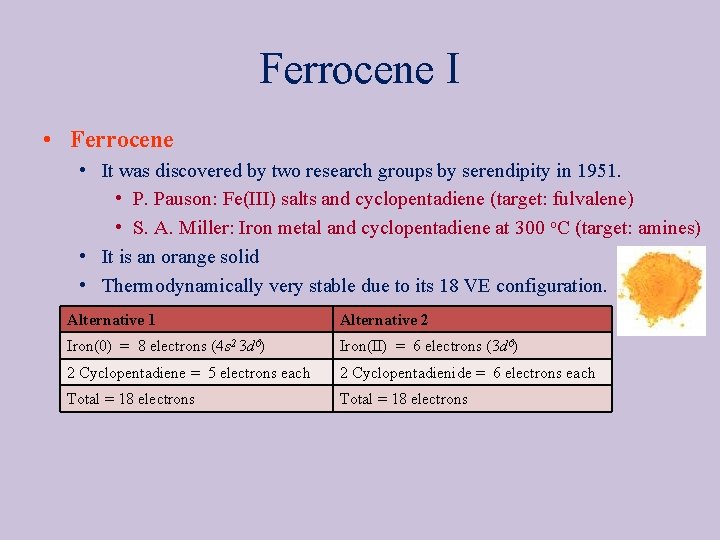
Ferrocene I • Ferrocene • It was discovered by two research groups by serendipity in 1951. • P. Pauson: Fe(III) salts and cyclopentadiene (target: fulvalene) • S. A. Miller: Iron metal and cyclopentadiene at 300 o. C (target: amines) • It is an orange solid • Thermodynamically very stable due to its 18 VE configuration. Alternative 1 Alternative 2 Iron(0) = 8 electrons (4 s 2 3 d 6) Iron(II) = 6 electrons (3 d 6) 2 Cyclopentadiene = 5 electrons each 2 Cyclopentadienide = 6 electrons each Total = 18 electrons
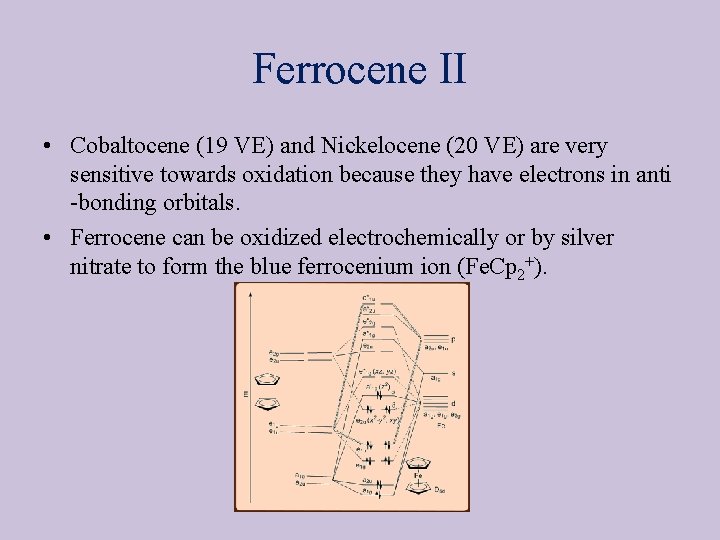
Ferrocene II • Cobaltocene (19 VE) and Nickelocene (20 VE) are very sensitive towards oxidation because they have electrons in anti -bonding orbitals. • Ferrocene can be oxidized electrochemically or by silver nitrate to form the blue ferrocenium ion (Fe. Cp 2+).
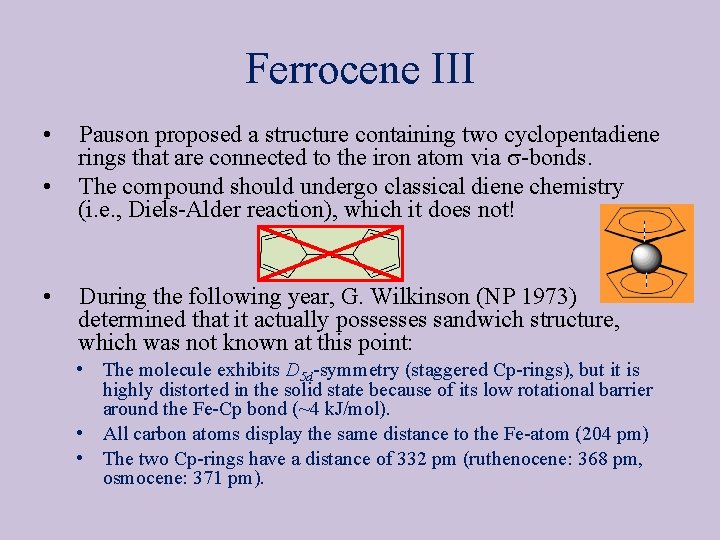
Ferrocene III • • • Pauson proposed a structure containing two cyclopentadiene rings that are connected to the iron atom via s-bonds. The compound should undergo classical diene chemistry (i. e. , Diels-Alder reaction), which it does not! During the following year, G. Wilkinson (NP 1973) determined that it actually possesses sandwich structure, which was not known at this point: • The molecule exhibits D 5 d-symmetry (staggered Cp-rings), but it is highly distorted in the solid state because of its low rotational barrier around the Fe-Cp bond (~4 k. J/mol). • All carbon atoms display the same distance to the Fe-atom (204 pm) • The two Cp-rings have a distance of 332 pm (ruthenocene: 368 pm, osmocene: 371 pm).
Ferrocene IV • In solution, a fast rotation is observed due to the low rotational barrier around the Fe-Cp axis: • One signal is observed in the 1 H-NMR spectrum (d=4. 15 ppm) • One signal in the 13 C-NMR spectrum (d=67. 8 ppm) • Ruthenocene (Ru(C 5 H 5)2, 1 H: 4. 46 ppm, 13 C: 70. 4 ppm), osmocene (Os(C 5 H 5)2, 1 H: 4. 72 ppm, 13 C: 63. 6 ppm), bis(benzene) chromium (Cr(C 6 H 6)2, 1 H: 4. 22 ppm, 13 C: 74. 9 ppm) display similar chemical shifts • Compared to benzene the signals in ferrocene are shifted upfield • This is due to the increased p-electron density (1. 2 p-electrons per carbon atom in ferrocene vs. 1 p-electron per carbon atom in benzene) • The higher electron-density causes an increased shielding of the hydrogen atoms and carbon atoms in ferrocene • The shielding is larger compared to the free cyclopentadienide ligand (Na. Cp: d. H=5. 60 ppm, d. C=94. 9 ppm in C 6 D 6)
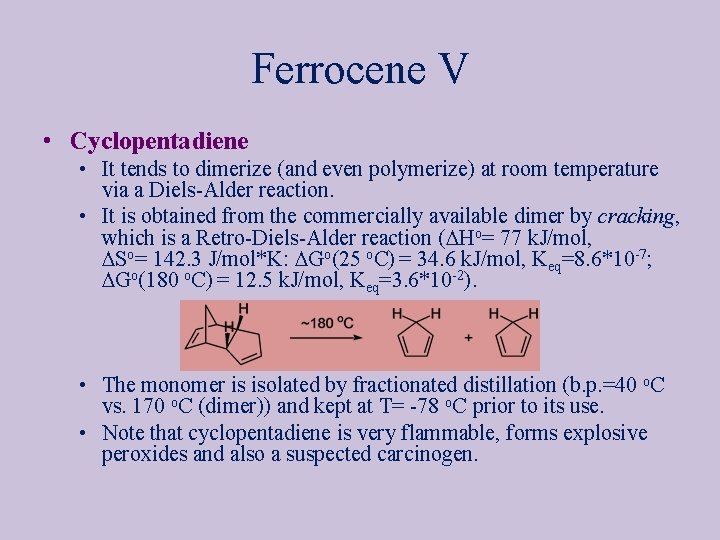
Ferrocene V • Cyclopentadiene • It tends to dimerize (and even polymerize) at room temperature via a Diels-Alder reaction. • It is obtained from the commercially available dimer by cracking, which is a Retro-Diels-Alder reaction (DHo= 77 k. J/mol, DSo= 142. 3 J/mol*K: DGo(25 o. C) = 34. 6 k. J/mol, Keq=8. 6*10 -7; DGo(180 o. C) = 12. 5 k. J/mol, Keq=3. 6*10 -2). • The monomer is isolated by fractionated distillation (b. p. =40 o. C vs. 170 o. C (dimer)) and kept at T= -78 o. C prior to its use. • Note that cyclopentadiene is very flammable, forms explosive peroxides and also a suspected carcinogen.
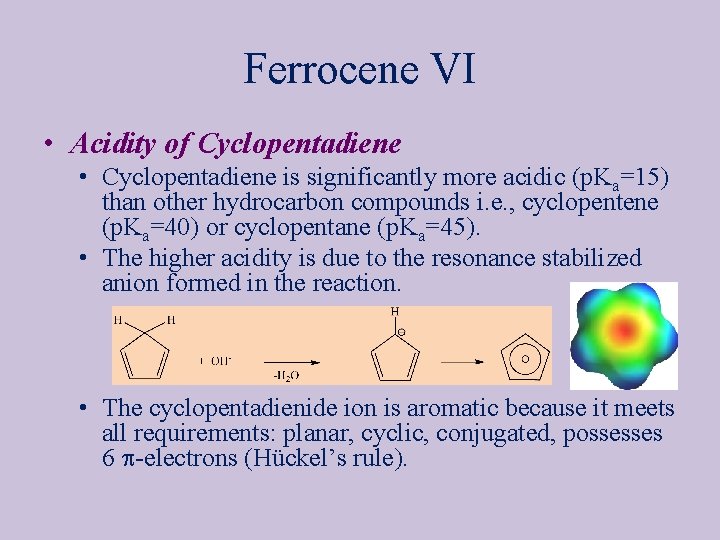
Ferrocene VI • Acidity of Cyclopentadiene • Cyclopentadiene is significantly more acidic (p. Ka=15) than other hydrocarbon compounds i. e. , cyclopentene (p. Ka=40) or cyclopentane (p. Ka=45). • The higher acidity is due to the resonance stabilized anion formed in the reaction. • The cyclopentadienide ion is aromatic because it meets all requirements: planar, cyclic, conjugated, possesses 6 p-electrons (Hückel’s rule).
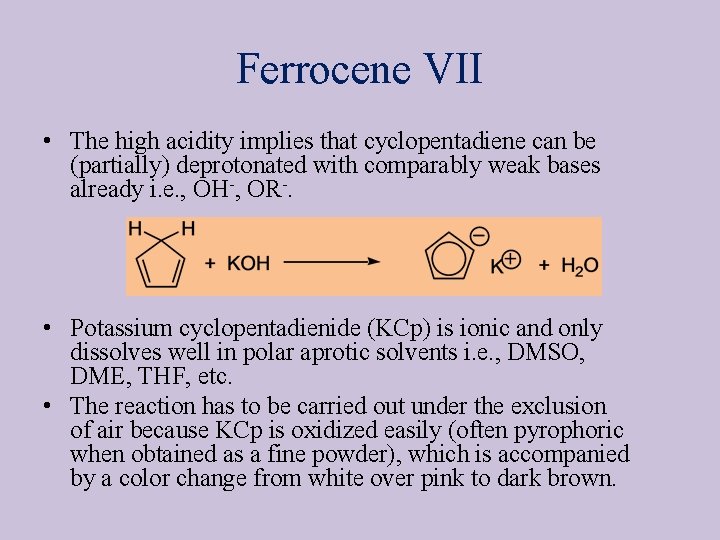
Ferrocene VII • The high acidity implies that cyclopentadiene can be (partially) deprotonated with comparably weak bases already i. e. , OH-, OR-. • Potassium cyclopentadienide (KCp) is ionic and only dissolves well in polar aprotic solvents i. e. , DMSO, DME, THF, etc. • The reaction has to be carried out under the exclusion of air because KCp is oxidized easily (often pyrophoric when obtained as a fine powder), which is accompanied by a color change from white over pink to dark brown.
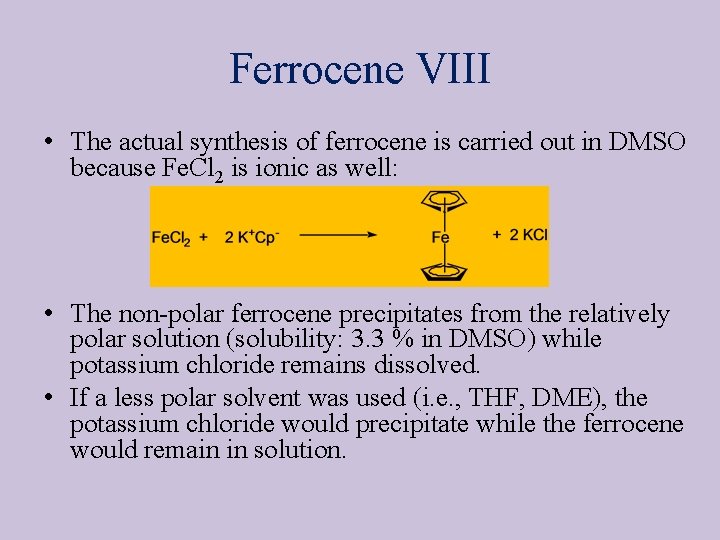
Ferrocene VIII • The actual synthesis of ferrocene is carried out in DMSO because Fe. Cl 2 is ionic as well: • The non-polar ferrocene precipitates from the relatively polar solution (solubility: 3. 3 % in DMSO) while potassium chloride remains dissolved. • If a less polar solvent was used (i. e. , THF, DME), the potassium chloride would precipitate while the ferrocene would remain in solution.
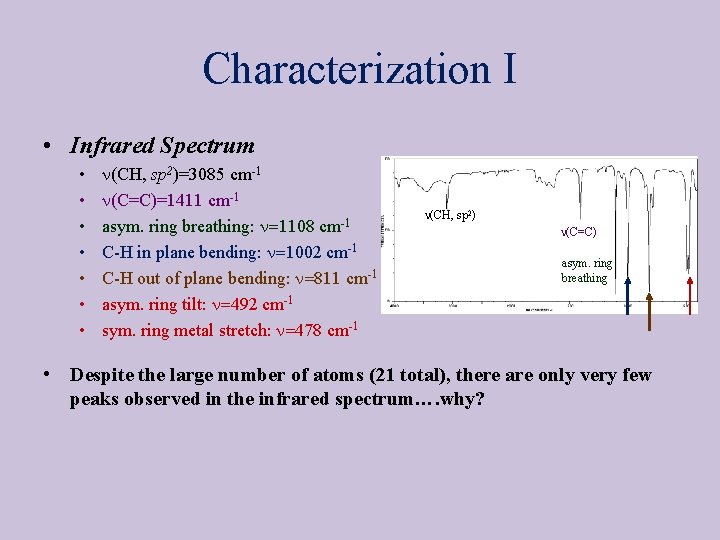
Characterization I • Infrared Spectrum • • n(CH, sp 2)=3085 cm-1 n(C=C)=1411 cm-1 asym. ring breathing: n=1108 cm-1 C-H in plane bending: n=1002 cm-1 C-H out of plane bending: n=811 cm-1 asym. ring tilt: n=492 cm-1 sym. ring metal stretch: n=478 cm-1 n(CH, sp 2) n(C=C) asym. ring breathing • Despite the large number of atoms (21 total), there are only very few peaks observed in the infrared spectrum…. why?
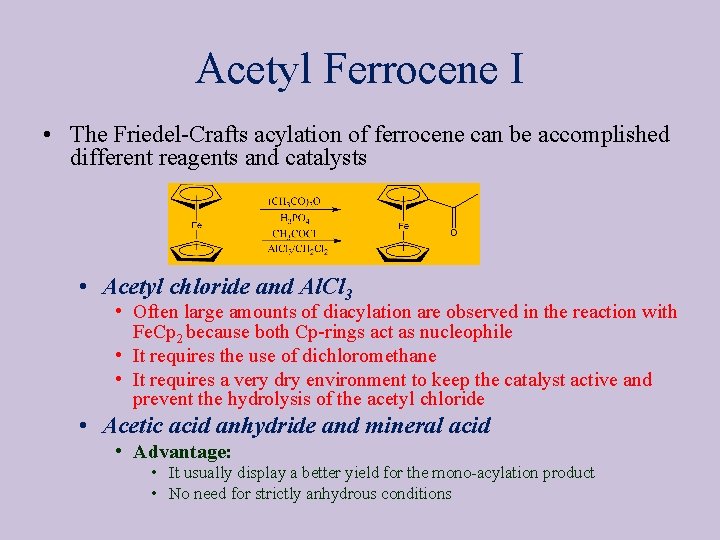
Acetyl Ferrocene I • The Friedel-Crafts acylation of ferrocene can be accomplished different reagents and catalysts • Acetyl chloride and Al. Cl 3 • Often large amounts of diacylation are observed in the reaction with Fe. Cp 2 because both Cp-rings act as nucleophile • It requires the use of dichloromethane • It requires a very dry environment to keep the catalyst active and prevent the hydrolysis of the acetyl chloride • Acetic acid anhydride and mineral acid • Advantage: • It usually display a better yield for the mono-acylation product • No need for strictly anhydrous conditions
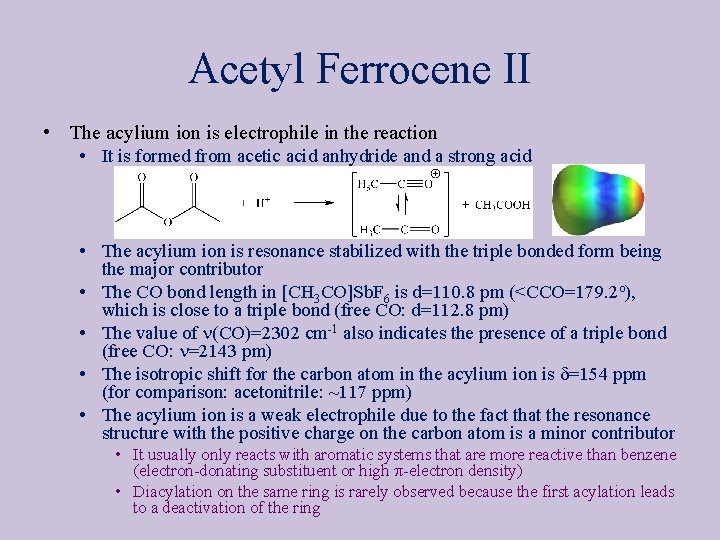
Acetyl Ferrocene II • The acylium ion is electrophile in the reaction • It is formed from acetic acid anhydride and a strong acid • The acylium ion is resonance stabilized with the triple bonded form being the major contributor • The CO bond length in [CH 3 CO]Sb. F 6 is d=110. 8 pm (<CCO=179. 2 o), which is close to a triple bond (free CO: d=112. 8 pm) • The value of n(CO)=2302 cm-1 also indicates the presence of a triple bond (free CO: n=2143 pm) • The isotropic shift for the carbon atom in the acylium ion is d=154 ppm (for comparison: acetonitrile: ~117 ppm) • The acylium ion is a weak electrophile due to the fact that the resonance structure with the positive charge on the carbon atom is a minor contributor • It usually only reacts with aromatic systems that are more reactive than benzene (electron-donating substituent or high p-electron density) • Diacylation on the same ring is rarely observed because the first acylation leads to a deactivation of the ring
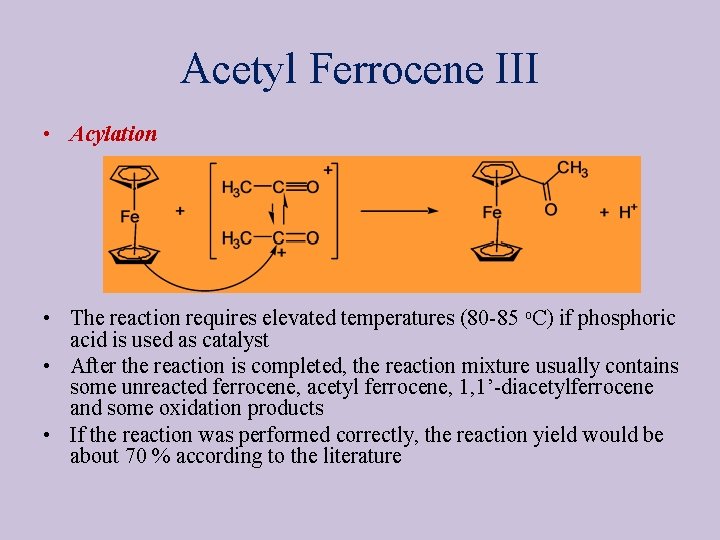
Acetyl Ferrocene III • Acylation • The reaction requires elevated temperatures (80 -85 o. C) if phosphoric acid is used as catalyst • After the reaction is completed, the reaction mixture usually contains some unreacted ferrocene, acetyl ferrocene, 1, 1’-diacetylferrocene and some oxidation products • If the reaction was performed correctly, the reaction yield would be about 70 % according to the literature
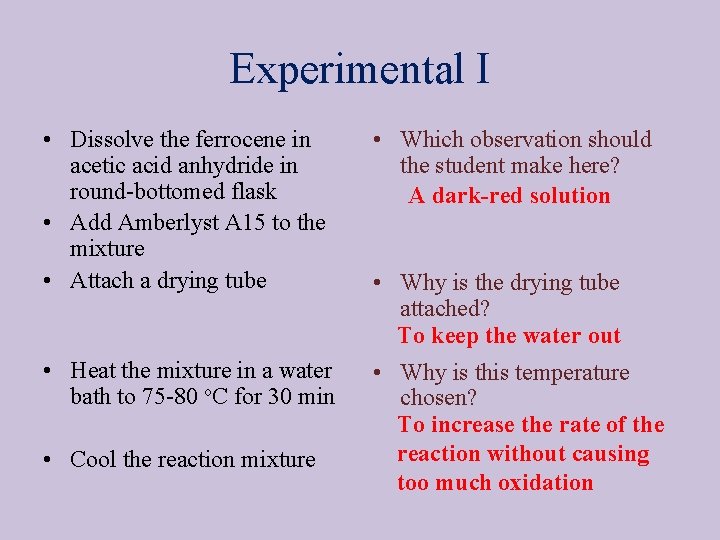
Experimental I • Dissolve the ferrocene in acetic acid anhydride in round-bottomed flask • Add Amberlyst A 15 to the mixture • Attach a drying tube • Heat the mixture in a water bath to 75 -80 o. C for 30 min • Cool the reaction mixture • Which observation should the student make here? A dark-red solution • Why is the drying tube attached? To keep the water out • Why is this temperature chosen? To increase the rate of the reaction without causing too much oxidation
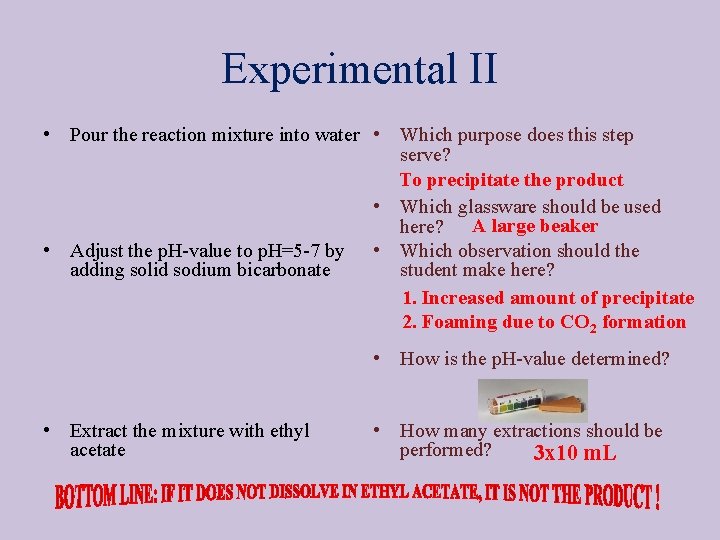
Experimental II • Pour the reaction mixture into water • Which purpose does this step serve? To precipitate the product • Which glassware should be used here? A large beaker • Adjust the p. H-value to p. H=5 -7 by • Which observation should the adding solid sodium bicarbonate student make here? 1. Increased amount of precipitate 2. Foaming due to CO 2 formation • How is the p. H-value determined? • Extract the mixture with ethyl acetate • How many extractions should be performed? 3 x 10 m. L
Experimental III • Extract the combined organic layers with water and sodium bicarbonate solution • Dry the organic layer over anhydrous magnesium sulfate • Remove the solvent using the rotary evaporator • Why is this step performed? To remove the remaining acid from the organic layer • How does the product look like at this point? Red-brown solid • Why is this technique used • Purify the crude product here? using flash chromatography All compounds (Fc. H, Fc. Ac 2) are neutral
Experimental IV • Pack the column like before • • • Is the pretreatment with 1 % NEt 3 NO solution needed here? Suspend the crude in petroleum • What is petroleum ether? ether: ethyl acetate (98: 2) and apply • Why does the crude not dissolve all of the suspension to the column completely in solvent mixture? The compounds are too polar Use petroleum ether: ethyl acetate • How does the student know that (98: 2) to elute the ferrocene off the he is done? column The eluent is colorless • How does the student know that Use a solvent mixture petroleum he is done? ether: ethyl acetate (80: 20) to elute acetyl ferrocene The eluent is light yellow Collect fraction that contain acetyl • How does the student identify these fractions? ferrocene only Using TLC
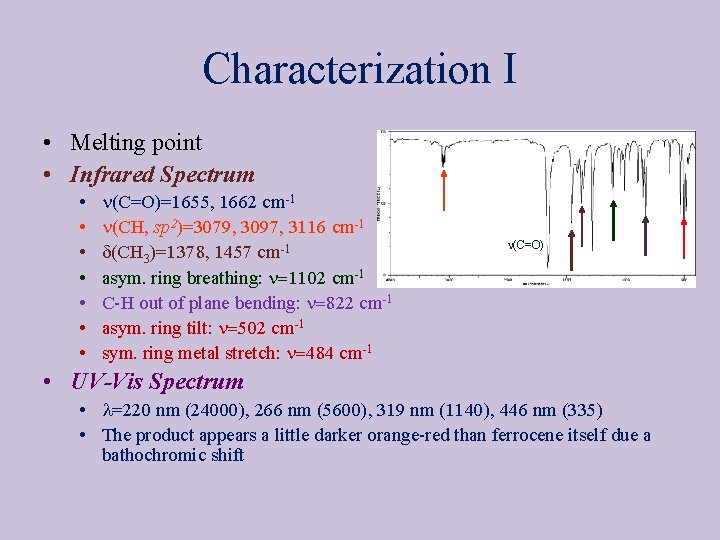
Characterization I • Melting point • Infrared Spectrum • • n(C=O)=1655, 1662 cm-1 n(CH, sp 2)=3079, 3097, 3116 cm-1 d(CH 3)=1378, 1457 cm-1 asym. ring breathing: n=1102 cm-1 C-H out of plane bending: n=822 cm-1 asym. ring tilt: n=502 cm-1 sym. ring metal stretch: n=484 cm-1 n(C=O) • UV-Vis Spectrum • l=220 nm (24000), 266 nm (5600), 319 nm (1140), 446 nm (335) • The product appears a little darker orange-red than ferrocene itself due a bathochromic shift
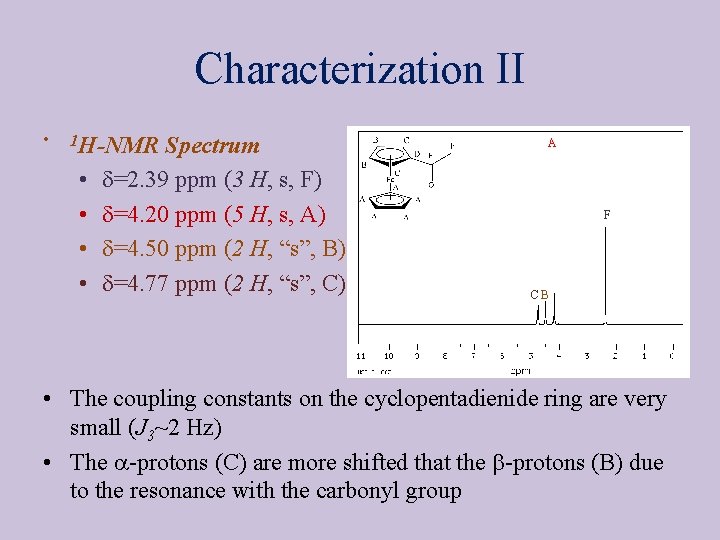
Characterization II • 1 H-NMR • • Spectrum d=2. 39 ppm (3 H, s, F) d=4. 20 ppm (5 H, s, A) d=4. 50 ppm (2 H, “s”, B) d=4. 77 ppm (2 H, “s”, C) A F CB • The coupling constants on the cyclopentadienide ring are very small (J 3~2 Hz) • The a-protons (C) are more shifted that the b-protons (B) due to the resonance with the carbonyl group
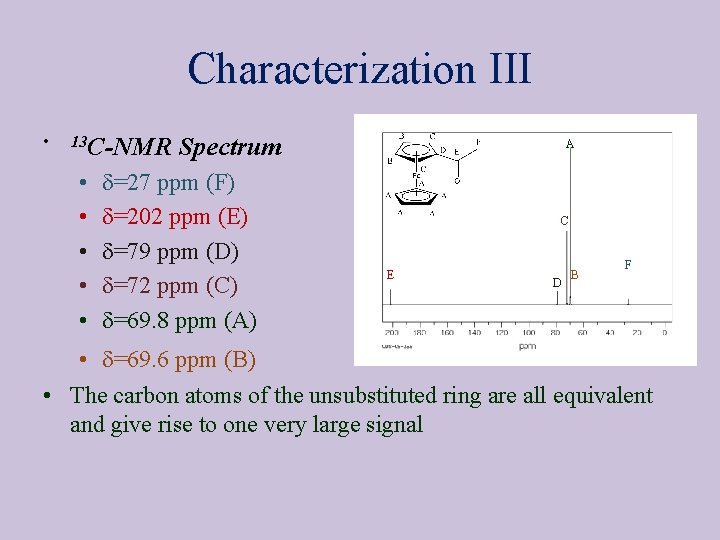
Characterization III • 13 C-NMR • • • Spectrum d=27 ppm (F) d=202 ppm (E) d=79 ppm (D) d=72 ppm (C) d=69. 8 ppm (A) A C E D B F • d=69. 6 ppm (B) • The carbon atoms of the unsubstituted ring are all equivalent and give rise to one very large signal
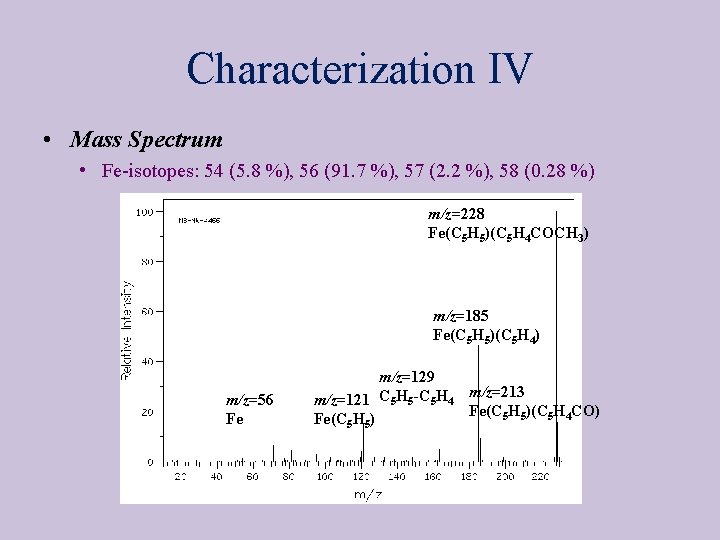
Characterization IV • Mass Spectrum • Fe-isotopes: 54 (5. 8 %), 56 (91. 7 %), 57 (2. 2 %), 58 (0. 28 %) m/z=228 Fe(C 5 H 5)(C 5 H 4 COCH 3) m/z=185 Fe(C 5 H 5)(C 5 H 4) m/z=56 Fe m/z=129 m/z=121 C 5 H 5 -C 5 H 4 m/z=213 Fe(C 5 H 5)(C 5 H 4 CO) Fe(C 5 H 5)
Common Mistakes • • • Using acetic acid as solvent instead of acetic acid anhydride Lack of use of an acidic catalyst Overheating of the reaction mixture during the reaction Trying to neutralize the reaction mixture to p. H=7. 00 Using the wrong solvent (too polar) to dissolve the crude sample to apply the sample to column Not applying the entire crude to the column Using the wrong mobile phase resulting in poor separation (if eluted too quickly) or too many fractions (if mobile phase was too low in polarity) Pretreating the column with triethylamine solution Packing the column incorrectly
- Slides: 22