
Lecture 12 B Carbohydrates oligo and polysaccharides Carbohydrates
Lecture 12 B Carbohydrates: oligo- and polysaccharides
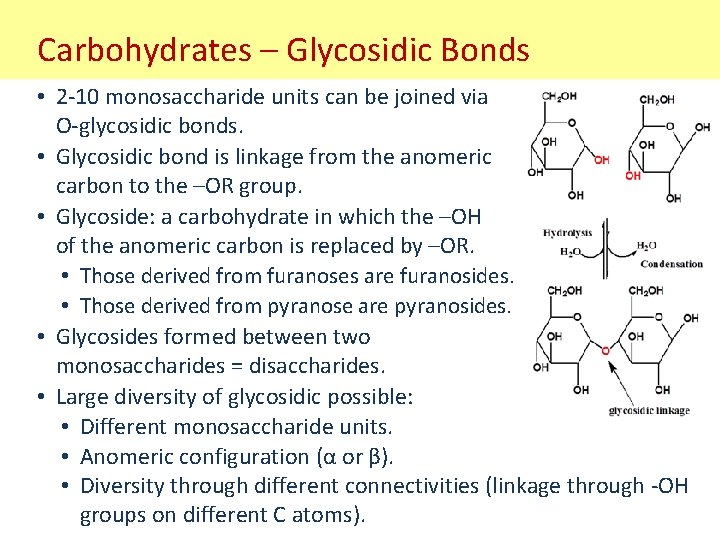
Carbohydrates – Glycosidic Bonds • 2 -10 monosaccharide units can be joined via O-glycosidic bonds. • Glycosidic bond is linkage from the anomeric carbon to the –OR group. • Glycoside: a carbohydrate in which the –OH of the anomeric carbon is replaced by –OR. • Those derived from furanoses are furanosides. • Those derived from pyranose are pyranosides. • Glycosides formed between two monosaccharides = disaccharides. • Large diversity of glycosidic possible: • Different monosaccharide units. • Anomeric configuration (α or β). • Diversity through different connectivities (linkage through -OH groups on different C atoms).
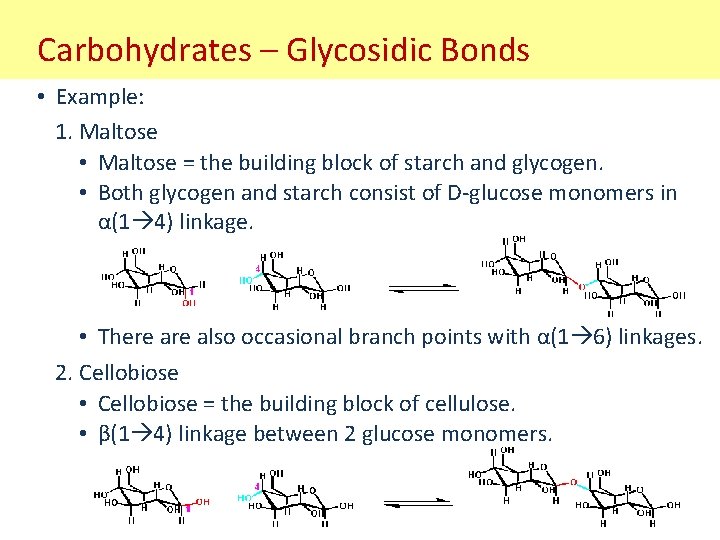
Carbohydrates – Glycosidic Bonds • Example: 1. Maltose • Maltose = the building block of starch and glycogen. • Both glycogen and starch consist of D-glucose monomers in α(1 4) linkage. • There also occasional branch points with α(1 6) linkages. 2. Cellobiose • Cellobiose = the building block of cellulose. • β(1 4) linkage between 2 glucose monomers.
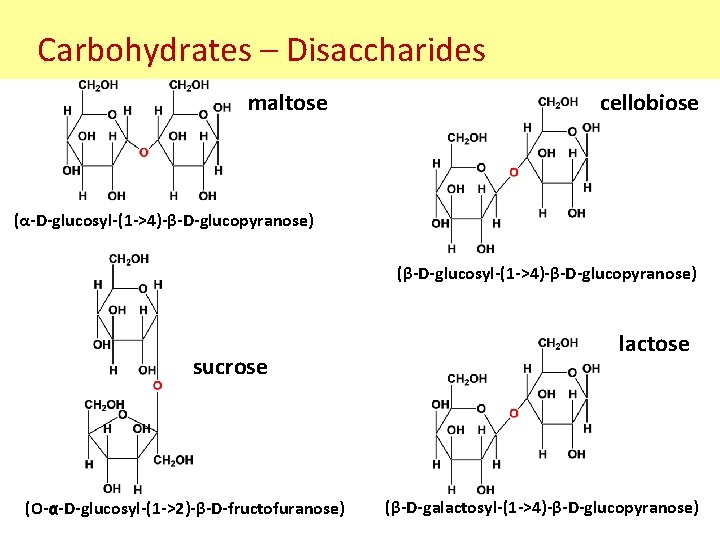
Carbohydrates – Disaccharides maltose cellobiose (α-D-glucosyl-(1 ->4)-β-D-glucopyranose) (β-D-glucosyl-(1 ->4)-β-D-glucopyranose) sucrose (O-α-D-glucosyl-(1 ->2)-β-D-fructofuranose) lactose (β-D-galactosyl-(1 ->4)-β-D-glucopyranose)
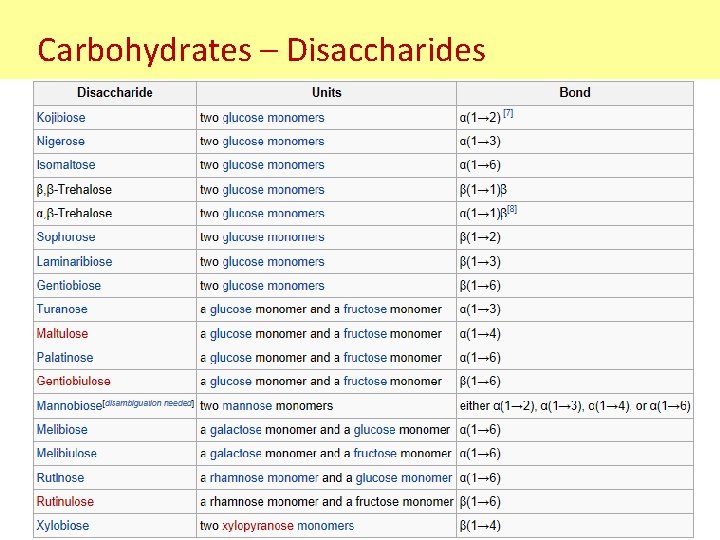
Carbohydrates – Disaccharides
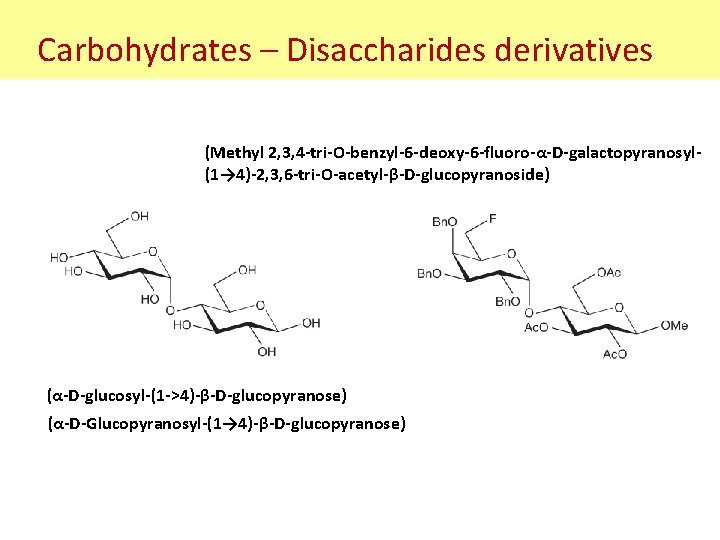
Carbohydrates – Disaccharides derivatives (Methyl 2, 3, 4 -tri-O-benzyl-6 -deoxy-6 -fluoro-α-D-galactopyranosyl(1→ 4)-2, 3, 6 -tri-O-acetyl-β-D-glucopyranoside) (α-D-glucosyl-(1 ->4)-β-D-glucopyranose) (α-D-Glucopyranosyl-(1→ 4)-β-D-glucopyranose)
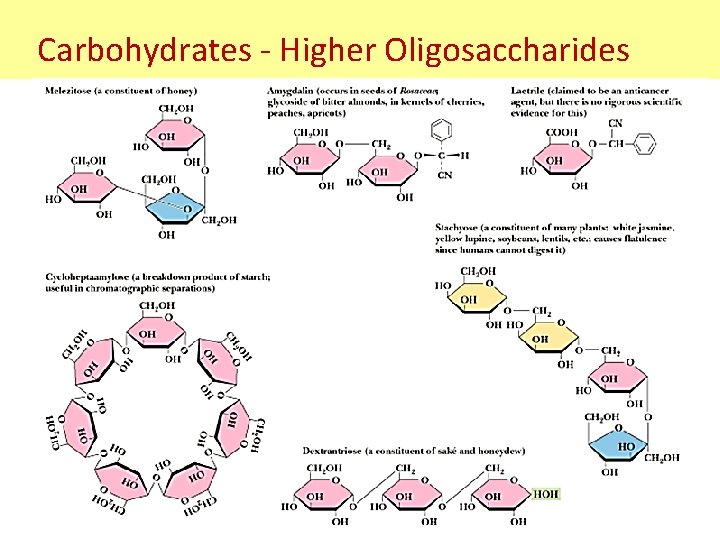
Carbohydrates - Higher Oligosaccharides

Carbohydrates - Higher Oligosaccharides • Oligosaccharide groups are incorporated into many drug structures.

Carbohydrates - Polysaccharides • Two types of polysaccharides: • HOMOpolysaccharides (all 1 type of monomer). glycogen, starch, cellulose, chitin. • HETEROpolysaccharides (different types of monomers). Hemicellulose, peptidoglycans, glycosaminoglycans. e. g. • Functions: • Storage (glycogen in animals & bacteria, starch in plants). • Structure (cellulose, chitin, peptidoglycans, glycosaminoglycans). • Information (cell surface oligo- and polysaccharides, on proteins/glycoproteins and on lipids/glycolipids).
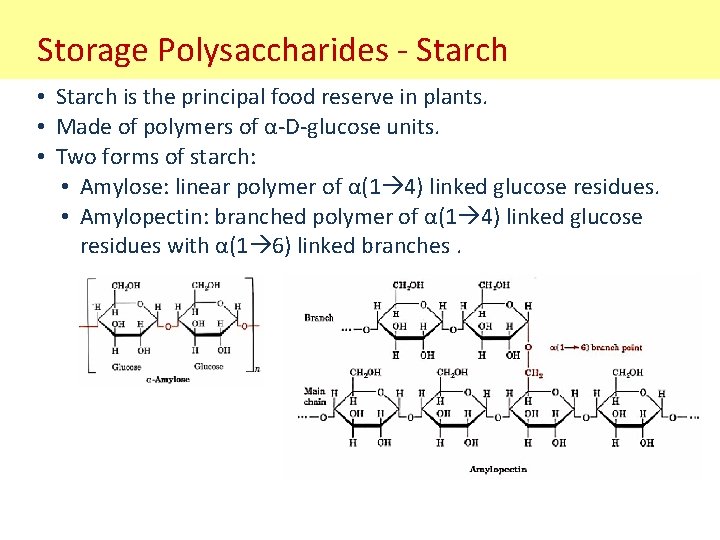
Storage Polysaccharides - Starch • Starch is the principal food reserve in plants. • Made of polymers of α-D-glucose units. • Two forms of starch: • Amylose: linear polymer of α(1 4) linked glucose residues. • Amylopectin: branched polymer of α(1 4) linked glucose residues with α(1 6) linked branches.
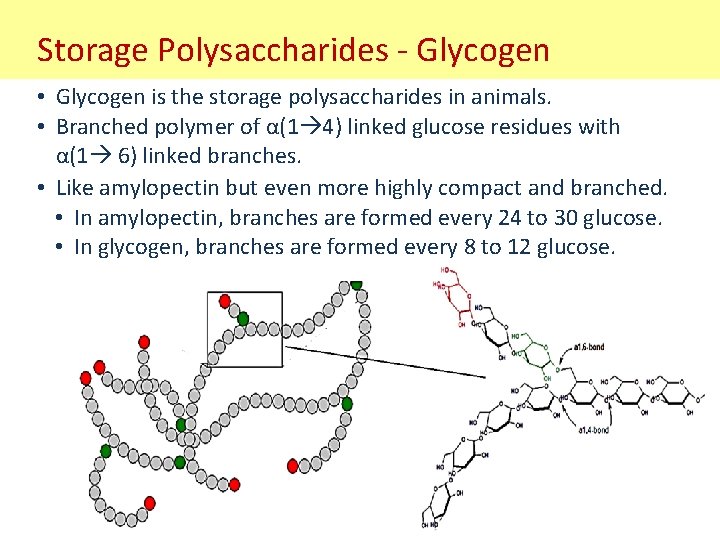
Storage Polysaccharides - Glycogen • Glycogen is the storage polysaccharides in animals. • Branched polymer of α(1 4) linked glucose residues with α(1 6) linked branches. • Like amylopectin but even more highly compact and branched. • In amylopectin, branches are formed every 24 to 30 glucose. • In glycogen, branches are formed every 8 to 12 glucose.
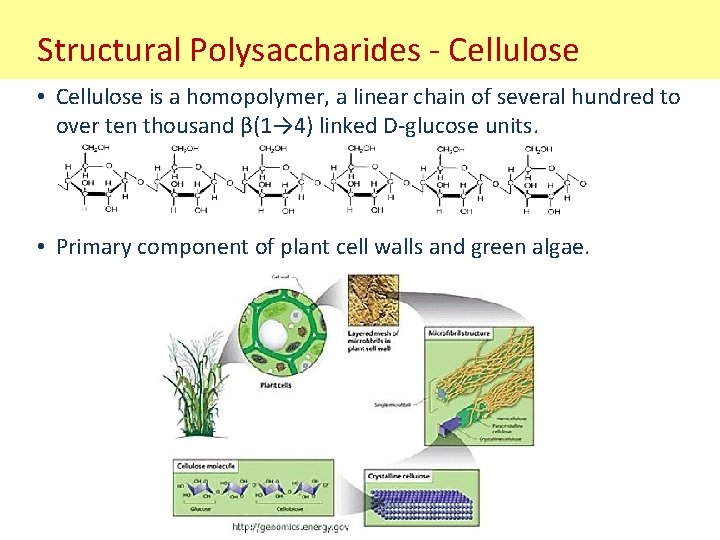
Structural Polysaccharides - Cellulose • Cellulose is a homopolymer, a linear chain of several hundred to over ten thousand β(1→ 4) linked D-glucose units. • Primary component of plant cell walls and green algae.
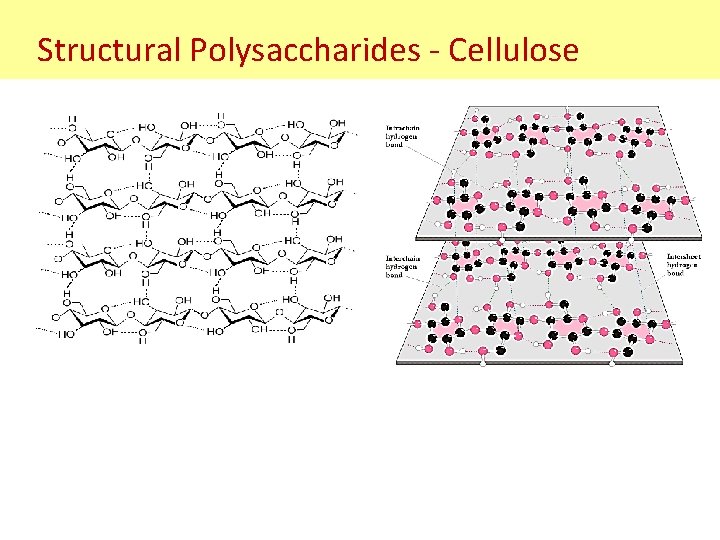
Structural Polysaccharides - Cellulose
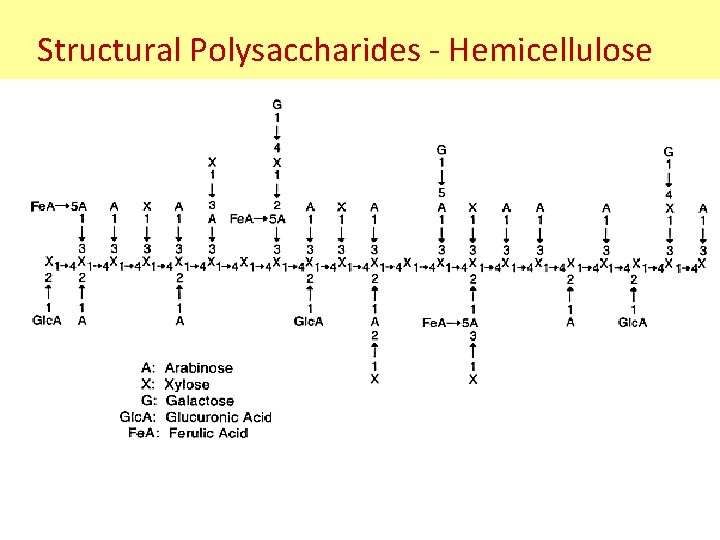
Structural Polysaccharides - Hemicellulose
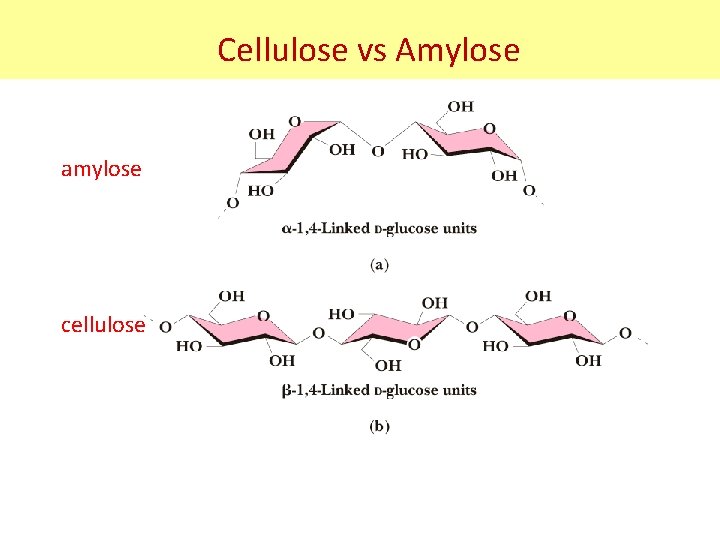
Cellulose vs Amylose amylose cellulose
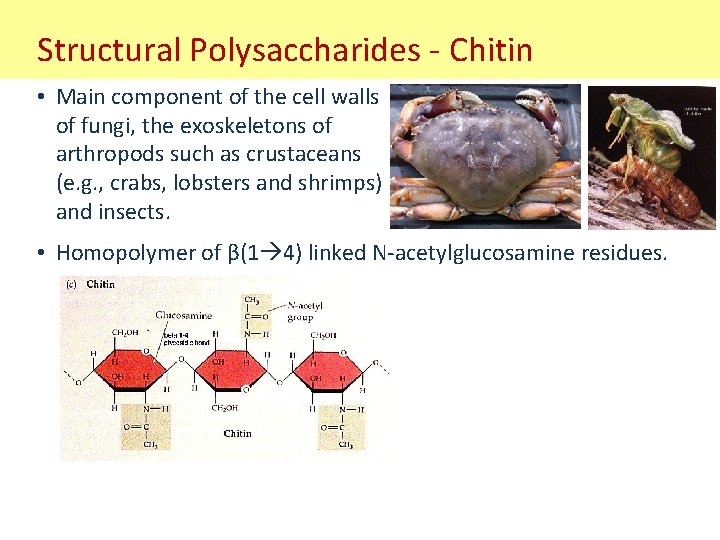
Structural Polysaccharides - Chitin • Main component of the cell walls of fungi, the exoskeletons of arthropods such as crustaceans (e. g. , crabs, lobsters and shrimps) and insects. • Homopolymer of β(1 4) linked N-acetylglucosamine residues.

Cellulose vs Chitin
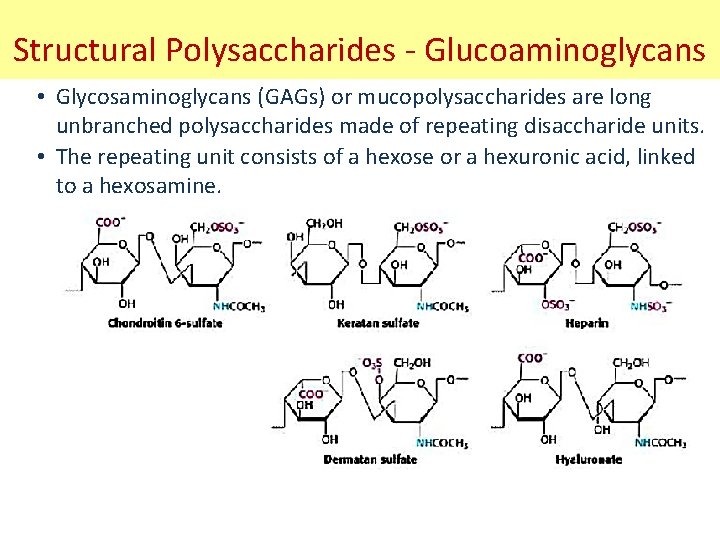
Structural Polysaccharides - Glucoaminoglycans • Glycosaminoglycans (GAGs) or mucopolysaccharides are long unbranched polysaccharides made of repeating disaccharide units. • The repeating unit consists of a hexose or a hexuronic acid, linked to a hexosamine.
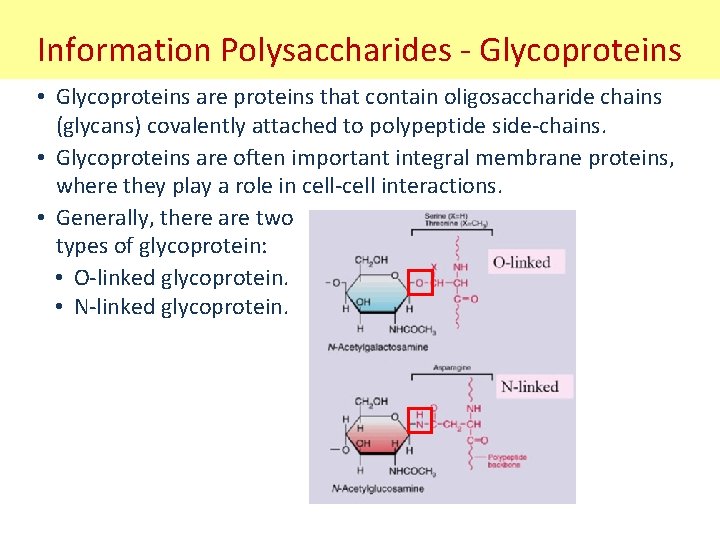
Information Polysaccharides - Glycoproteins • Glycoproteins are proteins that contain oligosaccharide chains (glycans) covalently attached to polypeptide side-chains. • Glycoproteins are often important integral membrane proteins, where they play a role in cell-cell interactions. • Generally, there are two types of glycoprotein: • O-linked glycoprotein. • N-linked glycoprotein.
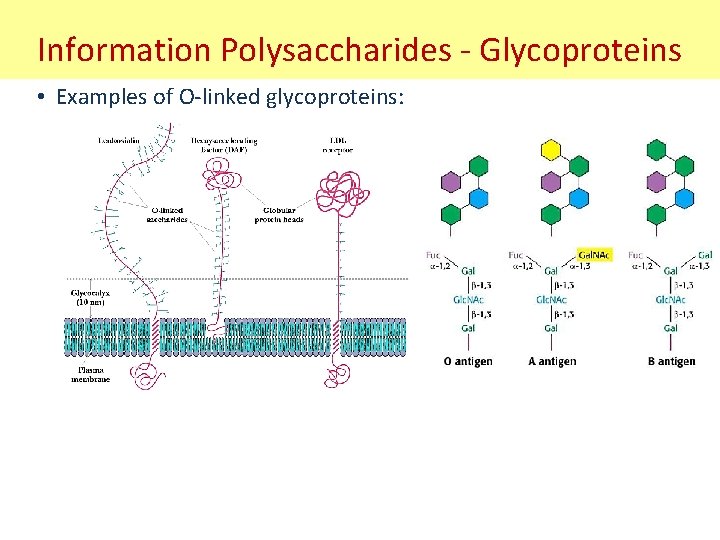
Information Polysaccharides - Glycoproteins • Examples of O-linked glycoproteins:
- Slides: 20