
Lecture 12 Atmospheric moisture Ch 5 Achieving saturation

- Slides: 14
Lecture 12: Atmospheric moisture (Ch 5) • Achieving saturation by • mixing parcels of air • cooling to the dewpoint • the dry adiabatic and saturated adiabatic “lapse rates” and their appearance on thermodynamic chart • condensation at/near ground: dew and frost, haze and fog • supercooled water
Given that formation of liquid or ice droplets in the atmosphere entails achieving an RH “near” 100%, how is this achieved? • add vapour • mix cold air + warm, moist air (see Fig. 5 -9 for explanation) • lower air temperature
Saturation resulting from mixing of cold and warm, moist parcels Specific humidity Fig. 5 -9 Add 1 kg of A to 1 kg of B. Result: 2 kg air 23 g water vapour S. H. = 23/2 (g/kg) T o. C
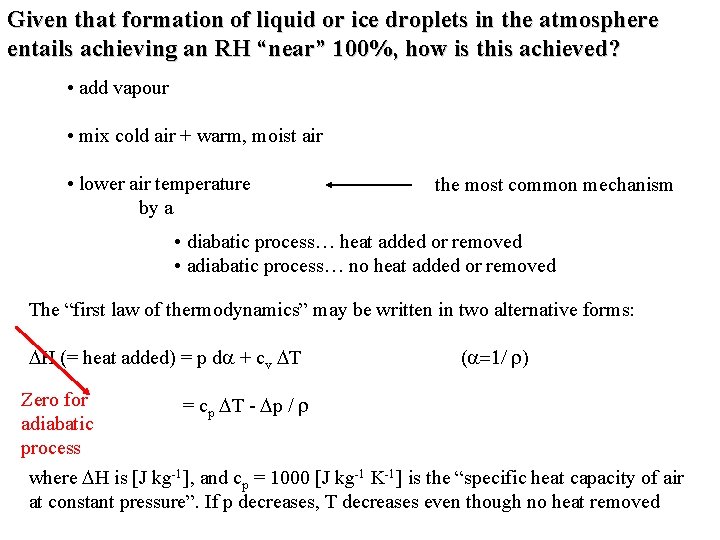
Given that formation of liquid or ice droplets in the atmosphere entails achieving an RH “near” 100%, how is this achieved? • add vapour • mix cold air + warm, moist air • lower air temperature by a the most common mechanism • diabatic process… heat added or removed • adiabatic process… no heat added or removed The “first law of thermodynamics” may be written in two alternative forms: DH (= heat added) = p da + cv DT (a=1/ r) Zero for = cp DT - Dp / r adiabatic process where DH is [J kg-1], and cp = 1000 [J kg-1 K-1] is the “specific heat capacity of air at constant pressure”. If p decreases, T decreases even though no heat removed
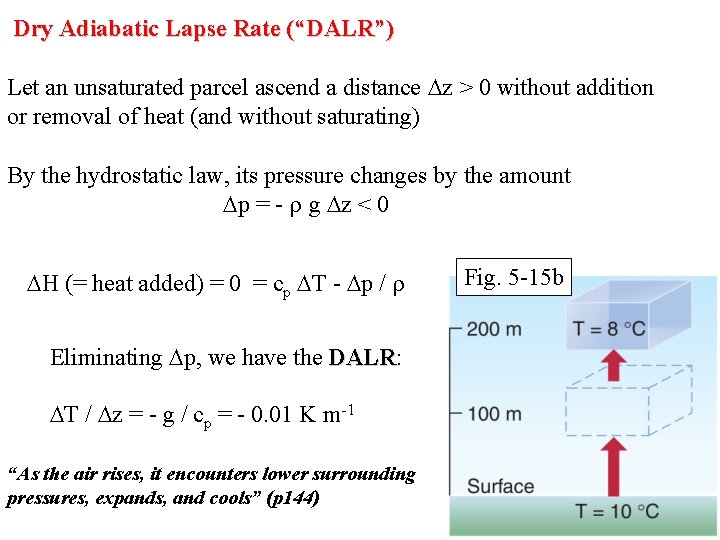
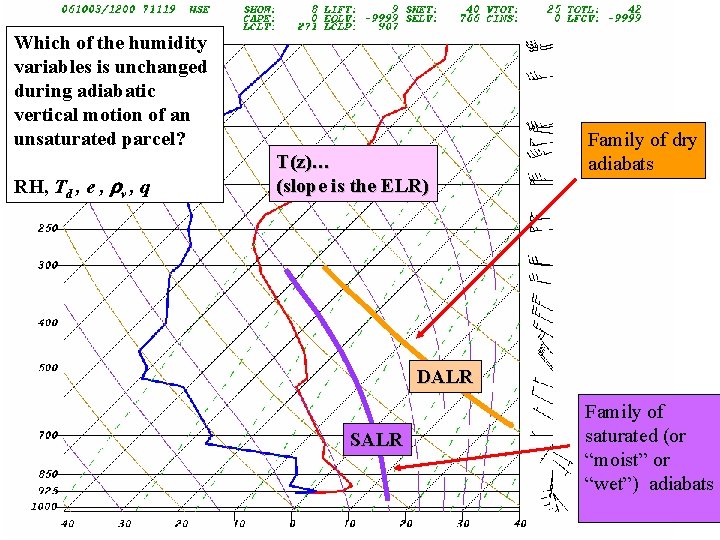
Dry Adiabatic Lapse Rate (“DALR”) Let an unsaturated parcel ascend a distance Dz > 0 without addition or removal of heat (and without saturating) By the hydrostatic law, its pressure changes by the amount Dp = - r g Dz < 0 DH (= heat added) = 0 = cp DT - Dp / r Eliminating Dp, we have the DALR: DALR DT / Dz = - g / cp = - 0. 01 K m-1 “As the air rises, it encounters lower surrounding pressures, expands, and cools” (p 144) Fig. 5 -15 b
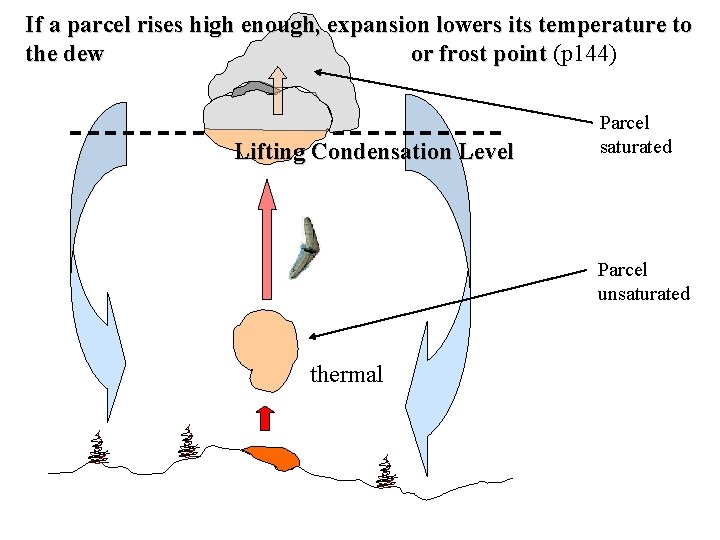
If a parcel rises high enough, expansion lowers its temperature to the dew or frost point (p 144) Lifting Condensation Level Parcel saturated Parcel unsaturated thermal
Saturated Adiabatic Lapse Rate (“SALR”) During the adiabatic ascent of a saturated parcel, the release of latent heat by condensing water vapour offsets the cooling by expansion… The rate of cooling per metre of lifting is consequently smaller (except high in the atmosphere where due to the cold temperature there is little vapour in the air to be condensed)
Which of the humidity variables is unchanged during adiabatic vertical motion of an unsaturated parcel? RH, Td , e , rv , q T(z)… (slope is the ELR) Family of dry adiabats DALR SALR Family of saturated (or “moist” or “wet”) adiabats
“Condensation or deposition can occur in the air as cloud or fog, or onto the surface as dew or frost” (p 156) Adiabatic cooling is normally the agency that produces condensation well aloft, ie. clouds What about the types of condensate we see at/near ground, viz. , dew, frost, fog…? In these latter cases, cooling to the dew (or frost) point usually entails some heat removal, ie. “diabatic processes” (e. g. Table 5 -4)
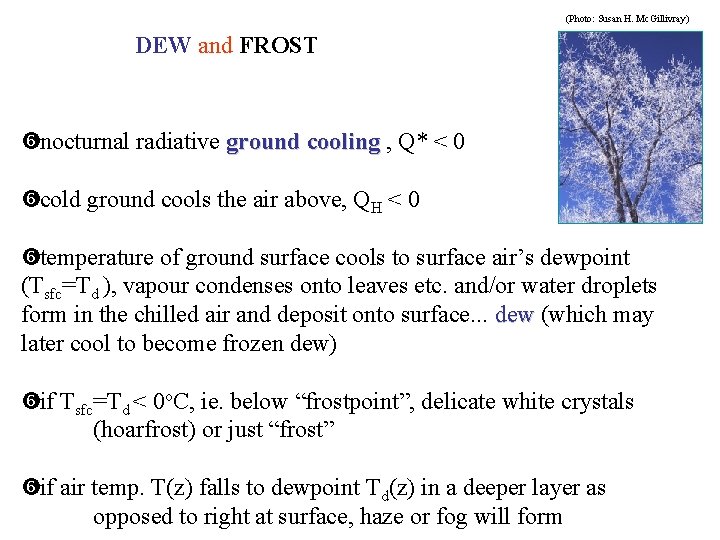
(Photo: Susan H. Mc. Gillivray) DEW and FROST nocturnal radiative ground cooling , Q* < 0 cold ground cools the air above, QH < 0 temperature of ground surface cools to surface air’s dewpoint (Tsfc=Td ), vapour condenses onto leaves etc. and/or water droplets form in the chilled air and deposit onto surface. . . dew (which may later cool to become frozen dew) if Tsfc=Td < 0 o. C, ie. below “frostpoint”, delicate white crystals (hoarfrost) or just “frost” if air temp. T(z) falls to dewpoint Td(z) in a deeper layer as opposed to right at surface, haze or fog will form
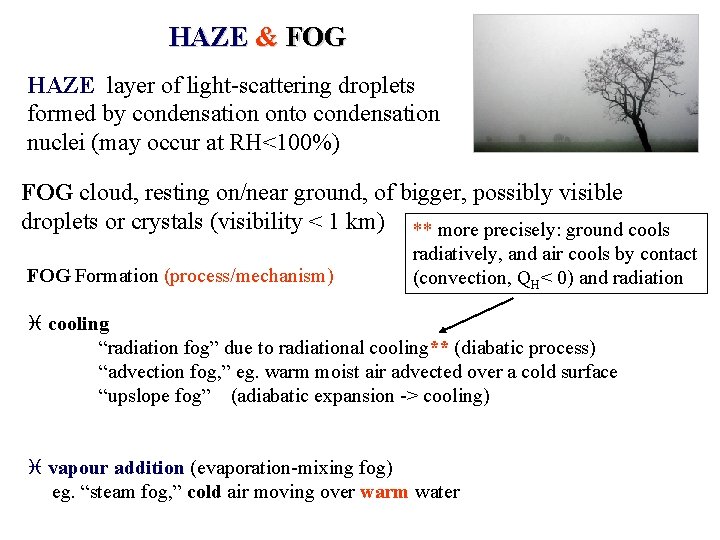
HAZE & FOG HAZE layer of light-scattering droplets formed by condensation onto condensation nuclei (may occur at RH<100%) FOG cloud, resting on/near ground, of bigger, possibly visible droplets or crystals (visibility < 1 km) ** more precisely: ground cools FOG Formation (process/mechanism) radiatively, and air cools by contact (convection, QH< 0) and radiation i cooling “radiation fog” due to radiational cooling** (diabatic process) “advection fog, ” eg. warm moist air advected over a cold surface “upslope fog” (adiabatic expansion -> cooling) i vapour addition (evaporation-mixing fog) eg. “steam fog, ” cold air moving over warm water
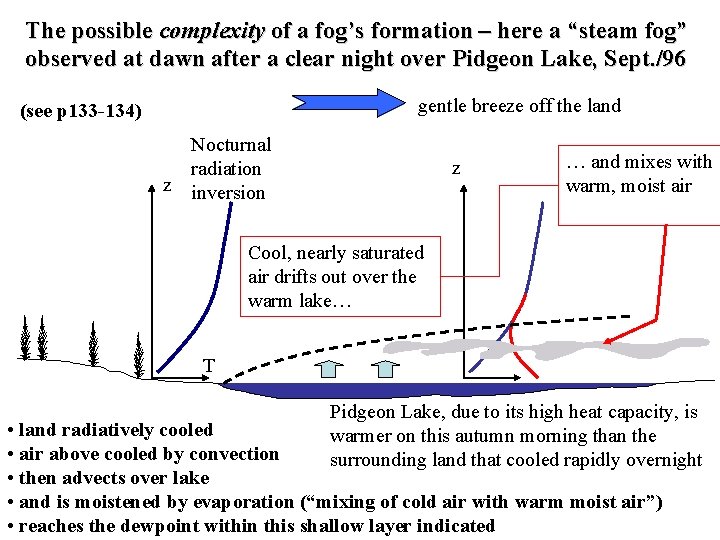
The possible complexity of a fog’s formation – here a “steam fog” observed at dawn after a clear night over Pidgeon Lake, Sept. /96 gentle breeze off the land (see p 133 -134) Nocturnal radiation z inversion z … and mixes with warm, moist air Cool, nearly saturated air drifts out over the warm lake… T Pidgeon Lake, due to its high heat capacity, is warmer on this autumn morning than the surrounding land that cooled rapidly overnight • land radiatively cooled • air above cooled by convection • then advects over lake • and is moistened by evaporation (“mixing of cold air with warm moist air”) • reaches the dewpoint within this shallow layer indicated
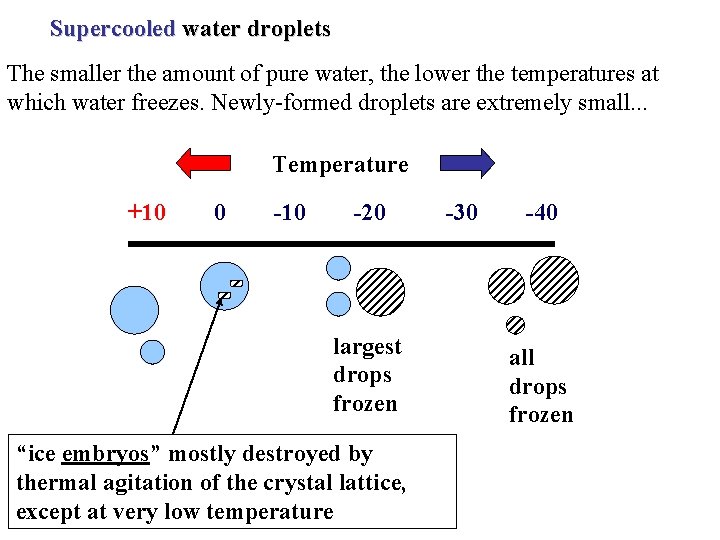
Supercooled water droplets “If saturation occurs** at temperatures between about -4 C and 0 C, surplus water invariably condenses as supercooled water…” (p 137) … formation of ice crystals near 0 o. C requires ice nuclei … which must have an ice-like crystal structure … and so (unlike condensation nuclei) are generally rare in the atmosphere … clay particles may serve as natural ice nuclei, but “no materials are effective ice nuclei at temperatures above – 4 o. C” … as temperature decreases, likelihood of ice formation increases (** i. e. T=Tf , the “frost point” )
Supercooled water droplets The smaller the amount of pure water, the lower the temperatures at which water freezes. Newly-formed droplets are extremely small. . . Temperature +10 0 -10 -20 largest drops frozen “ice embryos” mostly destroyed by thermal agitation of the crystal lattice, except at very low temperature -30 -40 all drops frozen