
Lecture 12 Advanced Combinational ATPG Algorithms FAN Multiple
Lecture 12 Advanced Combinational ATPG Algorithms § § § FAN – Multiple Backtrace (1983) TOPS – Dominators (1987) SOCRATES – Learning (1988) Legal Assignments (1990) EST – Search space learning (1991) BDD Test generation (1991) Implication Graphs and Transitive Closure (1988 - 97) Recursive Learning (1995) Test Generation Systems Test Compaction Summary Copyright 2001, Agrawal & Bushnell VLSI Test: Lecture 12 1
FAN -- Fujiwara and Shimono (1983) § New concepts: § Immediate assignment of uniquely- § § § determined signals Unique sensitization Stop Backtrace at head lines Multiple Backtrace Copyright 2001, Agrawal & Bushnell VLSI Test: Lecture 12 2
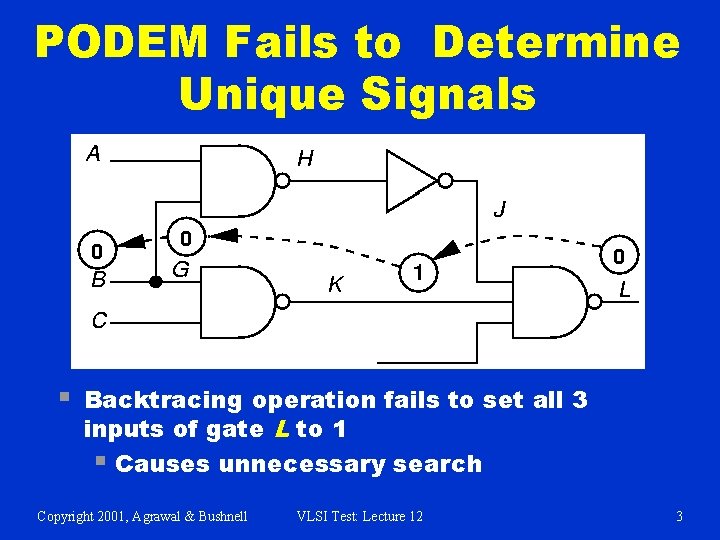
PODEM Fails to Determine Unique Signals § Backtracing operation fails to set all 3 inputs of gate L to 1 § Causes unnecessary search Copyright 2001, Agrawal & Bushnell VLSI Test: Lecture 12 3
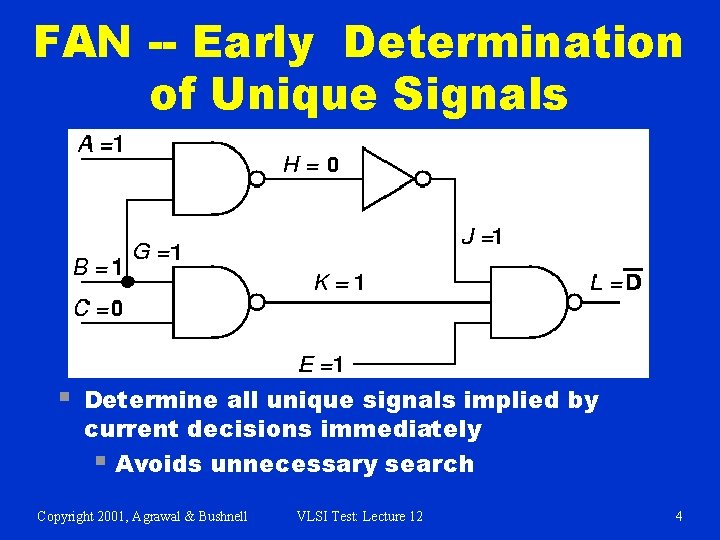
FAN -- Early Determination of Unique Signals § Determine all unique signals implied by current decisions immediately § Avoids unnecessary search Copyright 2001, Agrawal & Bushnell VLSI Test: Lecture 12 4
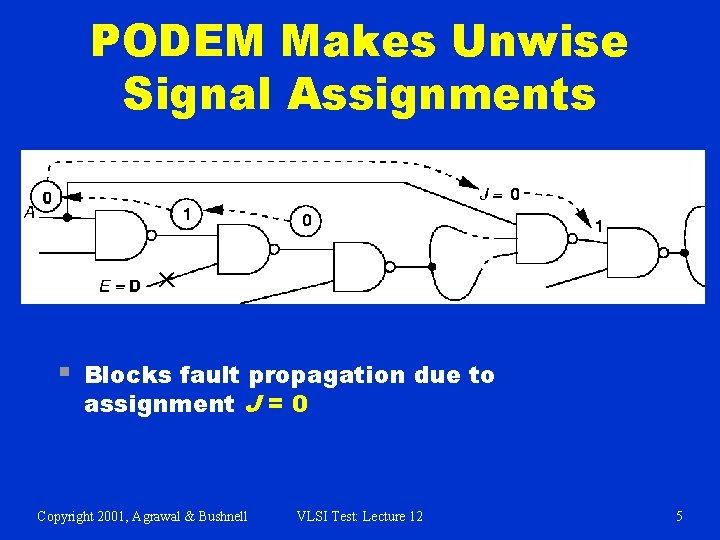
PODEM Makes Unwise Signal Assignments § Blocks fault propagation due to assignment J = 0 Copyright 2001, Agrawal & Bushnell VLSI Test: Lecture 12 5
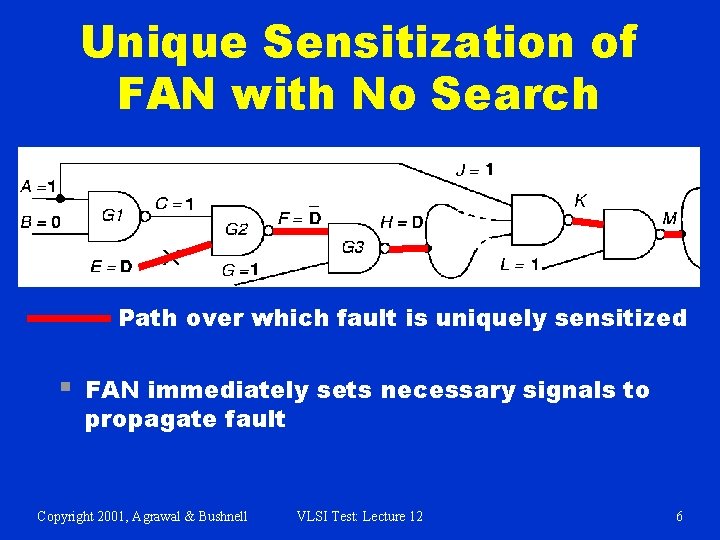
Unique Sensitization of FAN with No Search Path over which fault is uniquely sensitized § FAN immediately sets necessary signals to propagate fault Copyright 2001, Agrawal & Bushnell VLSI Test: Lecture 12 6
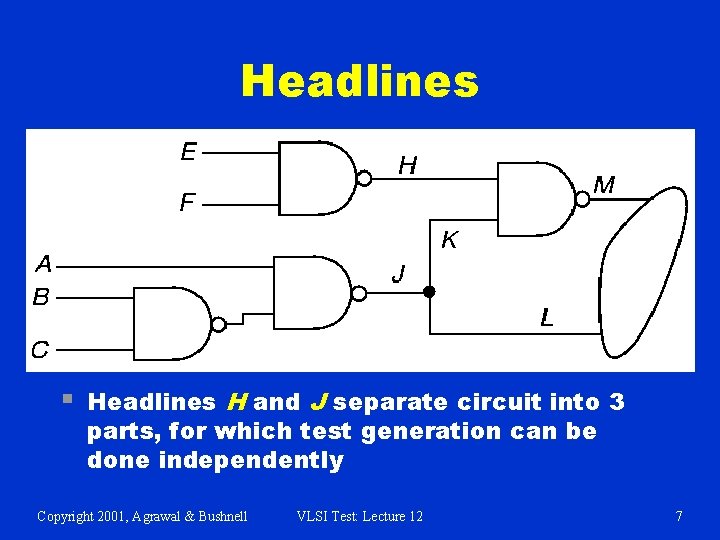
Headlines § Headlines H and J separate circuit into 3 parts, for which test generation can be done independently Copyright 2001, Agrawal & Bushnell VLSI Test: Lecture 12 7
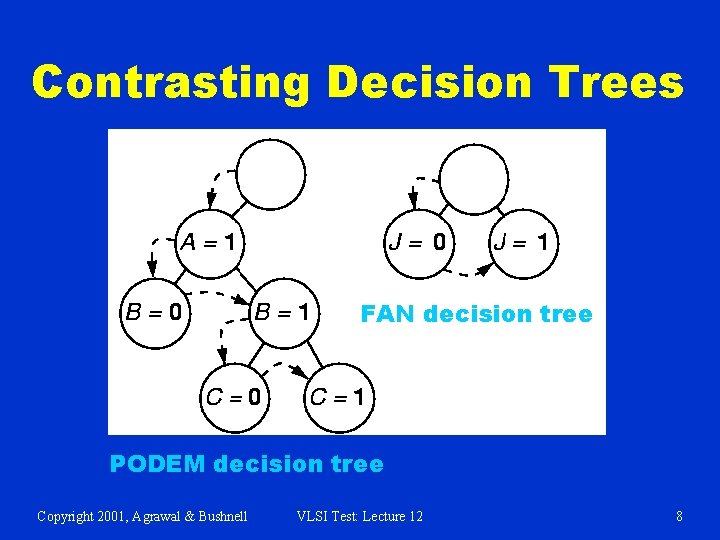
Contrasting Decision Trees FAN decision tree PODEM decision tree Copyright 2001, Agrawal & Bushnell VLSI Test: Lecture 12 8
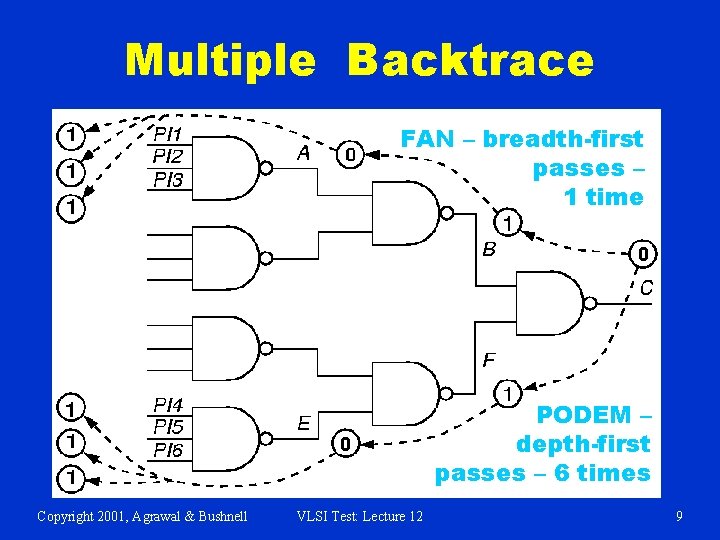
Multiple Backtrace FAN – breadth-first passes – 1 time PODEM – depth-first passes – 6 times Copyright 2001, Agrawal & Bushnell VLSI Test: Lecture 12 9
![AND Gate Vote Propagation [5, 3] [0, 3] § AND Gate § Easiest-to-control Input](http://slidetodoc.com/presentation_image_h/9851a2914e8b269fab094a402aa9e218/image-10.jpg "AND Gate Vote Propagation [5, 3] [0, 3] § AND Gate § Easiest-to-control Input")
AND Gate Vote Propagation [5, 3] [0, 3] § AND Gate § Easiest-to-control Input – § # 0’s = OUTPUT # 0’s § # 1’s = OUTPUT # 1’s § All other inputs -- § # 0’s = 0 § # 1’s = OUTPUT # 1’s Copyright 2001, Agrawal & Bushnell VLSI Test: Lecture 12 10
![Multiple Backtrace Fanout Stem Voting [5, 1] [1, 1] [3, 2] [18, 6] [4,](http://slidetodoc.com/presentation_image_h/9851a2914e8b269fab094a402aa9e218/image-11.jpg "Multiple Backtrace Fanout Stem Voting [5, 1] [1, 1] [3, 2] [18, 6] [4,")
Multiple Backtrace Fanout Stem Voting [5, 1] [1, 1] [3, 2] [18, 6] [4, 1] [5, 1] § Fanout Stem -- § # 0’s = S Branch # 0’s, § # 1’s = S Branch # 1’s Copyright 2001, Agrawal & Bushnell VLSI Test: Lecture 12 11
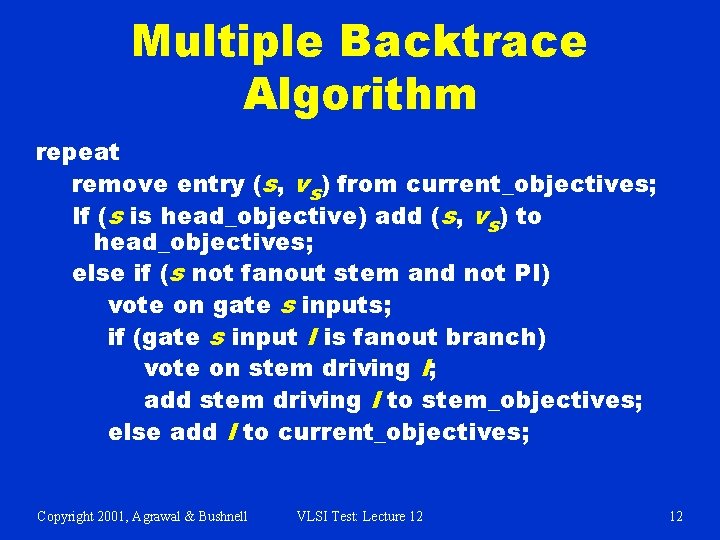
Multiple Backtrace Algorithm repeat remove entry (s, vs) from current_objectives; If (s is head_objective) add (s, vs) to head_objectives; else if (s not fanout stem and not PI) vote on gate s inputs; if (gate s input I is fanout branch) vote on stem driving I; add stem driving I to stem_objectives; else add I to current_objectives; Copyright 2001, Agrawal & Bushnell VLSI Test: Lecture 12 12
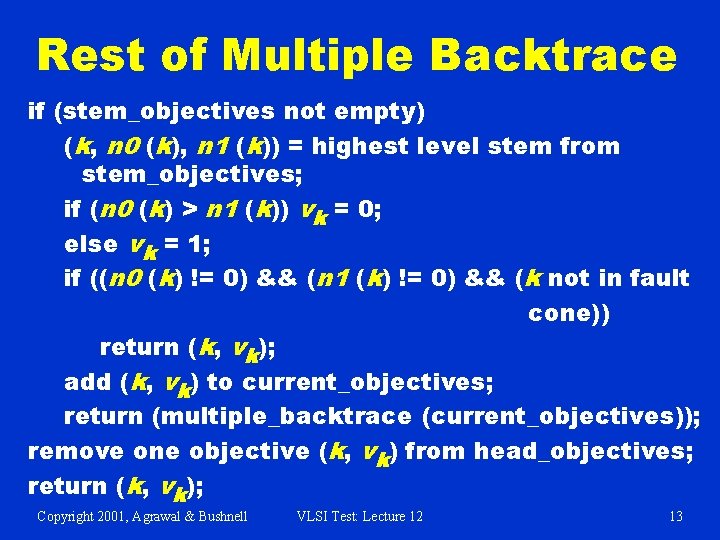
Rest of Multiple Backtrace if (stem_objectives not empty) (k, n 0 (k), n 1 (k)) = highest level stem from stem_objectives; if (n 0 (k) > n 1 (k)) vk = 0; else vk = 1; if ((n 0 (k) != 0) && (n 1 (k) != 0) && (k not in fault cone)) return (k, vk); add (k, vk) to current_objectives; return (multiple_backtrace (current_objectives)); remove one objective (k, vk) from head_objectives; return (k, vk); Copyright 2001, Agrawal & Bushnell VLSI Test: Lecture 12 13
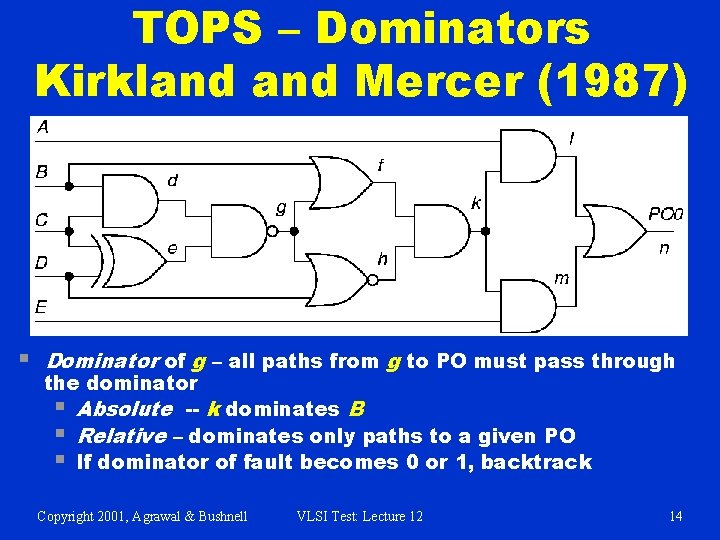
TOPS – Dominators Kirkland Mercer (1987) § Dominator of g – all paths from g to PO must pass through the dominator § Absolute -- k dominates B § Relative – dominates only paths to a given PO § If dominator of fault becomes 0 or 1, backtrack Copyright 2001, Agrawal & Bushnell VLSI Test: Lecture 12 14
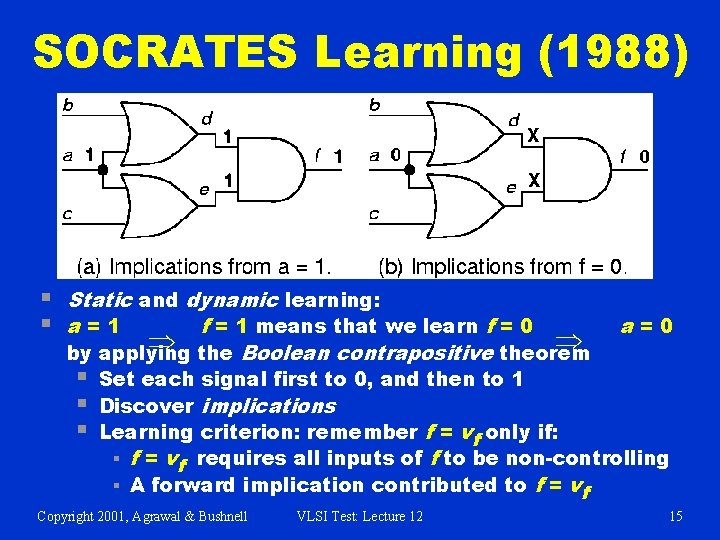
SOCRATES Learning (1988) § § Static and dynamic learning: a=1 f = 1 means that we learn f = 0 Þ Þ the Boolean contrapositive theorem by applying § § § a=0 Set each signal first to 0, and then to 1 Discover implications Learning criterion: remember f = vf only if: § f = vf requires all inputs of f to be non-controlling § A forward implication contributed to f = vf Copyright 2001, Agrawal & Bushnell VLSI Test: Lecture 12 15
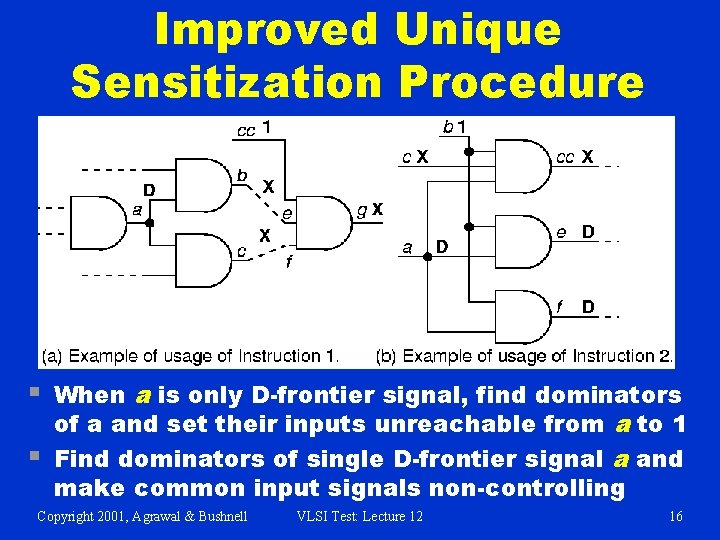
Improved Unique Sensitization Procedure § § When a is only D-frontier signal, find dominators of a and set their inputs unreachable from a to 1 Find dominators of single D-frontier signal a and make common input signals non-controlling Copyright 2001, Agrawal & Bushnell VLSI Test: Lecture 12 16
![Constructive Dilemma § [(a = 0) (i = 0)] [(a = 1) (i =](http://slidetodoc.com/presentation_image_h/9851a2914e8b269fab094a402aa9e218/image-17.jpg "Constructive Dilemma § [(a = 0) (i = 0)] [(a = 1) (i =")
Constructive Dilemma § [(a = 0) (i = 0)] [(a = 1) (i = 0)] (i = 0) Þ Ù Þ Þ § If both assignments 0 and 1 to a make i = 0, then i = 0 is implied independently of a Copyright 2001, Agrawal & Bushnell VLSI Test: Lecture 12 17
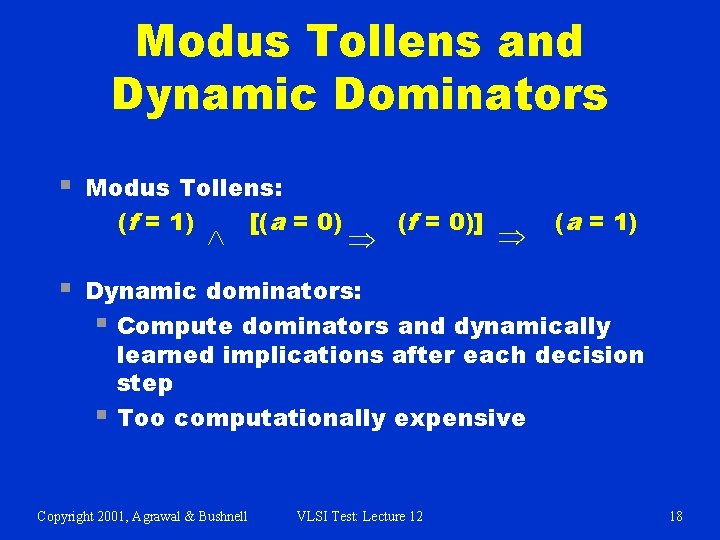
Modus Tollens and Dynamic Dominators § Modus Tollens: (f = 1) [(a = 0) Ù § Þ (f = 0)] Þ (a = 1) Dynamic dominators: § Compute dominators and dynamically learned implications after each decision step § Too computationally expensive Copyright 2001, Agrawal & Bushnell VLSI Test: Lecture 12 18
EST – Dynamic Programming (Giraldi & Bushnell) § § E-frontier – partial circuit functional decomposition § § Equivalent to a node in a BDD Cut-set between circuit part with known labels and part with X signal labels EST learns E-frontiers during ATPG and stores them in a hash table § Dynamic programming – when new decomposition generated from implications of a variable assignment, looks it up in the hash table § Avoids repeating a search already conducted Terminates search when decomposition matches: § Earlier one that lead to a test (retrieves stored test) § Earlier one that lead to a backtrack Accelerated SOCRATES nearly 5. 6 times Copyright 2001, Agrawal & Bushnell VLSI Test: Lecture 12 19
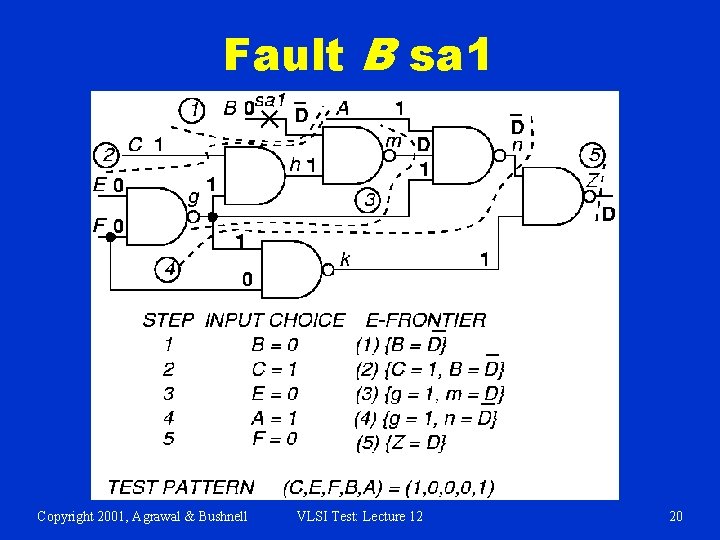
Fault B sa 1 Copyright 2001, Agrawal & Bushnell VLSI Test: Lecture 12 20
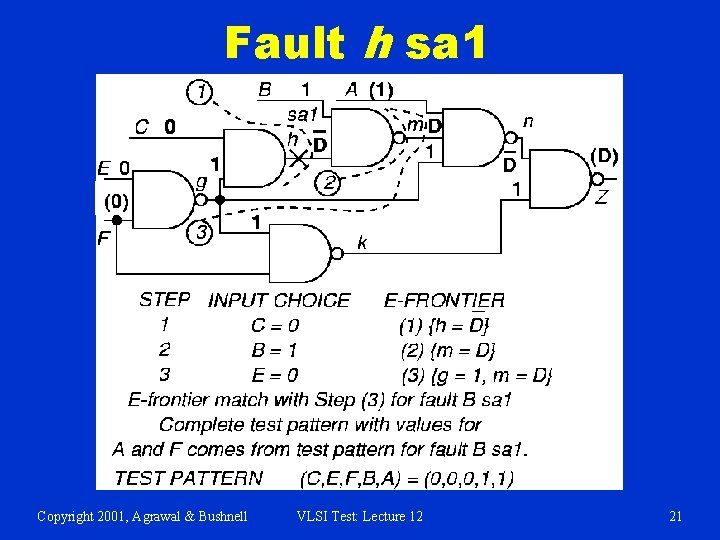
Fault h sa 1 Copyright 2001, Agrawal & Bushnell VLSI Test: Lecture 12 21
Implication Graph ATPG Chakradhar et al. (1990) § § Model logic behavior using implication graphs § Nodes for each literal and its complement § Arc from literal a to literal b means that if a = 1 then b must also be 1 Extended to find implications by using a graph transitive closure algorithm – finds paths of edges § Made much better decisions than earlier ATPG search algorithms § Uses a topological graph sort to determine order of setting circuit variables during ATPG Copyright 2001, Agrawal & Bushnell VLSI Test: Lecture 12 22
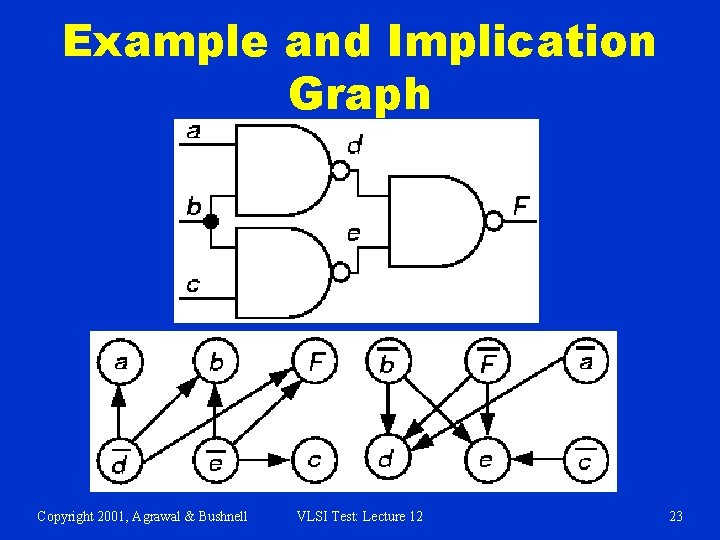
Example and Implication Graph Copyright 2001, Agrawal & Bushnell VLSI Test: Lecture 12 23
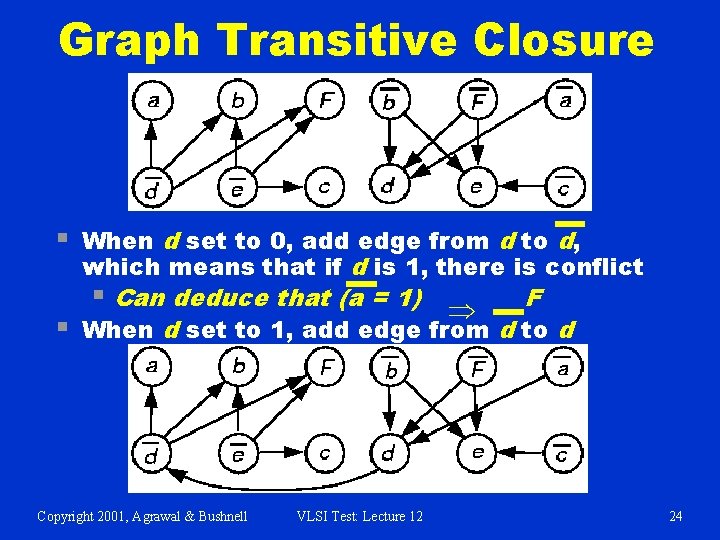
Graph Transitive Closure § § When d set to 0, add edge from d to d, which means that if d is 1, there is conflict § Can deduce that (a = 1) Þ F When d set to 1, add edge from d to d Copyright 2001, Agrawal & Bushnell VLSI Test: Lecture 12 24
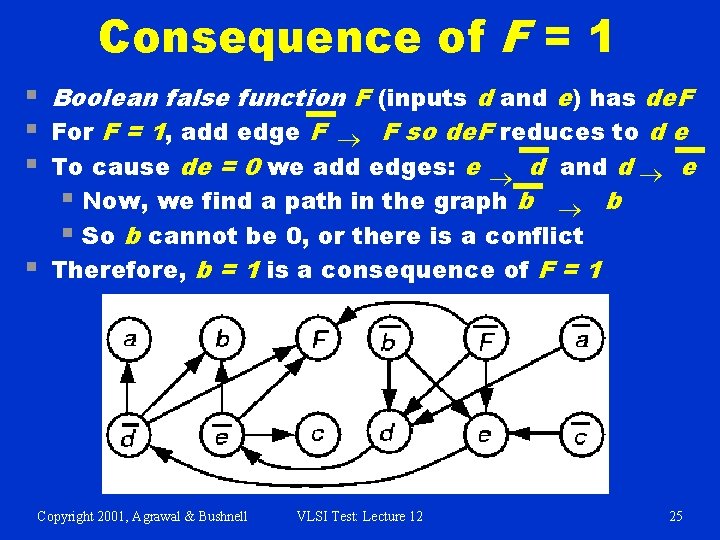
Consequence of F = 1 § Boolean false function F (inputs d and e) has de. F § For F = 1, add edge F ® F so de. F reduces to d e § To cause de = 0 we add edges: e ® d and d ® e § Now, we find a path in the graph b ® b § So b cannot be 0, or there is a conflict § Therefore, b = 1 is a consequence of F = 1 Copyright 2001, Agrawal & Bushnell VLSI Test: Lecture 12 25
Related Contributions § Larrabee – NEMESIS -- Test generation using satisfiability and implication graphs § Chakradhar, Bushnell, and Agrawal – NNATPG – ATPG using neural networks & implication graphs § Chakradhar, Agrawal, and Rothweiler – TRAN -Transitive Closure test generation algorithm § Cooper and Bushnell – Switch-level ATPG § Agrawal, Bushnell, and Lin – Redundancy identification using transitive closure § Stephan et al. – TEGUS – satisfiability ATPG § Henftling et al. and Tafertshofer et al. – ANDing node in implication graphs for efficient solution Copyright 2001, Agrawal & Bushnell VLSI Test: Lecture 12 26
Recursive Learning Kunz and Pradhan (1992) § Applied SOCRATES type learning recursively § Maximum recursion depth rmax determines what is learned about circuit § Time complexity exponential in rmax § Memory grows linearly with rmax Copyright 2001, Agrawal & Bushnell VLSI Test: Lecture 12 27
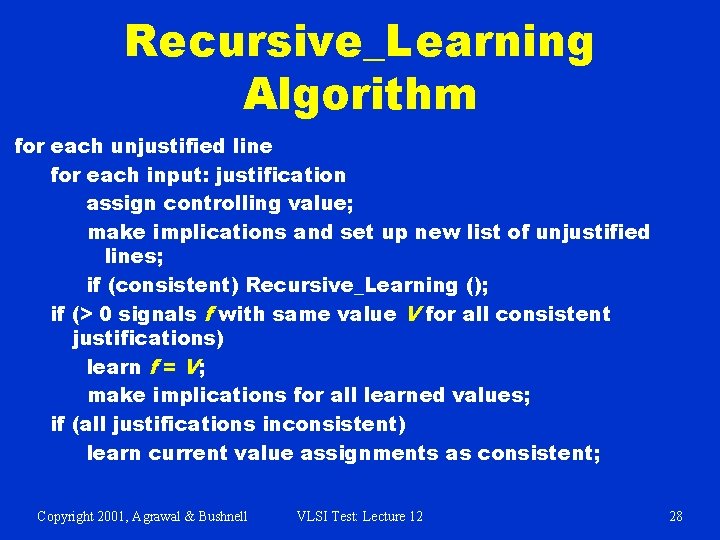
Recursive_Learning Algorithm for each unjustified line for each input: justification assign controlling value; make implications and set up new list of unjustified lines; if (consistent) Recursive_Learning (); if (> 0 signals f with same value V for all consistent justifications) learn f = V; make implications for all learned values; if (all justifications inconsistent) learn current value assignments as consistent; Copyright 2001, Agrawal & Bushnell VLSI Test: Lecture 12 28
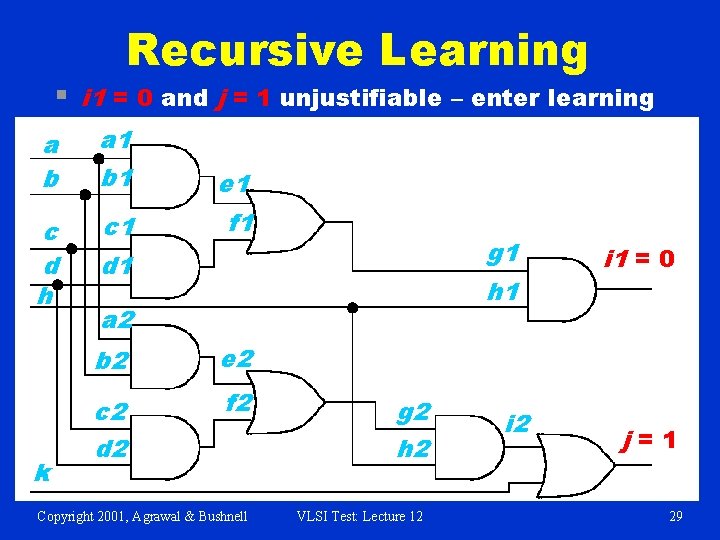
Recursive Learning § i 1 = 0 and j = 1 unjustifiable – enter learning a b a 1 b 1 e 1 c d h c 1 f 1 k g 1 d 1 h 1 a 2 b 2 e 2 c 2 d 2 f 2 Copyright 2001, Agrawal & Bushnell g 2 h 2 VLSI Test: Lecture 12 i 1 = 0 j=1 29
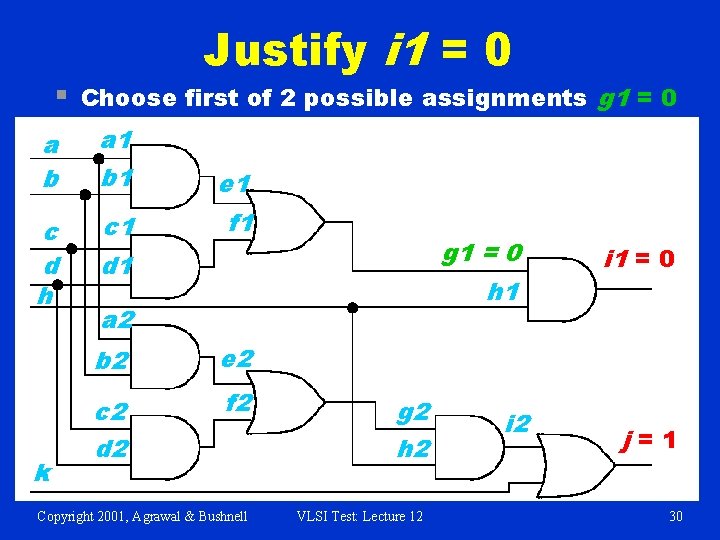
§ Justify i 1 = 0 Choose first of 2 possible assignments g 1 = 0 a b a 1 b 1 e 1 c d h c 1 f 1 k g 1 = 0 d 1 h 1 a 2 b 2 e 2 c 2 d 2 f 2 Copyright 2001, Agrawal & Bushnell g 2 h 2 VLSI Test: Lecture 12 i 1 = 0 j=1 30
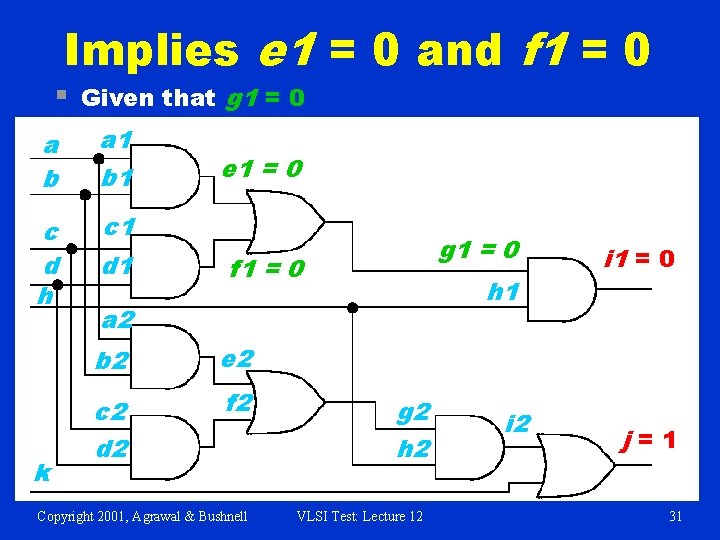
Implies e 1 = 0 and f 1 = 0 § Given that g 1 = 0 a b a 1 b 1 c d h c 1 k d 1 e 1 = 0 g 1 = 0 f 1 = 0 h 1 a 2 b 2 e 2 c 2 d 2 f 2 Copyright 2001, Agrawal & Bushnell g 2 h 2 VLSI Test: Lecture 12 i 1 = 0 j=1 31
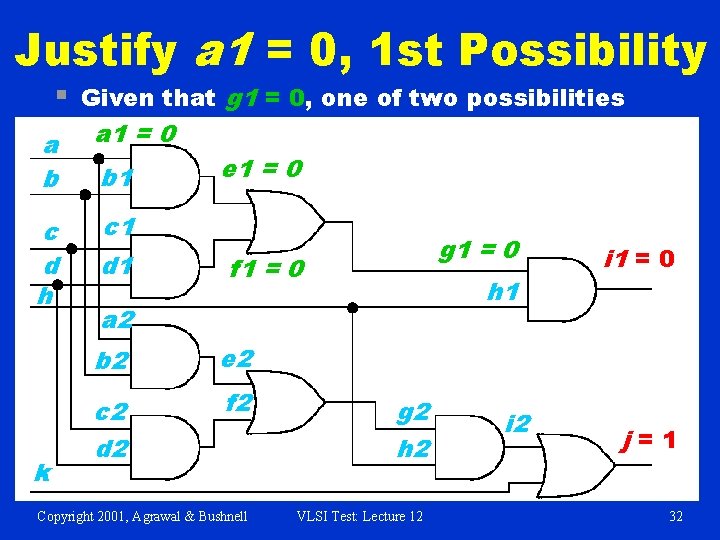
Justify a 1 = 0, 1 st Possibility § Given that g 1 = 0, one of two possibilities a b a 1 = 0 c d h c 1 k b 1 d 1 e 1 = 0 g 1 = 0 f 1 = 0 h 1 a 2 b 2 e 2 c 2 d 2 f 2 Copyright 2001, Agrawal & Bushnell g 2 h 2 VLSI Test: Lecture 12 i 1 = 0 j=1 32
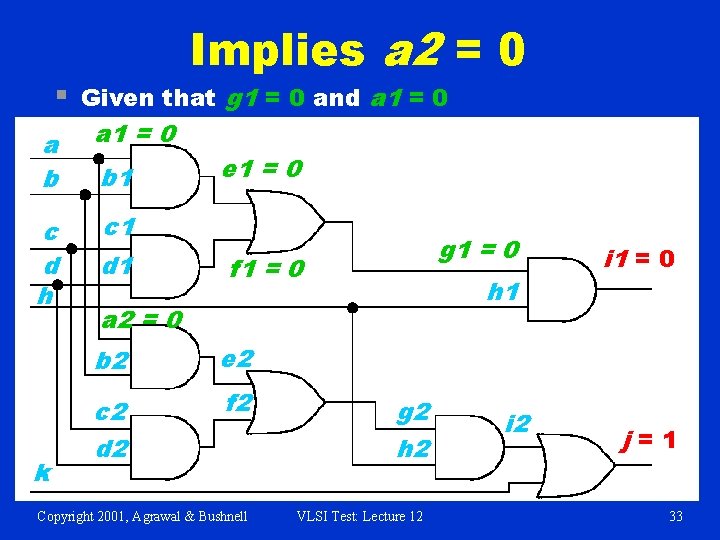
§ Implies a 2 = 0 Given that g 1 = 0 and a 1 = 0 a b a 1 = 0 c d h c 1 k b 1 d 1 e 1 = 0 g 1 = 0 f 1 = 0 h 1 a 2 = 0 b 2 e 2 c 2 d 2 f 2 Copyright 2001, Agrawal & Bushnell g 2 h 2 VLSI Test: Lecture 12 i 1 = 0 j=1 33
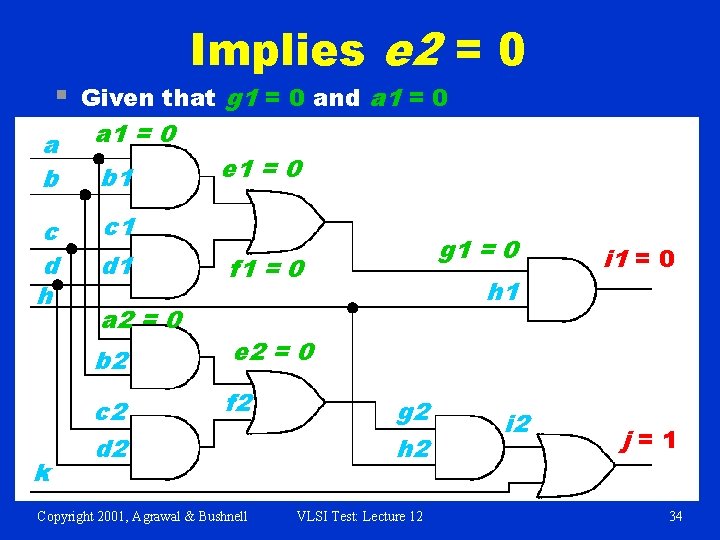
§ Implies e 2 = 0 Given that g 1 = 0 and a 1 = 0 a b a 1 = 0 c d h c 1 k b 1 d 1 a 2 = 0 e 1 = 0 g 1 = 0 f 1 = 0 b 2 e 2 = 0 c 2 d 2 f 2 Copyright 2001, Agrawal & Bushnell h 1 g 2 h 2 VLSI Test: Lecture 12 i 1 = 0 j=1 34
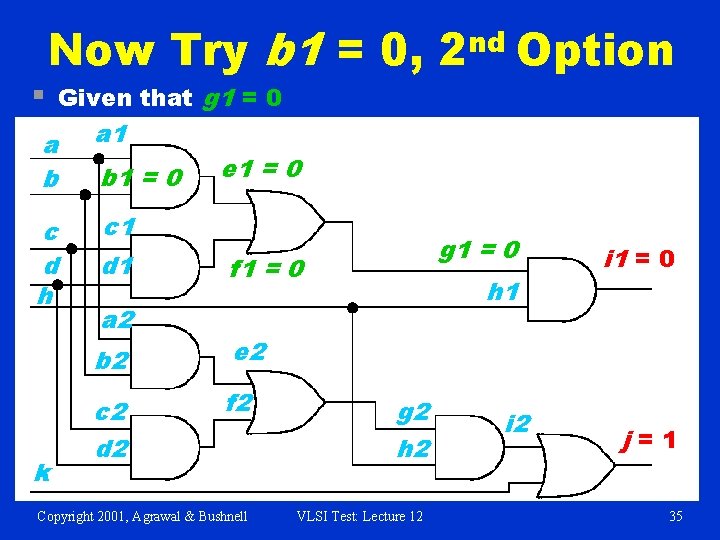
§ Now Try b 1 = 0, Given that g 1 = 0 a b a 1 c d h c 1 k b 1 = 0 d 1 a 2 nd 2 Option e 1 = 0 g 1 = 0 f 1 = 0 b 2 e 2 c 2 d 2 f 2 Copyright 2001, Agrawal & Bushnell h 1 g 2 h 2 VLSI Test: Lecture 12 i 1 = 0 j=1 35
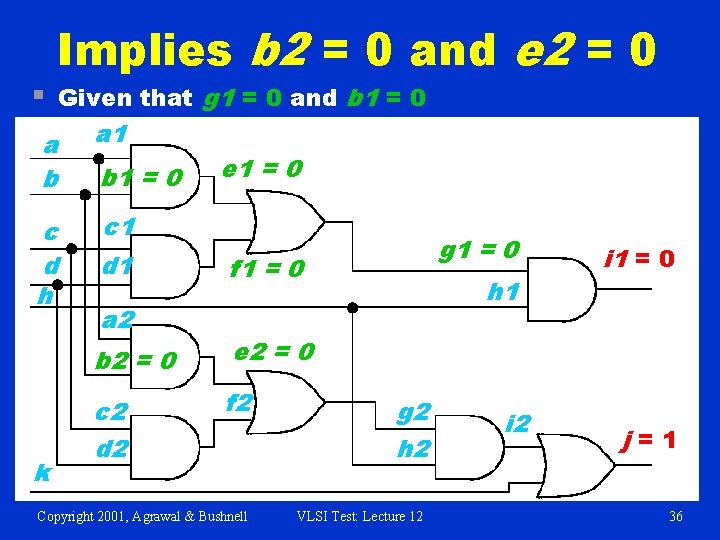
§ Implies b 2 = 0 and e 2 = 0 Given that g 1 = 0 and b 1 = 0 a b a 1 c d h c 1 k b 1 = 0 d 1 a 2 e 1 = 0 g 1 = 0 f 1 = 0 b 2 = 0 e 2 = 0 c 2 d 2 f 2 Copyright 2001, Agrawal & Bushnell h 1 g 2 h 2 VLSI Test: Lecture 12 i 1 = 0 j=1 36
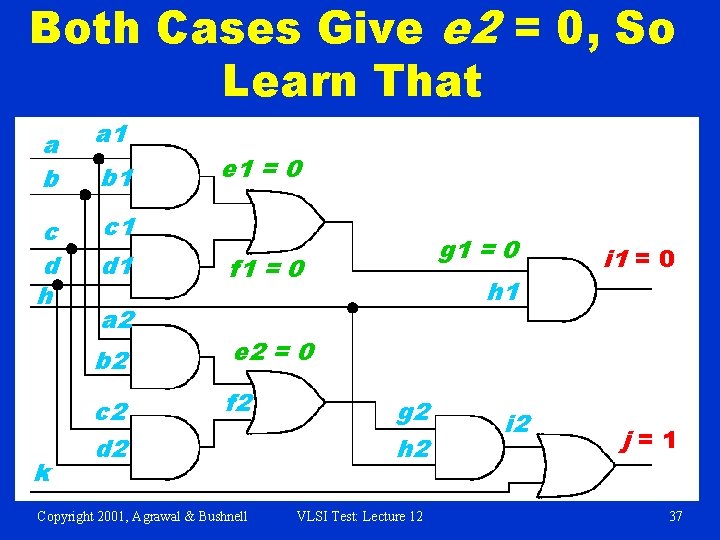
Both Cases Give e 2 = 0, So Learn That a b a 1 c d h c 1 k b 1 d 1 a 2 e 1 = 0 g 1 = 0 f 1 = 0 b 2 e 2 = 0 c 2 d 2 f 2 Copyright 2001, Agrawal & Bushnell h 1 g 2 h 2 VLSI Test: Lecture 12 i 1 = 0 j=1 37
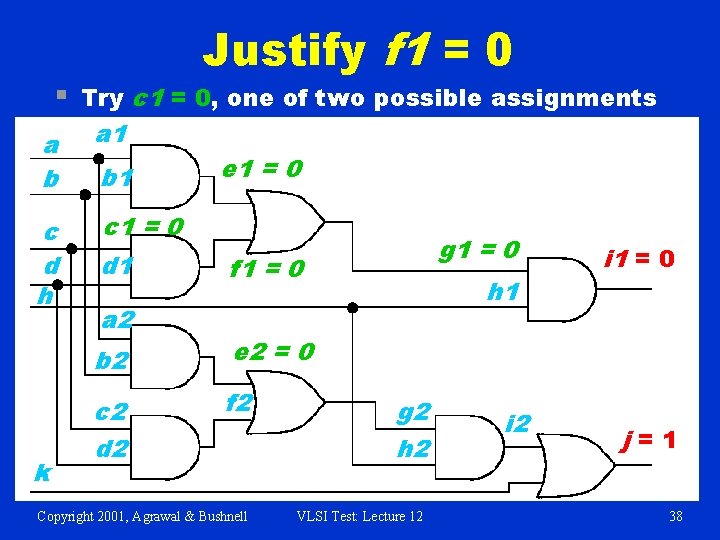
§ Justify f 1 = 0 Try c 1 = 0, one of two possible assignments a b a 1 c d h c 1 = 0 k b 1 d 1 a 2 e 1 = 0 g 1 = 0 f 1 = 0 b 2 e 2 = 0 c 2 d 2 f 2 Copyright 2001, Agrawal & Bushnell h 1 g 2 h 2 VLSI Test: Lecture 12 i 1 = 0 j=1 38
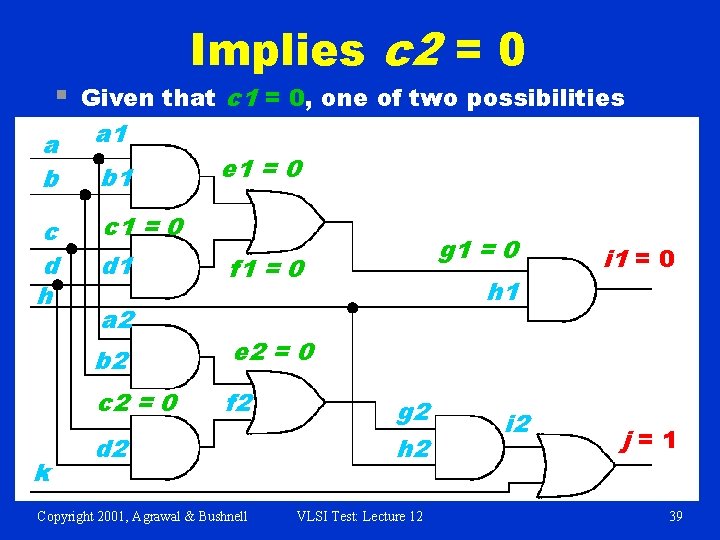
§ Implies c 2 = 0 Given that c 1 = 0, one of two possibilities a b a 1 c d h c 1 = 0 k b 1 d 1 a 2 e 1 = 0 g 1 = 0 f 1 = 0 b 2 e 2 = 0 c 2 = 0 f 2 d 2 Copyright 2001, Agrawal & Bushnell h 1 g 2 h 2 VLSI Test: Lecture 12 i 1 = 0 j=1 39
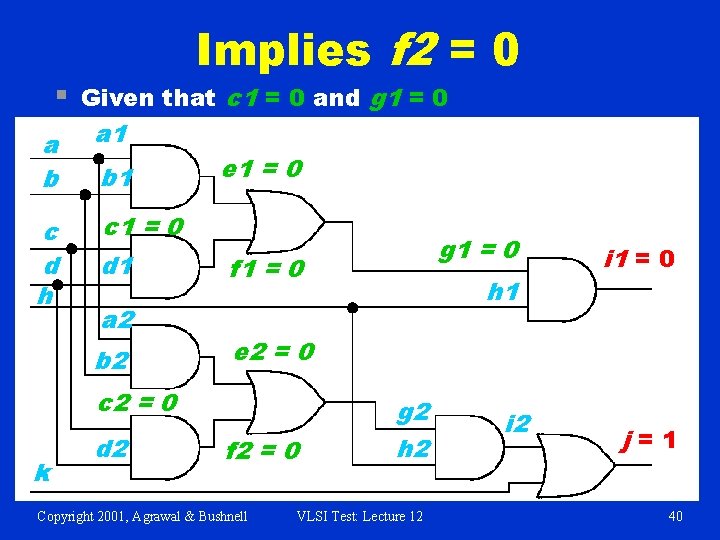
§ Implies f 2 = 0 Given that c 1 = 0 and g 1 = 0 a b a 1 c d h c 1 = 0 b 1 d 1 a 2 b 2 e 1 = 0 f 1 = 0 k h 1 i 1 = 0 e 2 = 0 c 2 = 0 d 2 g 1 = 0 f 2 = 0 Copyright 2001, Agrawal & Bushnell g 2 h 2 VLSI Test: Lecture 12 i 2 j=1 40
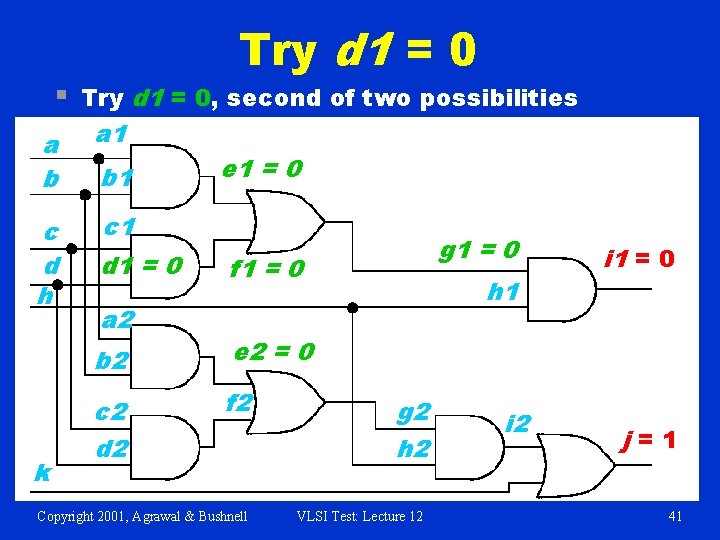
§ Try d 1 = 0, second of two possibilities a b a 1 c d h c 1 k b 1 d 1 = 0 a 2 e 1 = 0 g 1 = 0 f 1 = 0 b 2 e 2 = 0 c 2 d 2 f 2 Copyright 2001, Agrawal & Bushnell h 1 g 2 h 2 VLSI Test: Lecture 12 i 1 = 0 j=1 41
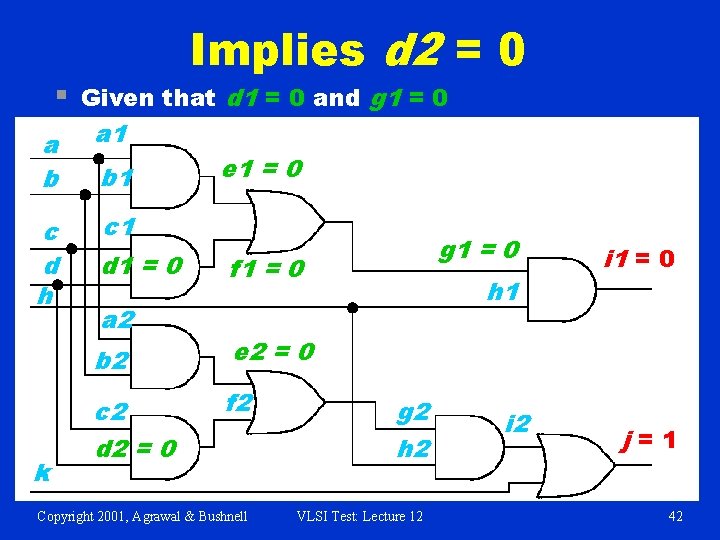
§ Implies d 2 = 0 Given that d 1 = 0 and g 1 = 0 a b a 1 c d h c 1 k b 1 d 1 = 0 a 2 e 1 = 0 g 1 = 0 f 1 = 0 b 2 e 2 = 0 c 2 d 2 = 0 f 2 Copyright 2001, Agrawal & Bushnell h 1 g 2 h 2 VLSI Test: Lecture 12 i 1 = 0 j=1 42
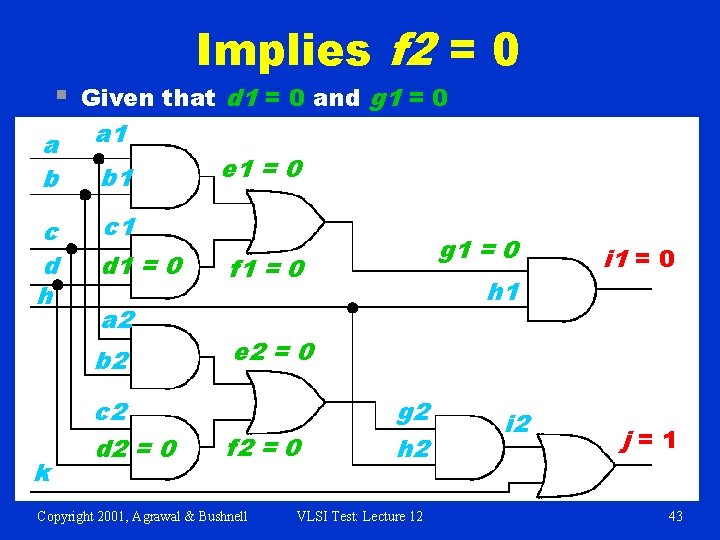
§ Implies f 2 = 0 Given that d 1 = 0 and g 1 = 0 a b a 1 c d h c 1 b 1 d 1 = 0 a 2 b 2 k c 2 d 2 = 0 e 1 = 0 g 1 = 0 f 1 = 0 h 1 i 1 = 0 e 2 = 0 f 2 = 0 Copyright 2001, Agrawal & Bushnell g 2 h 2 VLSI Test: Lecture 12 i 2 j=1 43
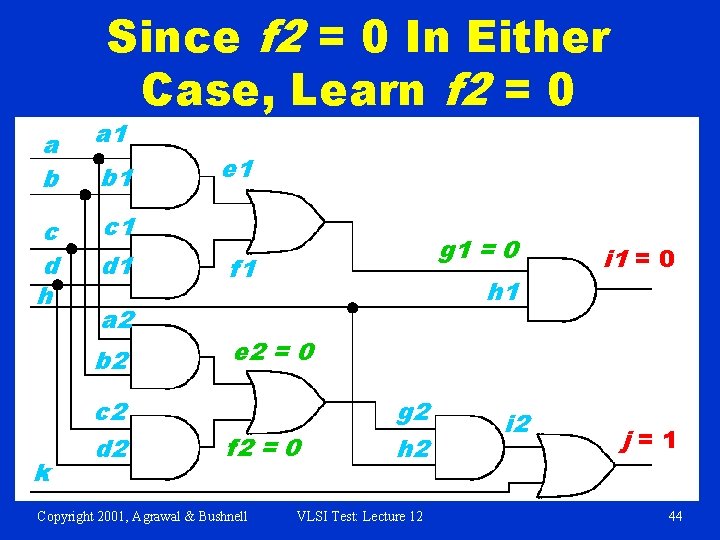
Since f 2 = 0 In Either Case, Learn f 2 = 0 a b a 1 c d h c 1 b 1 d 1 a 2 b 2 k c 2 d 2 e 1 g 1 = 0 f 1 h 1 i 1 = 0 e 2 = 0 f 2 = 0 Copyright 2001, Agrawal & Bushnell g 2 h 2 VLSI Test: Lecture 12 i 2 j=1 44
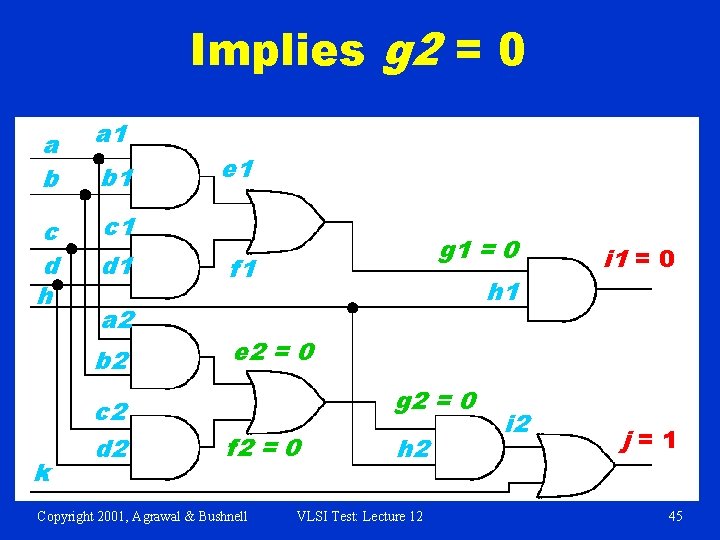
Implies g 2 = 0 a b a 1 c d h c 1 b 1 d 1 a 2 b 2 k c 2 d 2 e 1 g 1 = 0 f 1 h 1 i 1 = 0 e 2 = 0 g 2 = 0 f 2 = 0 Copyright 2001, Agrawal & Bushnell h 2 VLSI Test: Lecture 12 i 2 j=1 45
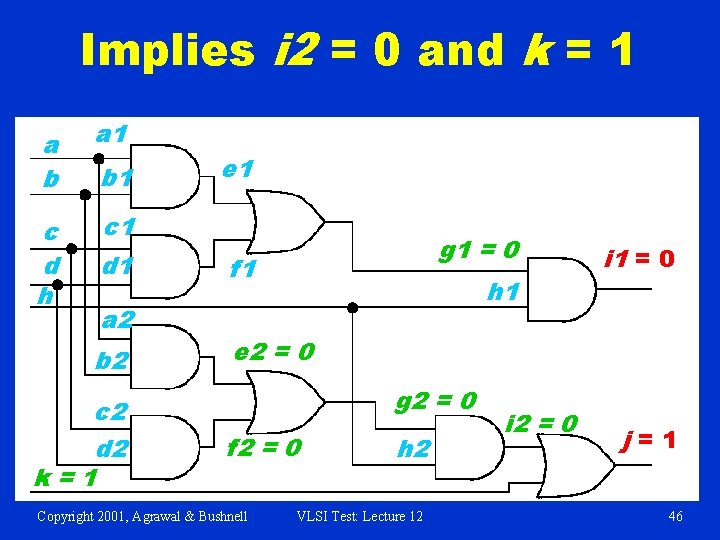
Implies i 2 = 0 and k = 1 a b a 1 c d h c 1 b 1 d 1 a 2 b 2 c 2 d 2 k=1 e 1 g 1 = 0 f 1 h 1 i 1 = 0 e 2 = 0 g 2 = 0 f 2 = 0 Copyright 2001, Agrawal & Bushnell h 2 VLSI Test: Lecture 12 i 2 = 0 j=1 46
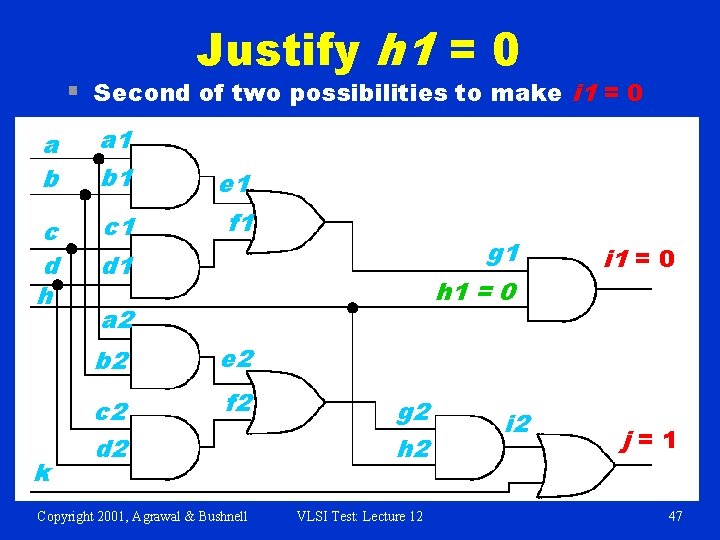
Justify h 1 = 0 § Second of two possibilities to make i 1 = 0 a b a 1 b 1 e 1 c d h c 1 f 1 k g 1 d 1 h 1 = 0 a 2 b 2 e 2 c 2 d 2 f 2 Copyright 2001, Agrawal & Bushnell g 2 h 2 VLSI Test: Lecture 12 i 1 = 0 j=1 47
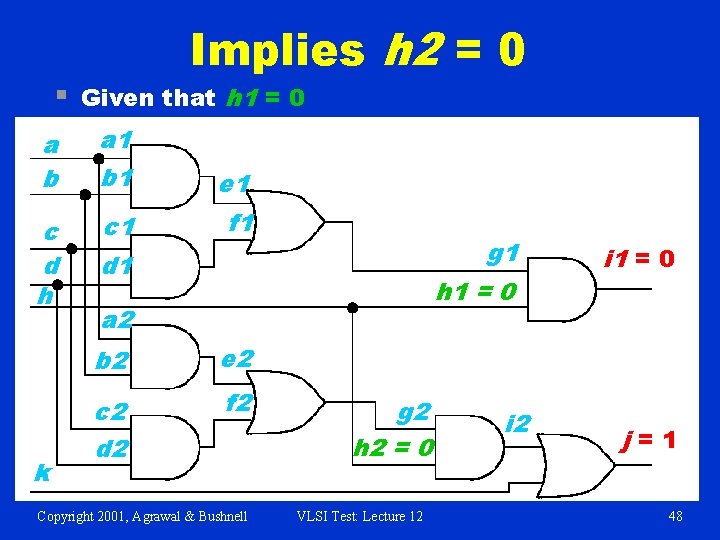
§ Implies h 2 = 0 Given that h 1 = 0 a b a 1 b 1 e 1 c d h c 1 f 1 k g 1 d 1 h 1 = 0 a 2 b 2 e 2 c 2 d 2 f 2 Copyright 2001, Agrawal & Bushnell g 2 h 2 = 0 VLSI Test: Lecture 12 i 1 = 0 j=1 48
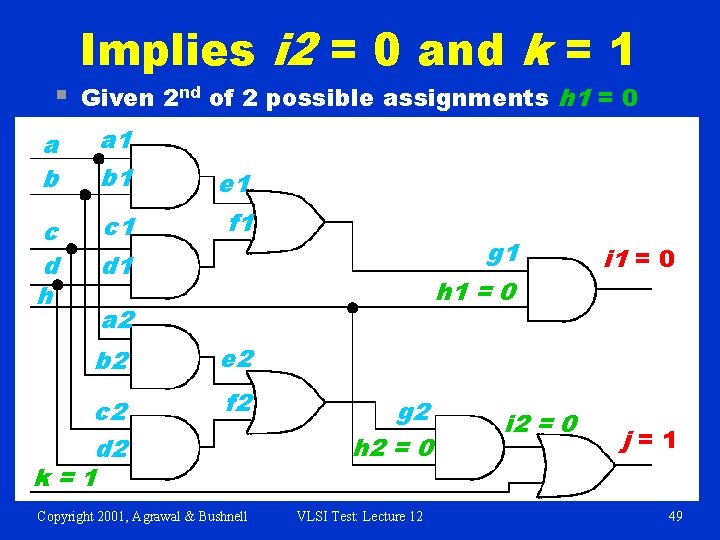
§ Implies i 2 = 0 and k = 1 Given 2 nd of 2 possible assignments h 1 = 0 a b a 1 b 1 e 1 c d h c 1 f 1 g 1 d 1 h 1 = 0 a 2 b 2 e 2 c 2 d 2 k=1 f 2 Copyright 2001, Agrawal & Bushnell g 2 h 2 = 0 VLSI Test: Lecture 12 i 2 = 0 i 1 = 0 j=1 49
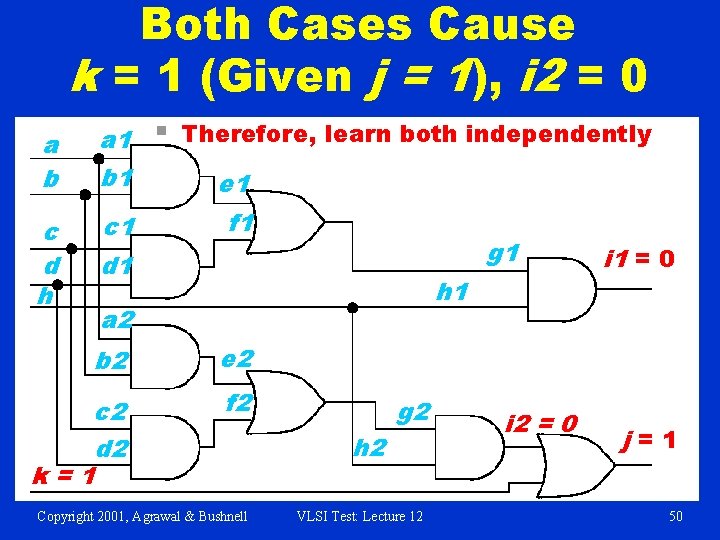
Both Cases Cause k = 1 (Given j = 1), i 2 = 0 a b a 1 b 1 c d h c 1 § Therefore, learn both independently e 1 f 1 g 1 d 1 h 1 a 2 b 2 e 2 c 2 d 2 k=1 f 2 Copyright 2001, Agrawal & Bushnell g 2 h 2 VLSI Test: Lecture 12 i 2 = 0 i 1 = 0 j=1 50
Other ATPG Algorithms § § Legal assignment ATPG (Rajski and Cox) § Maintains power-set of possible assignments on each node {0, 1, D, D, X} BDD-based algorithms § Catapult (Gaede, Mercer, Butler, Ross) § Tsunami (Stanion and Bhattacharya) – maintains BDD fragment along fault propagation path and incrementally extends it § Unable to do highly reconverging circuits (parallel multipliers) because BDD essentially becomes infinite Copyright 2001, Agrawal & Bushnell VLSI Test: Lecture 12 51
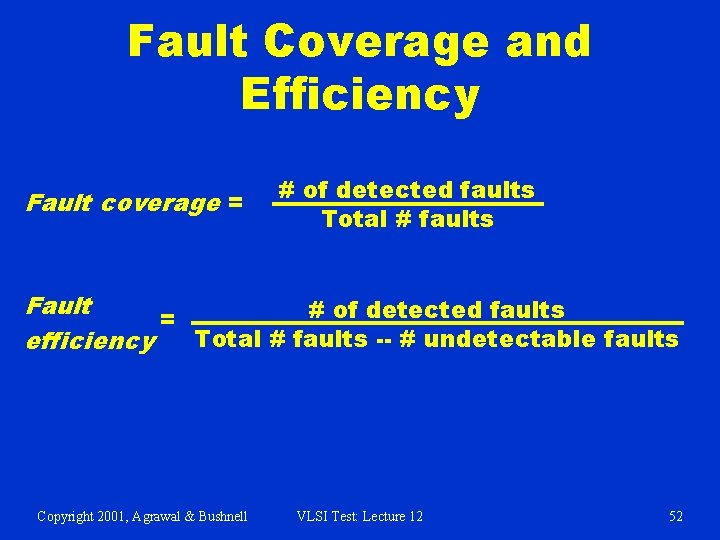
Fault Coverage and Efficiency Fault coverage = # of detected faults Total # faults Fault # of detected faults = Total # faults -- # undetectable faults efficiency Copyright 2001, Agrawal & Bushnell VLSI Test: Lecture 12 52
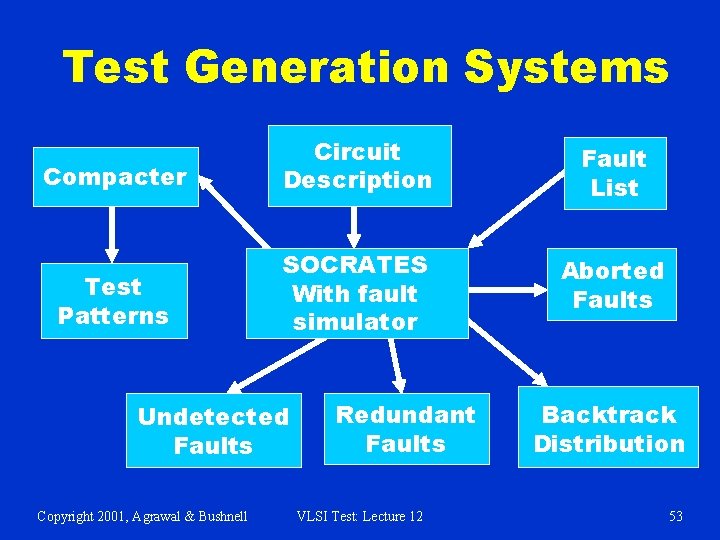
Test Generation Systems Compacter Circuit Description Fault List Test Patterns SOCRATES With fault simulator Aborted Faults Undetected Faults Copyright 2001, Agrawal & Bushnell Redundant Faults VLSI Test: Lecture 12 Backtrack Distribution 53
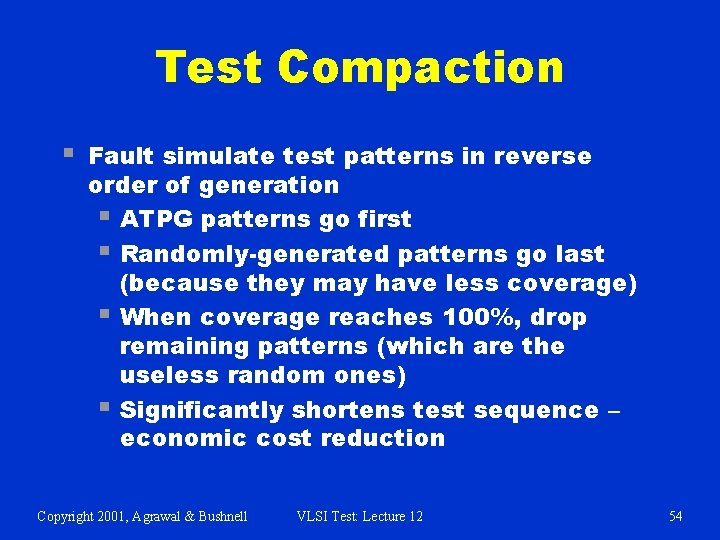
Test Compaction § Fault simulate test patterns in reverse order of generation § ATPG patterns go first § Randomly-generated patterns go last (because they may have less coverage) § When coverage reaches 100%, drop remaining patterns (which are the useless random ones) § Significantly shortens test sequence – economic cost reduction Copyright 2001, Agrawal & Bushnell VLSI Test: Lecture 12 54
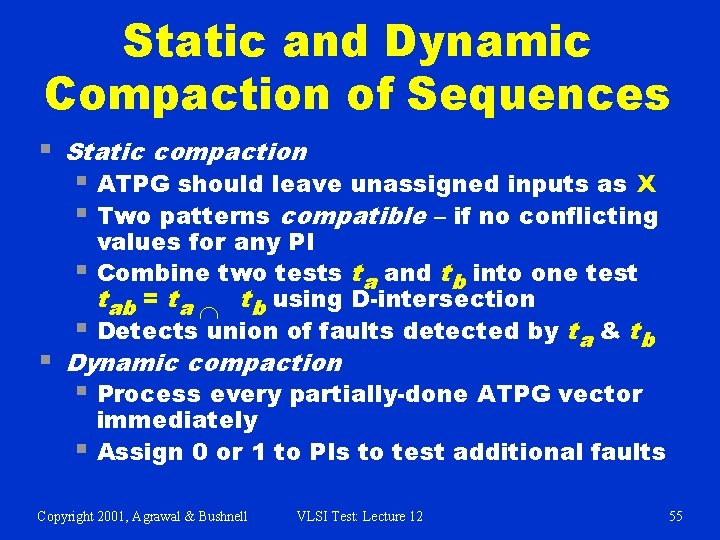
Static and Dynamic Compaction of Sequences § Static compaction § ATPG should leave unassigned inputs as X § Two patterns compatible – if no conflicting § values for any PI Combine two tests ta and tb into one test tab = ta Ç tb using D-intersection Detects union of faults detected by ta & tb § immediately Assign 0 or 1 to PIs to test additional faults § § Dynamic compaction § Process every partially-done ATPG vector Copyright 2001, Agrawal & Bushnell VLSI Test: Lecture 12 55
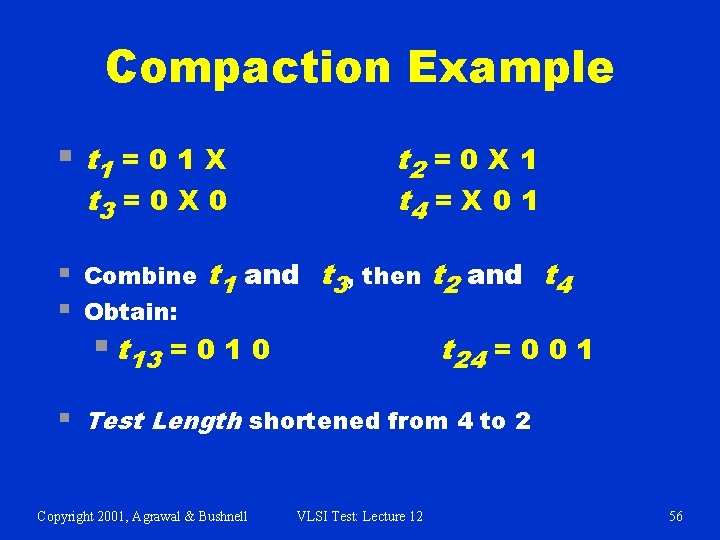
Compaction Example § t 1 = 0 1 X t 2 = 0 X 1 t 4 = X 0 1 t 3 = 0 X 0 § § Combine t 1 and Obtain: t 3, then t 2 and t 4 § t 13 = 0 1 0 t 24 = 0 0 1 § Test Length shortened from 4 to 2 Copyright 2001, Agrawal & Bushnell VLSI Test: Lecture 12 56
Summary § § § Test Bridging, Stuck-at, Delay, & Transistor Faults § Must handle non-Boolean tri-state devices, buses, & bidirectional devices (pass transistors) Hierarchical ATPG -- 9 Times speedup (Min) § Handles adders, comparators, MUXes § Compute propagation D-cubes § Propagate and justify fault effects with these § Use internal logic description for internal faults Results of 40 years research – mature – methods: § Path sensitization § Simulation-based § Boolean satisfiability and neural networks Copyright 2001, Agrawal & Bushnell VLSI Test: Lecture 12 57
- Slides: 57