
Lecture 12 1 Structure of GI book 4
Lecture 12 (1) Structure of GI book 4 – Procedure – The Formulary System (2) Basic Introduction to the XII Tables
![Procedure (GI. 4. 1– 187) [procedure] actions 1– 114 exceptions 115– 137 interdicts 138–](http://slidetodoc.com/presentation_image_h2/1885ea744f76dff0ec591ef9ace14ed2/image-2.jpg "Procedure (GI. 4. 1– 187) [procedure] actions 1– 114 exceptions 115– 137 interdicts 138–")
Procedure (GI. 4. 1– 187) [procedure] actions 1– 114 exceptions 115– 137 interdicts 138– 170 abuse of process summons 171– 182 183 -187
Procedure – Actions (GI. 4. 1– 114) Actio is derived from agere, a basic Latin verb that means ‘to do’, in the sense of ‘put in motion’. In law actio refers to both the capacity to complain and the procedure of complaining, but in classical law it always implies bifurcated proceedings. The praetor’s dabo actionem, ‘I will give an action’, implies a preference for proceedings apud iudicem. If this is right, then the scheme of Gaius’ book 4 becomes clear. It deals with civil legal proceedings, normally contested ones, but there is no general term for it. The most important topic within that category is actions. Some things that don’t have to do with actions but with defenses or the defendant get attached by convenience.
![Procedure – Actions (GI. 4. 1– 114) (cont’d) [procedure] actions 1– 114 exceptions 115–](http://slidetodoc.com/presentation_image_h2/1885ea744f76dff0ec591ef9ace14ed2/image-4.jpg "Procedure – Actions (GI. 4. 1– 114) (cont’d) [procedure] actions 1– 114 exceptions 115–")
Procedure – Actions (GI. 4. 1– 114) (cont’d) [procedure] actions 1– 114 exceptions 115– 137 interdicts 138– 170 abuse of process summons 171– 182 183 -187 in general legis actiones formulae representation 1– 10 11– 30 30– 68 69– 87 security 88– 102 extinction 103– 114
![Procedure – Exceptions (GI. 4. 115– 137) [procedure] actions 1– 114 exceptions 115– 137](http://slidetodoc.com/presentation_image_h2/1885ea744f76dff0ec591ef9ace14ed2/image-5.jpg "Procedure – Exceptions (GI. 4. 115– 137) [procedure] actions 1– 114 exceptions 115– 137")
Procedure – Exceptions (GI. 4. 115– 137) [procedure] actions 1– 114 exceptions 115– 137 exceptions 115– 125 interdicts 138– 170 replications 126– 129 abuse of process summons 171– 182 183 -187 prescriptions 130– 137
Procedure – Exceptions (GI. 4. 115– 137) (cont’d) Prescriptions are in a queer place: after exceptions and replications. They were written at the head of the formula to avoid extinction. For example if I am suing on an obligation to pay a debt owed in installments, I will put a prescription at the head of the formula to say that I am suing only for the installment due now. Perhaps Gaius put them where he did because they can be raised by either party.
Procedure – Interdicts, Abuse of Process, Summons (GI. 4. 137– 187) • Interdicts are where they are because they are not actions; they have no proceedings apud iudicem. • Abuse of process can apply to either the plaintiff or the defendant, but it may be significant that Gaius begins with the defendant. • Summons is not an action. The fact that it is at the end should strike us as really odd. All the medieval treatises on procedure begin with it. As Bracton says in another context “You must first catch your buck before you skin it. ” I think what this is may be telling us is that Gaius was not training litigating lawyers. Perhaps he was training bureaucrats; perhaps he was training budding jurists. Jurists, however, were not litigating lawyers.
![Procedure – Actions – In General (GI. 4. 1– 10) [procedure] actions 1– 114](http://slidetodoc.com/presentation_image_h2/1885ea744f76dff0ec591ef9ace14ed2/image-8.jpg "Procedure – Actions – In General (GI. 4. 1– 10) [procedure] actions 1– 114")
Procedure – Actions – In General (GI. 4. 1– 10) [procedure] actions 1– 114 exceptions 115– 137 interdicts 138– 170 abuse of process summons 171– 182 183 -187 in general legis actiones formulae representation 1– 10 11– 30 30– 68 69– 87 in rem / in personam reipersecutory/penal/mixed 1– 5 6– 9 security 88– 102 extinction 103– 114 ad legis actionem / sua vi 10
Procedure – Actions – In General (GI. 4. 1– 10) (cont’d) • In rem vs. in personam we have already discussed at some length. It is the basic and problematic distinction between property and obligation. • Reipersecutory vs. penal vs. mixed applies principally to obligations, because Gaius does not regard in rem actions as reipersecutory. How, he asks, can we sue for something that is already ours? Hence, his distinction corresponds fairly closely to our distinction between compensatory damages and penal damages, except, as we have seen, all the delicts have a penal element. All contractual actions, Gaius tells us, are reipersecutory only. He regards the actions for furtum and iniuria as penal only. (He apparently does not regard the condictio for stolen goods as part of the furtum action. ) The mixed actions are those where the defendant has to pay double damages if s/he denies liability.
Procedure – Actions – In General (GI. 4. 1– 10) (cont’d) • Ad legis actionem vs. sua vi, ‘on the model of a legis actio’ vs. ‘on their own force’, we have not seen before. Gaius says little about it because the mention of legis actio brings him right into his excursus on the legis actiones. The link may be to fictitious formulae in §§ 32 -38, which follows after the excursus on the legis actiones. It is possible that Gaius was thinking that all civil-law actions were modelled after the legis actiones, and that he is referring to praetorian actions as those arising sua vi. But that is almost certainly not right as an historical matter, and G. probably knew that. That fictions come first in the treatment of the formulae suggests, perhaps, a priority in time. This passage may be a source of Maine’s dictum that change in the law comes as a result of fiction, equity, and legislation in that order. Gaius’ order certainly suggests the priority in time of the legis actiones.
Procedure (GI. 4. 1– 187) (concluded) We said that this book is about procedure, but that the Romans did not have a word for it. That they had the concept I think is pretty clear. All the topics treated here are topics that we would call procedural, and the description of books 2 and 3 as being about res can bear the translation that they are about substance, one of the many possible meanings of the word res. What we do not find anyplace in the classical jurists is an express distinction between substance and procedure. That, as I have suggested before, may be the result of the fact that they did not see the two as separate, but intertwined.
Procedure (Justinian, book 4) Justinian does not begin the topic of procedure until title 6 of book 4. He then gets sidetracked with titles on contracts made with persons in power, noxal actions (an archaic institution that G. treats with only briefly), pauperies (and even more archaic institution that G. doesn’t deal with at all) before returning to titles on representation, security, extinction of actions, exceptions, replications, interdicts, penalties for reckless litigation, the duties of the judge, and public criminal actions, all except for the last two being topics that Gaius treats. In the process J. takes out everything that shows how the formulary system worked without substituting much that shows how the extraordinaria cognitio worked. When the medieval jurists created Romano-canonical procedures, the direct ancestor of both the civil and criminal procedure of Continental Europe today, they basically were creating a new entity, half imaginative reconstruction of what the extraordinaria cognitio might have been and half what has to be there in order to make it work.
Gaius’ Institutes Summary One should try to summarize this long exercise on Gaius and his categories, but any summary would be incomplete at this point. I said when we began the exercise that I thought that lawyers’ categories were important but that in order to do real legal history one had to do more. The second part of this course is designed to prove that point. But we will constantly be returning to the categories, not only as benchmarks from which to begin discussion but also to ask the question what effect did they have.
Introduction to the XII Tables • What are we trying to do in the next two parts of the course? (a) real history, (b) law and society, (c) juristic method. • How are we going to do the XII Tables? Go through the XII Tables topic by topic, with the aid of Alan Watson’s Rome of the Twelve Tables, on Canvas under ‘Files’. No prerecorded lectures except at the end. Read the primary Materials, and Watson if you can. React to them on the Discussion Board in Canvas. Watson does not do procedure or delicts separately; so we’ll have to strike out on our own at the beginning and at the end.
Approaches to the XII Tables and the History of Law and Society Generally The name of the game is law and society, and the problem is that we don’t know nearly as much as we would like to know about either in 450 B. C. Watson is cautious, perhaps overly cautious. His fundamental methodological point is that you can posit neither a state of law nor a state of society on the basis of the knowledge of the other. Further, he will admit the use of comparative material only to the extent that he has direct but incomplete evidence of a phenomenon in the society which he is studying. He also believes that subsequent developments in a legal system can be used to describe what the prior legal system was like. The Roman law of persons and property reflects a continuous development from the time of the XII. In the Roman law of delicts and procedure, on the other hand, there were radical breaks. Hence, Watson largely confines himself to persons and property.
Approaches to the XII Tables and the History of Law and Society Generally (cont’d) I agree with Watson that it is the sheerest of speculation to posit a state of a society from its laws, if one knows nothing about the society; and that the converse is perhaps even more dangerous. The relationship between law and society is not that tight, or at least no one has come up with a predictive theory that will hold up. But the fact is that we are not trying to reconstruct Roman society in 450 B. C. from the fragments of the XII alone, nor are we trying to reconstruct the XII from what Cicero, Livy, Dionysius of Halicarnassus, Plutarch, and the archaeological remains tell us about the state of society. We have some evidence about the law and some evidence about the society, but not as much as we would like. The question is what can we use to fill in these gaps?
Approaches to the XII Tables and the History of Law and Society Generally (cont’d) • Diachronic. Watson makes considerable use of it. You take a point in time when you are reasonably clear what the law was and try to reason to back to what it must have been like in some prior time. • Synchronic. Here much depends on what chronology you are talking about: • Social anthropology • Ancient law • Literate peoples of the Mediterranean basin • Indo-European
Approaches to the XII Tables and the History of Law and Society Generally – Social Anthropology • Here our chronology may be more imagined than real. Roman society in the mid-5 th century BC had households organized under the control of a single male (hence, patriarchal), a kinship pattern that emphasized relationships through males (hence, patrilineal), and households were located where the male figure was and the wife came to live there (hence, patrilocal). The predominant economic activity was agriculture. The society was organized for war and fought with its neighbors frequently. The basic element in the military was the quite heavily armed foot soldier. The society had a dominant class that thought of itself as being organized into clans. It also had an underclass which had a group identity. Below both was a rather large population of enslaved people. All, both slave and free, shared a common religion. How far can we go to filling in what we don’t know about this society with evidence from other societies that share those characteristics?
Approaches to the XII Tables and the History of Law and Society Generally – ‘Ancient Law’ • The laws of the literate peoples of the Mediterranean basin. E. g. , the laws of Athens in the 5 th century BC. E. g. , The code of Gortyn, a city in central Crete, deals with many topics that are also found in the XII Tables. (6 th– 5 th century BC). The Semitic peoples of the Mediterranean had their own laws. E. g. the Jewish law as found in the Hebrew Bible (? 1000– 500 BC). • A very large number of European and Asian languages, including the Celtic languages, the Germanic languages, Latin, Greek, the Iranian languages, and some of the languages of India, notably Hindi, ultimately derive from a hypothetical proto. Indo-European language that was spoken by a people that probably lived on the steppes north of and between the Black and Caspian Seas around 4000 BC.
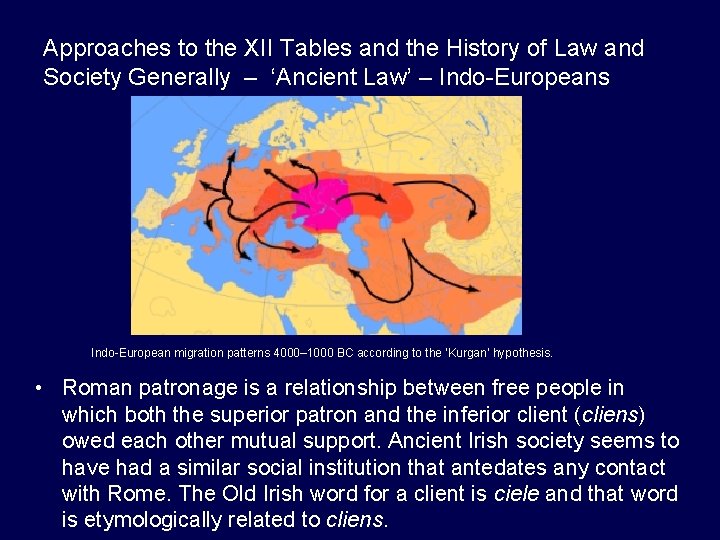
Approaches to the XII Tables and the History of Law and Society Generally – ‘Ancient Law’ – Indo-Europeans Indo-European migration patterns 4000– 1000 BC according to the ‘Kurgan’ hypothesis. • Roman patronage is a relationship between free people in which both the superior patron and the inferior client (cliens) owed each other mutual support. Ancient Irish society seems to have had a similar social institution that antedates any contact with Rome. The Old Irish word for a client is ciele and that word is etymologically related to cliens.
Approaches to the XII Tables and the History of Law and Society Generally – Dangers of Each Approach • The diachronic approach can lead to the conclusion that law develops largely as the result of an autonomous group of professionals manipulating their law within a closed system. The danger is particularly prominent in societies that, like the Roman, had a group of semi-autonomous professionals who specialized in private law. Watson seems to fall into this trap with regard to patria potestas. • The social anthropological approach can lead to positing institutions in a society that they, in fact, do not have. Fustel de Coulanges did fall into this trap with regard to male primogeniture. • The only way to stay out of the traps is carefully to define in advance what you know and don’t know, what your methodological assumptions are, and what questions you want to answer.
Approaches to the XII Tables and the History of Law and Society Generally – Theories of Causation • Law is the product of autonomous development by professionals, frequently if not always, unrelated to social and economic forces. • Social and economic structure determines what the law is. • Law is determined by culture, and culture is a pattern of thought largely determined by language. • If one is inclined to the eclectic when faced with potentially univocal choices among these three, then what is likely to be the dominant force in each particular area?
The XII Tables – The Circumstances of Their Adoption • We have 2 narrative accounts of the passage of the XII Tables, one in Livy, the other in Dionysius of Halicarnassus, roughly a contemporary of Livy’s who wrote in Greek a book called Roman Antiquities. There is also some information on the topic in the surviving parts of Cicero’s On the Republic. There is certainly much in these accounts that is demonstrably legendary. We follow Livy’s account, though with caution. • The whole of the first part of Livy has been devoted to the struggle between patrician and plebeian, and to the struggle against the Etruscan rulers of Rome. While there is much in Livy’s account, particularly of the former, that is anachronistic – he saw the struggle between patrician and plebeian as like the struggle between the optimates and populares of more recent Roman history – there is no sound reason to doubt the basic historicity of Livy’s account.
The XII Tables – Livy’s Account of Their Adoption • Rome gradually freed itself from Etruscan rulers and Etruscan influence, probably between the years 500 BC and 450 BC. “Lars Porsena of Clusium by the nine gods he swore that the great house of Tarquin should suffer wrong no more. ” (T. B. Macaulay, ‘Horatius’. ) There was a break. • Nor do we have any reason to doubt that the chief issues in the social struggle were debt and the power of the tribunes of the plebs. In 494 Livy reports the plebeians refused to fight, and some such revolt is probably historical though it may not have happened in 494.
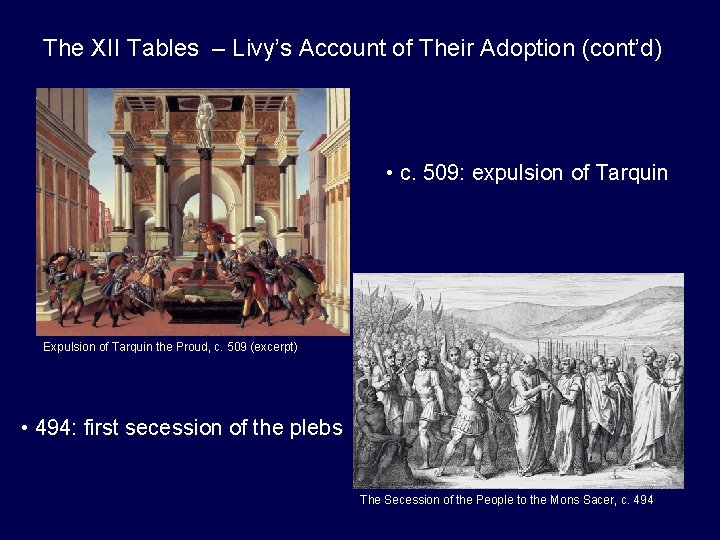
The XII Tables – Livy’s Account of Their Adoption (cont’d) • c. 509: expulsion of Tarquin Expulsion of Tarquin the Proud, c. 509 (excerpt) • 494: first secession of the plebs The Secession of the People to the Mons Sacer, c. 494
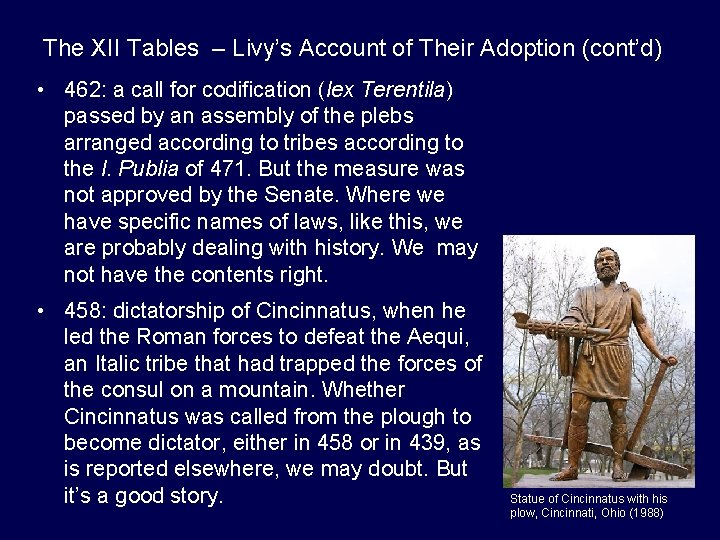
The XII Tables – Livy’s Account of Their Adoption (cont’d) • 462: a call for codification (lex Terentila) passed by an assembly of the plebs arranged according to tribes according to the l. Publia of 471. But the measure was not approved by the Senate. Where we have specific names of laws, like this, we are probably dealing with history. We may not have the contents right. • 458: dictatorship of Cincinnatus, when he led the Roman forces to defeat the Aequi, an Italic tribe that had trapped the forces of the consul on a mountain. Whether Cincinnatus was called from the plough to become dictator, either in 458 or in 439, as is reported elsewhere, we may doubt. But it’s a good story. Statue of Cincinnatus with his plow, Cincinnati, Ohio (1988)
The XII Tables – Livy’s Account of Their Adoption (cont’d) • 454: embassy to Athens, may or may not be historical. Famine and plague in the same year probably is. • 451: first decemvirate, first X Tables. Their names seem historical, at least in the sense that men with similar or the same names are found this far back in Roman history. • 450: second decemvirate, last II Tables. None of the names given appears until much later in Roman history. The contrast in Livy between the good men who produced the good X tables and the bad men who produced the bad final two need not be believed, although Cicero has basically the same story. • 450: threat of war and the summoning of the Senate; the legend of L. Siccius, the Roman Achilles; the legend of Verginia and Appius Claudius, to which we will return. It is certainly legendary, but it may contain historically plausible details.
The XII Tables – Livy’s Account of Their Adoption (cont’d) • 449: second secession of the plebs. According to Livy, Valerius and Horatius, the good consuls, enacted that the plebs could pass plebiscita, that anyone condemned by a magistrate could appeal to the people (provocatio), and that the tribunes of the plebs could not be touched (sacrosanctitas). These institutions eventually existed as part of the Republican constitution. Whether Livy has the dates rights is quite questionable. • 445: abolition of the position on conubium between patricians and plebeians (lex Canuleia). The beginning of the military tribunes, who served in place of the consuls, a dodge related, perhaps, to a desire to get plebeians into power. • Not in Livy: 474 BC the Etruscans suffered a crushing defeat at Cumae at the hands of Hiero of Syracuse. About the middle of the 5 th c. Etruscan remains in Rome cease. The funeral provisions in the XII Tables may be anti-Etruscan.
The XII Tables – Surviving Fragments The supposedly ‘bronze’ tablets on which the XII Tables were written were destroyed by the Gauls when they sacked the city around 390 BC. But the text of them was memorized. Cicero, De legibus 2. 59: “we learned the Law of the Twelve Tables in our boyhood as a required formula (carmen necessarium). ” Cicero, De legibus 2. 9: “Ever since we were children, Quintus, we have learned to call, ‘If one summon another to court [si in ius vocat], ’ and other rules of the same kind, laws. ”
The XII Tables – Surviving Fragments Section 4 of the Materials has all the surviving fragments. The text is by Salvatore Riccobono and dates from the mid 20 th century. There is a more recent text by Michael Crawford is much less sanguine than Riccobono in that there are many places where Riccobono gives a quotation or at least a summary of a text, and Crawford says we simply don’t know. We will use Riccobono’s text, which is also the one that Watson uses. We’ll mention Crawford’s text in a few places where he offers plausible alternative views. We should mention here that he doubts that the XII had their origins in the patrician/plebeian conflict described by Livy. He also doubts contrary to Watson – and this is pretty fundamental – that we can use later law to reconstruct the law at the time of the XII Tables.
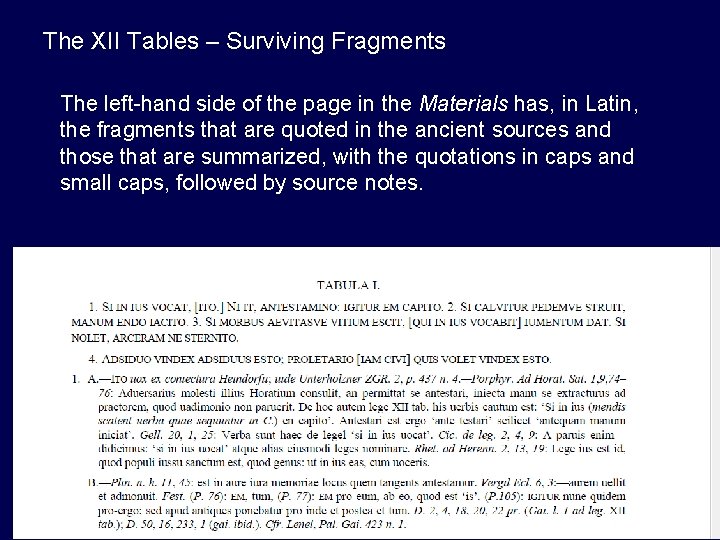
The XII Tables – Surviving Fragments The left-hand side of the page in the Materials has, in Latin, the fragments that are quoted in the ancient sources and those that are summarized, with the quotations in caps and small caps, followed by source notes.
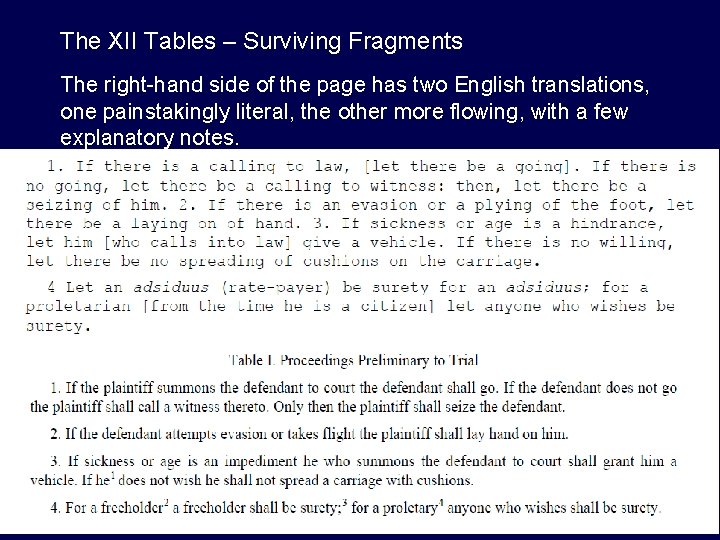
The XII Tables – Surviving Fragments The right-hand side of the page has two English translations, one painstakingly literal, the other more flowing, with a few explanatory notes.
The XII Tables – Surviving Fragments – Number and Order • In the Materials, the order both of the tables and of the laws within them is traditional, but the tradition does not go back before the Renaissance. • There are four instances of references to a provision of the Tables by number, the first of which also has the number of the law: • Festus, The Meaning of Words s. v. reus: ”But Ateius Capito [late Republican jurist] is, indeed, of the same opinion [that the word reus meant both plaintiff and defendant in the XII], and he supports this interpretation by giving an example: in the second law of the second table, in which it is written, “if any of these matters is an <impediment> for the iudex or for the arbiter or for the reus, for that reason the day [of trial] shall be postponed. ” Here both plaintiff and defendant in the trial are called reus. ”
The XII Tables – Surviving Fragments – Number and Order (cont’d) • Dionysius of Halicarnassus, Roman Antiquities 2. 27. 3 (on IV. 2 b): “The decemviri recorded this law among the rest, and it now stands on the fourth of the Twelve Tables, as they are called, which they then set up in the Forum. ” • Cicero, Laws 2. 25. 64: “Later. . . when extravagance in expenditure and mourning grew up, it was abolished by the law of Solon—a law which our decemvirs took over almost word for word and placed in the tenth Table. • Cicero, The Republic 2. 62: ” The decemvirs had added two tables of unjust laws, among which was one that most cruelly prohibited intermarriage between plebeians and patricians, though this privilege is usually permitted even between citizens of different States; this was later repealed by the lex Canuleia, a decree of the plebeian assembly. ”
The XII Tables – Surviving Fragments – Number and Order (cont’d) Further sources of information about the order: • Gaius’ commentary on the XII Tables: 28 fragments in Digest. From this we learn that each of G’s books dealt with 2 Tables. If this is right, then a lot of our numbers are wrong. For example, Table 1 probably had some provisions dealing with theft and iniuria. Crawford’s new text follows Gaius’ order quite rigidly. • Sabinus’ commentary on the ius civile: Sabinus seems to have followed the order of XII. Almost no fragments survive of his three books, but there a number of commentaries on Sabinus that give some sense of Sabinus’ order. • Edict of the Praetor: reconstructed from commentaries. Although there is much material in it that seems to have been added in odd places, it is generally thought that the basic structure of the work followed the order of the XII.
The XII Tables – Surviving Fragments – Number and Order (cont’d) There actually very few archaic collections of laws that are organized by topics in the way that we would order them or that seem to us logical. This is particularly true of collections that were promulgated by writing them in media of a fixed size, like metal tablets. Both Sabinus and the Edict are likely to have put things more in an order that made sense to them, which is an order that also makes sense to us. Be that as it may be, we will follow the traditional order shown on the next slide:
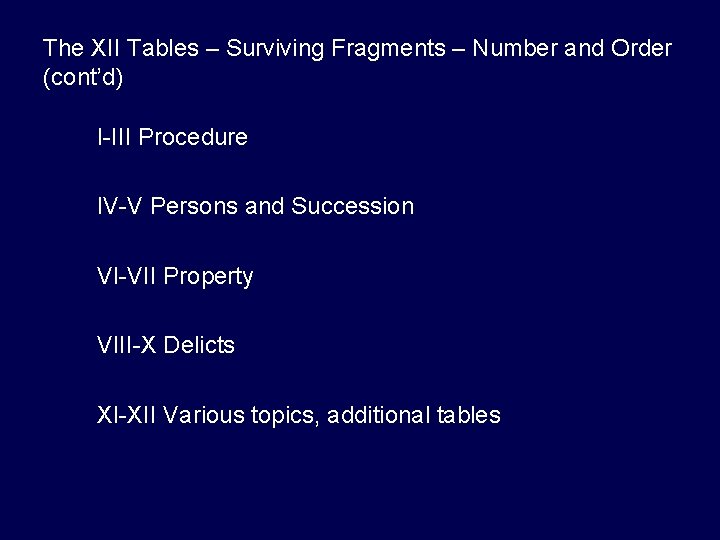
The XII Tables – Surviving Fragments – Number and Order (cont’d) I-III Procedure IV-V Persons and Succession VI-VII Property VIII-X Delicts XI-XII Various topics, additional tables
The XII Tables – Surviving Fragments – Language How accurate is the language that we have? There is very little writing in Latin that dates this far back. What is called the lapis niger, an inscription on a black stone that seems to be of a religious nature and that dates from c. 500 BC, contains about 16 full words and about 16 more partial ones. Only 3 are relevant here:
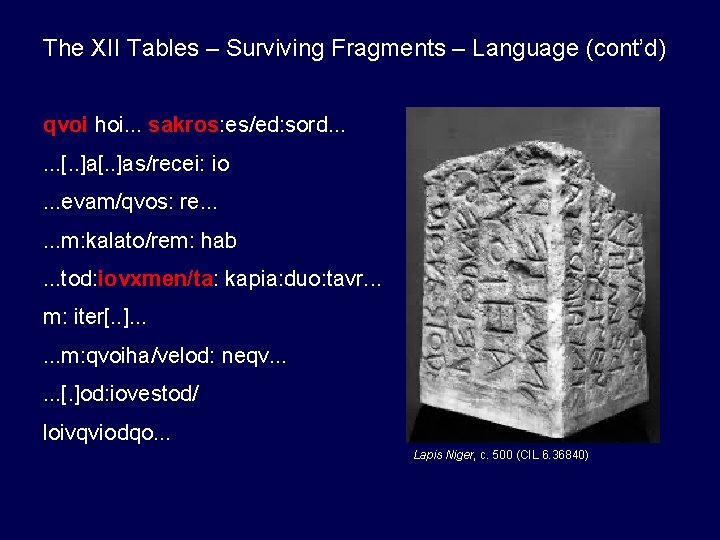
The XII Tables – Surviving Fragments – Language (cont’d) qvoi hoi. . . sakros: es/ed: sord. . . [. . ]as/recei: io. . . evam/qvos: re. . . m: kalato/rem: hab. . . tod: iovxmen/ta: kapia: duo: tavr. . . m: iter[. . ]. . . m: qvoiha/velod: neqv. . . [. ]od: iovestod/ loivqviodqo. . . Lapis Niger, c. 500 (CIL 6. 36840)
The XII Tables – Surviving Fragments – Language • qui ‘who’ ‘whoever’, which occurs many times in the XII (I. 1, III. 3, III. 4, III. 22, VI. 6 a, VIII. 1 a, IX. 8 a, IX. 22, X. 7), is written on the lapis niger as quoi • sacer, which occurs in the XII meaning ‘accursed’ (VIII. 21), is sakros on the lapis niger • iumentum, which occurs in the XII meaning ‘cart’ (I. 3), is iouxmenta (probably plural) on the lapis niger • In a way, this is encouraging. These are simply modernizations of spelling, reflecting changes in pronunciation. Words they didn’t understand, they retained e. g. , morbus sonticus in II. 2. The grammarians puzzled over these words and came up with suggestions that are frequently plausible. In all probability they kept the syntax when they were quoting.
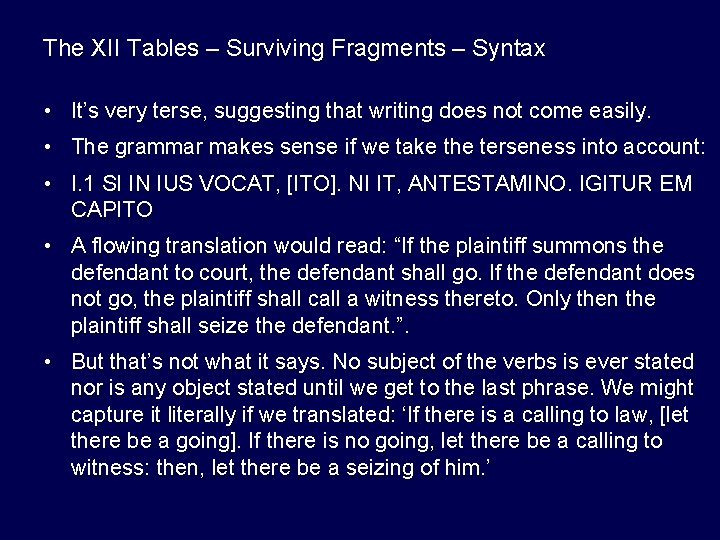
The XII Tables – Surviving Fragments – Syntax • It’s very terse, suggesting that writing does not come easily. • The grammar makes sense if we take the terseness into account: • I. 1 SI IN IUS VOCAT, [ITO]. NI IT, ANTESTAMINO. IGITUR EM CAPITO • A flowing translation would read: “If the plaintiff summons the defendant to court, the defendant shall go. If the defendant does not go, the plaintiff shall call a witness thereto. Only then the plaintiff shall seize the defendant. ”. • But that’s not what it says. No subject of the verbs is ever stated nor is any object stated until we get to the last phrase. We might capture it literally if we translated: ‘If there is a calling to law, [let there be a going]. If there is no going, let there be a calling to witness: then, let there be a seizing of him. ’
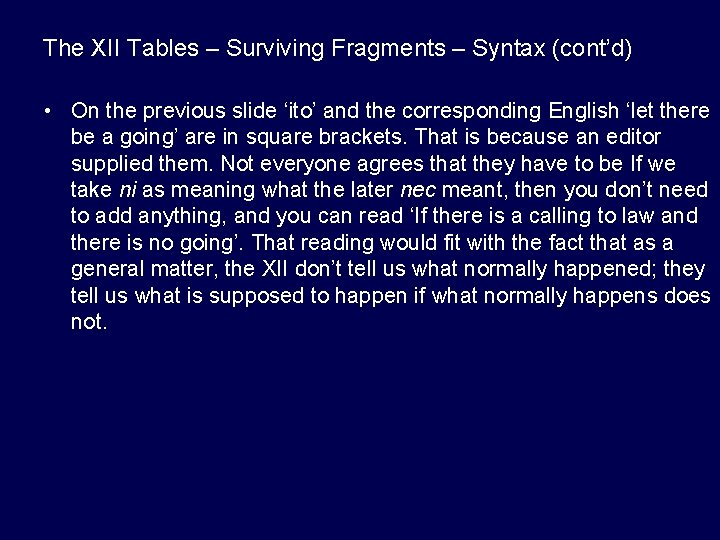
The XII Tables – Surviving Fragments – Syntax (cont’d) • On the previous slide ‘ito’ and the corresponding English ‘let there be a going’ are in square brackets. That is because an editor supplied them. Not everyone agrees that they have to be If we take ni as meaning what the later nec meant, then you don’t need to add anything, and you can read ‘If there is a calling to law and there is no going’. That reading would fit with the fact that as a general matter, the XII don’t tell us what normally happened; they tell us what is supposed to happen if what normally happens does not.
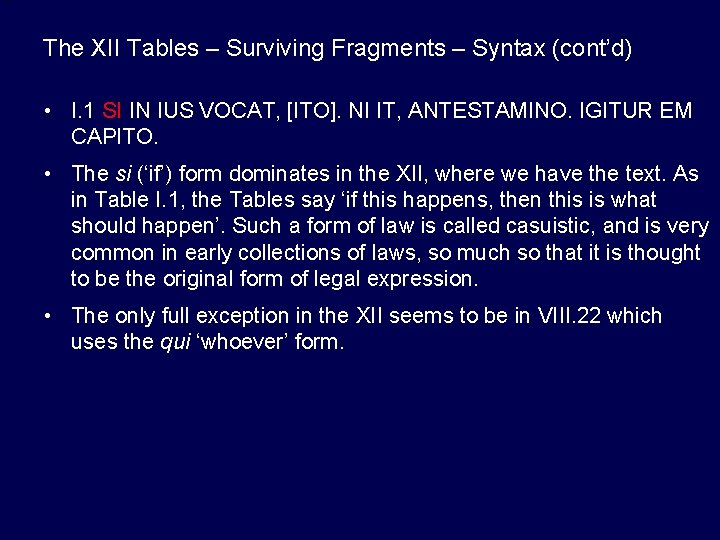
T The XII Tables – Surviving Fragments – Syntax (cont’d) • I. 1 SI IN IUS VOCAT, [ITO]. NI IT, ANTESTAMINO. IGITUR EM CAPITO. • The si (‘if’) form dominates in the XII, where we have the text. As in Table I. 1, the Tables say ‘if this happens, then this is what should happen’. Such a form of law is called casuistic, and is very common in early collections of laws, so much so that it is thought to be the original form of legal expression. • The only full exception in the XII seems to be in VIII. 22 which uses the qui ‘whoever’ form.
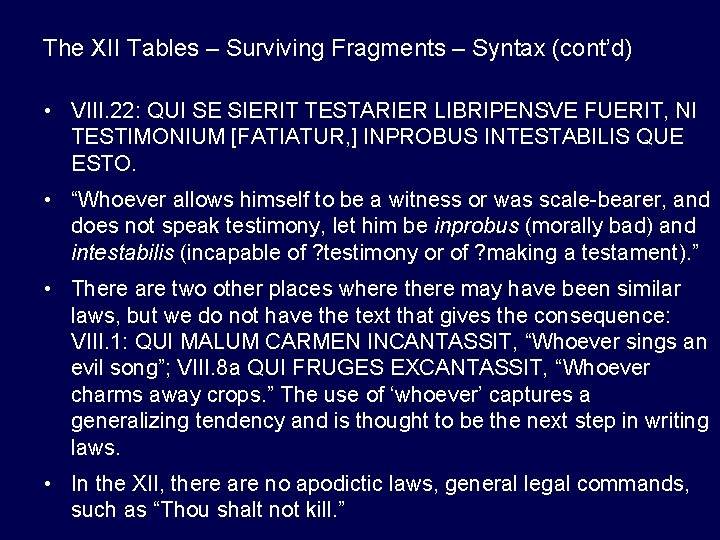
The XII Tables – Surviving Fragments – Syntax (cont’d) • VIII. 22: QUI SE SIERIT TESTARIER LIBRIPENSVE FUERIT, NI TESTIMONIUM [FATIATUR, ] INPROBUS INTESTABILIS QUE ESTO. • “Whoever allows himself to be a witness or was scale-bearer, and does not speak testimony, let him be inprobus (morally bad) and intestabilis (incapable of ? testimony or of ? making a testament). ” • There are two other places where there may have been similar laws, but we do not have the text that gives the consequence: VIII. 1: QUI MALUM CARMEN INCANTASSIT, “Whoever sings an evil song”; VIII. 8 a QUI FRUGES EXCANTASSIT, “Whoever charms away crops. ” The use of ‘whoever’ captures a generalizing tendency and is thought to be the next step in writing laws. • In the XII, there are no apodictic laws, general legal commands, such as “Thou shalt not kill. ”
The XII Tables – Surviving Fragments – Syntax (cont’d) • There are no laws in the XII that separate prohibition from penalty. This suggests novelty either in the protasis or in the apodosis. If everyone knew what the consequences of something were, there would be no necessity to state it. People who have difficulty writing do not write down what everyone knows. • I. 1 SI IN IUS VOCAT, [ITO]. NI IT, ANTESTAMINO. IGITUR EM CAPITO. • The commands of the law in the apodosis of the conditional are expressed in the third person imperative. This remained a characteristic of Roman statute-writing for centuries. • An alternative way of expressing this would be to use the verb opportet with an infinitive, ‘this ought to happen’. In the Roman context of the time the fact that opportet is not used, may – emphasize ‘may’ – mean that the duty is non-religious.
- Slides: 45