
Lecture 12 0 Deposition Materials Deposited l Dielectrics
- Slides: 42
Lecture 12. 0 Deposition
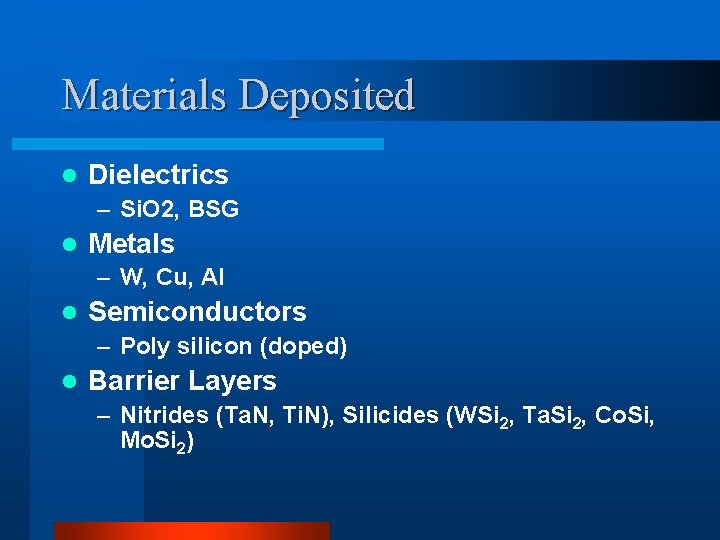
Materials Deposited l Dielectrics – Si. O 2, BSG l Metals – W, Cu, Al l Semiconductors – Poly silicon (doped) l Barrier Layers – Nitrides (Ta. N, Ti. N), Silicides (WSi 2, Ta. Si 2, Co. Si, Mo. Si 2)
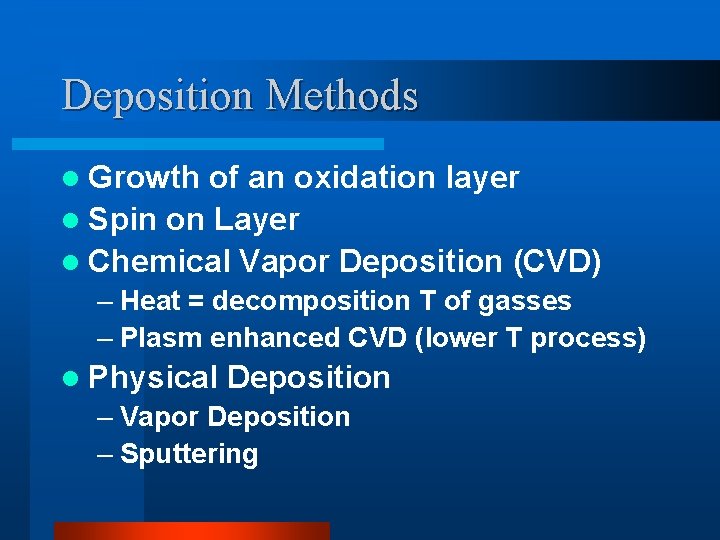
Deposition Methods l Growth of an oxidation layer l Spin on Layer l Chemical Vapor Deposition (CVD) – Heat = decomposition T of gasses – Plasm enhanced CVD (lower T process) l Physical Deposition – Vapor Deposition – Sputtering
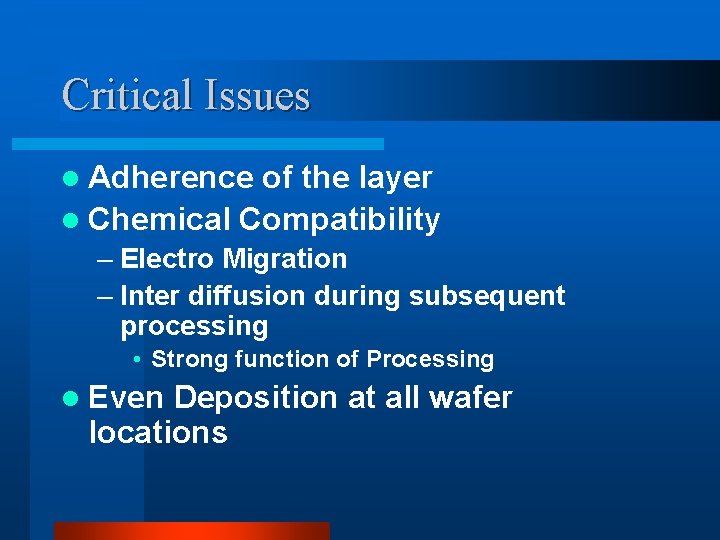
Critical Issues l Adherence of the layer l Chemical Compatibility – Electro Migration – Inter diffusion during subsequent processing • Strong function of Processing l Even Deposition at all wafer locations
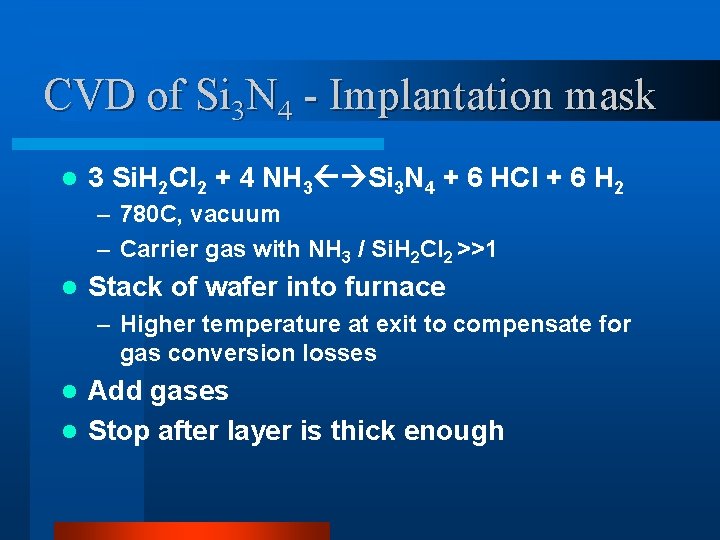
CVD of Si 3 N 4 - Implantation mask l 3 Si. H 2 Cl 2 + 4 NH 3 Si 3 N 4 + 6 HCl + 6 H 2 – 780 C, vacuum – Carrier gas with NH 3 / Si. H 2 Cl 2 >>1 l Stack of wafer into furnace – Higher temperature at exit to compensate for gas conversion losses Add gases l Stop after layer is thick enough l
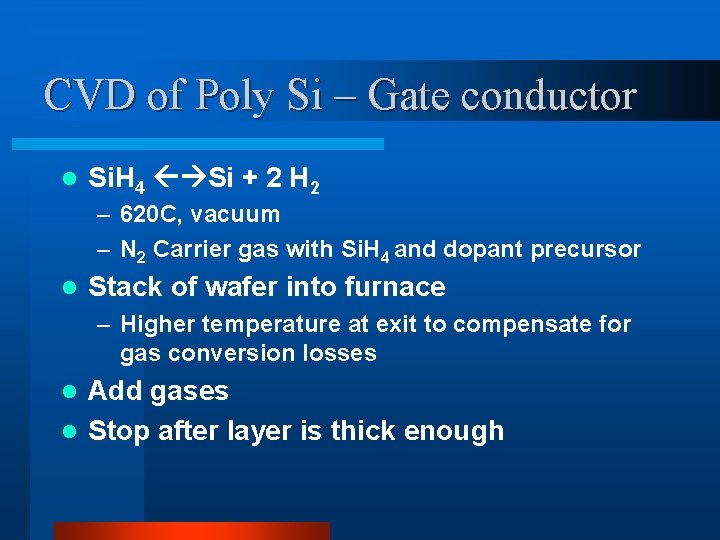
CVD of Poly Si – Gate conductor l Si. H 4 Si + 2 H 2 – 620 C, vacuum – N 2 Carrier gas with Si. H 4 and dopant precursor l Stack of wafer into furnace – Higher temperature at exit to compensate for gas conversion losses Add gases l Stop after layer is thick enough l
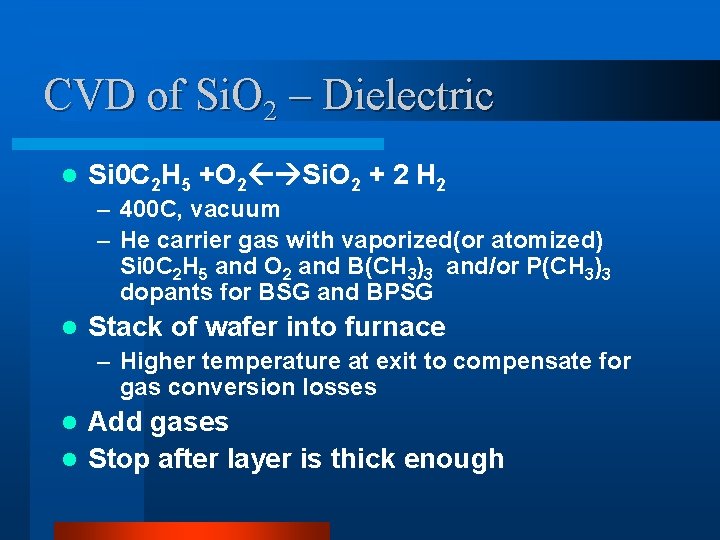
CVD of Si. O 2 – Dielectric l Si 0 C 2 H 5 +O 2 Si. O 2 + 2 H 2 – 400 C, vacuum – He carrier gas with vaporized(or atomized) Si 0 C 2 H 5 and O 2 and B(CH 3)3 and/or P(CH 3)3 dopants for BSG and BPSG l Stack of wafer into furnace – Higher temperature at exit to compensate for gas conversion losses Add gases l Stop after layer is thick enough l
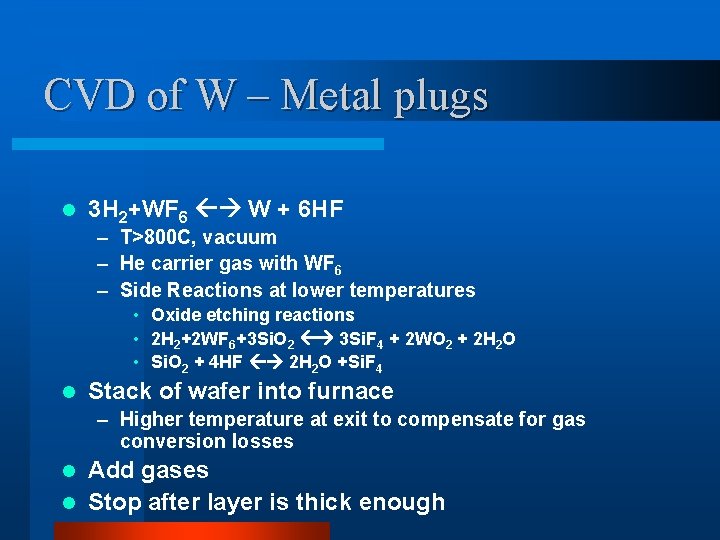
CVD of W – Metal plugs l 3 H 2+WF 6 W + 6 HF – T>800 C, vacuum – He carrier gas with WF 6 – Side Reactions at lower temperatures • Oxide etching reactions • 2 H 2+2 WF 6+3 Si. O 2 3 Si. F 4 + 2 WO 2 + 2 H 2 O • Si. O 2 + 4 HF 2 H 2 O +Si. F 4 l Stack of wafer into furnace – Higher temperature at exit to compensate for gas conversion losses Add gases l Stop after layer is thick enough l
Chemical Equilibrium
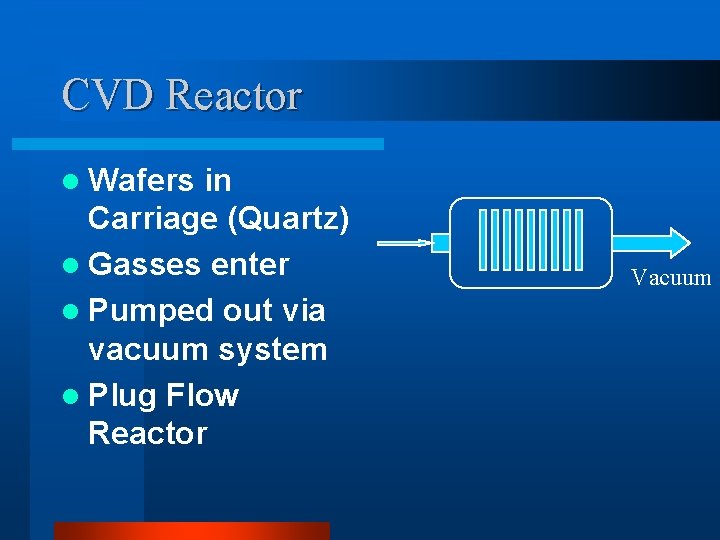
CVD Reactor l Wafers in Carriage (Quartz) l Gasses enter l Pumped out via vacuum system l Plug Flow Reactor Vacuum
CVD Reactor l Macroscopic Analysis – Plug flow reactor l Microscopic Analysis – Surface Reaction • Film Growth Rate
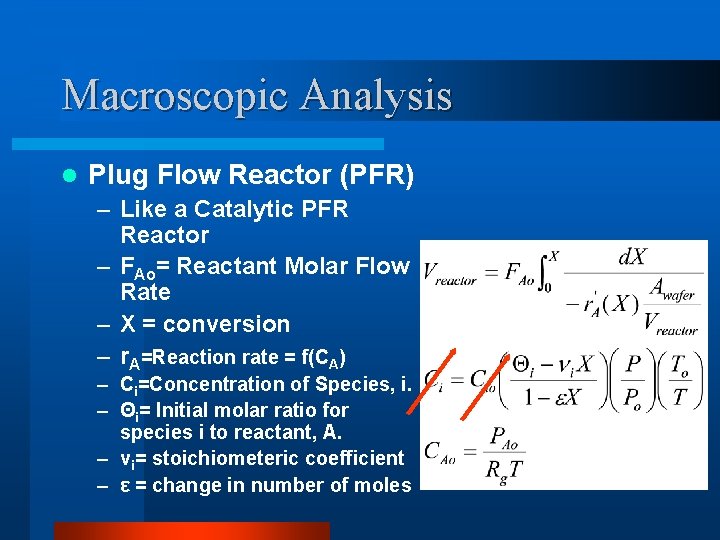
Macroscopic Analysis l Plug Flow Reactor (PFR) – Like a Catalytic PFR Reactor – FAo= Reactant Molar Flow Rate – X = conversion – r. A=Reaction rate = f(CA) – Ci=Concentration of Species, i. – Θi= Initial molar ratio for species i to reactant, A. – νi= stoichiometeric coefficient – ε = change in number of moles
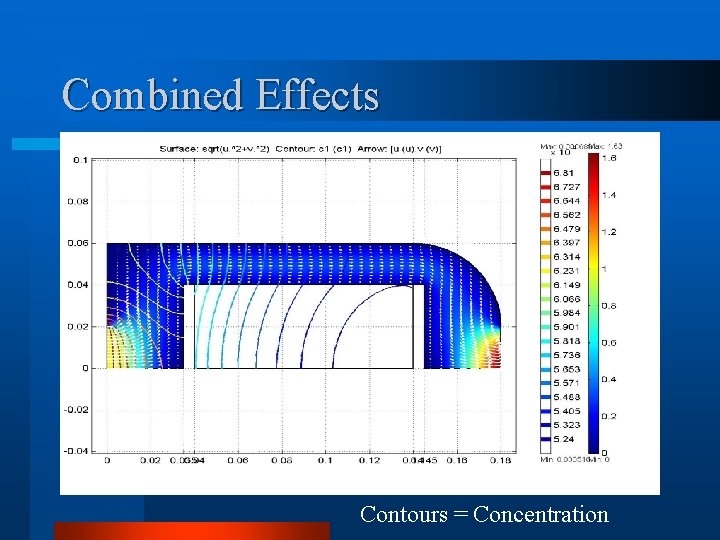
Combined Effects Contours = Concentration
Reactor Length Effects Si. H 2 Cl 2(g) + 2 N 2 O(g) Si. O 2(s)+ 2 N 2(g)+2 HCl(g) How to solve? Higher T at exit!
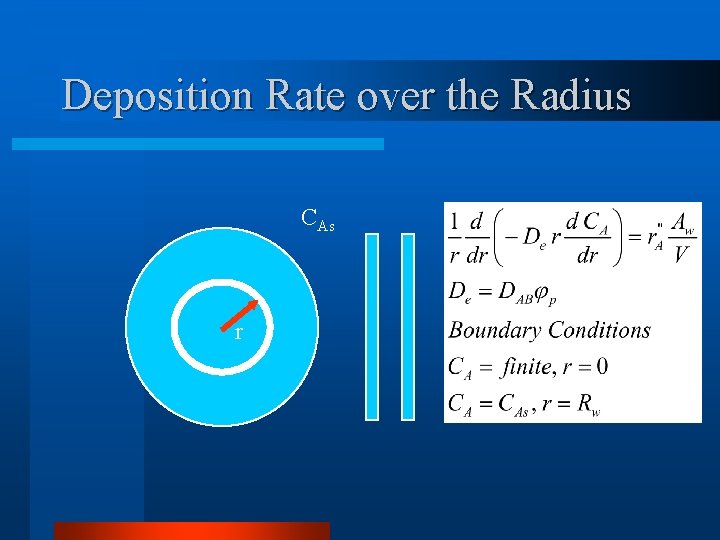
Deposition Rate over the Radius CAs r
Radial Effects This is bad!!!
Combined Length and Radial Effects Wafer 10 Wafer 20
CVD Reactor l External Convective Diffusion – Either reactants or products l Internal Diffusion in Wafer Stack – Either reactants or products l Adsorption l Surface Reaction l Desorption
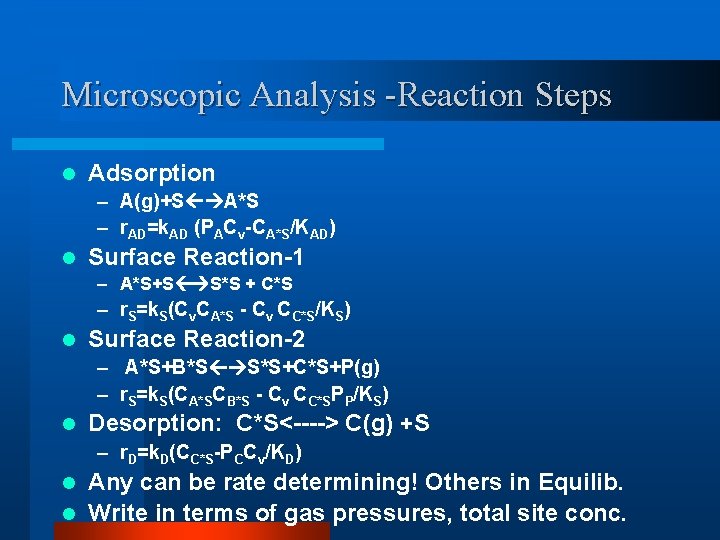
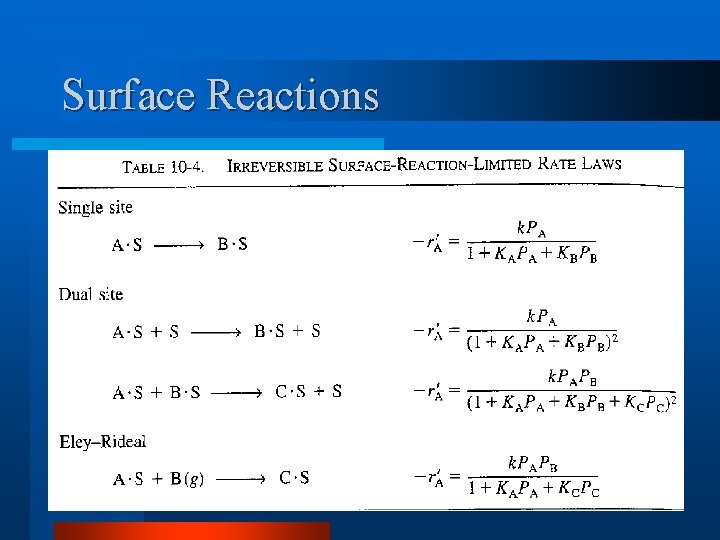
Microscopic Analysis -Reaction Steps l Adsorption – A(g)+S A*S – r. AD=k. AD (PACv-CA*S/KAD) l Surface Reaction-1 – A*S+S S*S + C*S – r. S=k. S(Cv. CA*S - Cv CC*S/KS) l Surface Reaction-2 – A*S+B*S S*S+C*S+P(g) – r. S=k. S(CA*SCB*S - Cv CC*SPP/KS) l Desorption: C*S<----> C(g) +S – r. D=k. D(CC*S-PCCv/KD) Any can be rate determining! Others in Equilib. l Write in terms of gas pressures, total site conc. l
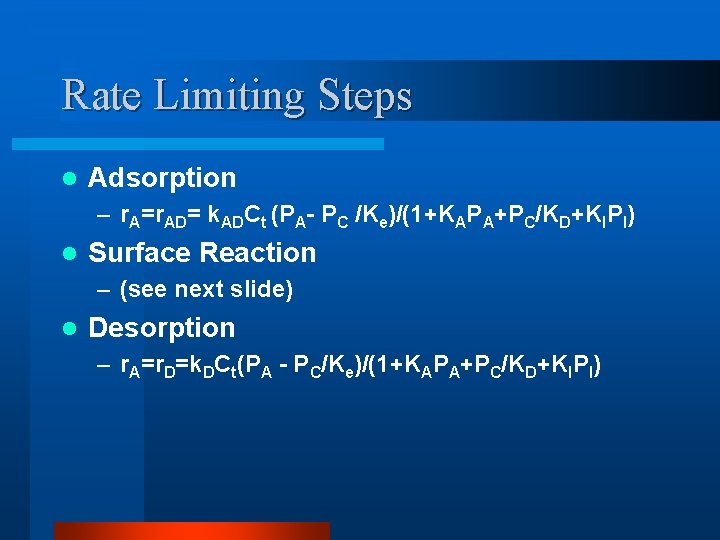
Rate Limiting Steps l Adsorption – r. A=r. AD= k. ADCt (PA- PC /Ke)/(1+KAPA+PC/KD+KIPI) l Surface Reaction – (see next slide) l Desorption – r. A=r. D=k. DCt(PA - PC/Ke)/(1+KAPA+PC/KD+KIPI)
Surface Reactions
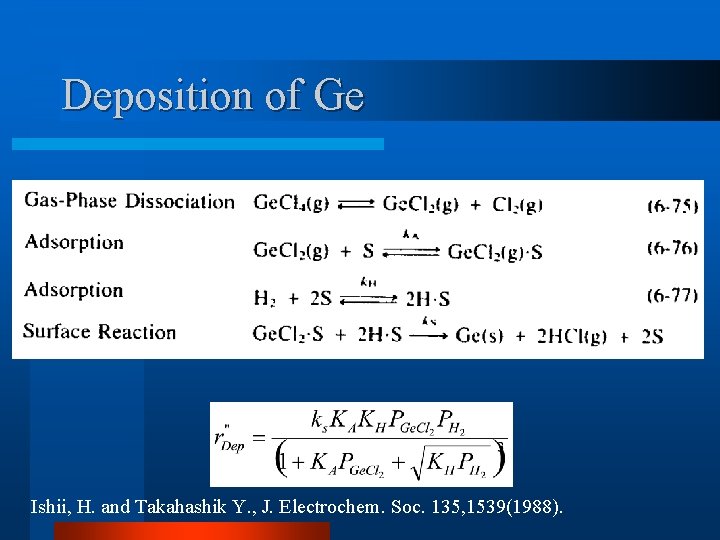
Deposition of Ge Ishii, H. and Takahashik Y. , J. Electrochem. Soc. 135, 1539(1988).
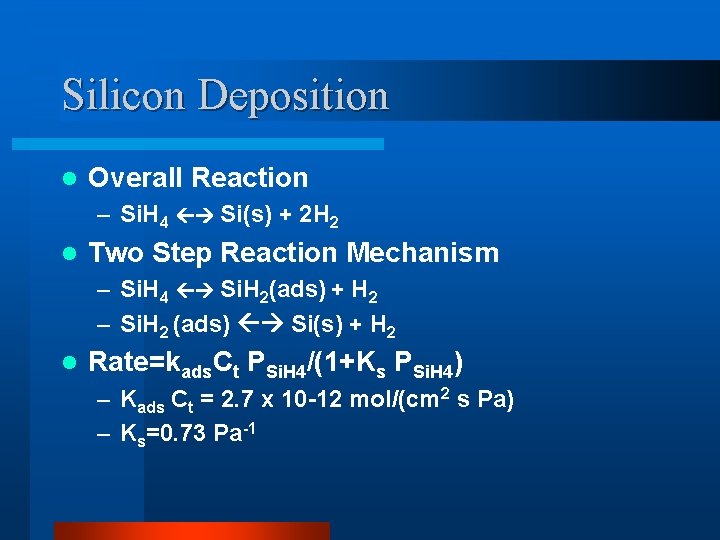
Silicon Deposition l Overall Reaction – Si. H 4 Si(s) + 2 H 2 l Two Step Reaction Mechanism – Si. H 4 Si. H 2(ads) + H 2 – Si. H 2 (ads) Si(s) + H 2 l Rate=kads. Ct PSi. H 4/(1+Ks PSi. H 4) – Kads Ct = 2. 7 x 10 -12 mol/(cm 2 s Pa) – Ks=0. 73 Pa-1
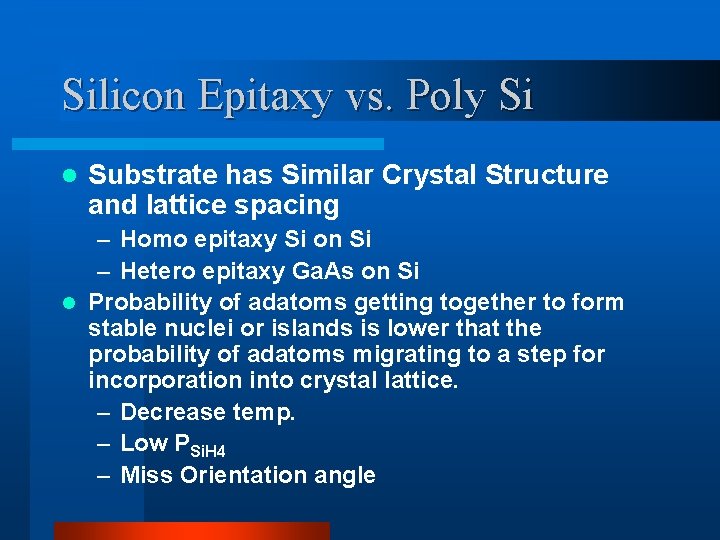
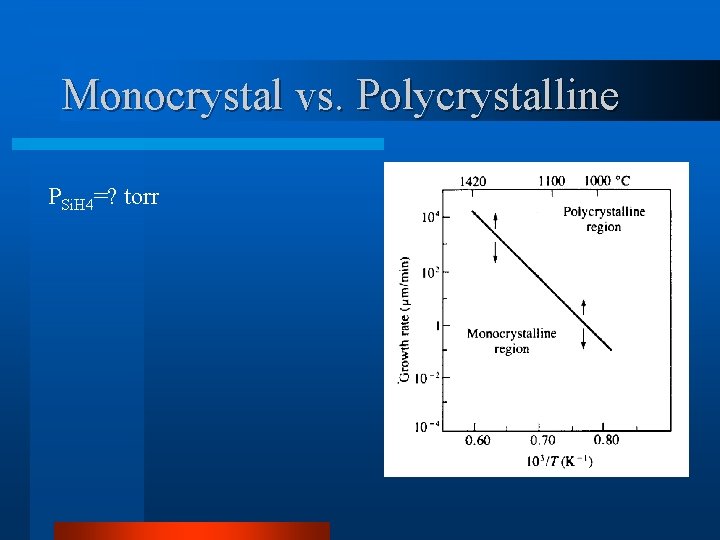
Silicon Epitaxy vs. Poly Si l Substrate has Similar Crystal Structure and lattice spacing – Homo epitaxy Si on Si – Hetero epitaxy Ga. As on Si l Probability of adatoms getting together to form stable nuclei or islands is lower that the probability of adatoms migrating to a step for incorporation into crystal lattice. – Decrease temp. – Low PSi. H 4 – Miss Orientation angle
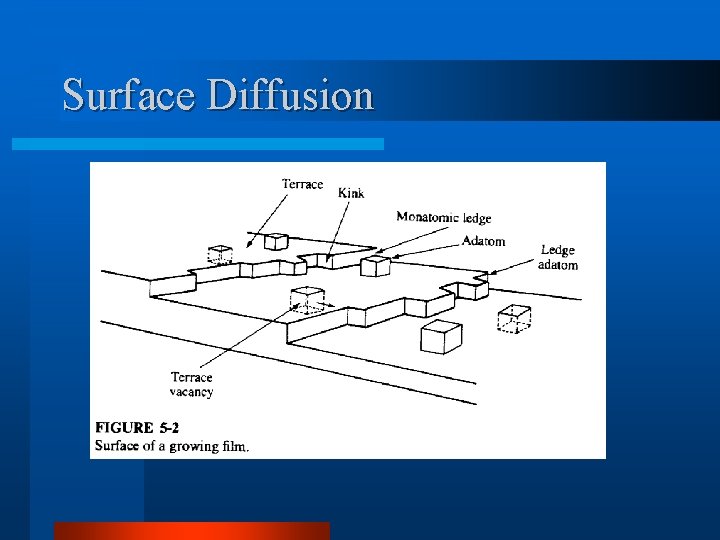
Surface Diffusion
Monocrystal vs. Polycrystalline PSi. H 4=? torr
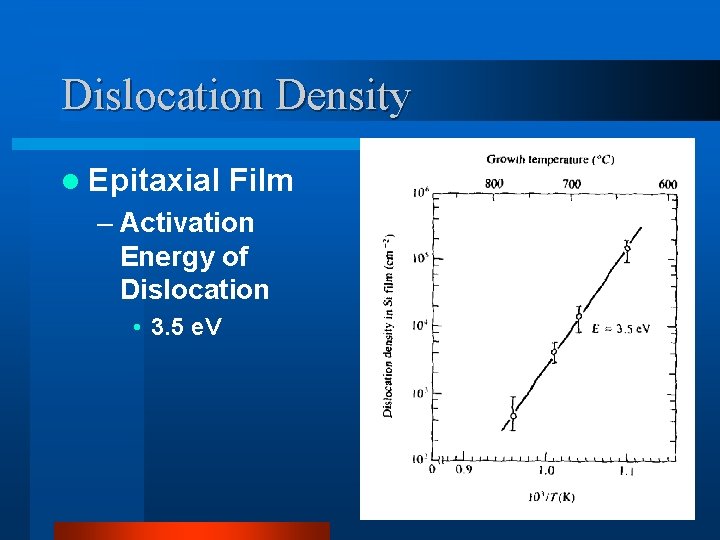
Dislocation Density l Epitaxial Film – Activation Energy of Dislocation • 3. 5 e. V
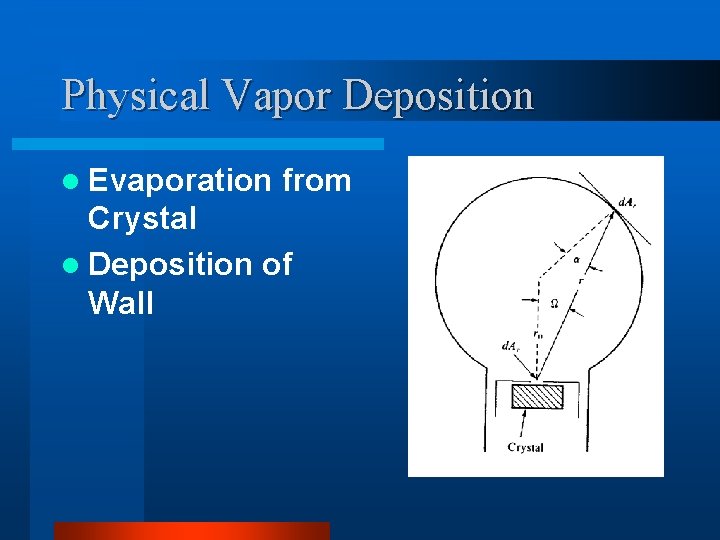
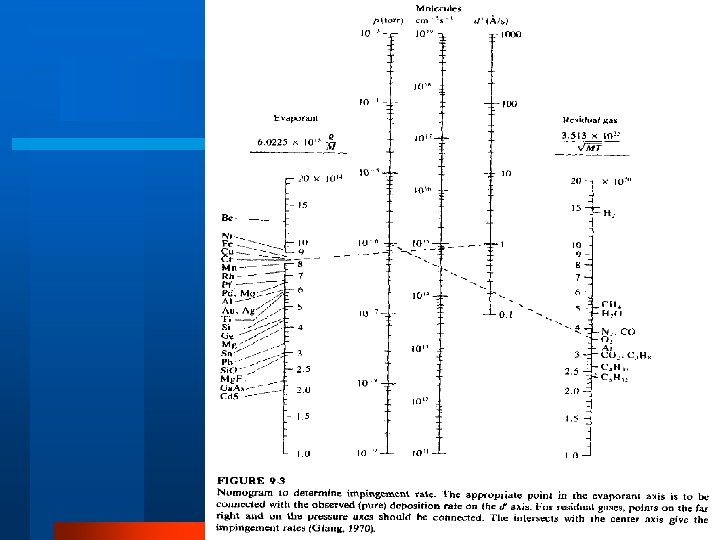
Physical Vapor Deposition l Evaporation from Crystal l Deposition of Wall
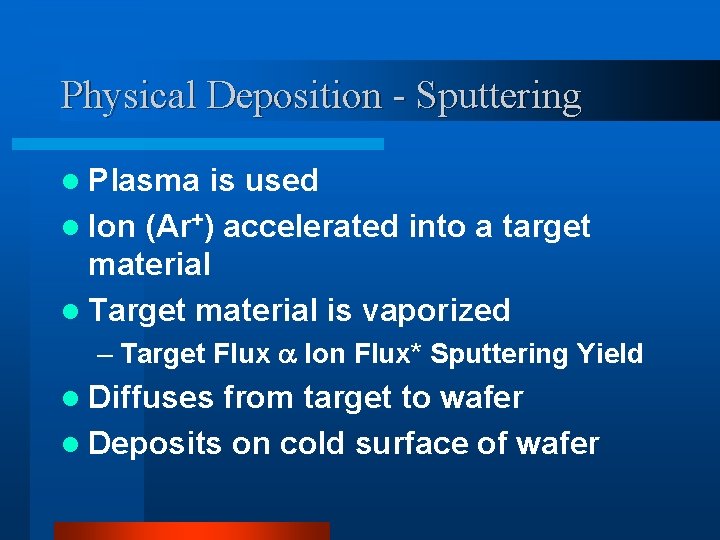
Physical Deposition - Sputtering l Plasma is used l Ion (Ar+) accelerated into a target material l Target material is vaporized – Target Flux Ion Flux* Sputtering Yield l Diffuses from target to wafer l Deposits on cold surface of wafer
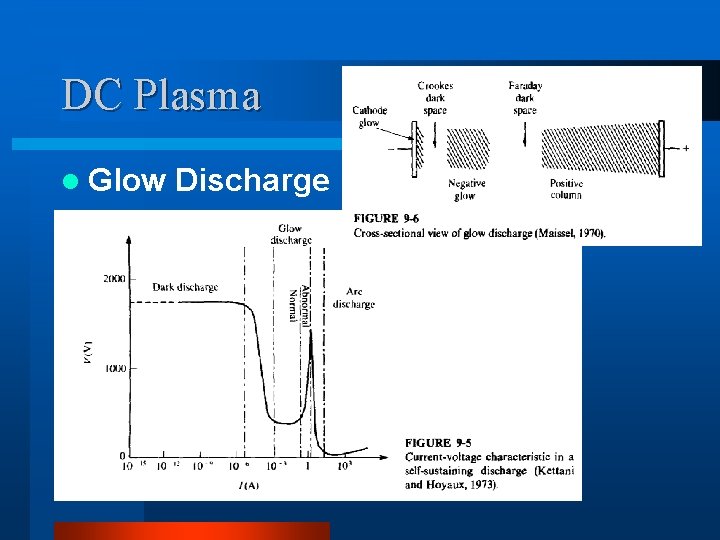
DC Plasma l Glow Discharge
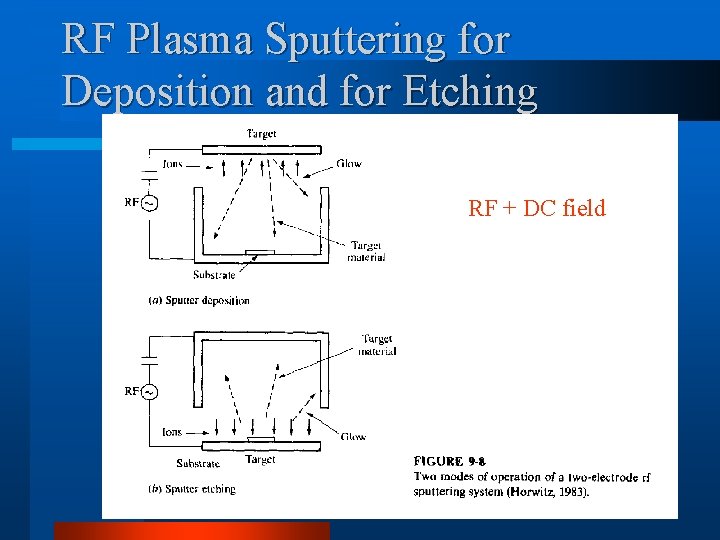
RF Plasma Sputtering for Deposition and for Etching RF + DC field
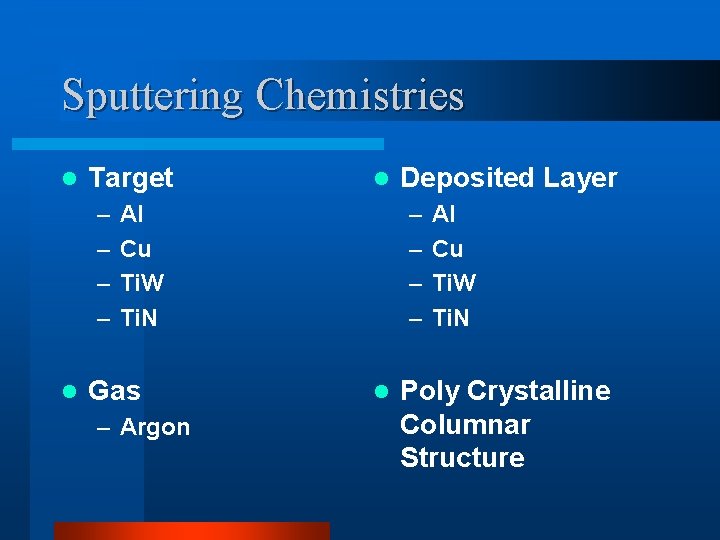
Sputtering Chemistries l Target – – l l – – Al Cu Ti. W Ti. N Gas – Argon Deposited Layer l Al Cu Ti. W Ti. N Poly Crystalline Columnar Structure
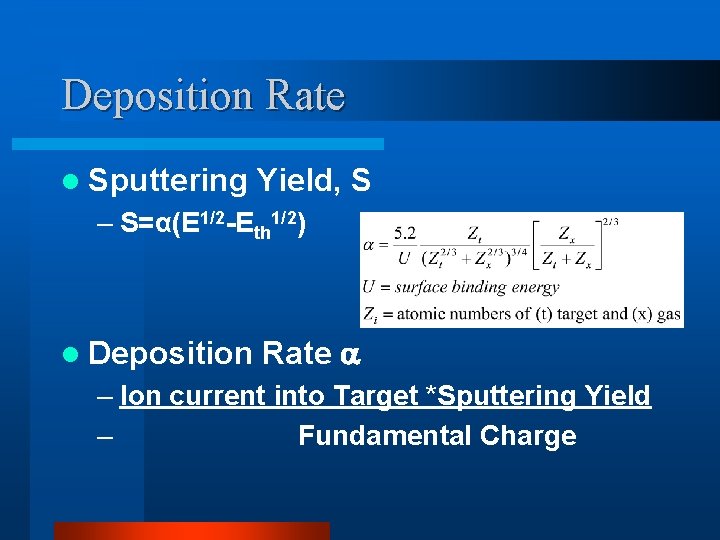
Deposition Rate l Sputtering Yield, S – S=α(E 1/2 -Eth 1/2) l Deposition Rate – Ion current into Target *Sputtering Yield – Fundamental Charge
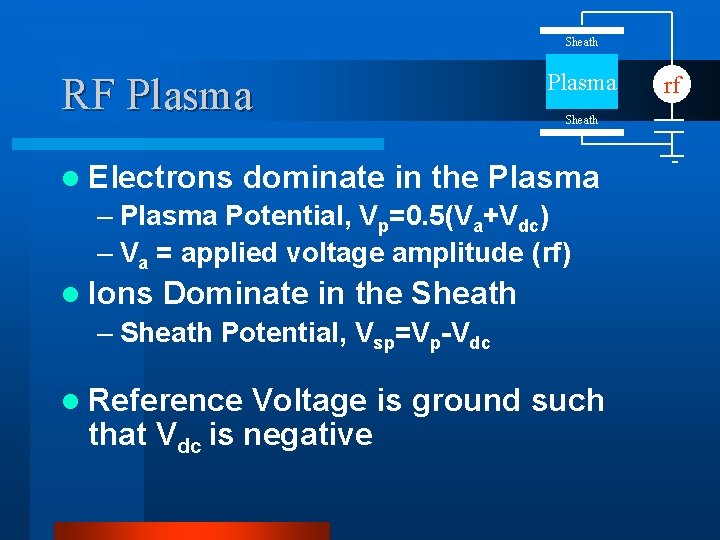
Sheath RF Plasma l Electrons Plasma Sheath dominate in the Plasma – Plasma Potential, Vp=0. 5(Va+Vdc) – Va = applied voltage amplitude (rf) l Ions Dominate in the Sheath – Sheath Potential, Vsp=Vp-Vdc l Reference Voltage is ground such that Vdc is negative rf
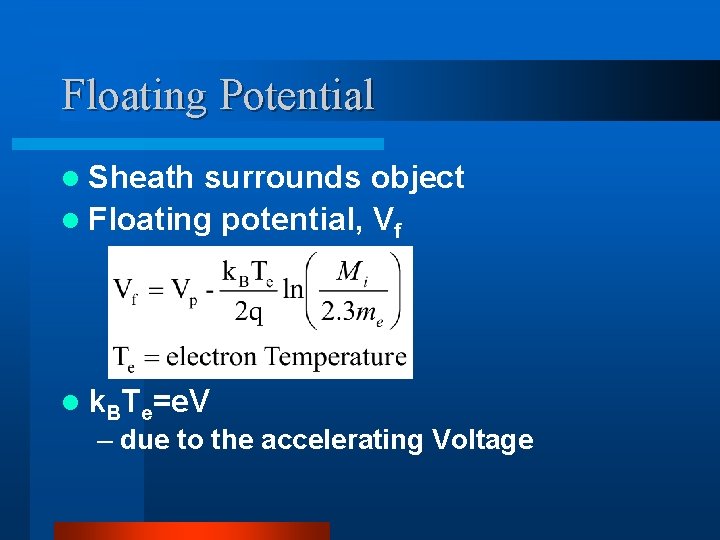
Floating Potential l Sheath surrounds object l Floating potential, Vf l k. BTe=e. V – due to the accelerating Voltage
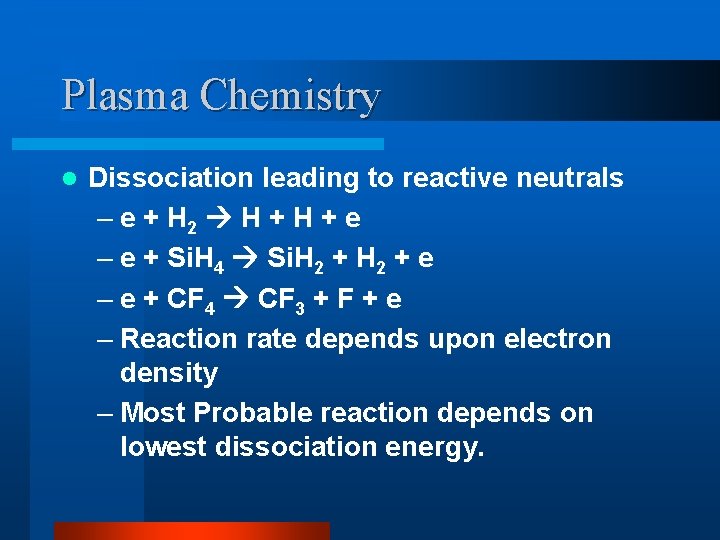
Plasma Chemistry l Dissociation leading to reactive neutrals – e + H 2 H + e – e + Si. H 4 Si. H 2 + e – e + CF 4 CF 3 + F + e – Reaction rate depends upon electron density – Most Probable reaction depends on lowest dissociation energy.
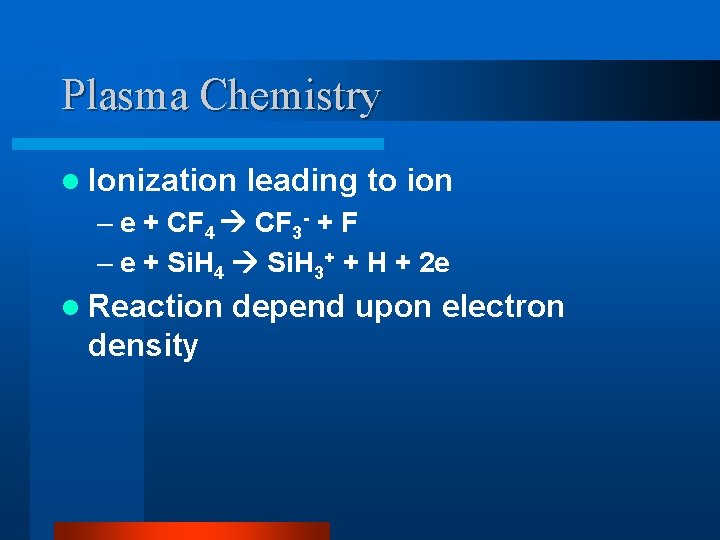
Plasma Chemistry l Ionization leading to ion – e + CF 4 CF 3 - + F – e + Si. H 4 Si. H 3+ + H + 2 e l Reaction density depend upon electron
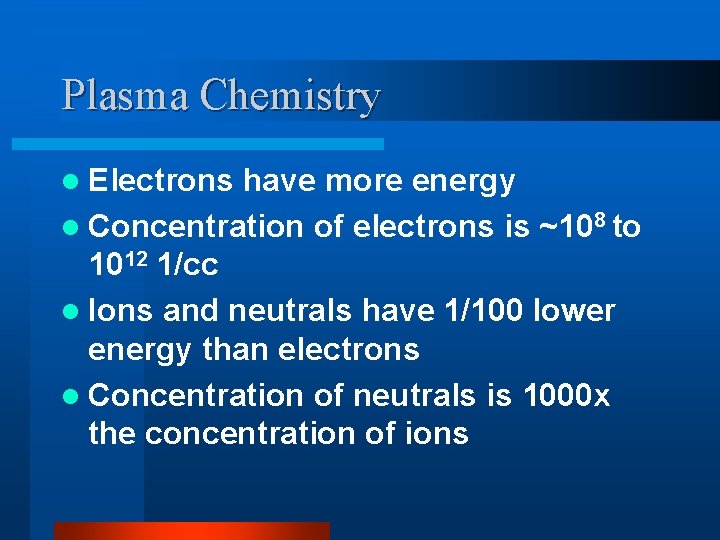
Plasma Chemistry l Electrons have more energy l Concentration of electrons is ~108 to 1012 1/cc l Ions and neutrals have 1/100 lower energy than electrons l Concentration of neutrals is 1000 x the concentration of ions
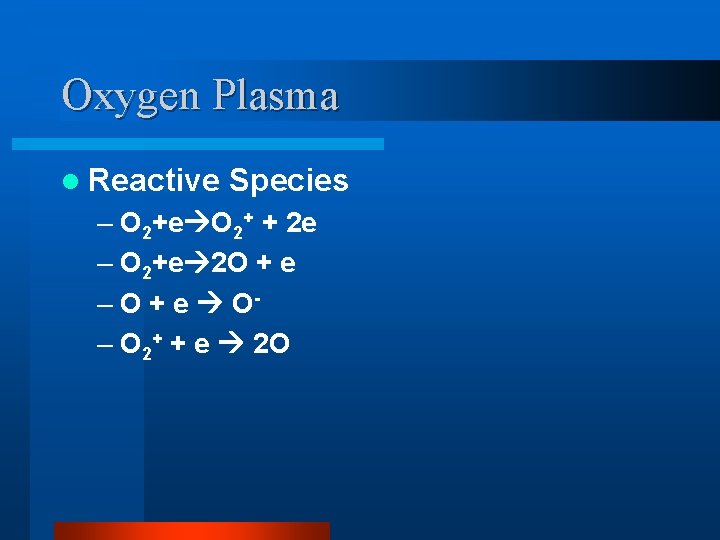
Oxygen Plasma l Reactive Species – O 2+e O 2+ + 2 e – O 2+e 2 O + e – O + e O– O 2+ + e 2 O
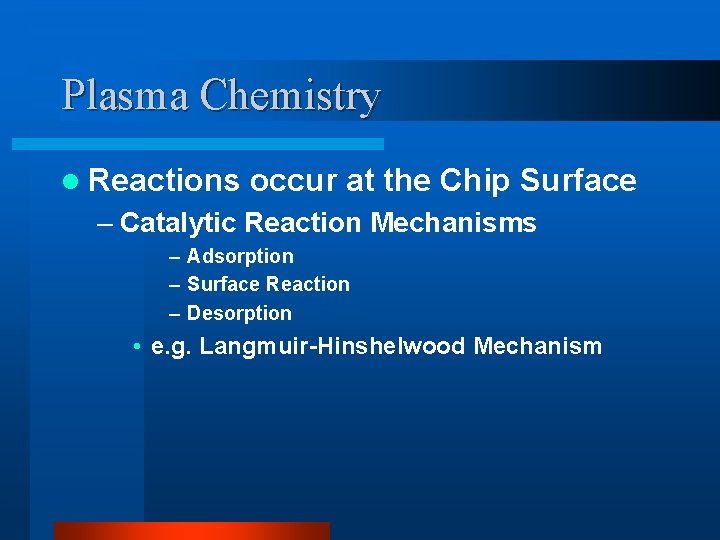
Plasma Chemistry l Reactions occur at the Chip Surface – Catalytic Reaction Mechanisms – Adsorption – Surface Reaction – Desorption • e. g. Langmuir-Hinshelwood Mechanism
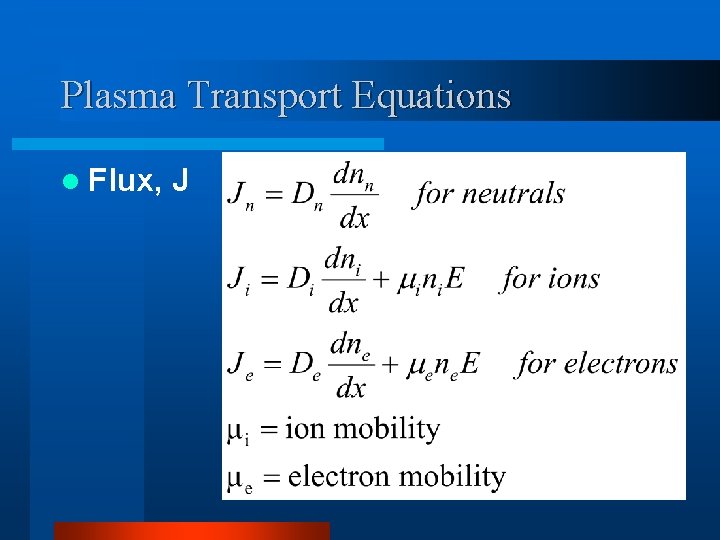
Plasma Transport Equations l Flux, J