
Lecture 11 Unit 3 4 Nursing Care for




- Slides: 102
Lecture 11 – Unit 3. 4 Nursing Care for Health Problems of Toddlers and Preschool Children Skin Alterations in Children Wong 9 th edition pp. 423 -432, 435 -445, 1010 -1035 8 th edition pp 453 -480, 1061 -1089 Gail Mc. Ilvain-Simpson, MSN, PNP-BC 1
2
3
Learning Objectives At the end of this discussion learners will be able to: • Discuss skin alterations & importance in addressing this issue • Discuss nursing assessment and management of skin lesions. • Compare and contrast primary skin lesions. • Discuss 3 common nursing management points regarding atopic dermatitis. • Name 2 reasons the incidence of childhood communicable diseases have significantly declined. • Discuss 2 teaching points for parents regarding communicable diseases. 4
Learning Objectives continued • Discuss key points and nursing management of the following diseases: fifth disease, roseola, and scarlet fever. • Discuss diagnosis, symptoms, nursing management and treatment of pinworms. • Describe lead poisoning, its impact on children, nursing management and treatment. • Discuss childhood poisonings and nursing interventions for its prevention. • Describe diagnosis, treatment and anticipatory guidance for: impetigo, tinea capitis, pediculosis capitis and Lyme disease 5
Skin Alterations in Children • What is key job of skin? 6
Skin Lesions Etiologic Factors • Contact with injurious agents, hereditary factors, external factors; & systemic diseases • Highly individualized responses • Child’s age is an important factor 7
Integument of Infants & Young Children • • Epidermis loosely bound to dermis More susceptible to superficial bacterial infections More likely to have associated systemic symptoms Reacts to a primary irritant versus sensitizing antigen 8
Pathophysiology of Dermatitis • Accounts for more than half the skin problems in children • Inflammatory changes in skin • Changes reversible • More permanent issues with chronic problem 9
Integumentary - Nursing History – – – – – Painful, itching, tingling Restless or irritable Favor or avoid a body part New exposure New food New medications Any allergies? Playmates with similar lesions Plants, insects, or chemicals 10
Diagnostic Evaluation • What piece of the nursing process is key ? 11
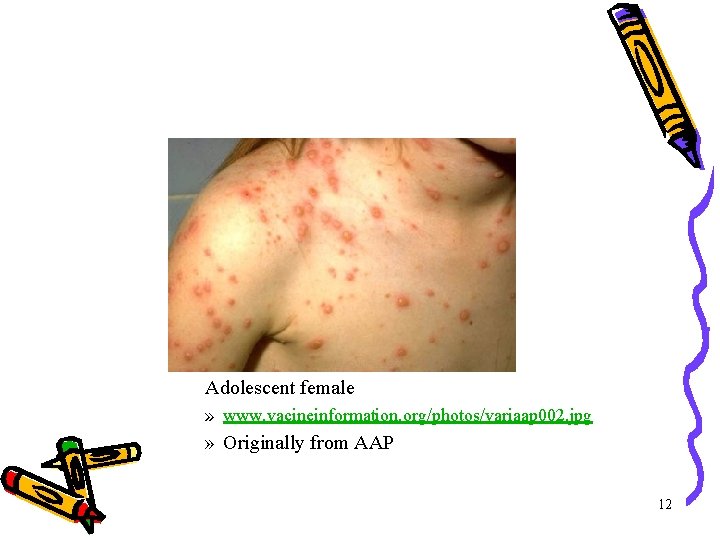
Adolescent female » www. vacineinformation. org/photos/variaap 002. jpg » Originally from AAP 12
Nursing Assessment • Inspect - Describe color, shape, size, distribution of lesions • Palpate for temperature, moisture, elasticity and edema 13
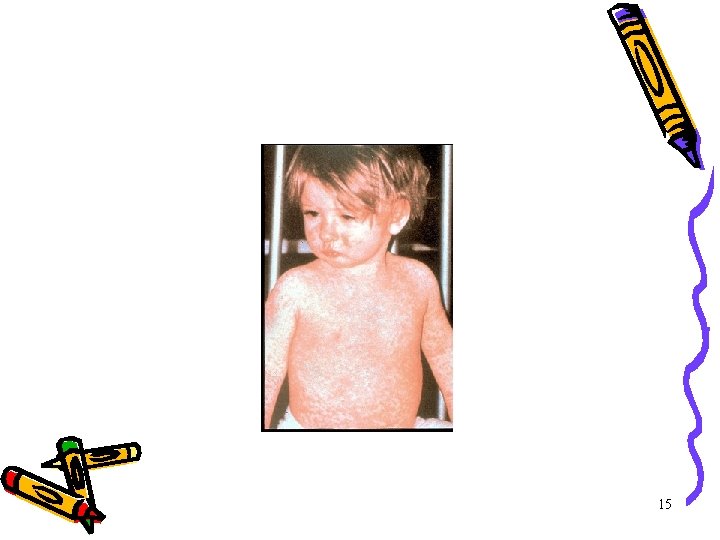
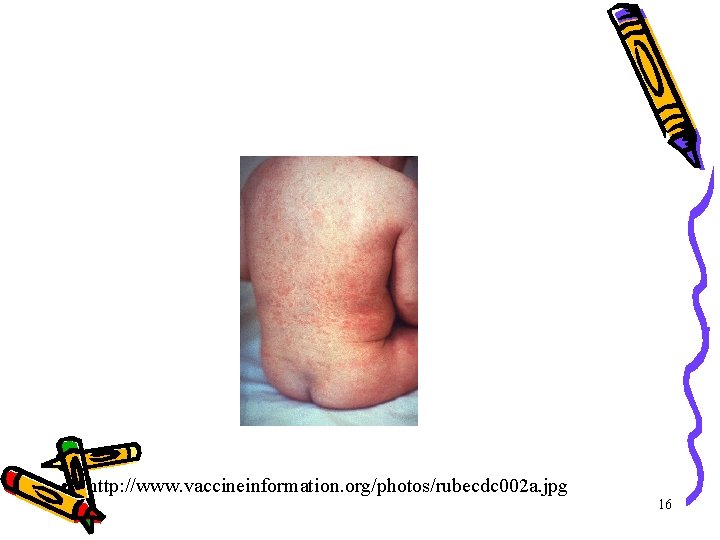
Descriptive Characteristics • • Erythema Ecchymosis Petechiae Primary lesions Secondary lesions Distribution pattern Configuration and arrangement 14
15
• http: //www. vaccineinformation. org/photos/rubecdc 002 a. jpg 16
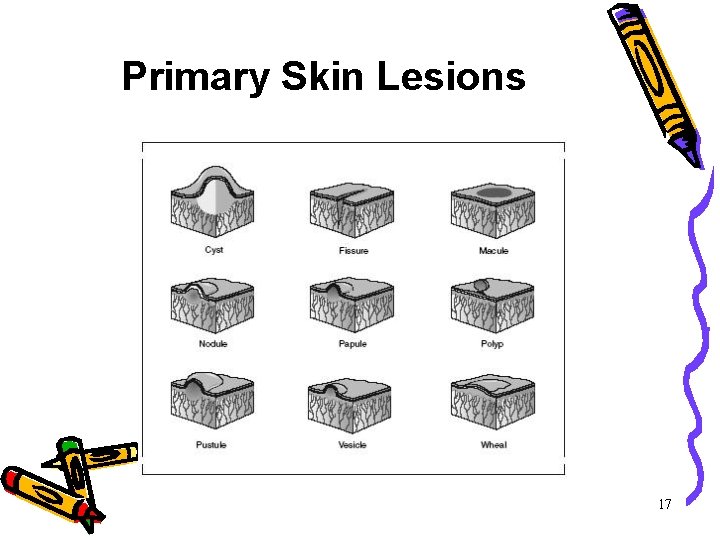
Primary Skin Lesions 17
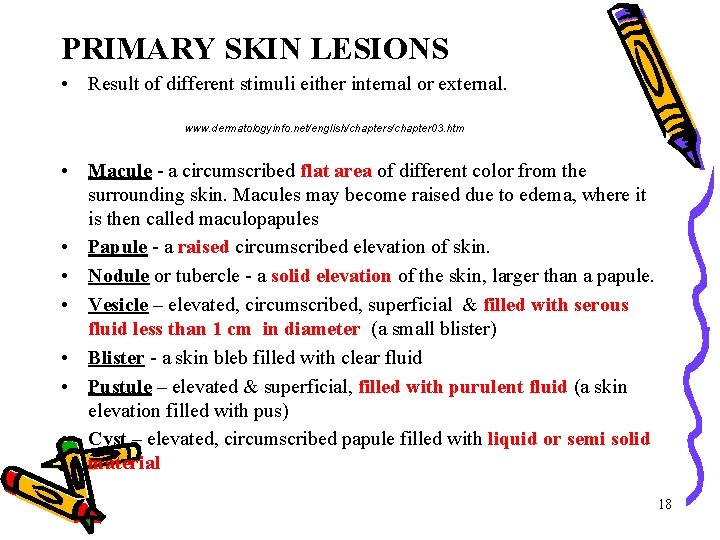
PRIMARY SKIN LESIONS • Result of different stimuli either internal or external. www. dermatologyinfo. net/english/chapters/chapter 03. htm • Macule - a circumscribed flat area of different color from the surrounding skin. Macules may become raised due to edema, where it is then called maculopapules • Papule - a raised circumscribed elevation of skin. • Nodule or tubercle - a solid elevation of the skin, larger than a papule. • Vesicle – elevated, circumscribed, superficial & filled with serous fluid less than 1 cm in diameter (a small blister) • Blister - a skin bleb filled with clear fluid • Pustule – elevated & superficial, filled with purulent fluid (a skin elevation filled with pus) • Cyst – elevated, circumscribed papule filled with liquid or semi solid material 18
Therapeutic Management • • Prevent further damage Eliminate cause Prevent complications Provide relief 19
Relief of symptoms • Pruritus management • Topical therapy • Systemic Therapy 20
21
Contact Dermatitis • Inflammatory reaction of the skin to chemical substances (natural or synthetic) • Causes a hypersensitivity response or direct irritation • Initial reaction in exposed area • Sharp delineation between inflamed & normal skin (faint erythema to massive bullae) • Itching is constant primary irritant or sensitizing agent • Infants – contact dermatitis occurs on convex surface of diaper area • Other agents – plants (poison ivy), animal irritants (fur), metal etc 22
Treatment of Contact Dermatitis • Major goal – to prevent further exposure of the skin to offending substance • Based on severity • If exposed cleanse as soon as possible 23
Atopic Dermatitis Eczema • Pruritic eczema • Usually occurs during infancy & is associated with allergic tendency (atopy) • 3 Forms based on age & distribution of lesions: Infantile eczema Childhood Pre adolescent & adolescent 24
Atopic Dermatitis • Diagnosed via combination of history & morphologic findings • Cause unknown • Majority of those affected have eczema, asthma, food allergies or allergic rhinitis 25
Atopic Dermatitis Management • Major goals: hydrate skin, relieve pruritis, reduce flare-ups, prevent & control secondary infection. • Avoid skin irritants & overheating • Administer meds • Shorten fingernails & toenails • Enhance skin hydration – apply emollients while skin is wet 26
Nursing Care Management • Take history – Atopy in family Previous involvement • Controlling pruritus • Dietary modifications • Family Support 27
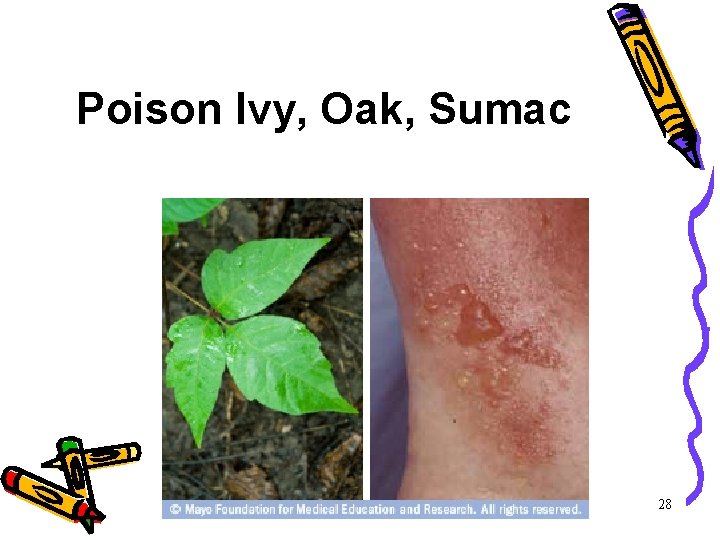
Poison Ivy, Oak, Sumac 28
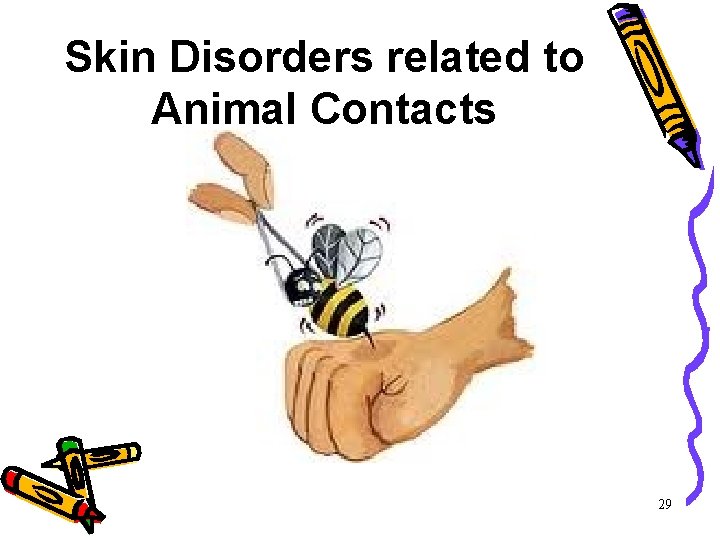
Skin Disorders related to Animal Contacts 29
30
Communicable Diseases • Why has the incidence of childhood communicable diseases significantly declined? • Why have serious complications resulting from such infections been further reduced? • Why do nurses need to be familiar with infectious agents? 31
Nursing Process for the Child with Communicable Disease • • • Assessment- signs & symptoms Diagnosis – ID of disease Planning- expected patient outcome Implementation- intervention strategies Evaluation 32
What to assess if suspicion of communicable disease? • • Recent exposure to known case Prodromal symptoms Immunization history History of having the disease 33
Components of Prevention Prevent disease Prevent spread Prevent complications 34
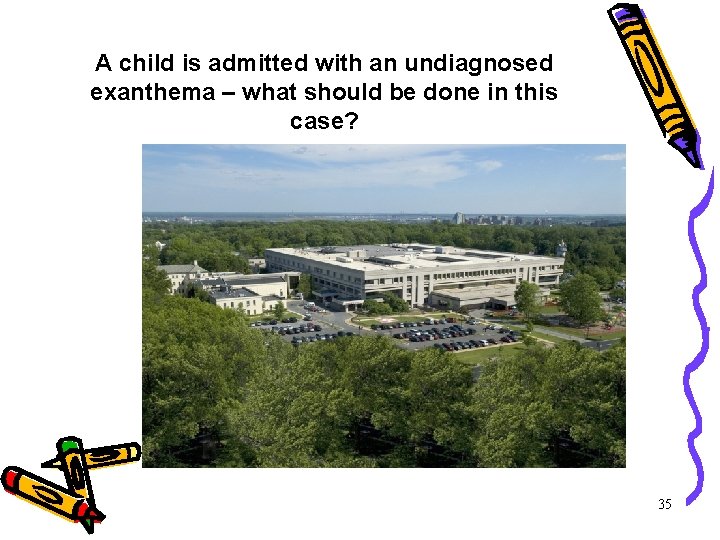
A child is admitted with an undiagnosed exanthema – what should be done in this case? 35
Communicable Disease • • Know what it looks like How it acts What to do What is the danger? 36
What to know about Infections or Communicable Diseases? • Occurs in humans of all ages • Certain ones occur in specific age or developmental groups • Can be transmitted by direct or indirect route • Can have total systemic involvement or sequelae • May develop slowly after prolonged incubation period 37
Symptomatic and Supportive Care • • • Isolation Skin care Antipyretics, analgesics, anti inflammatories Rest Hydration/Fluids Comfort measures 38
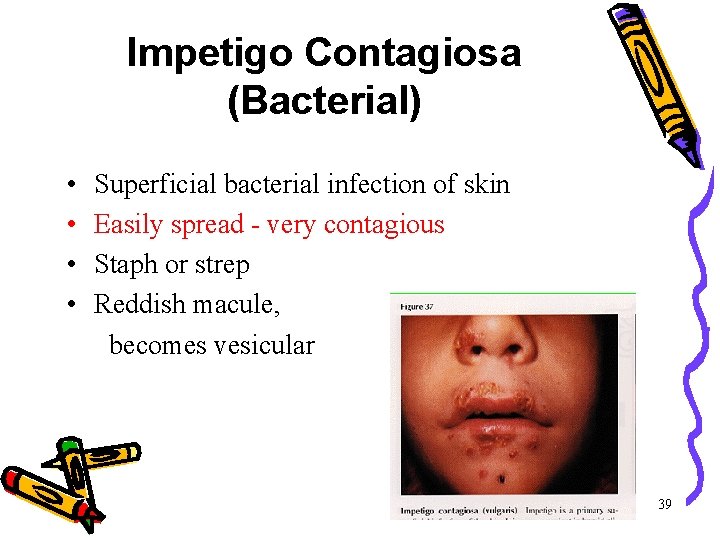
Impetigo Contagiosa (Bacterial) • Superficial bacterial infection of skin • Easily spread - very contagious • Staph or strep • Reddish macule, becomes vesicular 39
Treatment of Impetigo • Use of Burow solution • Topical use of bactericidal ointment • Systemic administration of oral or parenteral antibiotics in severe or extensive cases • Tends to heal without scarring • Common in toddler, preschooler • May superimpose on eczema 40
Viral Diseases of Childhood • Childhood communicable diseases • Such as fifth disease 41
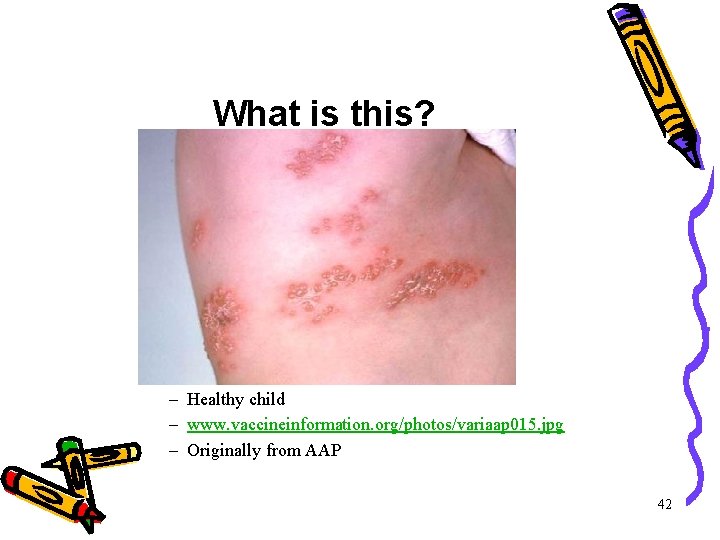
What is this? – Healthy child – www. vaccineinformation. org/photos/variaap 015. jpg – Originally from AAP 42
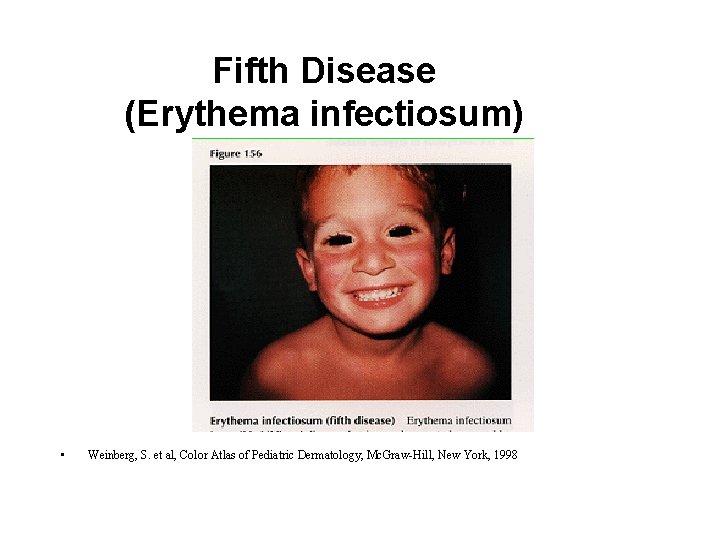
Fifth Disease Erythema Infectiosum • Agent - Human parvovirus B 19 (HPV) • Source- infected persons, mainly school age • Transmission – Respiratory secretions, blood & blood products • Clinical Manifestations - rash in three stages: • a) “Slapped- cheek” rash on the face • b) 1 day after rash on face, maculopapular red spots • c) Rash reappears if skin irritated or traumatized 43
Fifth Disease (Erythema infectiosum) • Weinberg, S. et al, Color Atlas of Pediatric Dermatology, Mc. Graw-Hill, New York, 1998
Fifth Disease - Management • Complications -may result in fetal death (if mother is infected during 2 nd trimester of pregnancy. • Aplastic crisis in children with hemolytic disease. • Self-limited arthritis and arthralgia. • Nursing care – symptomatic & supportive/isolation of child not necessary, except hospitalized child (immunosuppressed or with aplastic crises) 45
Roseola Exanthema Subitum • Agent - Human Herpes virus type 6 (HHV-6) • Source - Possibly acquired from saliva of healthy adult person, entry via nasal buccal or conjunctival mucosa • Transmission –year round, no reported contact with infected individual in most cases (usually limited to children under 3 years of age but peak age is 6 -15 months) 46
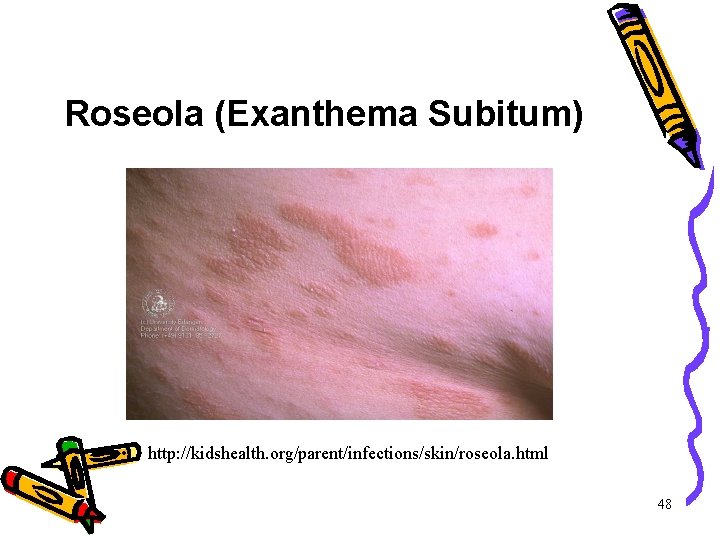
Roseola (Exanthema Subitum) • Clinical manifestations – Persistent high fever for 3 to 4 days in a child who appears well/quick drop in fever to normal with appearance of rash. Rose pink macules to maculopapules appearing first on trunk, then spreading to neck, face & extremities. Lymphadenopathy , inflamed pharynx, cough Non pruritic rash fades on pressure so when you press on the area the rash fades. 47
Roseola (Exanthema Subitum) • http: //kidshealth. org/parent/infections/skin/roseola. html 48
Roseola - Management • Treatment: nonspecific • Nursing care – symptomatic, antipyretics to control fever (can have febrile seizure) discuss precautions if they are prone to fever. • Teach parents about antipyretic therapy. 49
Scarlet Fever • Agent: Group A beta-hemolytic streptococci • (called scarlatina in the past) diagnosed with a throat culture/strep test • Source: Usually from nasopharyngeal secretions of infected persons and carriers. • Transmission: direct contact, airborne droplets, indirectly by contact with contaminated article or ingestion of contaminated milk or food. • Period of communicability: 10 days – during incubation • period & during clinical illness: during first 2 weeks • of carrier phase 50
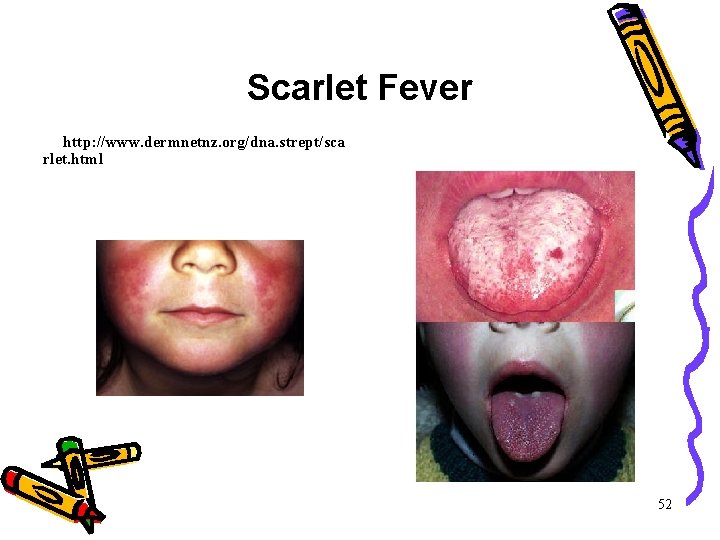
Scarlet Fever Abrupt high fever, increased pulse, vomiting, headache, chills, malaise, halitosis, abdominal pain Enanthema – tonsils enlarged, edematous & reddened White strawberry tongue day 1 Red strawberry tongue day 4 -5 Exanthema: rash appears within 12 hrs of prodromal signs • Rash is tiny pinkish-red spots that cover whole body (absent on face/flushed with circumoral pallor) scarlet spots or blotches, giving a boiled lobster appearance. progresses to “sunburn with goose pimples” • (feels like rough sandpaper) • Sloughing on palms & soles – complete by 2 weeks 51
Scarlet Fever http: //www. dermnetnz. org/dna. strept/sca rlet. html 52
Scarlet Fever – Management • Penicillin or oral cephalosporin • Nursing Care: Droplet precautions until 24 hours after treatment initiated Compliance with antibiotic therapy Encourage rest and fluids Measures to decrease discomfort of sore throat 53
54
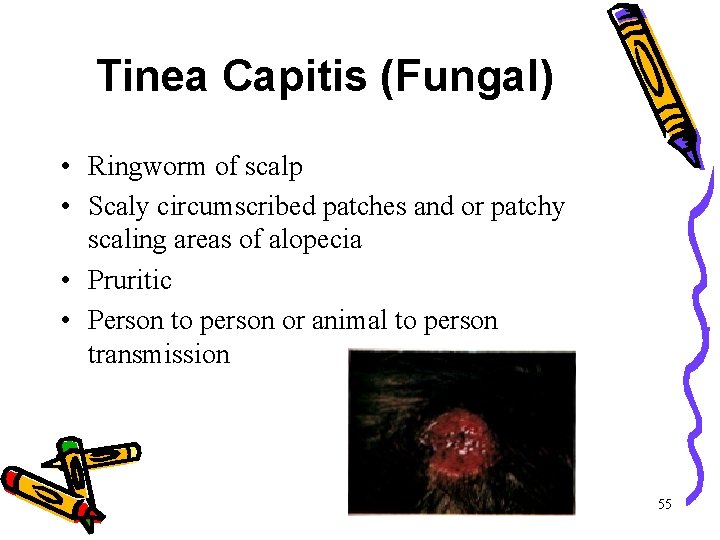
Tinea Capitis (Fungal) • Ringworm of scalp • Scaly circumscribed patches and or patchy scaling areas of alopecia • Pruritic • Person to person or animal to person transmission 55
Tinea Capitis-Treatment • • Oral griseofulvin - for weeks or months Oral ketaconazole Selenium sulfide shampoos Topical antifungal agents(clortrimazole) – inactivates organisms on hair 56
Tinea Capitis - Teaching • • • No exchange of anything that touches area Use own towel Protective cap at night Examine pets Watch public seats with headrests 57
Pinworms - Enterobiasis • Agent: enterobius vermicularis the most common helminthic (worms) infection in US • Transmission: Pinworms are transferred via fecal oral route. Can also be airborne • Crowded conditions promote spread 58
Pinworm Life Cycle • • Eggs ingested or inhaled and hatch in small intestine Hatch in upper intestine Mature & migrate through intestine After mating adult females migrate out anus and lay eggs • Eggs transferred to mouth by fingers from scratching or from soiled night clothes, underclothes, bed linen or other contaminated objects. Can also be inhaled because the eggs float in air, that why it is so easily transmitted. • Prone to reinfection • 59
Pinworm - Symptoms • • Intense itching of perianal area General irritability Restlessness Poor sleep Bedwetting Distractibility Short attention span • Perivaginal itching • www. biosci. ohio~parasite/enterobius. html 60
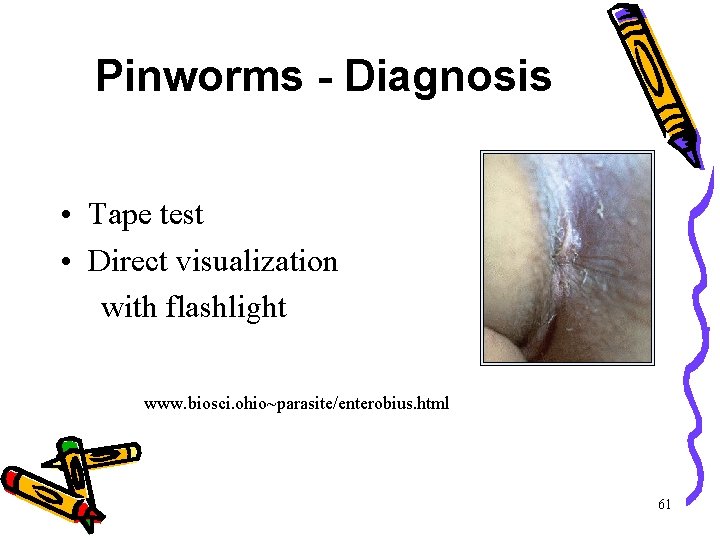
Pinworms - Diagnosis • Tape test • Direct visualization with flashlight www. biosci. ohio~parasite/enterobius. html 61
Pinworms - Treatment • Medications – Anti helminthic – **Mebendazole (Vermox) – Pyrantel pamoate (Antiminth) Pinrid – Albendazole 62
Pinworms – Nursing Care Management • Identify parasite, eradicate organism & prevent reinfection • Environmental – good hand washing – daily showers – wash bedding – clean pajamas – snug underwear – fingernails short 63
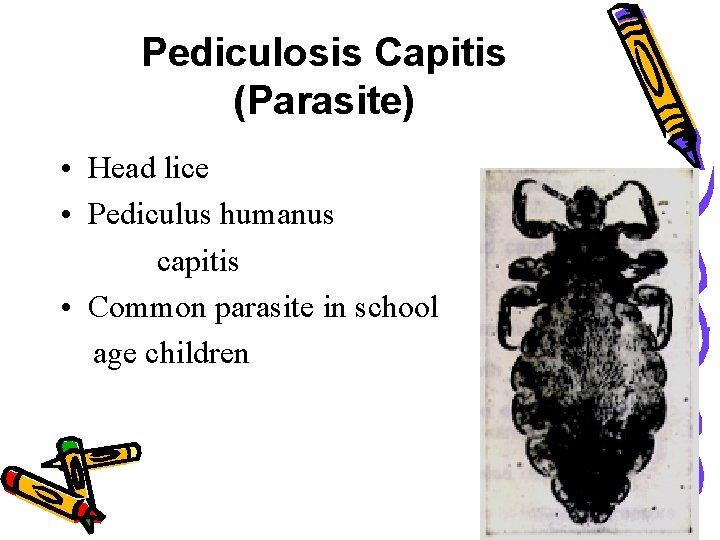
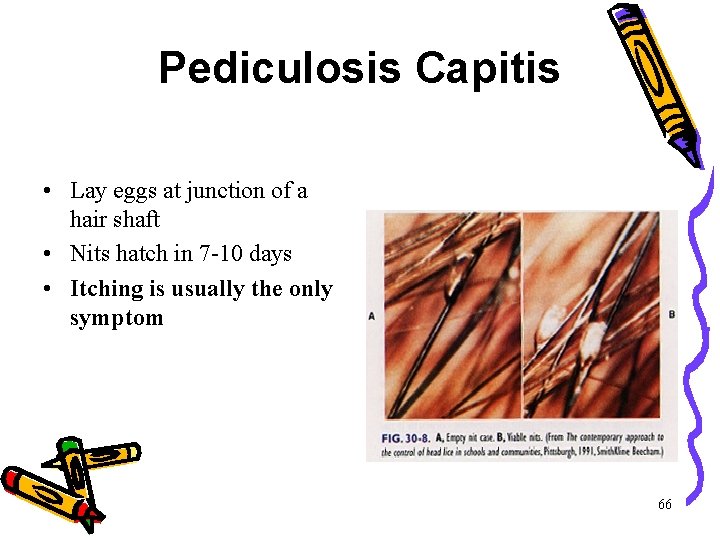
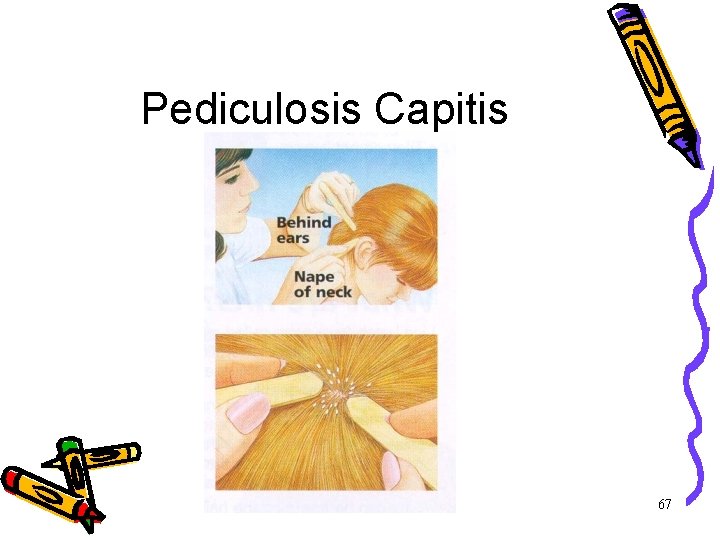
Pediculosis Capitis (Parasite) • Head lice • Pediculus humanus capitis • Common parasite in school age children 64
65
Pediculosis Capitis • Lay eggs at junction of a hair shaft • Nits hatch in 7 -10 days • Itching is usually the only symptom 66
Pediculosis Capitis 67
Three Steps to Treatment 1. Application of pediculicidal product – Permethrin (1%) crème rinse (NIX) – Pyrethin Piperonyl butoxide Preparations – RID – Lindane shampoos - 1% Kwell, Scabene – FDA warning neurotoxic) – Malathion 0. 5%Ovide 2. Manual removal of nit cases • 3. Environmental 68
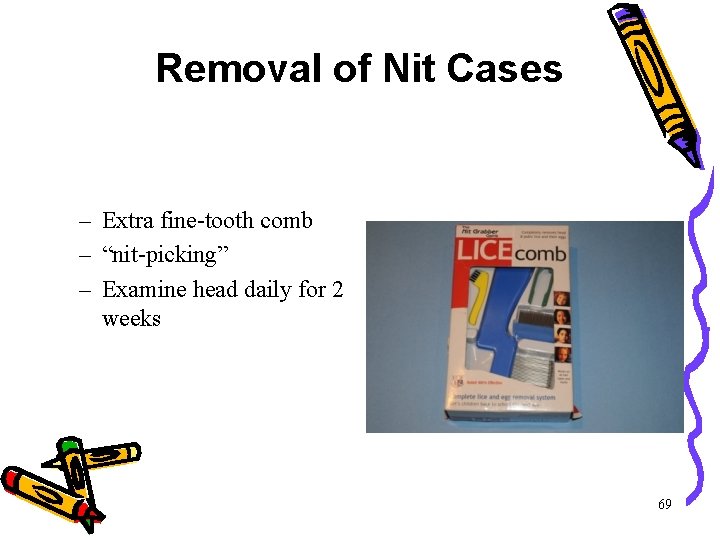
Removal of Nit Cases – Extra fine-tooth comb – “nit-picking” – Examine head daily for 2 weeks 69
Environmental - Teaching – – – Anyone can get them Can be transmitted on personal items Wash clothing and linens in hot water Dry clothing in hot dryer Seal non-washable items in plastic bags for 14 days Soak combs in lice-killing products for 1 hour or in boiling water for 10 minutes – Vacuum car seats, furniture, stuffed animals 70
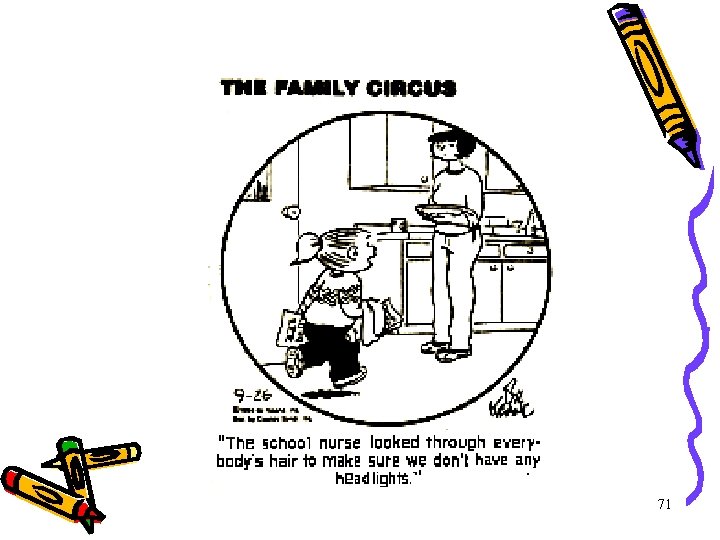
71
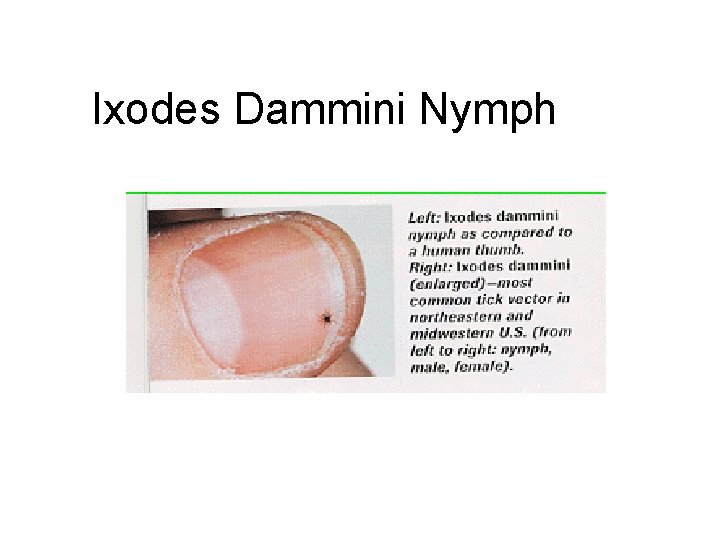
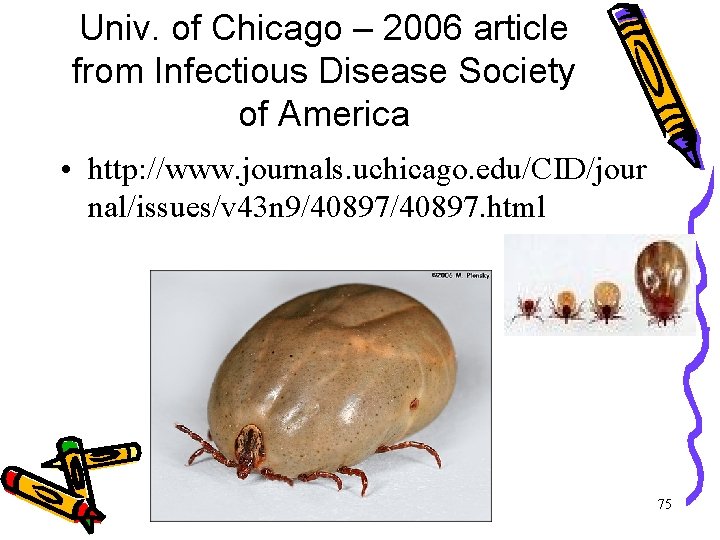
Lyme Disease • • • Recognized in 1975 Most common tick borne disease in US Spirochete - Borrelia burgdorferi Deer tick - Ixodes Dammini in northeast Host - white tailed deer and white footed mice 72
Ixodes Dammini Nymph
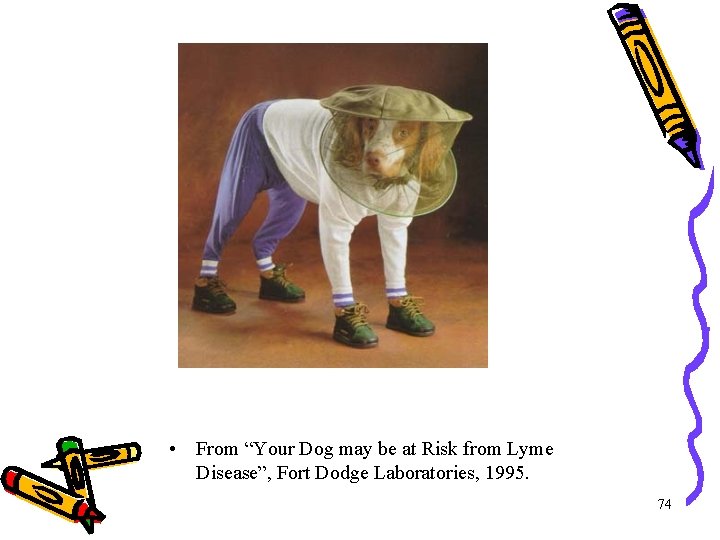
• From “Your Dog may be at Risk from Lyme Disease”, Fort Dodge Laboratories, 1995. 74
Univ. of Chicago – 2006 article from Infectious Disease Society of America • http: //www. journals. uchicago. edu/CID/jour nal/issues/v 43 n 9/40897. html 75
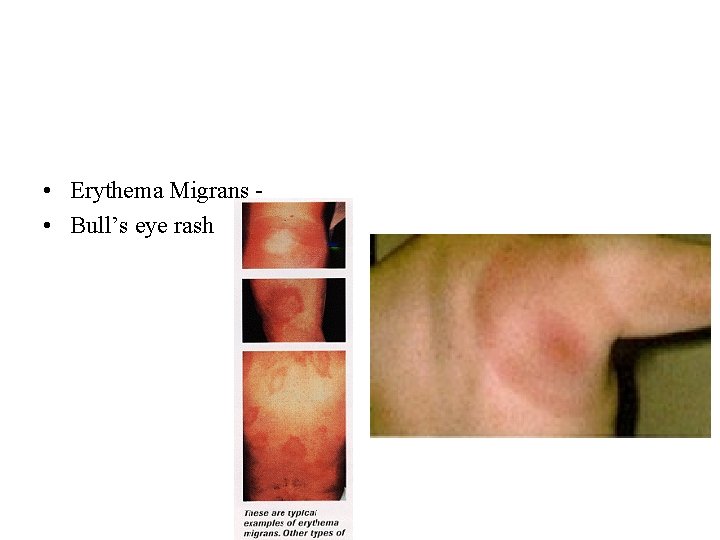
Lyme Disease - Stages • Stage 1 – Tick bite – Erythematous papule – Bull’s eye rash 76
• Erythema Migrans • Bull’s eye rash
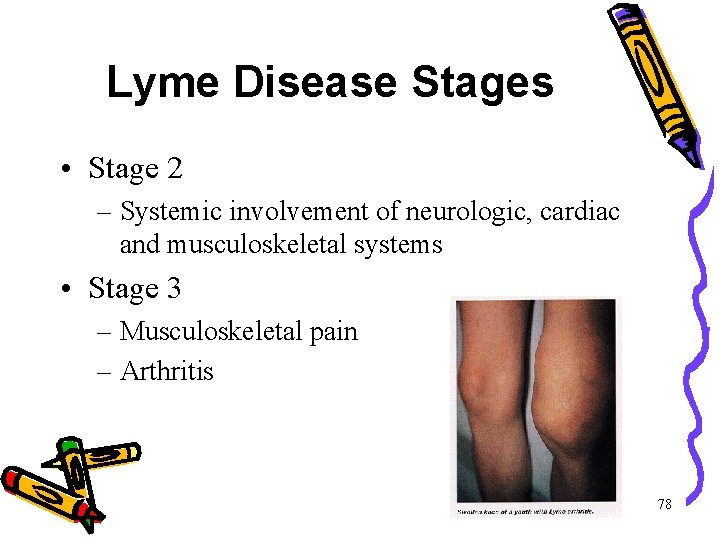
Lyme Disease Stages • Stage 2 – Systemic involvement of neurologic, cardiac and musculoskeletal systems • Stage 3 – Musculoskeletal pain – Arthritis 78
Lyme Disease • Diagnosis – Symptoms – Lab: Elisa, Western Blot, PCR • Management – Doxycycline or Amoxicillin 79
Teaching - Prevention & Education • Avoid areas where deer are frequently seen • Walk in the center of trails • Wear long pants and long-sleeved shirts that fit tightly at the ankles and wrists • Wear light colored clothing • Wear a hat • Tuck pant legs into socks • Wear shoes that leave no part of the foot exposed • No DEET for infants & smaller children 80
Lead Poisoning • Major preventable environmental health problem (CDC – 1997) • Irreversible health effects Brain & nervous system damage Reduced intelligence Learning disabilities 81
Lead Poisoning • • Historical perspective Lead does not decompose Cultural perspective Risk factors 82
Pathophysiology of Lead Poisoning • Lead can affect any part of body • Most concerning – effect on young child’s developing brain & nervous system • Lead disrupts biochemical processes & may have direct effect on release of neurotransmitters, causing alterations in blood brain barrier & may interfere with regulation of synaptic activity • Mild to moderate levels of lead – can affect cognition & behavior in children • Can cause long term neurocognitive signs 83
Lead Poisoning Diagnostic Evaluation • Children rarely have symptoms • Venous blood specimen • Lead levels greater than 10 mcg/dl (has dropped from 80 mcg/dl in 1950’s) • CDC –recommends targeted screening on basis of each state’s determination of need • Universal screening done at ages 1 -2 years 84
85
Anticipatory Guidance • Hazards of lead based paint in older housing • Ways to control lead hazards safety • How to choose safe toys • Hazards accompanying repainting and renovation in homes built before 1978 • Other exposure sources 86
Screening • Universal screening- ages 1 & 2 • Targeting screening- is acceptable when an area has been determined by existing data to have less risk 87
Lead Poison Treatment • Chelation therapy – Medications • Succimer • Ca Na 2 EDTA 88
Nursing Care Management • As nurses what is your primary goal? 89
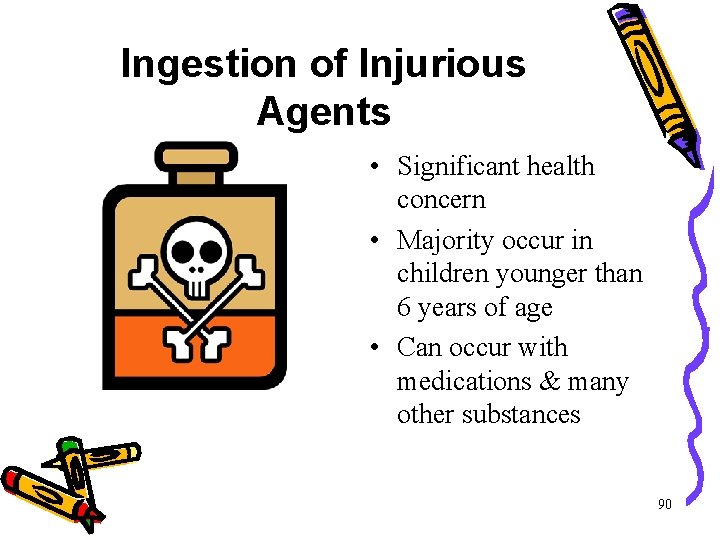
Ingestion of Injurious Agents • Significant health concern • Majority occur in children younger than 6 years of age • Can occur with medications & many other substances 90
Most Common Poisonings • • • Cleaning substances Cosmetics & Personal care products Plants Foreign bodies Pharmaceuticals 91
Poisonings • • First Priority – Assess the child Terminate exposure Identify poison Prevent poison absorption 92
Principles of Emergency Treatment • Advise parents to Call Poison Control Center before initiating any intervention • PCC begin treatment at home or take to emergency room • Treat the child first, not the poison (vital signs, respiratory or circulatory support) • Terminate exposure • Identify the poison 93
Gastric Decontamination • Remove ingested poison: Absorbing toxin with activated charcoal Gastric Lavage Increase bowel motility (catharsis) 94
Activated Charcoal • Most commonly used method of gastric decontamination • odorless, tasteless, fine black powder • give within 1 hour of poison • mix with water, saline or flavoring to make slurry • give through straw or NG tube • Potential complications – aspiration, constipation, intestinal obstruction 95
Gastric Lavage • Performed to empty stomach of toxic contents. • Procedure associated with serious complications: gastrointestinal perforation, hypoxia, aspiration • No longer recommended in all cases of ingestion • To use in cases who present within 1 hr of ingestion, decreased GI motility, sustained release medication ingestion, or massive amounts of life threatening poison 96
Antidotes • Minority of poisons have specific antidotes • Used to counteract the poison • Highly effective & should be available in all Emergency facilities • Examples – N-acetlcysteine for acetaminophen poisoning, oxygen for carbon monoxide inhalation, naloxone for opioid overdose 97
Stages of Acetaminophen Poisoning • Initial Period (2 to 4 hours after ingestion) – Nausea, vomiting, sweating, pallor • Latent period (24 to 36 hours) – patient improves • Hepatic involvement (may last up to 7 days) – pain in right upper quadrant – jaundice, confusion, stupor – coagulation abnormalities • Recovery – patients who do not die in hepatic stage gradually – recover 98
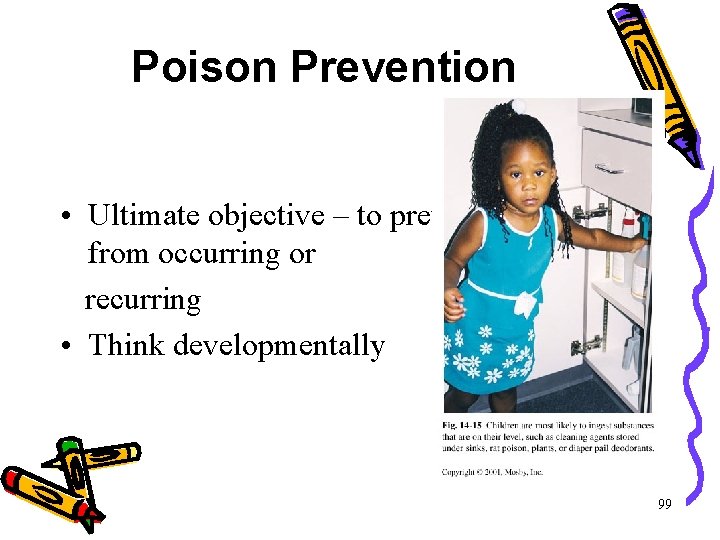
Poison Prevention • Ultimate objective – to prevent poisonings from occurring or recurring • Think developmentally 99
Prevention • Prevent recurrence • Discuss difficulties of constantly watching & safeguarding children • How to identify risk? 100
Poison Prevention • • Store poisons out of children’s reach Keep products in the original containers Never call medicine “candy” Place safety latches on all drawers and cabinets containing poisonous products Read labels before using a cleanser or other chemical product Post poison Control Center number near the telephone 1 -800 -222 -1222 Educate children 101
Questions 102