
Lecture 11 UML Terminology Additional Models Model Features


- Slides: 37
Lecture 11: UML Terminology, Additional Models, Model Features and Notation Copyright W. Howden 1
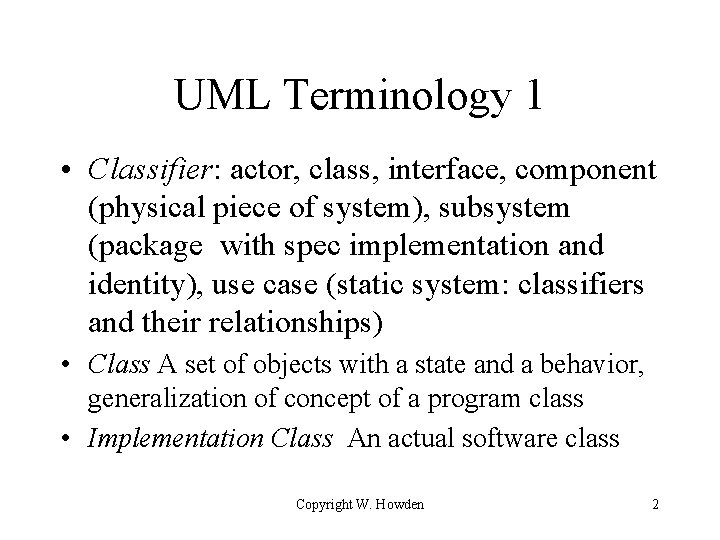
UML Terminology 1 • Classifier: actor, class, interface, component (physical piece of system), subsystem (package with spec implementation and identity), use case (static system: classifiers and their relationships) • Class A set of objects with a state and a behavior, generalization of concept of a program class • Implementation Class An actual software class Copyright W. Howden 2
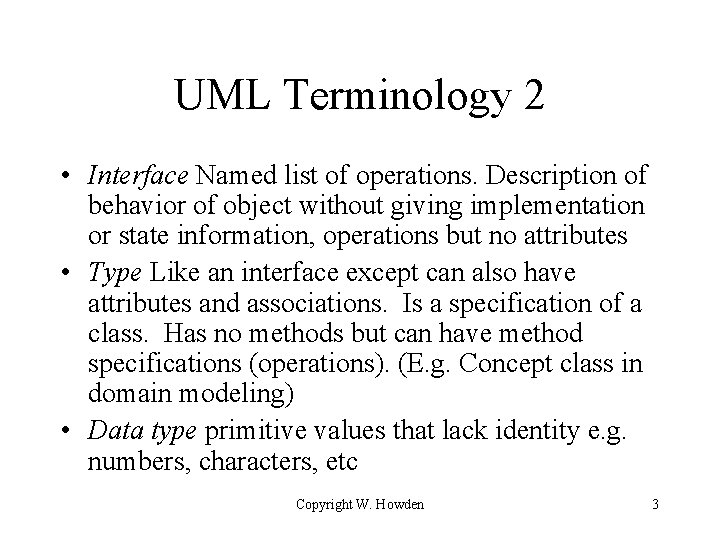
UML Terminology 2 • Interface Named list of operations. Description of behavior of object without giving implementation or state information, operations but no attributes • Type Like an interface except can also have attributes and associations. Is a specification of a class. Has no methods but can have method specifications (operations). (E. g. Concept class in domain modeling) • Data type primitive values that lack identity e. g. numbers, characters, etc Copyright W. Howden 3
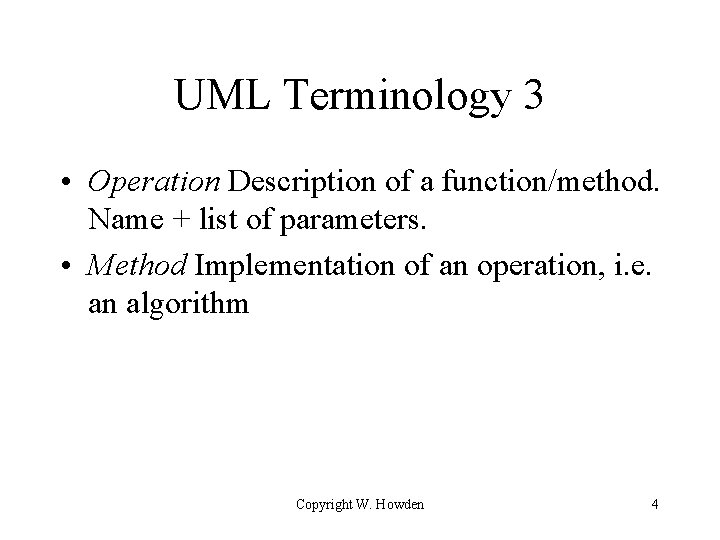
UML Terminology 3 • Operation Description of a function/method. Name + list of parameters. • Method Implementation of an operation, i. e. an algorithm Copyright W. Howden 4
UML Diagrams • • Use Case Class Interaction Sequence Collaboration Package Activity Deployment State Copyright W. Howden 5
UML Class Diagrams • Generic, used for both Domain and Design Class Models • Additional kinds of associations – Generalization – Aggregation Copyright W. Howden 6
Generalization • A general term in UML, also applicable to classifiers other than classes, such as actors, Use Cases, etc. • Used to indicate that one kind of classifier is a generalization of another • When applied to classes, similar to inheritance Copyright W. Howden 7
Generalization and Types • Subtype A subset of the instances of some classifier, having special properties of their own. All members of a subtype set are members of the supertype set • Supertype More abstract classifier having common properties of subtypes. A supertype set contains all elements in subtype sets. Copyright W. Howden 8
Rules for Creating Sub. Types • Correctness guidelines – When is a generalization “valid”? • Usefulness guidelines – A generalization may be correct but not that useful – The goal is not to create as many classes as possible Copyright W. Howden 9
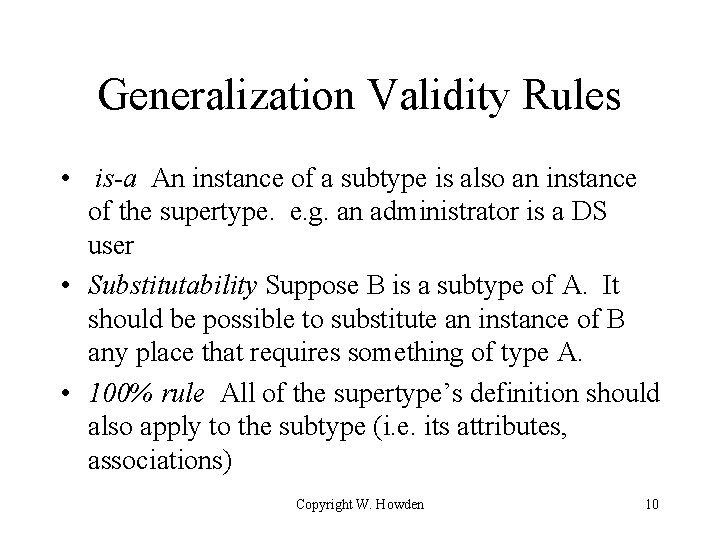
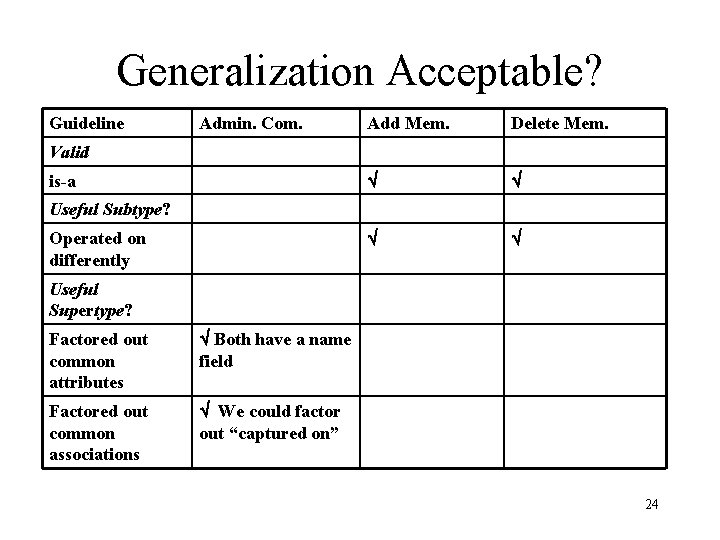
Generalization Validity Rules • is-a An instance of a subtype is also an instance of the supertype. e. g. an administrator is a DS user • Substitutability Suppose B is a subtype of A. It should be possible to substitute an instance of B any place that requires something of type A. • 100% rule All of the supertype’s definition should also apply to the subtype (i. e. its attributes, associations) Copyright W. Howden 10
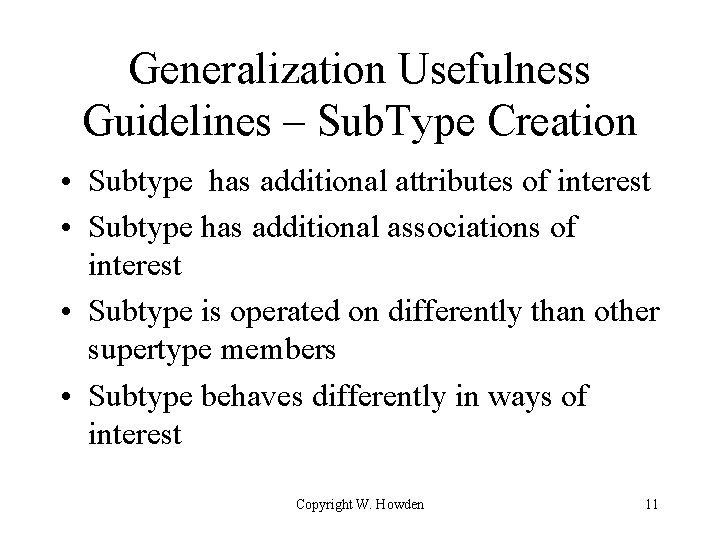
Generalization Usefulness Guidelines – Sub. Type Creation • Subtype has additional attributes of interest • Subtype has additional associations of interest • Subtype is operated on differently than other supertype members • Subtype behaves differently in ways of interest Copyright W. Howden 11
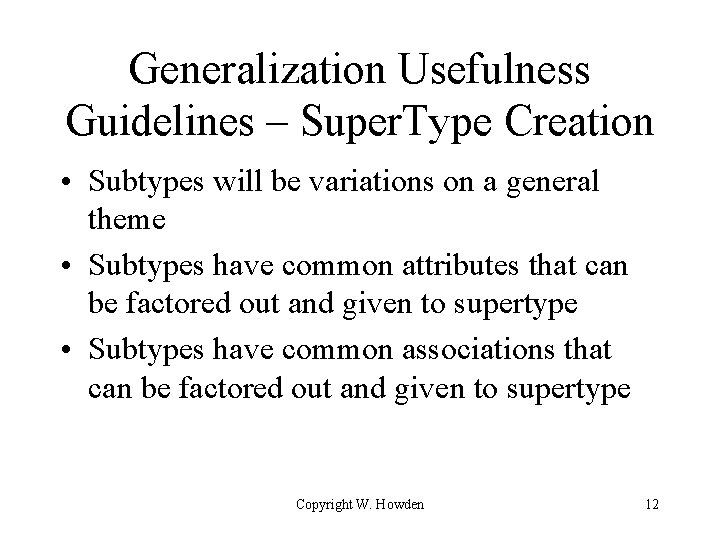
Generalization Usefulness Guidelines – Super. Type Creation • Subtypes will be variations on a general theme • Subtypes have common attributes that can be factored out and given to supertype • Subtypes have common associations that can be factored out and given to supertype Copyright W. Howden 12
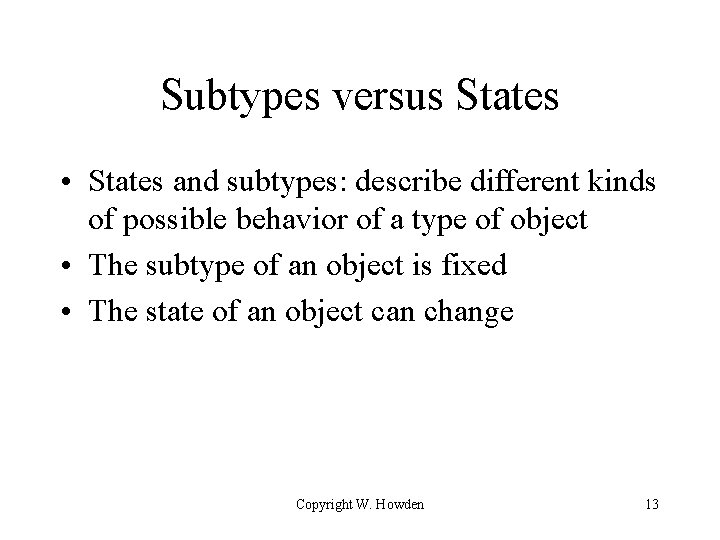
Subtypes versus States • States and subtypes: describe different kinds of possible behavior of a type of object • The subtype of an object is fixed • The state of an object can change Copyright W. Howden 13
Aggregation • A has an aggregation relationship with B and C if they are parts of A • Fuzzy distinctions between – Aggregation – Composition – Association • E. g. DS Member. Data has a Datee. Data Copyright W. Howden 14
Composition • Strong form of aggregation – Parts only belong to one whole – If whole is deleted, parts get deleted • E. g. composition – fingers on your hand • E. g. simple aggregation – change in your pocket Copyright W. Howden 15
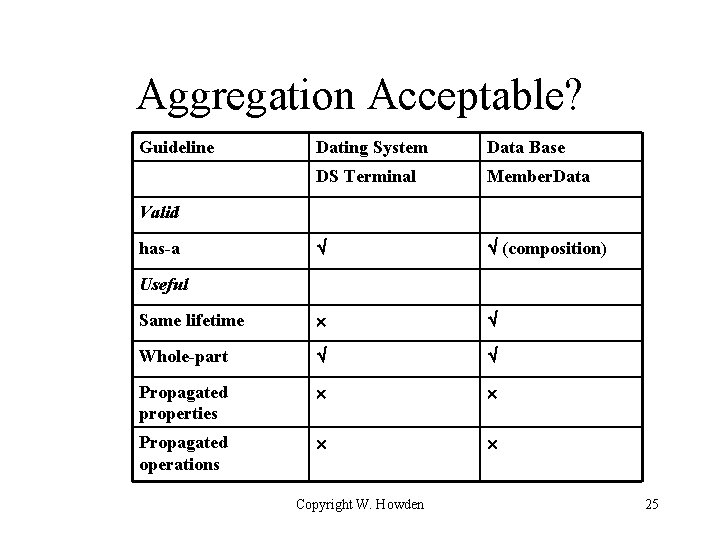
Aggregation Validity Rules • has-a The composite object has an instance of each class that it aggregates • Contrast with the is-a correctness rule for generalization Copyright W. Howden 16
Aggregation Usefulness Rules • Lifetime of part bound within lifetime of composite (if not, -> simple aggregation only? ) • Whole-part physical or logical relationship • Some properties of composite are automatically part of properties of parts (e. g. location) • Some operations of composite are automatically applied to the parts Copyright W. Howden 17
Generalization vs Aggregation 1 • • Defining a new class, e. g. stack from vector Generalization – • Subtype vector and define new stack class operations that use the inherited operations Aggregation – – New stack class has a vector class variable Use define stack operations using vector operations Copyright W. Howden 18
Generalization vs Aggregation 2 • Which is the better OO definition of a stack? • Apply the is-a/substituability and has-a correctness rules Stack is-a vector? substitute a stack any place where you need a vector? Stack has-a vector? Copyright W. Howden 19
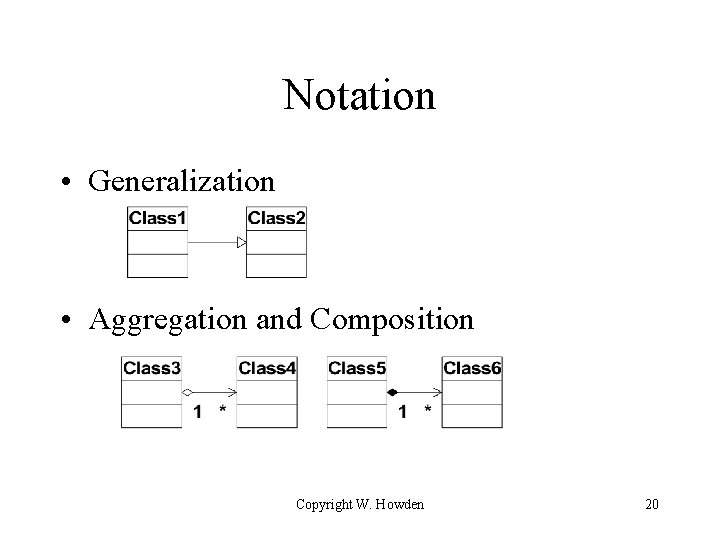
Notation • Generalization • Aggregation and Composition Copyright W. Howden 20
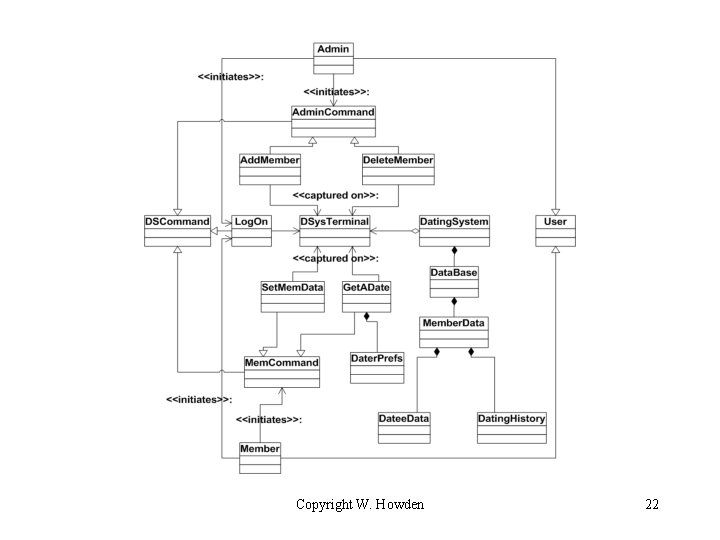
Phase 2 DS Domain Model • Includes use of generalization, aggregation and composition notation • Class/concept attributes listed separately • Assumes a single DS terminal Copyright W. Howden 21
Copyright W. Howden 22
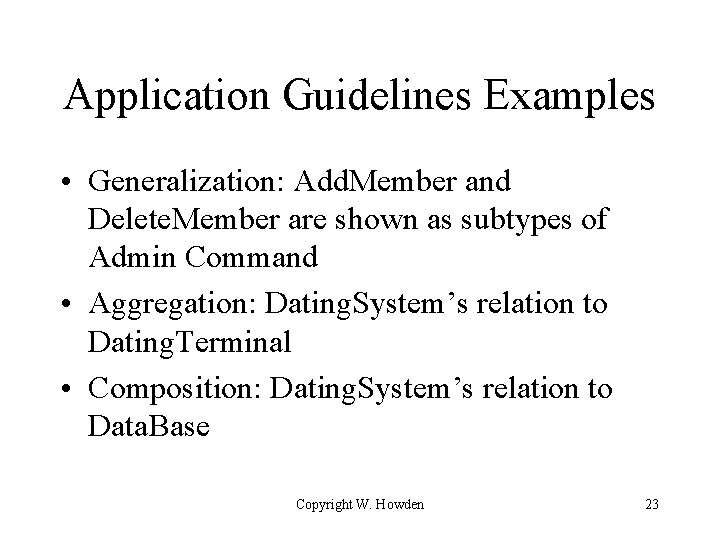
Application Guidelines Examples • Generalization: Add. Member and Delete. Member are shown as subtypes of Admin Command • Aggregation: Dating. System’s relation to Dating. Terminal • Composition: Dating. System’s relation to Data. Base Copyright W. Howden 23
Generalization Acceptable? Guideline Admin. Com. Add Mem. Delete Mem. Valid is-a Useful Subtype? Operated on differently Useful Supertype? Factored out common attributes Both have a name field Factored out common associations We could factor out “captured on” 24
Aggregation Acceptable? Guideline Dating System Data Base DS Terminal Member. Data (composition) Same lifetime Whole-part Propagated properties Propagated operations Valid has-a Useful Copyright W. Howden 25
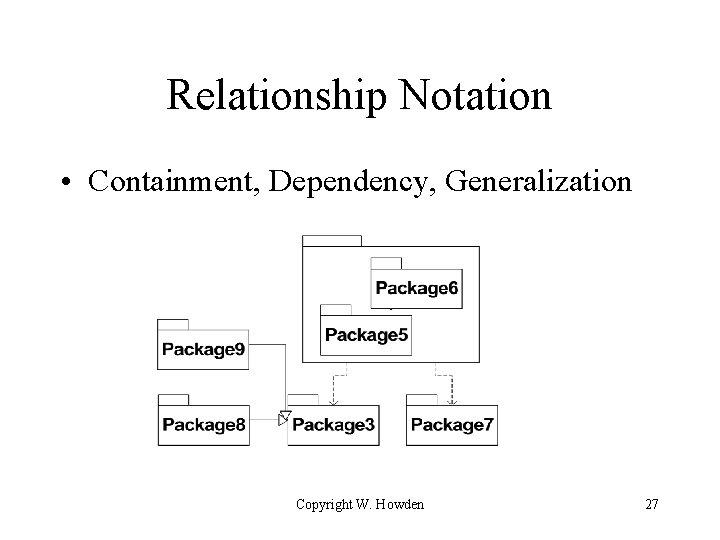
UML Package Diagrams – Package Relationships • Containment In addition to classes, a package may contain other packages • Dependencies If one package is dependent on others, changes to their classes/packages may require changes to it also • Generalization A “subtype” package must conform to the interface for the more general package. Copyright W. Howden 26
Relationship Notation • Containment, Dependency, Generalization Copyright W. Howden 27
DS Package Examples • Containment: e. g. GUI package contains separate packages for the Member and Admin GUI Classes • Dependencies: changes in one package cause changes in a depending class e. g. changes to classes in DL package/subsystem may require changes to classes in GUI package/subsystem • Generalization: e. g. original DB has a proxy interface that can be implemented in different ways, with different classes of packages Copyright W. Howden 28
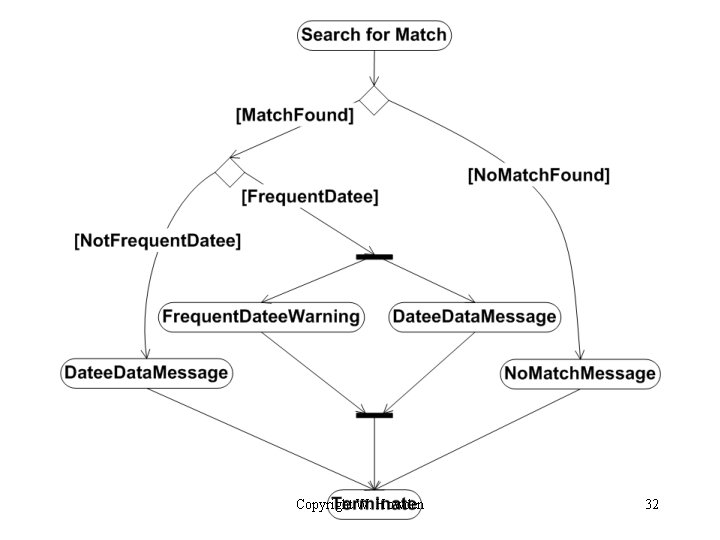
UML Activity Diagrams • Similar to flow charts but also allow parallel processes • Components – Activity: task that needs to be done – Sequence flow: from one task to the next – Synchronization bar: splitting into and merging back for parallel flows – Decision: conditional branch Copyright W. Howden 29
Activity Diagram Applications • Use case documentation • Activities whose sequencing is not determined • Describing development process workflows Copyright W. Howden 30
DS Activity Diagram Example • Describes what the system must do when the user asks for a date • High level abstraction before deciding how it will do these tasks • E. g. Frequent. Datee Warning and Datee. Data. Message may be combined Copyright W. Howden 31
Copyright W. Howden 32
OO Design and Activity Diagrams • Activity diagrams are not OO oriented • Compare with Interaction Sequence Diagrams – Focus on objects and messages between them • Swimlanes: additional notation that can be used to make activity diagrams more OO – Divide up diagram into zones/columns associated with party responsible for zone tasks – E. g. example from DS Copyright W. Howden 33
Copyright W. Howden 34
Activity Diagrams – Evaluation • Used as flow charts for algorithms, with or without use of parallel processing • For system level, useful if there are interacting parallel processes • Not that effective for system level object oriented descriptions with non-parallel processing, as in previous example Copyright W. Howden 35
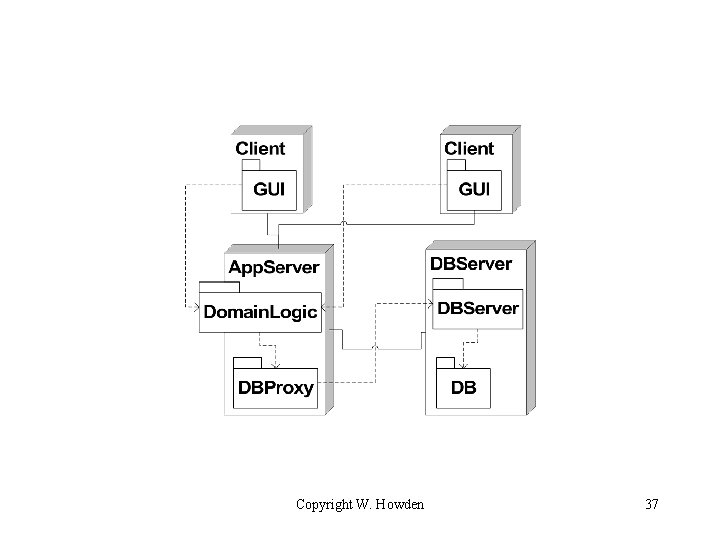
UML Deployment Diagrams • Purpose: show software is distributed amongst hardware, where it runs • Diagram components Node: hardware of some kind, computer, sensor Component: software modules/packages Connections: communication paths between nodes • E. g. Client-Server version of DS Copyright W. Howden 36
Copyright W. Howden 37