
Lecture 11 Strong Passwords problem statement Lamports hash
Lecture 11: Strong Passwords • • problem statement Lamport’s hash encrypted key exchange (EKE) secure credentials download 1
Strong Password Protocols • Obtaining the benefits of cryptographic authentication with the user being able to remember passwords only • in particular: – no security information is kept at the user’s machine (the machine is trusted but not configured) – someone impersonating either party will not be able to obtain information for off-line password guessing (online password guessing is not preventable) 2
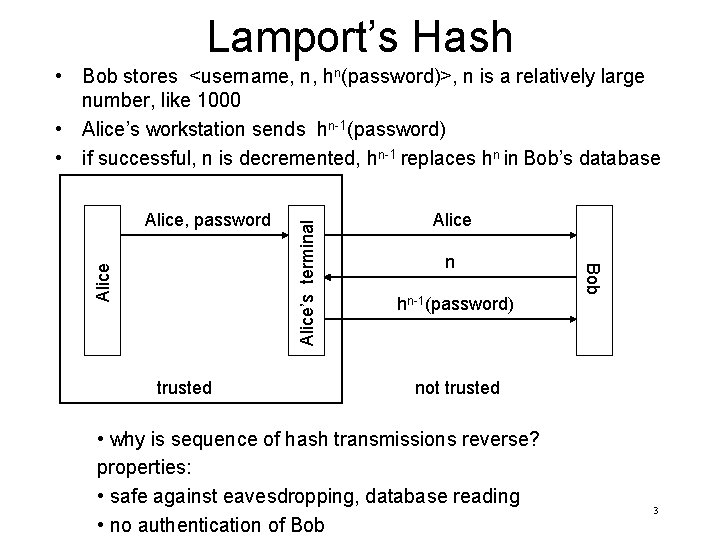
Lamport’s Hash trusted Alice n hn-1(password) Bob Alice, password Alice’s terminal • Bob stores <username, n, hn(password)>, n is a relatively large number, like 1000 • Alice’s workstation sends hn-1(password) • if successful, n is decremented, hn-1 replaces hn in Bob’s database not trusted • why is sequence of hash transmissions reverse? properties: • safe against eavesdropping, database reading • no authentication of Bob 3

Salting Lamport’s Hash • hn-1(pwd|salt) is used for authentication • salt is stored at Bob’s at setup time, Bob sends salt each time along with n • advantages: – Alice can use the same password with multiple servers, why? • what may happen if two servers pick the same salt? – to ensure that the salt is different, servers name is also hashed in – easy password reset (when reaches 1) – just change the salt – defense dictionary attacks • how would Trudy mount a dictionary attack without the salt? 4
Lamport’s Hash: Other Properties • small n attack – when Alice tries to login Trudy impersonates Bob and sends n’ < n and Bob’s salt, when Trudy gets the reply she can impersonate Alice after n is decremented to n’ – defense: Alice’s workstation presents submitted n to Alice to verify the “approximate” range (Alice has to remember it) • “human and paper” environment – in case Alice workstation is not trusted or too “dumb” to do hashing – Alice is given a list of all hashes starting from 1000, she uses each hash exactly once • automatically prevents small n attack • string size – 64 bits (~10 characters) is secure enough • implemented as S/Key and standardized as one-time password system 5
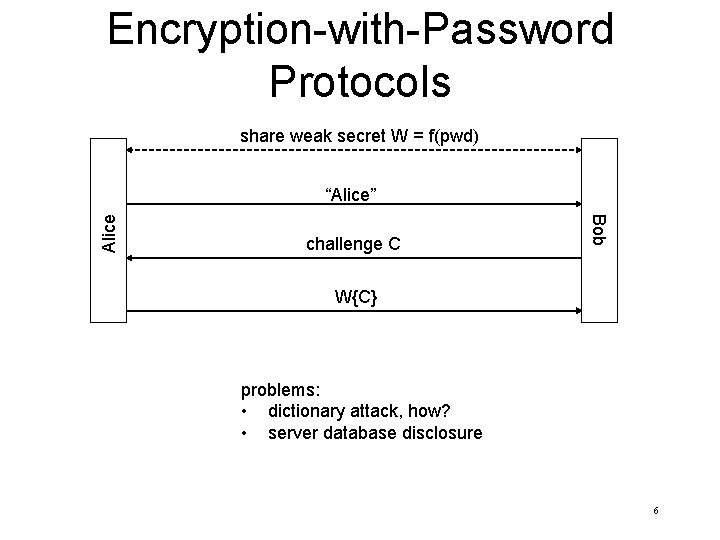
Encryption-with-Password Protocols share weak secret W = f(pwd) challenge C Bob Alice “Alice” W{C} problems: • dictionary attack, how? • server database disclosure 6
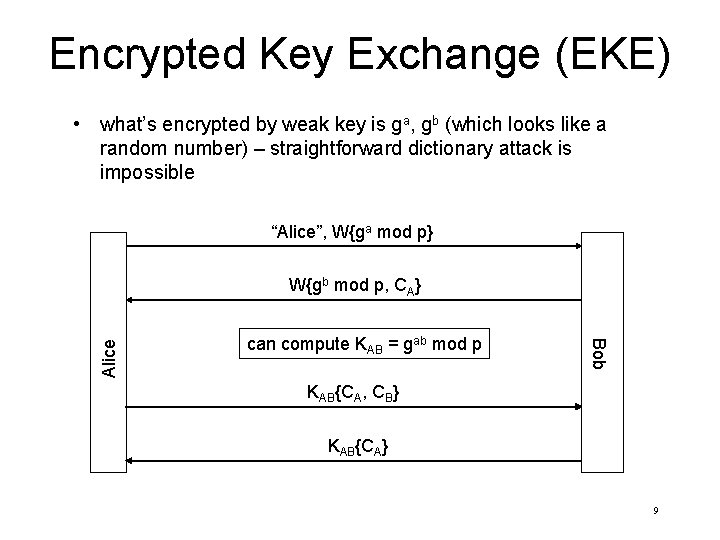
Encrypted Key Exchange (EKE) • what’s encrypted by weak key is ga, gb (which looks like a random number) – straightforward dictionary attack is impossible “Alice”, W{ga mod p} can compute KAB = gab mod p Bob Alice W{gb mod p, CA} KAB{CA, CB} KAB{CA} 9
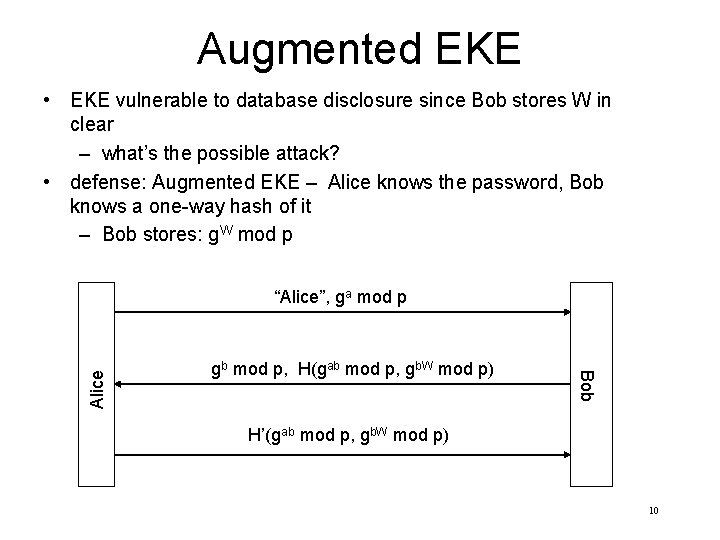
Augmented EKE • EKE vulnerable to database disclosure since Bob stores W in clear – what’s the possible attack? • defense: Augmented EKE – Alice knows the password, Bob knows a one-way hash of it – Bob stores: g. W mod p gb mod p, H(gab mod p, gb. W mod p) Bob Alice “Alice”, ga mod p H’(gab mod p, gb. W mod p) 10
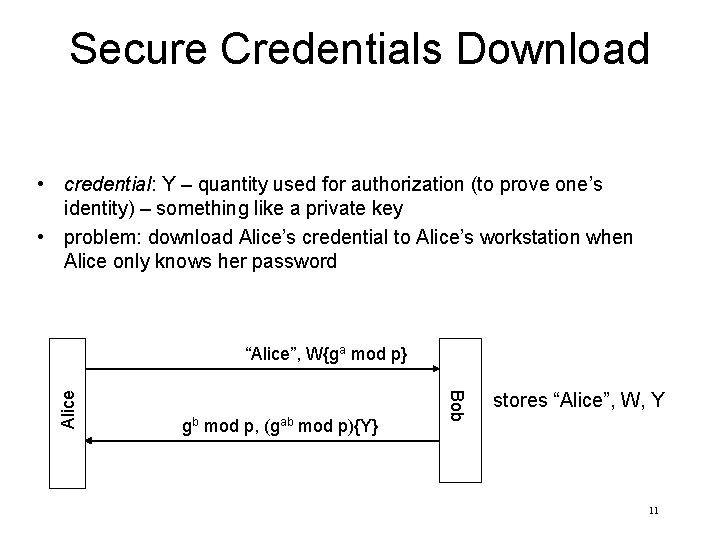
Secure Credentials Download • credential: Y – quantity used for authorization (to prove one’s identity) – something like a private key • problem: download Alice’s credential to Alice’s workstation when Alice only knows her password gb mod p, (gab mod p){Y} Bob Alice “Alice”, W{ga mod p} stores “Alice”, W, Y 11
- Slides: 9