
Lecture 11 Stable Isotopes of Elements Chart of
Lecture 11 Stable Isotopes of Elements Chart of the Nuclides Delta Notation Isotope Fractionation Equilibrium Kinetic Raleigh See E & H Chpt. 5 When the universe was formed 15 billion years ago (the “Big Bang”) light elements of H (99%), He (1%) and trace amounts of Li were formed. Subsequent reactions during star formation created the remaining elements,
Isotopes of Elements The chemical characteristic of an element is determined by the number of protons in its nucleus. Atomic Number = # Protons = define the chemistry Different elements can have different numbers of neutrons and thus atomic weights (the sum of protons plus neutrons). Atomic Weight = protons + neutrons = referred to as isotopes There are 92 naturally occurring elements Some are stable; some are Radioactive
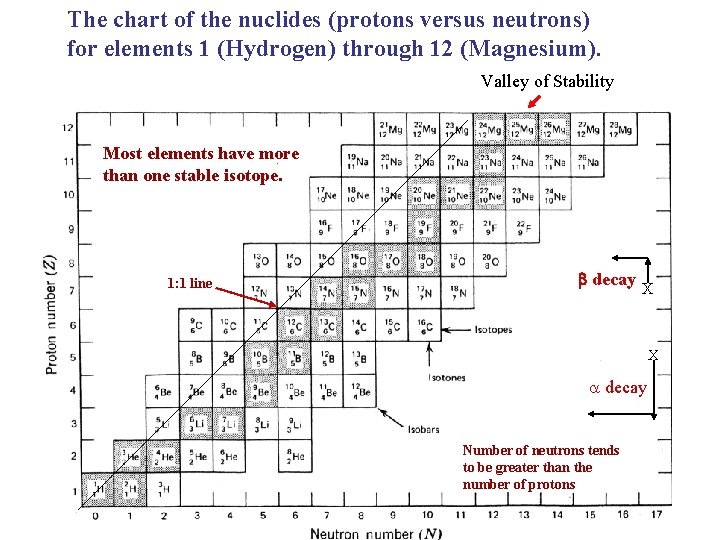
The chart of the nuclides (protons versus neutrons) for elements 1 (Hydrogen) through 12 (Magnesium). Valley of Stability Most elements have more than one stable isotope. 1: 1 line b decay X X decay Number of neutrons tends to be greater than the number of protons
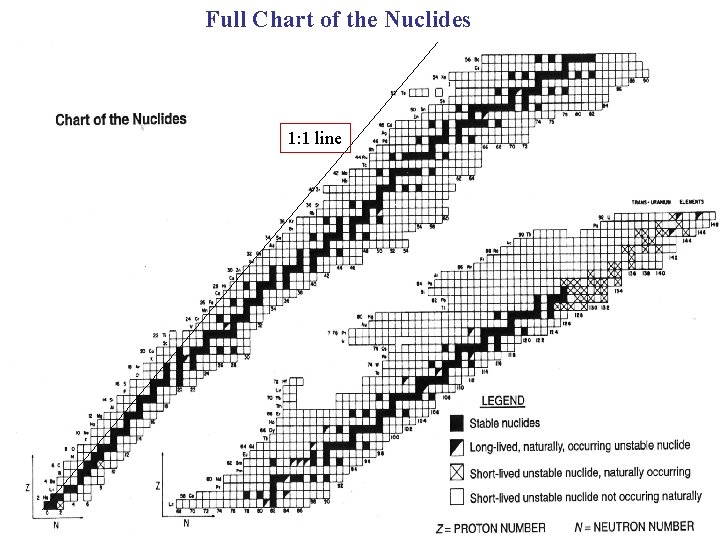
Full Chart of the Nuclides 1: 1 line
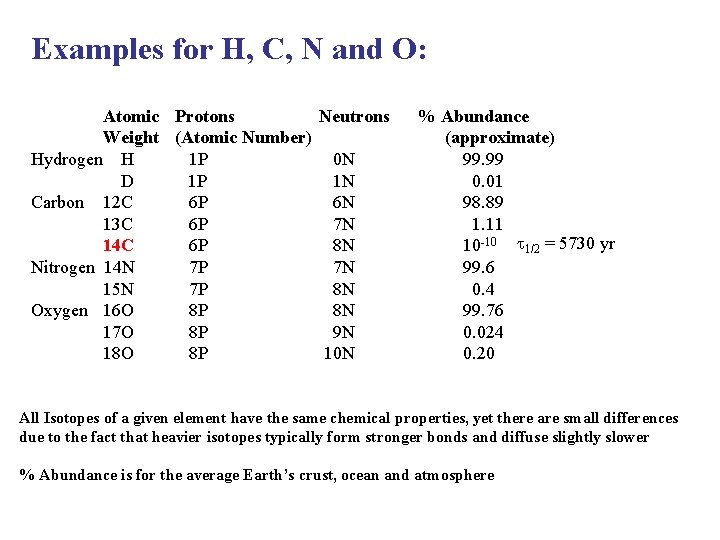
Examples for H, C, N and O: Atomic Protons Neutrons Weight (Atomic Number) Hydrogen H 1 P 0 N D 1 P 1 N Carbon 12 C 6 P 6 N 13 C 6 P 7 N 14 C 6 P 8 N Nitrogen 14 N 7 P 7 N 15 N 7 P 8 N Oxygen 16 O 8 P 8 N 17 O 8 P 9 N 18 O 8 P 10 N % Abundance (approximate) 99. 99 0. 01 98. 89 1. 11 10 -10 1/2 = 5730 yr 99. 6 0. 4 99. 76 0. 024 0. 20 All Isotopes of a given element have the same chemical properties, yet there are small differences due to the fact that heavier isotopes typically form stronger bonds and diffuse slightly slower % Abundance is for the average Earth’s crust, ocean and atmosphere
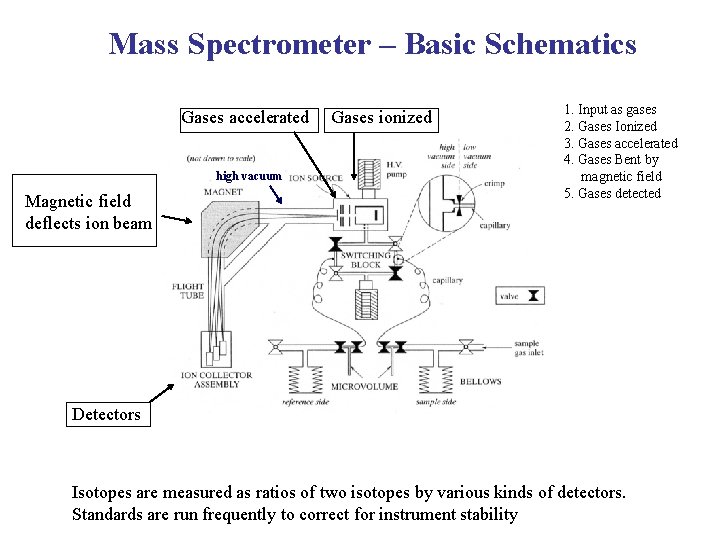
Mass Spectrometer – Basic Schematics Gases accelerated high vacuum Magnetic field deflects ion beam Gases ionized 1. Input as gases 2. Gases Ionized 3. Gases accelerated 4. Gases Bent by magnetic field 5. Gases detected Detectors Isotopes are measured as ratios of two isotopes by various kinds of detectors. Standards are run frequently to correct for instrument stability
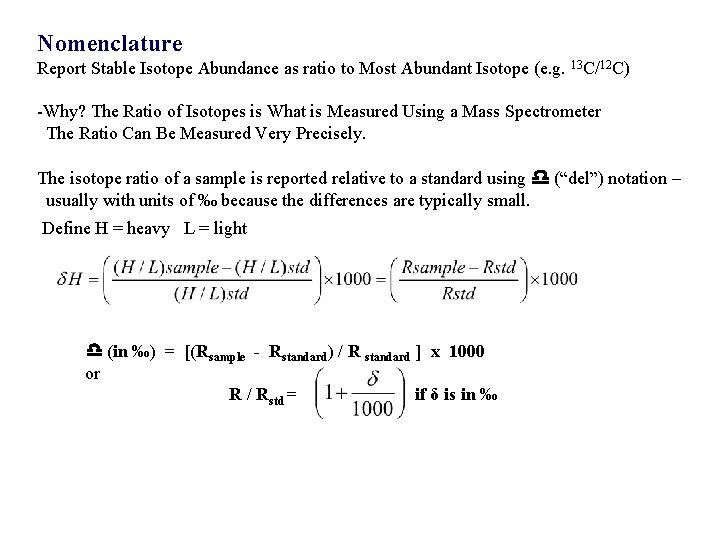
Nomenclature Report Stable Isotope Abundance as ratio to Most Abundant Isotope (e. g. 13 C/12 C) -Why? The Ratio of Isotopes is What is Measured Using a Mass Spectrometer The Ratio Can Be Measured Very Precisely. The isotope ratio of a sample is reported relative to a standard using d (“del”) notation – usually with units of ‰ because the differences are typically small. Define H = heavy L = light d (in ‰) = [(Rsample - Rstandard) / R standard ] x 1000 or R / Rstd = if δ is in ‰
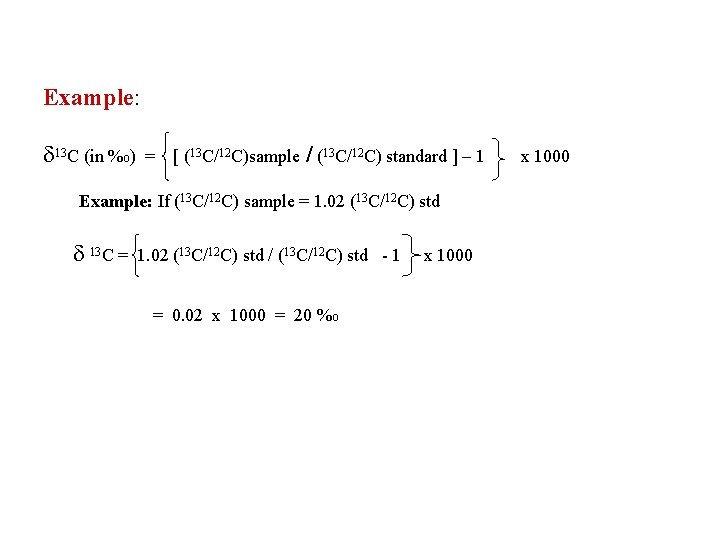
Example: d 13 C (in %o) = [ (13 C/12 C)sample / (13 C/12 C) standard ] – 1 Example: If (13 C/12 C) sample = 1. 02 (13 C/12 C) std d 13 C = 1. 02 (13 C/12 C) std / (13 C/12 C) std - 1 = 0. 02 x 1000 = 20 %o x 1000
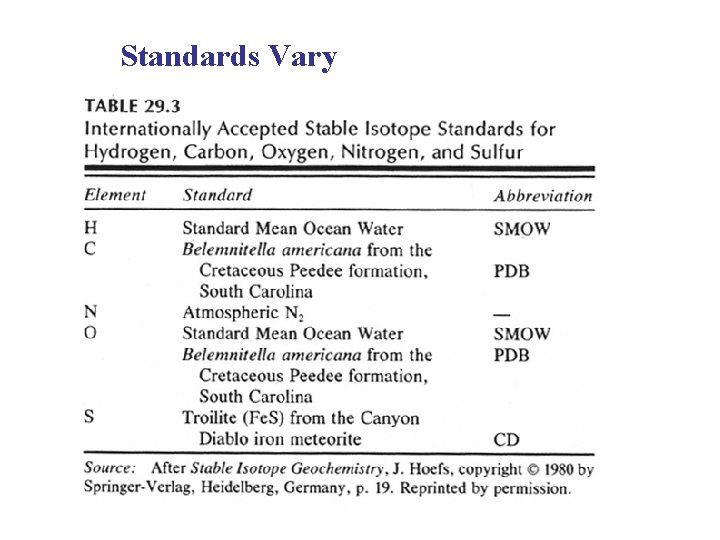
Standards Vary
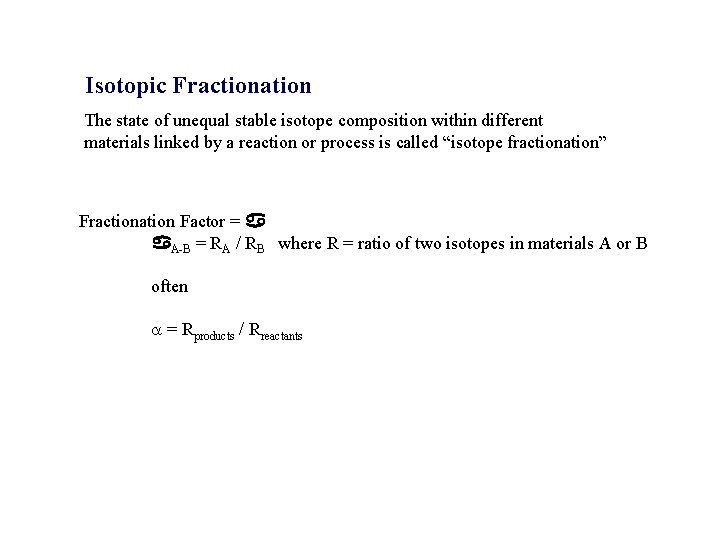
Isotopic Fractionation The state of unequal stable isotope composition within different materials linked by a reaction or process is called “isotope fractionation” Fractionation Factor = a a. A-B = RA / RB where R = ratio of two isotopes in materials A or B often = Rproducts / Rreactants
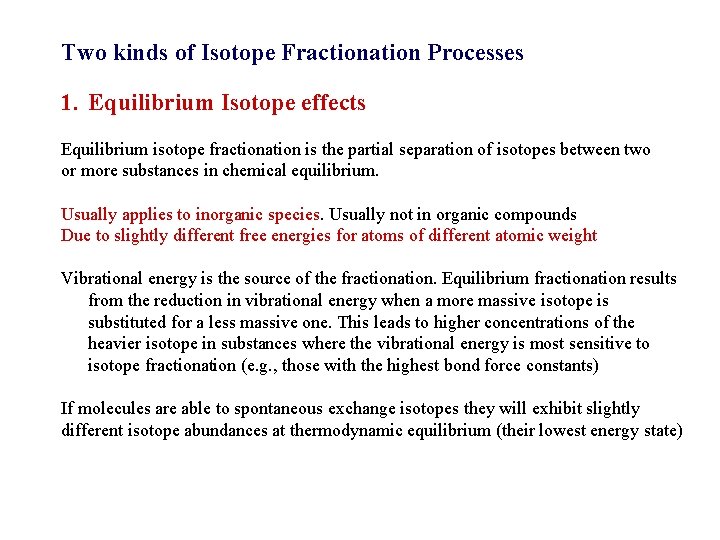
Two kinds of Isotope Fractionation Processes 1. Equilibrium Isotope effects Equilibrium isotope fractionation is the partial separation of isotopes between two or more substances in chemical equilibrium. Usually applies to inorganic species. Usually not in organic compounds Due to slightly different free energies for atoms of different atomic weight Vibrational energy is the source of the fractionation. Equilibrium fractionation results from the reduction in vibrational energy when a more massive isotope is substituted for a less massive one. This leads to higher concentrations of the heavier isotope in substances where the vibrational energy is most sensitive to isotope fractionation (e. g. , those with the highest bond force constants) If molecules are able to spontaneous exchange isotopes they will exhibit slightly different isotope abundances at thermodynamic equilibrium (their lowest energy state)
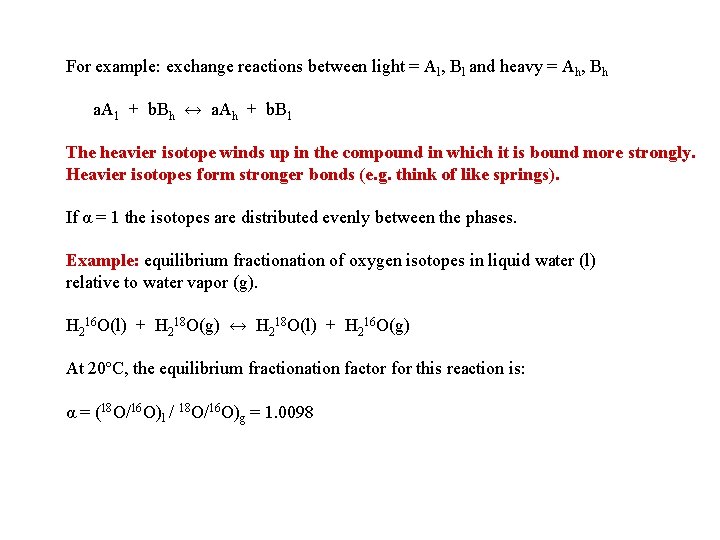
For example: exchange reactions between light = Al, Bl and heavy = Ah, Bh a. A 1 + b. Bh ↔ a. Ah + b. B 1 The heavier isotope winds up in the compound in which it is bound more strongly. Heavier isotopes form stronger bonds (e. g. think of like springs). If α = 1 the isotopes are distributed evenly between the phases. Example: equilibrium fractionation of oxygen isotopes in liquid water (l) relative to water vapor (g). H 216 O(l) + H 218 O(g) ↔ H 218 O(l) + H 216 O(g) At 20ºC, the equilibrium fractionation factor for this reaction is: α = (18 O/16 O)l / 18 O/16 O)g = 1. 0098
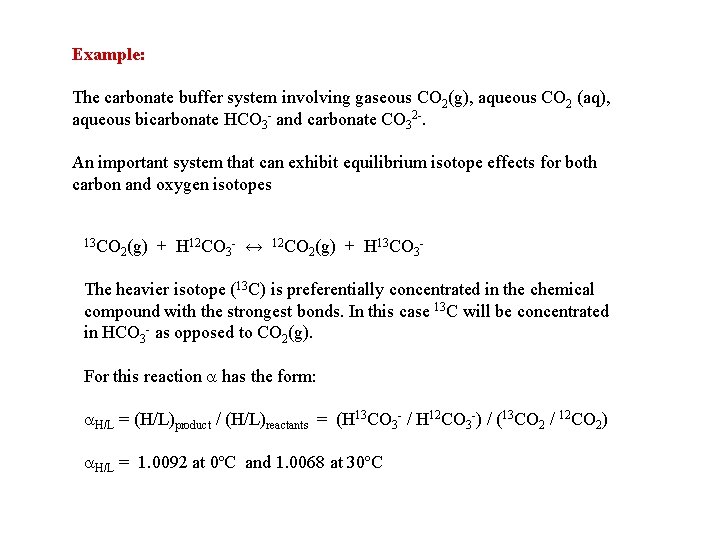
Example: The carbonate buffer system involving gaseous CO 2(g), aqueous CO 2 (aq), aqueous bicarbonate HCO 3 - and carbonate CO 32 -. An important system that can exhibit equilibrium isotope effects for both carbon and oxygen isotopes 13 CO 2(g) + H 12 CO 3 - ↔ 12 CO 2(g) + H 13 CO 3 - The heavier isotope (13 C) is preferentially concentrated in the chemical compound with the strongest bonds. In this case 13 C will be concentrated in HCO 3 - as opposed to CO 2(g). For this reaction has the form: H/L = (H/L)product / (H/L)reactants = (H 13 CO 3 - / H 12 CO 3 -) / (13 CO 2 / 12 CO 2) H/L = 1. 0092 at 0ºC and 1. 0068 at 30ºC
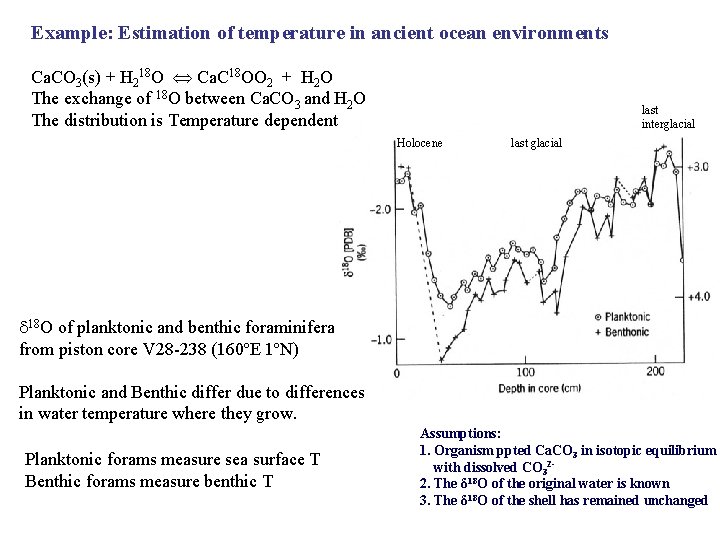
Example: Estimation of temperature in ancient ocean environments Ca. CO 3(s) + H 218 O Ca. C 18 OO 2 + H 2 O The exchange of 18 O between Ca. CO 3 and H 2 O The distribution is Temperature dependent last interglacial Holocene last glacial d 18 O of planktonic and benthic foraminifera from piston core V 28 -238 (160ºE 1ºN) Planktonic and Benthic differ due to differences in water temperature where they grow. Planktonic forams measure sea surface T Benthic forams measure benthic T Assumptions: 1. Organism ppted Ca. CO 3 in isotopic equilibrium with dissolved CO 322. The δ 18 O of the original water is known 3. The δ 18 O of the shell has remained unchanged
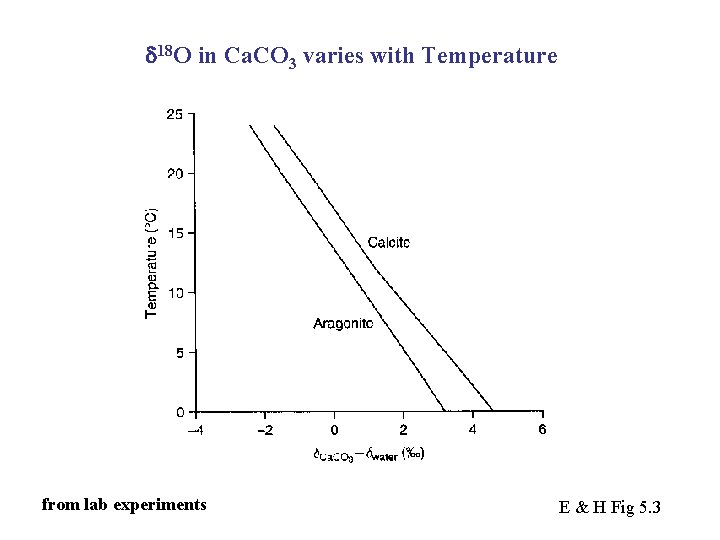
d 18 O in Ca. CO 3 varies with Temperature from lab experiments E & H Fig 5. 3
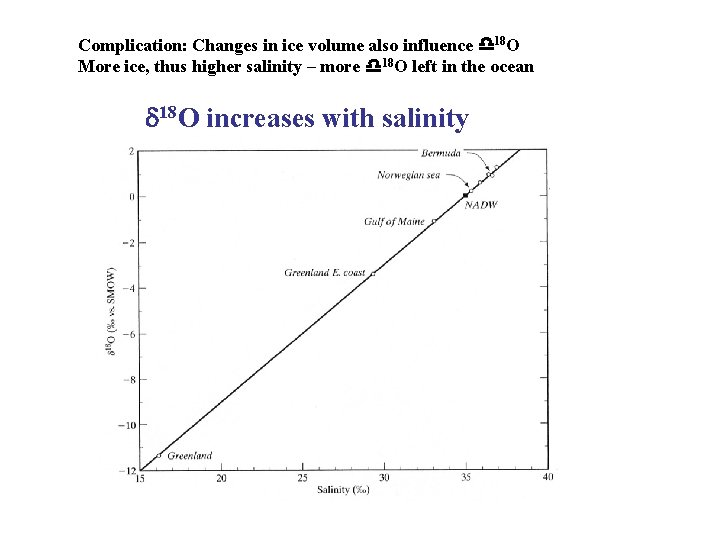
Complication: Changes in ice volume also influence d 18 O More ice, thus higher salinity – more d 18 O left in the ocean d 18 O increases with salinity
2. Kinetic Fractionation Non-equilibrium – during irreversible reactions like photosynthesis Occurs when the rate of chemical reaction is sensitive to atomic mass Results from either differential rates of bond breaking or diffusion rates Compounds move at different rates due to unequal masses. Light are always faster. For kinetic fractionation, the breaking of the chemical bonds is the rate limiting step. Essentially all isotopic effects involved with formation / destruction of organic matter are kinetic There is always a preferential enrichment for the lighter isotope in the products. 12 CO mw = 44 13 CO mw = 45 2 2 These must have the same kinetic energy (Ek = 1/2 mv 2) so 12 CO 2 travels 12% faster than 13 CO 2. All isotope effects involving organic matter are kinetic Example: 12 CO + H O = 12 CH O + O 2 2 faster 13 CO + H O = 13 CH O + O slower 2 2 Thus organic matter gets enriched in 12 C during photosynthesis (d 13 C becomes negative)
Carbon has only two stable isotopes with the following natural abundances: 12 C 13 C 98. 89%o 1. 11%o Below are some typical d 13 C values on the PDB scale in %o. Standard (Ca. CO 3; PDB) Atmospheric CO 2 Ocean SCO 2 Plankton Ca. CO 3 Plankton organic carbon Trees Atmospheric CH 4 Coal and Oil 0 -8 (was -6‰, getting lighter due to new CO 2) +2 (surface) 0 (deep) +0 (same as seawater) -20 -26 -47 -26
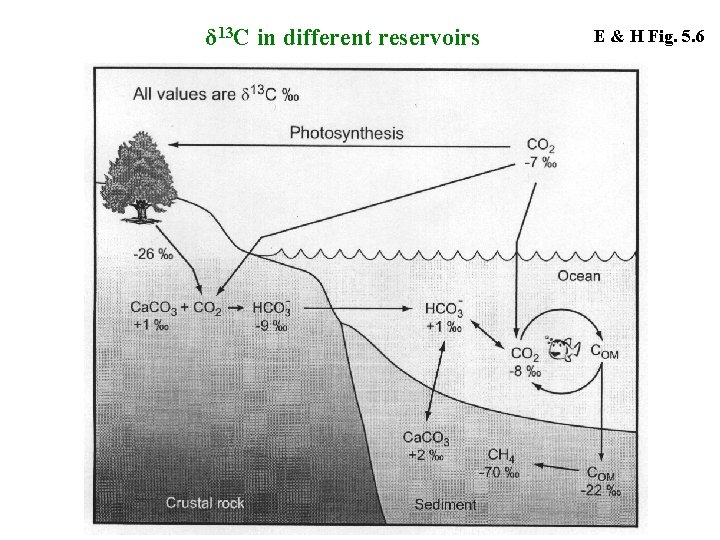
δ 13 C in different reservoirs E & H Fig. 5. 6
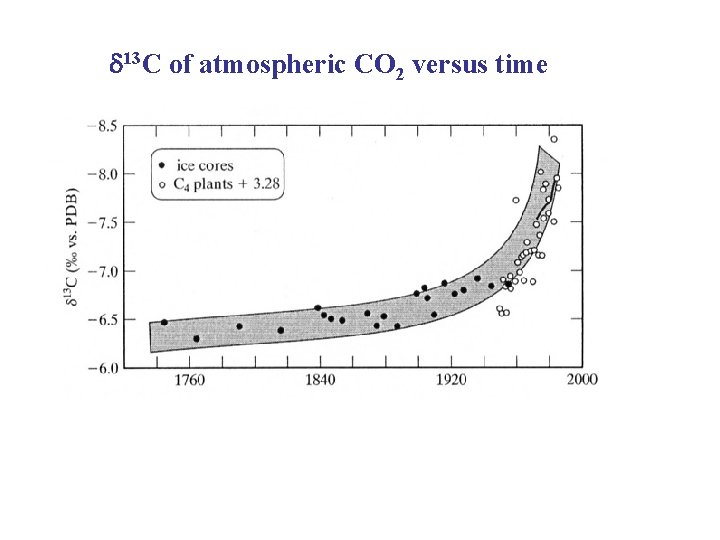
d 13 C of atmospheric CO 2 versus time
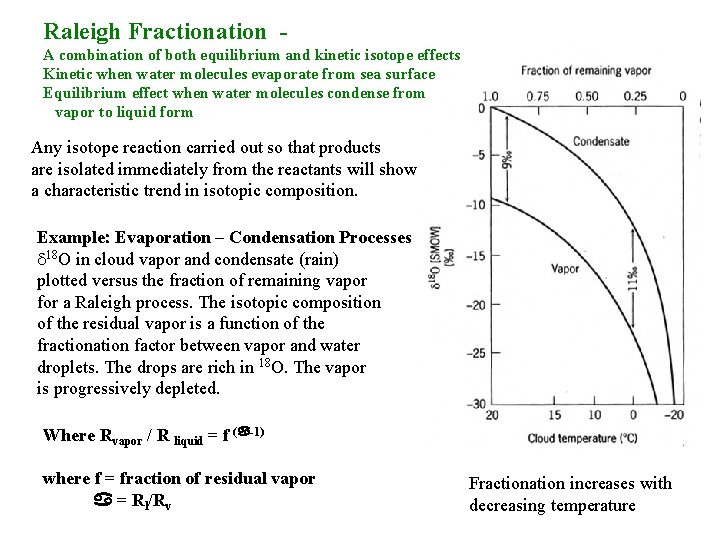
Raleigh Fractionation A combination of both equilibrium and kinetic isotope effects Kinetic when water molecules evaporate from sea surface Equilibrium effect when water molecules condense from vapor to liquid form Any isotope reaction carried out so that products are isolated immediately from the reactants will show a characteristic trend in isotopic composition. Example: Evaporation – Condensation Processes d 18 O in cloud vapor and condensate (rain) plotted versus the fraction of remaining vapor for a Raleigh process. The isotopic composition of the residual vapor is a function of the fractionation factor between vapor and water droplets. The drops are rich in 18 O. The vapor is progressively depleted. Where Rvapor / R liquid = f (a-1) where f = fraction of residual vapor a = Rl/Rv Fractionation increases with decreasing temperature
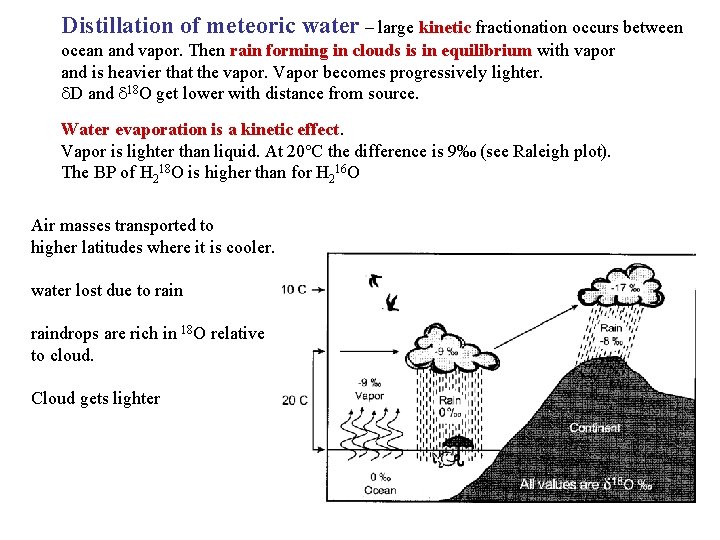
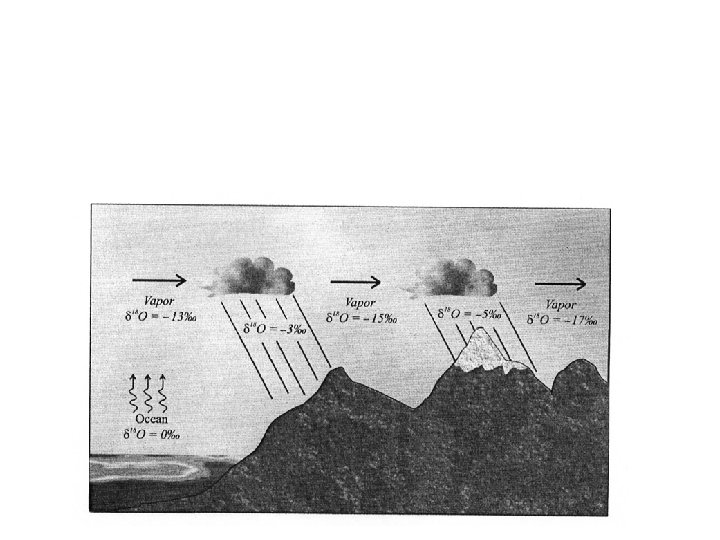
Distillation of meteoric water – large kinetic fractionation occurs between ocean and vapor. Then rain forming in clouds is in equilibrium with vapor and is heavier that the vapor. Vapor becomes progressively lighter. d. D and d 18 O get lower with distance from source. Water evaporation is a kinetic effect. Vapor is lighter than liquid. At 20ºC the difference is 9‰ (see Raleigh plot). The BP of H 218 O is higher than for H 216 O Air masses transported to higher latitudes where it is cooler. water lost due to raindrops are rich in 18 O relative to cloud. Cloud gets lighter
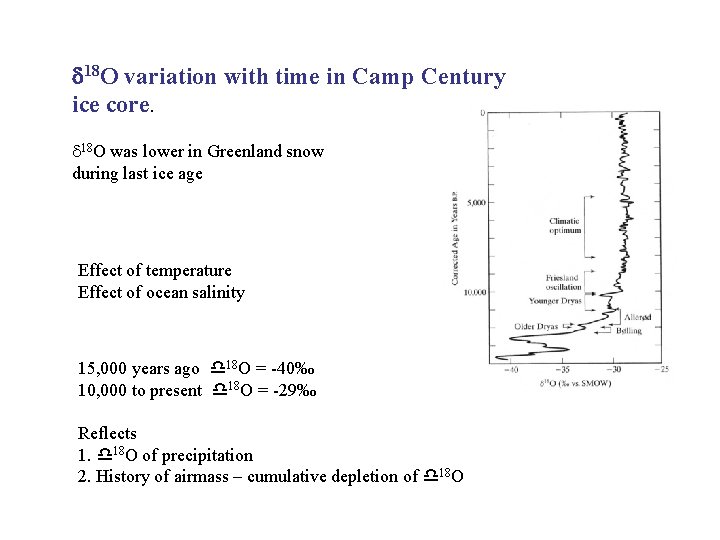
d 18 O variation with time in Camp Century ice core. d 18 O was lower in Greenland snow during last ice age Effect of temperature Effect of ocean salinity 15, 000 years ago d 18 O = -40‰ 10, 000 to present d 18 O = -29‰ Reflects 1. d 18 O of precipitation 2. History of airmass – cumulative depletion of d 18 O

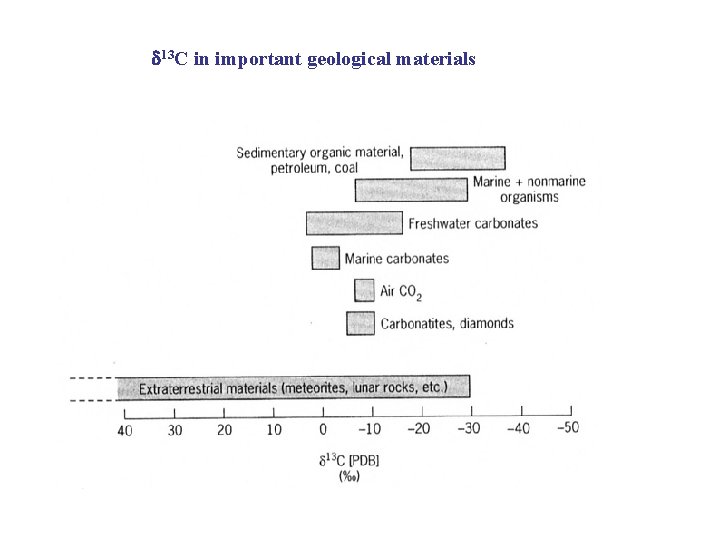
d 13 C in important geological materials
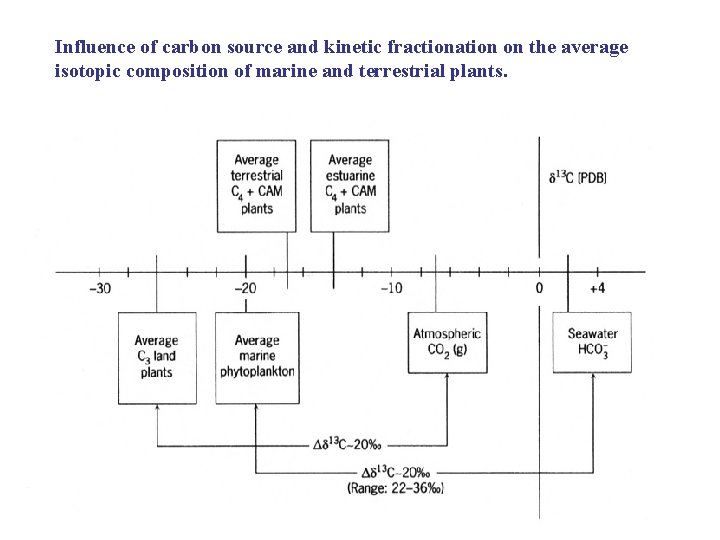
Influence of carbon source and kinetic fractionation on the average isotopic composition of marine and terrestrial plants.
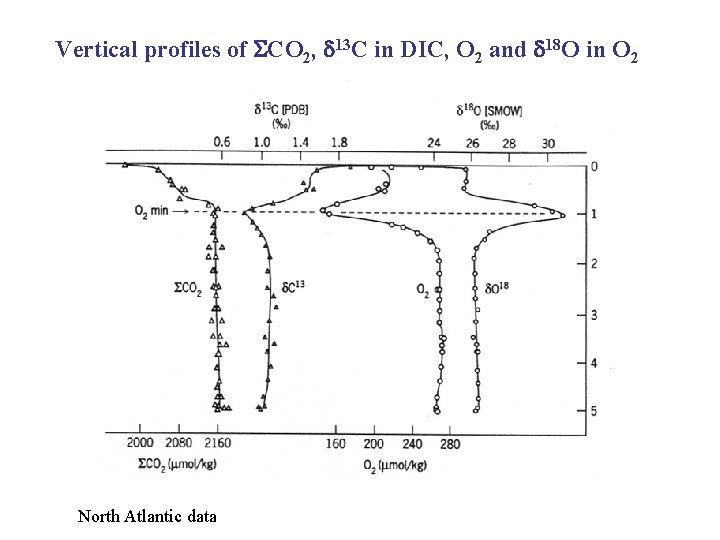
Vertical profiles of SCO 2, d 13 C in DIC, O 2 and d 18 O in O 2 North Atlantic data

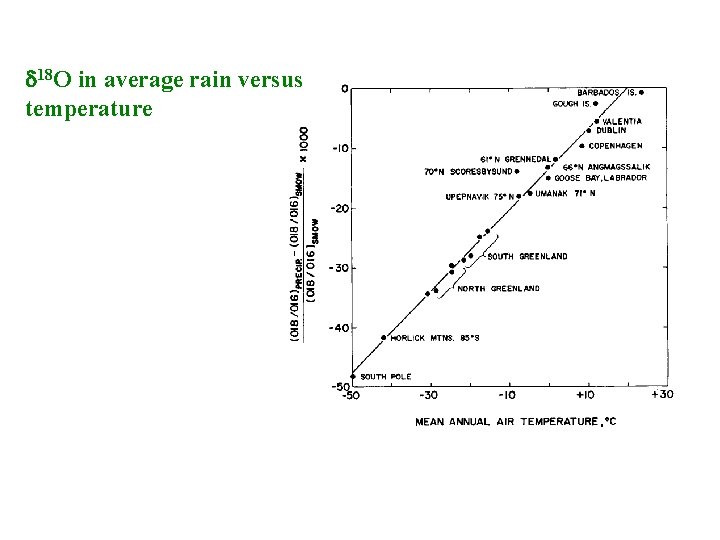
d 18 O in average rain versus temperature
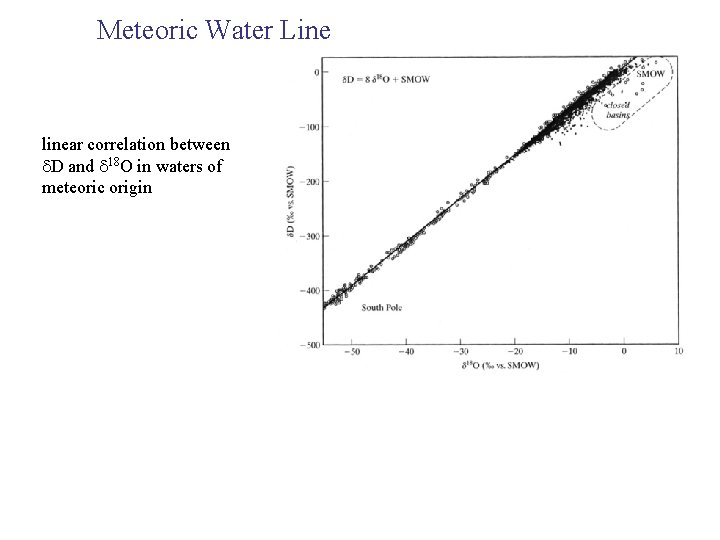
Meteoric Water Line linear correlation between d. D and d 18 O in waters of meteoric origin
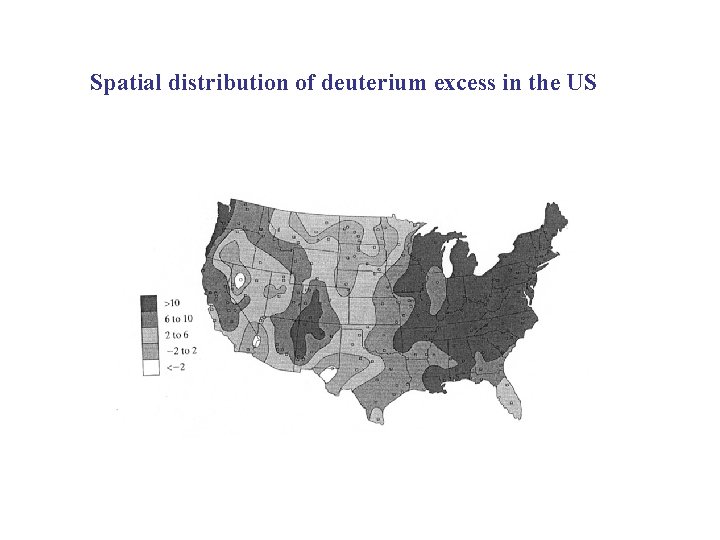
Spatial distribution of deuterium excess in the US
- Slides: 32