
Lecture 11 Nanomaterial Properties This lecture is based
Lecture 11 Nanomaterial Properties This lecture is based in large parts on Materials from Guozhong Cao's book. physical properties change from bulk properties
Physical Properties of Nanomaterials • physical properties change! • Some such peculiar properties are known, but there may be more to be discovered!

Physical Properties of Nanomaterials • Known origins that cause physical properties to change: (i) large fraction of surface atoms, (ii) large surface energy, (iii) spatial confinement, and (iv) reduced imperfections
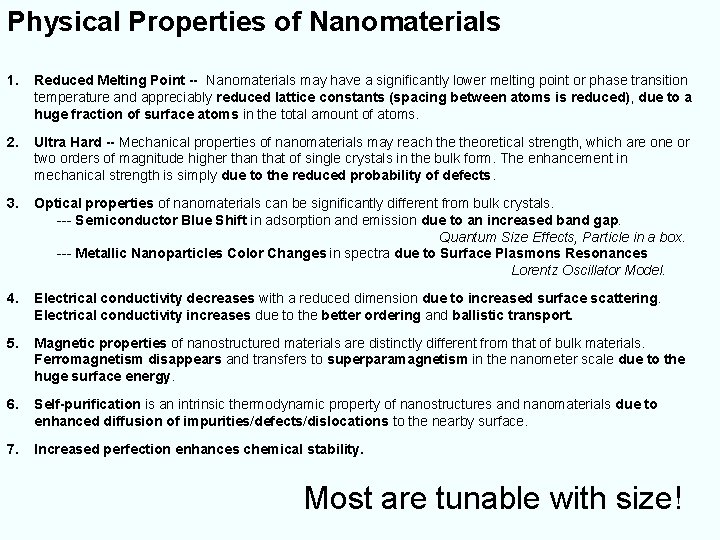
Physical Properties of Nanomaterials 1. Reduced Melting Point -- Nanomaterials may have a significantly lower melting point or phase transition temperature and appreciably reduced lattice constants (spacing between atoms is reduced), due to a huge fraction of surface atoms in the total amount of atoms. 2. Ultra Hard -- Mechanical properties of nanomaterials may reach theoretical strength, which are one or two orders of magnitude higher than that of single crystals in the bulk form. The enhancement in mechanical strength is simply due to the reduced probability of defects. 3. Optical properties of nanomaterials can be significantly different from bulk crystals. Semiconductor Blue Shift in adsorption and emission due to an increased band gap. Quantum Size Effects, Particle in a box. Metallic Nanoparticles Color Changes in spectra due to Surface Plasmons Resonances Lorentz Oscillator Model. 4. Electrical conductivity decreases with a reduced dimension due to increased surface scattering. Electrical conductivity increases due to the better ordering and ballistic transport. 5. Magnetic properties of nanostructured materials are distinctly different from that of bulk materials. Ferromagnetism disappears and transfers to superparamagnetism in the nanometer scale due to the huge surface energy. 6. Self-purification is an intrinsic thermodynamic property of nanostructures and nanomaterials due to enhanced diffusion of impurities/defects/dislocations to the nearby surface. 7. Increased perfection enhances chemical stability. Most are tunable with size!
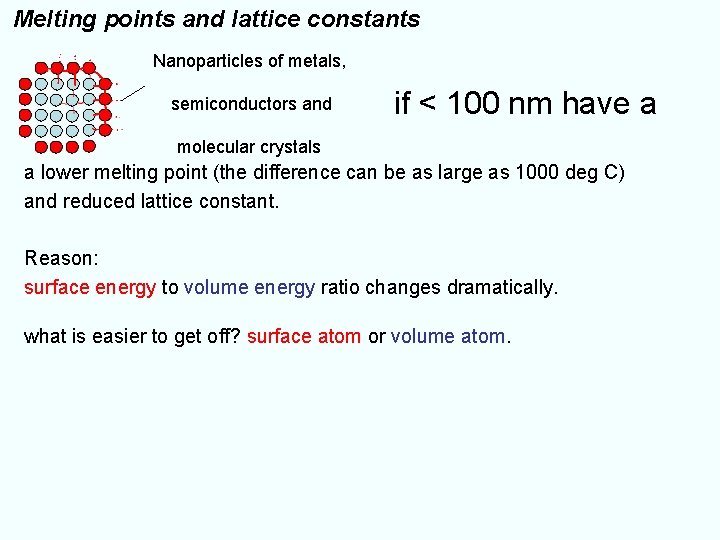
Melting points and lattice constants Nanoparticles of metals, semiconductors and if < 100 nm have a molecular crystals a lower melting point (the difference can be as large as 1000 deg C) and reduced lattice constant. Reason: surface energy to volume energy ratio changes dramatically. what is easier to get off? surface atom or volume atom.
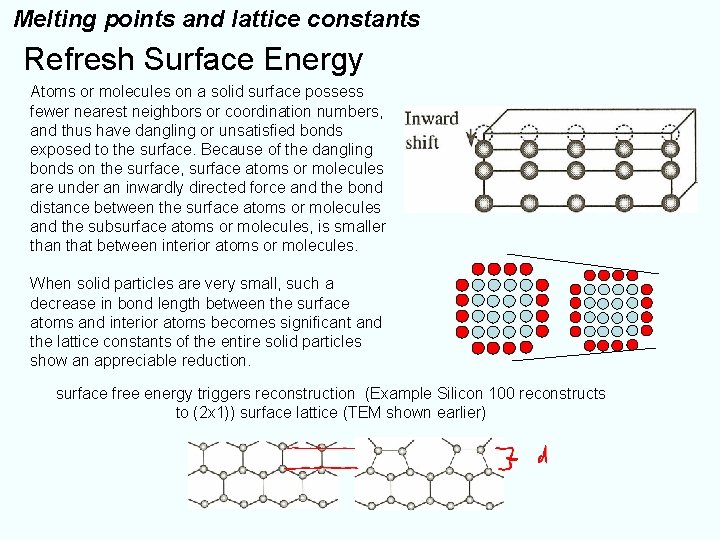
Melting points and lattice constants Refresh Surface Energy Atoms or molecules on a solid surface possess fewer nearest neighbors or coordination numbers, and thus have dangling or unsatisfied bonds exposed to the surface. Because of the dangling bonds on the surface, surface atoms or molecules are under an inwardly directed force and the bond distance between the surface atoms or molecules and the subsurface atoms or molecules, is smaller than that between interior atoms or molecules. When solid particles are very small, such a decrease in bond length between the surface atoms and interior atoms becomes significant and the lattice constants of the entire solid particles show an appreciable reduction. surface free energy triggers reconstruction (Example Silicon 100 reconstructs to (2 x 1)) surface lattice (TEM shown earlier)
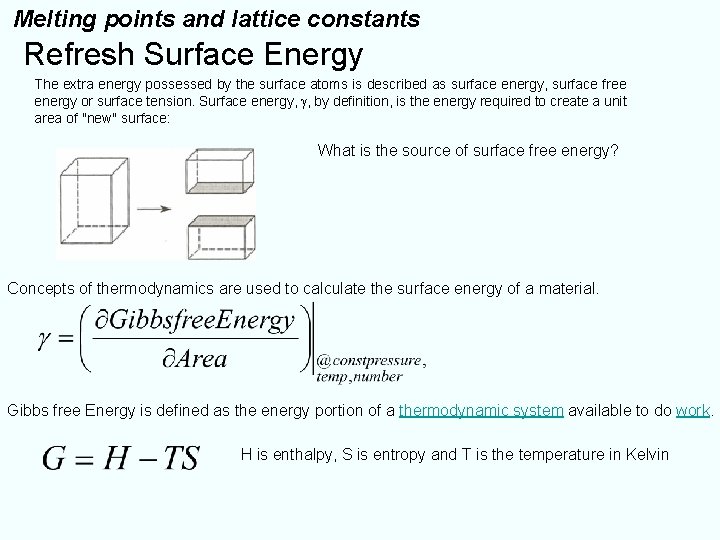
Melting points and lattice constants Refresh Surface Energy The extra energy possessed by the surface atoms is described as surface energy, surface free energy or surface tension. Surface energy, g, by definition, is the energy required to create a unit area of "new" surface: What is the source of surface free energy? Concepts of thermodynamics are used to calculate the surface energy of a material. Gibbs free Energy is defined as the energy portion of a thermodynamic system available to do work. H is enthalpy, S is entropy and T is the temperature in Kelvin
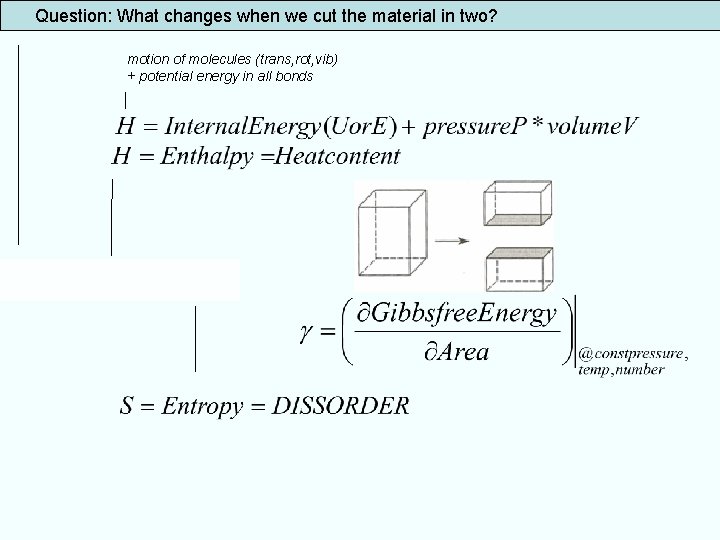
Summary: TO DO when WORK Question: ABILITY What changes we cut the material in two? motion of molecules (trans, rot, vib) + potential energy in all bonds
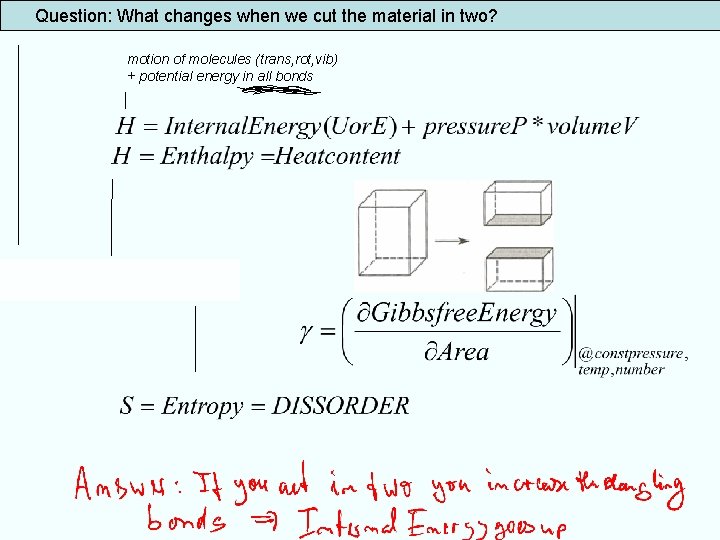
Summary: TO DO when WORK Question: ABILITY What changes we cut the material in two? motion of molecules (trans, rot, vib) + potential energy in all bonds
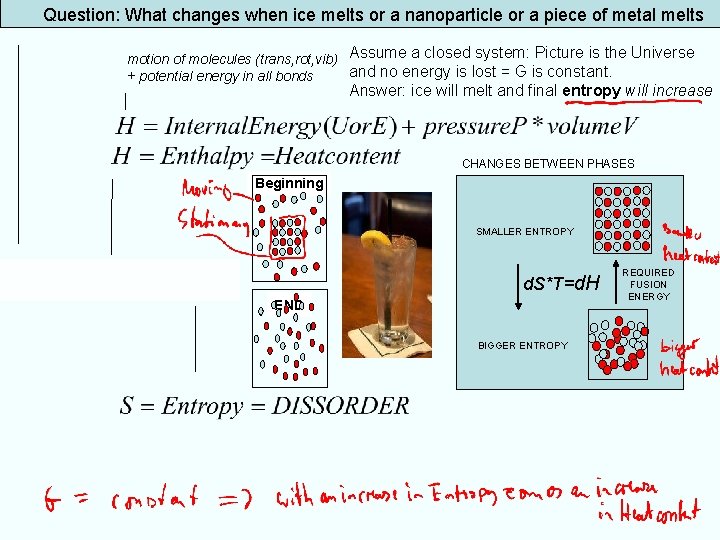
Question: What changes when ice melts or a nanoparticle or a piece of metal melts motion of molecules (trans, rot, vib) Assume a closed system: Picture is the Universe and no energy is lost = G is constant. + potential energy in all bonds Answer: ice will melt and final entropy will increase CHANGES BETWEEN PHASES Beginning SMALLER ENTROPY d. S*T=d. H END BIGGER ENTROPY REQUIRED FUSION ENERGY
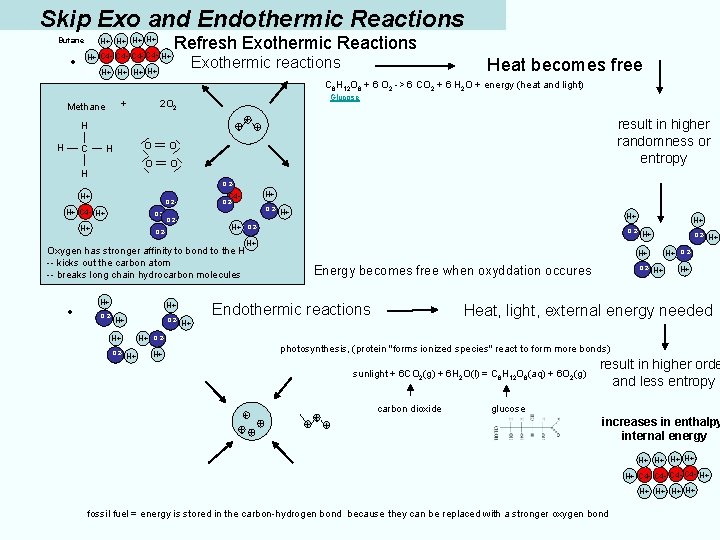
Skip Exo and Endothermic Reactions Butane H+ H+ • H+ C 4 C 4 H+ O 2 Refresh Exothermic Reactions H+ H+ Exothermic reactions Heat becomes free C 6 H 12 O 6 + 6 O 2 > 6 CO 2 + 6 H 2 O + energy (heat and light) + Methane Glucose 2 O 2 H H + C H H O O + result in higher randomness or entropy + O 2 H+ C 4 H+ O 2 Oxygen has stronger affinity to bond to the H kicks out the carbon atom breaks long chain hydrocarbon molecules • H+ H+ O 2 H+ H+ H+ O 2 H+ Energy becomes free when oxyddation occures Endothermic reactions O 2 H+ H+ H+ O 2 H+ Heat, light, external energy needed O 2 photosynthesis, (protein "forms ionized species" react to form more bonds) H+ sunlight + 6 CO 2(g) + 6 H 2 O(l) = C 6 H 12 O 6(aq) + 6 O 2(g) + + + carbon dioxide + result in higher orde and less entropy glucose increases in enthalpy internal energy H+ H+ H+ C 4 C 4 H+ O 2 fossil fuel = energy is stored in the carbon hydrogen bond because they can be replaced with a stronger oxygen bond H+ H+
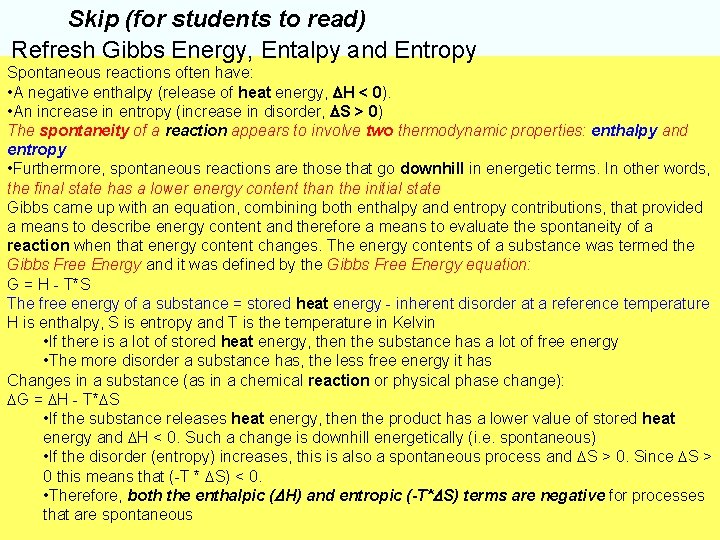
Skip (for students to read) Refresh Gibbs Energy, Entalpy and Entropy Spontaneous reactions often have: • A negative enthalpy (release of heat energy, DH < 0). • An increase in entropy (increase in disorder, DS > 0) The spontaneity of a reaction appears to involve two thermodynamic properties: enthalpy and entropy • Furthermore, spontaneous reactions are those that go downhill in energetic terms. In other words, the final state has a lower energy content than the initial state Gibbs came up with an equation, combining both enthalpy and entropy contributions, that provided a means to describe energy content and therefore a means to evaluate the spontaneity of a reaction when that energy content changes. The energy contents of a substance was termed the Gibbs Free Energy and it was defined by the Gibbs Free Energy equation: G = H T*S The free energy of a substance = stored heat energy inherent disorder at a reference temperature H is enthalpy, S is entropy and T is the temperature in Kelvin • If there is a lot of stored heat energy, then the substance has a lot of free energy • The more disorder a substance has, the less free energy it has Changes in a substance (as in a chemical reaction or physical phase change): DG = DH T*DS • If the substance releases heat energy, then the product has a lower value of stored heat energy and DH < 0. Such a change is downhill energetically (i. e. spontaneous) • If the disorder (entropy) increases, this is also a spontaneous process and DS > 0. Since DS > 0 this means that ( T * DS) < 0. • Therefore, both the enthalpic (DH) and entropic (-T*DS) terms are negative for processes that are spontaneous
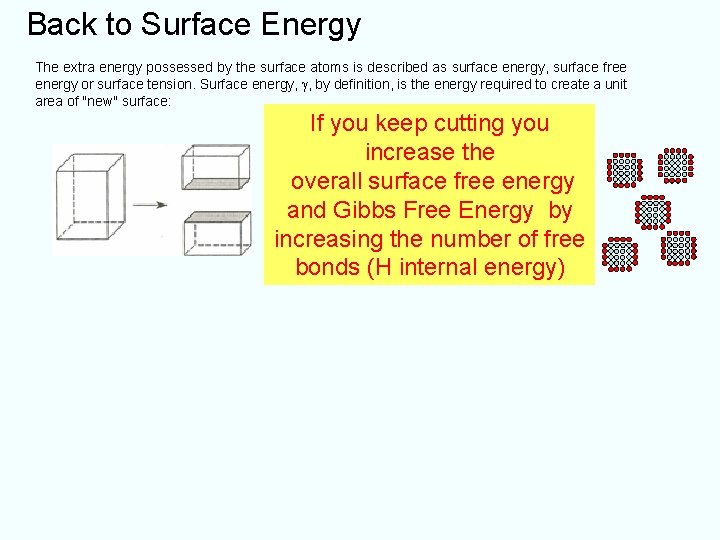
Back to Surface Energy The extra energy possessed by the surface atoms is described as surface energy, surface free energy or surface tension. Surface energy, g, by definition, is the energy required to create a unit area of "new" surface: If you keep cutting you increase the overall surface free energy and Gibbs Free Energy by increasing the number of free bonds (H internal energy)
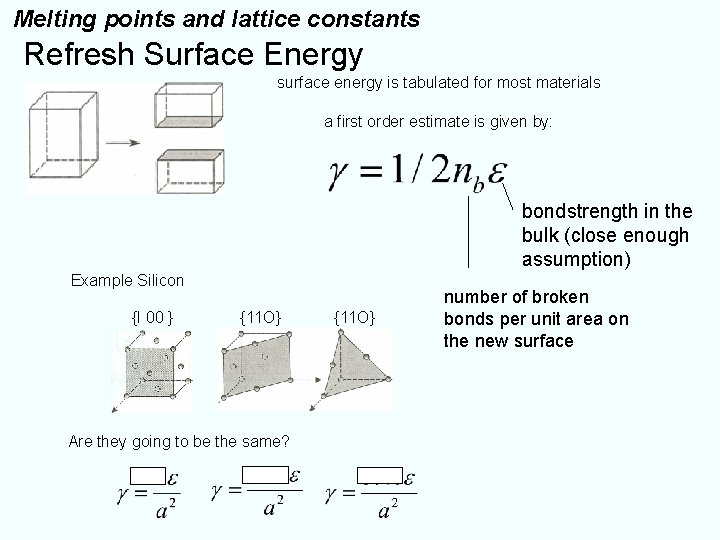
Melting points and lattice constants Refresh Surface Energy surface energy is tabulated for most materials a first order estimate is given by: bondstrength in the bulk (close enough assumption) Example Silicon {I 00 } {11 O} Are they going to be the same? {11 O} number of broken bonds per unit area on the new surface
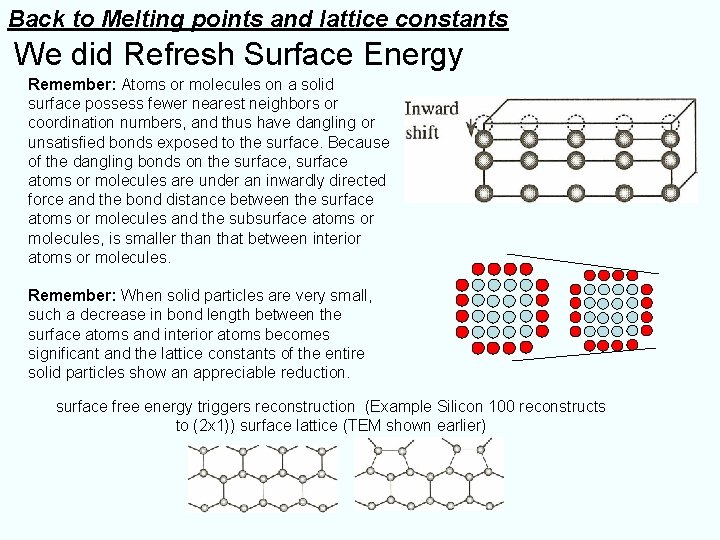
Back to Melting points and lattice constants We did Refresh Surface Energy Remember: Atoms or molecules on a solid surface possess fewer nearest neighbors or coordination numbers, and thus have dangling or unsatisfied bonds exposed to the surface. Because of the dangling bonds on the surface, surface atoms or molecules are under an inwardly directed force and the bond distance between the surface atoms or molecules and the subsurface atoms or molecules, is smaller than that between interior atoms or molecules. Remember: When solid particles are very small, such a decrease in bond length between the surface atoms and interior atoms becomes significant and the lattice constants of the entire solid particles show an appreciable reduction. surface free energy triggers reconstruction (Example Silicon 100 reconstructs to (2 x 1)) surface lattice (TEM shown earlier)
Write down the primary reason why the crystal lattice constant becomes smaller.
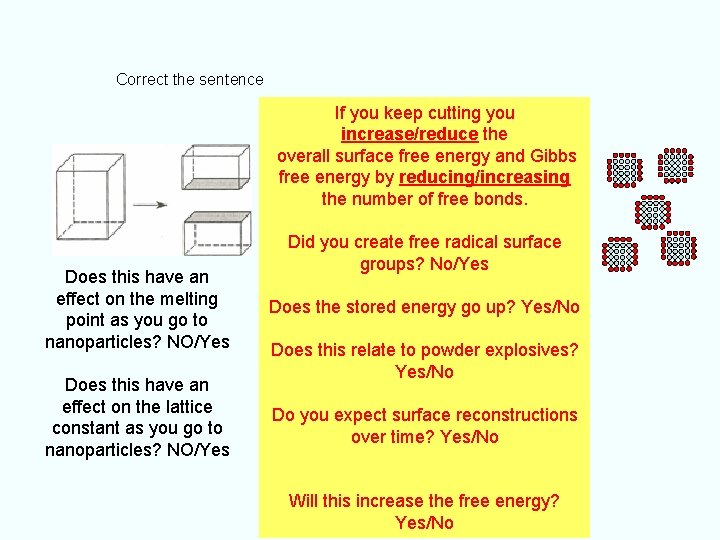
Correct the sentence If you keep cutting you increase/reduce the overall surface free energy and Gibbs free energy by reducing/increasing the number of free bonds. Did you create free radical surface groups? No/Yes Does this have an effect on the melting point as you go to nanoparticles? NO/Yes Does the stored energy go up? Yes/No Does this have an effect on the lattice constant as you go to nanoparticles? NO/Yes Do you expect surface reconstructions over time? Yes/No Does this relate to powder explosives? Yes/No Will this increase the free energy? Yes/No
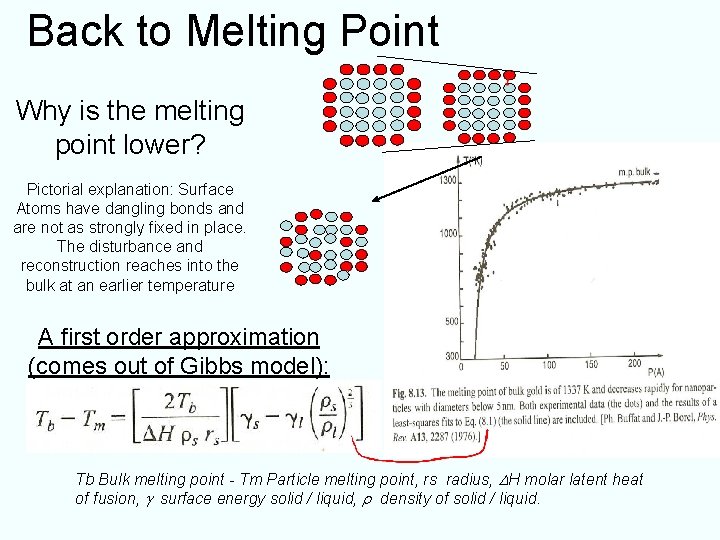
Back to Melting Point Why is the melting point lower? Pictorial explanation: Surface Atoms have dangling bonds and are not as strongly fixed in place. The disturbance and reconstruction reaches into the bulk at an earlier temperature A first order approximation (comes out of Gibbs model): Tb Bulk melting point - Tm Particle melting point, rs radius, DH molar latent heat of fusion, g surface energy solid / liquid, r density of solid / liquid.
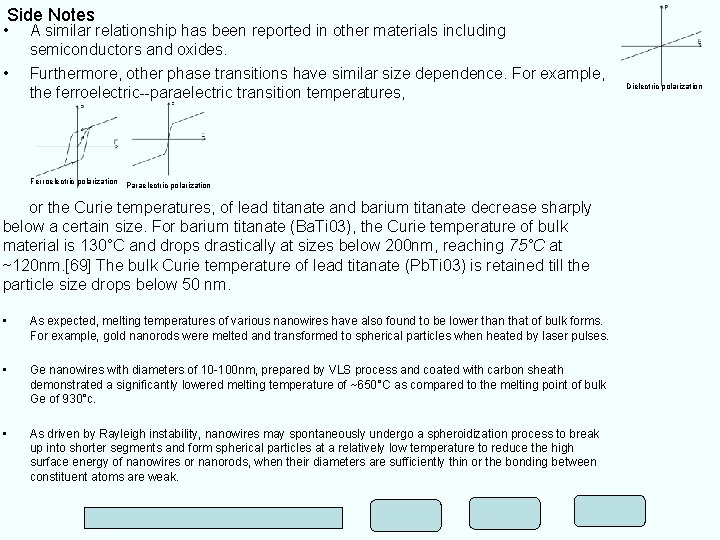
Side Notes • • A similar relationship has been reported in other materials including semiconductors and oxides. Furthermore, other phase transitions have similar size dependence. For example, the ferroelectric paraelectric transition temperatures, Ferroelectric polarization Paraelectric polarization or the Curie temperatures, of lead titanate and barium titanate decrease sharply below a certain size. For barium titanate (Ba. Ti 03), the Curie temperature of bulk material is 130°C and drops drastically at sizes below 200 nm, reaching 75°C at ~120 nm. [69] The bulk Curie temperature of lead titanate (Pb. Ti 03) is retained till the particle size drops below 50 nm. • As expected, melting temperatures of various nanowires have also found to be lower than that of bulk forms. For example, gold nanorods were melted and transformed to spherical particles when heated by laser pulses. • Ge nanowires with diameters of 10 100 nm, prepared by VLS process and coated with carbon sheath demonstrated a significantly lowered melting temperature of ~650°C as compared to the melting point of bulk Ge of 930°c. • As driven by Rayleigh instability, nanowires may spontaneously undergo a spheroidization process to break up into shorter segments and form spherical particles at a relatively low temperature to reduce the high surface energy of nanowires or nanorods, when their diameters are sufficiently thin or the bonding between constituent atoms are weak. Dielectric polarization
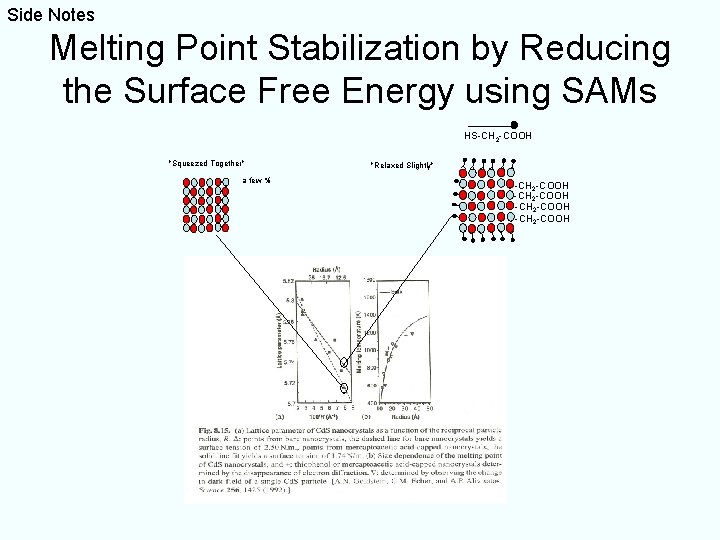
Side Notes Melting Point Stabilization by Reducing the Surface Free Energy using SAMs HS CH 2 COOH "Squeezed Together" a few % "Relaxed Slightly" CH 2 COOH
Self Assembled Monolayers can Change the Surface Free Energy. A nanocrystal has been passivated and the surface free energy has been reduced. Do you expect it to be under reduced "compression"? What do you expect in terms of lattice constant?
Mechanical Properties Typically Improve! The calculated strength of perfect crystals exceeds that of real ones by two or three orders of magnitudes. A lot of work has been done on whiskers that approach theoretical limit first demonstrated by Herring and Galt in 1952 if diameter are less than 10 um. Note: The enhancement starts in the micrometer scale which is different from other size dependent properties. Two possible mechanisms have been proposed to explain the enhanced strength of nanowires or nanorods (in reality with diameters less than 10 microns). Increased Internal Perfection Increased Surface Perfection
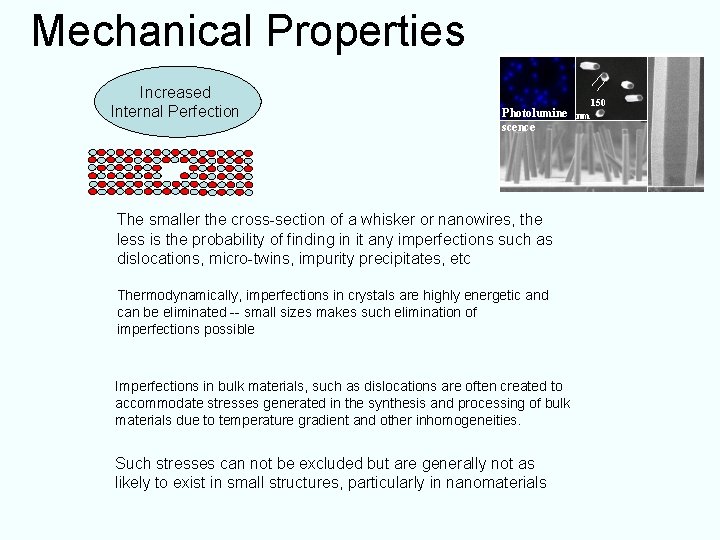
Mechanical Properties Increased Internal Perfection Photolumine nm scence The smaller the cross section of a whisker or nanowires, the less is the probability of finding in it any imperfections such as dislocations, micro twins, impurity precipitates, etc Thermodynamically, imperfections in crystals are highly energetic and can be eliminated small sizes makes such elimination of imperfections possible Imperfections in bulk materials, such as dislocations are often created to accommodate stresses generated in the synthesis and processing of bulk materials due to temperature gradient and other inhomogeneities. Such stresses can not be excluded but are generally not as likely to exist in small structures, particularly in nanomaterials 150
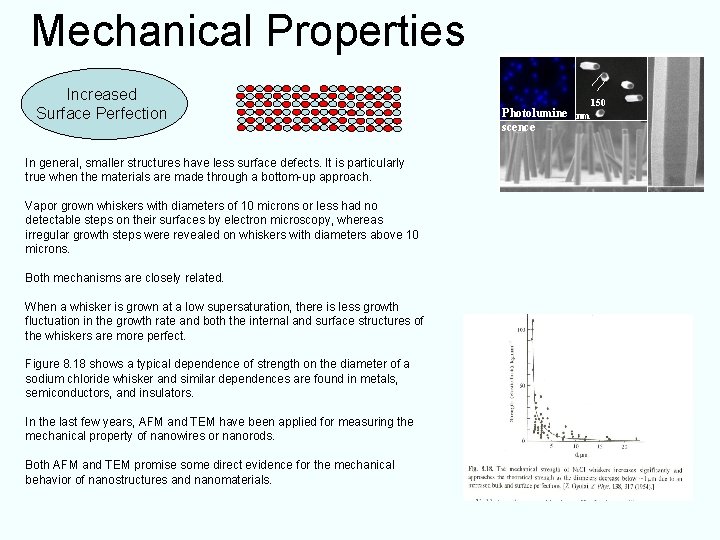
Mechanical Properties Increased Surface Perfection In general, smaller structures have less surface defects. It is particularly true when the materials are made through a bottom up approach. Vapor grown whiskers with diameters of 10 microns or less had no detectable steps on their surfaces by electron microscopy, whereas irregular growth steps were revealed on whiskers with diameters above 10 microns. Both mechanisms are closely related. When a whisker is grown at a low supersaturation, there is less growth fluctuation in the growth rate and both the internal and surface structures of the whiskers are more perfect. Figure 8. 18 shows a typical dependence of strength on the diameter of a sodium chloride whisker and similar dependences are found in metals, semiconductors, and insulators. In the last few years, AFM and TEM have been applied for measuring the mechanical property of nanowires or nanorods. Both AFM and TEM promise some direct evidence for the mechanical behavior of nanostructures and nanomaterials. Photolumine nm scence 150
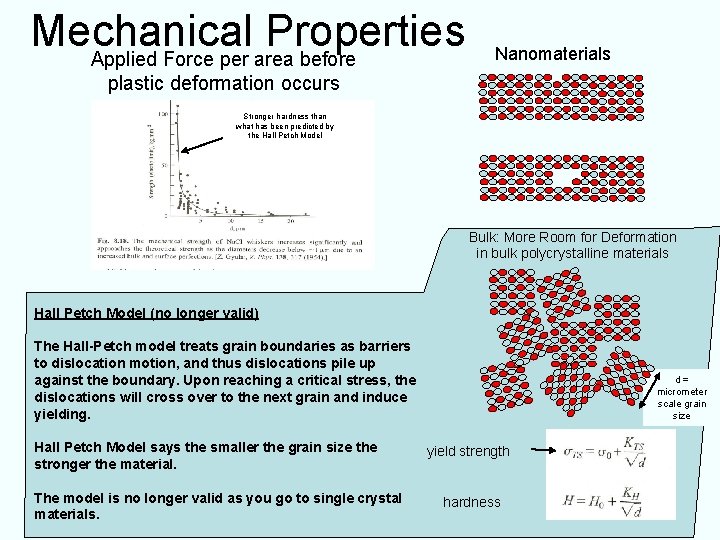
Mechanical Properties Applied Force per area before Nanomaterials plastic deformation occurs Stronger hardness than what has been predicted by the Hall Petch Model Bulk: More Room for Deformation in bulk polycrystalline materials Hall Petch Model (no longer valid) The Hall-Petch model treats grain boundaries as barriers to dislocation motion, and thus dislocations pile up against the boundary. Upon reaching a critical stress, the dislocations will cross over to the next grain and induce yielding. Hall Petch Model says the smaller the grain size the stronger the material. The model is no longer valid as you go to single crystal materials. d= micrometer scale grain size yield strength hardness
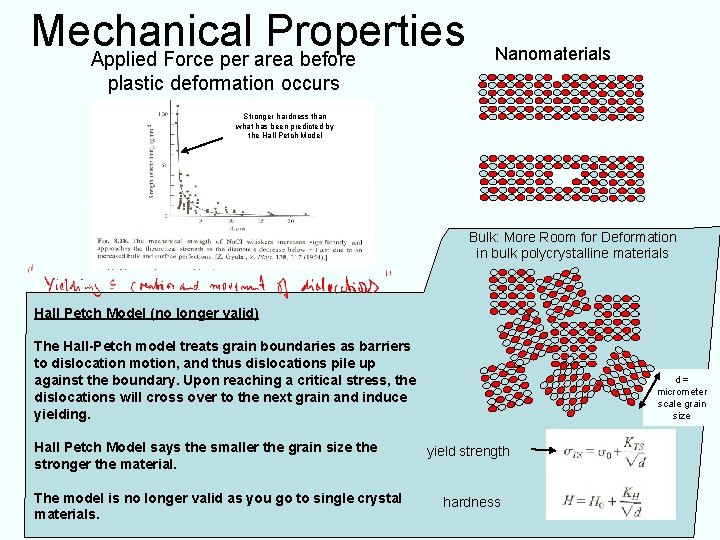
Mechanical Properties Applied Force per area before Nanomaterials plastic deformation occurs Stronger hardness than what has been predicted by the Hall Petch Model Bulk: More Room for Deformation in bulk polycrystalline materials Hall Petch Model (no longer valid) The Hall-Petch model treats grain boundaries as barriers to dislocation motion, and thus dislocations pile up against the boundary. Upon reaching a critical stress, the dislocations will cross over to the next grain and induce yielding. Hall Petch Model says the smaller the grain size the stronger the material. The model is no longer valid as you go to single crystal materials. d= micrometer scale grain size yield strength hardness
Name the primary two reasons for an increased hardness in the case of nanowiskers?


Further Reading on Mechanical Properties

Time 70 Minutes. . .
- Slides: 30