
Lecture 11 Manycore GPU Architectures and Programming Part
- Slides: 67
Lecture 11: Manycore GPU Architectures and Programming, Part 1 CSCE 790: Parallel Programming Models for Multicore and Manycore Processors Department of Computer Science and Engineering Yonghong Yan yanyh@cse. sc. edu http: //cse. sc. edu/~yanyh 1
Manycore GPU Architectures and Programming: Outline • Introduction – GPU architectures, GPGPUs, and CUDA • GPU Execution model • CUDA Programming model • Working with Memory in CUDA – Global memory, shared and constant memory • • Streams and concurrency CUDA instruction intrinsic and library Performance, profiling, debugging, and error handling Directive-based high-level programming model – Open. ACC and Open. MP 2
Computer Graphics GPU: Graphics Processing Unit 3
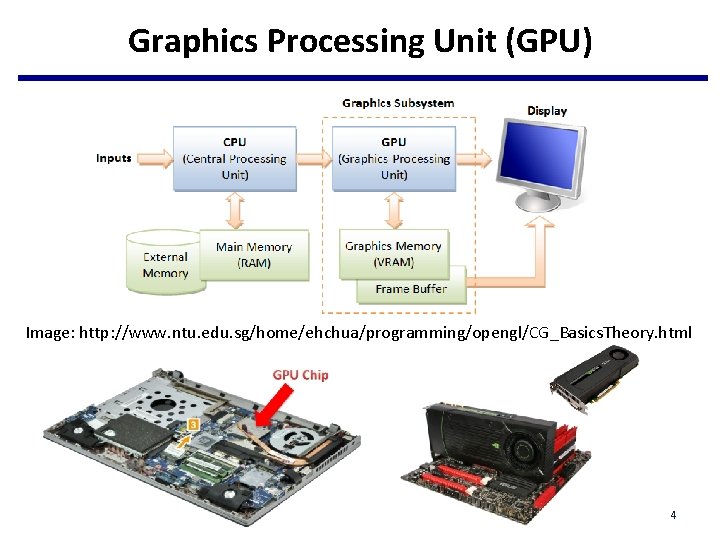
Graphics Processing Unit (GPU) Image: http: //www. ntu. edu. sg/home/ehchua/programming/opengl/CG_Basics. Theory. html 4
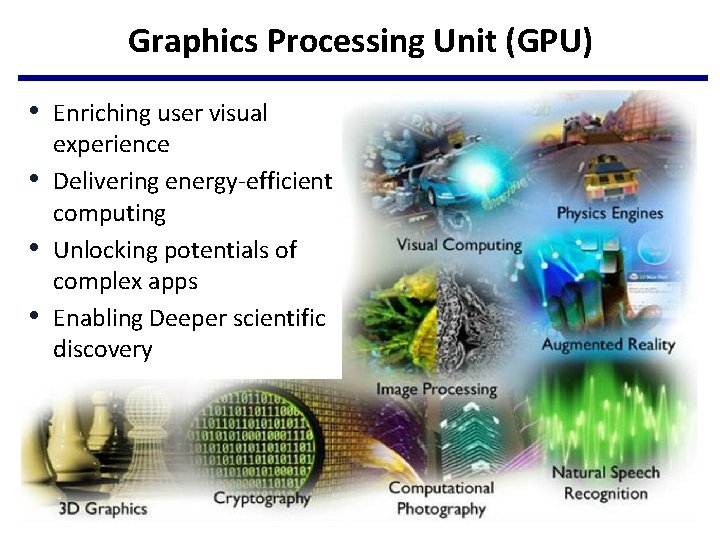
Graphics Processing Unit (GPU) • Enriching user visual • • • experience Delivering energy-efficient computing Unlocking potentials of complex apps Enabling Deeper scientific discovery 5
GPU Computing – General Purpose GPUs (GPGPUs) • Use GPU for more than just generating graphics – The computational resources are there, they are most of the time underutilized 66
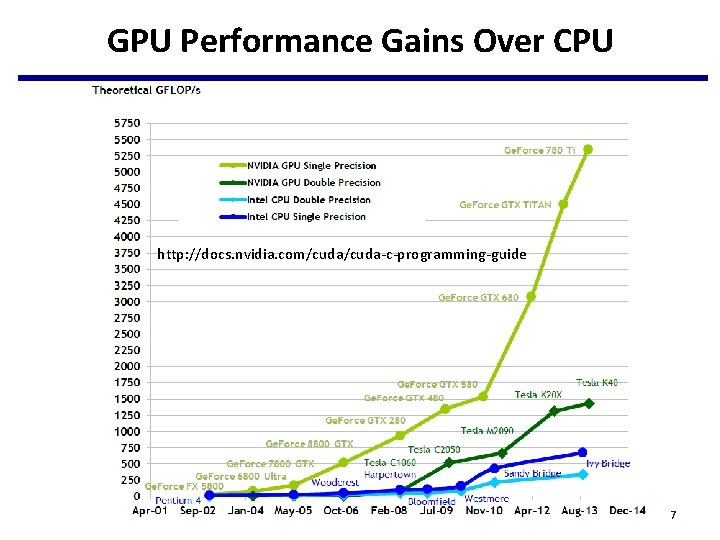
GPU Performance Gains Over CPU http: //docs. nvidia. com/cuda-c-programming-guide 7
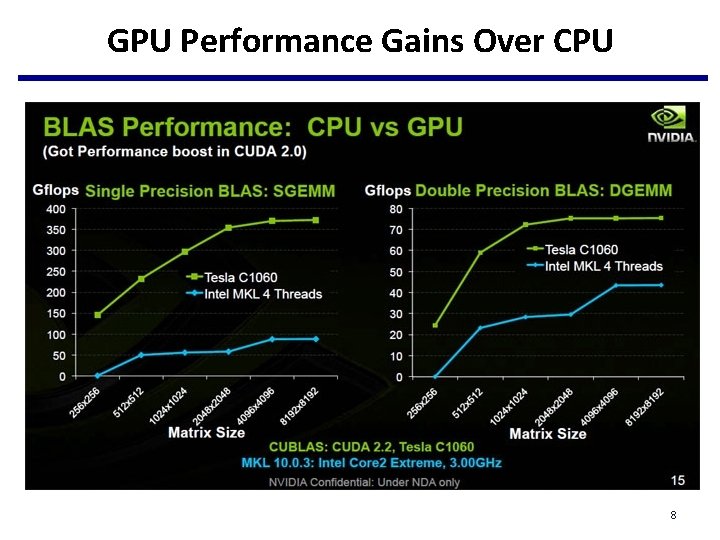
GPU Performance Gains Over CPU 8
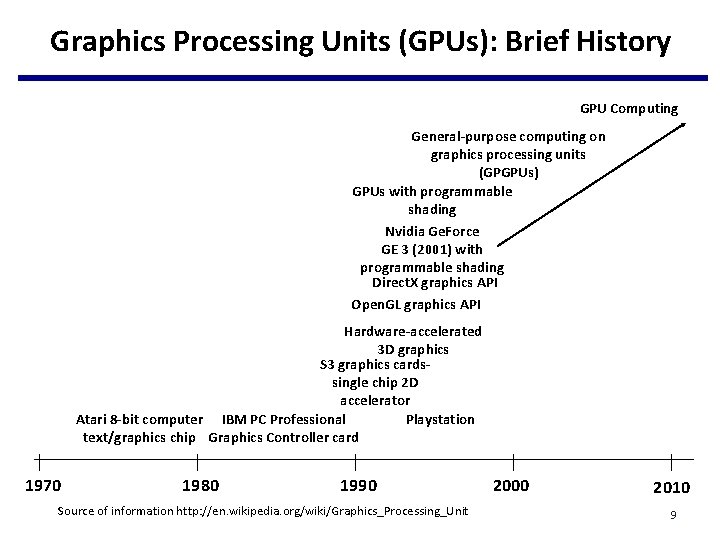
Graphics Processing Units (GPUs): Brief History GPU Computing General-purpose computing on graphics processing units (GPGPUs) GPUs with programmable shading Nvidia Ge. Force GE 3 (2001) with programmable shading Direct. X graphics API Open. GL graphics API Hardware-accelerated 3 D graphics S 3 graphics cardssingle chip 2 D accelerator Playstation Atari 8 -bit computer IBM PC Professional text/graphics chip Graphics Controller card 1970 1980 1990 Source of information http: //en. wikipedia. org/wiki/Graphics_Processing_Unit 2000 2010 9
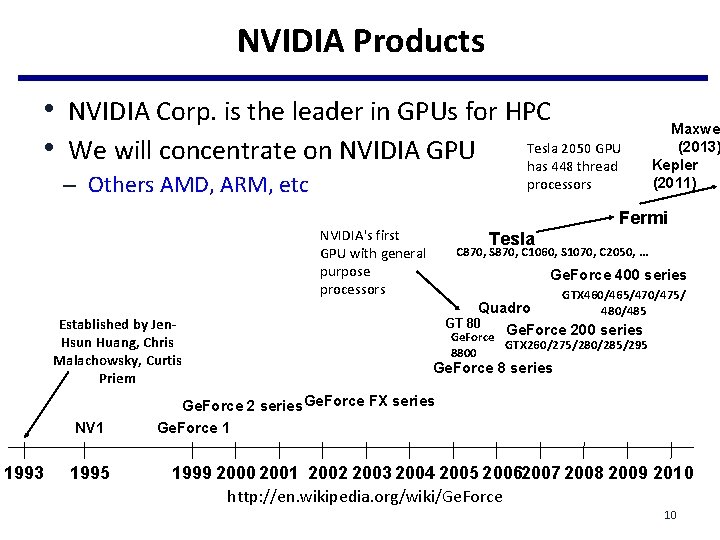
NVIDIA Products • NVIDIA Corp. is the leader in GPUs for HPC 2050 GPU • We will concentrate on NVIDIA GPU Tesla has 448 thread – Others AMD, ARM, etc processors Fermi NVIDIA's first GPU with general purpose processors Established by Jen. Hsun Huang, Chris Malachowsky, Curtis Priem NV 1 1993 1995 Maxwe (2013) Kepler (2011) Tesla C 870, S 870, C 1060, S 1070, C 2050, … Ge. Force 400 series Quadro GTX 460/465/470/475/ 480/485 GT 80 Ge. Force 200 series GTX 260/275/280/285/295 8800 Ge. Force 8 series Ge. Force 2 series Ge. Force FX series Ge. Force 1 1999 2000 2001 2002 2003 2004 2005 20062007 2008 2009 2010 http: //en. wikipedia. org/wiki/Ge. Force 10
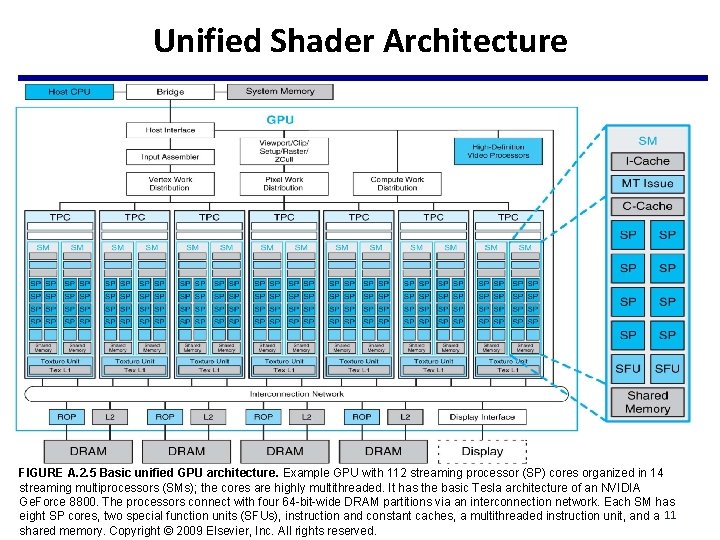
Unified Shader Architecture FIGURE A. 2. 5 Basic unified GPU architecture. Example GPU with 112 streaming processor (SP) cores organized in 14 streaming multiprocessors (SMs); the cores are highly multithreaded. It has the basic Tesla architecture of an NVIDIA Ge. Force 8800. The processors connect with four 64 -bit-wide DRAM partitions via an interconnection network. Each SM has eight SP cores, two special function units (SFUs), instruction and constant caches, a multithreaded instruction unit, and a 11 shared memory. Copyright © 2009 Elsevier, Inc. All rights reserved.
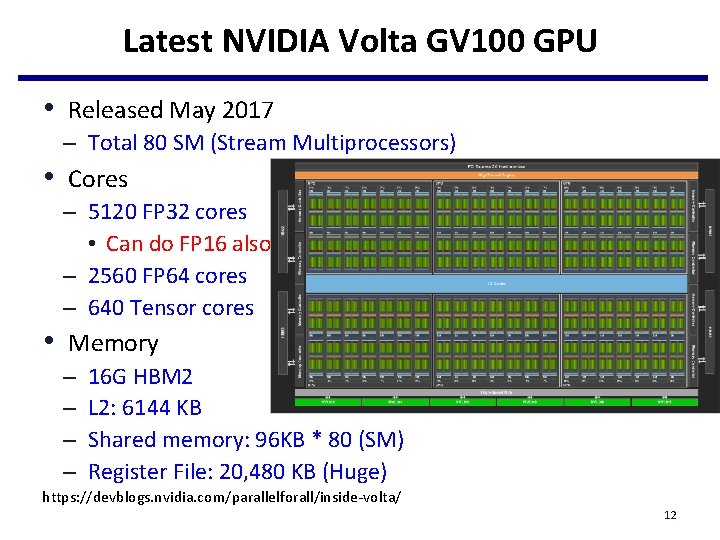
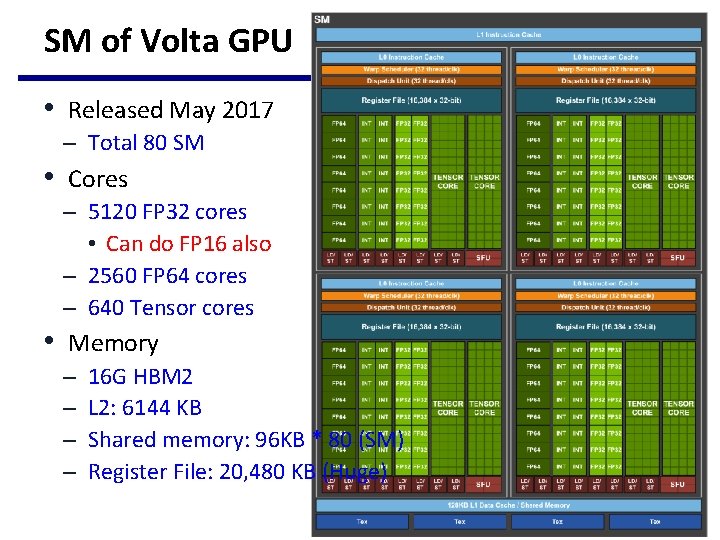
Latest NVIDIA Volta GV 100 GPU • Released May 2017 – Total 80 SM (Stream Multiprocessors) • Cores – 5120 FP 32 cores • Can do FP 16 also – 2560 FP 64 cores – 640 Tensor cores • Memory – – 16 G HBM 2 L 2: 6144 KB Shared memory: 96 KB * 80 (SM) Register File: 20, 480 KB (Huge) https: //devblogs. nvidia. com/parallelforall/inside-volta/ 12
SM of Volta GPU • Released May 2017 – Total 80 SM • Cores – 5120 FP 32 cores • Can do FP 16 also – 2560 FP 64 cores – 640 Tensor cores • Memory – – 16 G HBM 2 L 2: 6144 KB Shared memory: 96 KB * 80 (SM) Register File: 20, 480 KB (Huge) 13
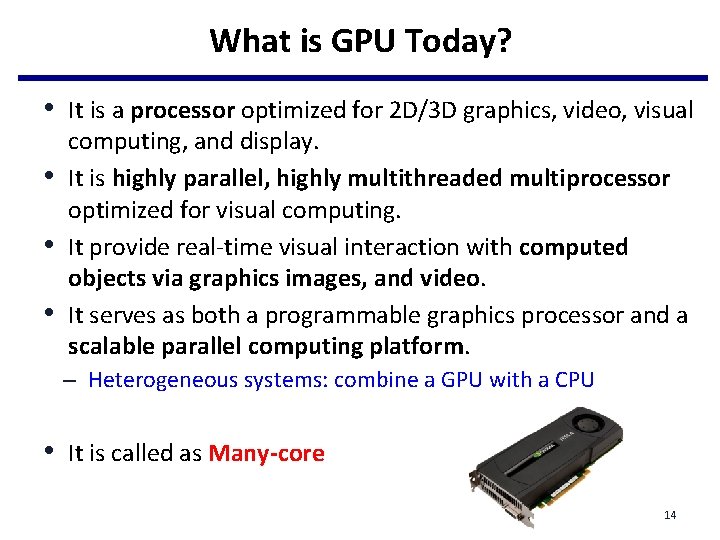
What is GPU Today? • It is a processor optimized for 2 D/3 D graphics, video, visual • • • computing, and display. It is highly parallel, highly multithreaded multiprocessor optimized for visual computing. It provide real-time visual interaction with computed objects via graphics images, and video. It serves as both a programmable graphics processor and a scalable parallel computing platform. – Heterogeneous systems: combine a GPU with a CPU • It is called as Many-core 14
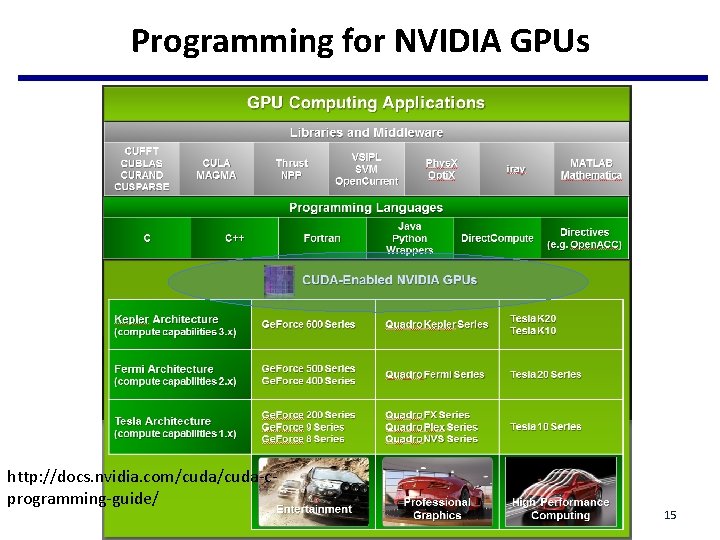
Programming for NVIDIA GPUs http: //docs. nvidia. com/cuda-cprogramming-guide/ 15
CUDA(Compute Unified Device Architecture) Both an architecture and programming model • Architecture and execution model – Introduced in NVIDIA in 2007 – Get highest possible execution performance requires understanding of hardware architecture • Programming model – Small set of extensions to C – Enables GPUs to execute programs written in C – Within C programs, call SIMT “kernel” routines that are executed on GPU. 16
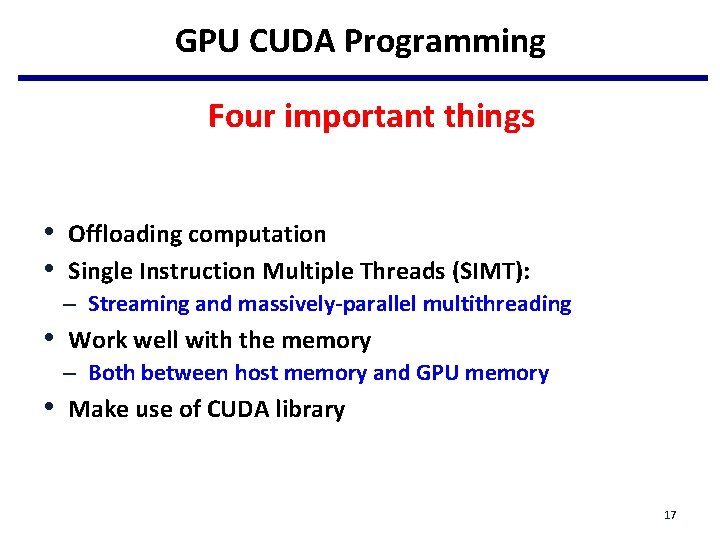
GPU CUDA Programming Four important things • Offloading computation • Single Instruction Multiple Threads (SIMT): – Streaming and massively-parallel multithreading • Work well with the memory – Both between host memory and GPU memory • Make use of CUDA library 17
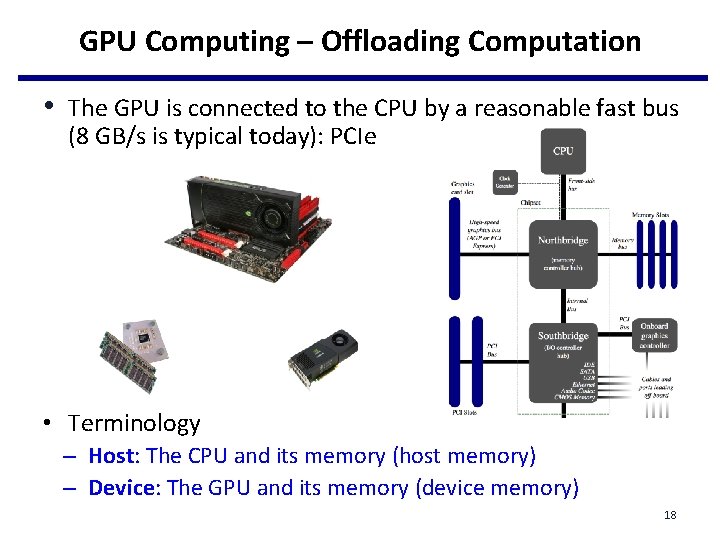
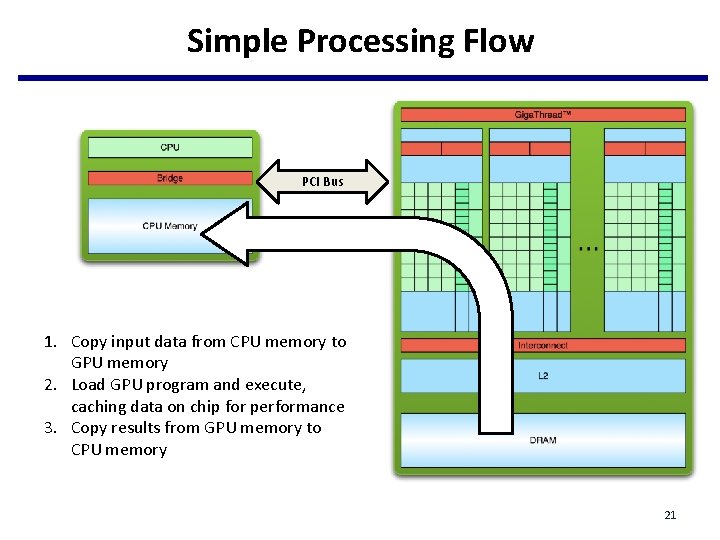
GPU Computing – Offloading Computation • The GPU is connected to the CPU by a reasonable fast bus (8 GB/s is typical today): PCIe • Terminology – Host: The CPU and its memory (host memory) – Device: The GPU and its memory (device memory) 18
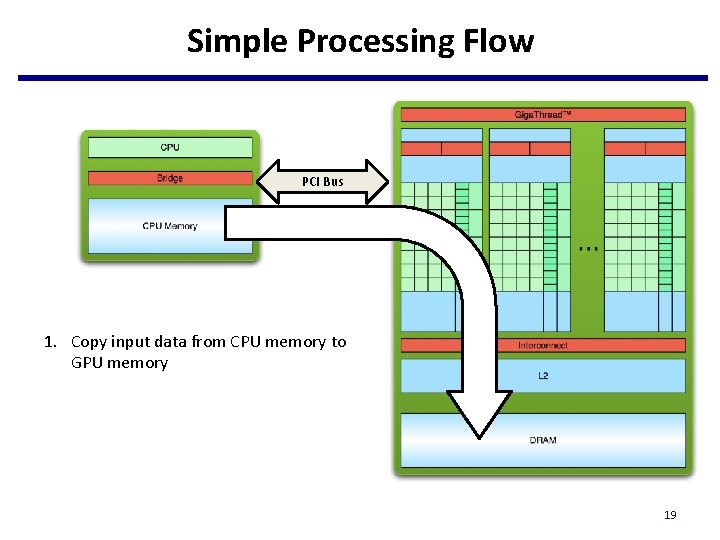
Simple Processing Flow PCI Bus 1. Copy input data from CPU memory to GPU memory 19
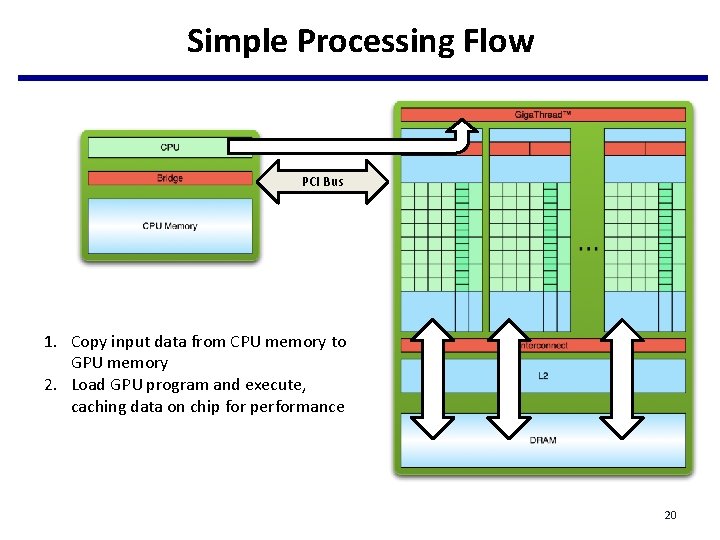
Simple Processing Flow PCI Bus 1. Copy input data from CPU memory to GPU memory 2. Load GPU program and execute, caching data on chip for performance 20
Simple Processing Flow PCI Bus 1. Copy input data from CPU memory to GPU memory 2. Load GPU program and execute, caching data on chip for performance 3. Copy results from GPU memory to CPU memory 21
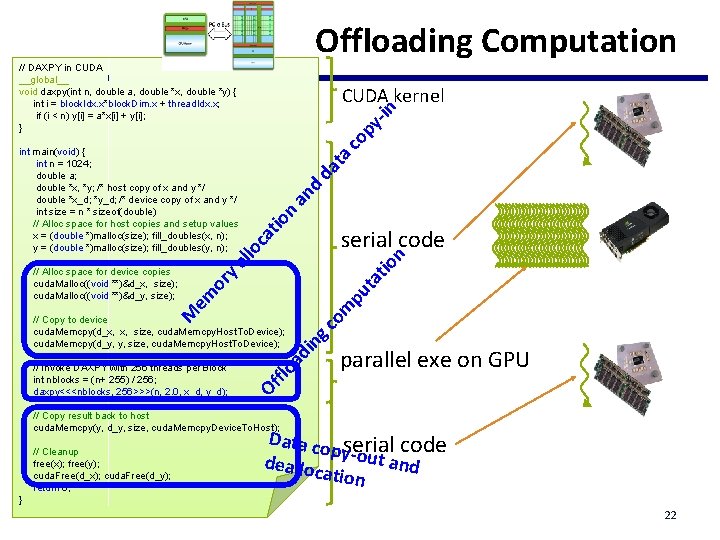
Offloading Computation // DAXPY in CUDA __global__ void daxpy(int n, double a, double *x, double *y) { int i = block. Idx. x*block. Dim. x + thread. Idx. x; if (i < n) y[i] = a*x[i] + y[i]; } yin op ac da t d an n io ca t serial code ta tio pu or ya // Invoke DAXPY with 256 threads per Block int nblocks = (n+ 255) / 256; daxpy<<<nblocks, 256>>>(n, 2. 0, x_d, y_d); ng c Of flo a di // Copy to device cuda. Memcpy(d_x, x, size, cuda. Memcpy. Host. To. Device); cuda. Memcpy(d_y, y, size, cuda. Memcpy. Host. To. Device); om M em // Alloc space for device copies cuda. Malloc((void **)&d_x, size); cuda. Malloc((void **)&d_y, size); n llo int main(void) { int n = 1024; double a; double *x, *y; /* host copy of x and y */ double *x_d; *y_d; /* device copy of x and y */ int size = n * sizeof(double) // Alloc space for host copies and setup values x = (double *)malloc(size); fill_doubles(x, n); y = (double *)malloc(size); fill_doubles(y, n); CUDA kernel parallel exe on GPU // Copy result back to host cuda. Memcpy(y, d_y, size, cuda. Memcpy. Device. To. Host); // Cleanup free(x); free(y); cuda. Free(d_x); cuda. Free(d_y); return 0; Data c serial code op dealloc y-out and ation } 22
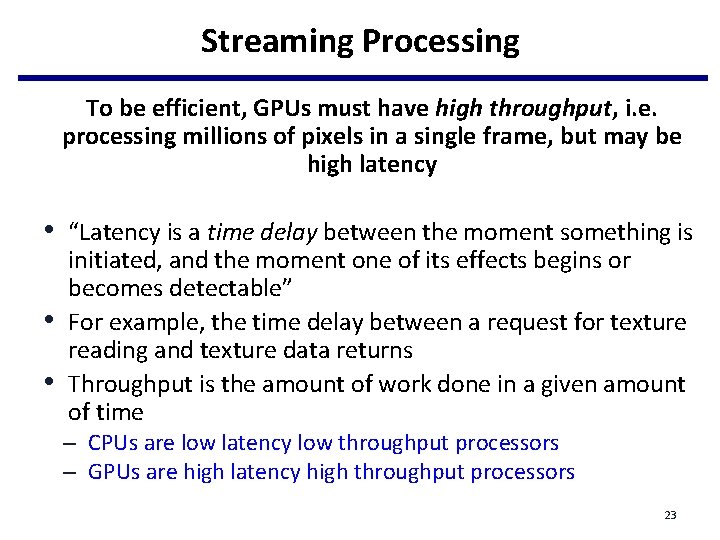
Streaming Processing To be efficient, GPUs must have high throughput, i. e. processing millions of pixels in a single frame, but may be high latency • “Latency is a time delay between the moment something is • • initiated, and the moment one of its effects begins or becomes detectable” For example, the time delay between a request for texture reading and texture data returns Throughput is the amount of work done in a given amount of time – CPUs are low latency low throughput processors – GPUs are high latency high throughput processors 23
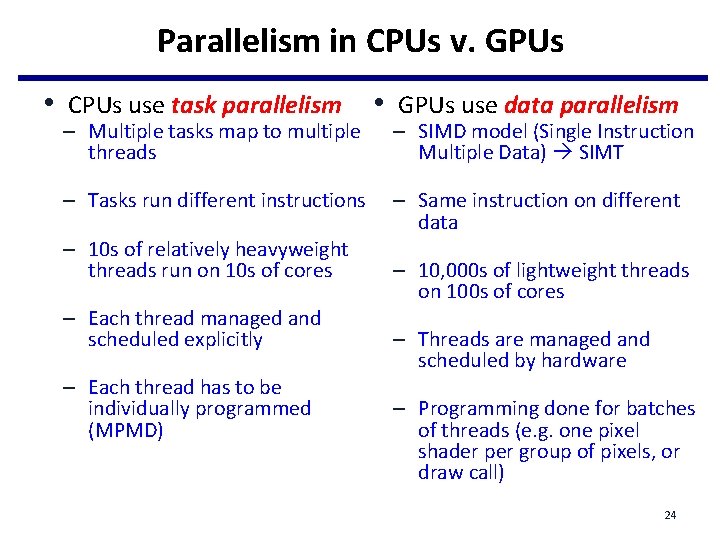
Parallelism in CPUs v. GPUs • CPUs use task parallelism • GPUs use data parallelism – Multiple tasks map to multiple threads – SIMD model (Single Instruction Multiple Data) SIMT – Tasks run different instructions – Same instruction on different data – 10 s of relatively heavyweight threads run on 10 s of cores – Each thread managed and scheduled explicitly – Each thread has to be individually programmed (MPMD) – 10, 000 s of lightweight threads on 100 s of cores – Threads are managed and scheduled by hardware – Programming done for batches of threads (e. g. one pixel shader per group of pixels, or draw call) 24
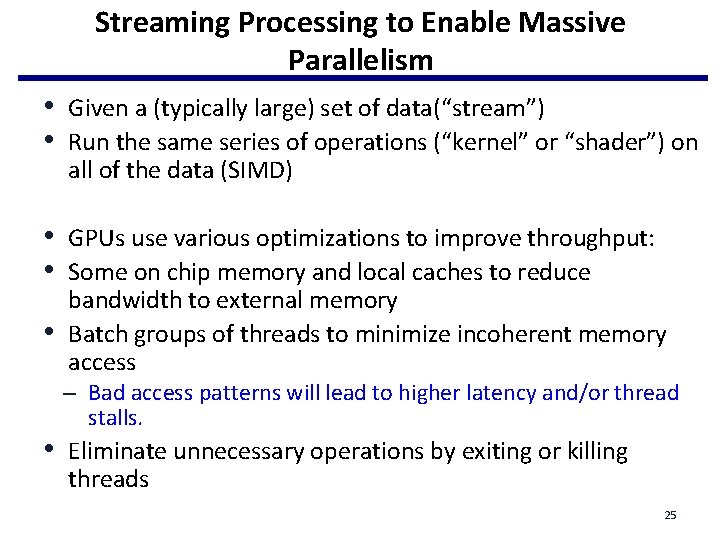
Streaming Processing to Enable Massive Parallelism • Given a (typically large) set of data(“stream”) • Run the same series of operations (“kernel” or “shader”) on all of the data (SIMD) • GPUs use various optimizations to improve throughput: • Some on chip memory and local caches to reduce • bandwidth to external memory Batch groups of threads to minimize incoherent memory access – Bad access patterns will lead to higher latency and/or thread stalls. • Eliminate unnecessary operations by exiting or killing threads 25
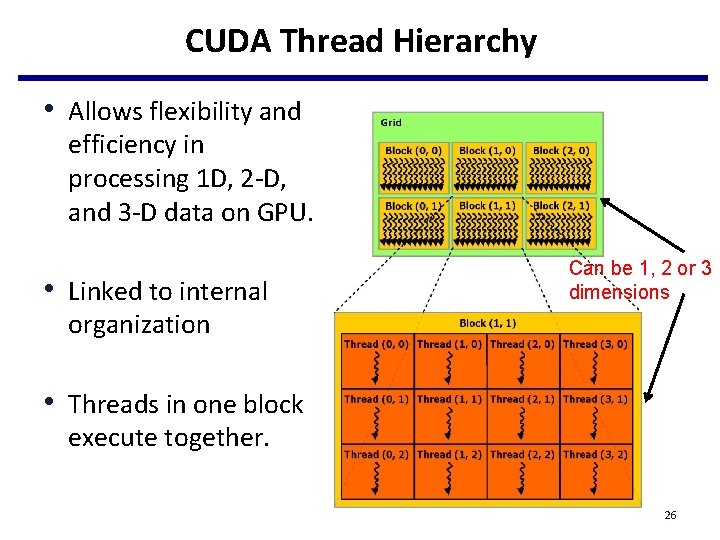
CUDA Thread Hierarchy • Allows flexibility and efficiency in processing 1 D, 2 -D, and 3 -D data on GPU. • Linked to internal Can be 1, 2 or 3 dimensions organization • Threads in one block execute together. 26
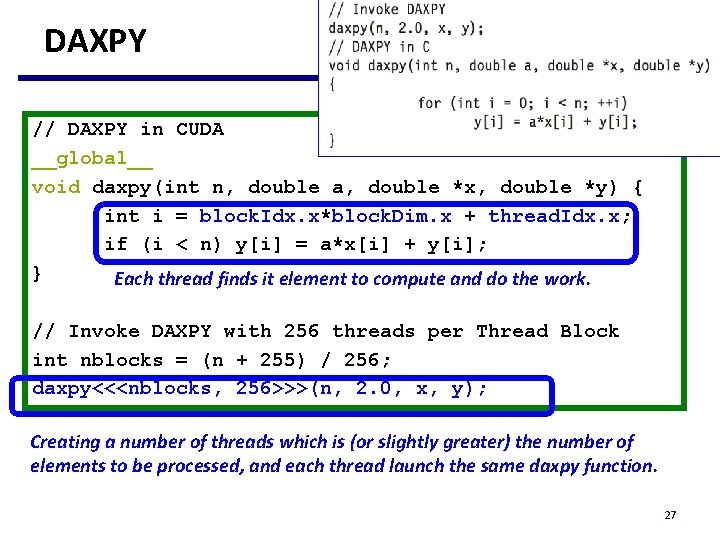
DAXPY // DAXPY in CUDA __global__ void daxpy(int n, double a, double *x, double *y) { int i = block. Idx. x*block. Dim. x + thread. Idx. x; if (i < n) y[i] = a*x[i] + y[i]; } Each thread finds it element to compute and do the work. // Invoke DAXPY with 256 threads per Thread Block int nblocks = (n + 255) / 256; daxpy<<<nblocks, 256>>>(n, 2. 0, x, y); Creating a number of threads which is (or slightly greater) the number of elements to be processed, and each thread launch the same daxpy function. 27
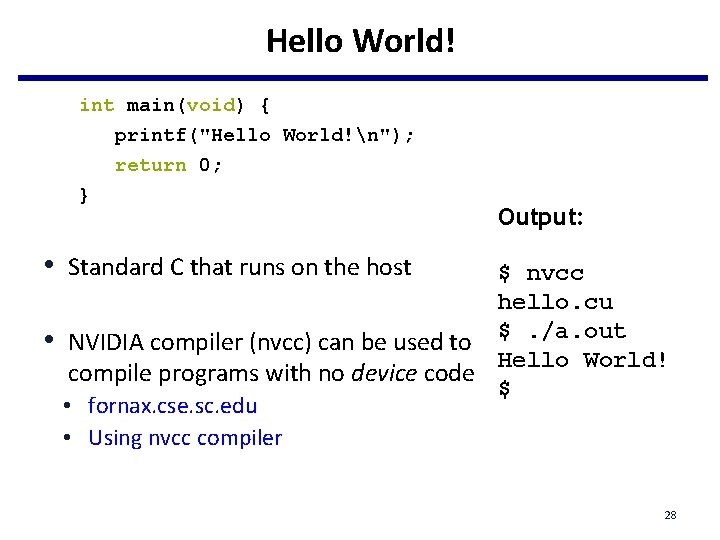
Hello World! int main(void) { printf("Hello World!n"); return 0; } Output: • Standard C that runs on the host • $ nvcc hello. cu NVIDIA compiler (nvcc) can be used to $. /a. out Hello World! compile programs with no device code $ • fornax. cse. sc. edu • Using nvcc compiler 28
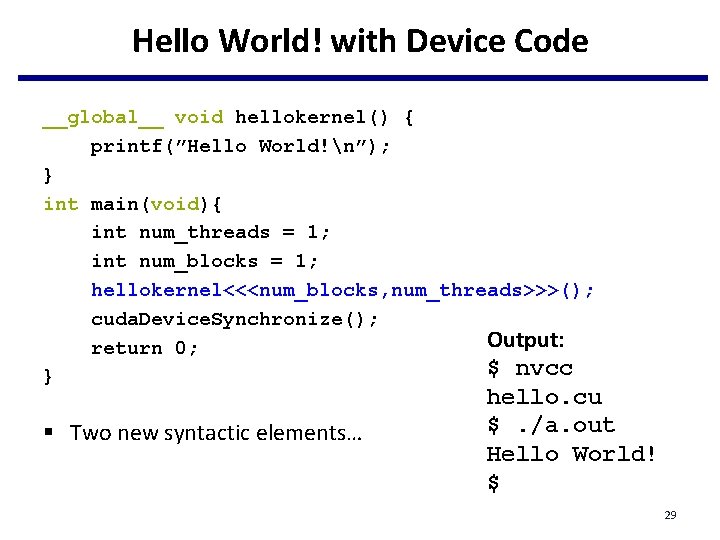
Hello World! with Device Code __global__ void hellokernel() { printf(”Hello World!n”); } int main(void){ int num_threads = 1; int num_blocks = 1; hellokernel<<<num_blocks, num_threads>>>(); cuda. Device. Synchronize(); Output: return 0; $ nvcc } § Two new syntactic elements… hello. cu $. /a. out Hello World! $ 29
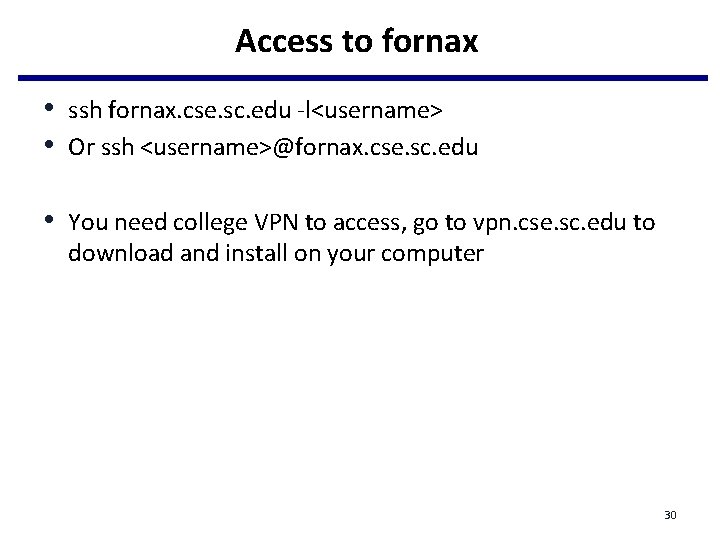
Access to fornax • ssh fornax. cse. sc. edu -l<username> • Or ssh <username>@fornax. cse. sc. edu • You need college VPN to access, go to vpn. cse. sc. edu to download and install on your computer 30
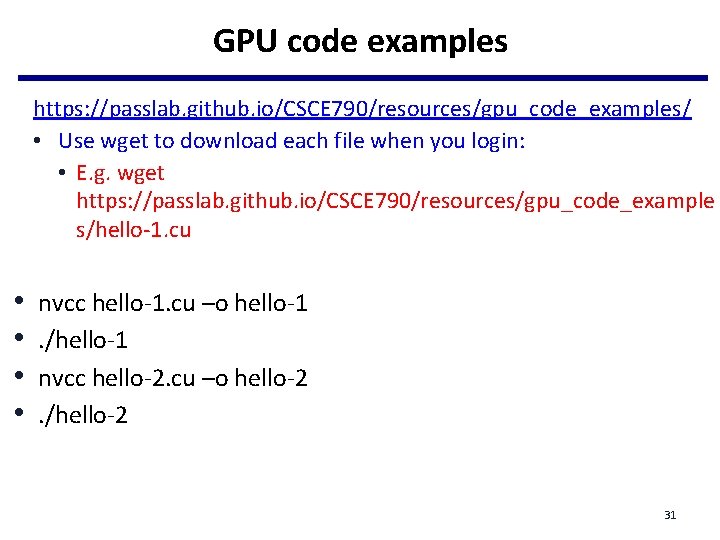
GPU code examples https: //passlab. github. io/CSCE 790/resources/gpu_code_examples/ • Use wget to download each file when you login: • E. g. wget https: //passlab. github. io/CSCE 790/resources/gpu_code_example s/hello-1. cu • • nvcc hello-1. cu –o hello-1. /hello-1 nvcc hello-2. cu –o hello-2. /hello-2 31
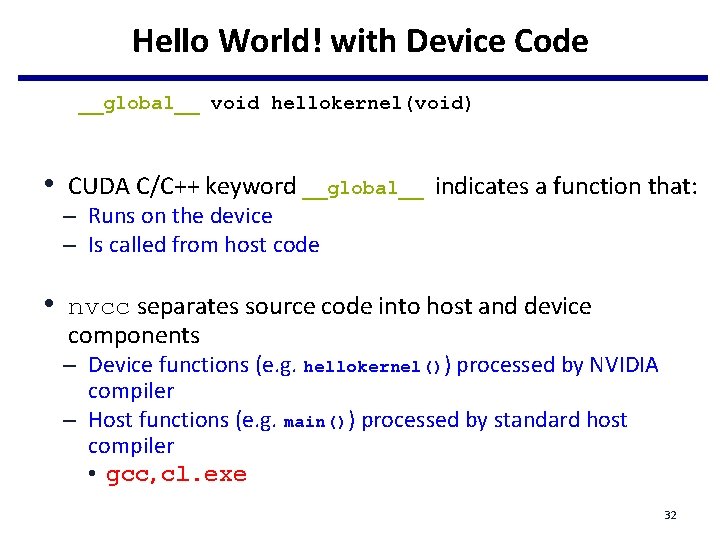
Hello World! with Device Code __global__ void hellokernel(void) • CUDA C/C++ keyword __global__ indicates a function that: – Runs on the device – Is called from host code • nvcc separates source code into host and device components – Device functions (e. g. hellokernel()) processed by NVIDIA compiler – Host functions (e. g. main()) processed by standard host compiler • gcc, cl. exe 32
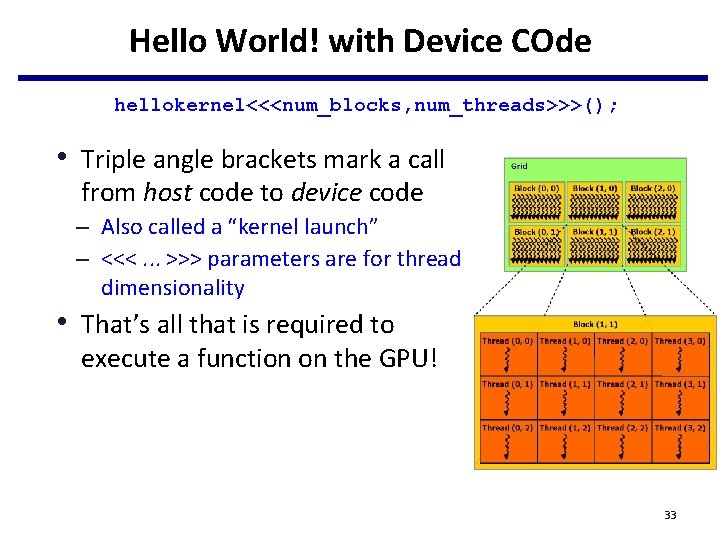
Hello World! with Device COde hellokernel<<<num_blocks, num_threads>>>(); • Triple angle brackets mark a call from host code to device code – Also called a “kernel launch” – <<<. . . >>> parameters are for thread dimensionality • That’s all that is required to execute a function on the GPU! 33
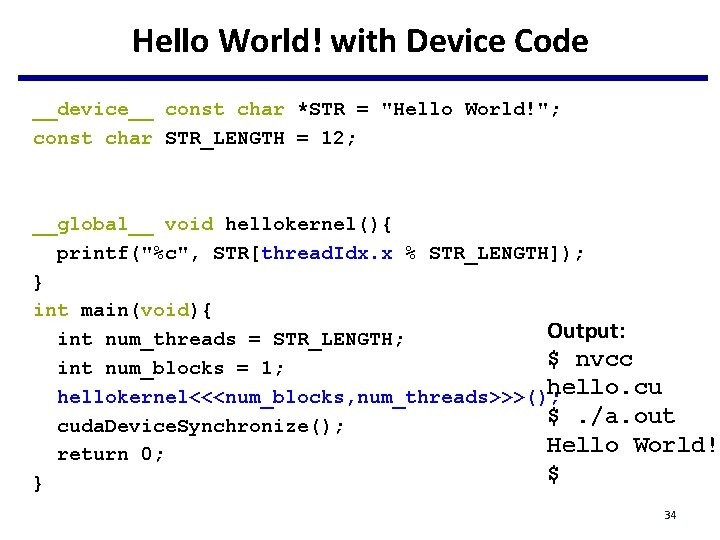
Hello World! with Device Code __device__ const char *STR = "Hello World!"; const char STR_LENGTH = 12; __global__ void hellokernel(){ printf("%c", STR[thread. Idx. x % STR_LENGTH]); } int main(void){ Output: int num_threads = STR_LENGTH; $ nvcc int num_blocks = 1; hello. cu hellokernel<<<num_blocks, num_threads>>>(); $. /a. out cuda. Device. Synchronize(); Hello World! return 0; $ } 34
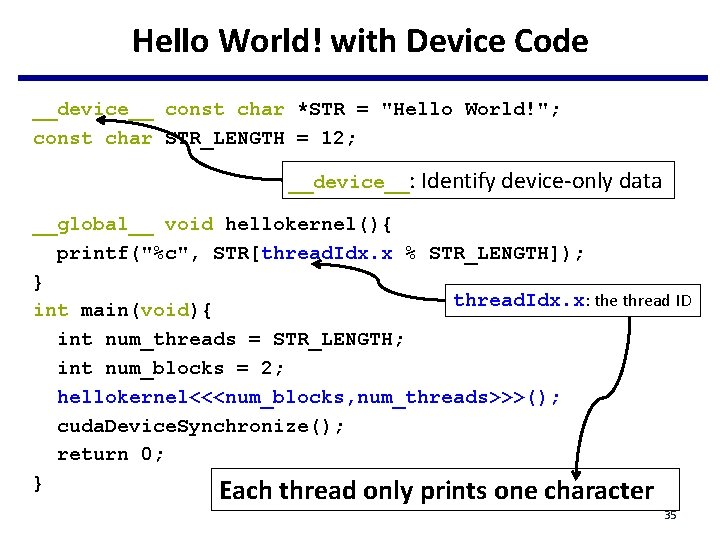
Hello World! with Device Code __device__ const char *STR = "Hello World!"; const char STR_LENGTH = 12; __device__: Identify device-only data __global__ void hellokernel(){ printf("%c", STR[thread. Idx. x % STR_LENGTH]); } thread. Idx. x: the thread ID int main(void){ int num_threads = STR_LENGTH; int num_blocks = 2; hellokernel<<<num_blocks, num_threads>>>(); cuda. Device. Synchronize(); return 0; } Each thread only prints one character 35
Manycore GPU Architectures and Programming • • GPU architectures, graphics and GPGPUs GPU Execution model CUDA Programming model Working with Memory in CUDA – Global memory, shared and constant memory • • Streams and concurrency CUDA instruction intrinsic and library Performance, profiling, debugging, and error handling Directive-based high-level programming model – Open. ACC and Open. MP 36
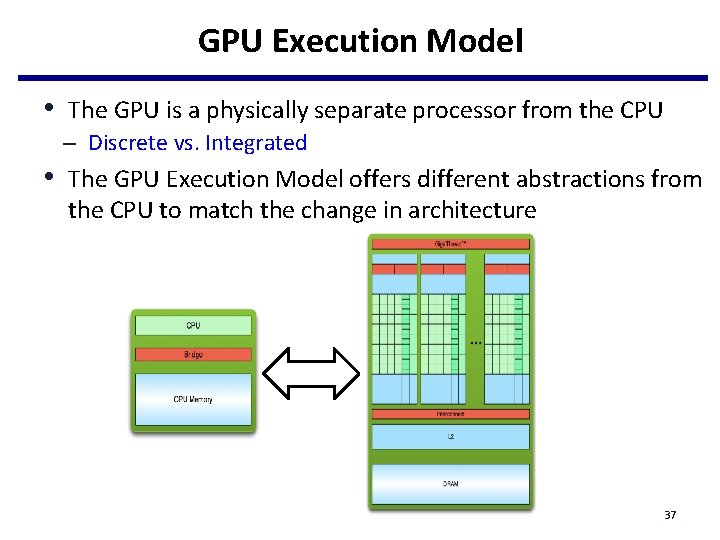
GPU Execution Model • The GPU is a physically separate processor from the CPU – Discrete vs. Integrated • The GPU Execution Model offers different abstractions from the CPU to match the change in architecture PCI Bus 37
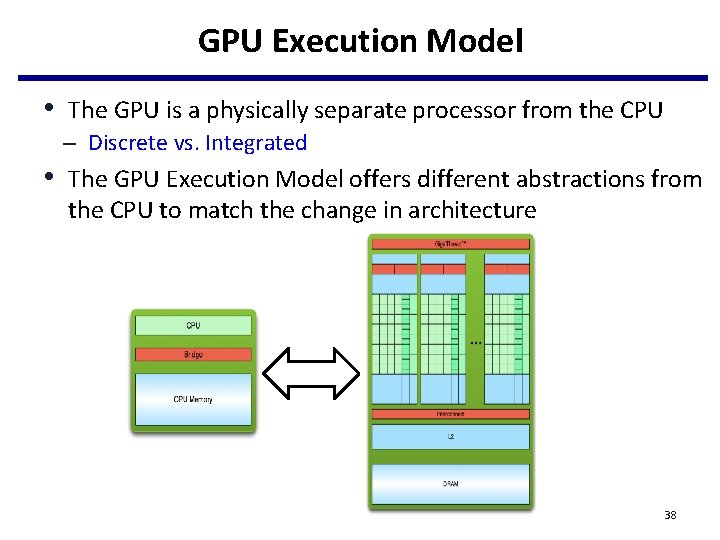
GPU Execution Model • The GPU is a physically separate processor from the CPU – Discrete vs. Integrated • The GPU Execution Model offers different abstractions from the CPU to match the change in architecture PCI Bus 38
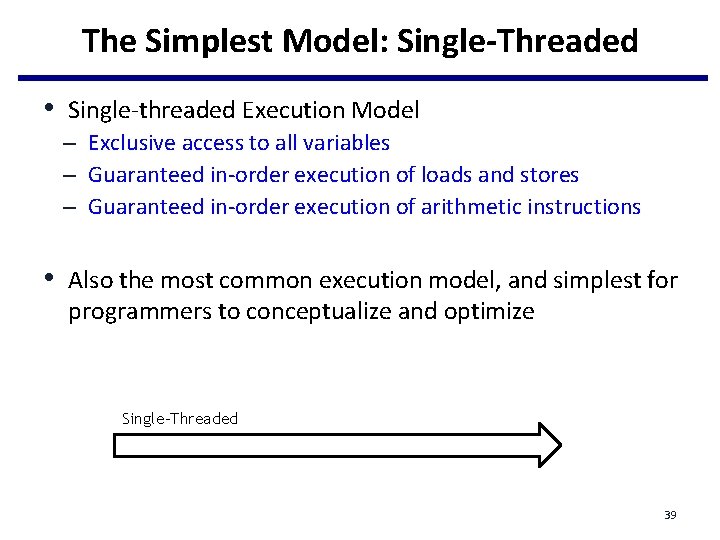
The Simplest Model: Single-Threaded • Single-threaded Execution Model – Exclusive access to all variables – Guaranteed in-order execution of loads and stores – Guaranteed in-order execution of arithmetic instructions • Also the most common execution model, and simplest for programmers to conceptualize and optimize Single-Threaded 39
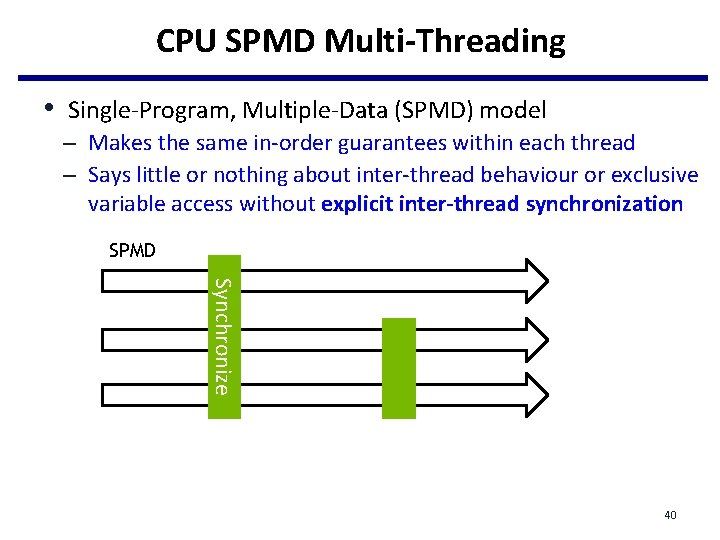
CPU SPMD Multi-Threading • Single-Program, Multiple-Data (SPMD) model – Makes the same in-order guarantees within each thread – Says little or nothing about inter-thread behaviour or exclusive variable access without explicit inter-thread synchronization SPMD Synchronize 40
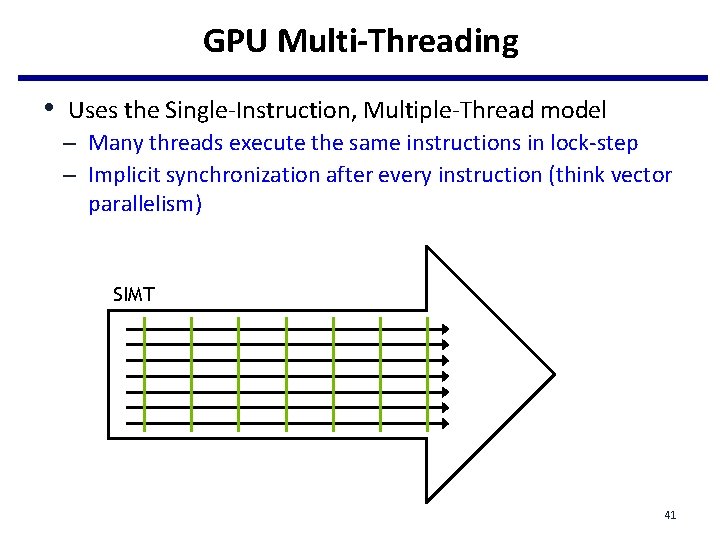
GPU Multi-Threading • Uses the Single-Instruction, Multiple-Thread model – Many threads execute the same instructions in lock-step – Implicit synchronization after every instruction (think vector parallelism) SIMT 41
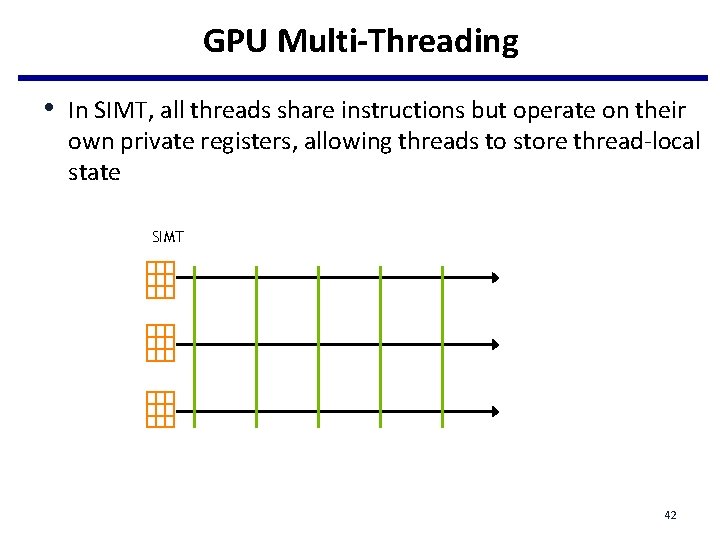
GPU Multi-Threading • In SIMT, all threads share instructions but operate on their own private registers, allowing threads to store thread-local state SIMT 42
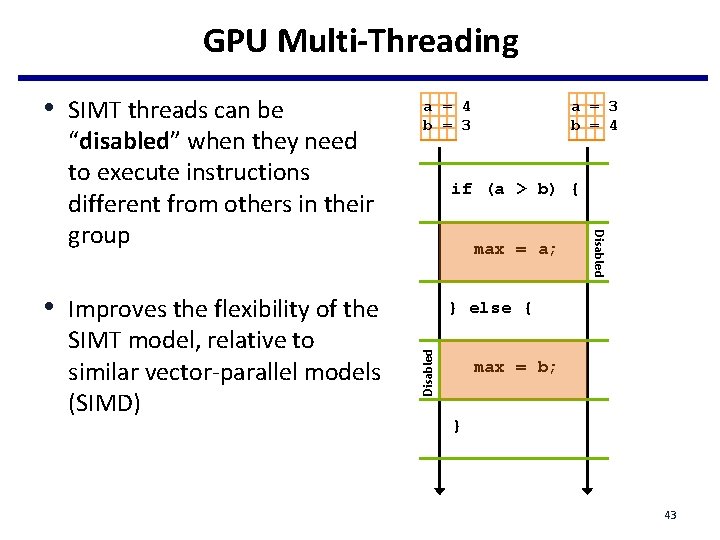
GPU Multi-Threading • SIMT threads can be if (a > b) { max = a; • Improves the flexibility of the } else { Disabled SIMT model, relative to similar vector-parallel models (SIMD) a = 3 b = 4 Disabled “disabled” when they need to execute instructions different from others in their group a = 4 b = 3 max = b; } 43
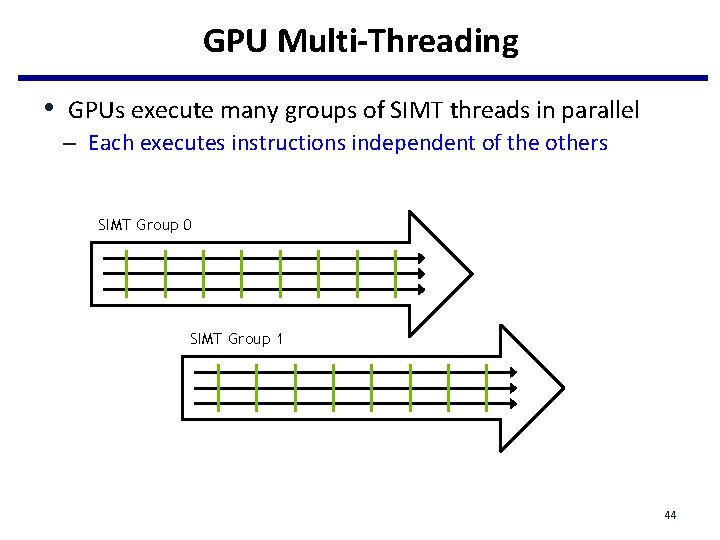
GPU Multi-Threading • GPUs execute many groups of SIMT threads in parallel – Each executes instructions independent of the others SIMT Group 0 SIMT Group 1 44
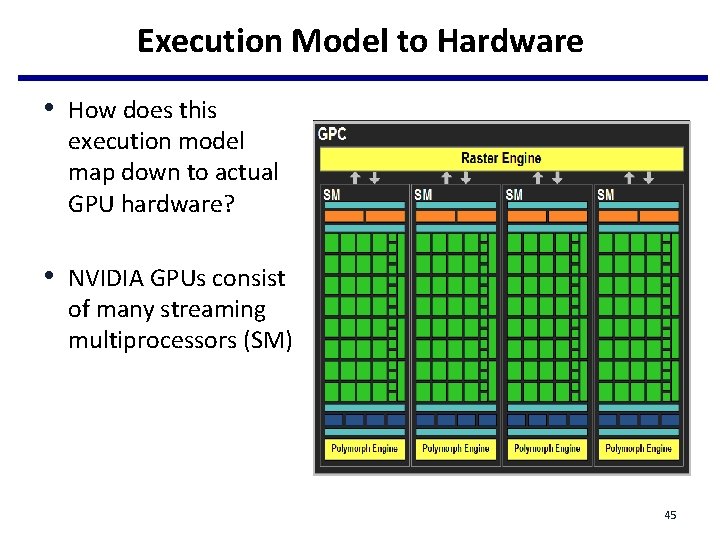
Execution Model to Hardware • How does this execution model map down to actual GPU hardware? • NVIDIA GPUs consist of many streaming multiprocessors (SM) 45
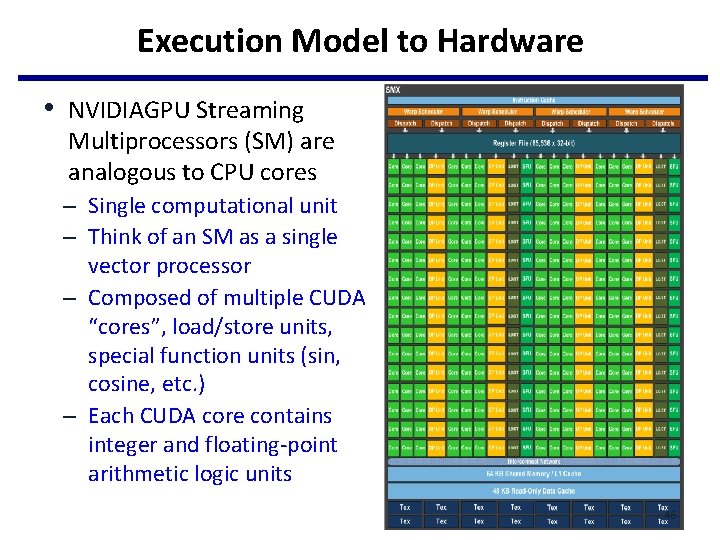
Execution Model to Hardware • NVIDIAGPU Streaming Multiprocessors (SM) are analogous to CPU cores – Single computational unit – Think of an SM as a single vector processor – Composed of multiple CUDA “cores”, load/store units, special function units (sin, cosine, etc. ) – Each CUDA core contains integer and floating-point arithmetic logic units 46
Execution Model to Hardware • GPUs can execute multiple SIMT groups on each SM – For example: on NVIDIA GPUs a SIMT group is 32 threads, each Kepler SM has 192 CUDA cores simultaneous execution of 6 SIMT groups on an SM • SMs can support more concurrent SIMT groups than core count would suggest – Each thread persistently stores its own state in a private register set – Many SIMT groups will spend time blocked on I/O, not actively computing – Keeping blocked SIMT groups scheduled on an SM would waste cores – Groups can be swapped in and out without worrying about losing state 47
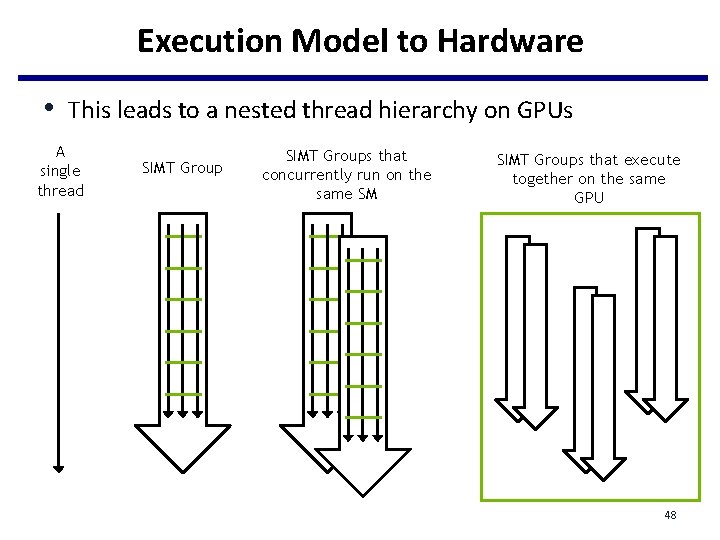
Execution Model to Hardware • This leads to a nested thread hierarchy on GPUs A single thread SIMT Groups that concurrently run on the same SM SIMT Groups that execute together on the same GPU 48
References 1. The sections on Introducing the CUDA Execution Model, 2. 3. 4. Understanding the Nature of Warp Execution, and Exposing Parallelism in Chapter 3 of Professional CUDA C Programming Michael Wolfe. Understanding the CUDA Data Parallel Threading Model. https: //www. pgroup. com/lit/articles/insider/v 2 n 1 a 5. htm Will Ramey. Introduction to CUDA Platform. http: //developer. download. nvidia. com/compute/developertrainingmaterials/presentations/general/W hy_GPU_ Computing. pptx Timo Stich. Fermi Hardware & Performance Tips. http: //theinf 2. informatik. uni-jena. de/ theinf 2_multimedia/Website_downloads/NVIDIA_Fermi_Perf_Jena_ 2011. pdf 49
More information about GPUs 50
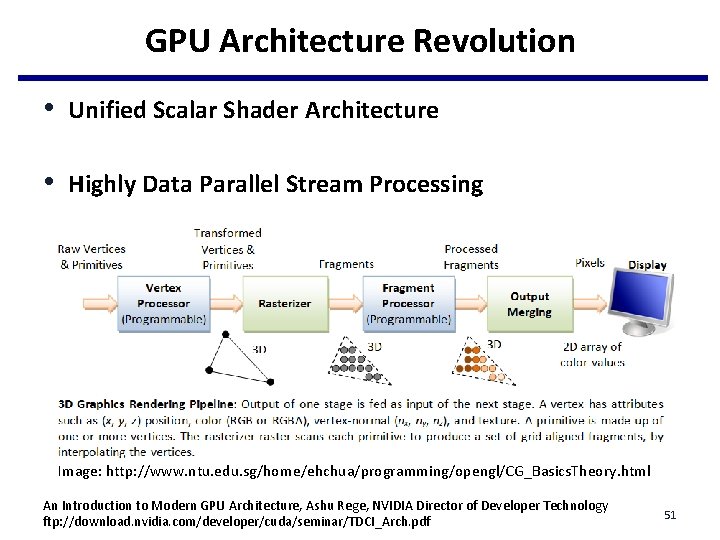
GPU Architecture Revolution • Unified Scalar Shader Architecture • Highly Data Parallel Stream Processing Image: http: //www. ntu. edu. sg/home/ehchua/programming/opengl/CG_Basics. Theory. html An Introduction to Modern GPU Architecture, Ashu Rege, NVIDIA Director of Developer Technology ftp: //download. nvidia. com/developer/cuda/seminar/TDCI_Arch. pdf 51
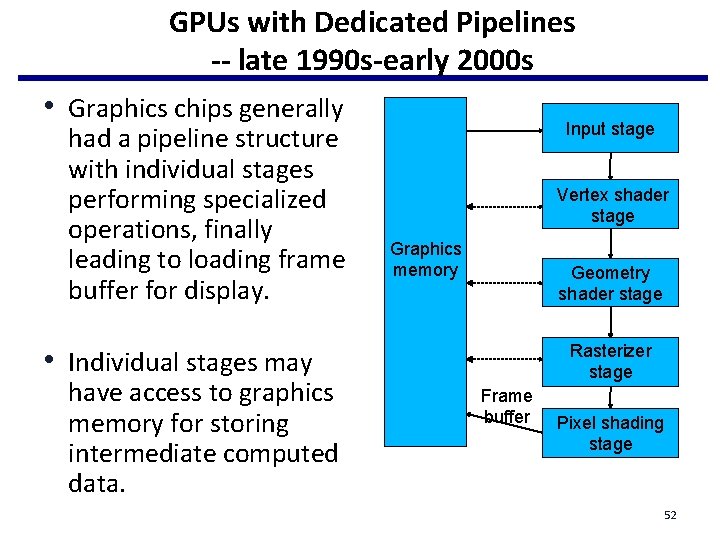
GPUs with Dedicated Pipelines -- late 1990 s-early 2000 s • Graphics chips generally had a pipeline structure with individual stages performing specialized operations, finally leading to loading frame buffer for display. Input stage Vertex shader stage Graphics memory Geometry shader stage • Individual stages may have access to graphics memory for storing intermediate computed data. Rasterizer stage Frame buffer Pixel shading stage 52
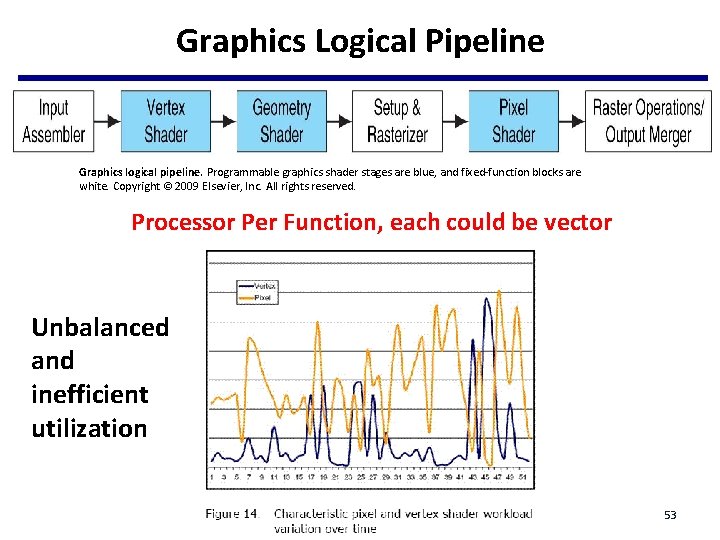
Graphics Logical Pipeline Graphics logical pipeline. Programmable graphics shader stages are blue, and fixed-function blocks are white. Copyright © 2009 Elsevier, Inc. All rights reserved. Processor Per Function, each could be vector Unbalanced and inefficient utilization 53
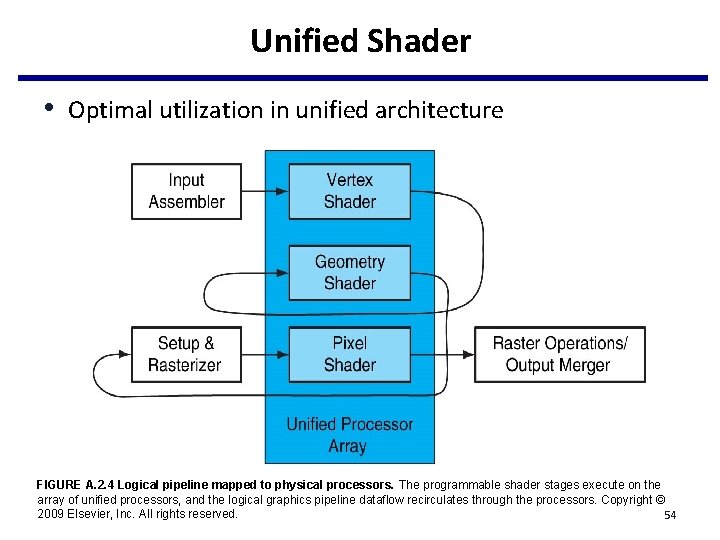
Unified Shader • Optimal utilization in unified architecture FIGURE A. 2. 4 Logical pipeline mapped to physical processors. The programmable shader stages execute on the array of unified processors, and the logical graphics pipeline dataflow recirculates through the processors. Copyright © 2009 Elsevier, Inc. All rights reserved. 54
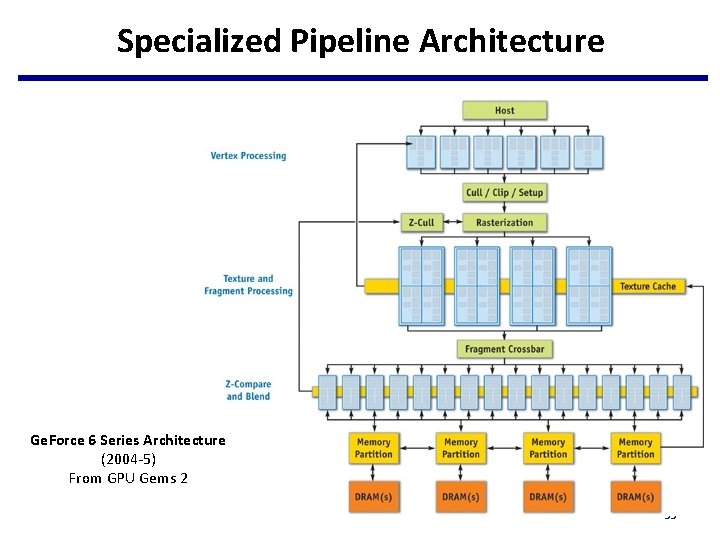
Specialized Pipeline Architecture Ge. Force 6 Series Architecture (2004 -5) From GPU Gems 2 55
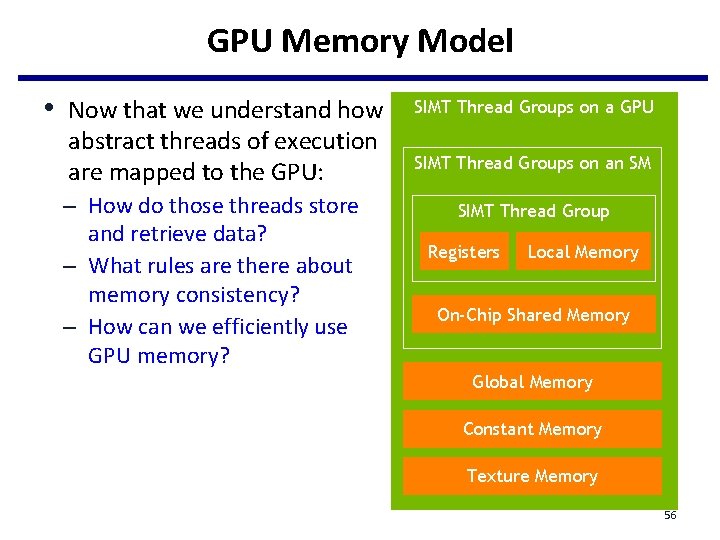
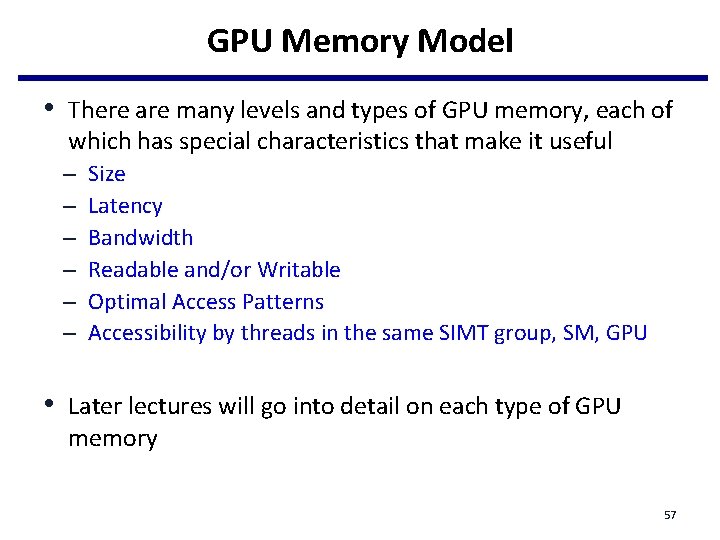
GPU Memory Model • Now that we understand how abstract threads of execution are mapped to the GPU: – How do those threads store and retrieve data? – What rules are there about memory consistency? – How can we efficiently use GPU memory? SIMT Thread Groups on a GPU SIMT Thread Groups on an SM SIMT Thread Group Registers Local Memory On-Chip Shared Memory Global Memory Constant Memory Texture Memory 56
GPU Memory Model • There are many levels and types of GPU memory, each of which has special characteristics that make it useful – – – Size Latency Bandwidth Readable and/or Writable Optimal Access Patterns Accessibility by threads in the same SIMT group, SM, GPU • Later lectures will go into detail on each type of GPU memory 57
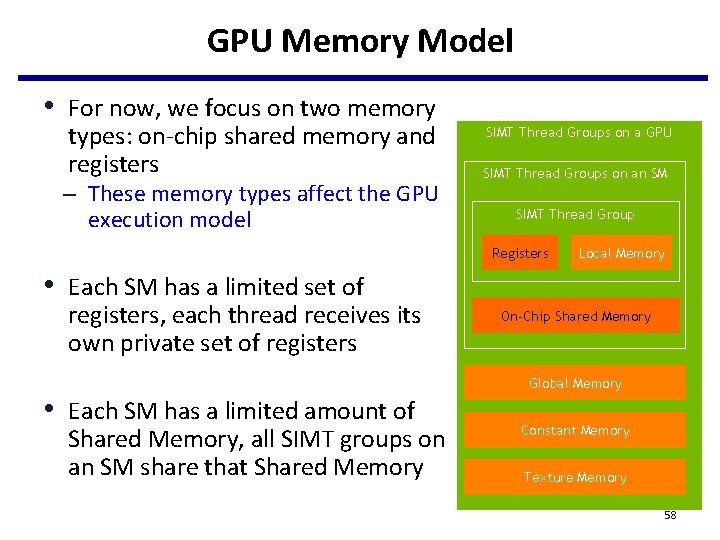
GPU Memory Model • For now, we focus on two memory types: on-chip shared memory and registers – These memory types affect the GPU execution model SIMT Thread Groups on a GPU SIMT Thread Groups on an SM SIMT Thread Group Registers Local Memory • Each SM has a limited set of registers, each thread receives its own private set of registers • Each SM has a limited amount of Shared Memory, all SIMT groups on an SM share that Shared Memory On-Chip Shared Memory Global Memory Constant Memory Texture Memory 58
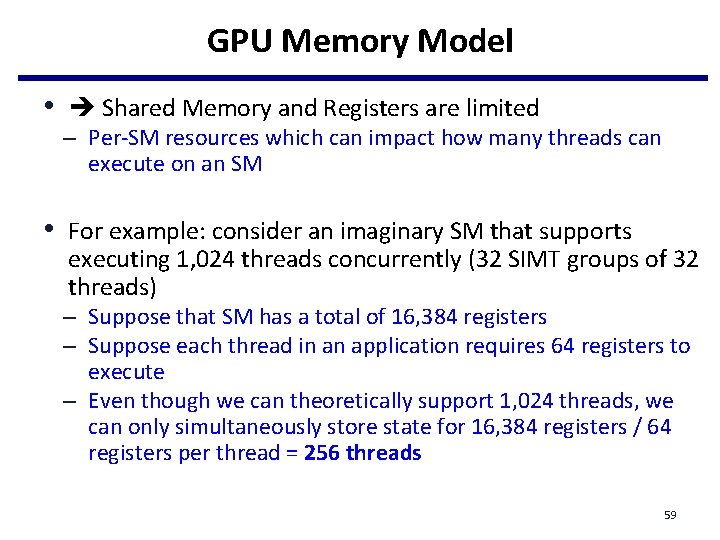
GPU Memory Model • Shared Memory and Registers are limited – Per-SM resources which can impact how many threads can execute on an SM • For example: consider an imaginary SM that supports executing 1, 024 threads concurrently (32 SIMT groups of 32 threads) – Suppose that SM has a total of 16, 384 registers – Suppose each thread in an application requires 64 registers to execute – Even though we can theoretically support 1, 024 threads, we can only simultaneously store state for 16, 384 registers / 64 registers per thread = 256 threads 59
GPU Memory Model • Parallelism is limited by both the computational and storage resources of the GPU. – In the GPU Execution Model, they are closely tied together. 60
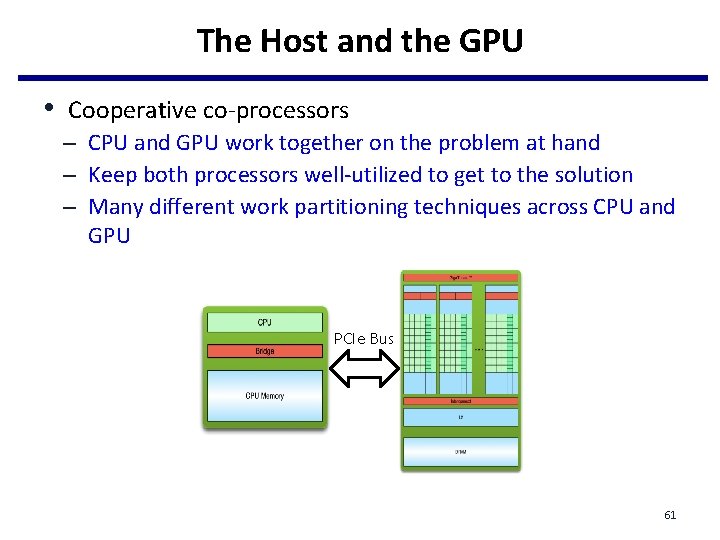
The Host and the GPU • Cooperative co-processors – CPU and GPU work together on the problem at hand – Keep both processors well-utilized to get to the solution – Many different work partitioning techniques across CPU and GPU PCIe Bus 61
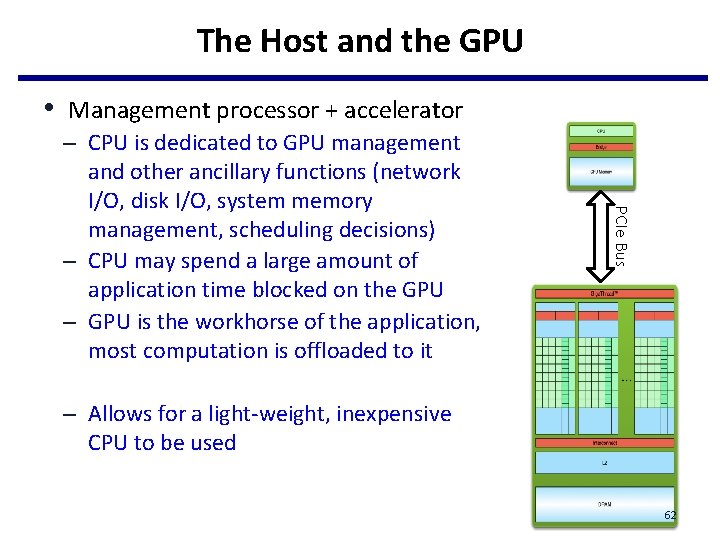
The Host and the GPU • Management processor + accelerator PCIe Bus – CPU is dedicated to GPU management and other ancillary functions (network I/O, disk I/O, system memory management, scheduling decisions) – CPU may spend a large amount of application time blocked on the GPU – GPU is the workhorse of the application, most computation is offloaded to it – Allows for a light-weight, inexpensive CPU to be used 62
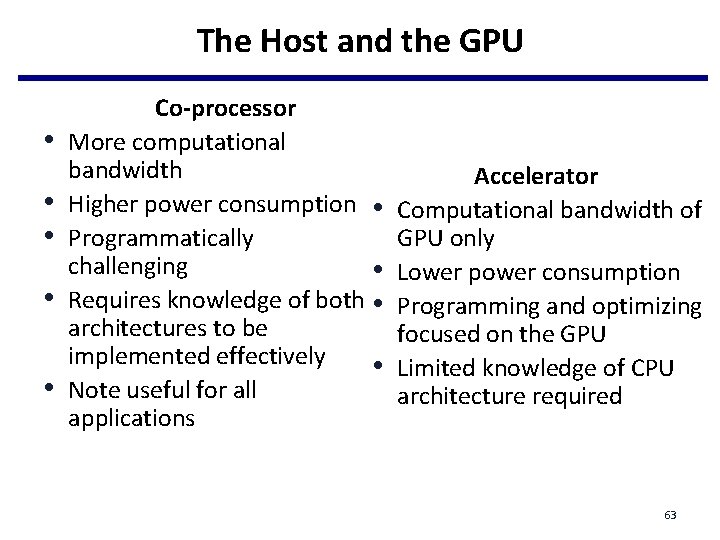
The Host and the GPU • • • Co-processor More computational bandwidth Higher power consumption • Programmatically challenging • Requires knowledge of both • architectures to be implemented effectively • Note useful for all applications Accelerator Computational bandwidth of GPU only Lower power consumption Programming and optimizing focused on the GPU Limited knowledge of CPU architecture required 63
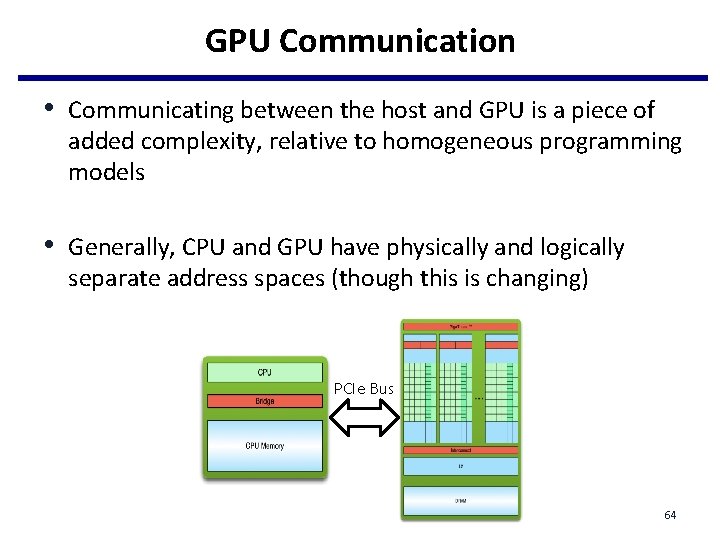
GPU Communication • Communicating between the host and GPU is a piece of added complexity, relative to homogeneous programming models • Generally, CPU and GPU have physically and logically separate address spaces (though this is changing) PCIe Bus 64
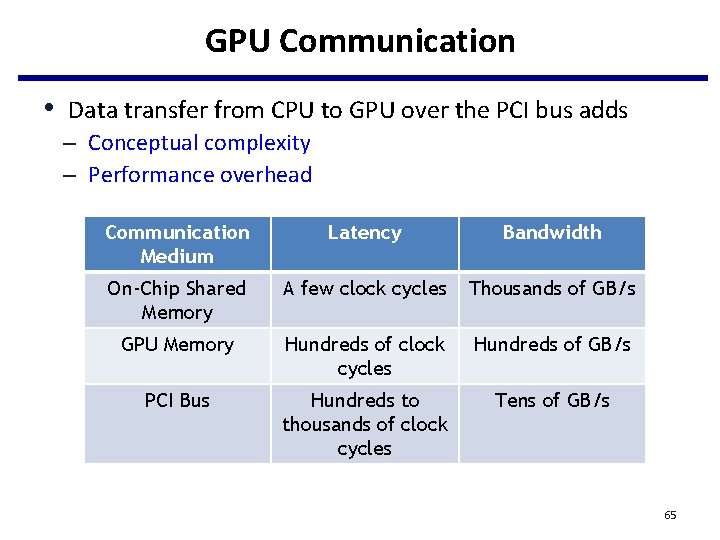
GPU Communication • Data transfer from CPU to GPU over the PCI bus adds – Conceptual complexity – Performance overhead Communication Medium Latency Bandwidth On-Chip Shared Memory A few clock cycles Thousands of GB/s GPU Memory Hundreds of clock cycles Hundreds of GB/s PCI Bus Hundreds to thousands of clock cycles Tens of GB/s 65
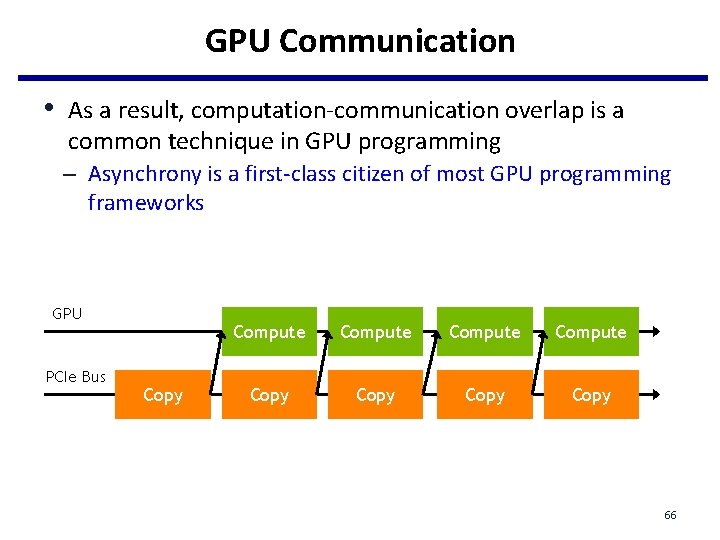
GPU Communication • As a result, computation-communication overlap is a common technique in GPU programming – Asynchrony is a first-class citizen of most GPU programming frameworks GPU PCIe Bus Copy Compute Copy 66
GPU Execution Model • GPUs introduce a new conceptual model for programmers used to CPU single- and multi-threaded programming • While the concepts are different, they are no more complex than those you would need to learn to extract optimal performance from CPU architectures • GPUs offer programmers more control over how their workloads map to hardware, which makes the results of optimizing applications more predictable 67