
Lecture 11 Magnetic Forces Sources of the magnetic
- Slides: 34
Lecture 11: Magnetic Forces, Sources of the magnetic field Looking forward at … • how to analyze magnetic forces on moving charged particles and currentcarrying conductors. • how to analyze magnetic forces on current-carrying conductors. • Loop of current is a magnetic dipole • DC electric motors • what is the fundamental reason for magnetic fields • how to calculate the magnetic field produced by a single moving charged particle, a straight current-carrying wire, or a current-carrying wire bent into a circle. • why wires carrying current in the same direction attract, while wires carrying opposing currents repel. © 2016 Pearson Education Inc.
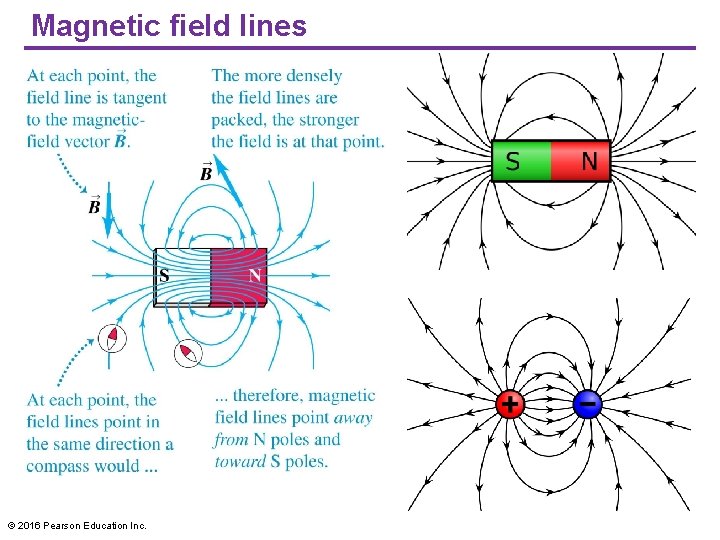
Magnetic field lines © 2016 Pearson Education Inc.
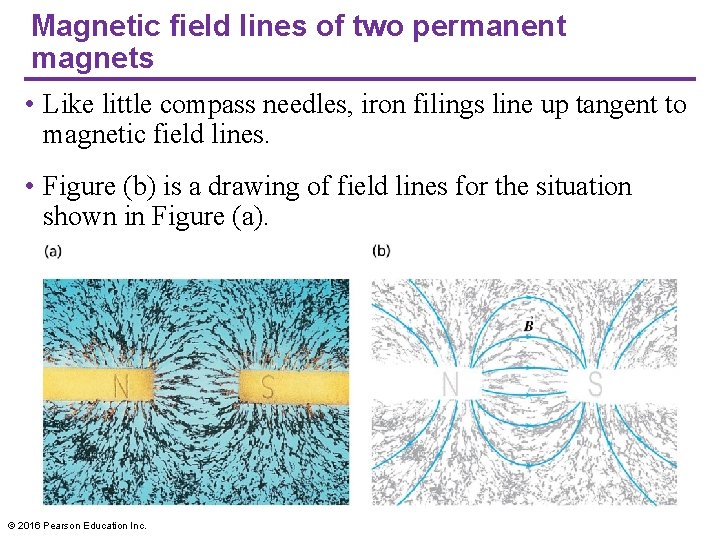
Magnetic field lines of two permanent magnets • Like little compass needles, iron filings line up tangent to magnetic field lines. • Figure (b) is a drawing of field lines for the situation shown in Figure (a). © 2016 Pearson Education Inc.
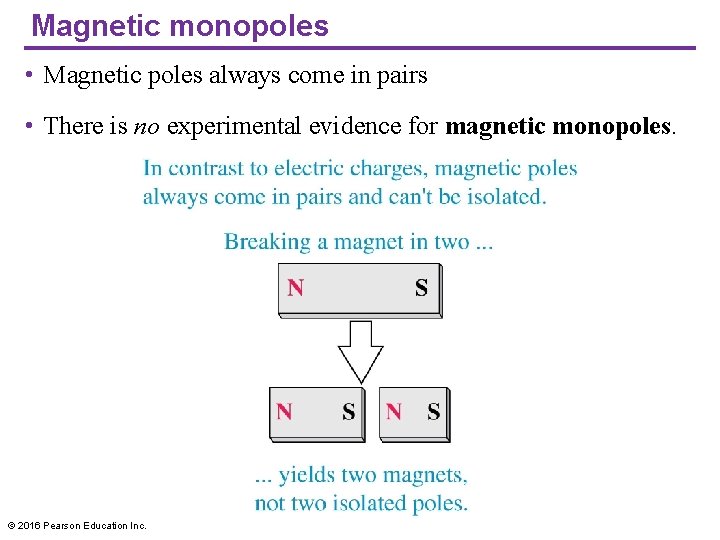
Magnetic monopoles • Magnetic poles always come in pairs • There is no experimental evidence for magnetic monopoles. © 2016 Pearson Education Inc.
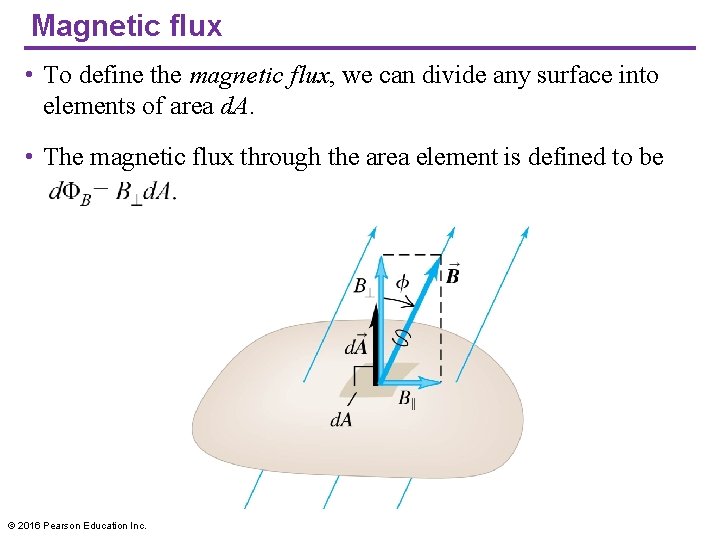
Magnetic flux • To define the magnetic flux, we can divide any surface into elements of area d. A. • The magnetic flux through the area element is defined to be © 2016 Pearson Education Inc.
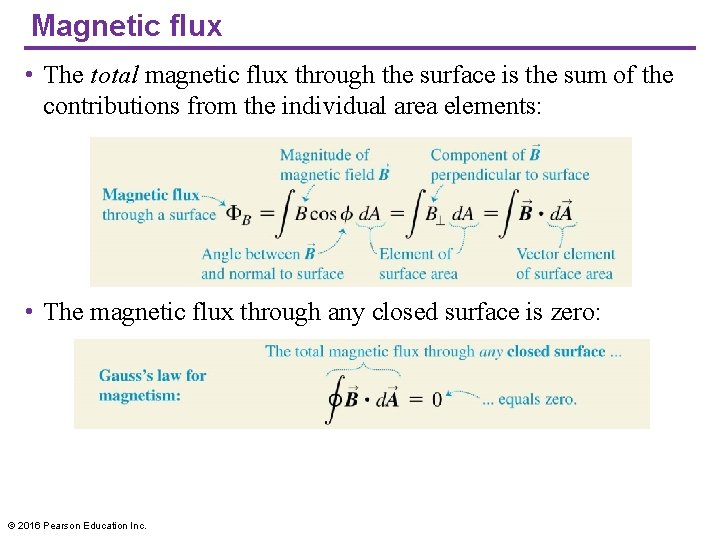
Magnetic flux • The total magnetic flux through the surface is the sum of the contributions from the individual area elements: • The magnetic flux through any closed surface is zero: © 2016 Pearson Education Inc.
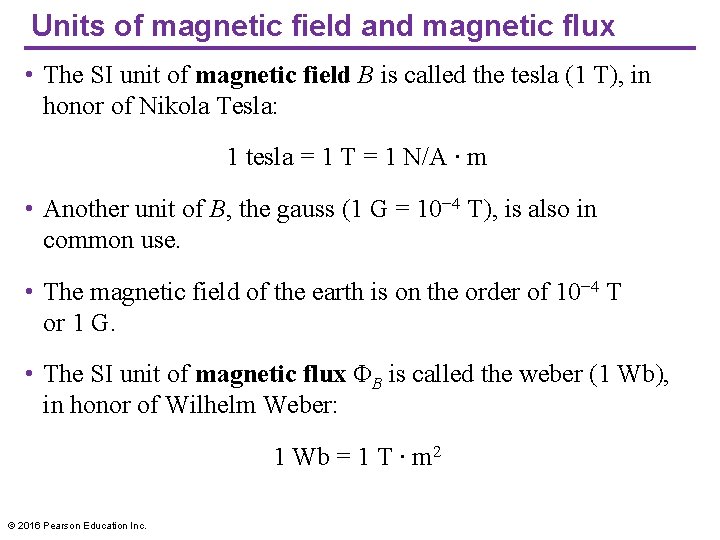
Units of magnetic field and magnetic flux • The SI unit of magnetic field B is called the tesla (1 T), in honor of Nikola Tesla: 1 tesla = 1 T = 1 N/A ∙ m • Another unit of B, the gauss (1 G = 10− 4 T), is also in common use. • The magnetic field of the earth is on the order of 10− 4 T or 1 G. • The SI unit of magnetic flux ΦB is called the weber (1 Wb), in honor of Wilhelm Weber: 1 Wb = 1 T ∙ m 2 © 2016 Pearson Education Inc.
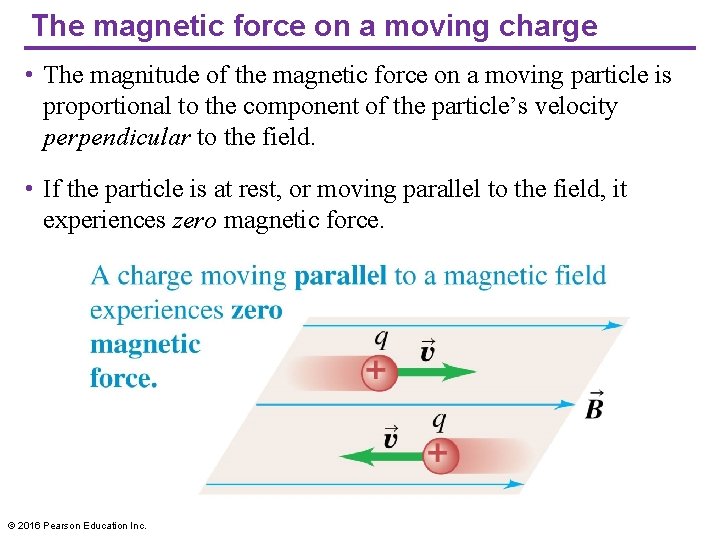
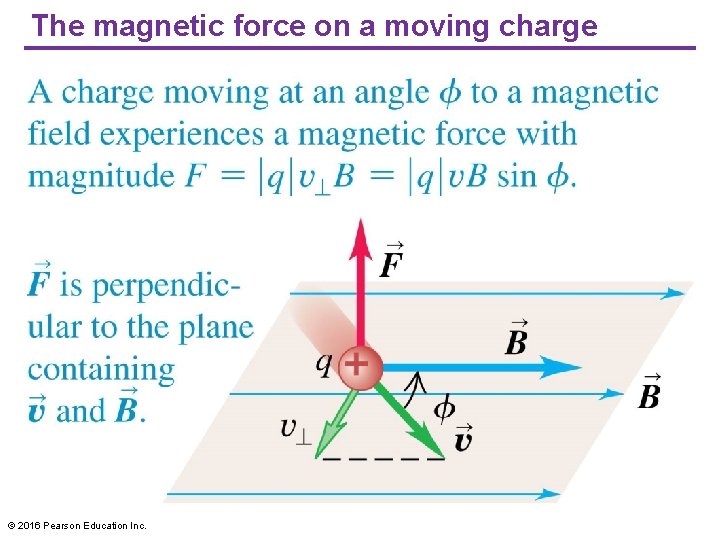
The magnetic force on a moving charge • The magnitude of the magnetic force on a moving particle is proportional to the component of the particle’s velocity perpendicular to the field. • If the particle is at rest, or moving parallel to the field, it experiences zero magnetic force. © 2016 Pearson Education Inc.
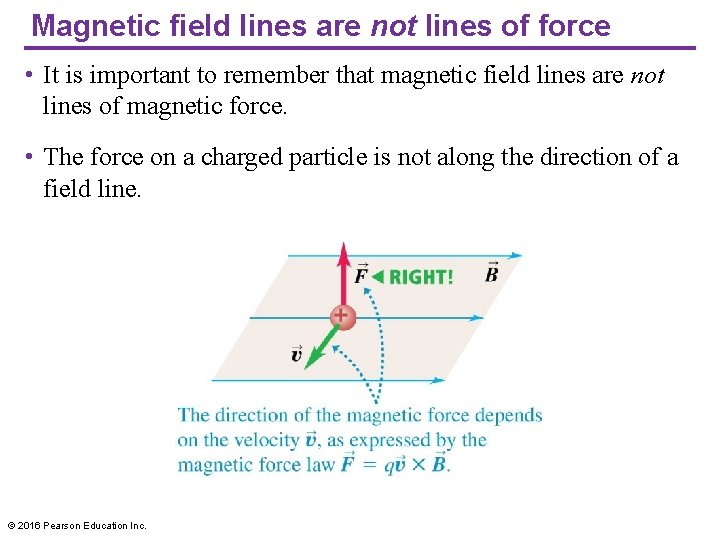
Magnetic field lines are not lines of force • It is important to remember that magnetic field lines are not lines of magnetic force. • The force on a charged particle is not along the direction of a field line. © 2016 Pearson Education Inc.
The magnetic force on a moving charge © 2016 Pearson Education Inc.
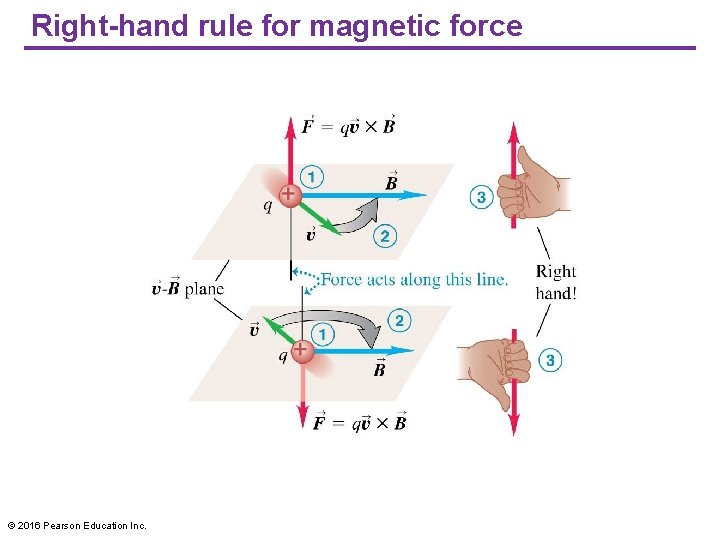
Right-hand rule for magnetic force © 2016 Pearson Education Inc.
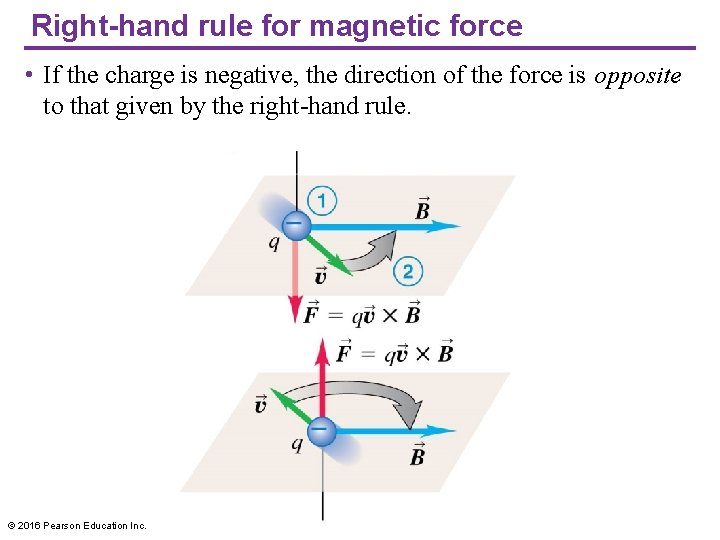
Right-hand rule for magnetic force • If the charge is negative, the direction of the force is opposite to that given by the right-hand rule. © 2016 Pearson Education Inc.
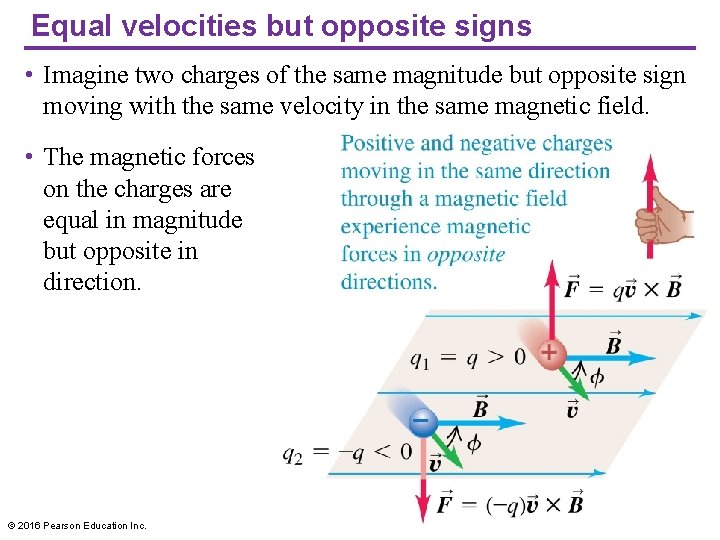
Equal velocities but opposite signs • Imagine two charges of the same magnitude but opposite sign moving with the same velocity in the same magnetic field. • The magnetic forces on the charges are equal in magnitude but opposite in direction. © 2016 Pearson Education Inc.
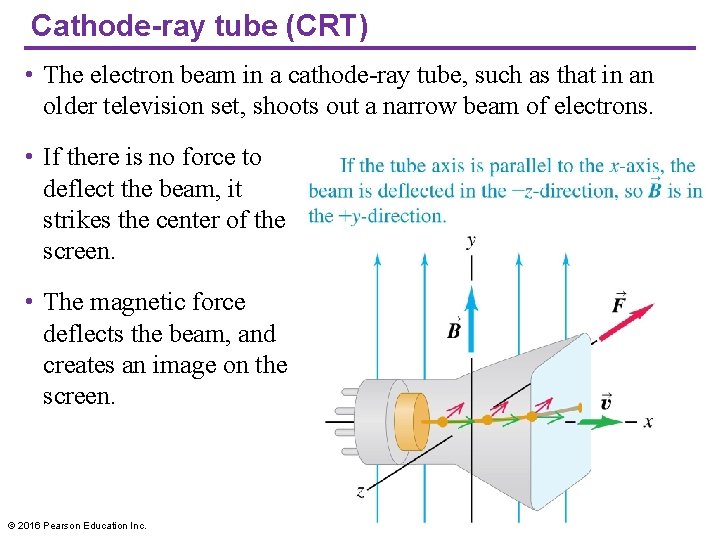
Cathode-ray tube (CRT) • The electron beam in a cathode-ray tube, such as that in an older television set, shoots out a narrow beam of electrons. • If there is no force to deflect the beam, it strikes the center of the screen. • The magnetic force deflects the beam, and creates an image on the screen. © 2016 Pearson Education Inc.
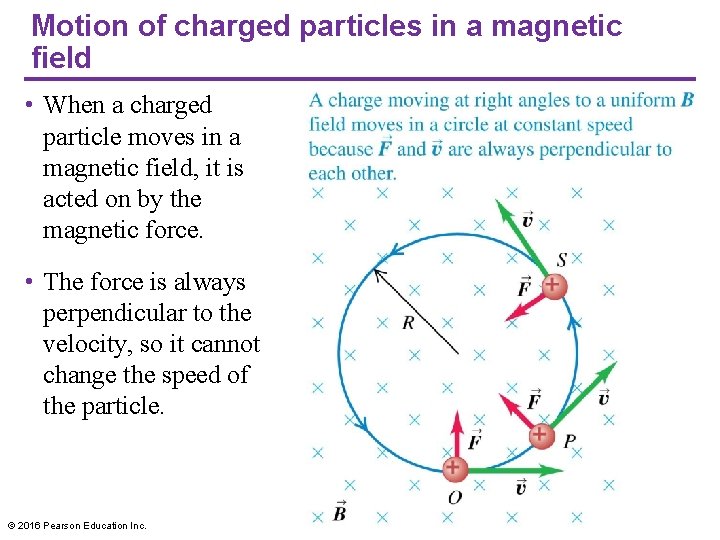
Motion of charged particles in a magnetic field • When a charged particle moves in a magnetic field, it is acted on by the magnetic force. • The force is always perpendicular to the velocity, so it cannot change the speed of the particle. © 2016 Pearson Education Inc.
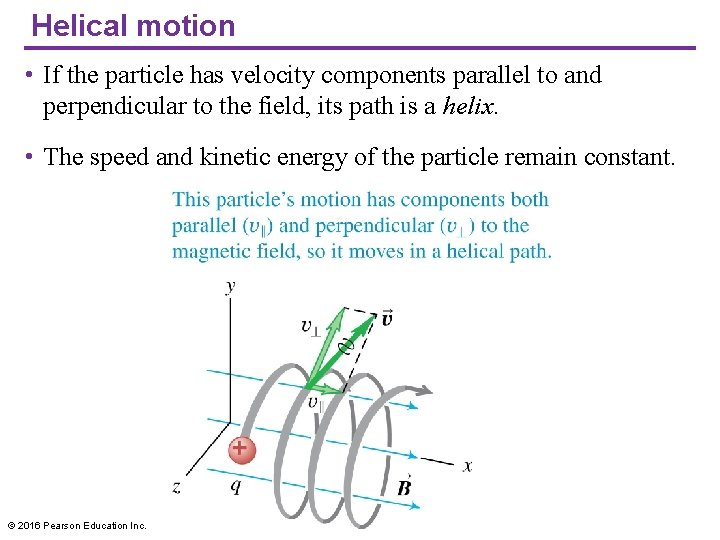
Helical motion • If the particle has velocity components parallel to and perpendicular to the field, its path is a helix. • The speed and kinetic energy of the particle remain constant. © 2016 Pearson Education Inc.
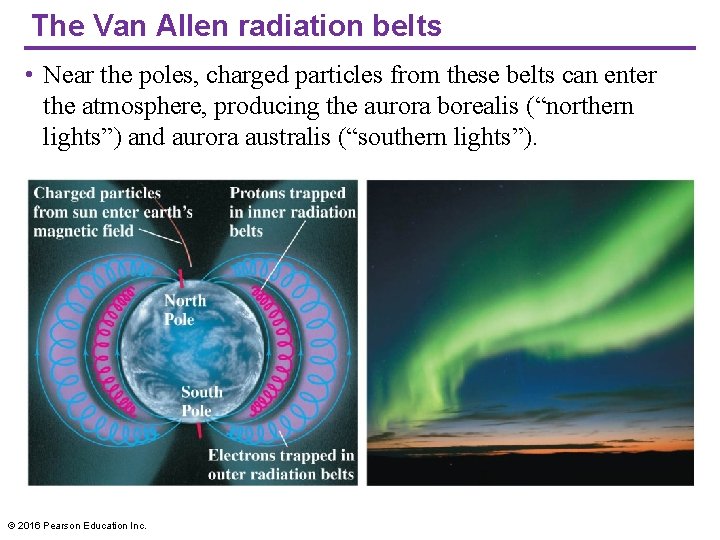
The Van Allen radiation belts • Near the poles, charged particles from these belts can enter the atmosphere, producing the aurora borealis (“northern lights”) and aurora australis (“southern lights”). © 2016 Pearson Education Inc.
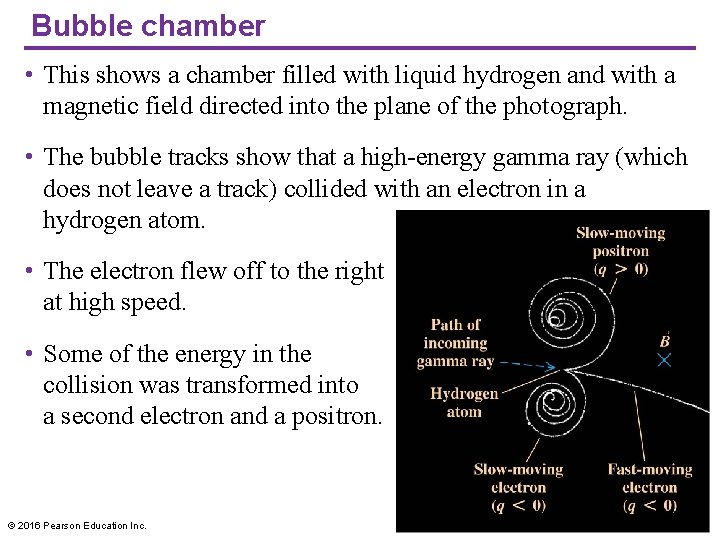
Bubble chamber • This shows a chamber filled with liquid hydrogen and with a magnetic field directed into the plane of the photograph. • The bubble tracks show that a high-energy gamma ray (which does not leave a track) collided with an electron in a hydrogen atom. • The electron flew off to the right at high speed. • Some of the energy in the collision was transformed into a second electron and a positron. © 2016 Pearson Education Inc.
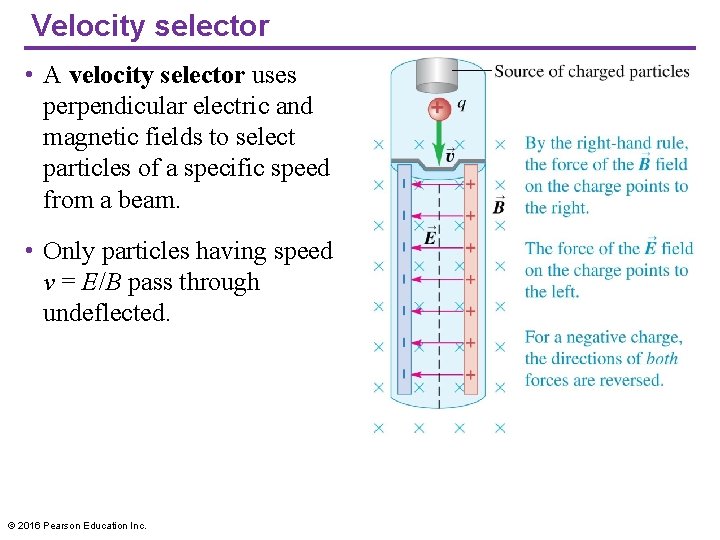
Velocity selector • A velocity selector uses perpendicular electric and magnetic fields to select particles of a specific speed from a beam. • Only particles having speed v = E/B pass through undeflected. © 2016 Pearson Education Inc.
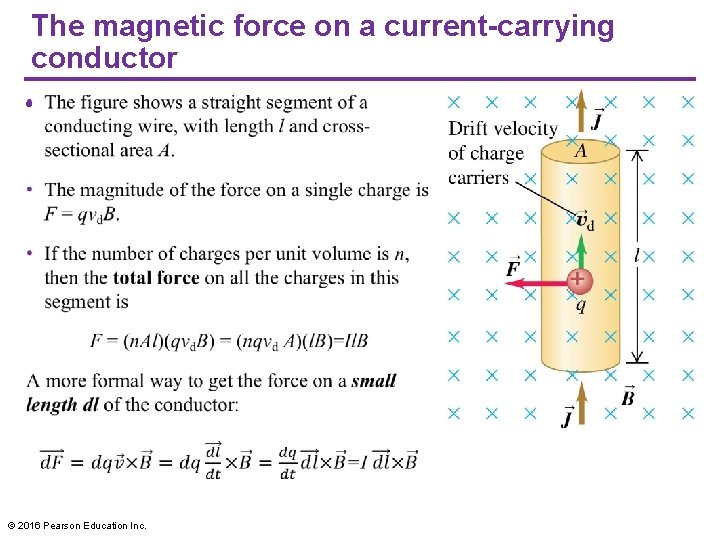
The magnetic force on a current-carrying conductor • © 2016 Pearson Education Inc.
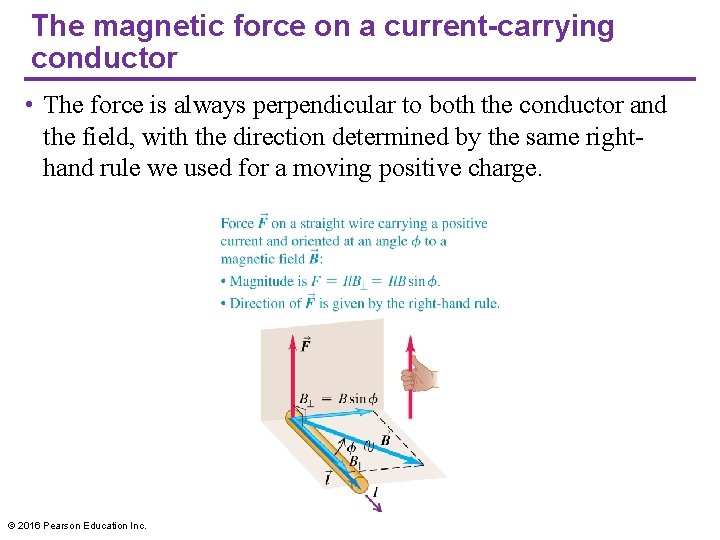
The magnetic force on a current-carrying conductor • The force is always perpendicular to both the conductor and the field, with the direction determined by the same righthand rule we used for a moving positive charge. © 2016 Pearson Education Inc.
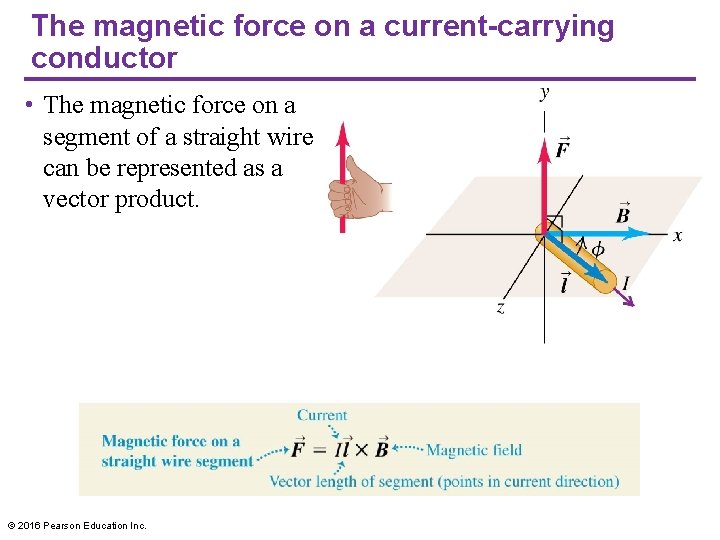
The magnetic force on a current-carrying conductor • The magnetic force on a segment of a straight wire can be represented as a vector product. © 2016 Pearson Education Inc.
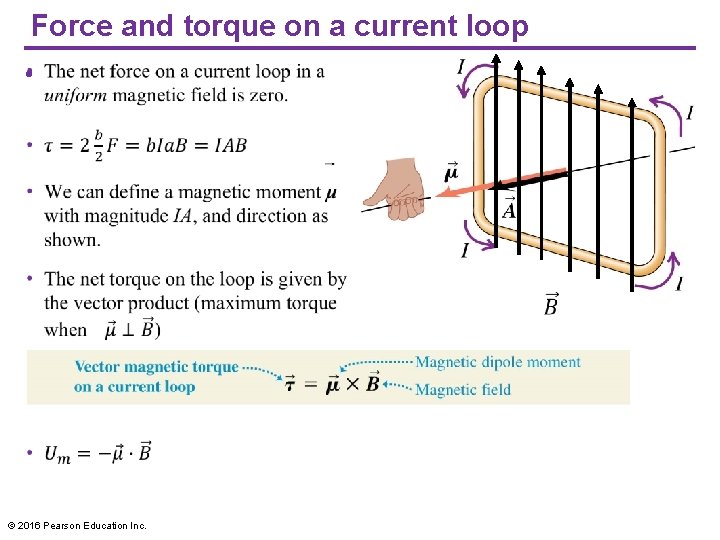
Force and torque on a current loop • © 2016 Pearson Education Inc.
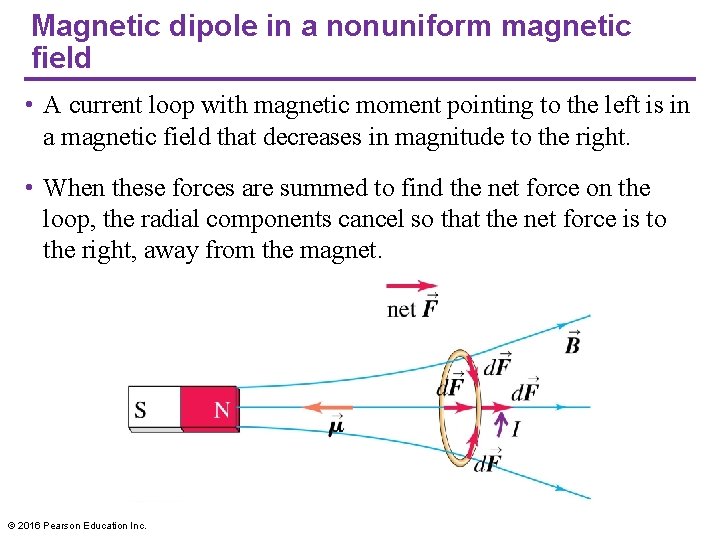
Magnetic dipole in a nonuniform magnetic field • A current loop with magnetic moment pointing to the left is in a magnetic field that decreases in magnitude to the right. • When these forces are summed to find the net force on the loop, the radial components cancel so that the net force is to the right, away from the magnet. © 2016 Pearson Education Inc.
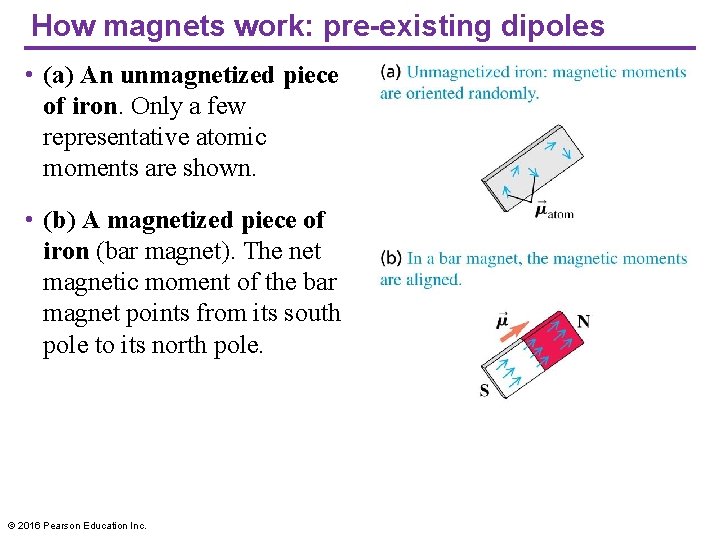
How magnets work: pre-existing dipoles • (a) An unmagnetized piece of iron. Only a few representative atomic moments are shown. • (b) A magnetized piece of iron (bar magnet). The net magnetic moment of the bar magnet points from its south pole to its north pole. © 2016 Pearson Education Inc.
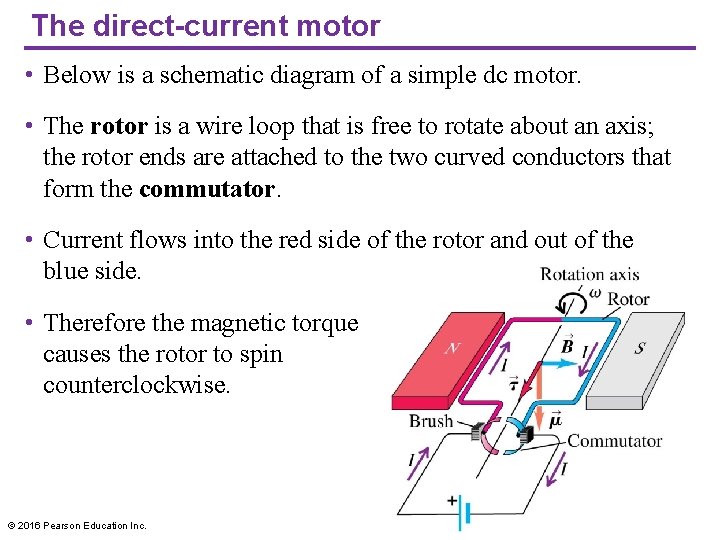
The direct-current motor • Below is a schematic diagram of a simple dc motor. • The rotor is a wire loop that is free to rotate about an axis; the rotor ends are attached to the two curved conductors that form the commutator. • Current flows into the red side of the rotor and out of the blue side. • Therefore the magnetic torque causes the rotor to spin counterclockwise. © 2016 Pearson Education Inc.
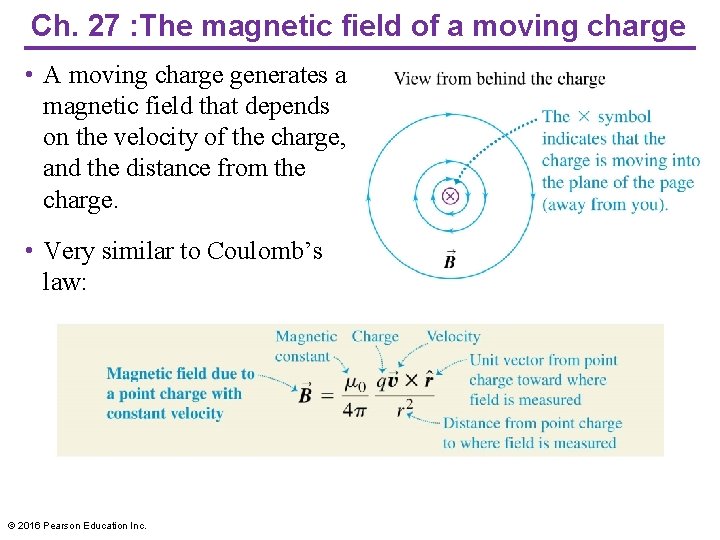
Ch. 27 : The magnetic field of a moving charge • A moving charge generates a magnetic field that depends on the velocity of the charge, and the distance from the charge. • Very similar to Coulomb’s law: © 2016 Pearson Education Inc.
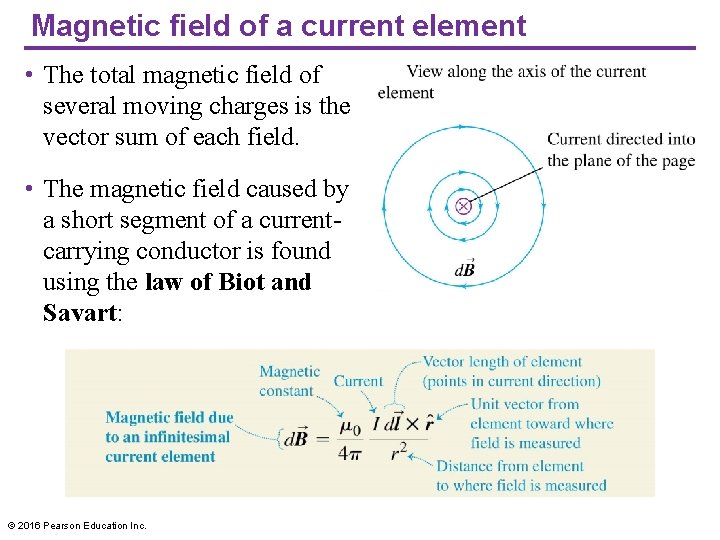
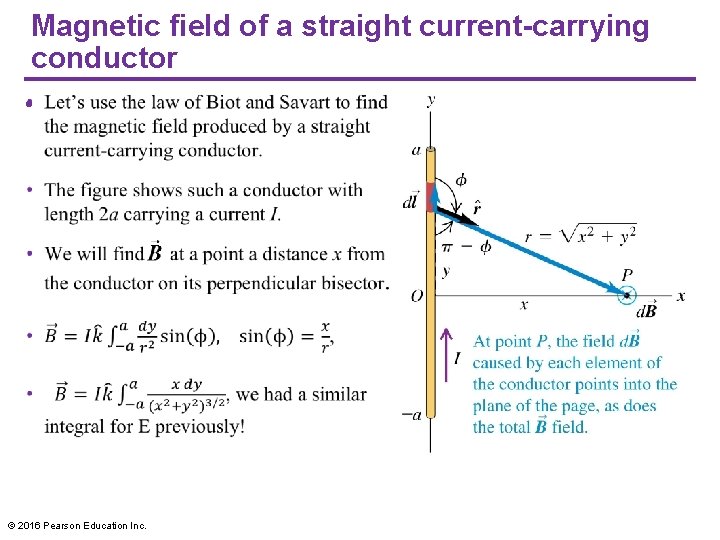
Magnetic field of a current element • The total magnetic field of several moving charges is the vector sum of each field. • The magnetic field caused by a short segment of a currentcarrying conductor is found using the law of Biot and Savart: © 2016 Pearson Education Inc.
Magnetic field of a straight current-carrying conductor • © 2016 Pearson Education Inc.
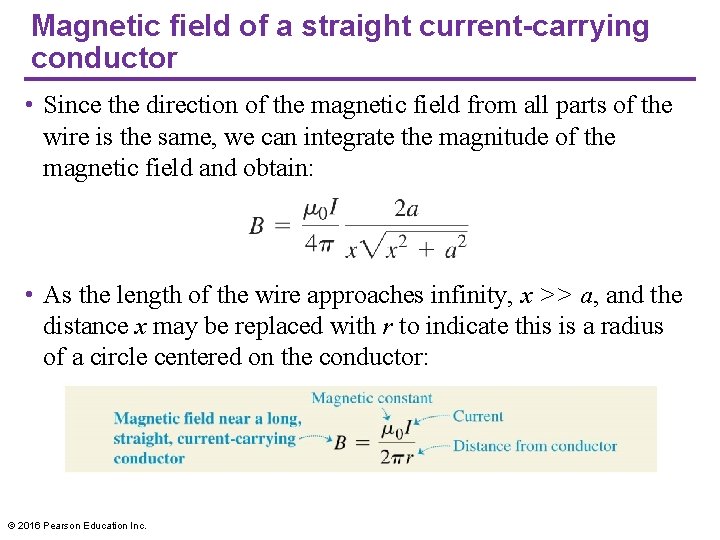
Magnetic field of a straight current-carrying conductor • Since the direction of the magnetic field from all parts of the wire is the same, we can integrate the magnitude of the magnetic field and obtain: • As the length of the wire approaches infinity, x >> a, and the distance x may be replaced with r to indicate this is a radius of a circle centered on the conductor: © 2016 Pearson Education Inc.
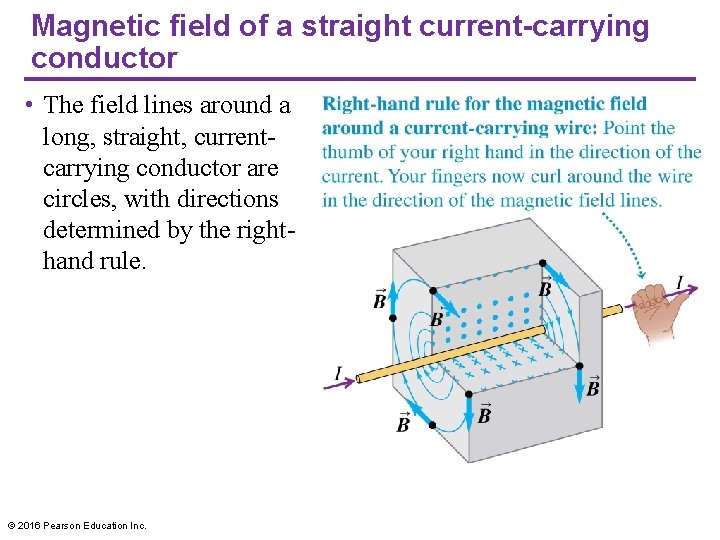
Magnetic field of a straight current-carrying conductor • The field lines around a long, straight, currentcarrying conductor are circles, with directions determined by the righthand rule. © 2016 Pearson Education Inc.
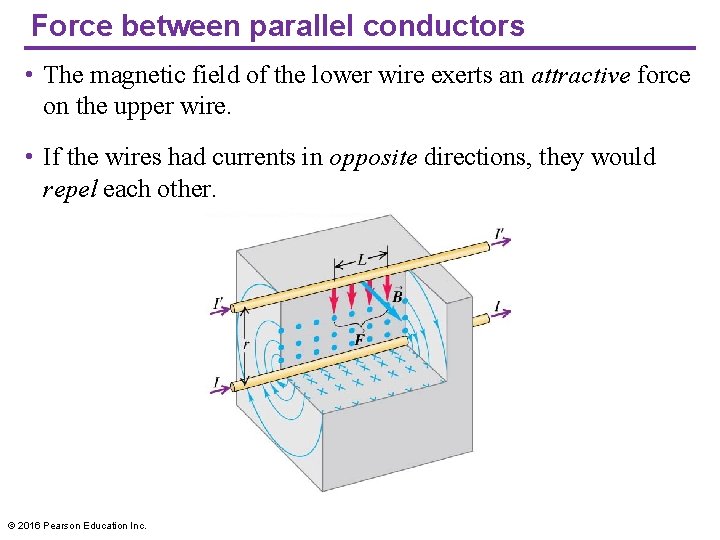
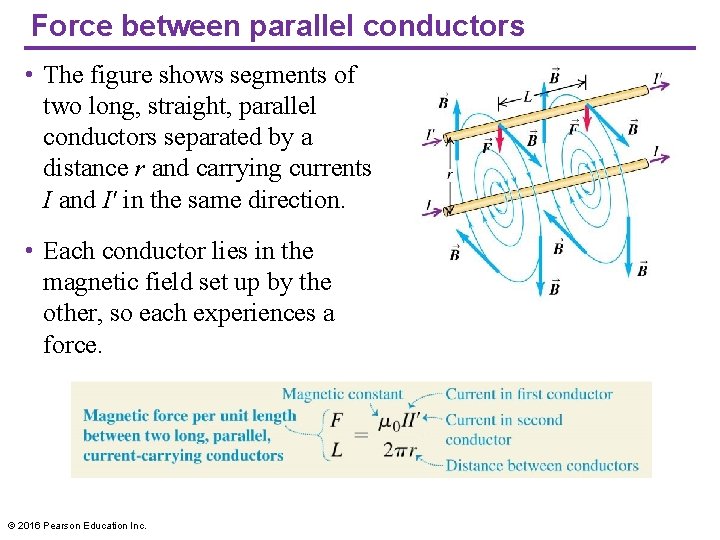
Force between parallel conductors • The magnetic field of the lower wire exerts an attractive force on the upper wire. • If the wires had currents in opposite directions, they would repel each other. © 2016 Pearson Education Inc.
Force between parallel conductors • The figure shows segments of two long, straight, parallel conductors separated by a distance r and carrying currents I and I' in the same direction. • Each conductor lies in the magnetic field set up by the other, so each experiences a force. © 2016 Pearson Education Inc.
The old definition of the ampere • The SI definition of the ampere is: One ampere is that unvarying current that, if present in each of two parallel conductors of infinite length and one meter apart in empty space, causes each conductor to experience a force of exactly 2 × 10− 7 newtons per meter of length. • This definition of the ampere is what leads us to choose the value of 4π × 10− 7 T ∙ m/A for the magnetic constant, μ 0. • The SI definition of the coulomb is the amount of charge transferred in one second by a current of one ampere. © 2016 Pearson Education Inc.