
Lecture 11 Kalman Filters CS 344 R Robotics

Lecture 11: Kalman Filters CS 344 R: Robotics Benjamin Kuipers
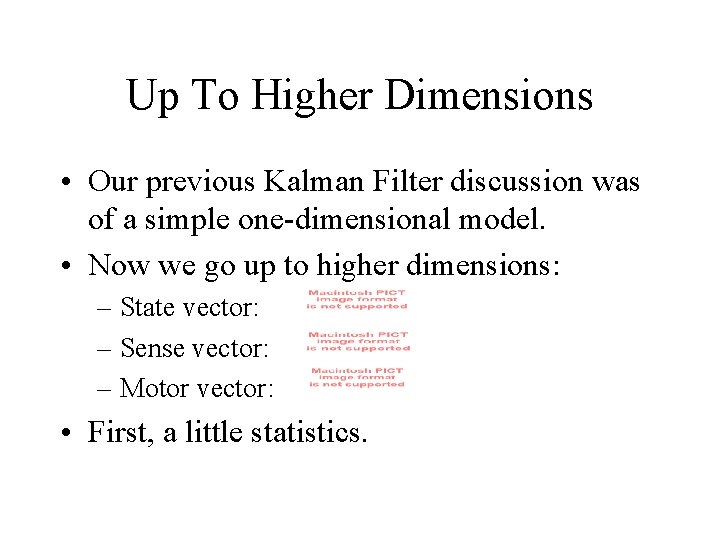
Up To Higher Dimensions • Our previous Kalman Filter discussion was of a simple one-dimensional model. • Now we go up to higher dimensions: – State vector: – Sense vector: – Motor vector: • First, a little statistics.
![Expectations • Let x be a random variable. • The expected value E[x] is](http://slidetodoc.com/presentation_image/33d801cec09361ffb1a3c61e6a5e545b/image-3.jpg "Expectations • Let x be a random variable. • The expected value E[x] is")
Expectations • Let x be a random variable. • The expected value E[x] is the mean: – The probability-weighted mean of all possible values. The sample mean approaches it. • Expected value of a vector x is by component.
![Variance and Covariance • The variance is E[ (x-E[x])2 ] • Covariance matrix is](http://slidetodoc.com/presentation_image/33d801cec09361ffb1a3c61e6a5e545b/image-4.jpg "Variance and Covariance • The variance is E[ (x-E[x])2 ] • Covariance matrix is")
Variance and Covariance • The variance is E[ (x-E[x])2 ] • Covariance matrix is E[ (x-E[x])T ] – Divide by N 1 to make the sample variance an unbiased estimator for the population variance.
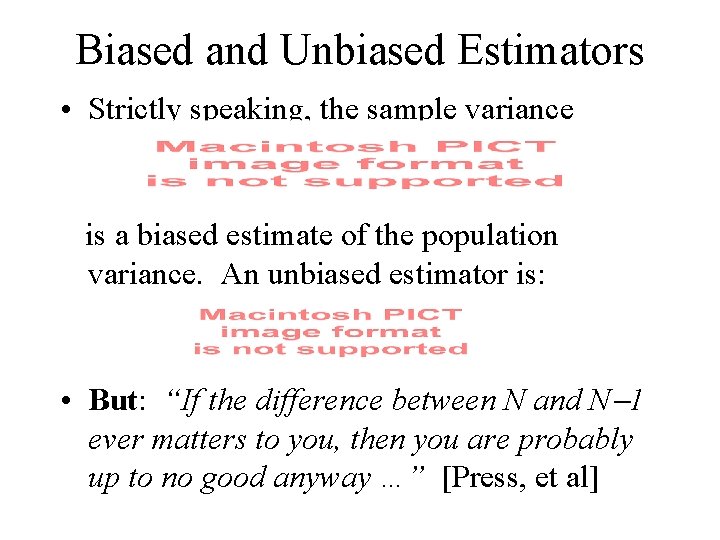
Biased and Unbiased Estimators • Strictly speaking, the sample variance is a biased estimate of the population variance. An unbiased estimator is: • But: “If the difference between N and N 1 ever matters to you, then you are probably up to no good anyway …” [Press, et al]
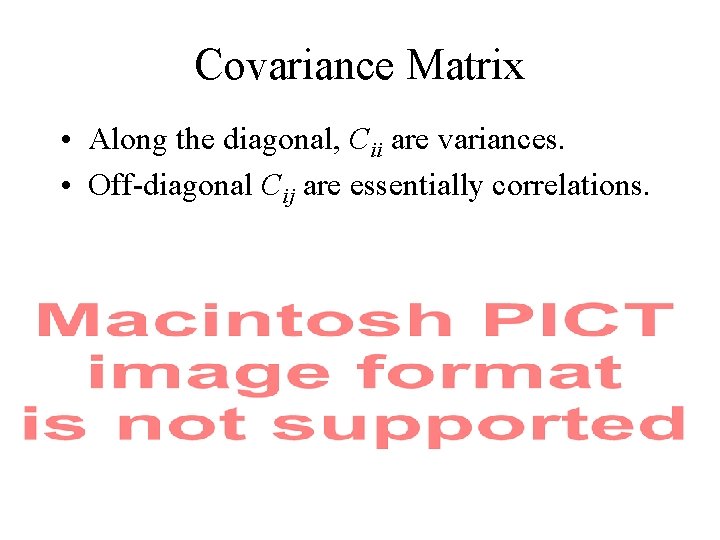
Covariance Matrix • Along the diagonal, Cii are variances. • Off-diagonal Cij are essentially correlations.
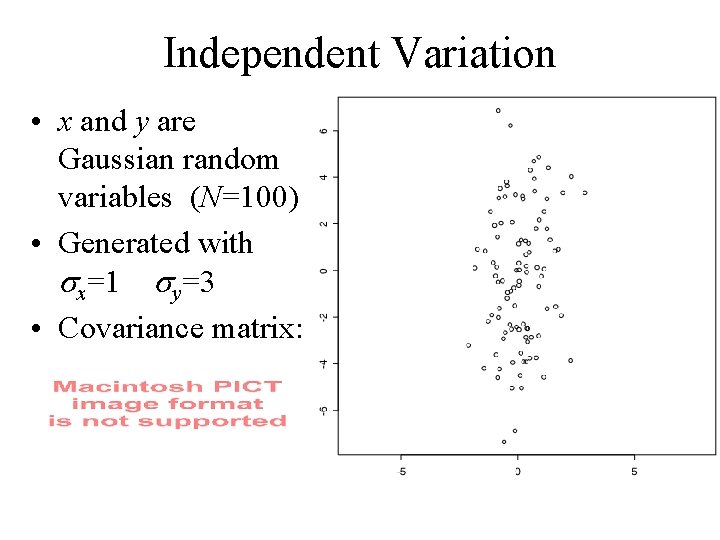
Independent Variation • x and y are Gaussian random variables (N=100) • Generated with x=1 y=3 • Covariance matrix:
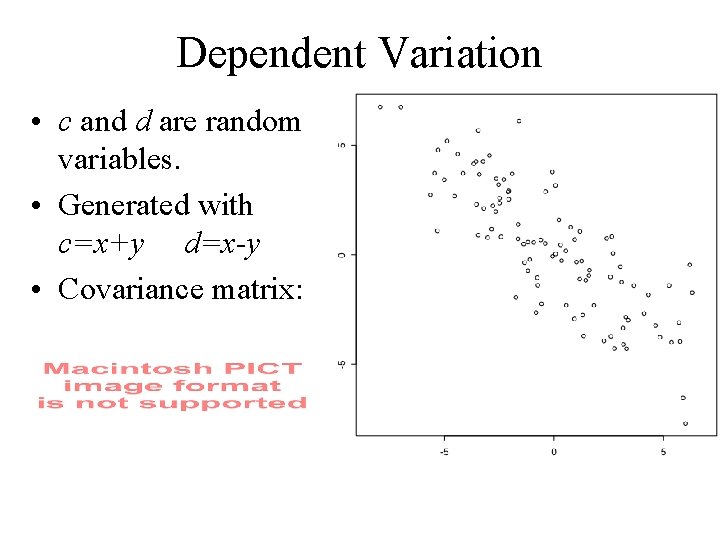
Dependent Variation • c and d are random variables. • Generated with c=x+y d=x-y • Covariance matrix:

Discrete Kalman Filter • Estimate the state difference equation of a linear stochastic – process noise w is drawn from N(0, Q), with covariance matrix Q. • with a measurement – measurement noise v is drawn from N(0, R), with covariance matrix R. • A, Q are nxn. B is nxl. R is mxm. H is mxn.
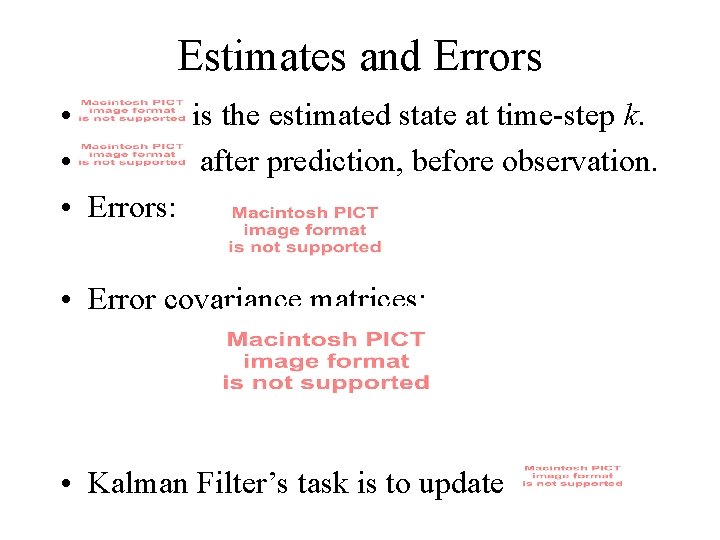
Estimates and Errors • is the estimated state at time-step k. • after prediction, before observation. • Errors: • Error covariance matrices: • Kalman Filter’s task is to update
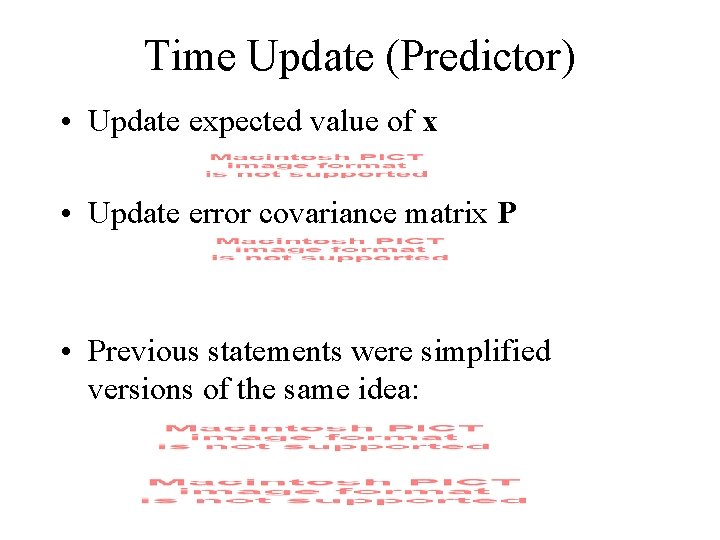
Time Update (Predictor) • Update expected value of x • Update error covariance matrix P • Previous statements were simplified versions of the same idea:
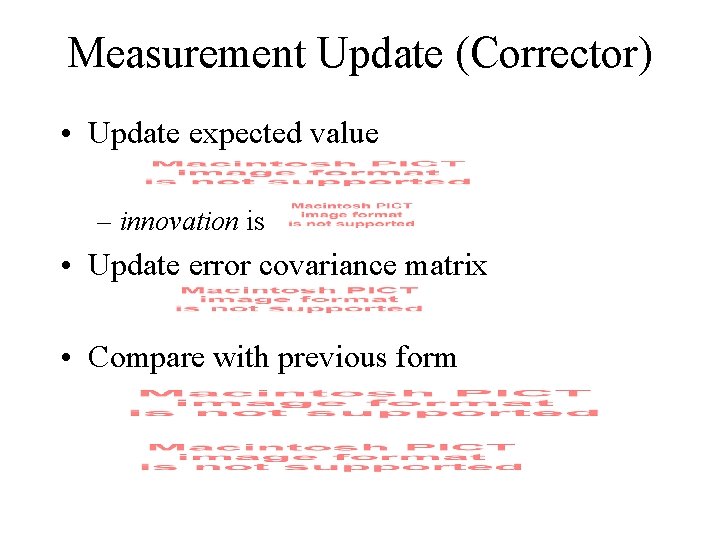
Measurement Update (Corrector) • Update expected value – innovation is • Update error covariance matrix • Compare with previous form
The Kalman Gain • The optimal Kalman gain Kk is • Compare with previous form

Extended Kalman Filter • Suppose the state-evolution and measurement equations are non-linear: – process noise w is drawn from N(0, Q), with covariance matrix Q. – measurement noise v is drawn from N(0, R), with covariance matrix R.

The Jacobian Matrix • For a scalar function y=f(x), • For a vector function y=f(x),
Linearize the Non-Linear • Let A be the Jacobian of f with respect to x. • Let H be the Jacobian of h with respect to x. • Then the Kalman Filter equations are almost the same as before!
EKF Update Equations • Predictor step: • Kalman gain: • Corrector step:
“Catch The Ball” Assignment • State evolution is linear (almost). – What is A? – B=0. • Sensor equation is non-linear. – What is y=h(x)? – What is the Jacobian H(x) of h with respect to x? • Errors are treated as additive. Is this OK? – What are the covariance matrices Q and R?
TTD • Intuitive explanations for APAT and HPHT in the update equations.
- Slides: 19