
Lecture 11 Evapotranspiration 4 ET Measurements Lysimeters Evaporation
- Slides: 11
Lecture 11 Evapotranspiration (4) ET Measurements • Lysimeters • Evaporation Pans • Pan size effects
Lysimeter • Allow determination of water balance of a block of soil • Maintain wet soil to measure PET • Allow soil moisture to fluctuate to measure AET http: //lawr. ucdavis. edu/classes/ hyd 143/hyd 143 week 2. html
Weighing Lysimeters • Use a balance to assess changes in storage • Small lysimeters can be removed and weighed • Measure both PET and AET http: //www. kfa-juelich. de/icg 5/irapic/einlasse. jpg
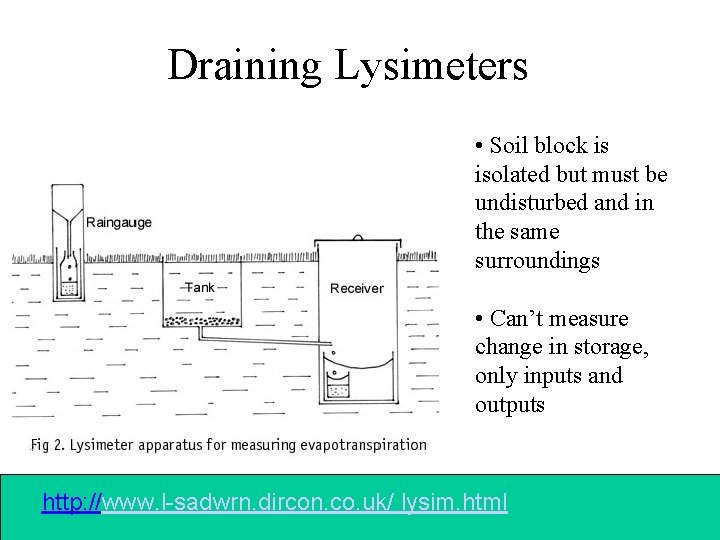
Draining Lysimeters • Soil block is isolated but must be undisturbed and in the same surroundings • Can’t measure change in storage, only inputs and outputs http: //www. l-sadwrn. dircon. co. uk/ lysim. html
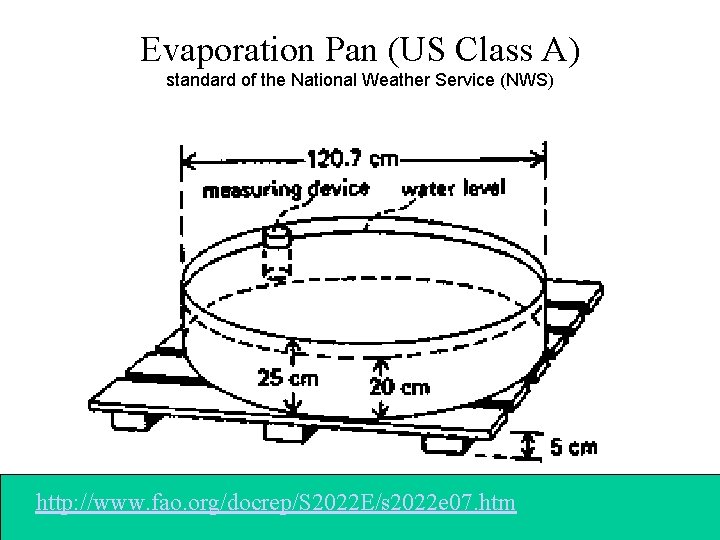
Evaporation Pan (US Class A) standard of the National Weather Service (NWS) http: //www. fao. org/docrep/S 2022 E/s 2022 e 07. htm
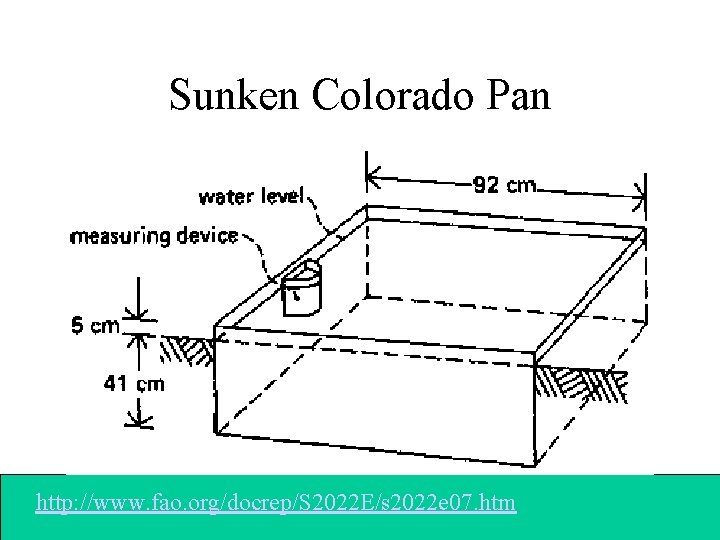
Sunken Colorado Pan http: //www. fao. org/docrep/S 2022 E/s 2022 e 07. htm
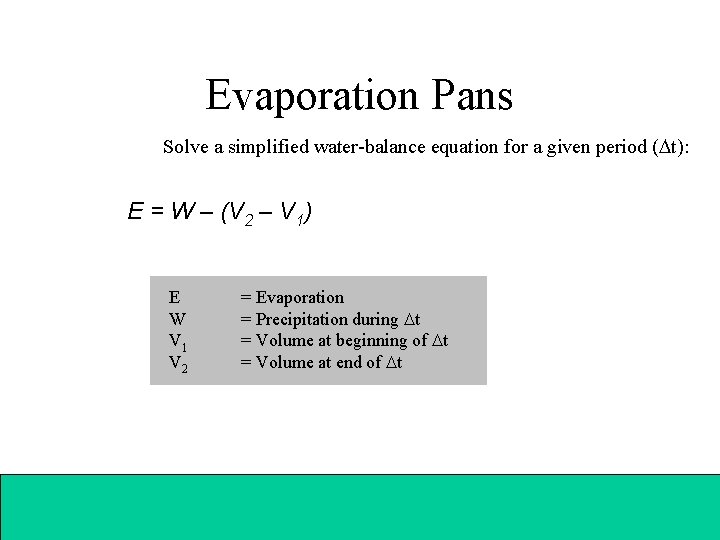
Evaporation Pans Solve a simplified water-balance equation for a given period ( t): E = W – (V 2 – V 1) E W V 1 V 2 = Evaporation = Precipitation during t = Volume at beginning of t = Volume at end of t
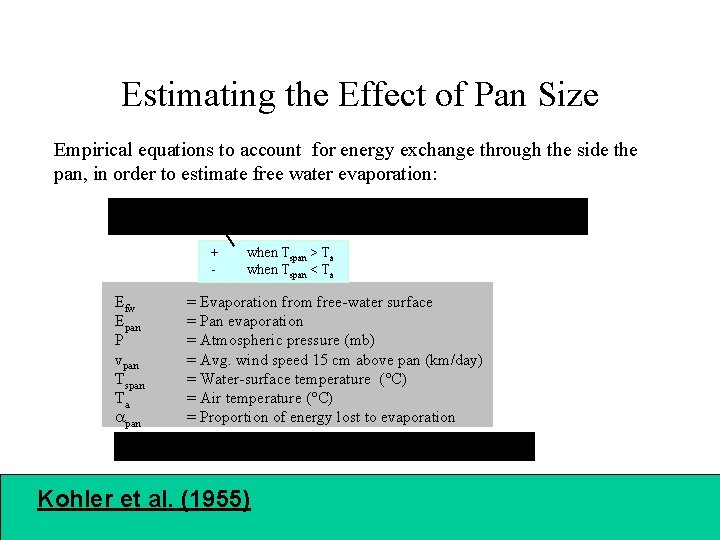
Estimating the Effect of Pan Size Empirical equations to account for energy exchange through the side the pan, in order to estimate free water evaporation: Efw Epan P vpan Tspan Ta pan + - when Tspan > Ta when Tspan < Ta = Evaporation from free-water surface = Pan evaporation = Atmospheric pressure (mb) = Avg. wind speed 15 cm above pan (km/day) = Water-surface temperature ( C) = Air temperature ( C) = Proportion of energy lost to evaporation Kohler et al. (1955)
Evaporation Pans • Free-water evaporation • Expose a cylindrical (or rectangular) pan of water to the atmosphere • Provide estimates of potential evapotranspiration (PET) – can be more accurate than formulae • Must be related to vegetation canopies using other methods (coefficients etc. ) • Precipitation is measured in an adjacent rain gauge • Pan volume is measured by recording water height (which is maintained by adding or removing measured amounts of water) • Pans can be placed on land in clearings or on floating platforms on open water and usually surrounded by fences
Plot Studies • Water balance approach applied to small undisturbed plots of land • Analogous to small lake for simple evaporation • Must select suitable sites where inputs/outputs can be measured • Spatial uncertainty increases with size of plot • Artificial rain (sprinklers) can be used to assess PET • Soil moisture assessed by spot sampling and measurement by: Gravimetric methods Soil block moisture Neutron probe Time domain reflectometry
Catchment Studies • Water balance of entire drainage basin • Even greater spatial uncertainties Variable precipitation, soil water capacity Ground water seepage • Better for long term estimates On a yearly basis, change in storage is approx. zero