
Lecture 11 Diode Limiters Diode limiters clippers are
- Slides: 8
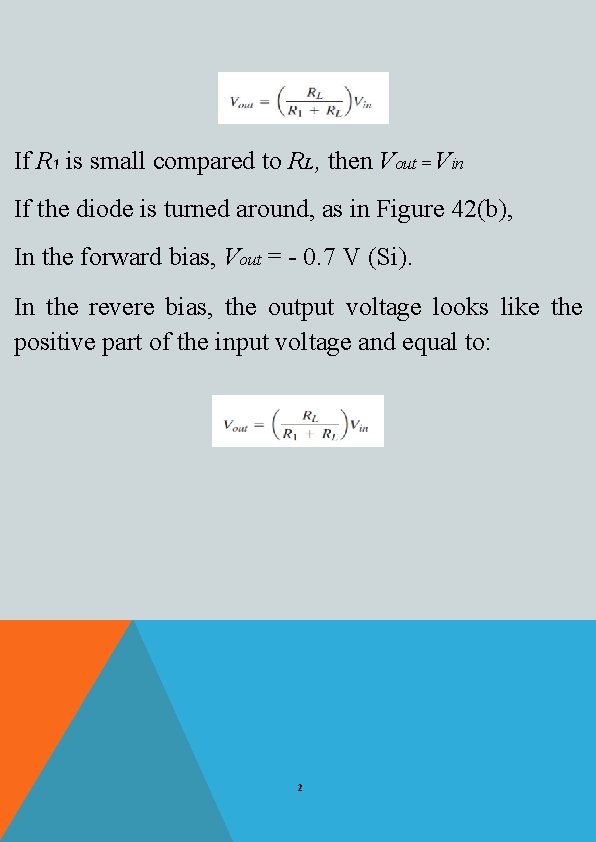
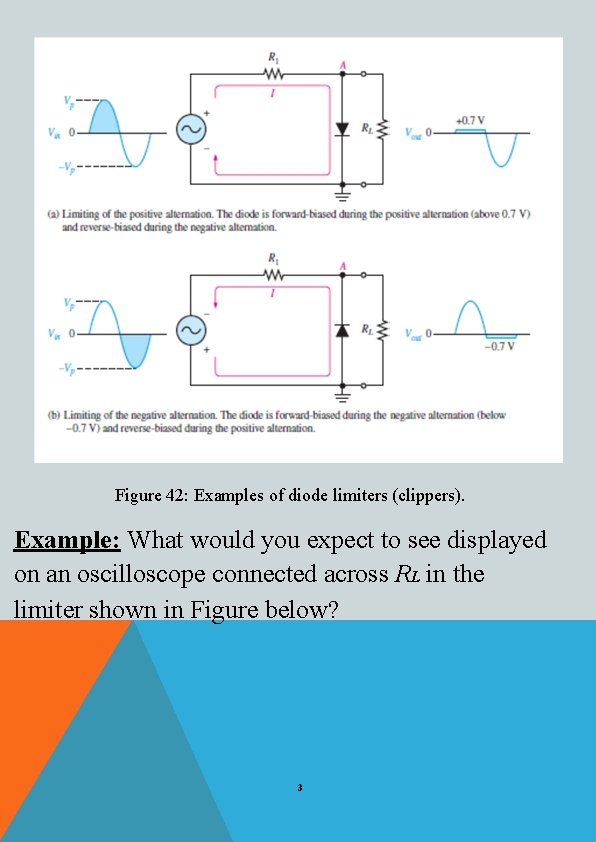
Lecture 11: Diode Limiters Diode limiters (clippers) are widely used in television receiver and FM (frequency modulation) transmitters, where the noise peaks can be removed by using clipping or limiting method. Diode Limiters (Clippers) Figure 42(a) shows a diode positive limiter (also called clipper) that limits or clips the positive part of the input voltage. As the input voltage goes positive, the diode becomes forward-biased and conducts current. Point A is limited to +0. 7 V, Vout = 0. 7 V (Si). When the input voltage goes back below 0. 7 V, the diode is reverse-biased and appears as an open. The output voltage looks like the negative part of the input voltage, but with a magnitude determined by the voltage divider formed by R 1 and the load resistor, RL, as follows: 1
If R 1 is small compared to RL, then Vout = Vin If the diode is turned around, as in Figure 42(b), In the forward bias, Vout = - 0. 7 V (Si). In the revere bias, the output voltage looks like the positive part of the input voltage and equal to: 2
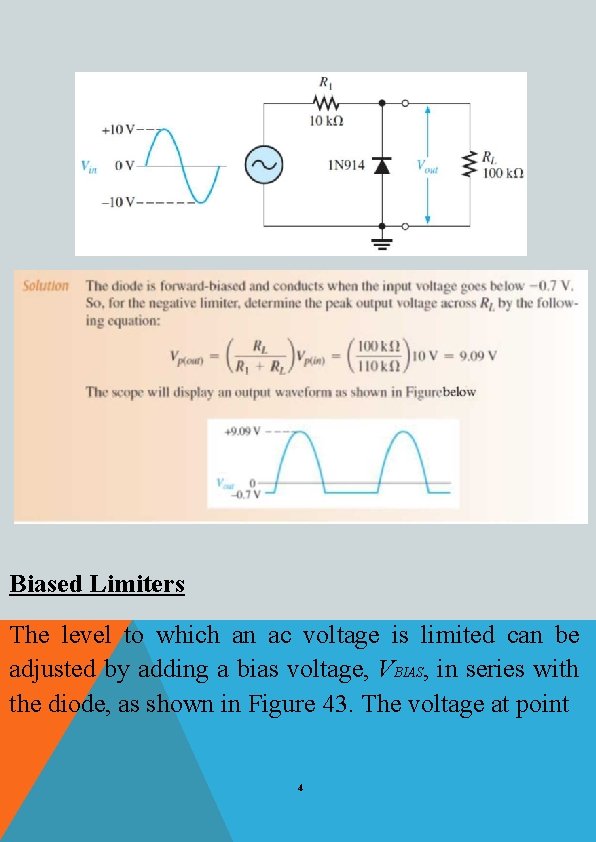
Figure 42: Examples of diode limiters (clippers). Example: What would you expect to see displayed on an oscilloscope connected across RL in the limiter shown in Figure below? 3
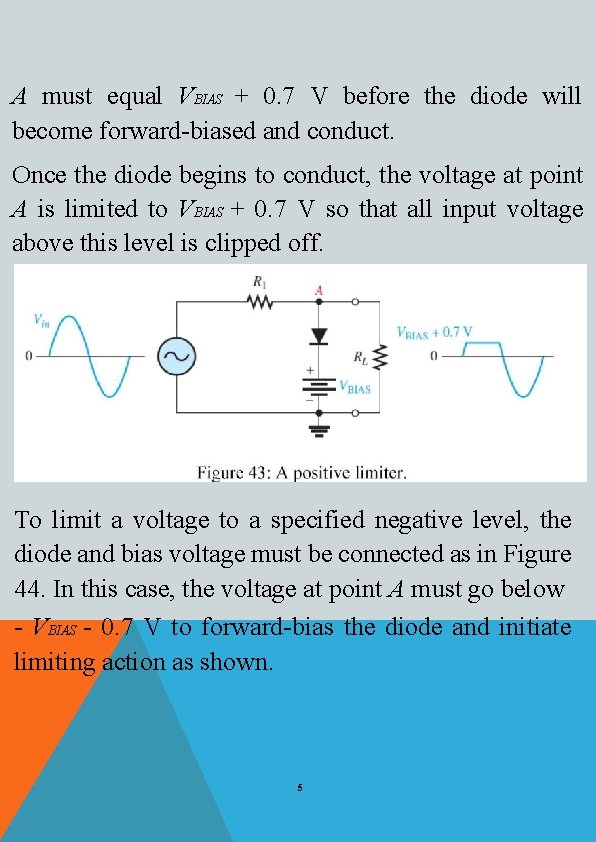
Biased Limiters The level to which an ac voltage is limited can be adjusted by adding a bias voltage, VBIAS, in series with the diode, as shown in Figure 43. The voltage at point 4
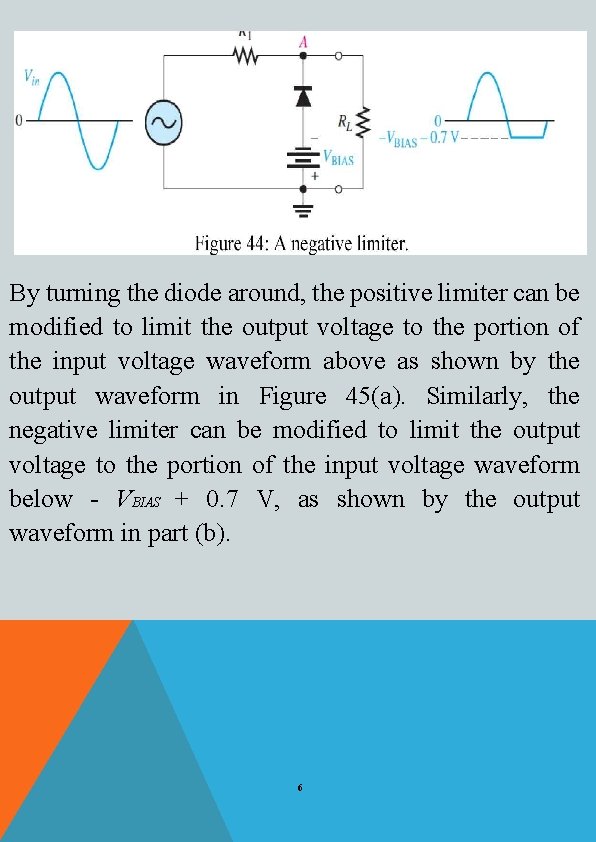
A must equal VBIAS + 0. 7 V before the diode will become forward-biased and conduct. Once the diode begins to conduct, the voltage at point A is limited to VBIAS + 0. 7 V so that all input voltage above this level is clipped off. To limit a voltage to a specified negative level, the diode and bias voltage must be connected as in Figure 44. In this case, the voltage at point A must go below - VBIAS - 0. 7 V to forward-bias the diode and initiate limiting action as shown. 5
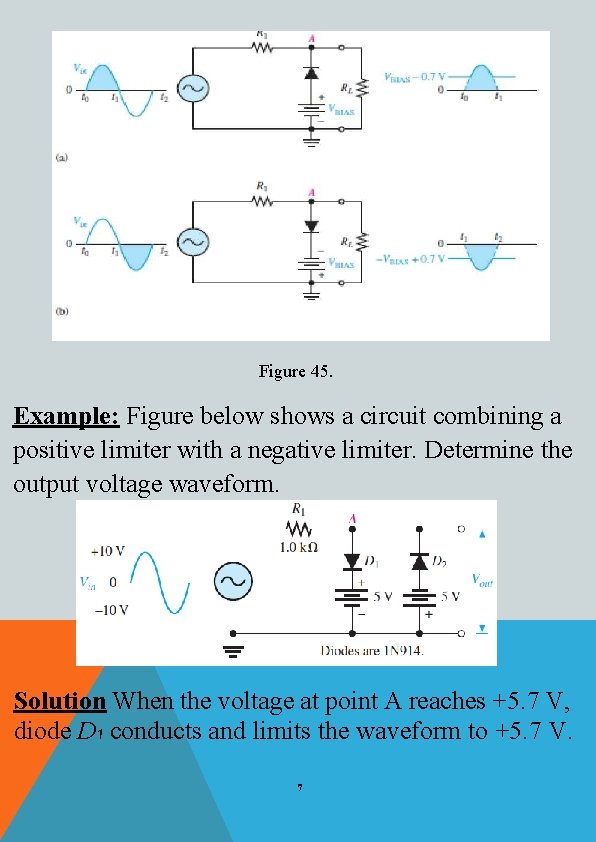
By turning the diode around, the positive limiter can be modified to limit the output voltage to the portion of the input voltage waveform above as shown by the output waveform in Figure 45(a). Similarly, the negative limiter can be modified to limit the output voltage to the portion of the input voltage waveform below - VBIAS + 0. 7 V, as shown by the output waveform in part (b). 6
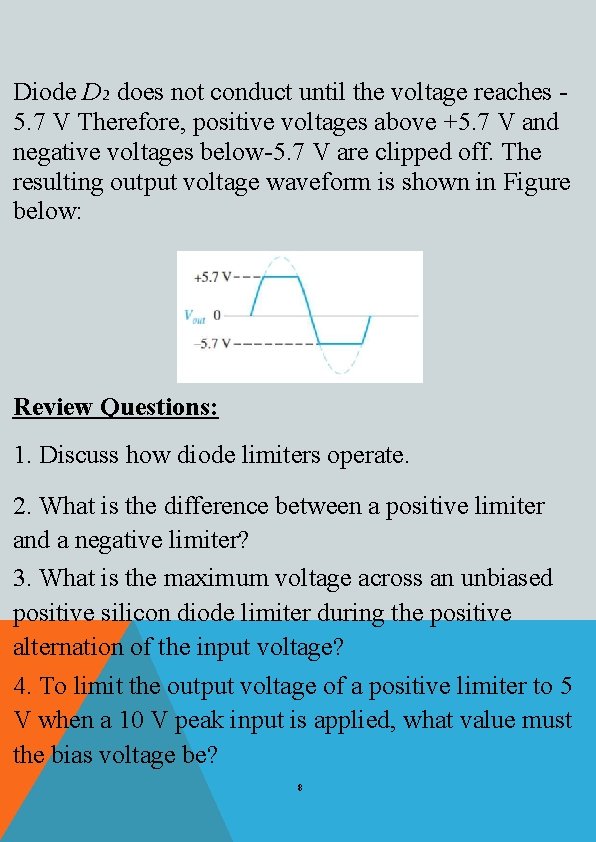
Figure 45. Example: Figure below shows a circuit combining a positive limiter with a negative limiter. Determine the output voltage waveform. Solution When the voltage at point A reaches +5. 7 V, diode D 1 conducts and limits the waveform to +5. 7 V. 7
Diode D 2 does not conduct until the voltage reaches 5. 7 V Therefore, positive voltages above +5. 7 V and negative voltages below-5. 7 V are clipped off. The resulting output voltage waveform is shown in Figure below: Review Questions: 1. Discuss how diode limiters operate. 2. What is the difference between a positive limiter and a negative limiter? 3. What is the maximum voltage across an unbiased positive silicon diode limiter during the positive alternation of the input voltage? 4. To limit the output voltage of a positive limiter to 5 V when a 10 V peak input is applied, what value must the bias voltage be? 8