
Lecture 11 Database Manipulation and Collecting Solutions Exercises

Lecture 11: Database Manipulation and Collecting Solutions • Exercises © Patrick Blackburn, Johan Bos & Kristina Striegnitz – Solutions to exercises LPN chapter 10 • Theory – Discuss database manipulation in Prolog – Discuss built-in predicates that collect all solutions to a problem into a single list
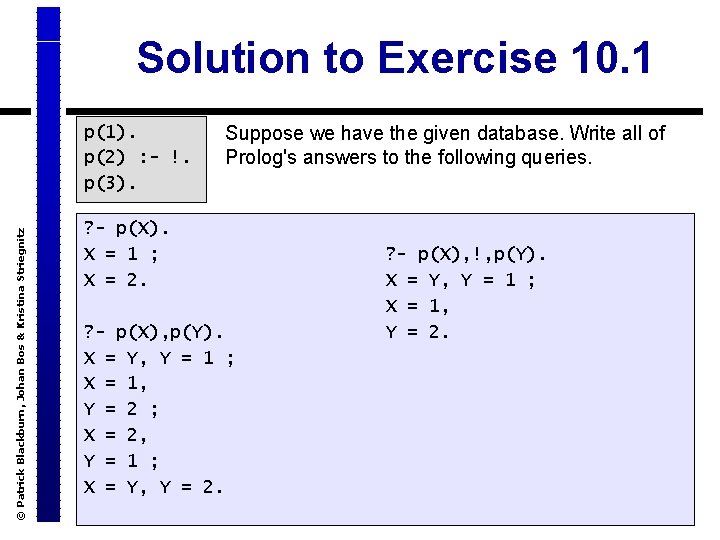
Solution to Exercise 10. 1 © Patrick Blackburn, Johan Bos & Kristina Striegnitz p(1). p(2) : - !. p(3). Suppose we have the given database. Write all of Prolog's answers to the following queries. ? - p(X). X = 1 ; X = 2. ? - p(X), p(Y). X = Y, Y = 1 ; X = 1, Y = 2 ; X = 2, Y = 1 ; X = Y, Y = 2. ? - p(X), !, p(Y). X = Y, Y = 1 ; X = 1, Y = 2.
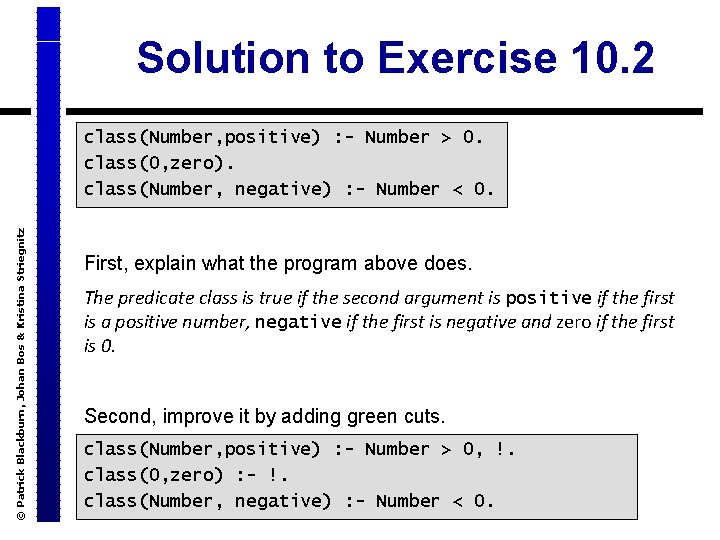
Solution to Exercise 10. 2 © Patrick Blackburn, Johan Bos & Kristina Striegnitz class(Number, positive) : - Number > 0. class(0, zero). class(Number, negative) : - Number < 0. First, explain what the program above does. The predicate class is true if the second argument is positive if the first is a positive number, negative if the first is negative and zero if the first is 0. Second, improve it by adding green cuts. class(Number, positive) : - Number > 0, !. class(0, zero) : - !. class(Number, negative) : - Number < 0.
Lecture 11: Database Manipulation and Collecting Solutions © Patrick Blackburn, Johan Bos & Kristina Striegnitz • Theory – Discuss database manipulation in Prolog – Discuss built-in predicates that collect all solutions to a problem into a single list
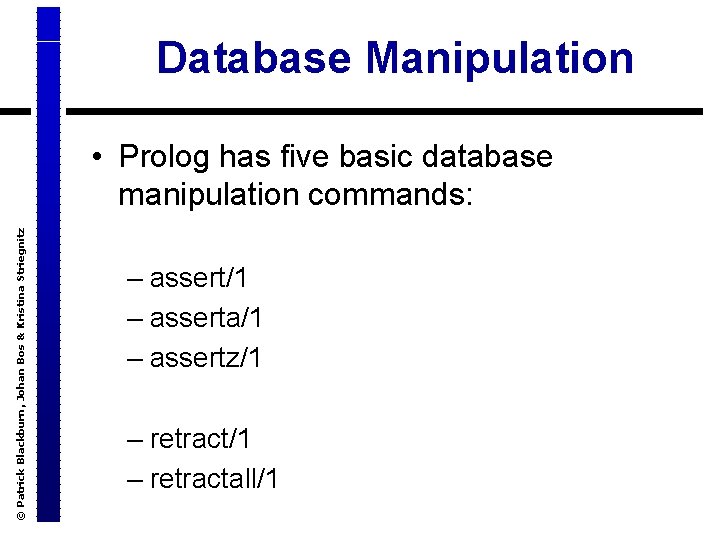
Database Manipulation © Patrick Blackburn, Johan Bos & Kristina Striegnitz • Prolog has five basic database manipulation commands: – assert/1 – asserta/1 – assertz/1 – retractall/1
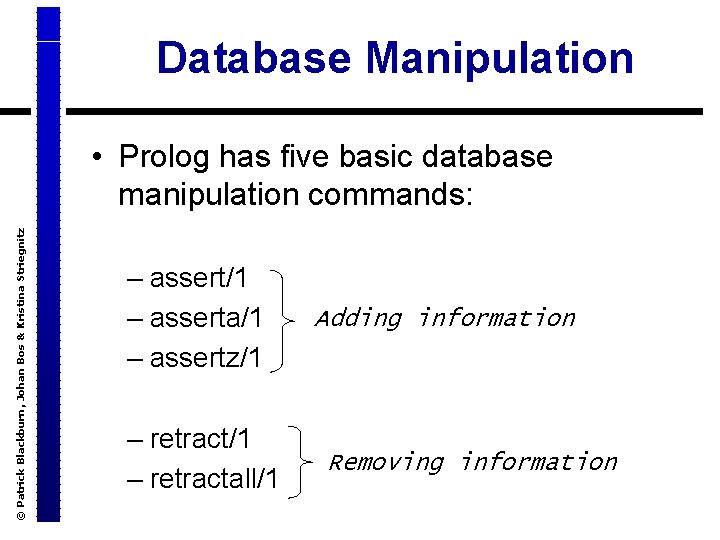
Database Manipulation © Patrick Blackburn, Johan Bos & Kristina Striegnitz • Prolog has five basic database manipulation commands: – assert/1 – asserta/1 – assertz/1 – retractall/1 Adding information Removing information
© Patrick Blackburn, Johan Bos & Kristina Striegnitz Start with an empty database
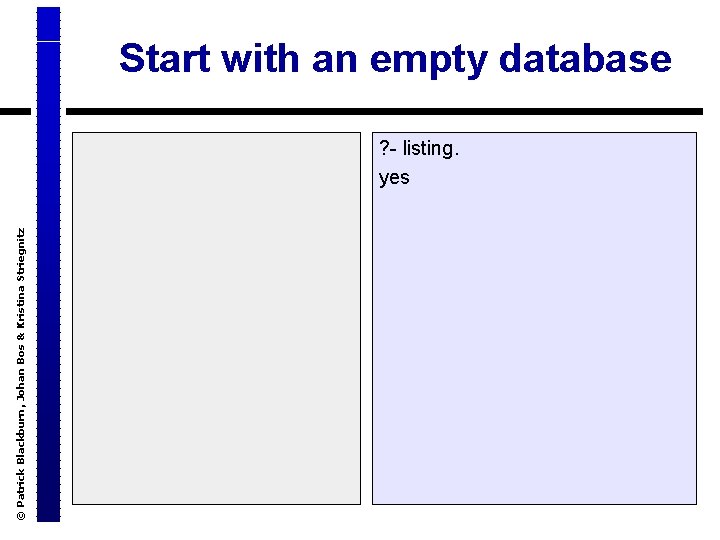
© Patrick Blackburn, Johan Bos & Kristina Striegnitz Start with an empty database ? - listing. yes
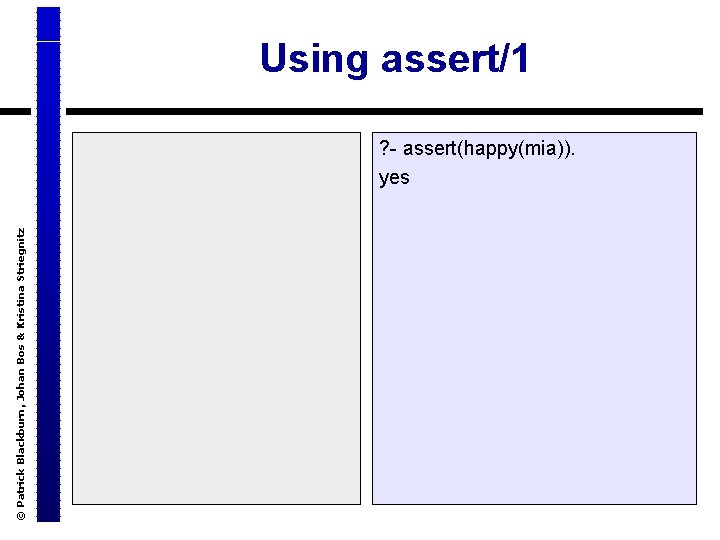
© Patrick Blackburn, Johan Bos & Kristina Striegnitz Using assert/1 ? - assert(happy(mia)). yes
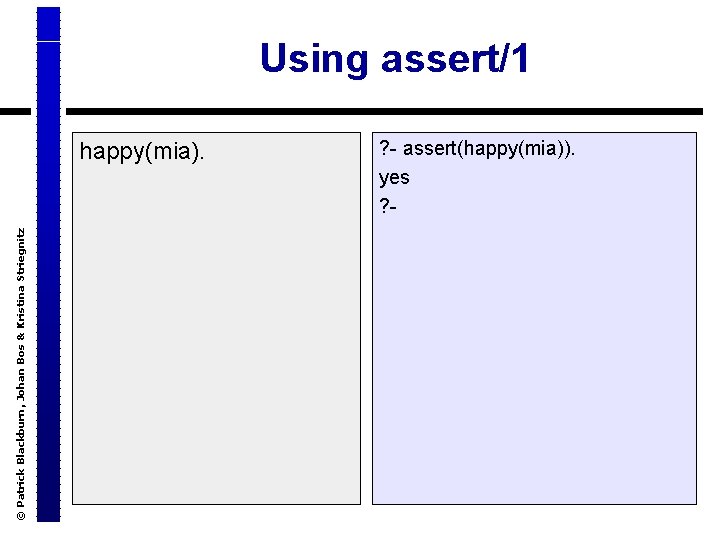
Using assert/1 © Patrick Blackburn, Johan Bos & Kristina Striegnitz happy(mia). ? - assert(happy(mia)). yes ? -
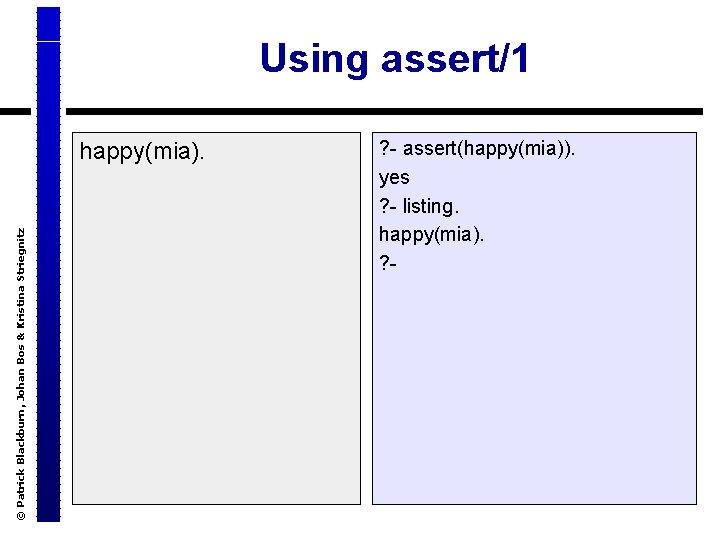
Using assert/1 © Patrick Blackburn, Johan Bos & Kristina Striegnitz happy(mia). ? - assert(happy(mia)). yes ? - listing. happy(mia). ? -
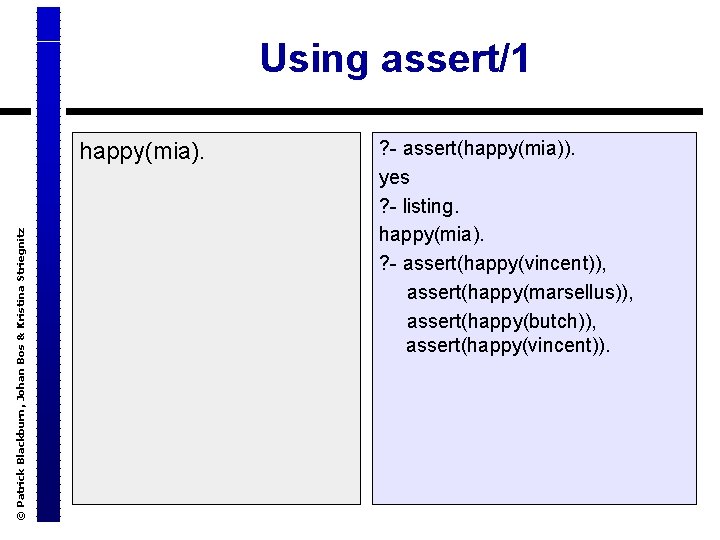
Using assert/1 © Patrick Blackburn, Johan Bos & Kristina Striegnitz happy(mia). ? - assert(happy(mia)). yes ? - listing. happy(mia). ? - assert(happy(vincent)), assert(happy(marsellus)), assert(happy(butch)), assert(happy(vincent)).
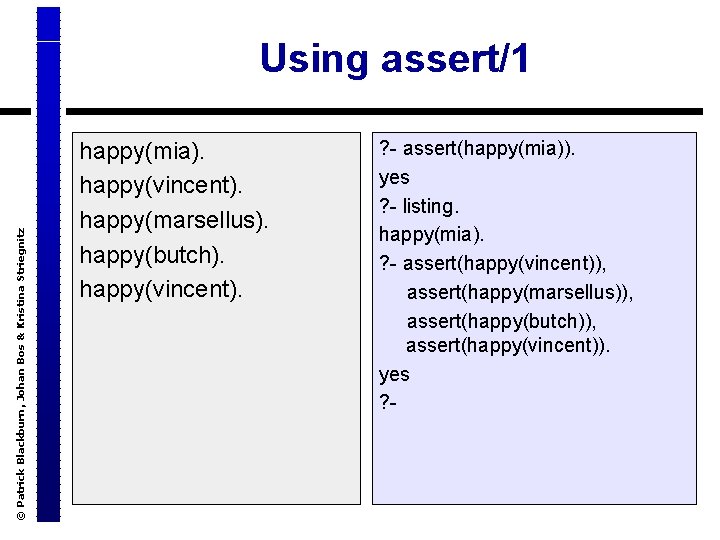
© Patrick Blackburn, Johan Bos & Kristina Striegnitz Using assert/1 happy(mia). happy(vincent). happy(marsellus). happy(butch). happy(vincent). ? - assert(happy(mia)). yes ? - listing. happy(mia). ? - assert(happy(vincent)), assert(happy(marsellus)), assert(happy(butch)), assert(happy(vincent)). yes ? -
© Patrick Blackburn, Johan Bos & Kristina Striegnitz Changing meaning of predicates • The database manipulations have changed the meaning of the predicate happy/1 • More generally: – database manipulation commands give us the ability to change the meaning of predicates during runtime
© Patrick Blackburn, Johan Bos & Kristina Striegnitz Dynamic and Static Predicates • Predicates whose meaning changing during runtime are called dynamic predicates – happy/1 is a dynamic predicate – Some Prolog interpreters require a declaration of dynamic predicates • Ordinary predicates are sometimes referred to as static predicates
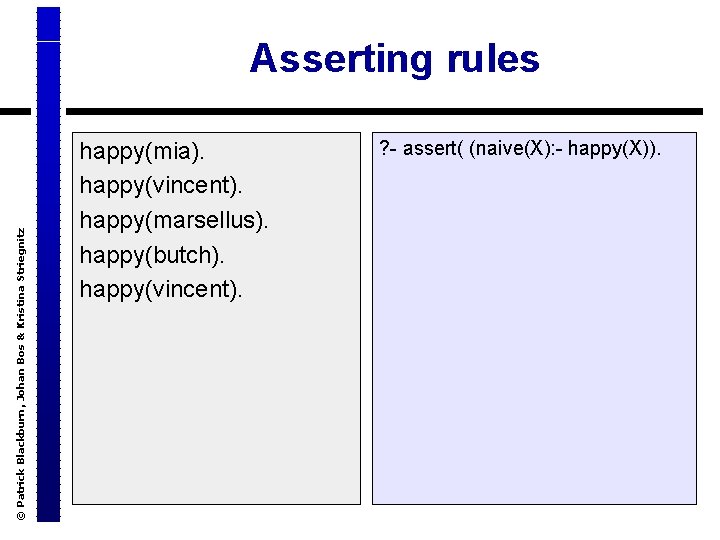
© Patrick Blackburn, Johan Bos & Kristina Striegnitz Asserting rules happy(mia). happy(vincent). happy(marsellus). happy(butch). happy(vincent). ? - assert( (naive(X): - happy(X)).
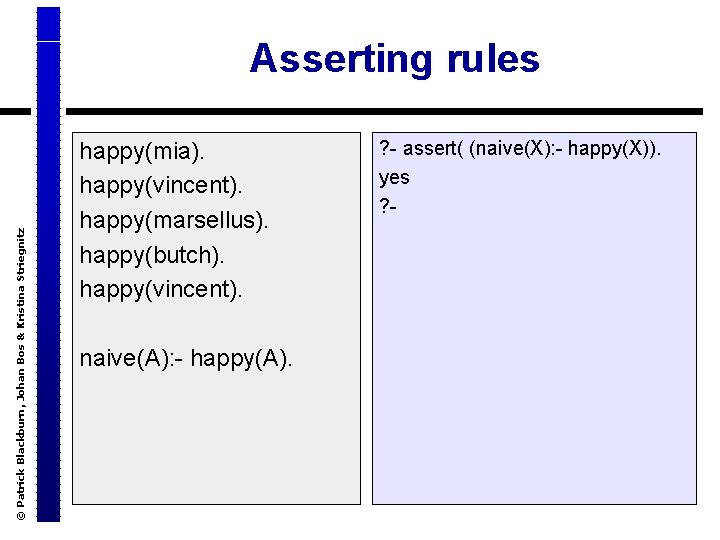
© Patrick Blackburn, Johan Bos & Kristina Striegnitz Asserting rules happy(mia). happy(vincent). happy(marsellus). happy(butch). happy(vincent). naive(A): - happy(A). ? - assert( (naive(X): - happy(X)). yes ? -
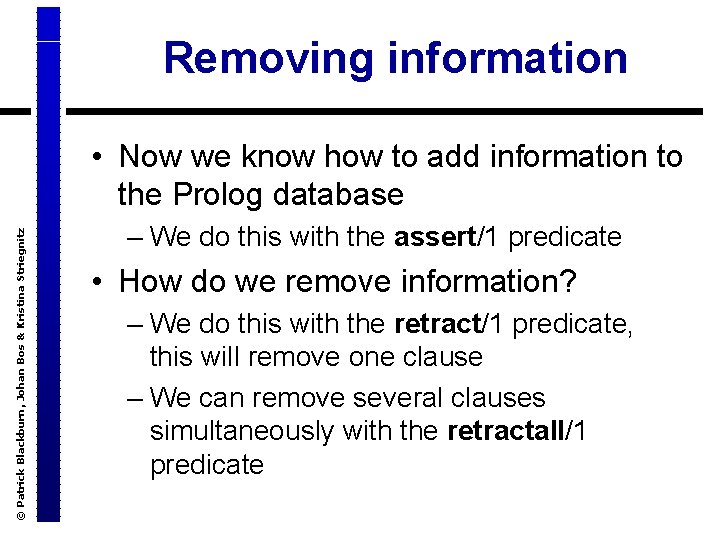
Removing information © Patrick Blackburn, Johan Bos & Kristina Striegnitz • Now we know how to add information to the Prolog database – We do this with the assert/1 predicate • How do we remove information? – We do this with the retract/1 predicate, this will remove one clause – We can remove several clauses simultaneously with the retractall/1 predicate
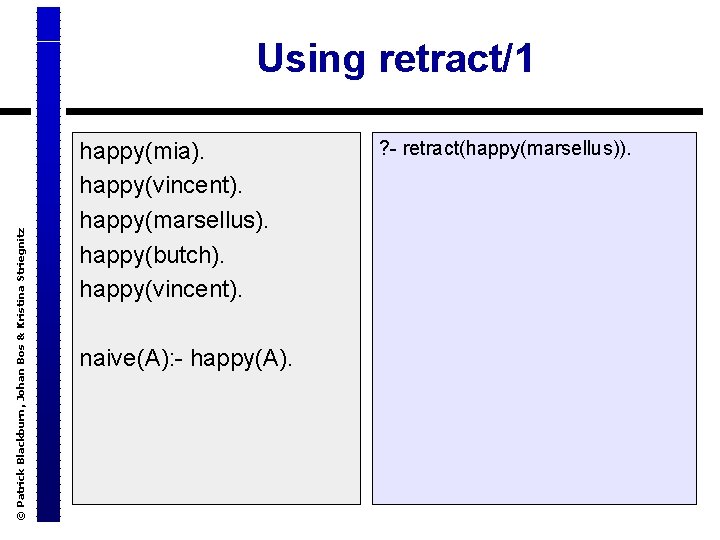
© Patrick Blackburn, Johan Bos & Kristina Striegnitz Using retract/1 happy(mia). happy(vincent). happy(marsellus). happy(butch). happy(vincent). naive(A): - happy(A). ? - retract(happy(marsellus)).
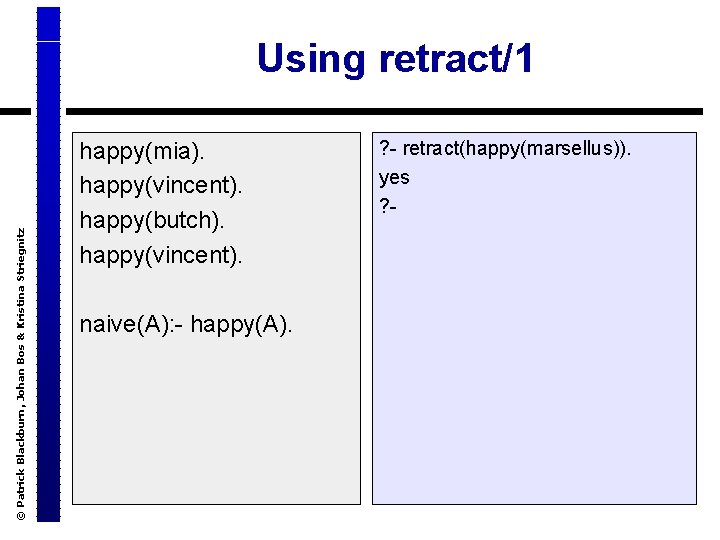
© Patrick Blackburn, Johan Bos & Kristina Striegnitz Using retract/1 happy(mia). happy(vincent). happy(butch). happy(vincent). naive(A): - happy(A). ? - retract(happy(marsellus)). yes ? -
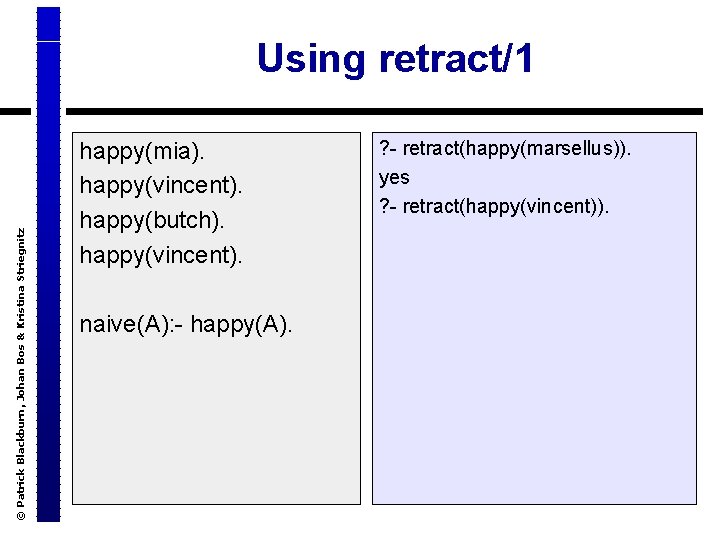
© Patrick Blackburn, Johan Bos & Kristina Striegnitz Using retract/1 happy(mia). happy(vincent). happy(butch). happy(vincent). naive(A): - happy(A). ? - retract(happy(marsellus)). yes ? - retract(happy(vincent)).
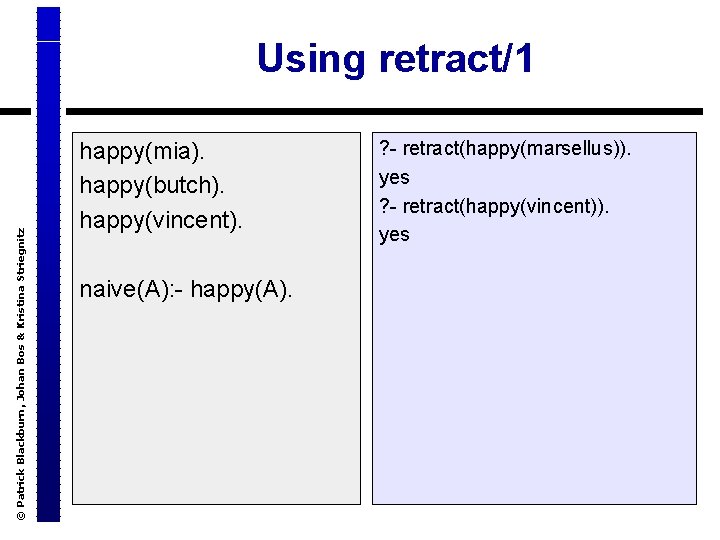
© Patrick Blackburn, Johan Bos & Kristina Striegnitz Using retract/1 happy(mia). happy(butch). happy(vincent). naive(A): - happy(A). ? - retract(happy(marsellus)). yes ? - retract(happy(vincent)). yes
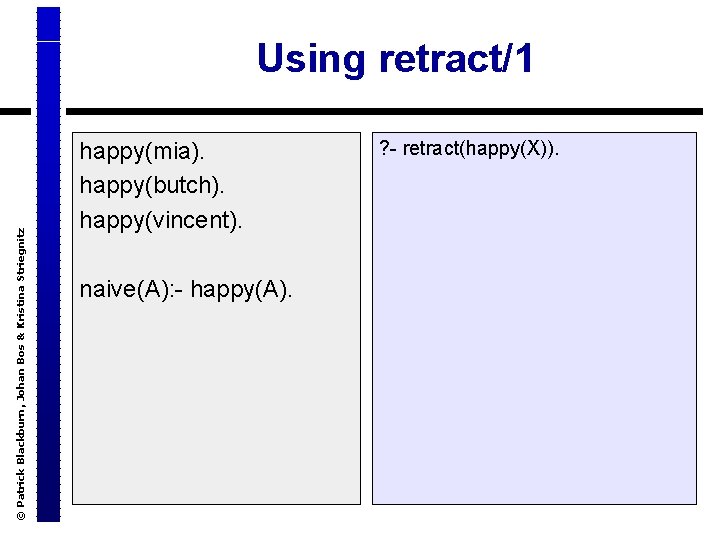
© Patrick Blackburn, Johan Bos & Kristina Striegnitz Using retract/1 happy(mia). happy(butch). happy(vincent). naive(A): - happy(A). ? - retract(happy(X)).
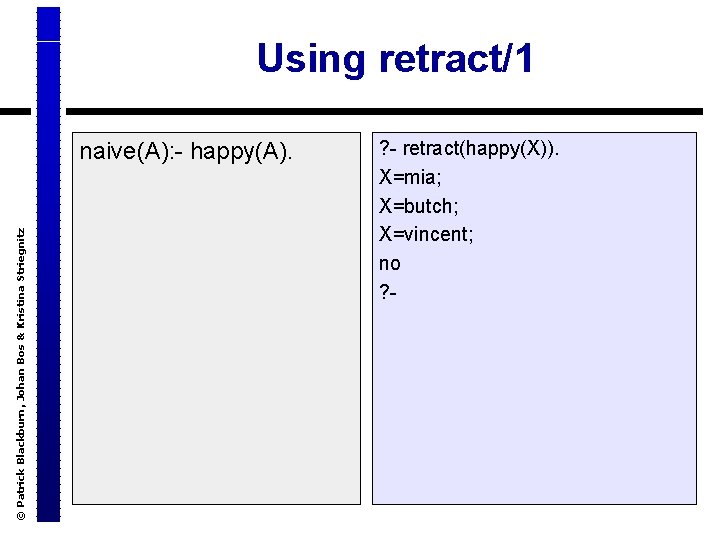
Using retract/1 © Patrick Blackburn, Johan Bos & Kristina Striegnitz naive(A): - happy(A). ? - retract(happy(X)). X=mia; X=butch; X=vincent; no ? -
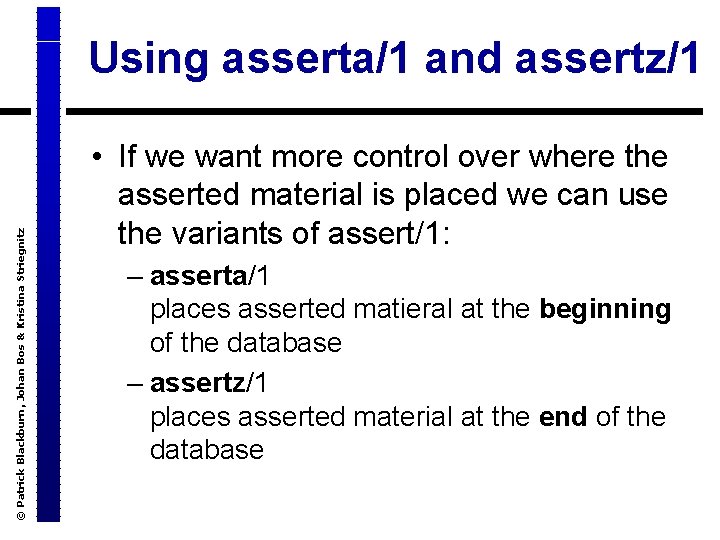
© Patrick Blackburn, Johan Bos & Kristina Striegnitz Using asserta/1 and assertz/1 • If we want more control over where the asserted material is placed we can use the variants of assert/1: – asserta/1 places asserted matieral at the beginning of the database – assertz/1 places asserted material at the end of the database
© Patrick Blackburn, Johan Bos & Kristina Striegnitz Memoisation • Database manipulation is a useful technique • It is especially useful for storing the results to computations, in case we need to recalculate the same query • This is often called memoisation or caching
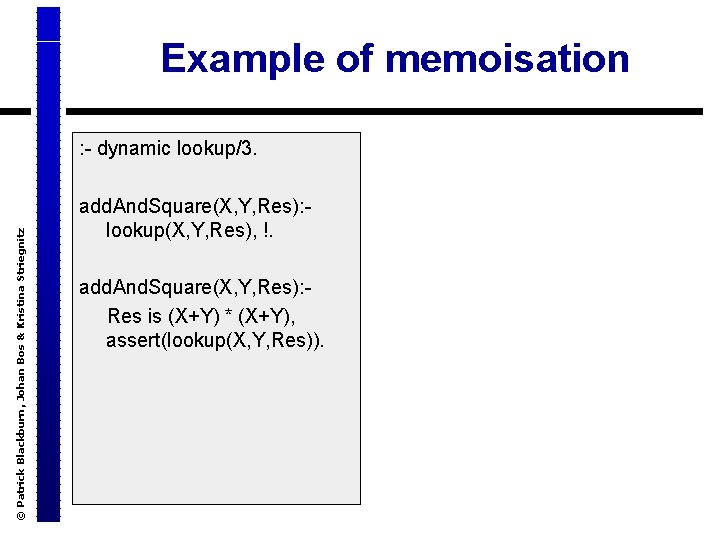
Example of memoisation © Patrick Blackburn, Johan Bos & Kristina Striegnitz : - dynamic lookup/3. add. And. Square(X, Y, Res): lookup(X, Y, Res), !. add. And. Square(X, Y, Res): Res is (X+Y) * (X+Y), assert(lookup(X, Y, Res)).
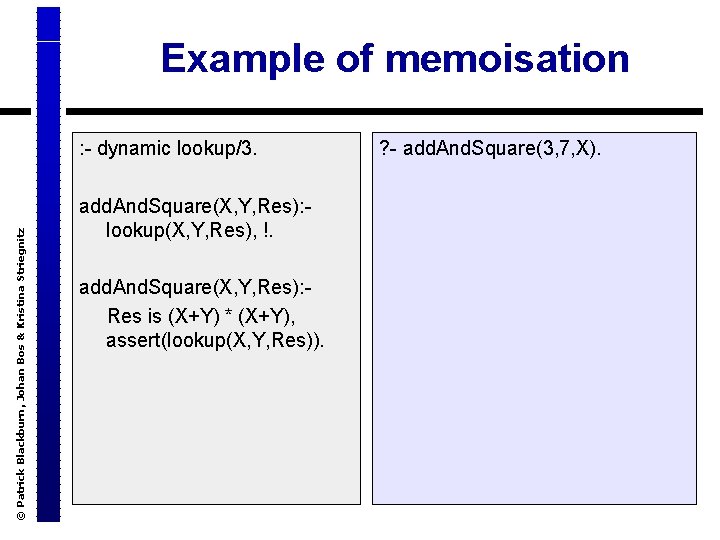
Example of memoisation © Patrick Blackburn, Johan Bos & Kristina Striegnitz : - dynamic lookup/3. add. And. Square(X, Y, Res): lookup(X, Y, Res), !. add. And. Square(X, Y, Res): Res is (X+Y) * (X+Y), assert(lookup(X, Y, Res)). ? - add. And. Square(3, 7, X).
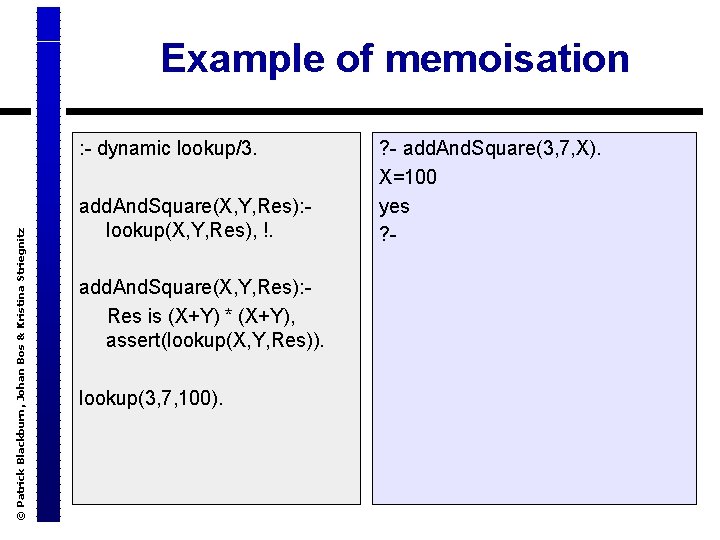
Example of memoisation © Patrick Blackburn, Johan Bos & Kristina Striegnitz : - dynamic lookup/3. add. And. Square(X, Y, Res): lookup(X, Y, Res), !. add. And. Square(X, Y, Res): Res is (X+Y) * (X+Y), assert(lookup(X, Y, Res)). lookup(3, 7, 100). ? - add. And. Square(3, 7, X). X=100 yes ? -
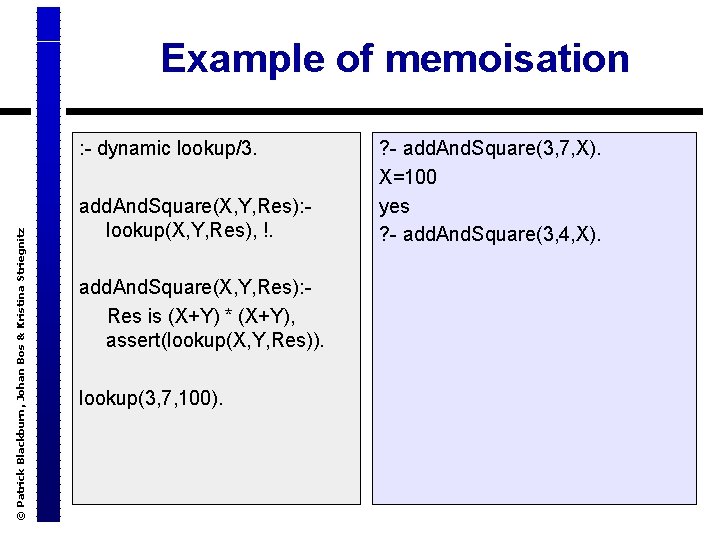
Example of memoisation © Patrick Blackburn, Johan Bos & Kristina Striegnitz : - dynamic lookup/3. add. And. Square(X, Y, Res): lookup(X, Y, Res), !. add. And. Square(X, Y, Res): Res is (X+Y) * (X+Y), assert(lookup(X, Y, Res)). lookup(3, 7, 100). ? - add. And. Square(3, 7, X). X=100 yes ? - add. And. Square(3, 4, X).
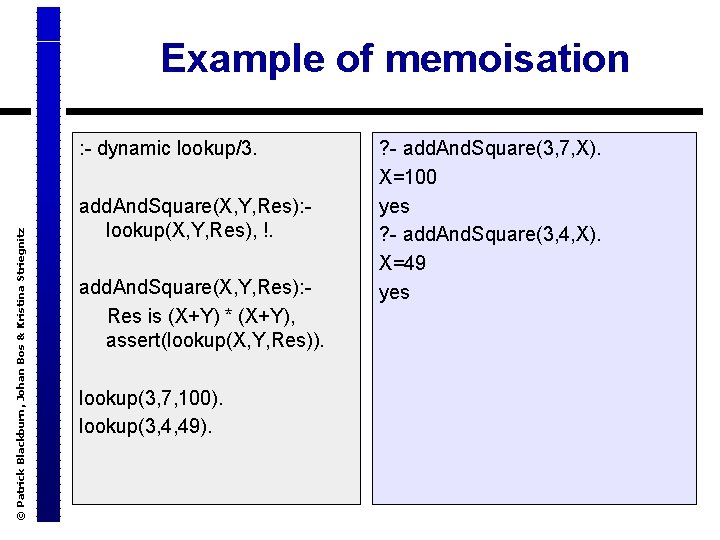
Example of memoisation © Patrick Blackburn, Johan Bos & Kristina Striegnitz : - dynamic lookup/3. add. And. Square(X, Y, Res): lookup(X, Y, Res), !. add. And. Square(X, Y, Res): Res is (X+Y) * (X+Y), assert(lookup(X, Y, Res)). lookup(3, 7, 100). lookup(3, 4, 49). ? - add. And. Square(3, 7, X). X=100 yes ? - add. And. Square(3, 4, X). X=49 yes
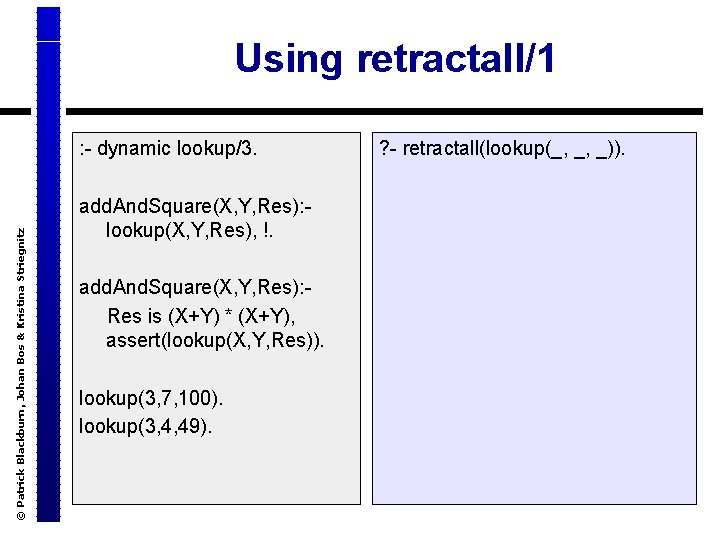
Using retractall/1 © Patrick Blackburn, Johan Bos & Kristina Striegnitz : - dynamic lookup/3. add. And. Square(X, Y, Res): lookup(X, Y, Res), !. add. And. Square(X, Y, Res): Res is (X+Y) * (X+Y), assert(lookup(X, Y, Res)). lookup(3, 7, 100). lookup(3, 4, 49). ? - retractall(lookup(_, _, _)).
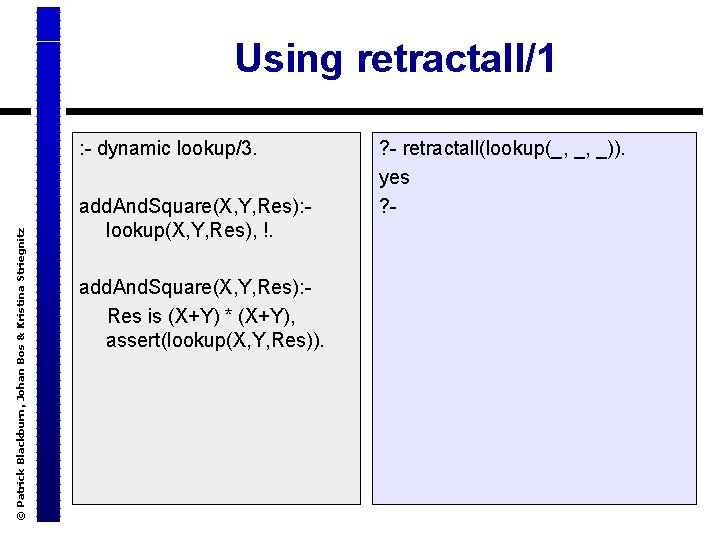
Using retractall/1 © Patrick Blackburn, Johan Bos & Kristina Striegnitz : - dynamic lookup/3. add. And. Square(X, Y, Res): lookup(X, Y, Res), !. add. And. Square(X, Y, Res): Res is (X+Y) * (X+Y), assert(lookup(X, Y, Res)). ? - retractall(lookup(_, _, _)). yes ? -
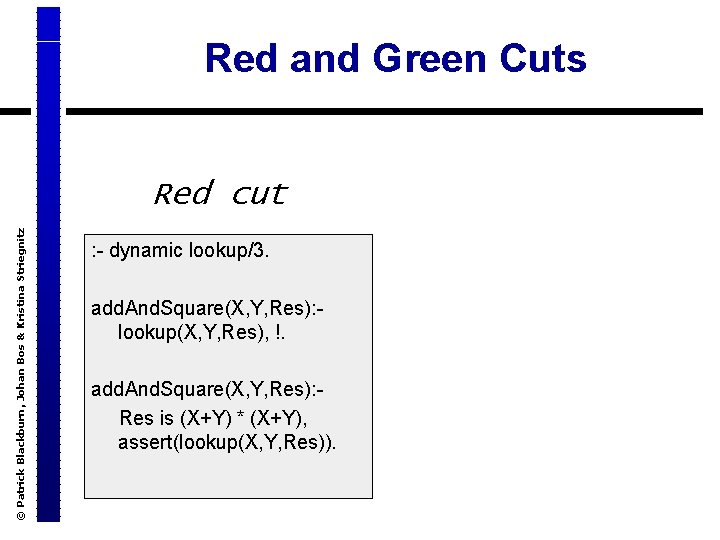
Red and Green Cuts © Patrick Blackburn, Johan Bos & Kristina Striegnitz Red cut : - dynamic lookup/3. add. And. Square(X, Y, Res): lookup(X, Y, Res), !. add. And. Square(X, Y, Res): Res is (X+Y) * (X+Y), assert(lookup(X, Y, Res)).
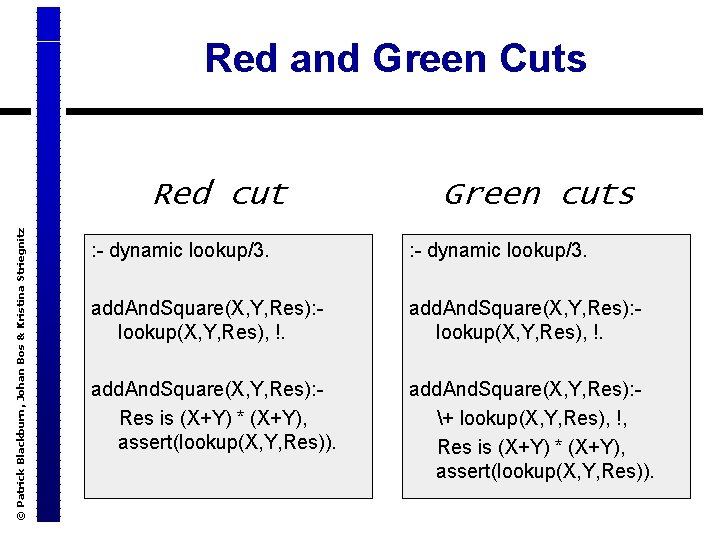
Red and Green Cuts © Patrick Blackburn, Johan Bos & Kristina Striegnitz Red cut Green cuts : - dynamic lookup/3. add. And. Square(X, Y, Res): lookup(X, Y, Res), !. add. And. Square(X, Y, Res): Res is (X+Y) * (X+Y), assert(lookup(X, Y, Res)). add. And. Square(X, Y, Res): + lookup(X, Y, Res), !, Res is (X+Y) * (X+Y), assert(lookup(X, Y, Res)).
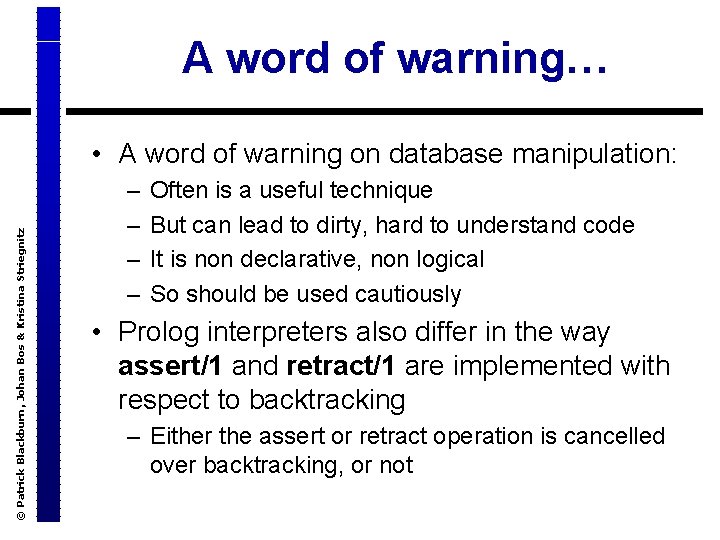
A word of warning… © Patrick Blackburn, Johan Bos & Kristina Striegnitz • A word of warning on database manipulation: – – Often is a useful technique But can lead to dirty, hard to understand code It is non declarative, non logical So should be used cautiously • Prolog interpreters also differ in the way assert/1 and retract/1 are implemented with respect to backtracking – Either the assert or retract operation is cancelled over backtracking, or not
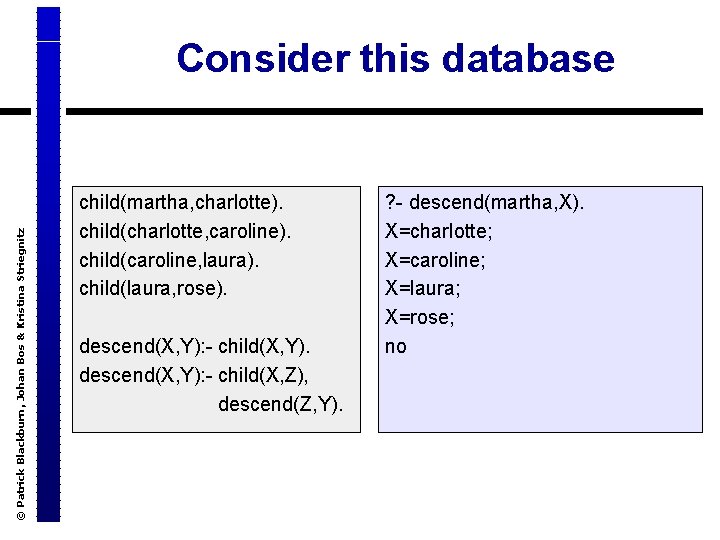
© Patrick Blackburn, Johan Bos & Kristina Striegnitz Consider this database child(martha, charlotte). child(charlotte, caroline). child(caroline, laura). child(laura, rose). descend(X, Y): - child(X, Y). descend(X, Y): - child(X, Z), descend(Z, Y). ? - descend(martha, X). X=charlotte; X=caroline; X=laura; X=rose; no
© Patrick Blackburn, Johan Bos & Kristina Striegnitz Collecting solutions • There may be many solutions to a Prolog query • However, Prolog generates solutions one by one • Sometimes we would like to have all the solutions to a query in one go • Needless to say, it would be handy to have them in a neat, usable format
© Patrick Blackburn, Johan Bos & Kristina Striegnitz Collecting solutions • Prolog has three built-in predicates that do this: findall/3, bagof/3 and setof/3 • In essence, all these predicates collect all the solutions to a query and put them into a single list • But there are important differences between them
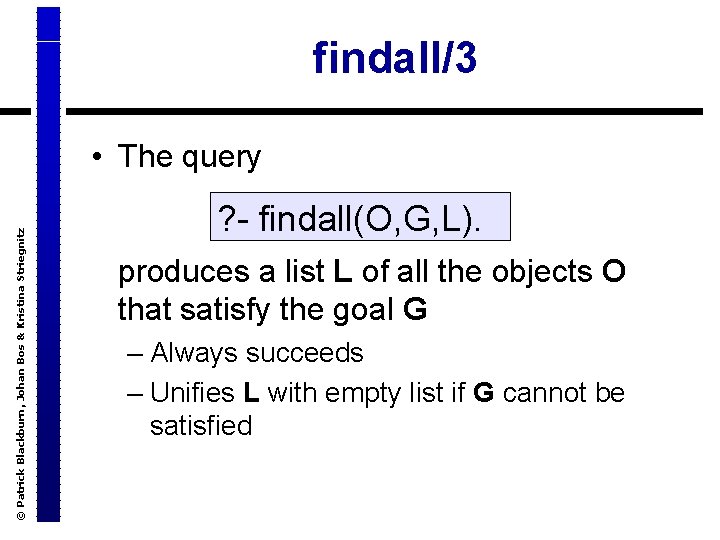
findall/3 © Patrick Blackburn, Johan Bos & Kristina Striegnitz • The query ? - findall(O, G, L). produces a list L of all the objects O that satisfy the goal G – Always succeeds – Unifies L with empty list if G cannot be satisfied
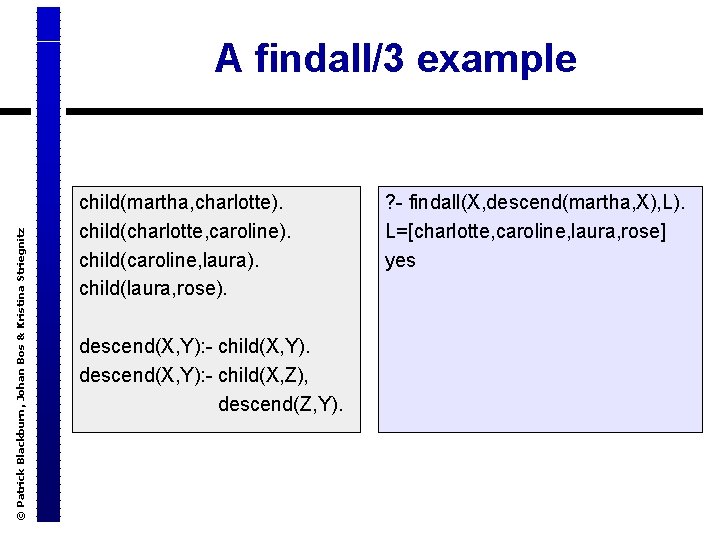
© Patrick Blackburn, Johan Bos & Kristina Striegnitz A findall/3 example child(martha, charlotte). child(charlotte, caroline). child(caroline, laura). child(laura, rose). descend(X, Y): - child(X, Y). descend(X, Y): - child(X, Z), descend(Z, Y). ? - findall(X, descend(martha, X), L). L=[charlotte, caroline, laura, rose] yes
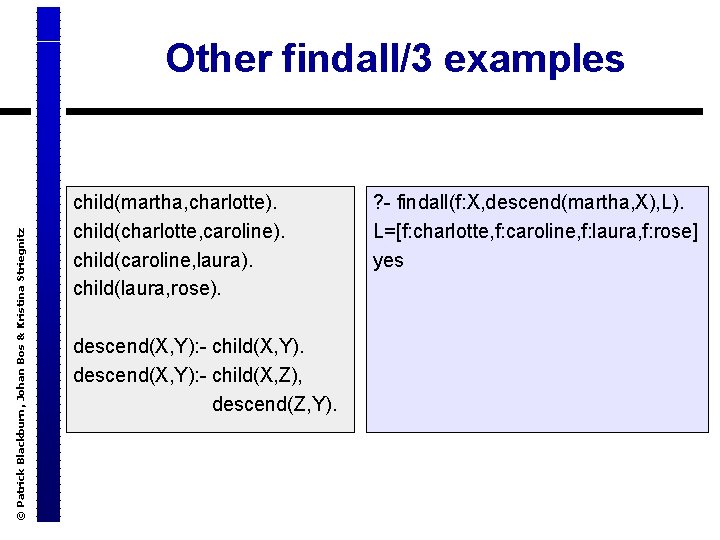
© Patrick Blackburn, Johan Bos & Kristina Striegnitz Other findall/3 examples child(martha, charlotte). child(charlotte, caroline). child(caroline, laura). child(laura, rose). descend(X, Y): - child(X, Y). descend(X, Y): - child(X, Z), descend(Z, Y). ? - findall(f: X, descend(martha, X), L). L=[f: charlotte, f: caroline, f: laura, f: rose] yes
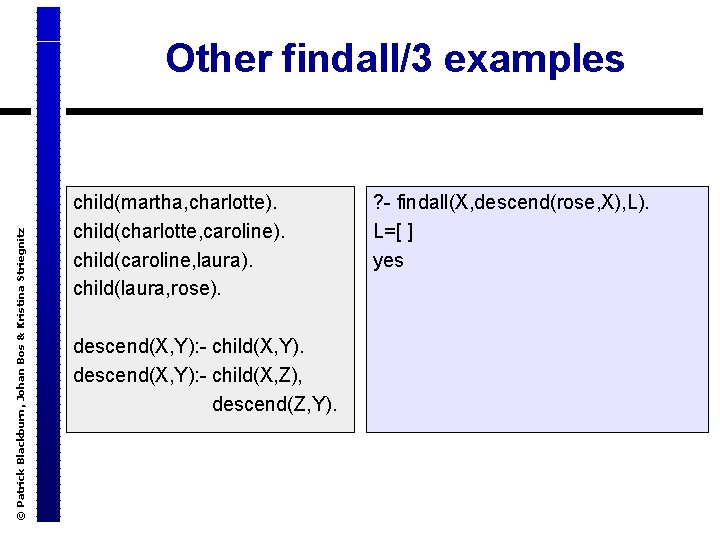
© Patrick Blackburn, Johan Bos & Kristina Striegnitz Other findall/3 examples child(martha, charlotte). child(charlotte, caroline). child(caroline, laura). child(laura, rose). descend(X, Y): - child(X, Y). descend(X, Y): - child(X, Z), descend(Z, Y). ? - findall(X, descend(rose, X), L). L=[ ] yes
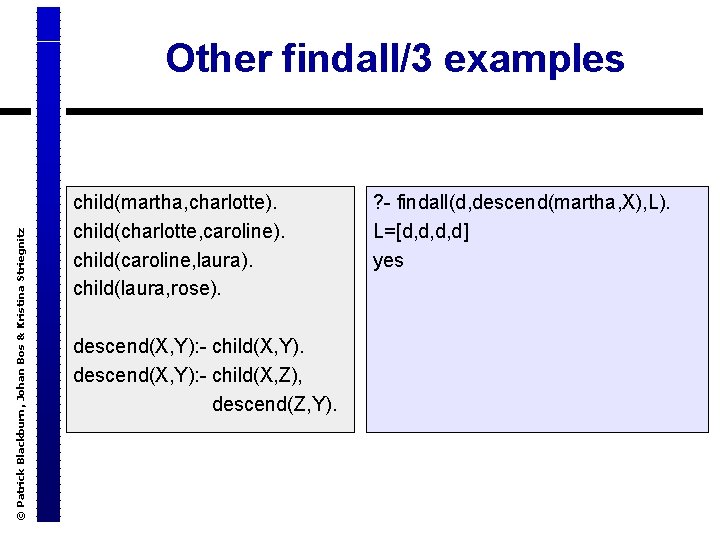
© Patrick Blackburn, Johan Bos & Kristina Striegnitz Other findall/3 examples child(martha, charlotte). child(charlotte, caroline). child(caroline, laura). child(laura, rose). descend(X, Y): - child(X, Y). descend(X, Y): - child(X, Z), descend(Z, Y). ? - findall(d, descend(martha, X), L). L=[d, d, d, d] yes
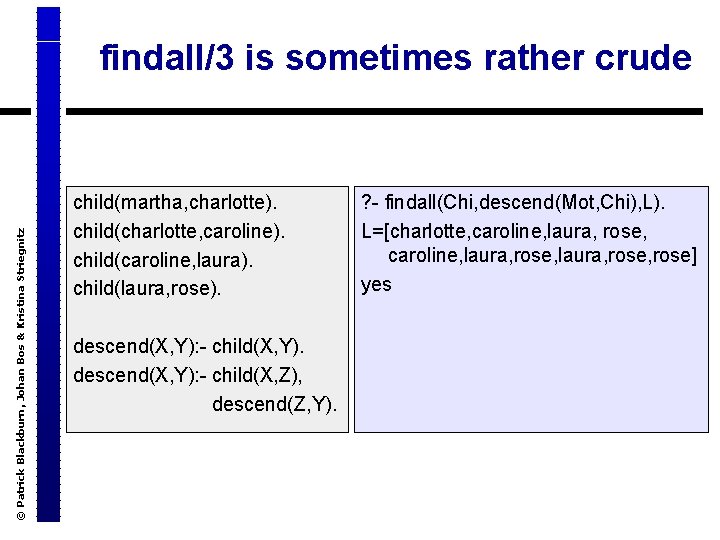
© Patrick Blackburn, Johan Bos & Kristina Striegnitz findall/3 is sometimes rather crude child(martha, charlotte). child(charlotte, caroline). child(caroline, laura). child(laura, rose). descend(X, Y): - child(X, Y). descend(X, Y): - child(X, Z), descend(Z, Y). ? - findall(Chi, descend(Mot, Chi), L). L=[charlotte, caroline, laura, rose, laura, rose] yes
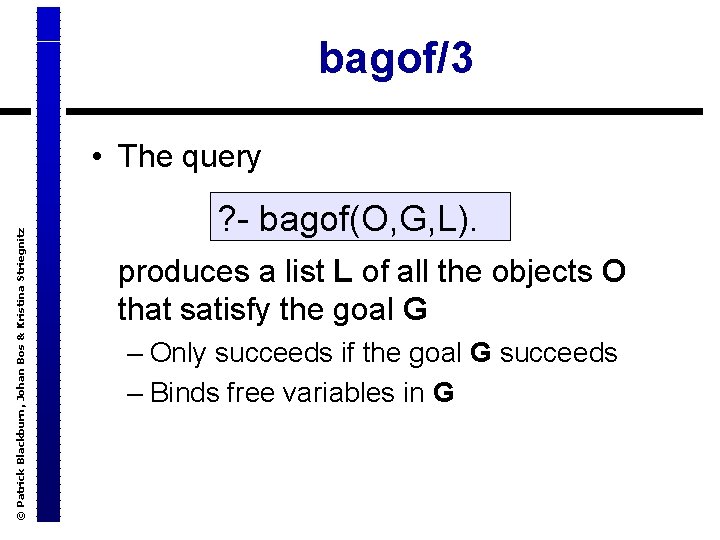
bagof/3 © Patrick Blackburn, Johan Bos & Kristina Striegnitz • The query ? - bagof(O, G, L). produces a list L of all the objects O that satisfy the goal G – Only succeeds if the goal G succeeds – Binds free variables in G
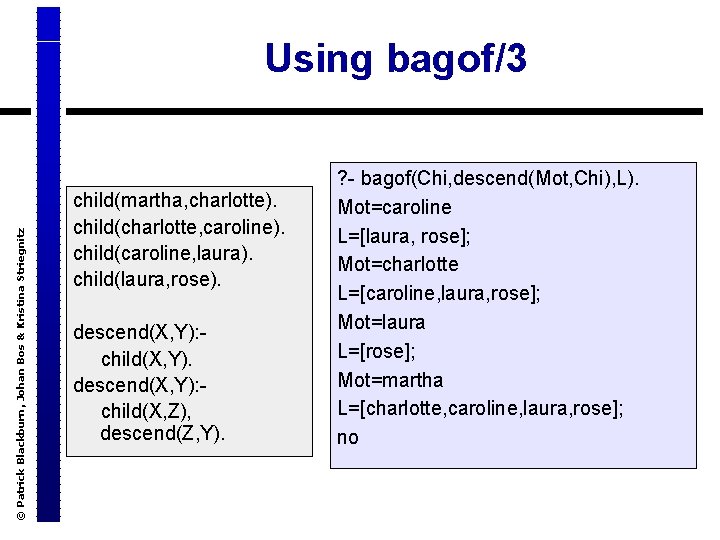
© Patrick Blackburn, Johan Bos & Kristina Striegnitz Using bagof/3 child(martha, charlotte). child(charlotte, caroline). child(caroline, laura). child(laura, rose). descend(X, Y): child(X, Y). descend(X, Y): child(X, Z), descend(Z, Y). ? - bagof(Chi, descend(Mot, Chi), L). Mot=caroline L=[laura, rose]; Mot=charlotte L=[caroline, laura, rose]; Mot=laura L=[rose]; Mot=martha L=[charlotte, caroline, laura, rose]; no
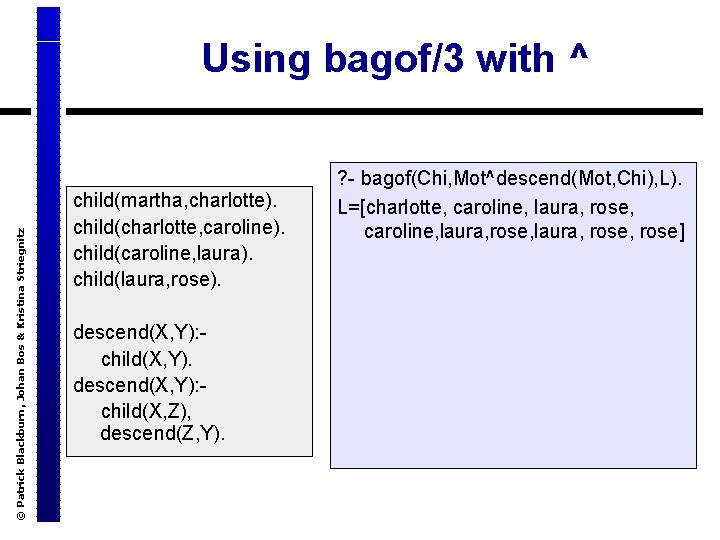
© Patrick Blackburn, Johan Bos & Kristina Striegnitz Using bagof/3 with ^ child(martha, charlotte). child(charlotte, caroline). child(caroline, laura). child(laura, rose). descend(X, Y): child(X, Y). descend(X, Y): child(X, Z), descend(Z, Y). ? - bagof(Chi, Mot^descend(Mot, Chi), L). L=[charlotte, caroline, laura, rose, laura, rose]
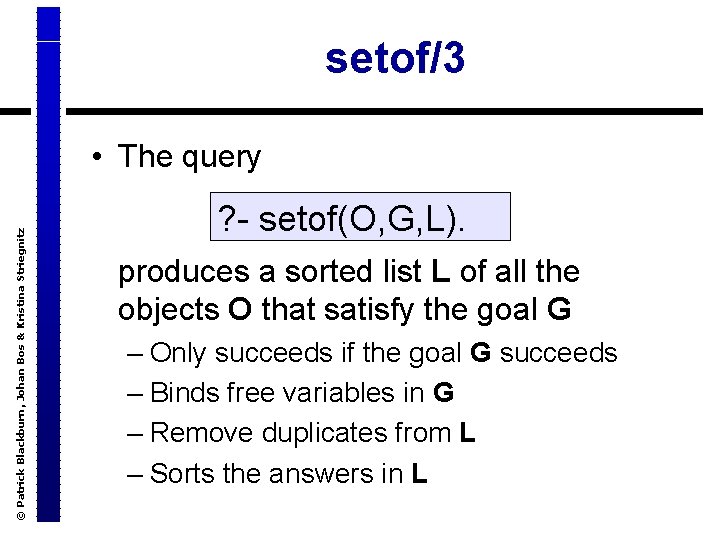
setof/3 © Patrick Blackburn, Johan Bos & Kristina Striegnitz • The query ? - setof(O, G, L). produces a sorted list L of all the objects O that satisfy the goal G – Only succeeds if the goal G succeeds – Binds free variables in G – Remove duplicates from L – Sorts the answers in L
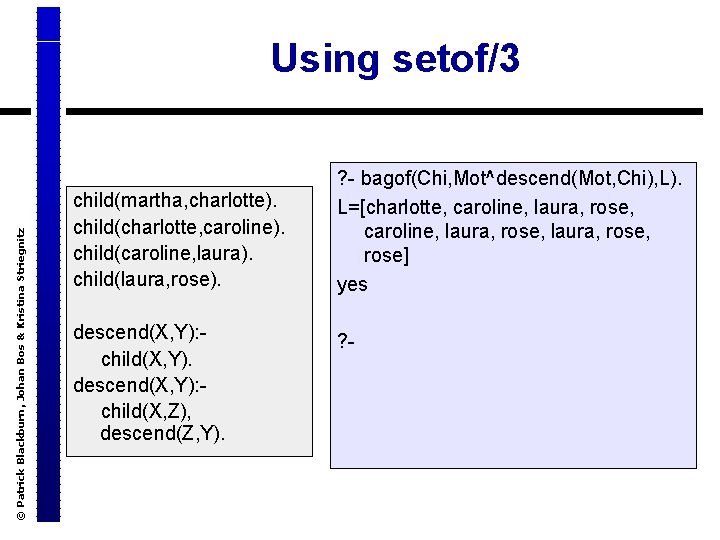
© Patrick Blackburn, Johan Bos & Kristina Striegnitz Using setof/3 child(martha, charlotte). child(charlotte, caroline). child(caroline, laura). child(laura, rose). descend(X, Y): child(X, Y). descend(X, Y): child(X, Z), descend(Z, Y). ? - bagof(Chi, Mot^descend(Mot, Chi), L). L=[charlotte, caroline, laura, rose, laura, rose] yes ? -
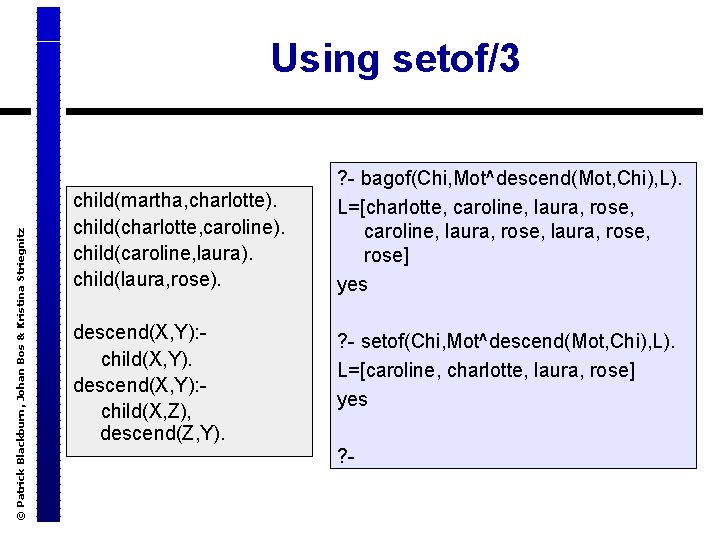
© Patrick Blackburn, Johan Bos & Kristina Striegnitz Using setof/3 child(martha, charlotte). child(charlotte, caroline). child(caroline, laura). child(laura, rose). descend(X, Y): child(X, Y). descend(X, Y): child(X, Z), descend(Z, Y). ? - bagof(Chi, Mot^descend(Mot, Chi), L). L=[charlotte, caroline, laura, rose, laura, rose] yes ? - setof(Chi, Mot^descend(Mot, Chi), L). L=[caroline, charlotte, laura, rose] yes ? -
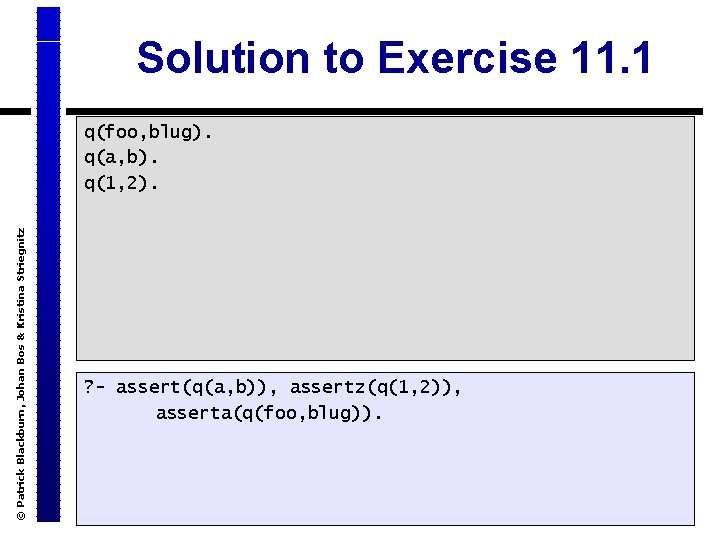
Solution to Exercise 11. 1 © Patrick Blackburn, Johan Bos & Kristina Striegnitz q(foo, blug). q(a, b). q(1, 2). ? - assert(q(a, b)), assertz(q(1, 2)), asserta(q(foo, blug)).
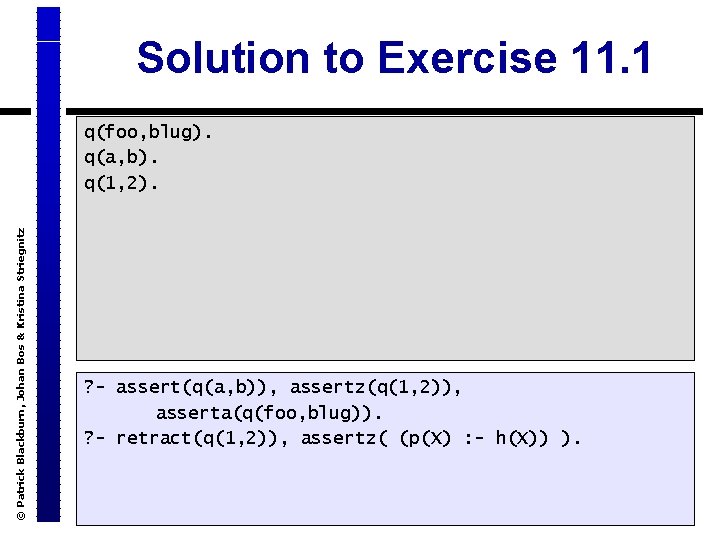
Solution to Exercise 11. 1 © Patrick Blackburn, Johan Bos & Kristina Striegnitz q(foo, blug). q(a, b). q(1, 2). ? - assert(q(a, b)), assertz(q(1, 2)), asserta(q(foo, blug)). ? - retract(q(1, 2)), assertz( (p(X) : - h(X)) ).
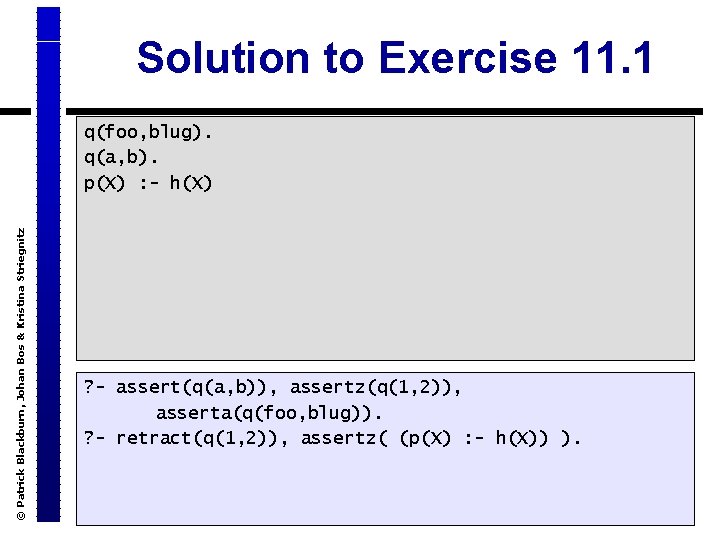
Solution to Exercise 11. 1 © Patrick Blackburn, Johan Bos & Kristina Striegnitz q(foo, blug). q(a, b). p(X) : - h(X) ? - assert(q(a, b)), assertz(q(1, 2)), asserta(q(foo, blug)). ? - retract(q(1, 2)), assertz( (p(X) : - h(X)) ).
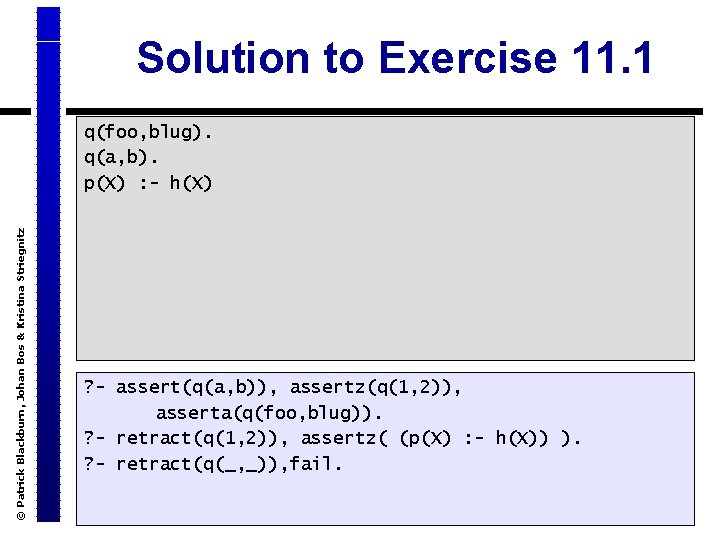
Solution to Exercise 11. 1 © Patrick Blackburn, Johan Bos & Kristina Striegnitz q(foo, blug). q(a, b). p(X) : - h(X) ? - assert(q(a, b)), assertz(q(1, 2)), asserta(q(foo, blug)). ? - retract(q(1, 2)), assertz( (p(X) : - h(X)) ). ? - retract(q(_, _)), fail.
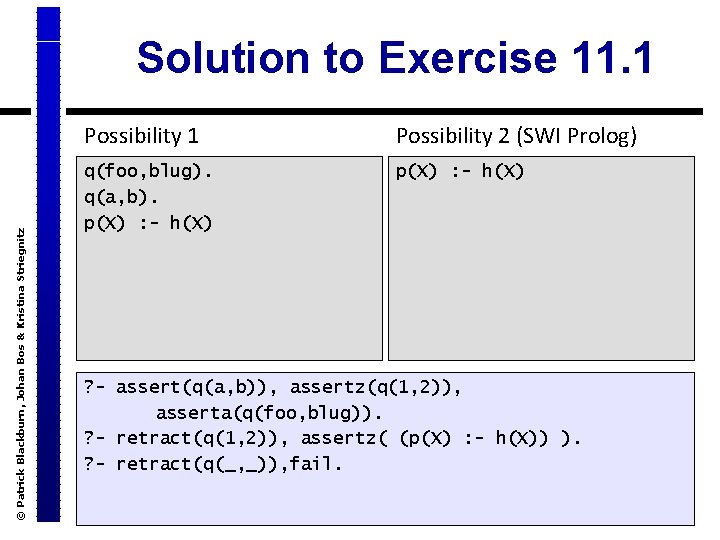
© Patrick Blackburn, Johan Bos & Kristina Striegnitz Solution to Exercise 11. 1 Possibility 2 (SWI Prolog) q(foo, blug). q(a, b). p(X) : - h(X) ? - assert(q(a, b)), assertz(q(1, 2)), asserta(q(foo, blug)). ? - retract(q(1, 2)), assertz( (p(X) : - h(X)) ). ? - retract(q(_, _)), fail.
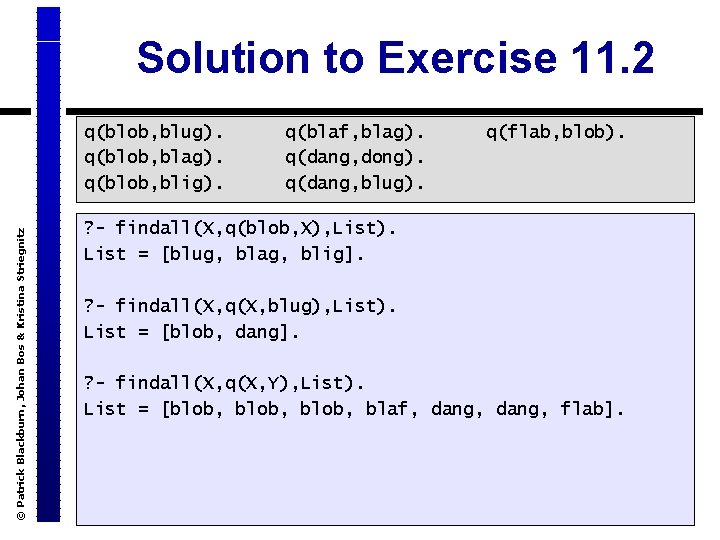
Solution to Exercise 11. 2 © Patrick Blackburn, Johan Bos & Kristina Striegnitz q(blob, blug). q(blob, blag). q(blob, blig). q(blaf, blag). q(dang, dong). q(dang, blug). q(flab, blob). ? - findall(X, q(blob, X), List). List = [blug, blag, blig]. ? - findall(X, q(X, blug), List). List = [blob, dang]. ? - findall(X, q(X, Y), List). List = [blob, blaf, dang, flab].
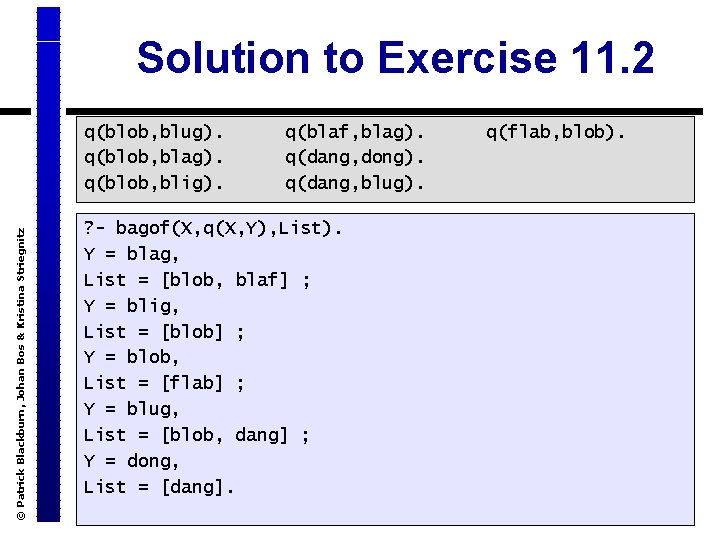
Solution to Exercise 11. 2 © Patrick Blackburn, Johan Bos & Kristina Striegnitz q(blob, blug). q(blob, blag). q(blob, blig). q(blaf, blag). q(dang, dong). q(dang, blug). ? - bagof(X, q(X, Y), List). Y = blag, List = [blob, blaf] ; Y = blig, List = [blob] ; Y = blob, List = [flab] ; Y = blug, List = [blob, dang] ; Y = dong, List = [dang]. q(flab, blob).
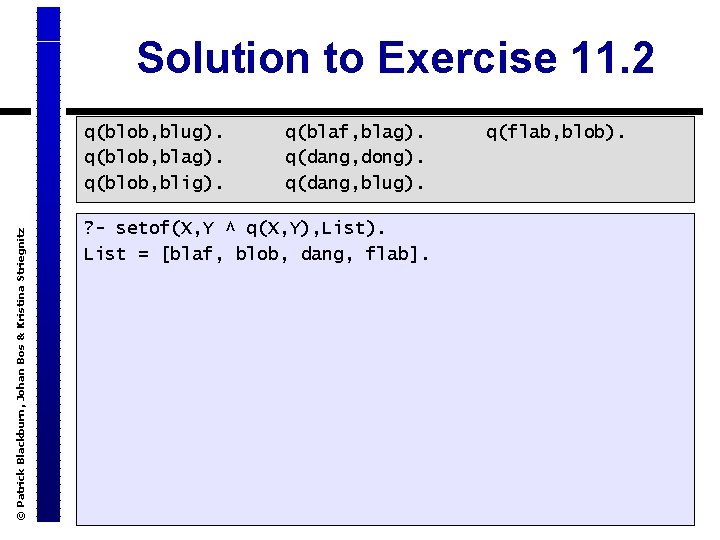
Solution to Exercise 11. 2 © Patrick Blackburn, Johan Bos & Kristina Striegnitz q(blob, blug). q(blob, blag). q(blob, blig). q(blaf, blag). q(dang, dong). q(dang, blug). ? - setof(X, Y ^ q(X, Y), List). List = [blaf, blob, dang, flab]. q(flab, blob).
© Patrick Blackburn, Johan Bos & Kristina Striegnitz Written Exam Datum: Dienstag, den 6. September 2011 Zeit: 10. 30 -12. 00 Ort: Appelstraße 4 (3703), Multimedia Hörsaal (Raum 023) Art: Schriftlich Hilfsmittel: Kein erlaubt Stoff: Beide KI Vorlesung und Einfürung zu Prolog (50%-50%) Sieh Beispiel Klausuren auf KI Webseite! Viel Glück!
- Slides: 60