
Lecture 11 Coordination and Agreement Central server for
- Slides: 22
Lecture 11: Coordination and Agreement • Central server for mutual exclusion • Election – getting a number of processes to agree which is “in charge” CDK 4: Chapter 12 (esp. Section 12. 3) CDK 5: Chapter 15 (esp. Section 15. 3) TVS: Chapter 6 (esp. Section 6. 5) COMP 28112 Lecture 11
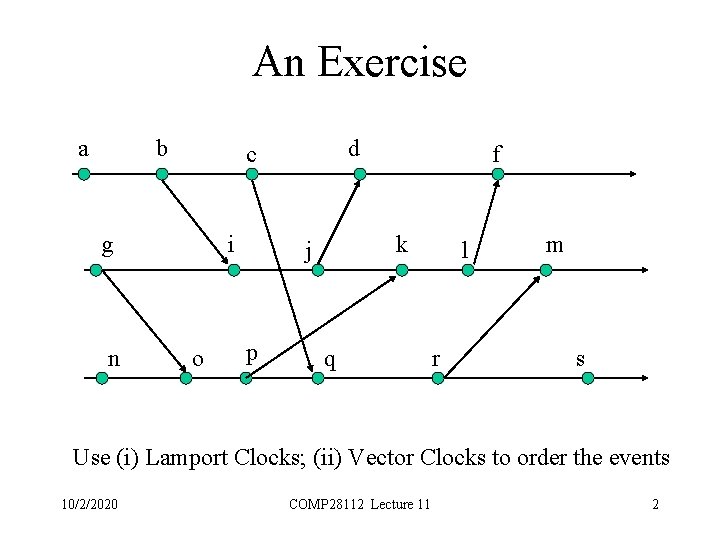
An Exercise a b g n d c i o k j p f q l r m s Use (i) Lamport Clocks; (ii) Vector Clocks to order the events 10/2/2020 COMP 28112 Lecture 11 2
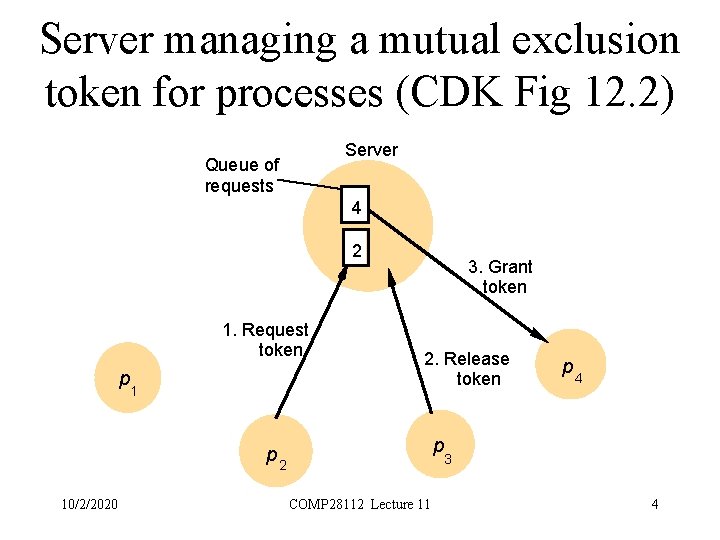
(Distributed) Mutual exclusion • In a single machine, you could use semaphores to implement mutual exclusion • How to implement semaphores? – Inhibit interrupts – Use clever instructions (e. g. test-and-set) • On a multiprocessor shared memory machine, only the latter works • On machines which don’t even share memory, need something different • The simplest solution is a central server • Client requests token on entry, and releases it on exit • Server queues requests when it has no token 10/2/2020 COMP 28112 Lecture 11 3
Server managing a mutual exclusion token for processes (CDK Fig 12. 2) Server Queue of requests 4 2 1. Request token p 1 3. Grant token 2. Release token p p 2 10/2/2020 p 4 3 COMP 28112 Lecture 11 4
Alternatives …? • The server is a single point of failure • Also possibly a bottleneck for the system • However many very clever, more distributed algorithms are generally worse in terms of number of messages, and have other problems! 10/2/2020 COMP 28112 Lecture 11 5
Election – why? Need a distinguished process: • To implement locking/mutual exclusion • Or to coordinate distributed transactions Election is also a good introduction to what is involved in getting processes in a distributed system to cooperate. 10/2/2020 COMP 28112 Lecture 11 6
Two Algorithms • A ring-based election algorithm • The bully algorithm Same scenario: • A fixed set of processes: p 1 … pn • Want to elect the process with the largest identifier – where identifiers are totally ordered, e. g. <1/(load+1), i> 10/2/2020 COMP 28112 Lecture 11 7
Requirements • Want all processes to agree who is elected i. e. they need to learn the result of the election • Any process can initiate an election – so there may be more than one happening at any one time …. 10/2/2020 COMP 28112 Lecture 11 8
Ring-based algorithm • Arrange the processes in a logical ring – so each knows which is next in order • Assume no failures and system is asynchronous • Initially every process is a non-participant • Initiating process changes itself to be a participant and sends its identifier in an election message to its neighbour 10/2/2020 COMP 28112 Lecture 11 9
Action on receiving election message • Receiver compares its own identifier with that in the message • If the identifier in the message is larger it forwards the election message unchanged • Otherwise if receiver is already a participant, it discards the message • Otherwise it forwards the message, but with its own identifier • It is now a participant 10/2/2020 COMP 28112 Lecture 11 10
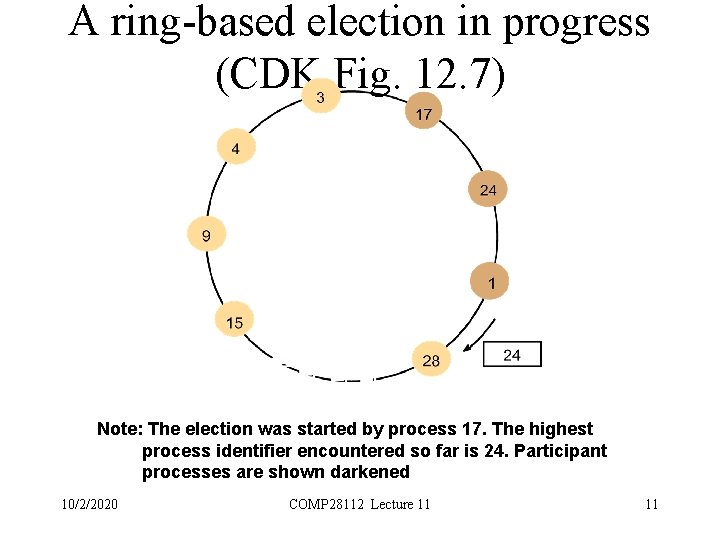
A ring-based election in progress (CDK Fig. 12. 7) Note: The election was started by process 17. The highest process identifier encountered so far is 24. Participant processes are shown darkened 10/2/2020 COMP 28112 Lecture 11 11
Until … • If the identifier in the received election message is that of the receiver, that process has just been elected! • It now sends an elected message round the ring – to tell everyone • Now each receiver notes the result, passes it on, and resets to non-participating 10/2/2020 COMP 28112 Lecture 11 12
Evaluation • How many messages are sent? • Worst case is when process elected is just before one which initiated election • Then there are 3 n– 1 messages • Toleration of failures: very limited – in principle can rebuild ring, but …. • Difficult to add new processes to ring too 10/2/2020 COMP 28112 Lecture 11 13
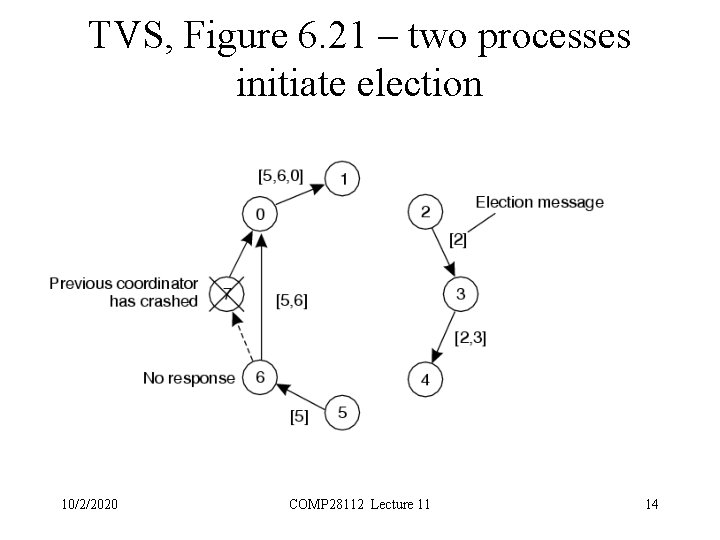
TVS, Figure 6. 21 – two processes initiate election 10/2/2020 COMP 28112 Lecture 11 14
Bully algorithm (Garcia-Molina 1982) • Designed for slightly different situation • Processes may crash (though messages are assumed reliable) • A process knows about the identifiers of other processes and can communicate with them • System is synchronous – it uses timeouts to detect process failure 10/2/2020 COMP 28112 Lecture 11 15
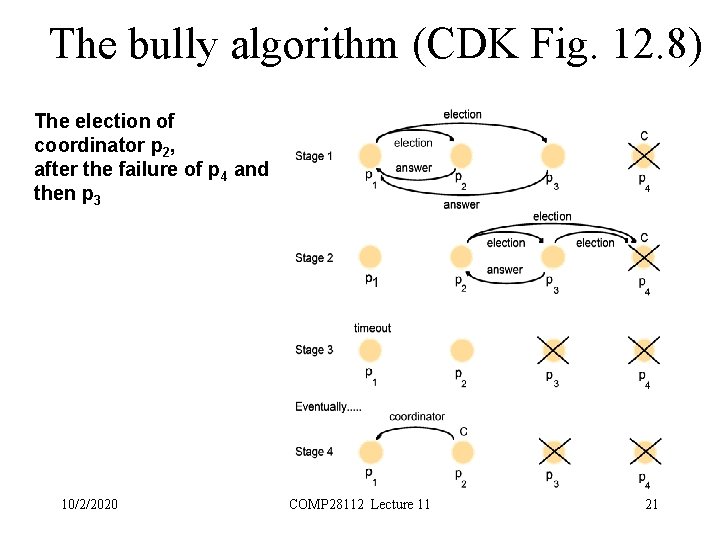
Three types of message • An election message – sent to initiate an election • An answer message – sent in response to an election message • A coordinator message – sent to announce the identity of the winner of the election 10/2/2020 COMP 28112 Lecture 11 16
Two timeouts • If no reply is received in time T, assume that the reply sender has crashed • If the initiator of an election doesn’t learn who won in time T + T’ it should begin another election – a process must have crashed in such a way as to mess up this one 10/2/2020 COMP 28112 Lecture 11 17
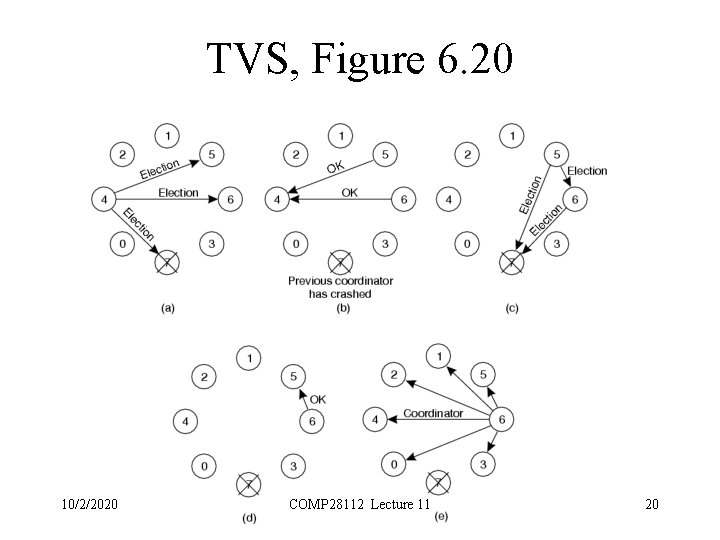
Initiating election • Process sends an election message to all processes with higher identifiers than itself • Those that have not crashed will respond with an answer message (within the timeout period) – and the initiating process can then sit back and wait for a coordinator message 10/2/2020 COMP 28112 Lecture 11 18
Receiving an election message • Any process receiving an election message should send an answer back to the sender • It should then initiate its own election – by sending an election message to each process with a larger identifier than itself • Unless it has recently done that, and had neither a coordination reply nor a timeout (T’). • A process with no answering process above it should consider itself elected • It should then send a coordinator message to all lower processes …. 10/2/2020 COMP 28112 Lecture 11 19
TVS, Figure 6. 20 10/2/2020 COMP 28112 Lecture 11 20
The bully algorithm (CDK Fig. 12. 8) The election of coordinator p 2, after the failure of p 4 and then p 3 10/2/2020 COMP 28112 Lecture 11 21
Evaluation • Need timeouts to be realistic • Problem if process restarts and elects itself …. • No of messages depends on which process initiates – the higher the less messages! If the lowest process initiates, O(n^2) …. Next: Dealing with failures… 10/2/2020 COMP 28112 Lecture 11 22