
Lecture 11 Consumption Points covered 1 Consumption in

- Slides: 11
Lecture 11: Consumption Points covered: 1) Consumption in history: sumptuary laws; 2) Consumers’ sovereignty; 3) The dependence effect. Writing skills: bibliographies
Sumptuary Laws Sumptuary laws have existed throughout much of human history to regulate expenditure and consumption (particularly of “luxuries”)
Sumptuary Laws: examples Two main areas: 1) Apparel (clothing) 2) Cuisine Other types: architectural; funerary; leisure activities.
Having desires Are we better off having more or fewer desires? If you could control the desires you acquire, would you try to minimize their number?
Capitalism & Consumption 1) Consumption is a private (apolitical) matter; it is minimally regulated. 2) Each person may decide for herself what to consume; consumption is based on free choice; nobody forces us to consume anything.
Consumers’ Sovereignty In a market economy, consumers’ decisions (demand) determines what is produced and sold. Producers are responsive to consumer demand tailor their output to it.
The Dependence Effect Consumer wants are ‘created’: 1) ‘Passive’ creation of wants via emulation (‘keeping up’ with others) 2) ‘Active’ creation of wants (advertizing)
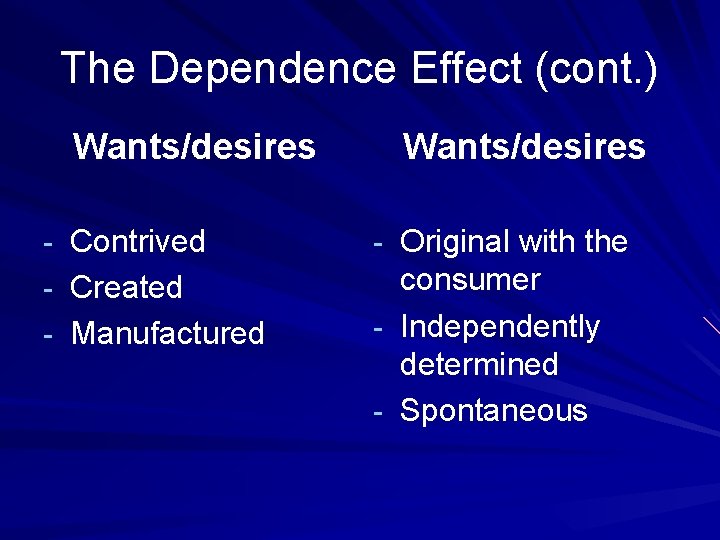
The Dependence Effect (cont. ) Wants/desires - Contrived - Original with the - Created consumer - Independently determined - Spontaneous - Manufactured
The Dependence Effect (cont. ) ‘Created’ wants are not ‘urgent’ because they are not ‘original’ with the consumer; they are not ‘independently determined’ (pp. 152, 155). Ideology of “production”
Questions 1) What are ‘independently determined’ wants? 2) Are created wants less urgent than others and, if so, why? 3) What are the welfare implications of Galbraith’s thesis? 4) What is dependent on what, in Galbraith’s dependence effect?
Word List p. 153: allay, pari passu; p. 155: behest; p. 157: pervious p. 157: to importune, deftly; p. 158: discreet (cf. discrete).