
Lecture 11 b Nitration Theory I The nitration
Lecture 11 b Nitration
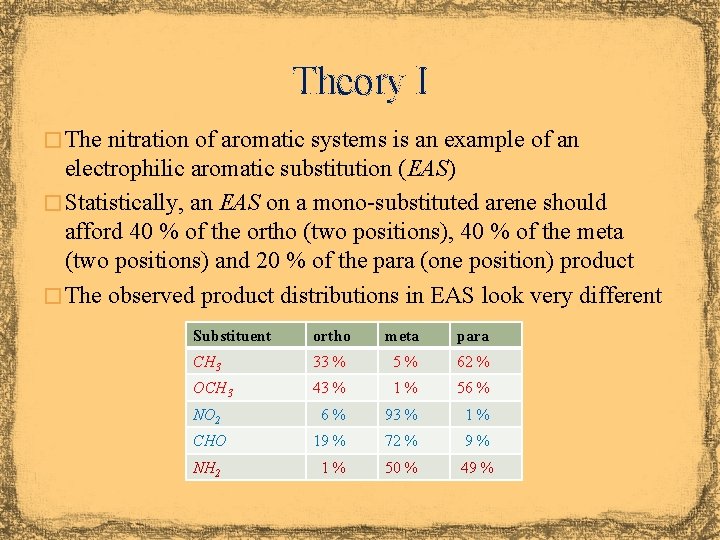
Theory I � The nitration of aromatic systems is an example of an electrophilic aromatic substitution (EAS) � Statistically, an EAS on a mono-substituted arene should afford 40 % of the ortho (two positions), 40 % of the meta (two positions) and 20 % of the para (one position) product � The observed product distributions in EAS look very different Substituent ortho meta para CH 3 33 % 5% 62 % OCH 3 43 % 1% 56 % NO 2 6% 93 % 1% CHO 19 % 72 % 9% NH 2 1% 50 % 49 %
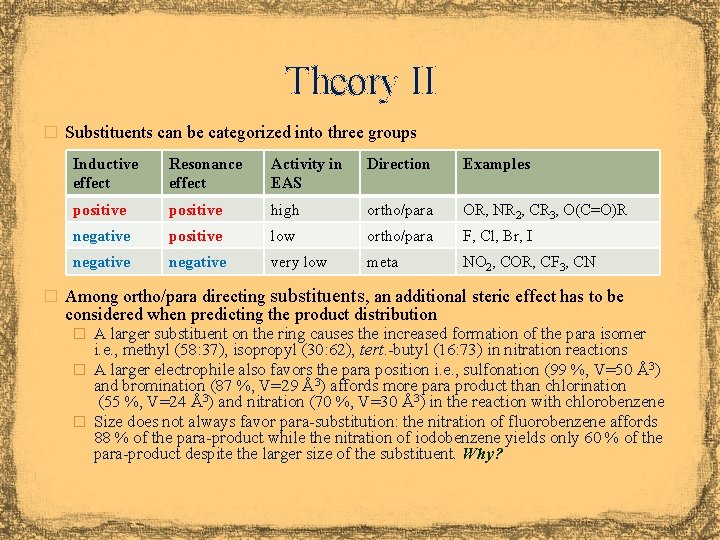
Theory II � Substituents can be categorized into three groups Inductive effect Resonance effect Activity in EAS Direction Examples positive high ortho/para OR, NR 2, CR 3, O(C=O)R negative positive low ortho/para F, Cl, Br, I negative very low meta NO 2, COR, CF 3, CN � Among ortho/para directing substituents, an additional steric effect has to be considered when predicting the product distribution � A larger substituent on the ring causes the increased formation of the para isomer i. e. , methyl (58: 37), isopropyl (30: 62), tert. -butyl (16: 73) in nitration reactions � A larger electrophile also favors the para position i. e. , sulfonation (99 %, V=50 Å3) and bromination (87 %, V=29 Å3) affords more para product than chlorination (55 %, V=24 Å3) and nitration (70 %, V=30 Å3) in the reaction with chlorobenzene � Size does not always favor para-substitution: the nitration of fluorobenzene affords 88 % of the para-product while the nitration of iodobenzene yields only 60 % of the para-product despite the larger size of the substituent. Why?
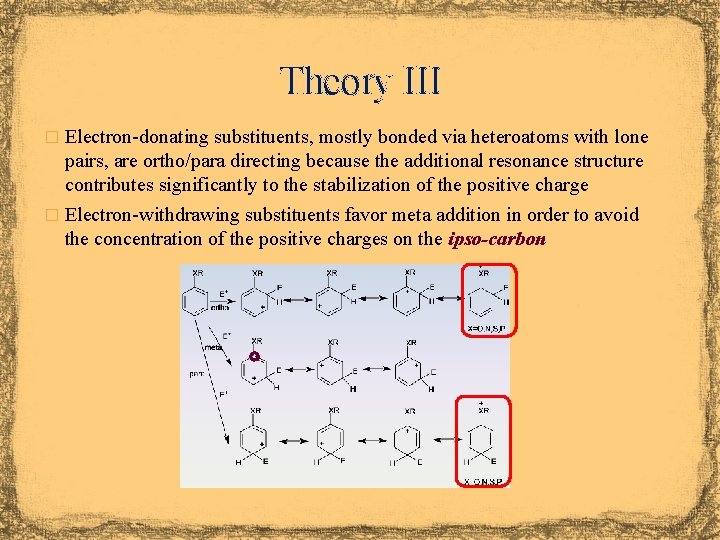
Theory III � Electron-donating substituents, mostly bonded via heteroatoms with lone pairs, are ortho/para directing because the additional resonance structure contributes significantly to the stabilization of the positive charge � Electron-withdrawing substituents favor meta addition in order to avoid the concentration of the positive charges on the ipso-carbon
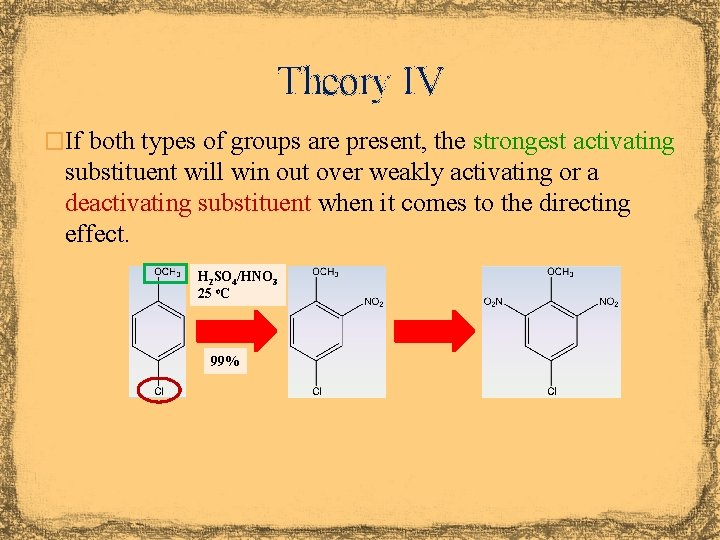
Theory IV �If both types of groups are present, the strongest activating substituent will win out over weakly activating or a deactivating substituent when it comes to the directing effect. H 2 SO 4/HNO 3 25 o. C 99%
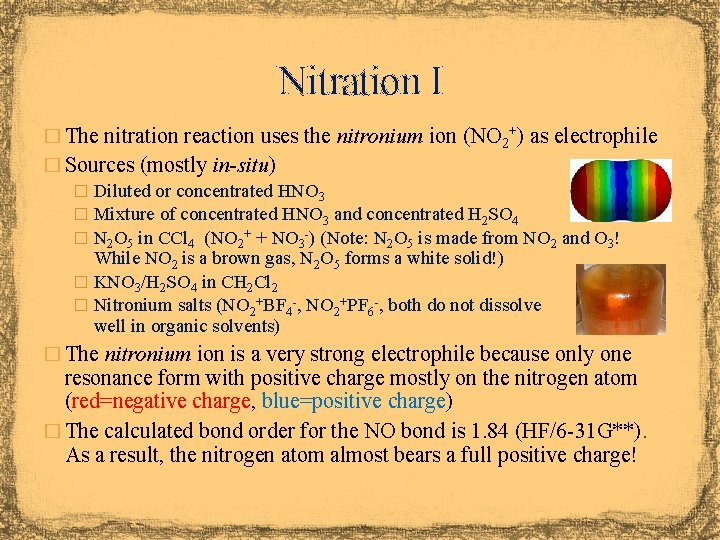
Nitration I � The nitration reaction uses the nitronium ion (NO 2+) as electrophile � Sources (mostly in-situ) � Diluted or concentrated HNO 3 � Mixture of concentrated HNO 3 and concentrated H 2 SO 4 � N 2 O 5 in CCl 4 (NO 2+ + NO 3 -) (Note: N 2 O 5 is made from NO 2 and O 3! While NO 2 is a brown gas, N 2 O 5 forms a white solid!) � KNO 3/H 2 SO 4 in CH 2 Cl 2 � Nitronium salts (NO 2+BF 4 -, NO 2+PF 6 -, both do not dissolve well in organic solvents) � The nitronium ion is a very strong electrophile because only one resonance form with positive charge mostly on the nitrogen atom (red=negative charge, blue=positive charge) � The calculated bond order for the NO bond is 1. 84 (HF/6 -31 G**). As a result, the nitrogen atom almost bears a full positive charge!
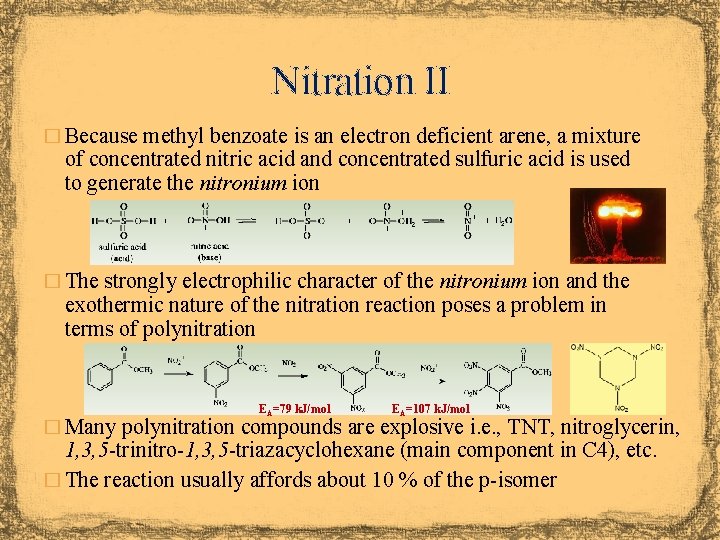
Nitration II � Because methyl benzoate is an electron deficient arene, a mixture of concentrated nitric acid and concentrated sulfuric acid is used to generate the nitronium ion � The strongly electrophilic character of the nitronium ion and the exothermic nature of the nitration reaction poses a problem in terms of polynitration EA=79 k. J/mol EA=107 k. J/mol � Many polynitration compounds are explosive i. e. , TNT, nitroglycerin, 1, 3, 5 -trinitro-1, 3, 5 -triazacyclohexane (main component in C 4), etc. � The reaction usually affords about 10 % of the p-isomer
Experimental I � Dissolve the methyl benzoate in � Why is the ester dissolved in conc. � Cool the mixture in an � What is an ice-bath? concentrated sulfuric acid? The ester is not soluble in the nitration mixture ice-bath A mixture of water and some ice � Slowly add the mixture of concentrated � Does the student have to prepare the nitric acid and concentrated sulfuric acid mixture himself? NO while stirring � Why is the mixture added slowly? To keep the temperature low � Why is it important to stir the mixture? To obtain a homogeneous mixture which provides better control � Which observations should the student make/not make? 1. Normally a color change to orange observed which is normal 2. The formation of a brown gas is a sign of undesirable side reactions
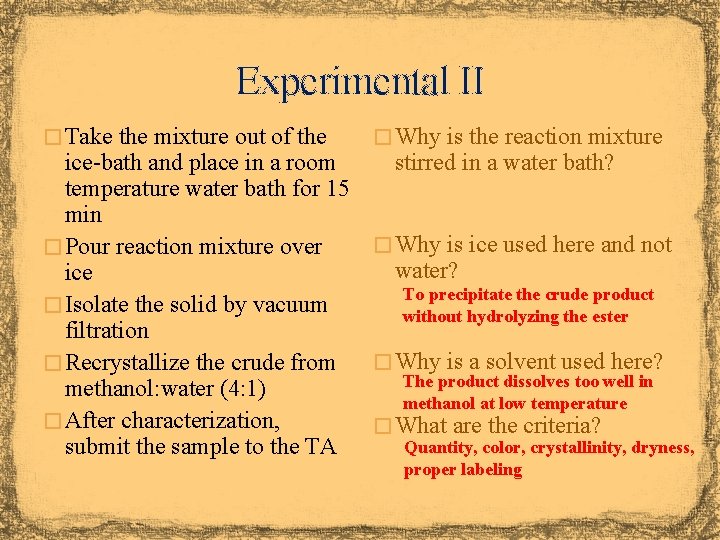
Experimental II � Take the mixture out of the � Why is the reaction mixture ice-bath and place in a room stirred in a water bath? temperature water bath for 15 min � Why is ice used here and not � Pour reaction mixture over water? ice To precipitate the crude product � Isolate the solid by vacuum without hydrolyzing the ester filtration � Why is a solvent used here? � Recrystallize the crude from The product dissolves too well in methanol: water (4: 1) methanol at low temperature � After characterization, � What are the criteria? Quantity, color, crystallinity, dryness, submit the sample to the TA proper labeling
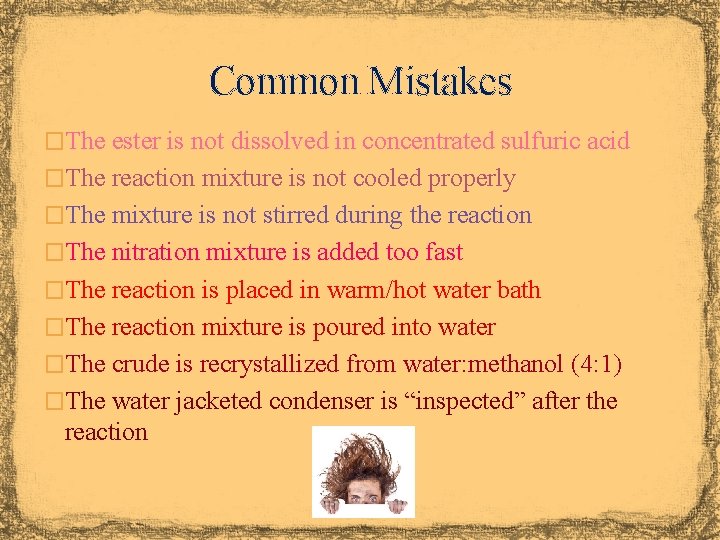
Common Mistakes �The ester is not dissolved in concentrated sulfuric acid �The reaction mixture is not cooled properly �The mixture is not stirred during the reaction �The nitration mixture is added too fast �The reaction is placed in warm/hot water bath �The reaction mixture is poured into water �The crude is recrystallized from water: methanol (4: 1) �The water jacketed condenser is “inspected” after the reaction
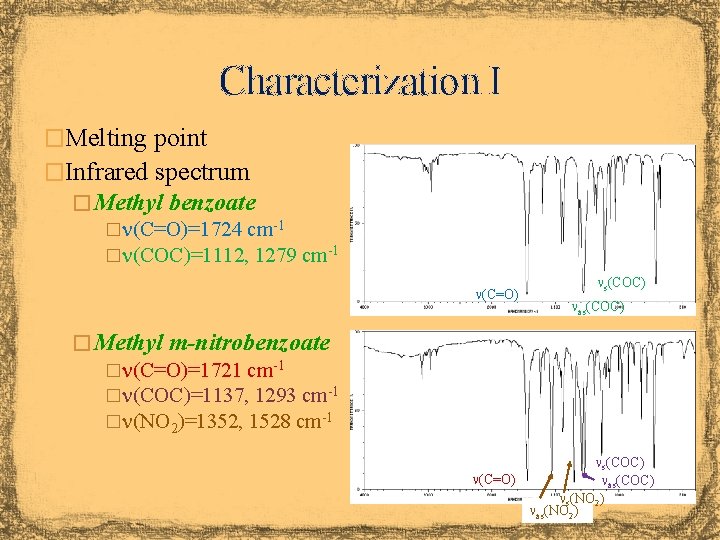
Characterization I �Melting point �Infrared spectrum � Methyl benzoate �n(C=O)=1724 cm-1 �n(COC)=1112, 1279 cm-1 n(C=O) ns(COC) nas(COC) � Methyl m-nitrobenzoate �n(C=O)=1721 cm-1 �n(COC)=1137, 1293 cm-1 �n(NO 2)=1352, 1528 cm-1 ns(COC) n(C=O) nas(COC) ns(NO 2) nas(NO 2)
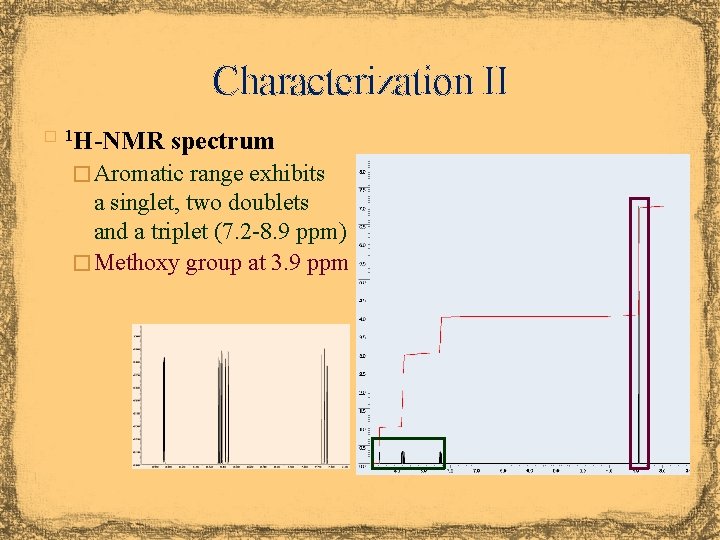
Characterization II H-NMR spectrum � 1 � Aromatic range exhibits a singlet, two doublets and a triplet (7. 2 -8. 9 ppm) � Methoxy group at 3. 9 ppm
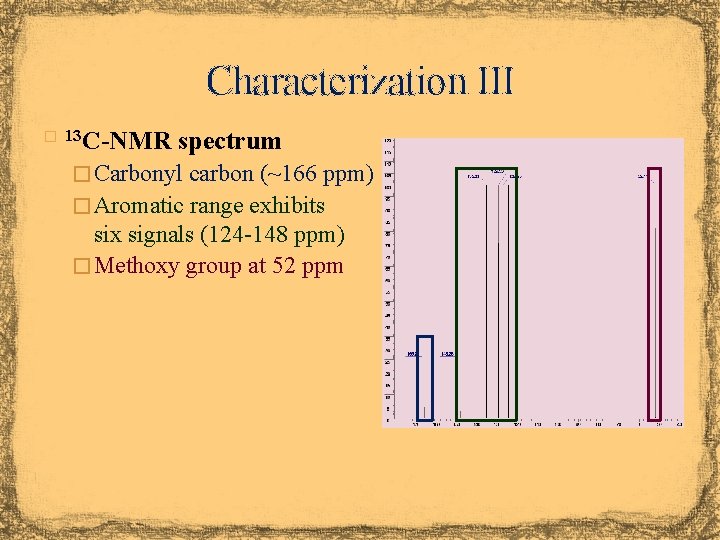
Characterization III � 13 C-NMR spectrum � Carbonyl carbon (~166 ppm) � Aromatic range exhibits six signals (124 -148 ppm) � Methoxy group at 52 ppm
![Characterization IV �Mass spectrum (EI) � m/z=181 ([M]+) � m/z=150 ([M-OCH 3)]+) � m/z=104](http://slidetodoc.com/presentation_image_h/d0dc6e9e8fd8c4f03c6a12ceb410000c/image-14.jpg "Characterization IV �Mass spectrum (EI) � m/z=181 ([M]+) � m/z=150 ([M-OCH 3)]+) � m/z=104")
Characterization IV �Mass spectrum (EI) � m/z=181 ([M]+) � m/z=150 ([M-OCH 3)]+) � m/z=104 ([M-OCH 3 -NO 2)]+)
- Slides: 14