
Lecture 11 Application of Photonics Optical Communication Telecommunications

- Slides: 41
Lecture 11 – Application of Photonics -Optical Communication
Telecommunications • Communications over 'long distances' • Information is encoded as signals – Signals are transmitted through a medium – Signals are directed to recipients • Many technologies – Electronic, radio, microwave – Fiber-optic, atmospheric optical
What is communicated? • Data – Telegrams – Computer data, telemetry, etc. – Internet e-mail, files, web pages • • Voice: telephone, radio Video: sound and images All are encoded as signals Systems are converging
Signal Structure • Signal modulates a carrier wave – Carrier wave is at much higher frequency • Amplitude modulation changes carrier intensity – Standard in fiber optics, AM radio • Frequency modulation changes carrier frequency – Standard for FM radio, television
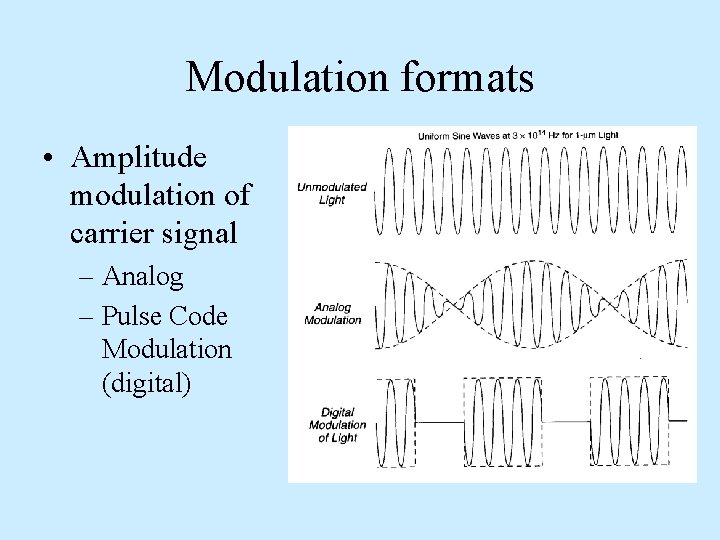
Modulation formats • Amplitude modulation of carrier signal – Analog – Pulse Code Modulation (digital)
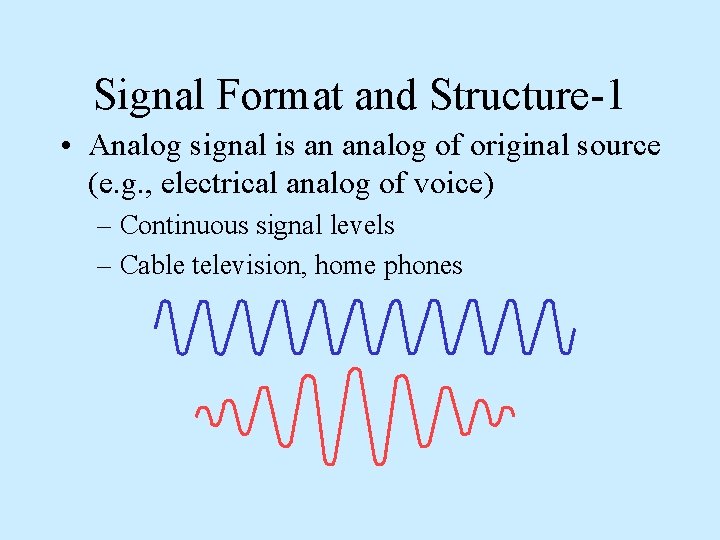
Signal Format and Structure-1 • Analog signal is an analog of original source (e. g. , electrical analog of voice) – Continuous signal levels – Cable television, home phones
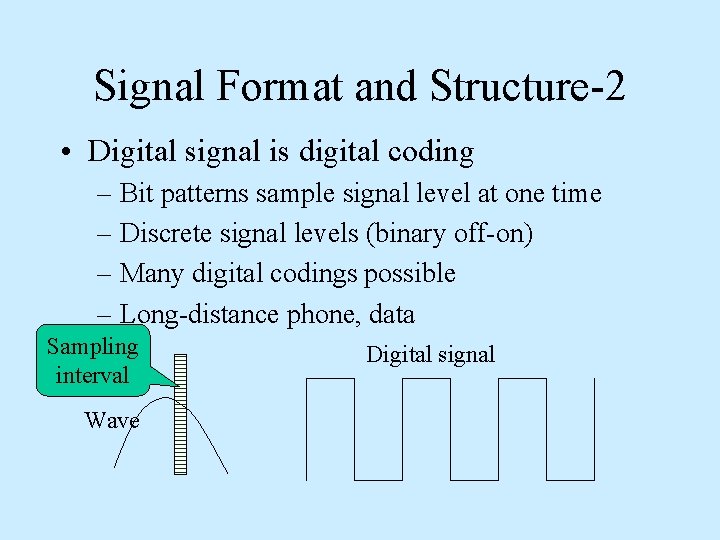
Signal Format and Structure-2 • Digital signal is digital coding – Bit patterns sample signal level at one time – Discrete signal levels (binary off-on) – Many digital codings possible – Long-distance phone, data Sampling interval Wave Digital signal
Bandwidth • Information per unit time – Frequency in Hertz (cycles per second) – Bits per second • Depends on signal source and format – HDTV is highest video, analog NTSC lower – Stereo music more than telephone audio • Capacity depends on transmission medium • May vary with length of medium
Multiplexing • • • Combines two or more signals Multiple signals sent over one path Dates back to telegraph Reduces costs Type – Frequency-division – Time-division – Wavelength-division
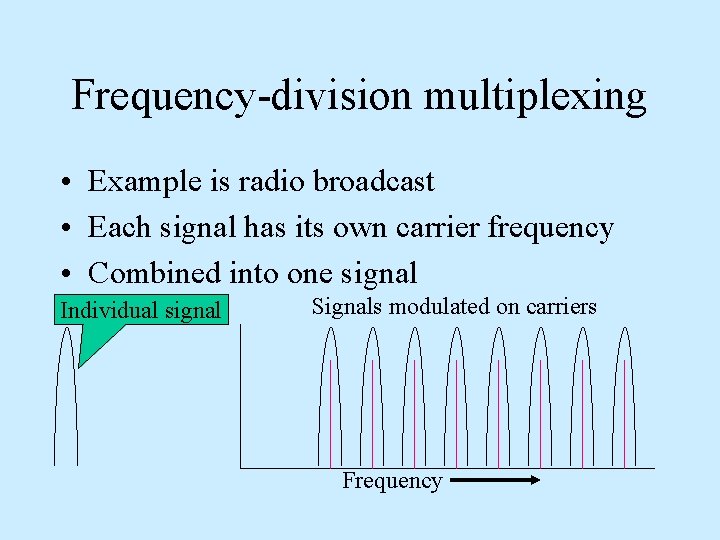
Frequency-division multiplexing • Example is radio broadcast • Each signal has its own carrier frequency • Combined into one signal Individual signal Signals modulated on carriers Frequency
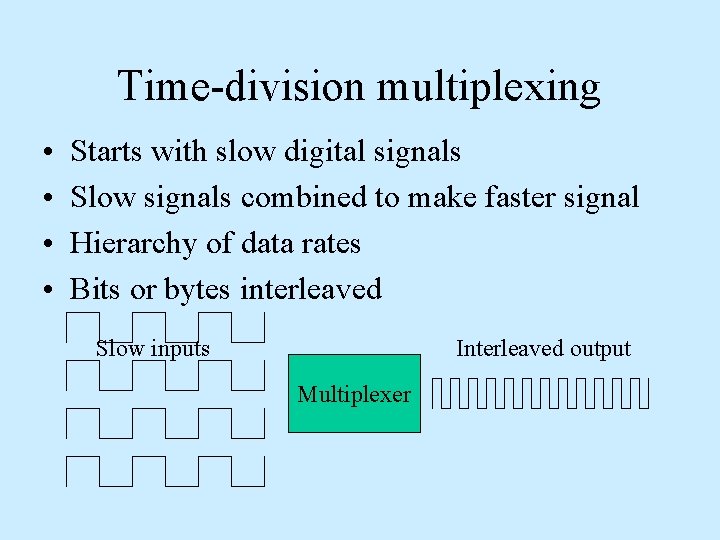
Time-division multiplexing • • Starts with slow digital signals Slow signals combined to make faster signal Hierarchy of data rates Bits or bytes interleaved Slow inputs Interleaved output Multiplexer
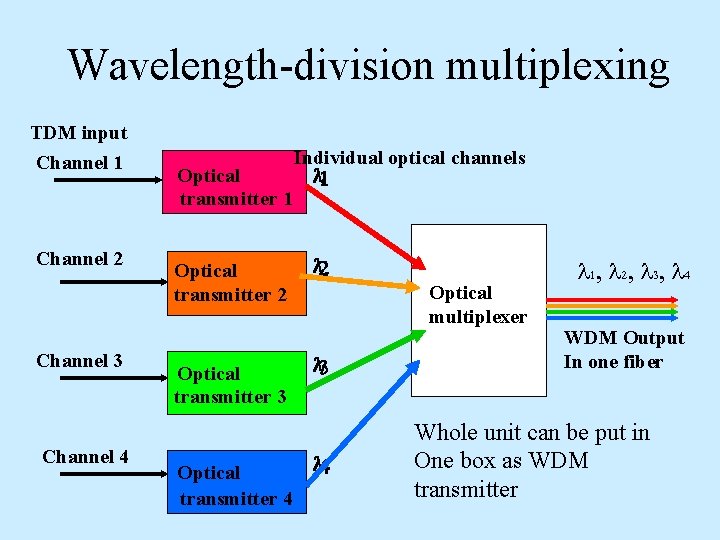
Wavelength-division multiplexing TDM input Channel 1 Channel 2 Channel 3 Channel 4 Optical transmitter 1 Optical transmitter 2 Optical transmitter 3 Individual optical channels l 1 l 2 Optical multiplexer l 3 l 4 Optical transmitter 4 l 1, l 2, l 3, l 4 WDM Output In one fiber Whole unit can be put in One box as WDM transmitter
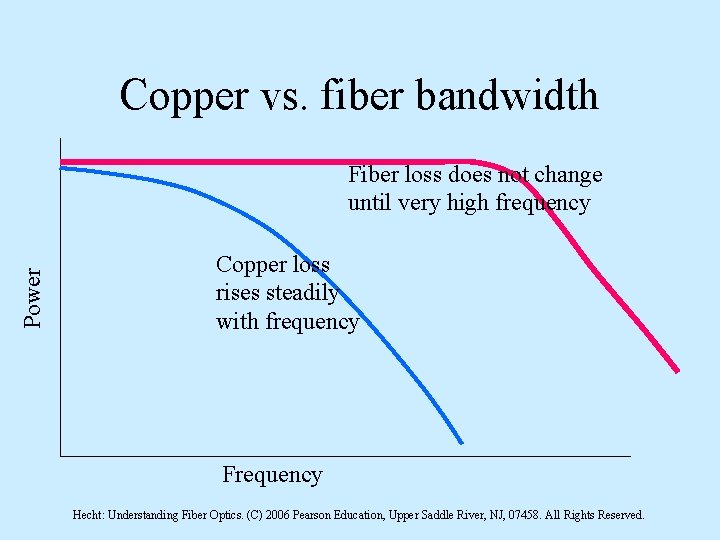
Transmission distance • Key figure of merit • Depends on – Transmitter power – Receiver sensitivity – Attenuation • May vary with signal bandwidth – Copper attenuation increases with frequency
Networks & Connectivity • Network distributes signals • Types of connectivity – Point to point – Point to multipoint (broadcast) – Switched – Networked
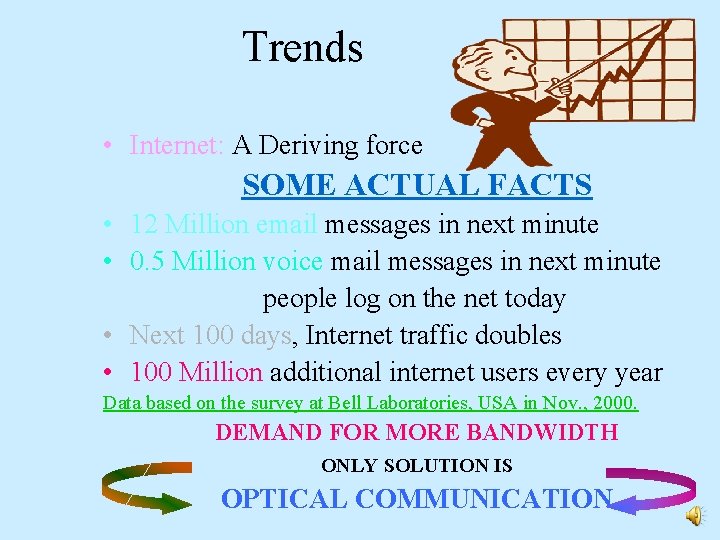
Trends • Internet: A Deriving force SOME ACTUAL FACTS • • • 12 Million email messages in next minute 0. 5 Million voice mail messages in next minute 3. 7 Million people log on the net today Next 100 days, Internet traffic doubles 100 Million additional internet users every year Data based on the survey at Bell Laboratories, USA in Nov. , 2000. DEMAND FOR MORE BANDWIDTH ONLY SOLUTION IS OPTICAL COMMUNICATION
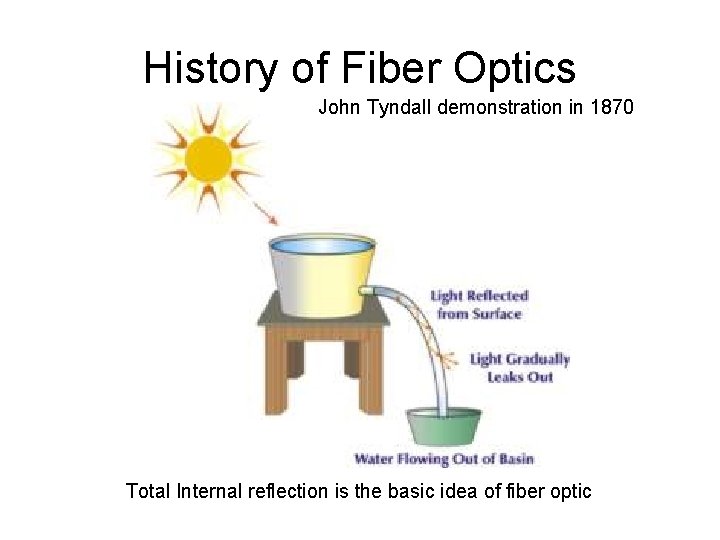
History of Fiber Optics John Tyndall demonstration in 1870 Total Internal reflection is the basic idea of fiber optic
Fiber-optic communication is a method of transmitting information from one place to another by sending light through an optical fiber. The light forms an electromagnetic carrier wave that is modulated to carry information.
Fiber-optic communication The process of communicating using fiberoptics involves the following basic steps: Creating the optical signal using a transmitter, relaying the signal along the fiber, ensuring that the signal does not become too distorted or weak, and receiving the optical signal and converting it into an electrical signal.
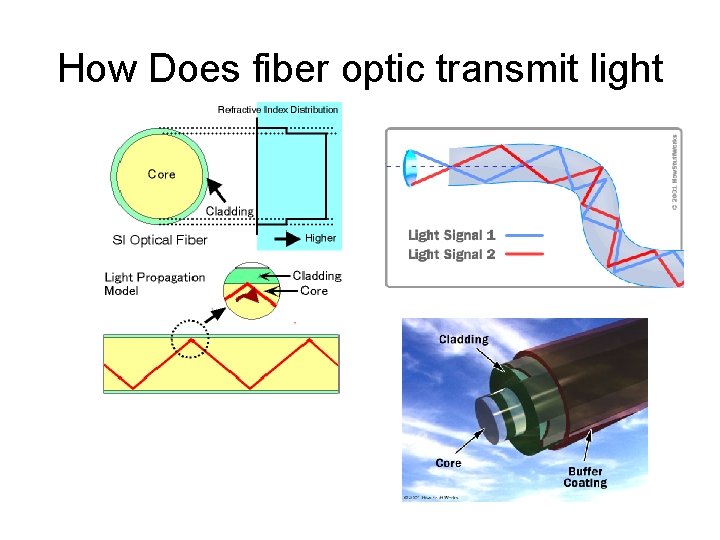
How Does fiber optic transmit light
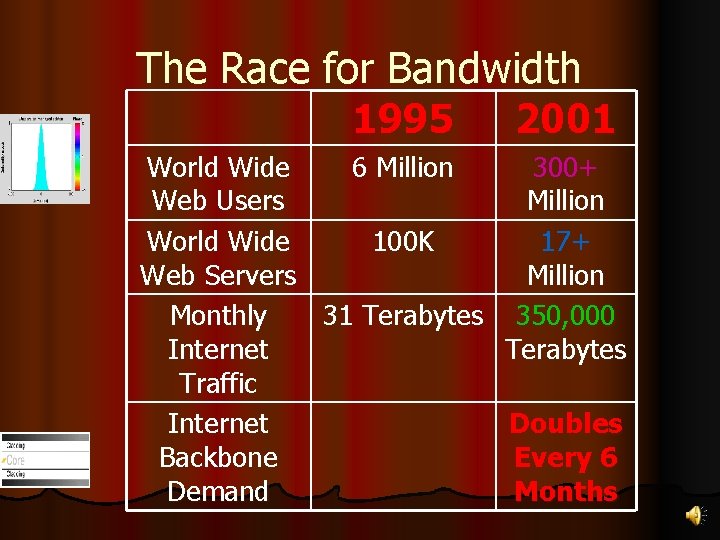
The Race for Bandwidth 1995 2001 World Wide 6 Million 300+ Web Users Million World Wide 100 K 17+ Web Servers Million Monthly 31 Terabytes 350, 000 Internet Terabytes Traffic Internet Doubles Backbone Every 6 Demand Months
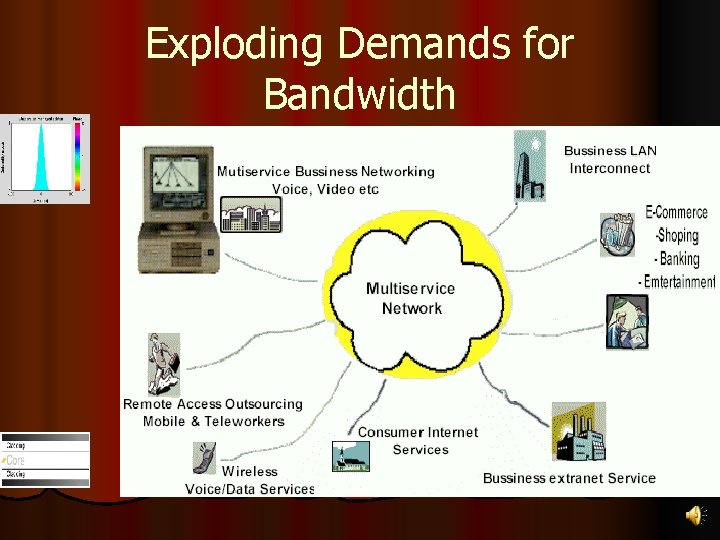
Exploding Demands for Bandwidth
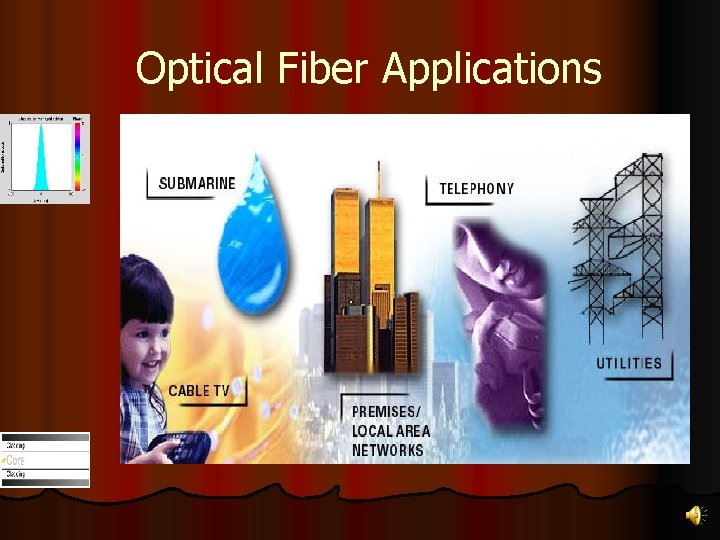
Optical Fiber Applications
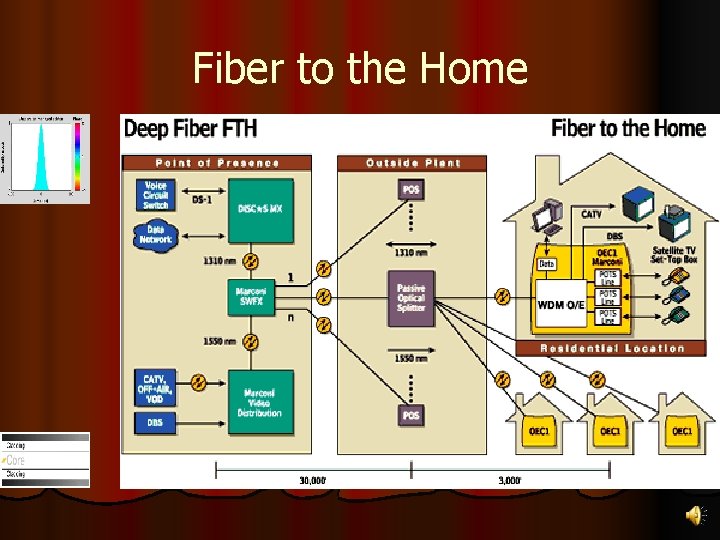
Fiber to the Home
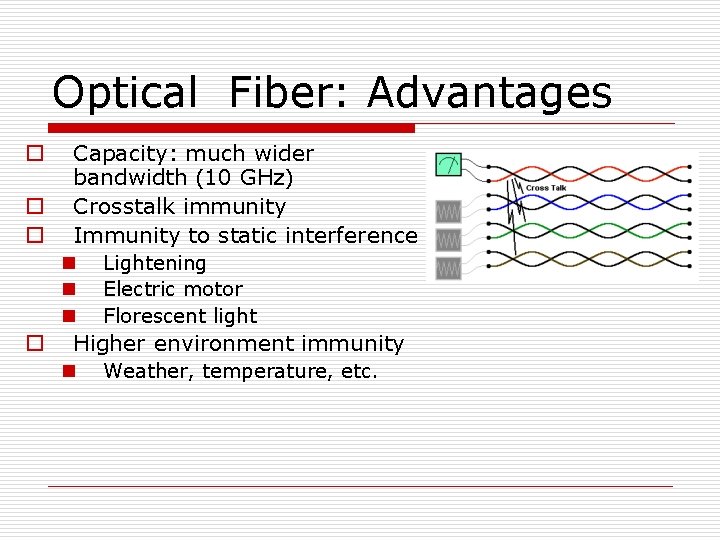
Optical Fiber: Advantages o o o Capacity: much wider bandwidth (10 GHz) Crosstalk immunity Immunity to static interference n n n o Lightening Electric motor Florescent light Higher environment immunity n Weather, temperature, etc.
Optical Fiber: Advantages o Safety: Fiber is non-metalic n o o o No explosion, no chock Longer lasting Security: tapping is difficult Economics: Fewer repeaters n Low transmission loss (d. B/km) n n Fewer repeaters Less cable Remember: Fiber is non-conductive Hence, change of magnetic field has No impact!
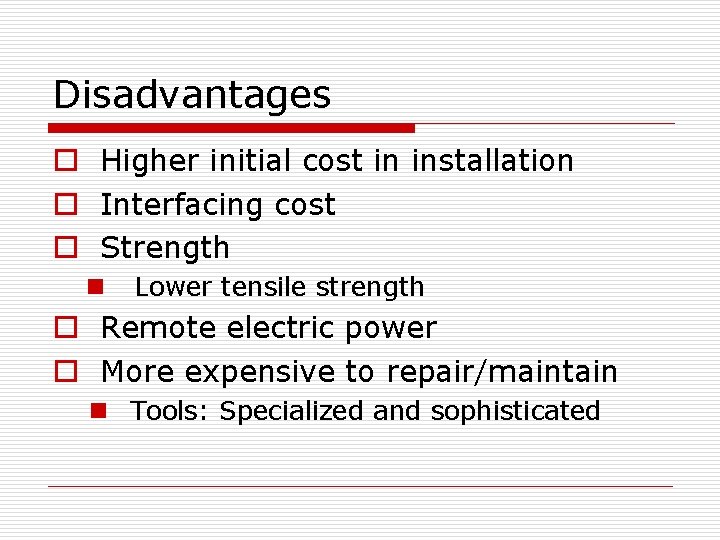
Disadvantages o Higher initial cost in installation o Interfacing cost o Strength n Lower tensile strength o Remote electric power o More expensive to repair/maintain n Tools: Specialized and sophisticated
Copper vs. fiber bandwidth Power Fiber loss does not change until very high frequency Copper loss rises steadily with frequency Frequency Hecht: Understanding Fiber Optics. (C) 2006 Pearson Education, Upper Saddle River, NJ, 07458. All Rights Reserved.
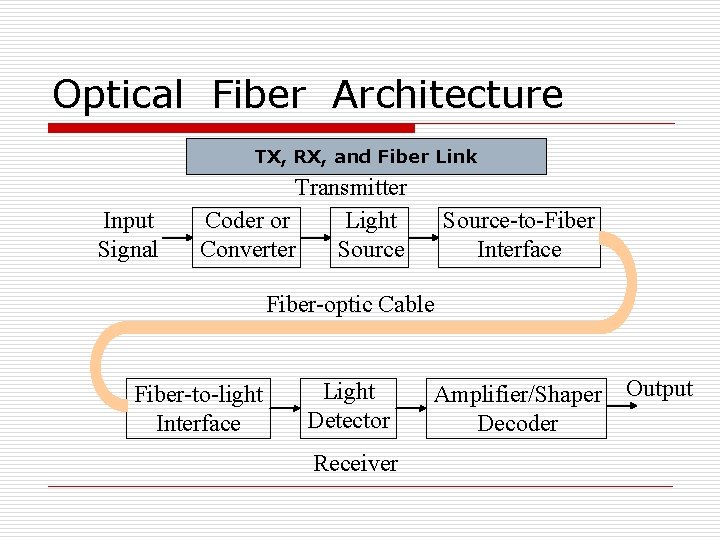
Optical Fiber Architecture TX, RX, and Fiber Link Input Signal Transmitter Coder or Light Converter Source-to-Fiber Interface Fiber-optic Cable Fiber-to-light Interface Light Detector Receiver Amplifier/Shaper Decoder Output
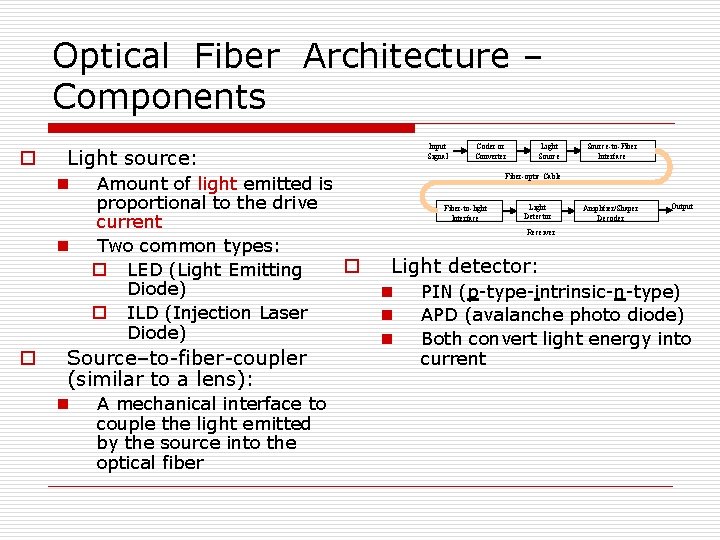
Optical Fiber Architecture – Components o Light source: n n o Input Signal Amount of light emitted is proportional to the drive current Two common types: o o LED (Light Emitting Diode) o ILD (Injection Laser Diode) Source–to-fiber-coupler (similar to a lens): n A mechanical interface to couple the light emitted by the source into the optical fiber Coder or Converter Light Source-to-Fiber Interface Fiber-optic Cable Fiber-to-light Interface Light Detector Amplifier/Shaper Decoder Output Receiver Light detector: n n n PIN (p-type-intrinsic-n-type) APD (avalanche photo diode) Both convert light energy into current
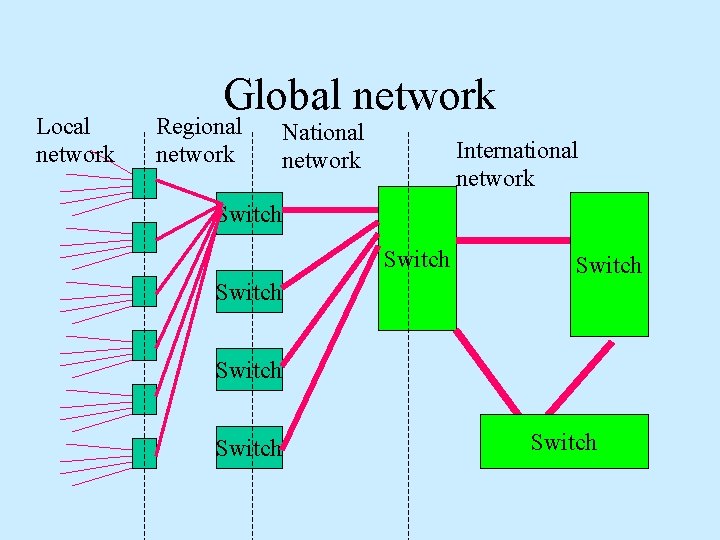
Local network Global network Regional network National network International network Switch Switch
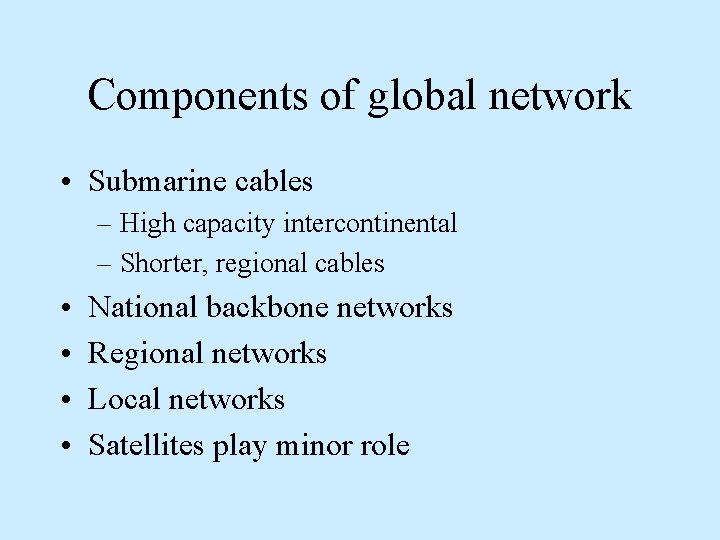
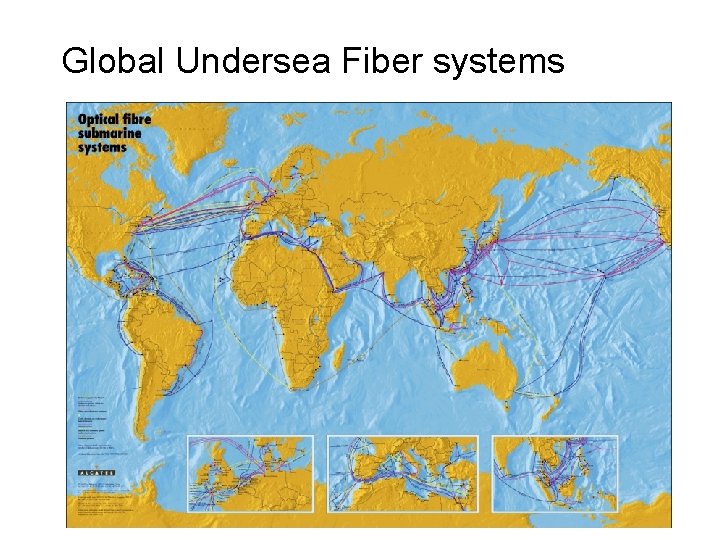
Components of global network • Submarine cables – High capacity intercontinental – Shorter, regional cables • • National backbone networks Regional networks Local networks Satellites play minor role
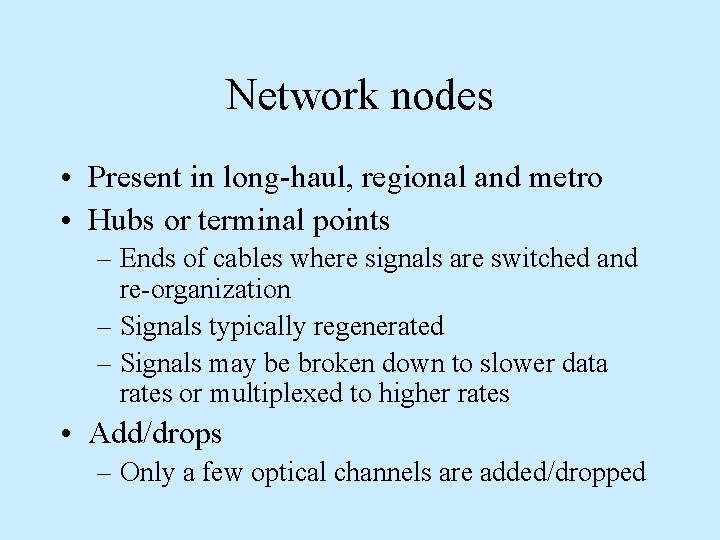
Network nodes • Present in long-haul, regional and metro • Hubs or terminal points – Ends of cables where signals are switched and re-organization – Signals typically regenerated – Signals may be broken down to slower data rates or multiplexed to higher rates • Add/drops – Only a few optical channels are added/dropped
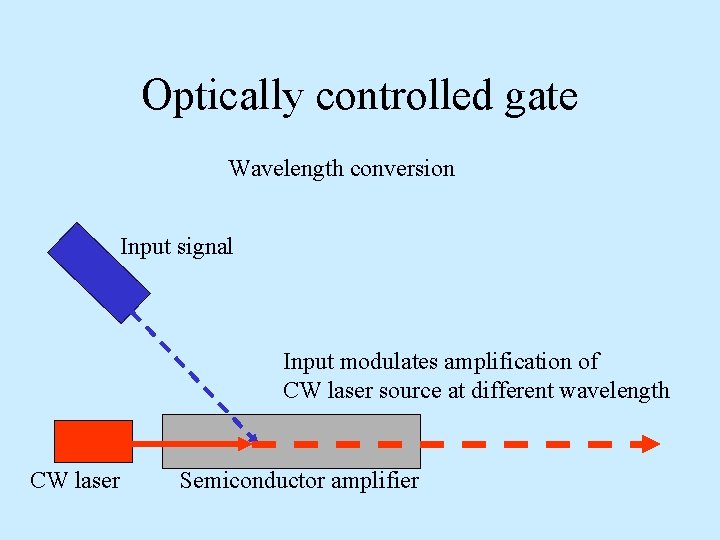
Optically controlled gate Wavelength conversion Input signal Input modulates amplification of CW laser source at different wavelength CW laser Semiconductor amplifier
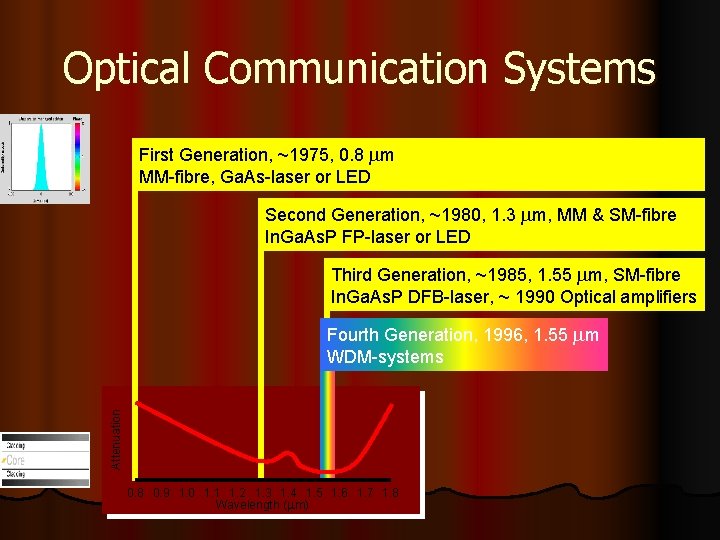
Optical Communication Systems First Generation, ~1975, 0. 8 mm MM-fibre, Ga. As-laser or LED Second Generation, ~1980, 1. 3 mm, MM & SM-fibre In. Ga. As. P FP-laser or LED Third Generation, ~1985, 1. 55 mm, SM-fibre In. Ga. As. P DFB-laser, ~ 1990 Optical amplifiers Attenuation Fourth Generation, 1996, 1. 55 mm WDM-systems 0. 8 0. 9 1. 0 1. 1 1. 2 1. 3 1. 4 1. 5 1. 6 1. 7 1. 8 Wavelength (mm)
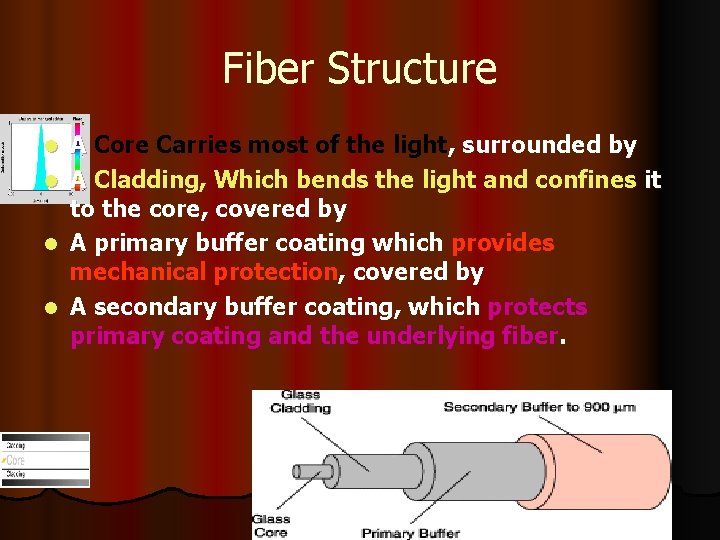
Fiber Structure l l A Core Carries most of the light, surrounded by A Cladding, Which bends the light and confines it to the core, covered by A primary buffer coating which provides mechanical protection, covered by A secondary buffer coating, which protects primary coating and the underlying fiber.
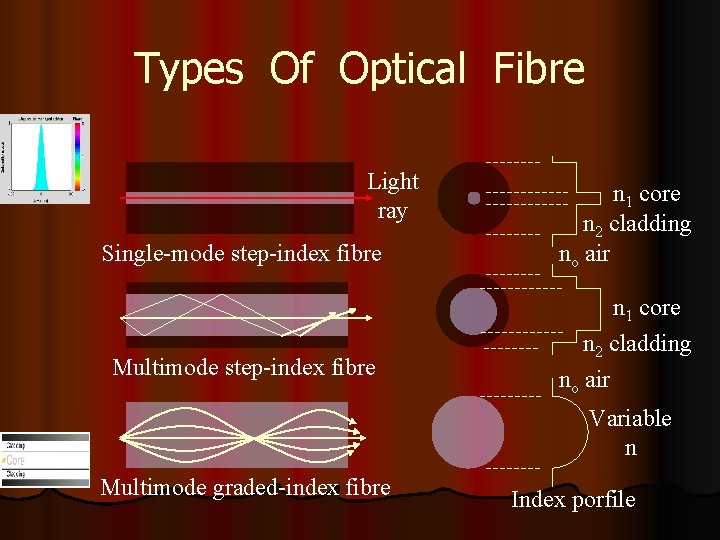
Types Of Optical Fibre Light ray Single-mode step-index fibre Multimode step-index fibre n 1 core n 2 cladding no air Variable n Multimode graded-index fibre Index porfile
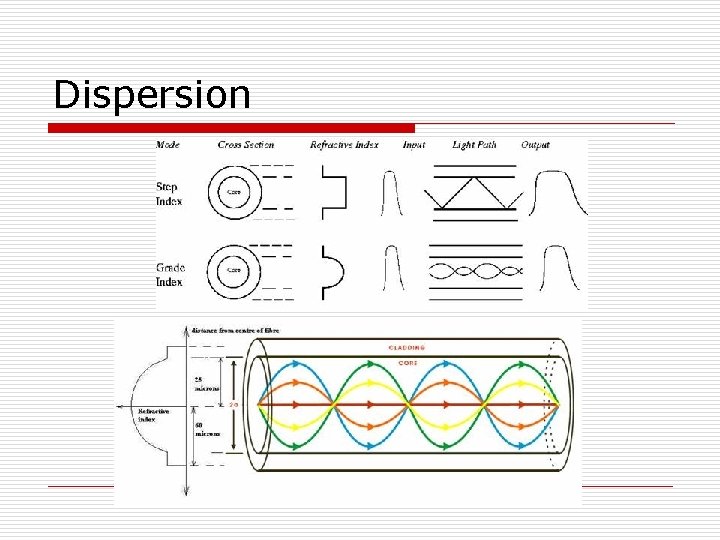
Dispersion
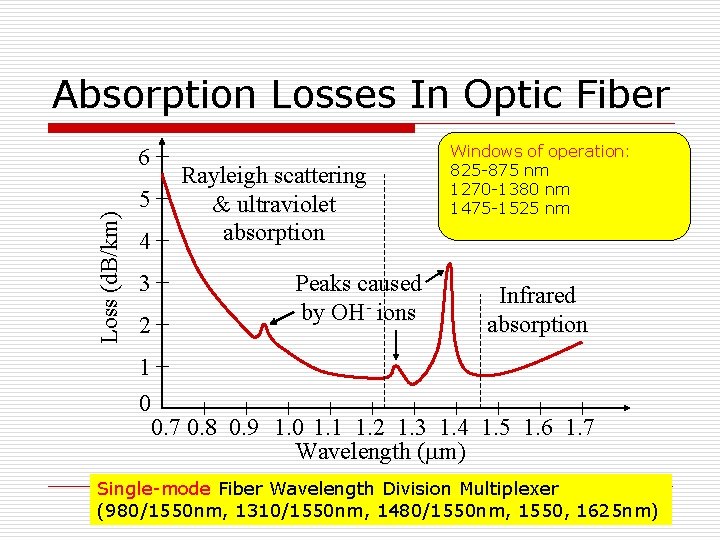
Absorption Losses In Optic Fiber Loss (d. B/km) 6 5 4 3 2 1 0 Rayleigh scattering & ultraviolet absorption Peaks caused by OH- ions Windows of operation: 825 -875 nm 1270 -1380 nm 1475 -1525 nm Infrared absorption 0. 7 0. 8 0. 9 1. 0 1. 1 1. 2 1. 3 1. 4 1. 5 1. 6 1. 7 Wavelength (mm) Single-mode Fiber Wavelength Division Multiplexer (980/1550 nm, 1310/1550 nm, 1480/1550 nm, 1550, 1625 nm)
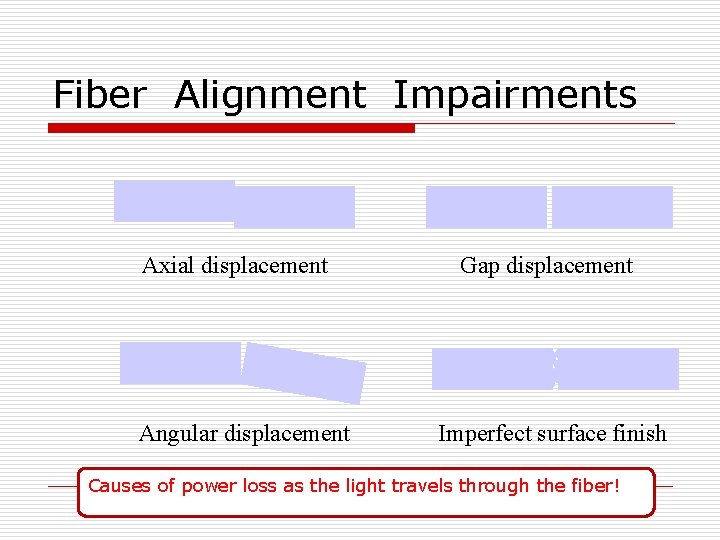
Fiber Alignment Impairments Axial displacement Angular displacement Gap displacement Imperfect surface finish Causes of power loss as the light travels through the fiber!
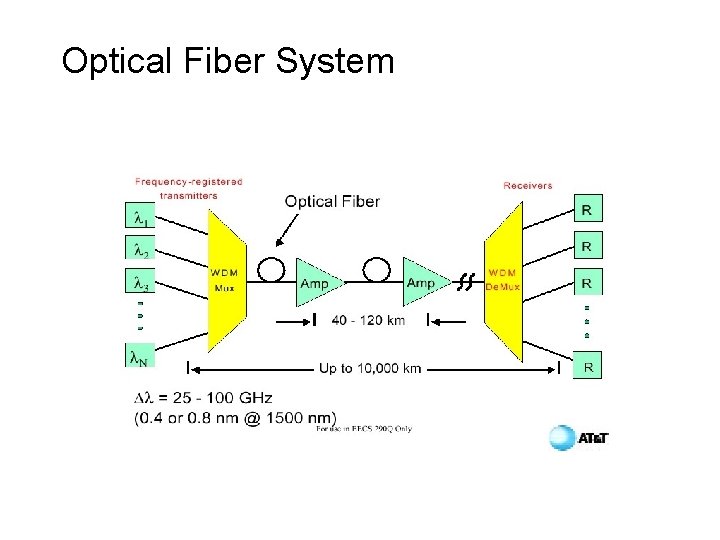
Optical Fiber System
Global Undersea Fiber systems