
Lecture 11 Algae Bryophytes and Ferns Kingdom Protista
Lecture 11: Algae, Bryophytes and Ferns • Kingdom Protista: Algae • Red algae, diatoms, kelps, dinoflagellates, green algae • Significance of algae to humans • Kingdom Plantae: moving onto land • Features and challenges for living on land • Bryophytes • Ferns
ALGAE • Algae belong to the Kingdom Protista • Algae are eukaryotes (cells have organelles) • Algae are mostly photosynthetic, like plants: – Have 4 kinds of photosynthetic pigments – Many accessory pigments – blue, red, brown, gold • Require moist environments because they lack a waxy cuticle (remember: cuticle prevents water loss in terrestrial plants)
General features of Algae • Can be microscopic or macroscopic: size ranges from bacteria size to 50 meters long! • Lack vascular (conducting) tissues – No xylem or phloem – No true roots, stems or leaves • Modes of sexual reproduction: – Both sexual and asexual • Algae illustrate the importance of photosynthesis to the Earth’s ecology!
Diversity of Algae • There are millions of algal species, but we’ll focus in these five groups: • • • Diatoms Dinoflagellates Red Algae Kelps or Brown Algae Green algae
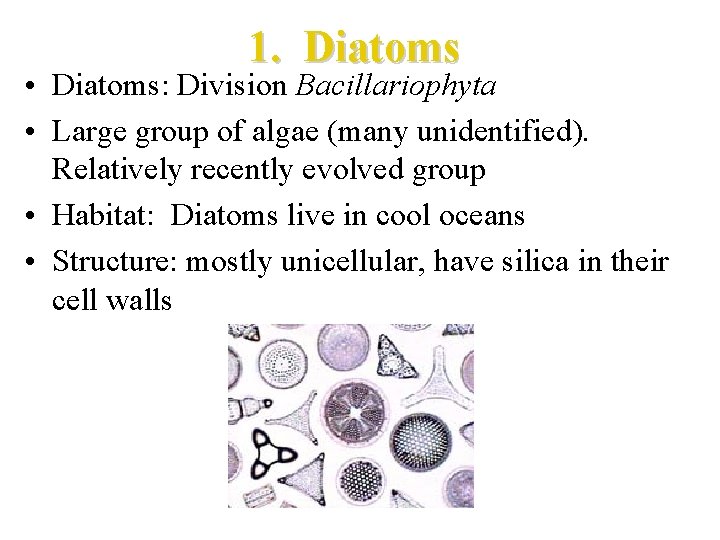
1. Diatoms • Diatoms: Division Bacillariophyta • Large group of algae (many unidentified). Relatively recently evolved group • Habitat: Diatoms live in cool oceans • Structure: mostly unicellular, have silica in their cell walls
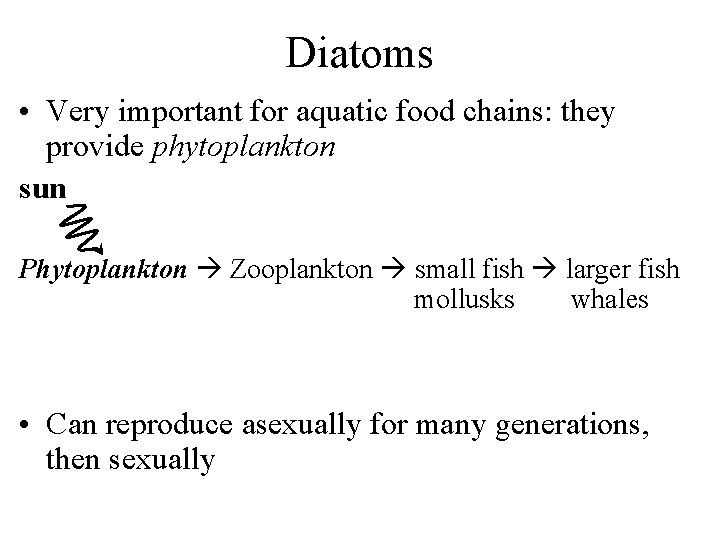
Diatoms • Very important for aquatic food chains: they provide phytoplankton sun Phytoplankton Zooplankton small fish larger fish mollusks whales • Can reproduce asexually for many generations, then sexually

3. Red Algae • Red algae: Division Rhodophyta (4000 species) • Are some of the oldest eukaryotic organisms on earth (2 billion year old fossils) • Abound in tropical, warm waters • Act as food and habitat for many marine species • Structure: from thin films to complex filamentous membranes
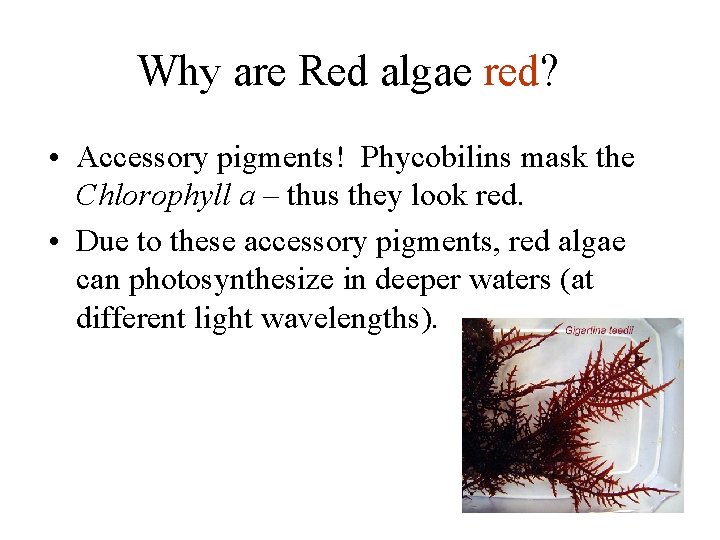
Why are Red algae red? • Accessory pigments! Phycobilins mask the Chlorophyll a – thus they look red. • Due to these accessory pigments, red algae can photosynthesize in deeper waters (at different light wavelengths).
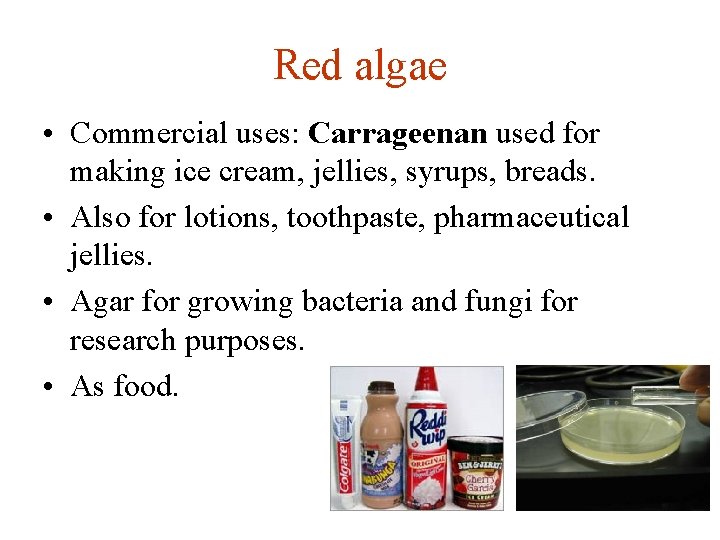
Red algae • Commercial uses: Carrageenan used for making ice cream, jellies, syrups, breads. • Also for lotions, toothpaste, pharmaceutical jellies. • Agar for growing bacteria and fungi for research purposes. • As food.
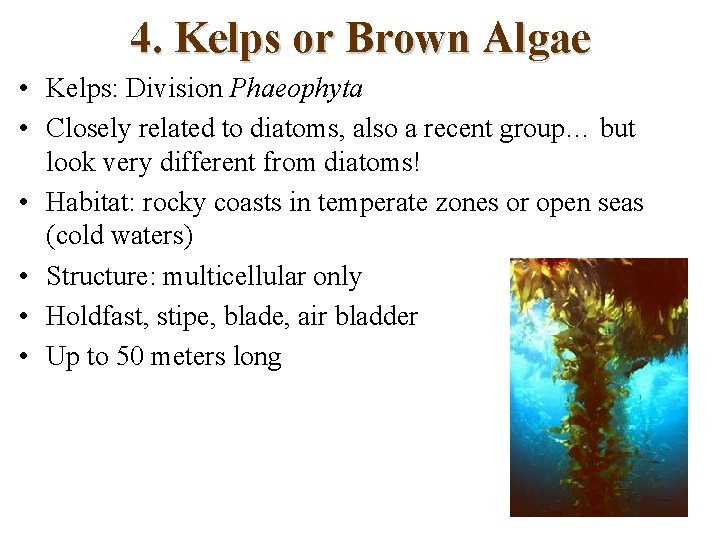
4. Kelps or Brown Algae • Kelps: Division Phaeophyta • Closely related to diatoms, also a recent group… but look very different from diatoms! • Habitat: rocky coasts in temperate zones or open seas (cold waters) • Structure: multicellular only • Holdfast, stipe, blade, air bladder • Up to 50 meters long
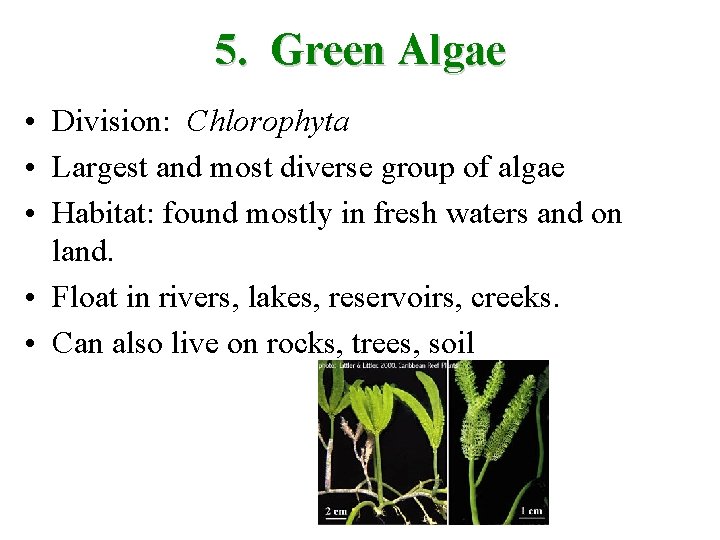
5. Green Algae • Division: Chlorophyta • Largest and most diverse group of algae • Habitat: found mostly in fresh waters and on land. • Float in rivers, lakes, reservoirs, creeks. • Can also live on rocks, trees, soil
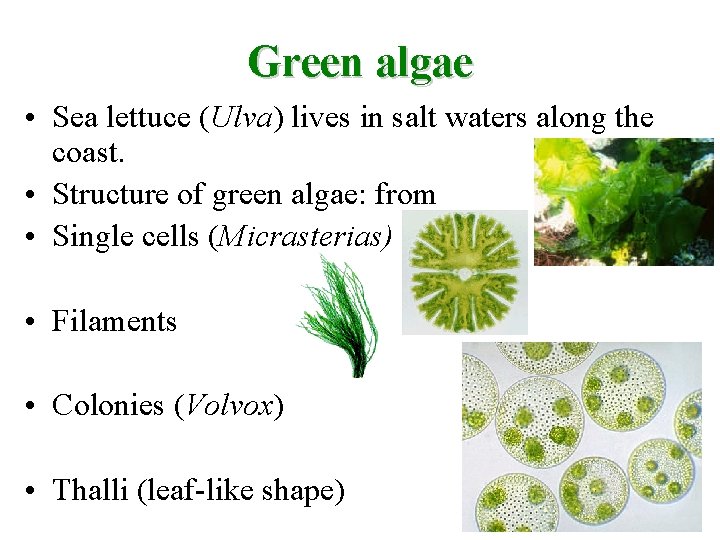
Green algae • Sea lettuce (Ulva) lives in salt waters along the coast. • Structure of green algae: from • Single cells (Micrasterias) • Filaments • Colonies (Volvox) • Thalli (leaf-like shape)
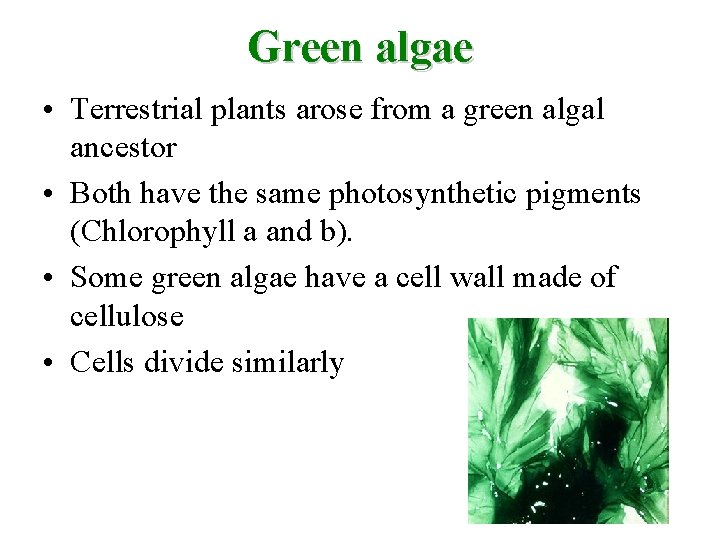
Green algae • Terrestrial plants arose from a green algal ancestor • Both have the same photosynthetic pigments (Chlorophyll a and b). • Some green algae have a cell wall made of cellulose • Cells divide similarly
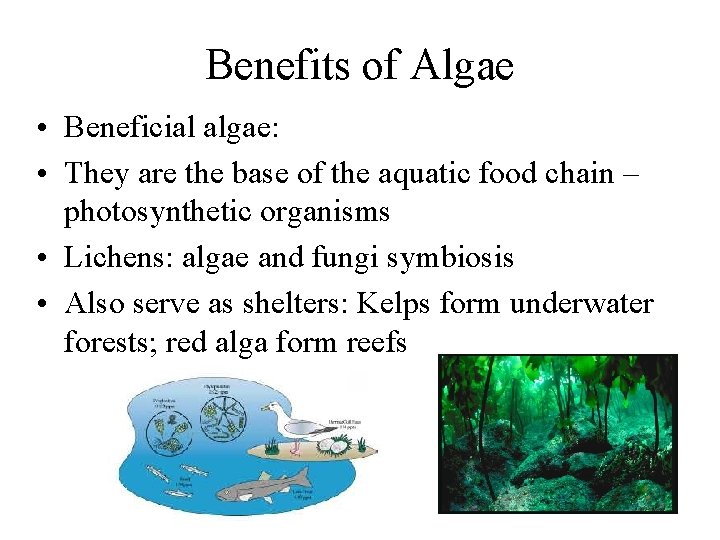
Benefits of Algae • Beneficial algae: • They are the base of the aquatic food chain – photosynthetic organisms • Lichens: algae and fungi symbiosis • Also serve as shelters: Kelps form underwater forests; red alga form reefs
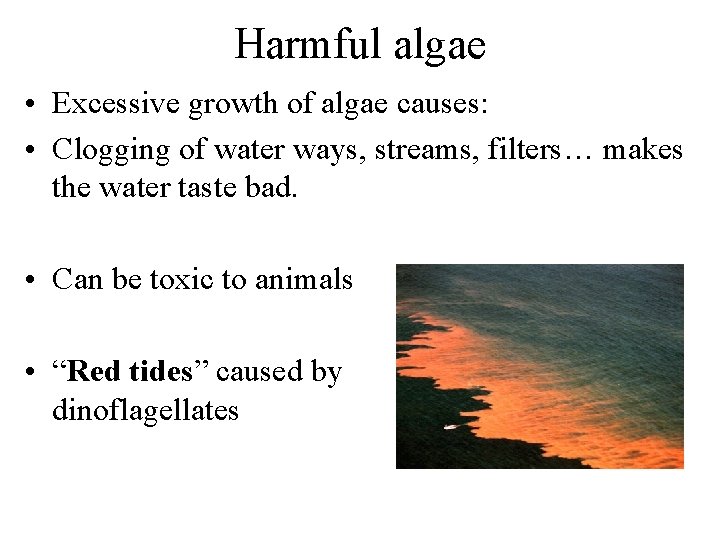
Harmful algae • Excessive growth of algae causes: • Clogging of water ways, streams, filters… makes the water taste bad. • Can be toxic to animals • “Red tides” caused by dinoflagellates
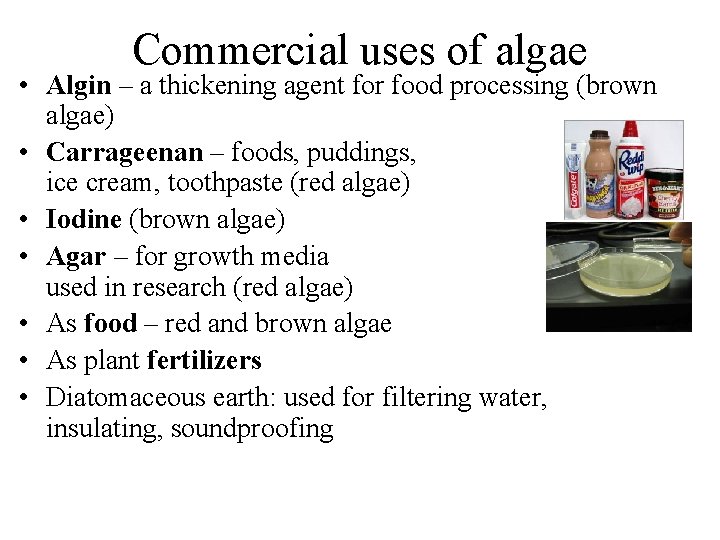
Commercial uses of algae • Algin – a thickening agent for food processing (brown algae) • Carrageenan – foods, puddings, ice cream, toothpaste (red algae) • Iodine (brown algae) • Agar – for growth media used in research (red algae) • As food – red and brown algae • As plant fertilizers • Diatomaceous earth: used for filtering water, insulating, soundproofing
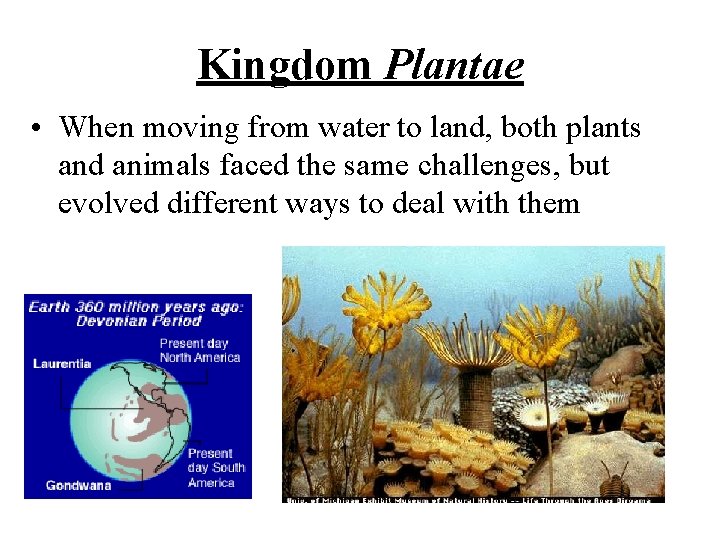
Kingdom Plantae • When moving from water to land, both plants and animals faced the same challenges, but evolved different ways to deal with them
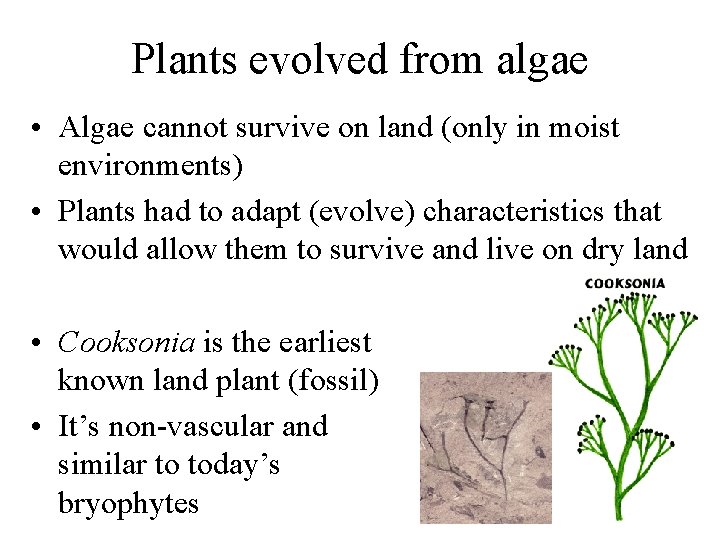
Plants evolved from algae • Algae cannot survive on land (only in moist environments) • Plants had to adapt (evolve) characteristics that would allow them to survive and live on dry land • Cooksonia is the earliest known land plant (fossil) • It’s non-vascular and similar to today’s bryophytes
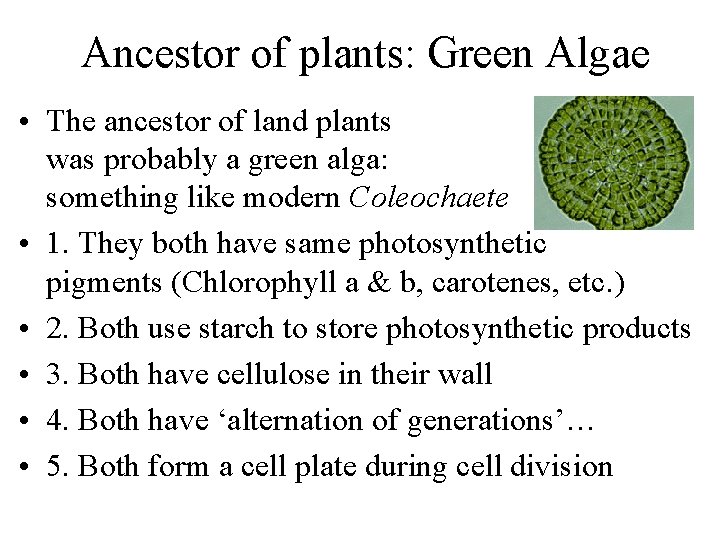
Ancestor of plants: Green Algae • The ancestor of land plants was probably a green alga: something like modern Coleochaete • 1. They both have same photosynthetic pigments (Chlorophyll a & b, carotenes, etc. ) • 2. Both use starch to store photosynthetic products • 3. Both have cellulose in their wall • 4. Both have ‘alternation of generations’… • 5. Both form a cell plate during cell division
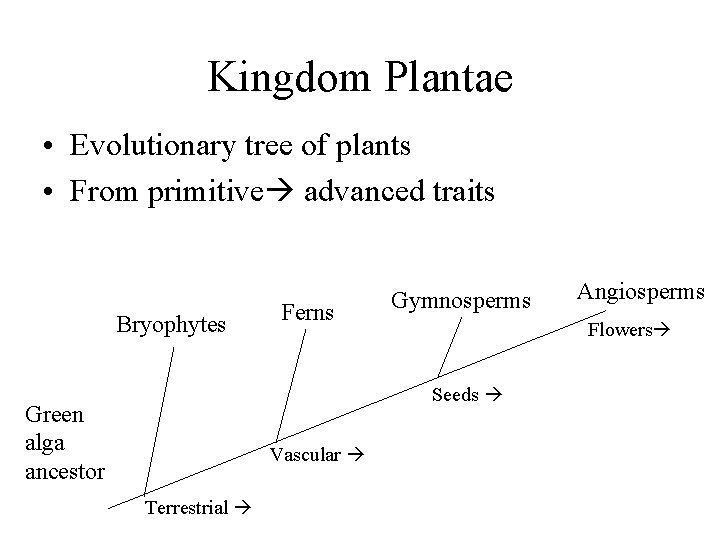
Kingdom Plantae • Evolutionary tree of plants • From primitive advanced traits Bryophytes Ferns Gymnosperms Flowers Seeds Green alga ancestor Vascular Terrestrial Angiosperms
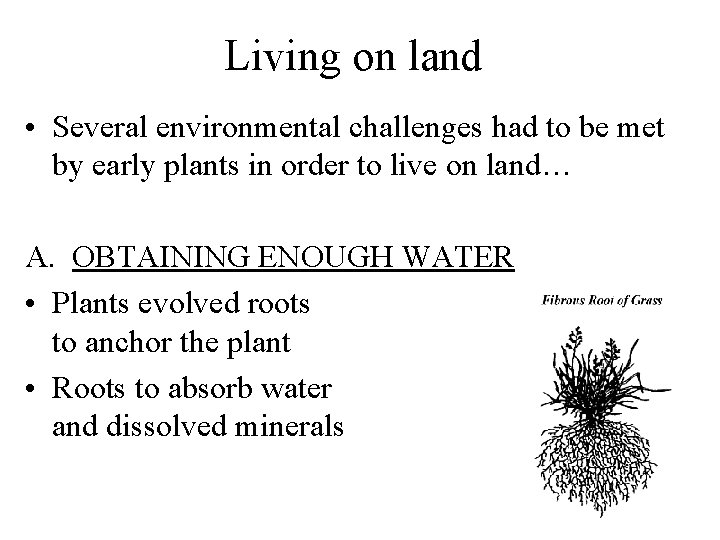
Living on land • Several environmental challenges had to be met by early plants in order to live on land… A. OBTAINING ENOUGH WATER • Plants evolved roots to anchor the plant • Roots to absorb water and dissolved minerals
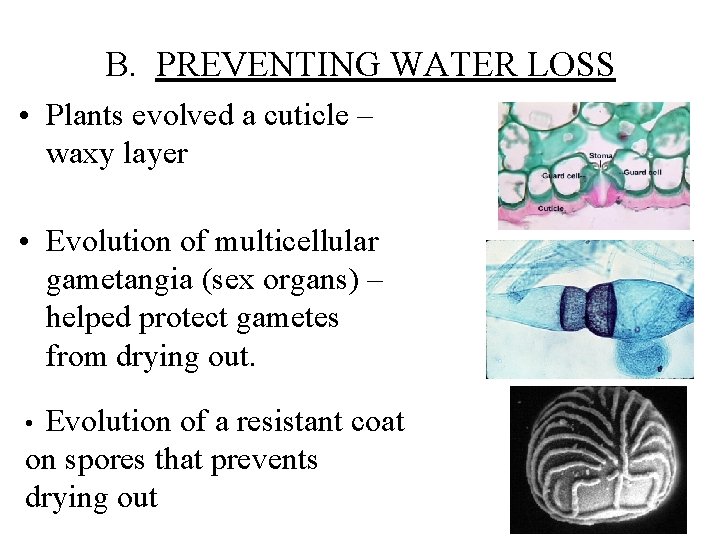
B. PREVENTING WATER LOSS • Plants evolved a cuticle – waxy layer • Evolution of multicellular gametangia (sex organs) – helped protect gametes from drying out. Evolution of a resistant coat on spores that prevents drying out •
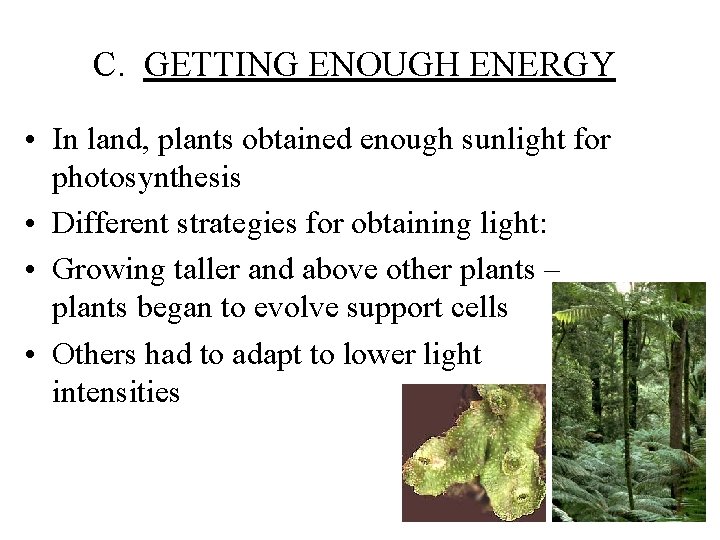
C. GETTING ENOUGH ENERGY • In land, plants obtained enough sunlight for photosynthesis • Different strategies for obtaining light: • Growing taller and above other plants – plants began to evolve support cells • Others had to adapt to lower light intensities
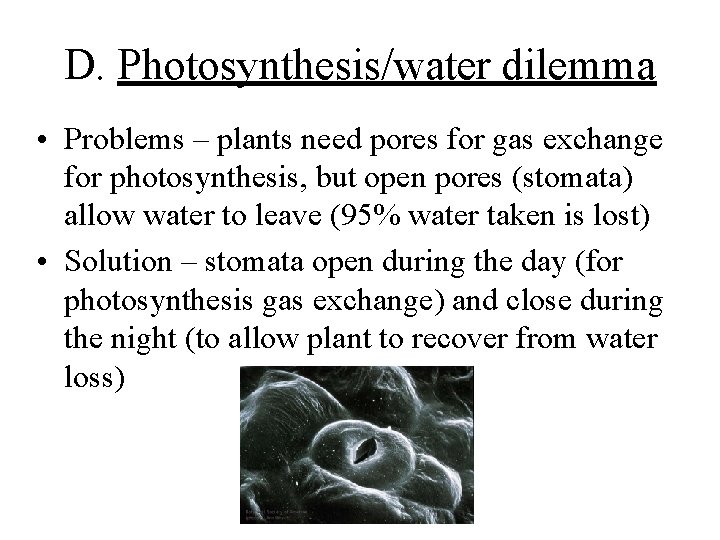
D. Photosynthesis/water dilemma • Problems – plants need pores for gas exchange for photosynthesis, but open pores (stomata) allow water to leave (95% water taken is lost) • Solution – stomata open during the day (for photosynthesis gas exchange) and close during the night (to allow plant to recover from water loss)
E. MULTICELLULARITY • Evolved in algae • Advantages: root better, protect gametes, grow tall to obtain sunshine • Disadvantage: getting water to all cells • Plants evolved vascular tissues, xylem and phloem
F. SEXUAL REPRODUCTION • Algae have motile gametes and single sex organs • Land plants developed air-borne dissemination of desiccation-resistant stage • Land plants developed multicellular sex organs • Sexual reproduction gives plants genetic variability – enable them to adapt better to their environments
G. LIFE CYCLE • Algae, water dependent life cycle water independent life cycle in land plants • Plants developed dryness-resistant gametophytes (spores) or zygotes (seeds) • Smaller size primitive larger size plants • Dominant gametophyte stage (n) dominant sporophyte stage (2 n)
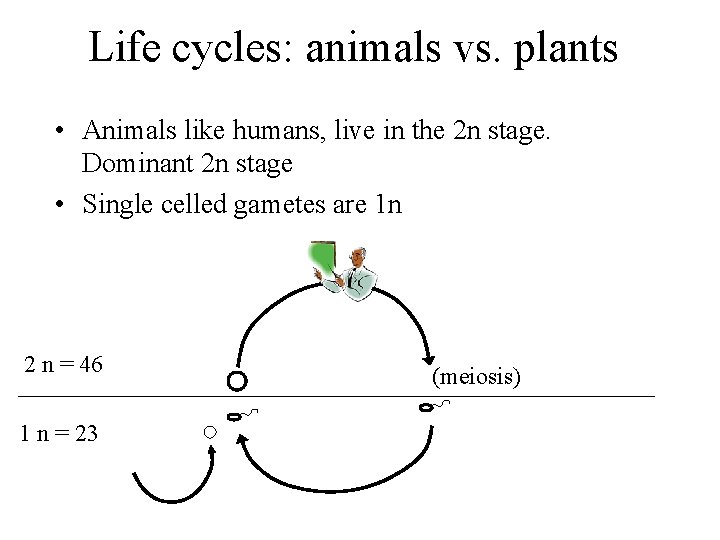
Life cycles: animals vs. plants • Animals like humans, live in the 2 n stage. Dominant 2 n stage • Single celled gametes are 1 n 2 n = 46 1 n = 23 (meiosis)
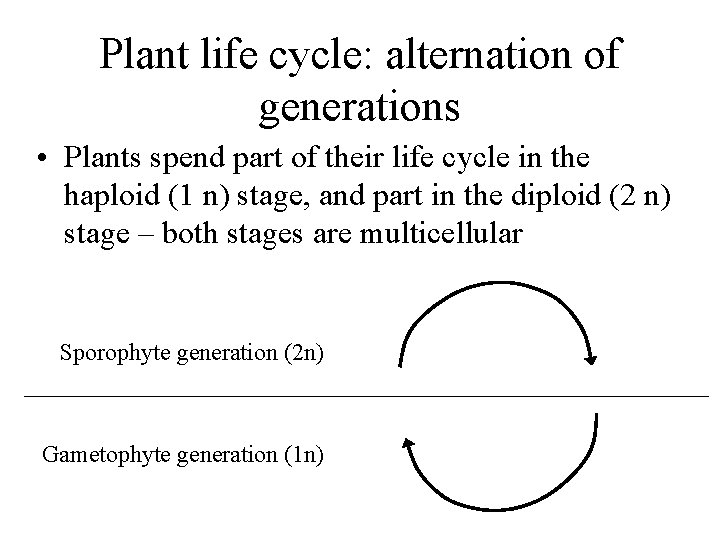
Plant life cycle: alternation of generations • Plants spend part of their life cycle in the haploid (1 n) stage, and part in the diploid (2 n) stage – both stages are multicellular Sporophyte generation (2 n) Gametophyte generation (1 n)
• Plants display an alternation of haploid and diploid phases in their life cycle. • (see text and image on page 139 in the textbook “Plants and Society”)
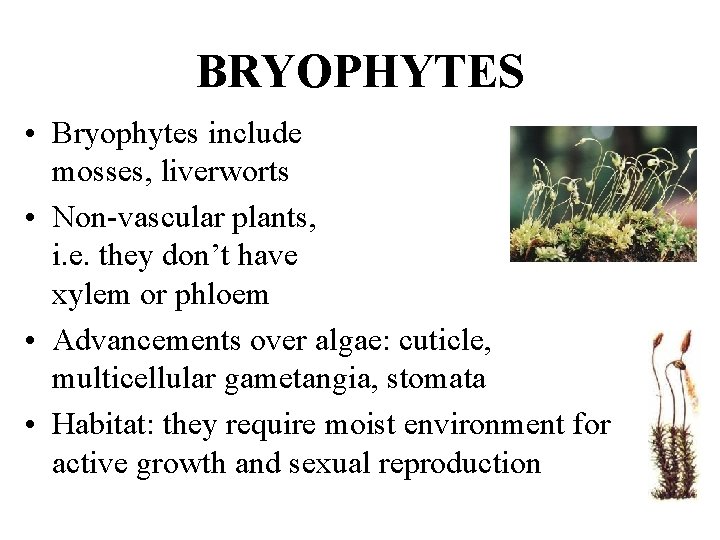
BRYOPHYTES • Bryophytes include mosses, liverworts • Non-vascular plants, i. e. they don’t have xylem or phloem • Advancements over algae: cuticle, multicellular gametangia, stomata • Habitat: they require moist environment for active growth and sexual reproduction
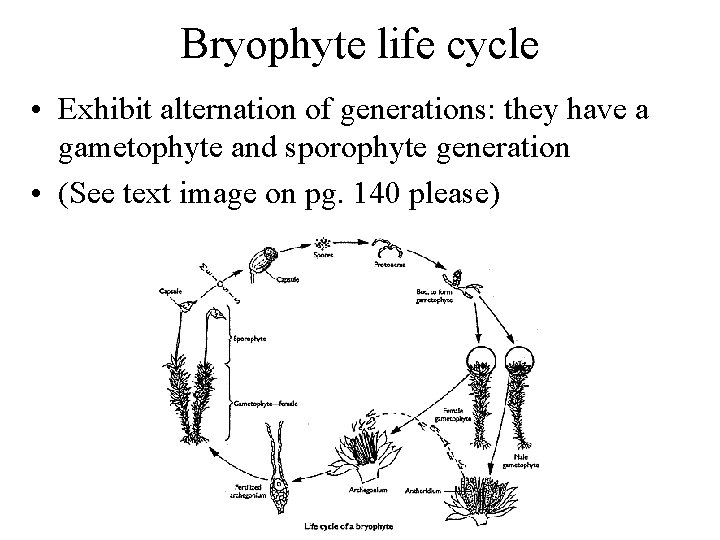
Bryophyte life cycle • Exhibit alternation of generations: they have a gametophyte and sporophyte generation • (See text image on pg. 140 please)
Bryophytes • Gametophyte generation (1 n) is dominant • Has green “leafy stems” and root-like structures called rhizoids, for anchoring (not true roots!) • Have stomata and cuticle • Bryophytes lack vascular tissue – do not have xylem or phloem. • This absence of vascular tissue prevents bryophytes from having true roots, stems or leaves. • Also, lack of conducting tissue limits their size.
Bryophyte reproduction • Gametophyte plant produces multicellular sex organs: • Archegonia – produces eggs (female) • Antheridia – produces motile sperm (male) • Outer layers protects and prevents drying • Motile sperm must swim to archegonia.
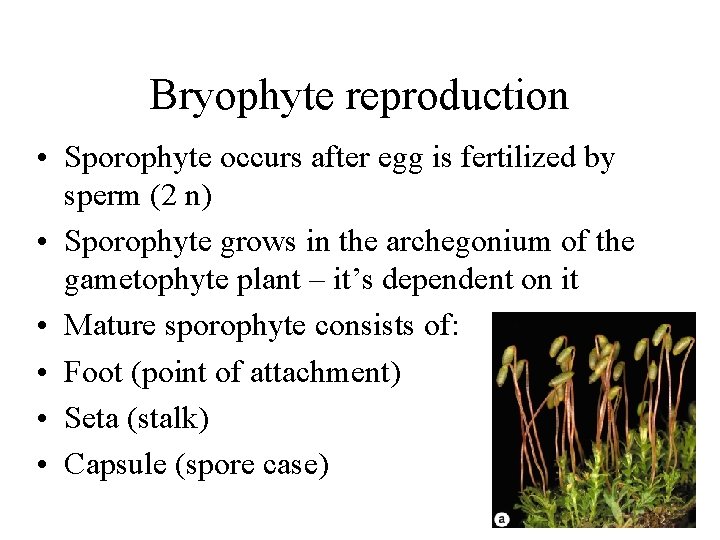
Bryophyte reproduction • Sporophyte occurs after egg is fertilized by sperm (2 n) • Sporophyte grows in the archegonium of the gametophyte plant – it’s dependent on it • Mature sporophyte consists of: • Foot (point of attachment) • Seta (stalk) • Capsule (spore case)
Bryophytes • Sporocytes within the Sporophyte undergo meiosis to produce a single kind of haploid spore • If spore lands on suitable place, it will germinate into a protonema, the initial stage of the gametophyte plant.
Bryophyte significance • Bryophytes are small and inconspicuous, but important part of the biosphere • Food for mammals, birds • Important to prevent soil erosion along streams • Commercially – peat moss (Sphagnum) is used as fuel, soil conditioner, by florists
FERNS • An important group of plants – 10, 000 species exist • Ferns have developed vascular tissue • Habitat: Moist tropics, woodlands, streambanks • Also exhibit Alternation of Generations, but… • The diploid Sporophyte generation is dominant (larger and more visible) • The haploid Gametophyte is small & short lived.
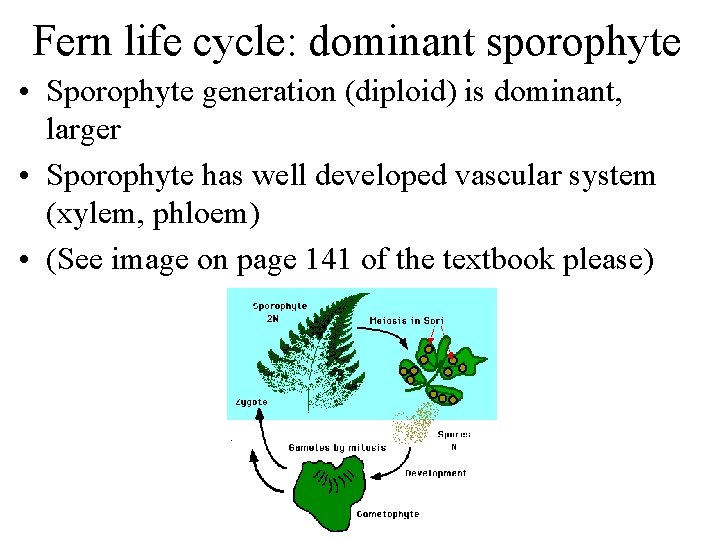
Fern life cycle: dominant sporophyte • Sporophyte generation (diploid) is dominant, larger • Sporophyte has well developed vascular system (xylem, phloem) • (See image on page 141 of the textbook please)
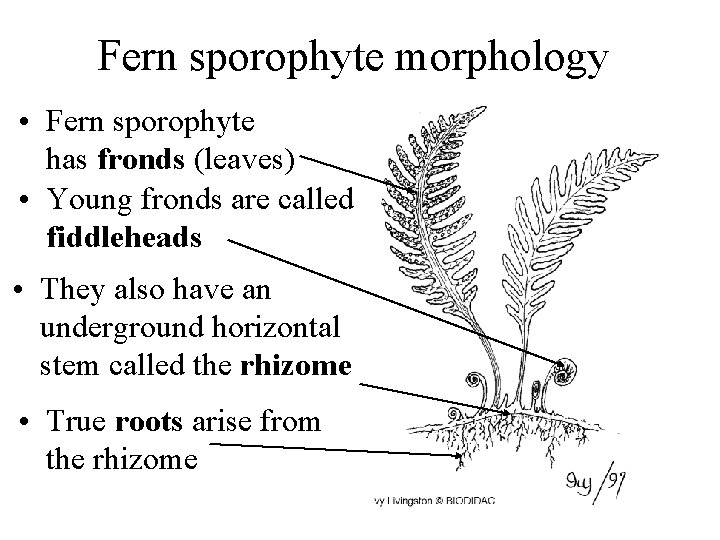
Fern sporophyte morphology • Fern sporophyte has fronds (leaves) • Young fronds are called fiddleheads • They also have an underground horizontal stem called the rhizome • True roots arise from the rhizome
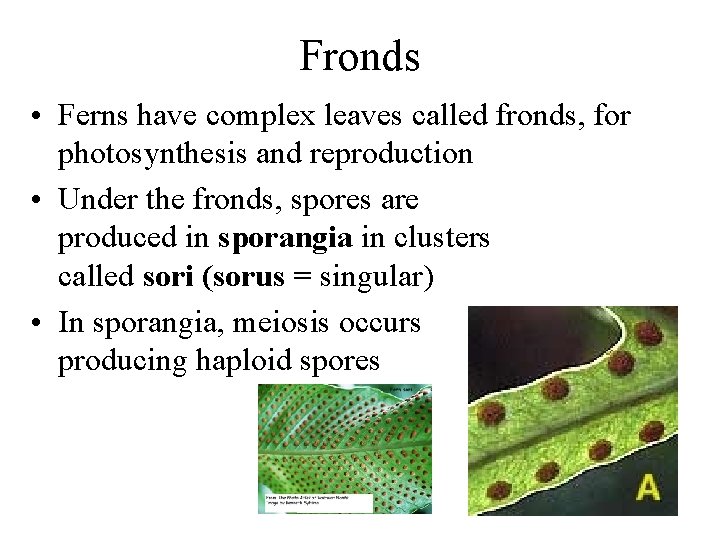
Fronds • Ferns have complex leaves called fronds, for photosynthesis and reproduction • Under the fronds, spores are produced in sporangia in clusters called sori (sorus = singular) • In sporangia, meiosis occurs producing haploid spores
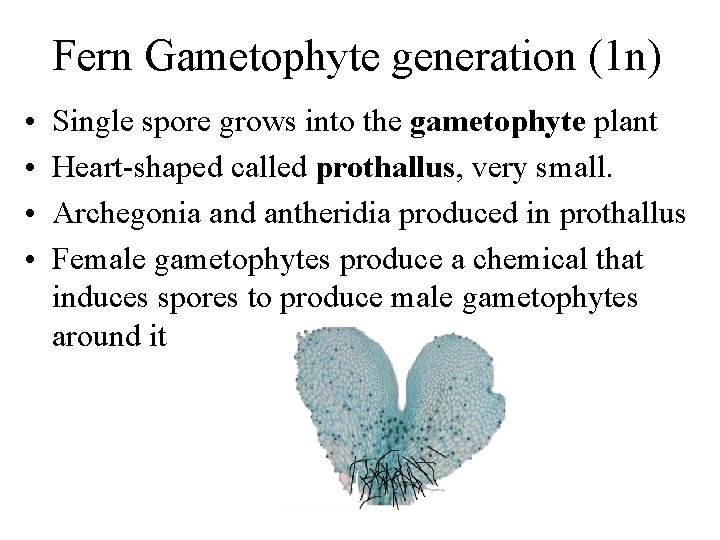
Fern Gametophyte generation (1 n) • • Single spore grows into the gametophyte plant Heart-shaped called prothallus, very small. Archegonia and antheridia produced in prothallus Female gametophytes produce a chemical that induces spores to produce male gametophytes around it
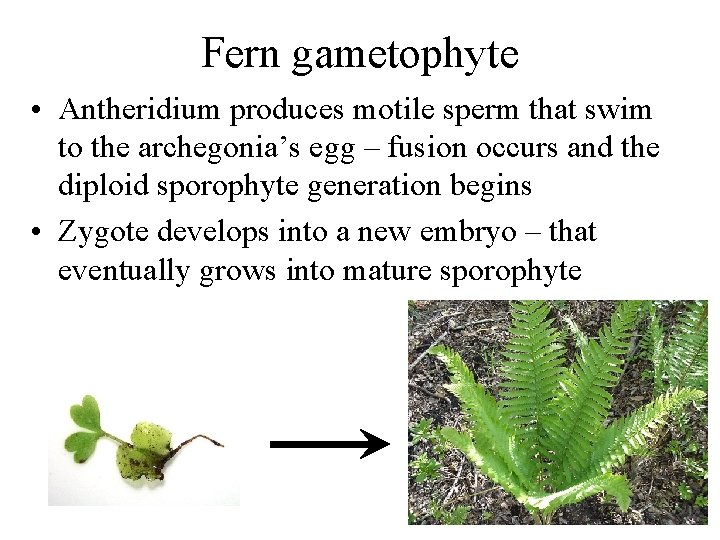
Fern gametophyte • Antheridium produces motile sperm that swim to the archegonia’s egg – fusion occurs and the diploid sporophyte generation begins • Zygote develops into a new embryo – that eventually grows into mature sporophyte
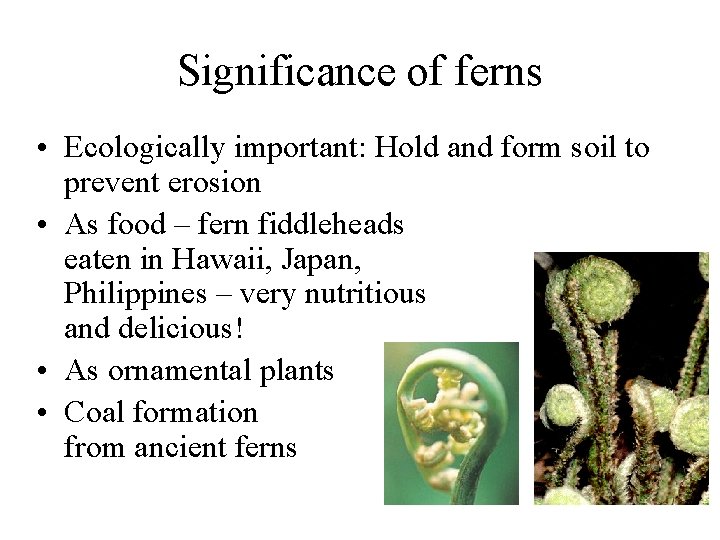
Significance of ferns • Ecologically important: Hold and form soil to prevent erosion • As food – fern fiddleheads eaten in Hawaii, Japan, Philippines – very nutritious and delicious! • As ornamental plants • Coal formation from ancient ferns
- Slides: 45