
Lecture 11 Advanced Dividers Required Reading Behrooz Parhami
Lecture 11 Advanced Dividers
Required Reading Behrooz Parhami, Computer Arithmetic: Algorithms and Hardware Design Chapter 15 Variation in Dividers 15. 3, Combinational and Array Dividers Chapter 16, Division by Convergence
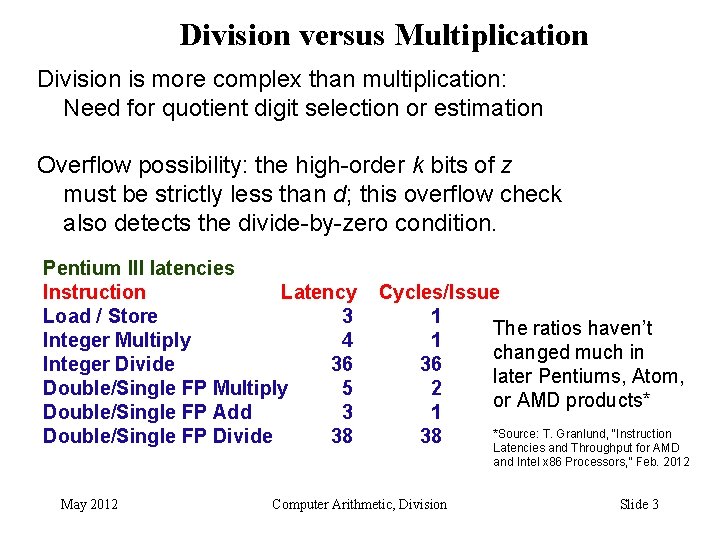
Division versus Multiplication Division is more complex than multiplication: Need for quotient digit selection or estimation Overflow possibility: the high-order k bits of z must be strictly less than d; this overflow check also detects the divide-by-zero condition. Pentium III latencies Instruction Latency Load / Store 3 Integer Multiply 4 Integer Divide 36 Double/Single FP Multiply 5 Double/Single FP Add 3 Double/Single FP Divide 38 Cycles/Issue 1 The ratios haven’t 1 changed much in 36 later Pentiums, Atom, 2 or AMD products* 1 *Source: T. Granlund, “Instruction 38 Latencies and Throughput for AMD and Intel x 86 Processors, ” Feb. 2012 May 2012 Computer Arithmetic, Division Slide 3
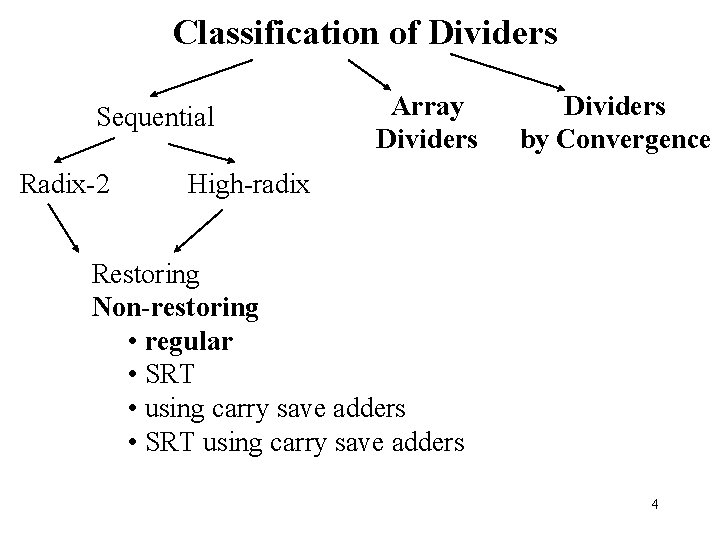
Classification of Dividers Sequential Radix-2 Array Dividers by Convergence High-radix Restoring Non-restoring • regular • SRT • using carry save adders • SRT using carry save adders 4
Fractional Division
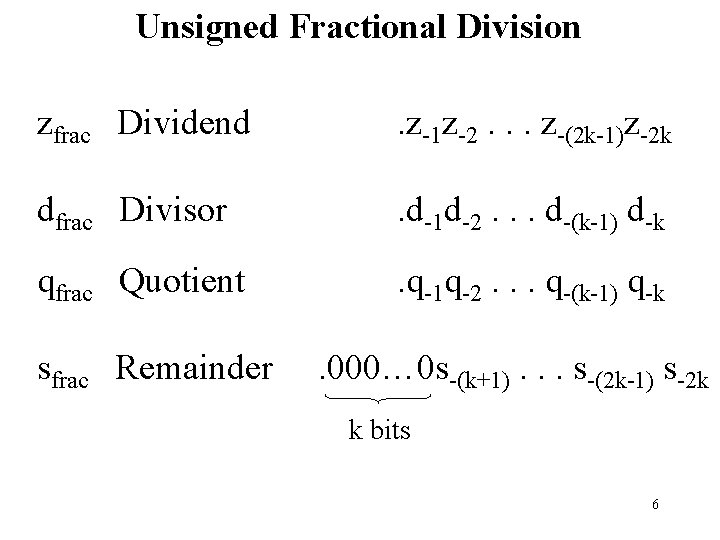
Unsigned Fractional Division zfrac Dividend . z-1 z-2. . . z-(2 k-1)z-2 k dfrac Divisor . d-1 d-2. . . d-(k-1) d-k qfrac Quotient . q-1 q-2. . . q-(k-1) q-k sfrac Remainder . 000… 0 s-(k+1). . . s-(2 k-1) s-2 k k bits 6
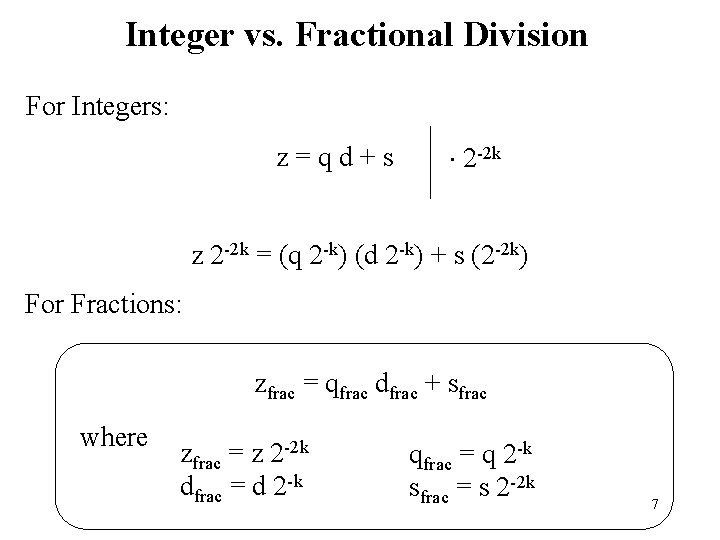
Integer vs. Fractional Division For Integers: z=qd+s 2 -2 k z 2 -2 k = (q 2 -k) (d 2 -k) + s (2 -2 k) For Fractions: zfrac = qfrac dfrac + sfrac where zfrac = z 2 -2 k dfrac = d 2 -k qfrac = q 2 -k sfrac = s 2 -2 k 7
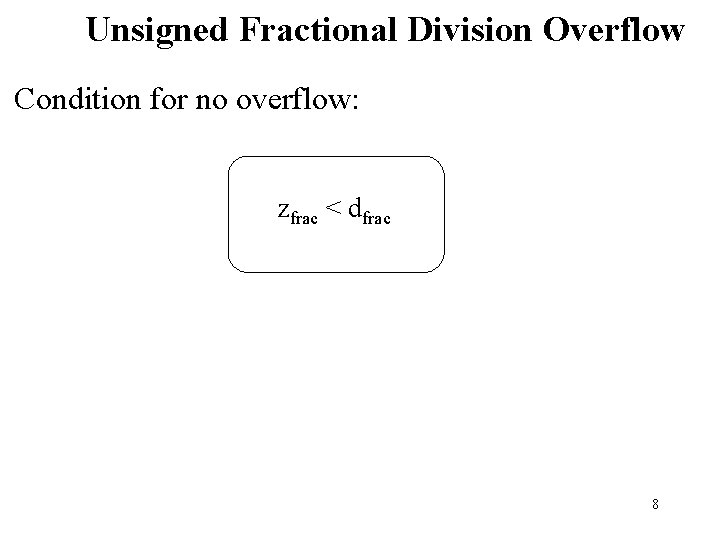
Unsigned Fractional Division Overflow Condition for no overflow: zfrac < dfrac 8
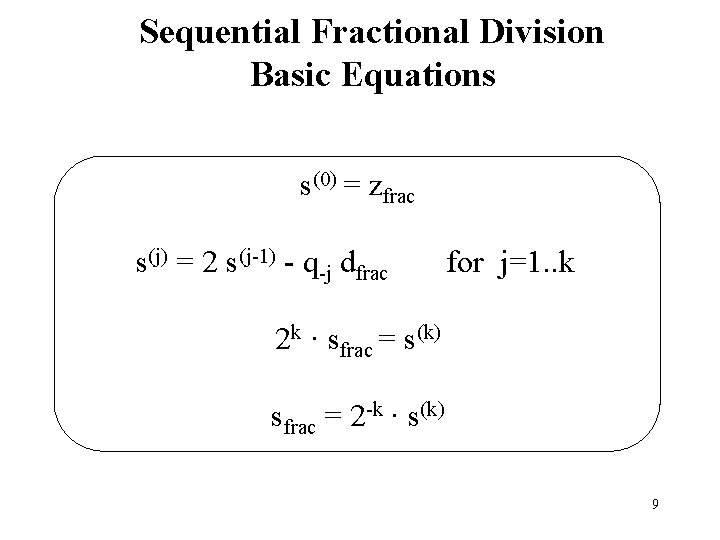
Sequential Fractional Division Basic Equations s(0) = zfrac s(j) = 2 s(j-1) - q-j dfrac for j=1. . k 2 k · sfrac = s(k) sfrac = 2 -k · s(k) 9
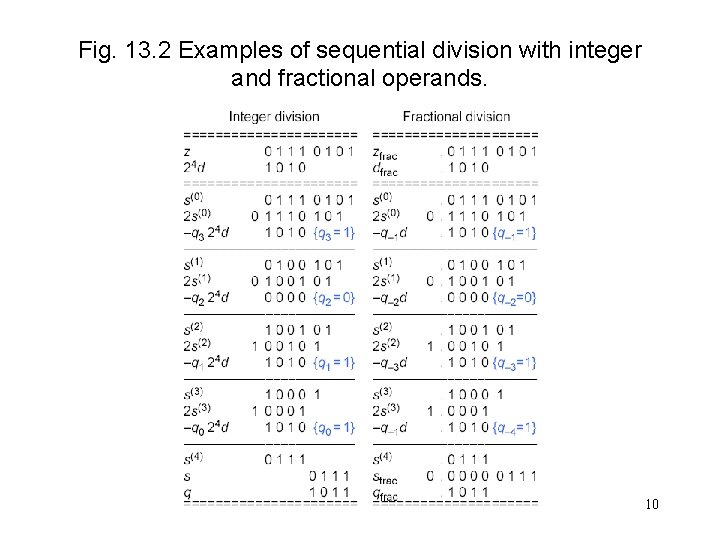
Fig. 13. 2 Examples of sequential division with integer and fractional operands. 10

Array Dividers 11
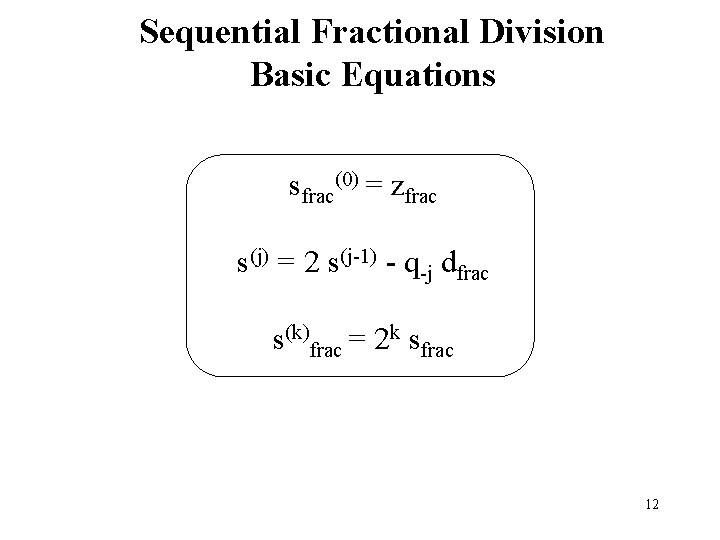
Sequential Fractional Division Basic Equations sfrac(0) = zfrac s(j) = 2 s(j-1) - q-j dfrac s(k)frac = 2 k sfrac 12
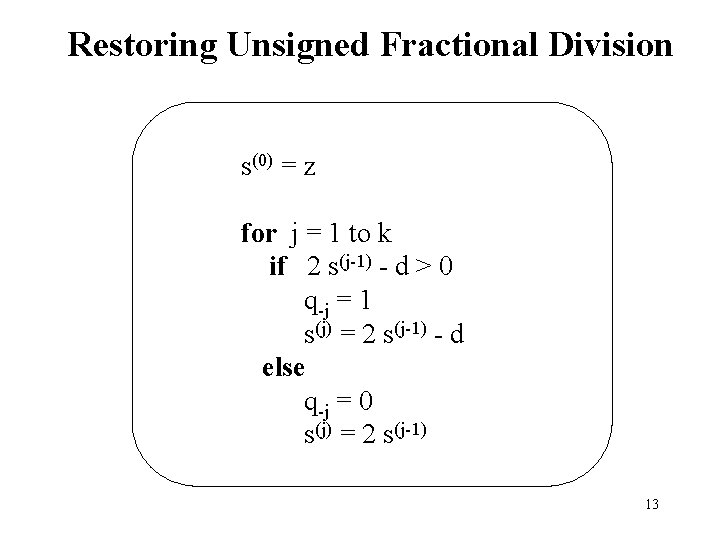
Restoring Unsigned Fractional Division s(0) = z for j = 1 to k if 2 s(j-1) - d > 0 q-j = 1 s(j) = 2 s(j-1) - d else q-j = 0 s(j) = 2 s(j-1) 13
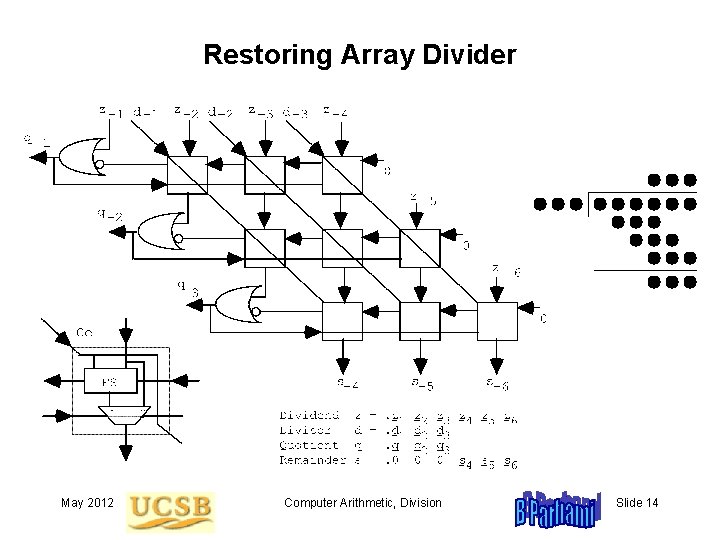
Restoring Array Divider May 2012 Computer Arithmetic, Division Slide 14
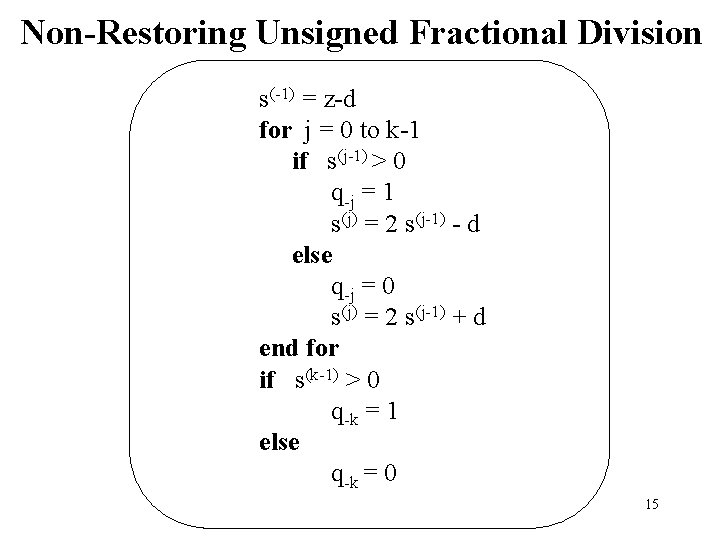
Non-Restoring Unsigned Fractional Division s(-1) = z-d for j = 0 to k-1 if s(j-1) > 0 q-j = 1 s(j) = 2 s(j-1) - d else q-j = 0 s(j) = 2 s(j-1) + d end for if s(k-1) > 0 q-k = 1 else q-k = 0 15
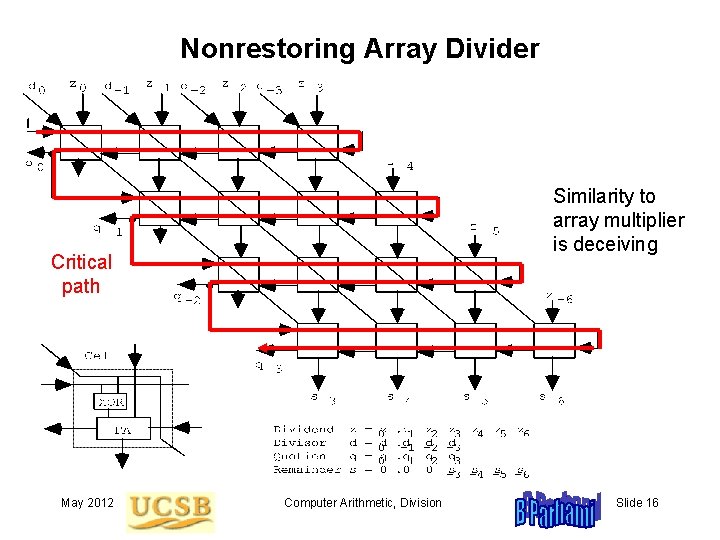
Nonrestoring Array Divider Similarity to array multiplier is deceiving Critical path May 2012 Computer Arithmetic, Division Slide 16
Division by Convergence 17
Division by Convergence Chapter Goals Show by using multiplication as the basic operation in each division step, the number of iterations can be reduced Chapter Highlights Digit-recurrence as convergence method Convergence by Newton-Raphson iteration Computing the reciprocal of a number Hardware implementation and fine tuning May 2012 Computer Arithmetic, Division Slide 18
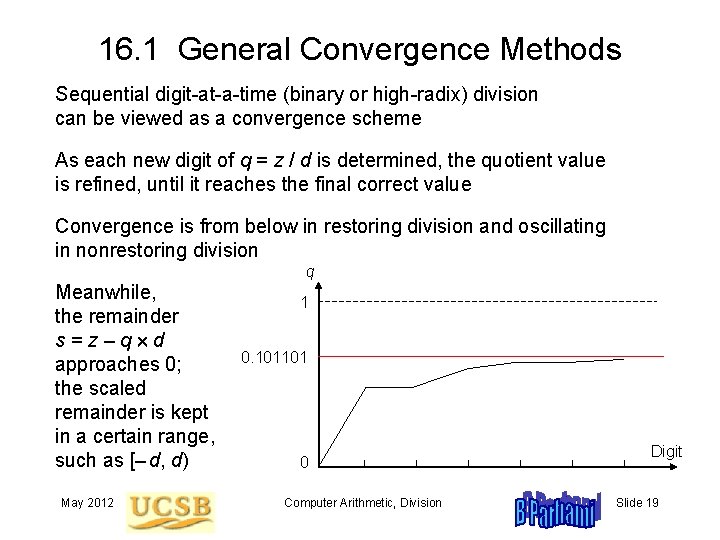
16. 1 General Convergence Methods Sequential digit-at-a-time (binary or high-radix) division can be viewed as a convergence scheme As each new digit of q = z / d is determined, the quotient value is refined, until it reaches the final correct value Convergence is from below in restoring division and oscillating in nonrestoring division q Meanwhile, the remainder s=z–q d approaches 0; the scaled remainder is kept in a certain range, such as [– d, d) May 2012 1 0. 101101 0 Computer Arithmetic, Division Digit Slide 19
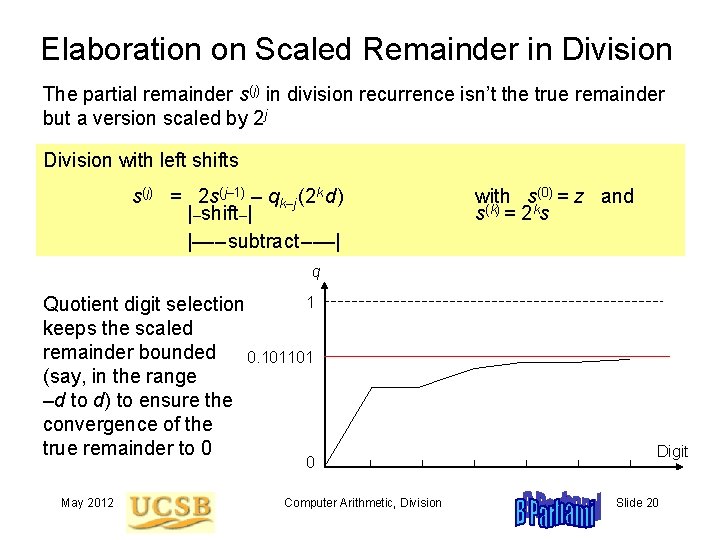
Elaboration on Scaled Remainder in Division The partial remainder s(j) in division recurrence isn’t the true remainder but a version scaled by 2 j Division with left shifts s(j) = 2 s(j– 1) – qk–j (2 k d) |–shift–| |––– subtract –––| with s(0) = z and s(k) = 2 ks q 1 Quotient digit selection keeps the scaled remainder bounded 0. 101101 (say, in the range –d to d) to ensure the convergence of the true remainder to 0 0 May 2012 Computer Arithmetic, Division Digit Slide 20
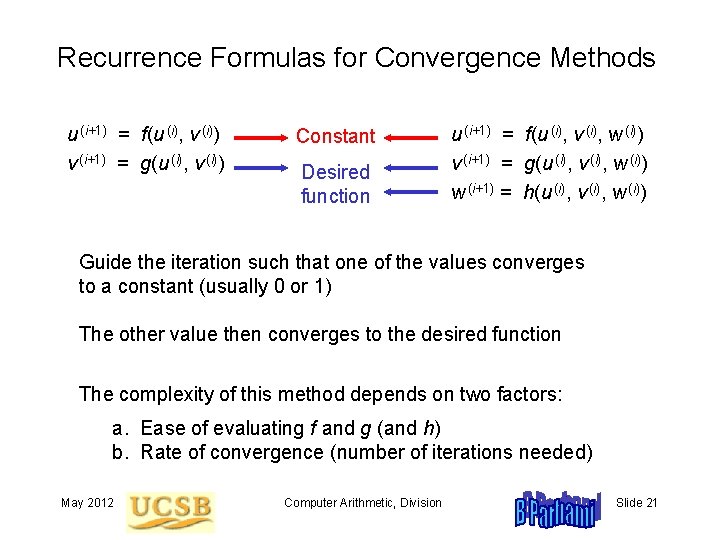
Recurrence Formulas for Convergence Methods u (i+1) = f(u (i), v (i)) v (i+1) = g(u (i), v (i)) Constant Desired function u (i+1) = f(u (i), v (i), w (i)) v (i+1) = g(u (i), v (i), w (i)) w (i+1) = h(u (i), v (i), w (i)) Guide the iteration such that one of the values converges to a constant (usually 0 or 1) The other value then converges to the desired function The complexity of this method depends on two factors: a. Ease of evaluating f and g (and h) b. Rate of convergence (number of iterations needed) May 2012 Computer Arithmetic, Division Slide 21
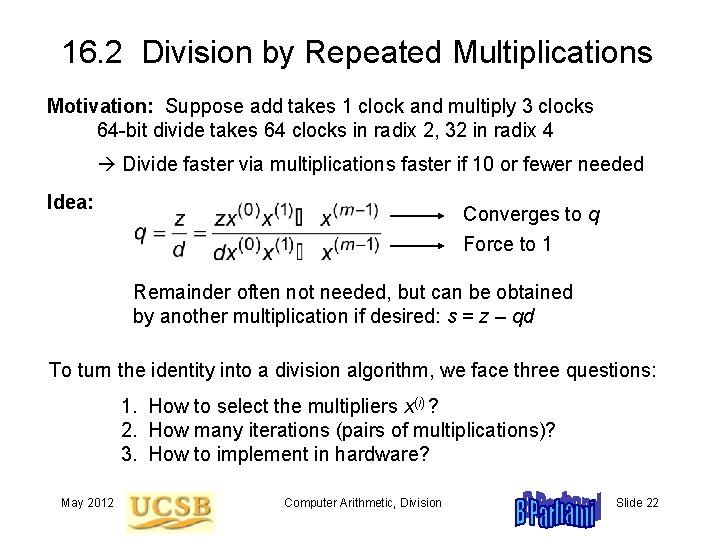
16. 2 Division by Repeated Multiplications Motivation: Suppose add takes 1 clock and multiply 3 clocks 64 -bit divide takes 64 clocks in radix 2, 32 in radix 4 Divide faster via multiplications faster if 10 or fewer needed Idea: Converges to q Force to 1 Remainder often not needed, but can be obtained by another multiplication if desired: s = z – qd To turn the identity into a division algorithm, we face three questions: 1. How to select the multipliers x(i) ? 2. How many iterations (pairs of multiplications)? 3. How to implement in hardware? May 2012 Computer Arithmetic, Division Slide 22
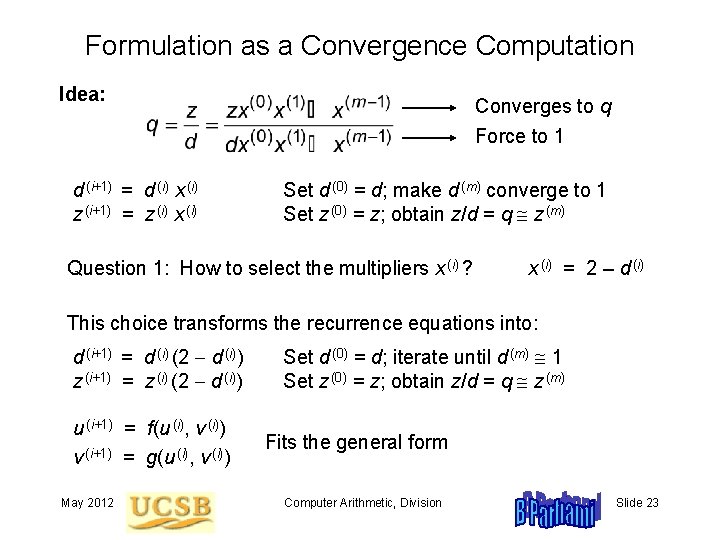
Formulation as a Convergence Computation Idea: d (i+1) = d (i) x (i) z (i+1) = z (i) x (i) Converges to q Force to 1 Set d (0) = d; make d (m) converge to 1 Set z (0) = z; obtain z/d = q z (m) Question 1: How to select the multipliers x (i) ? x (i) = 2 – d (i) This choice transforms the recurrence equations into: d (i+1) = d (i) (2 - d (i)) z (i+1) = z (i) (2 - d (i)) u (i+1) = f(u (i), v (i)) v (i+1) = g(u (i), v (i)) May 2012 Set d (0) = d; iterate until d (m) 1 Set z (0) = z; obtain z/d = q z (m) Fits the general form Computer Arithmetic, Division Slide 23
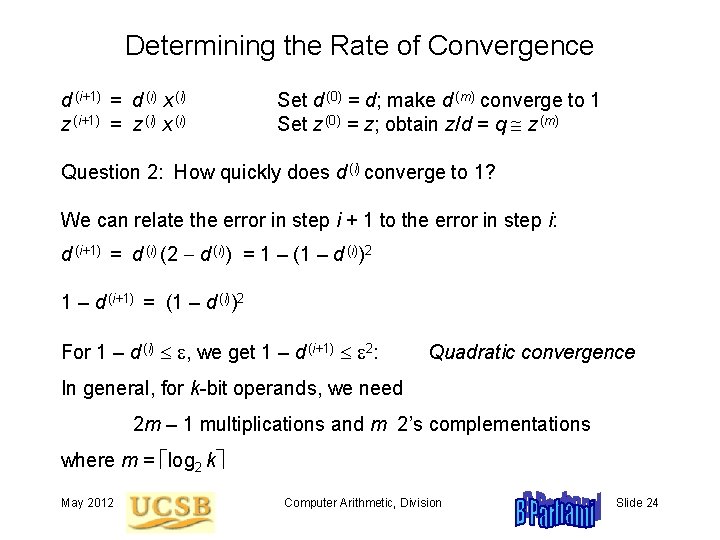
Determining the Rate of Convergence d (i+1) = d (i) x (i) z (i+1) = z (i) x (i) Set d (0) = d; make d (m) converge to 1 Set z (0) = z; obtain z/d = q z (m) Question 2: How quickly does d (i) converge to 1? We can relate the error in step i + 1 to the error in step i: d (i+1) = d (i) (2 - d (i)) = 1 – (1 – d (i))2 1 – d (i+1) = (1 – d (i))2 For 1 – d (i) e, we get 1 – d (i+1) e 2: Quadratic convergence In general, for k-bit operands, we need 2 m – 1 multiplications and m 2’s complementations where m = log 2 k May 2012 Computer Arithmetic, Division Slide 24
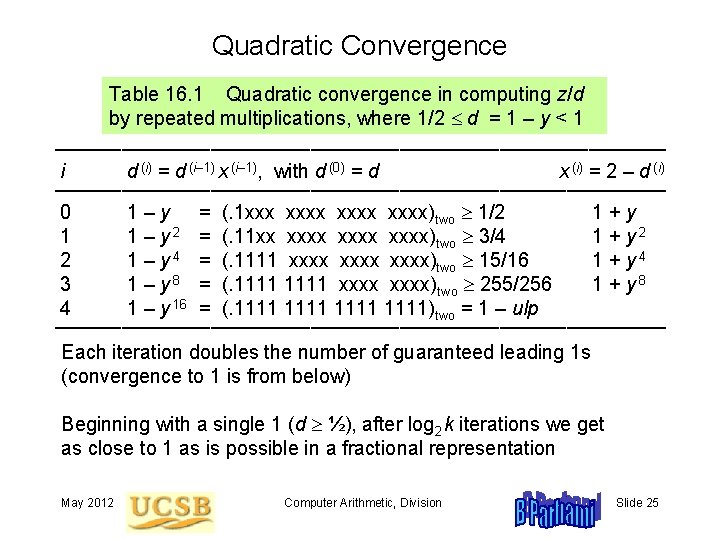
Quadratic Convergence Table 16. 1 Quadratic convergence in computing z/d by repeated multiplications, where 1/2 d = 1 – y < 1 –––––––––––––––––––––––––––– i d (i) = d (i– 1) x (i– 1), with d (0) = d x (i) = 2 – d (i) –––––––––––––––––––––––––––– 0 1 – y = (. 1 xxx xxxx)two 1/2 1+y 1 1 – y 2 = (. 11 xx xxxx)two 3/4 1 + y 2 2 1 – y 4 = (. 1111 xxxx)two 15/16 1 + y 4 3 1 – y 8 = (. 1111 xxxx)two 255/256 1 + y 8 4 1 – y 16 = (. 1111)two = 1 – ulp –––––––––––––––––––––––––––– Each iteration doubles the number of guaranteed leading 1 s (convergence to 1 is from below) Beginning with a single 1 (d ½), after log 2 k iterations we get as close to 1 as is possible in a fractional representation May 2012 Computer Arithmetic, Division Slide 25
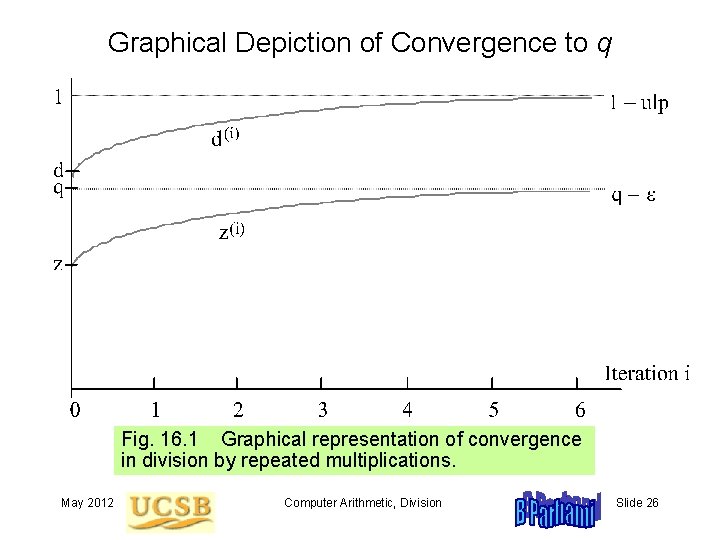
Graphical Depiction of Convergence to q Fig. 16. 1 Graphical representation of convergence in division by repeated multiplications. May 2012 Computer Arithmetic, Division Slide 26
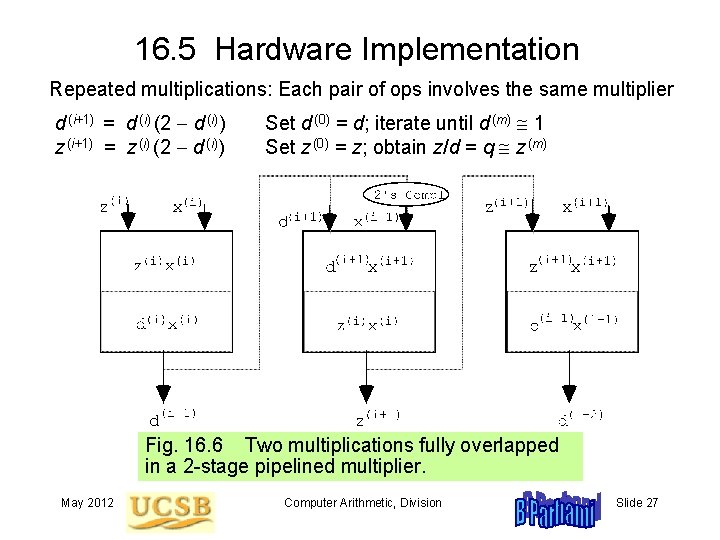
16. 5 Hardware Implementation Repeated multiplications: Each pair of ops involves the same multiplier d (i+1) = d (i) (2 - d (i)) z (i+1) = z (i) (2 - d (i)) Set d (0) = d; iterate until d (m) 1 Set z (0) = z; obtain z/d = q z (m) Fig. 16. 6 Two multiplications fully overlapped in a 2 -stage pipelined multiplier. May 2012 Computer Arithmetic, Division Slide 27
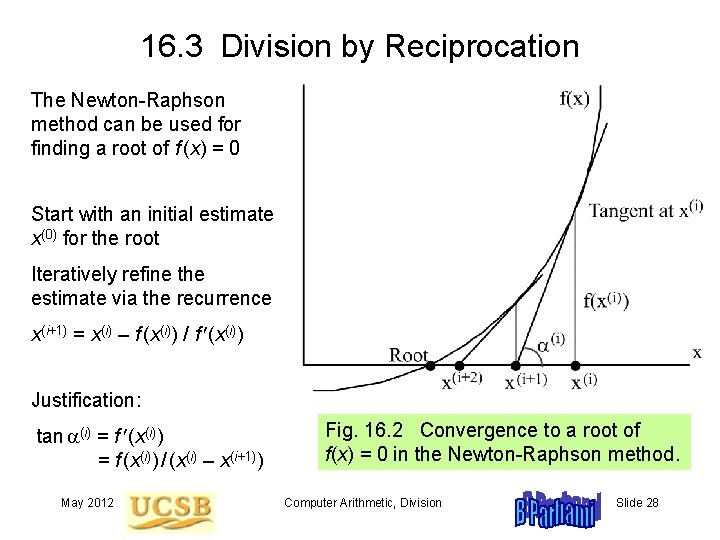
16. 3 Division by Reciprocation The Newton-Raphson method can be used for finding a root of f (x) = 0 Start with an initial estimate x(0) for the root Iteratively refine the estimate via the recurrence x(i+1) = x(i) – f (x(i)) / f (x(i)) Justification: tan a(i) = f (x(i)) / (x(i) – x(i+1)) May 2012 Fig. 16. 2 Convergence to a root of f(x) = 0 in the Newton-Raphson method. Computer Arithmetic, Division Slide 28
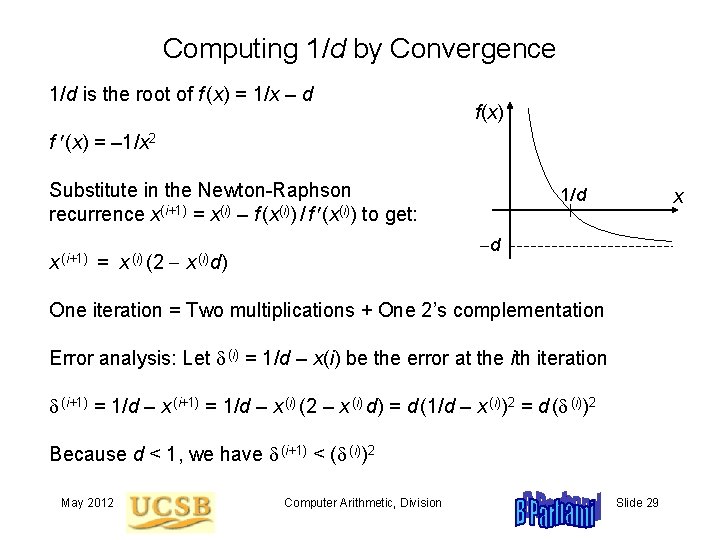
Computing 1/d by Convergence 1/d is the root of f (x) = 1/x – d f(x) f (x) = – 1/x 2 Substitute in the Newton-Raphson recurrence x(i+1) = x(i) – f (x(i)) / f (x(i)) to get: x (i+1) = x (i) (2 - 1/d x -d x (i)d) One iteration = Two multiplications + One 2’s complementation Error analysis: Let d (i) = 1/d – x(i) be the error at the ith iteration d (i+1) = 1/d – x (i) (2 – x (i) d) = d (1/d – x (i))2 = d (d (i))2 Because d < 1, we have d (i+1) < (d (i))2 May 2012 Computer Arithmetic, Division Slide 29
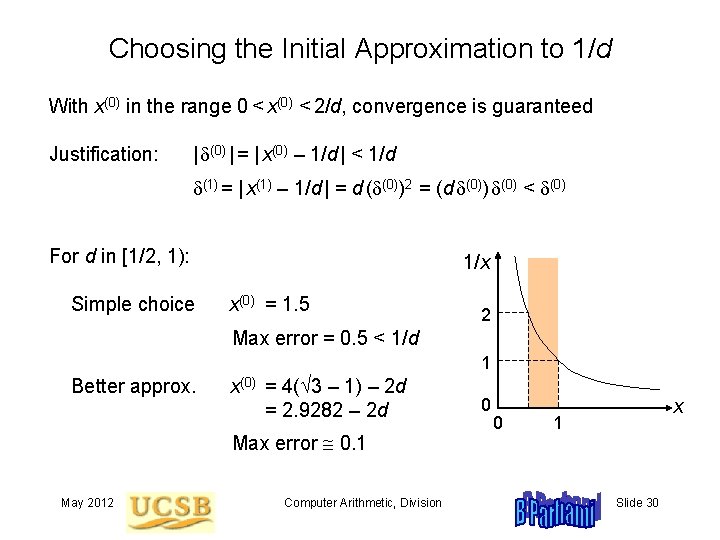
Choosing the Initial Approximation to 1/d With x(0) in the range 0 < x(0) < 2/d, convergence is guaranteed Justification: | d(0) | = | x(0) – 1/d | < 1/d d(1) = | x(1) – 1/d | = d (d(0))2 = (d d(0)) d(0) < d(0) For d in [1/2, 1): Simple choice 1/x x(0) = 1. 5 2 Max error = 0. 5 < 1/d 1 Better approx. x(0) = 4( 3 – 1) – 2 d = 2. 9282 – 2 d Max error 0. 1 May 2012 Computer Arithmetic, Division 0 0 x 1 Slide 30
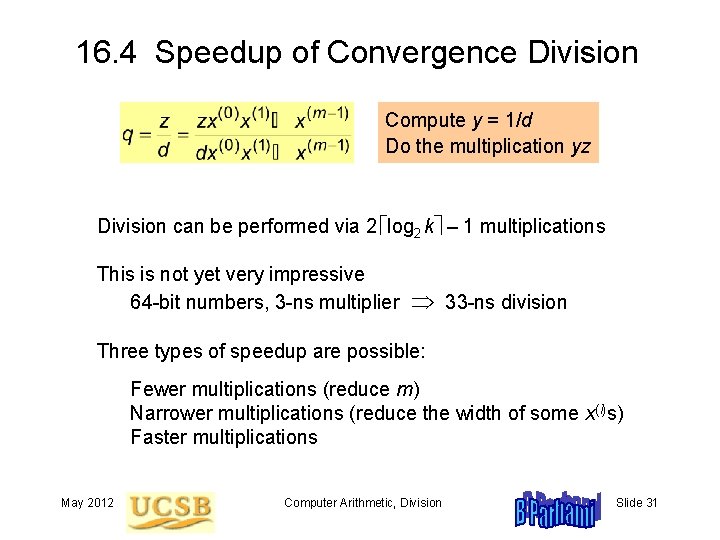
16. 4 Speedup of Convergence Division Compute y = 1/d Do the multiplication yz Division can be performed via 2 log 2 k – 1 multiplications This is not yet very impressive 64 -bit numbers, 3 -ns multiplier 33 -ns division Three types of speedup are possible: Fewer multiplications (reduce m) Narrower multiplications (reduce the width of some x(i)s) Faster multiplications May 2012 Computer Arithmetic, Division Slide 31
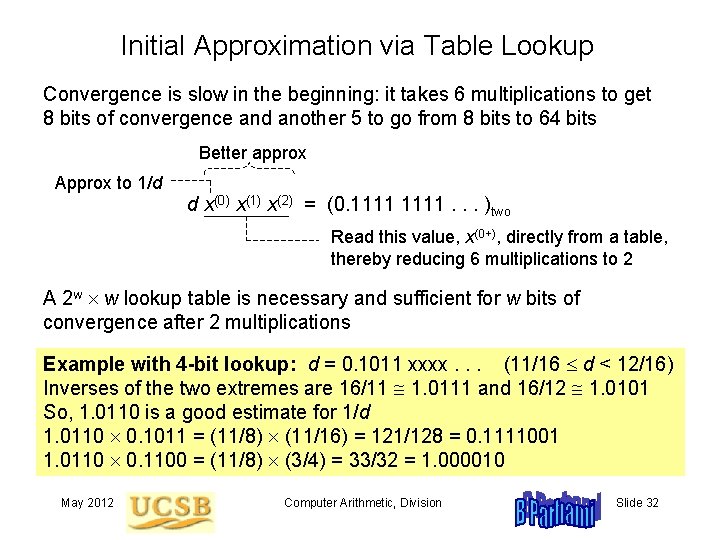
Initial Approximation via Table Lookup Convergence is slow in the beginning: it takes 6 multiplications to get 8 bits of convergence and another 5 to go from 8 bits to 64 bits Better approx Approx to 1/d d x(0) x(1) x(2) = (0. 1111. . . )two Read this value, x(0+), directly from a table, thereby reducing 6 multiplications to 2 A 2 w w lookup table is necessary and sufficient for w bits of convergence after 2 multiplications Example with 4 -bit lookup: d = 0. 1011 xxxx. . . (11/16 d < 12/16) Inverses of the two extremes are 16/11 1. 0111 and 16/12 1. 0101 So, 1. 0110 is a good estimate for 1/d 1. 0110 0. 1011 = (11/8) (11/16) = 121/128 = 0. 1111001 1. 0110 0. 1100 = (11/8) (3/4) = 33/32 = 1. 000010 May 2012 Computer Arithmetic, Division Slide 32
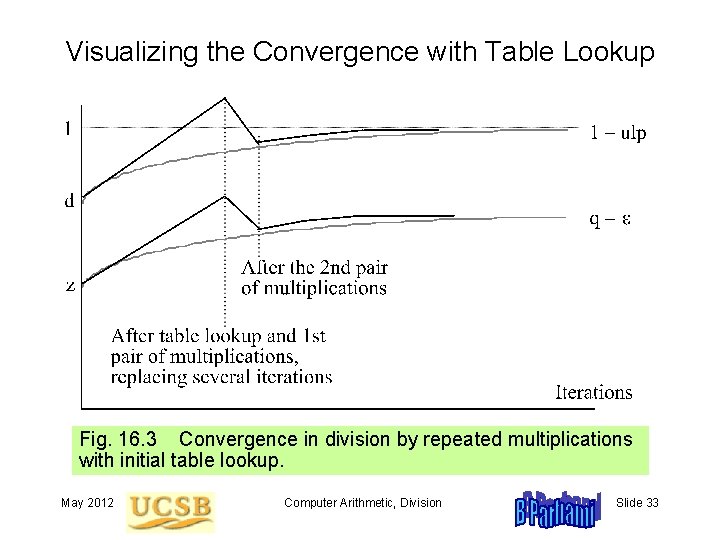
Visualizing the Convergence with Table Lookup Fig. 16. 3 Convergence in division by repeated multiplications with initial table lookup. May 2012 Computer Arithmetic, Division Slide 33
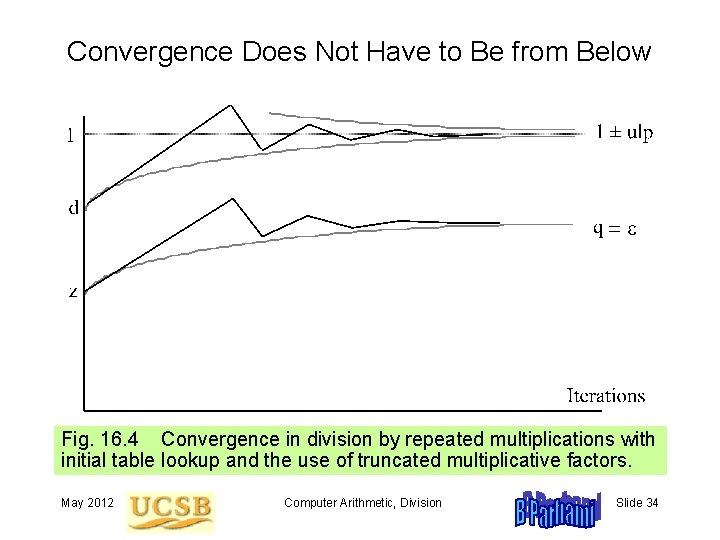
Convergence Does Not Have to Be from Below Fig. 16. 4 Convergence in division by repeated multiplications with initial table lookup and the use of truncated multiplicative factors. May 2012 Computer Arithmetic, Division Slide 34
Sequential Dividers with Carry-Save Adders 35
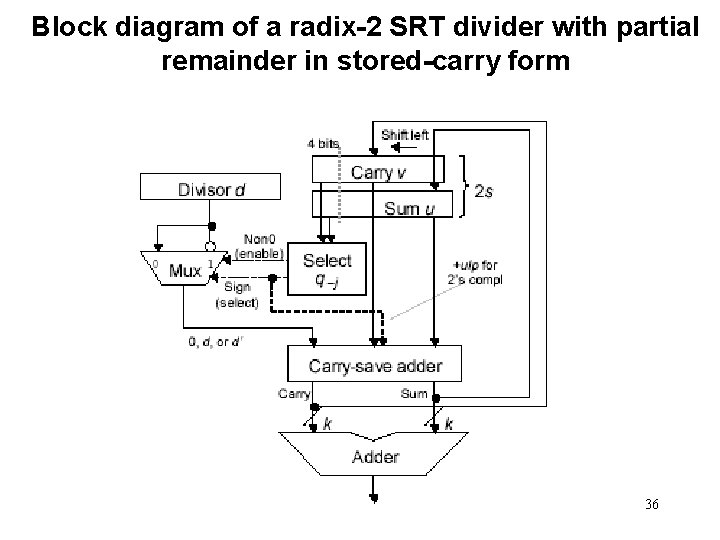
Block diagram of a radix-2 SRT divider with partial remainder in stored-carry form 36
October 1994 Pentium bug (1) Thomas Nicely, Lynchburg Collage, Virginia finds an error in his computer calculations, and traces it back to the Pentium processor November 7, 1994 First press announcement, Electronic Engineering Times Late 1994 Tim Coe, Vitesse Semiconductor presents an example with the worst-case error c = 4 195 835/3 145 727 Pentium = 1. 333 739 06. . . Correct result = 1. 333 820 44. . . 37
Pentium bug (2) Intel admits “subtle flaw” November 30, 1994 Intel’s white paper about the bug and its possible consequences Intel - average spreadsheet user affected once in 27, 000 years IBM - average spreadsheet user affected once every 24 days Replacements based on customer needs December 20, 1994 Announcement of no-question-asked replacements 38
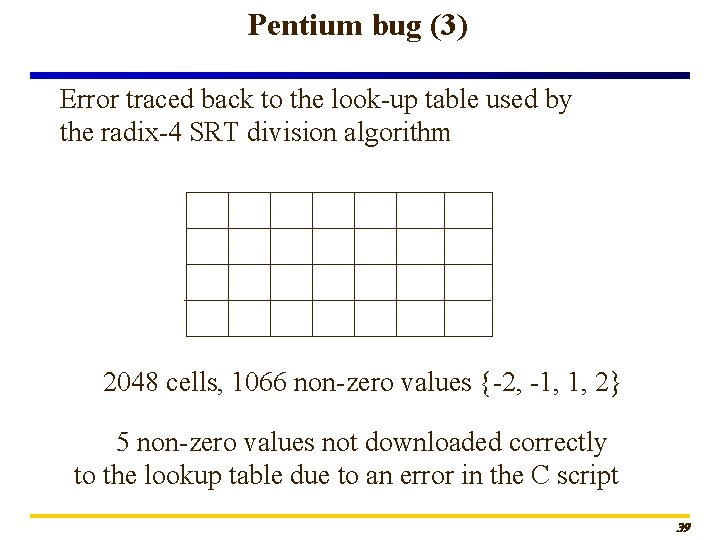
Pentium bug (3) Error traced back to the look-up table used by the radix-4 SRT division algorithm 2048 cells, 1066 non-zero values {-2, -1, 1, 2} 5 non-zero values not downloaded correctly to the lookup table due to an error in the C script 39
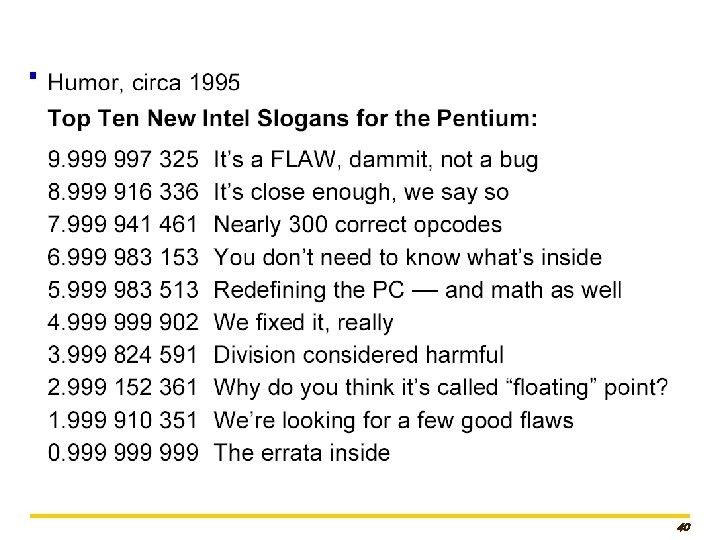
40

Follow-up Courses 41
DIGITAL SYSTEMS DESIGN 1. ECE 681 VLSI Design for ASICs (Fall semesters) H. Homayoun, project/lab, front-end and back-end ASIC design with Synopsys tools 2. ECE 699 Digital Signal Processing Hardware Architectures (Spring semesters) A. Cohen, project, FPGA design for DSP 3. ECE 682 VLSI Test Concepts (Spring semesters) T. Storey, homework
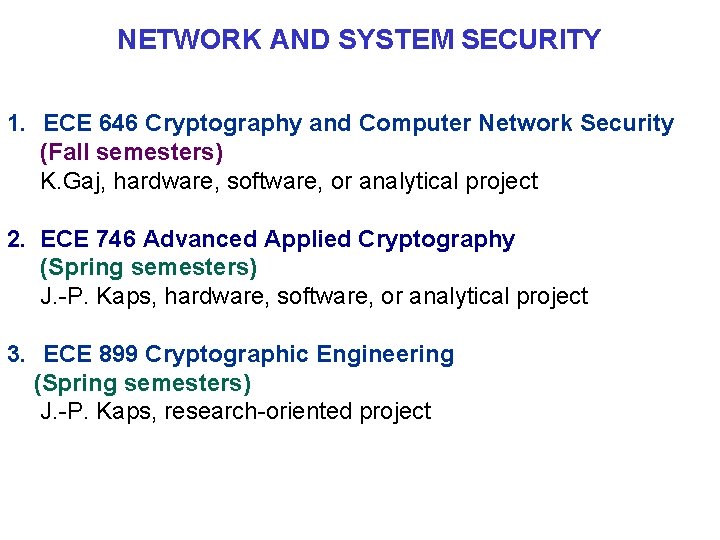
NETWORK AND SYSTEM SECURITY 1. ECE 646 Cryptography and Computer Network Security (Fall semesters) K. Gaj, hardware, software, or analytical project 2. ECE 746 Advanced Applied Cryptography (Spring semesters) J. -P. Kaps, hardware, software, or analytical project 3. ECE 899 Cryptographic Engineering (Spring semesters) J. -P. Kaps, research-oriented project
- Slides: 43