
Lecture 10 The ER Model III Lecture and
- Slides: 25
Lecture 10: The E/R Model III Lecture and activity contents are based on what Prof Chris Ré used in his CS 145 in the fall 2016 term with permission.
3. Advanced E/R Concepts 2
What you will learn about in this section 1. Subclasses & connection to OO 2. Constraints 3. Weak entity sets 4. ACTIVITY: Crayon Time! Drawing E/R diagrams Pt. III 3
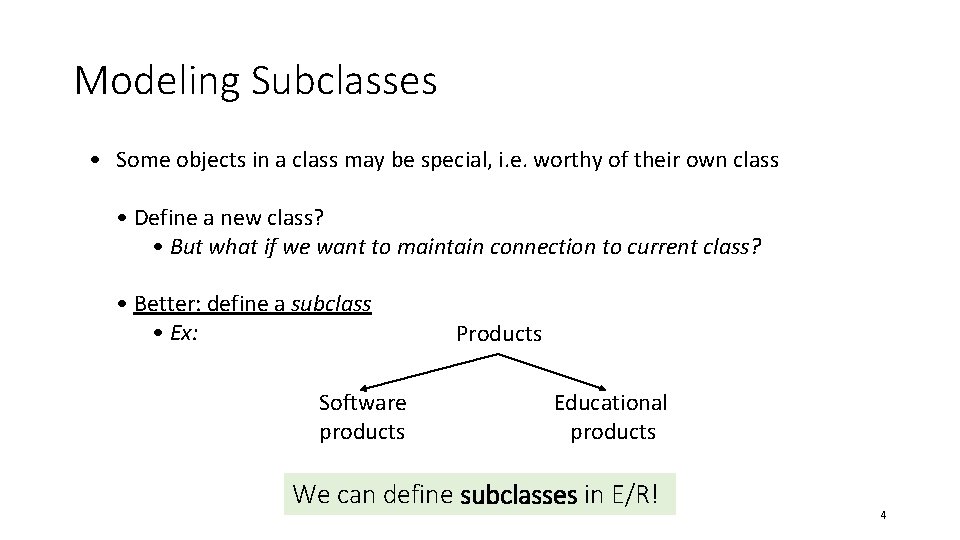
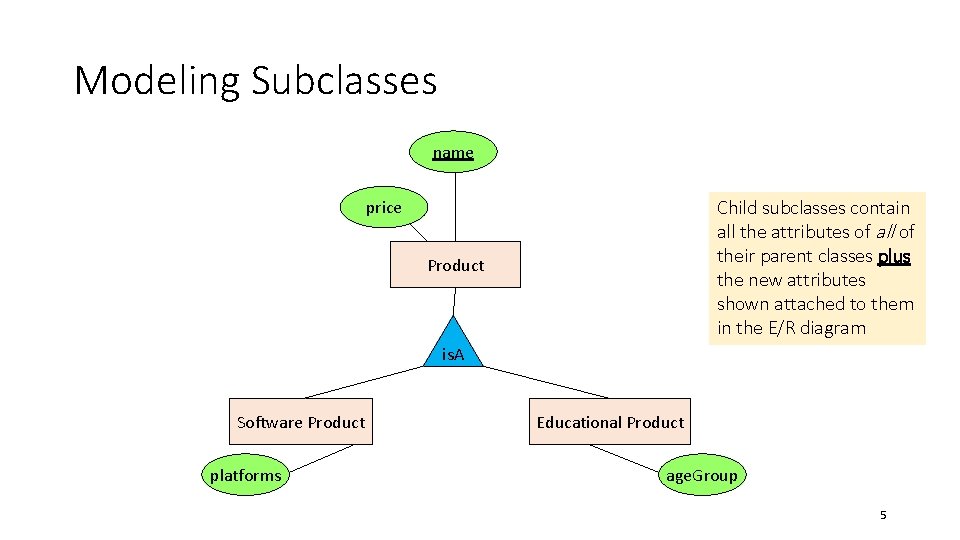
Modeling Subclasses • Some objects in a class may be special, i. e. worthy of their own class • Define a new class? • But what if we want to maintain connection to current class? • Better: define a subclass • Ex: Software products Products Educational products We can define subclasses in E/R! 4
Modeling Subclasses name Child subclasses contain all the attributes of all of their parent classes plus the new attributes shown attached to them in the E/R diagram price Product is. A Software Product platforms Educational Product age. Group 5
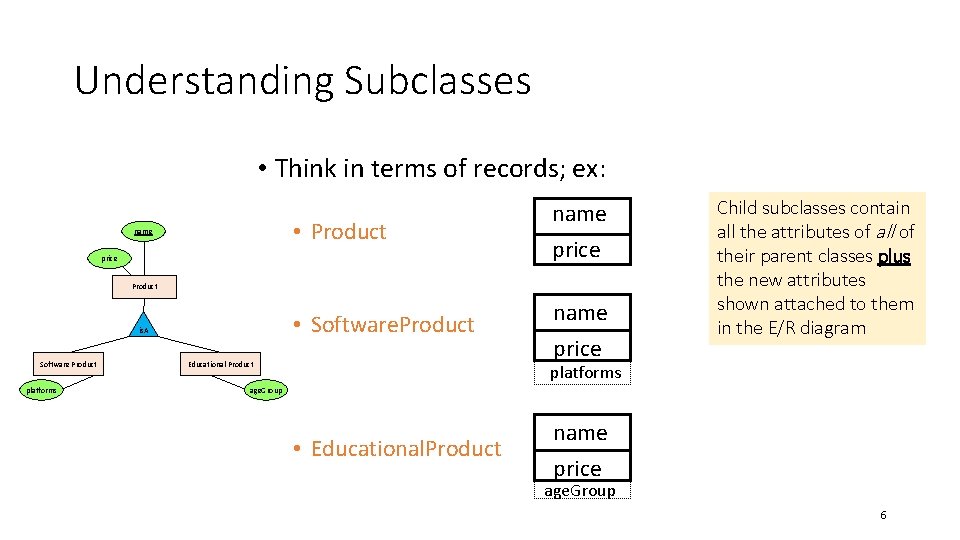
Understanding Subclasses • Think in terms of records; ex: • Product name price Product • Software. Product is. A Software Product platforms Educational Product name price Child subclasses contain all the attributes of all of their parent classes plus the new attributes shown attached to them in the E/R diagram platforms age. Group • Educational. Product name price age. Group 6
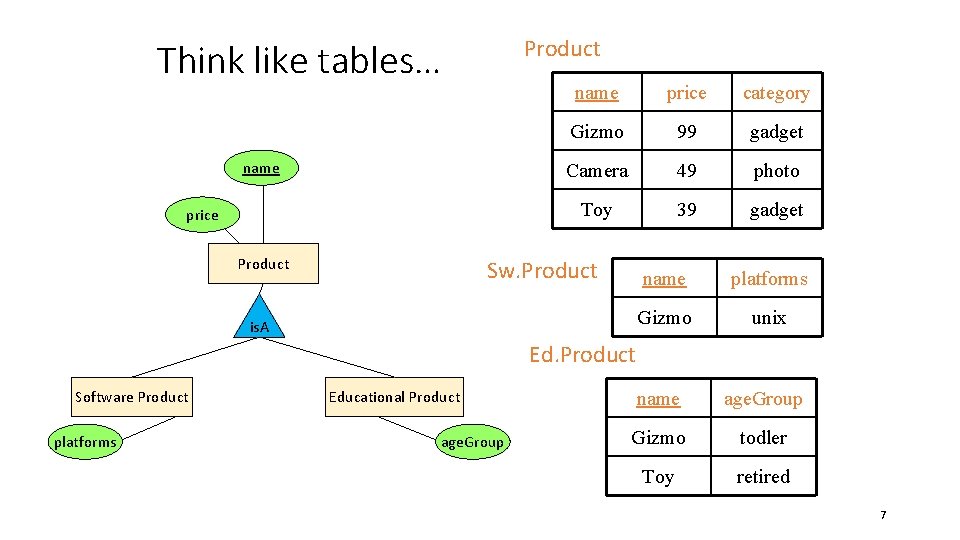
Product Think like tables… name price Product name price category Gizmo 99 gadget Camera 49 photo Toy 39 gadget Sw. Product is. A name platforms Gizmo unix Ed. Product Software Product platforms Educational Product age. Group name age. Group Gizmo todler Toy retired 7
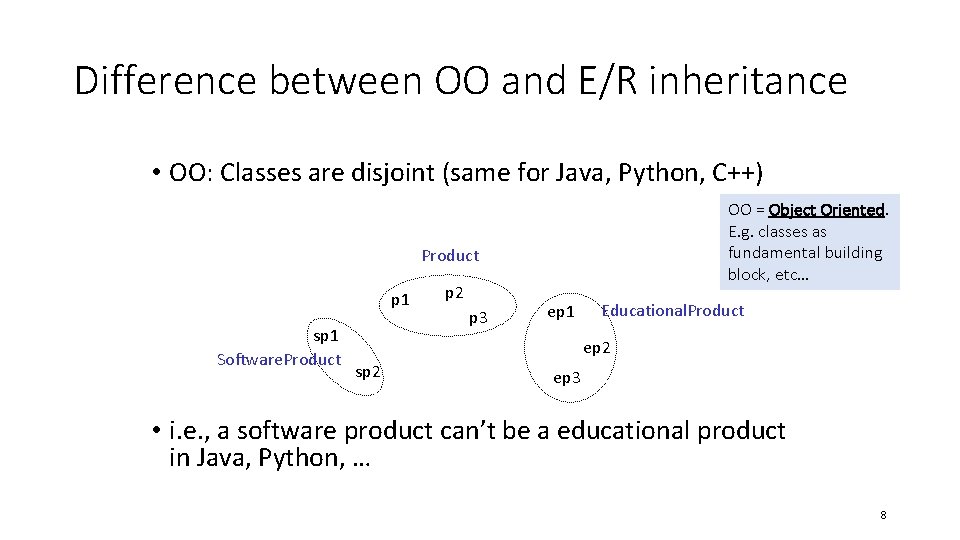
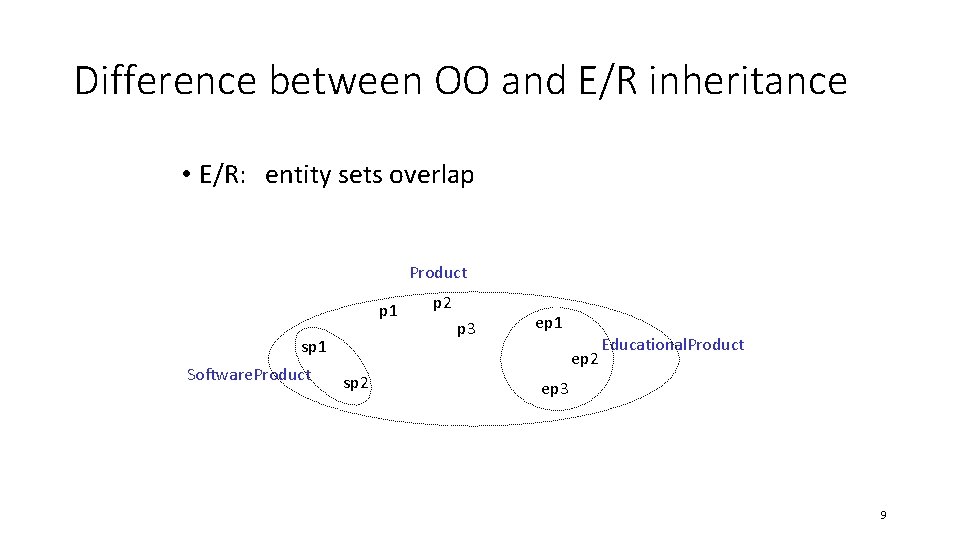
Difference between OO and E/R inheritance • OO: Classes are disjoint (same for Java, Python, C++) OO = Object Oriented. E. g. classes as fundamental building block, etc… Product p 1 sp 1 Software. Product p 2 p 3 ep 1 Educational. Product ep 2 sp 2 ep 3 • i. e. , a software product can’t be a educational product in Java, Python, … 8
Difference between OO and E/R inheritance • E/R: entity sets overlap Product p 1 sp 1 Software. Product p 2 p 3 ep 1 ep 2 sp 2 Educational. Product ep 3 9
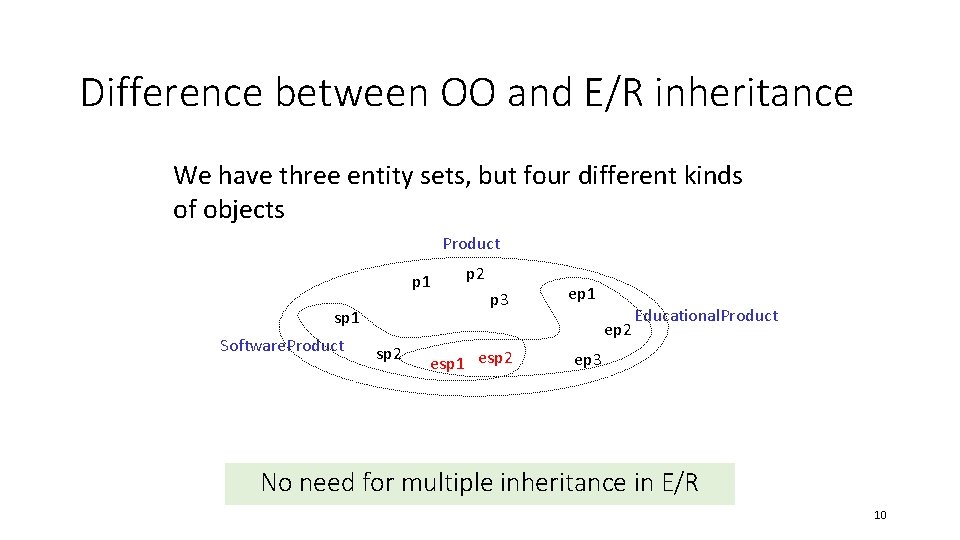
Difference between OO and E/R inheritance We have three entity sets, but four different kinds of objects Product p 1 sp 1 Software. Product p 2 p 3 ep 1 ep 2 sp 2 esp 1 esp 2 Educational. Product ep 3 No need for multiple inheritance in E/R 10
Is. A Review • If we declare A Is. A B then every A is a B • We use Is. A to • Add descriptive attributes to a subclass • To identify entities that participate in a relationship • No need for multiple inheritance 11
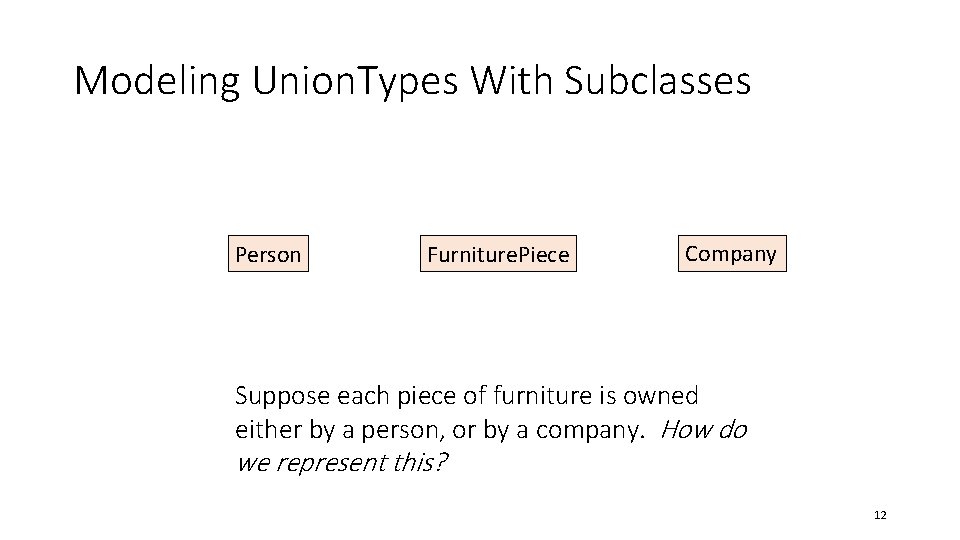
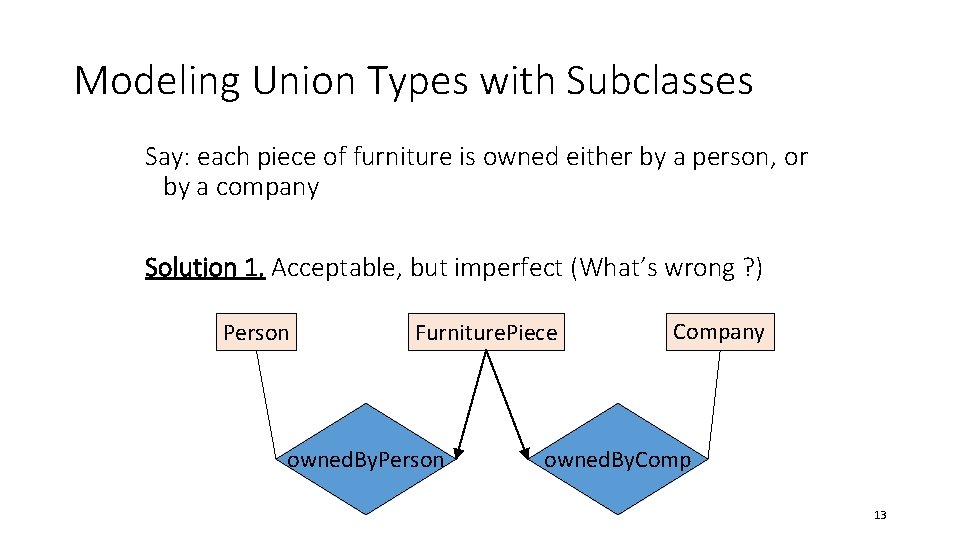
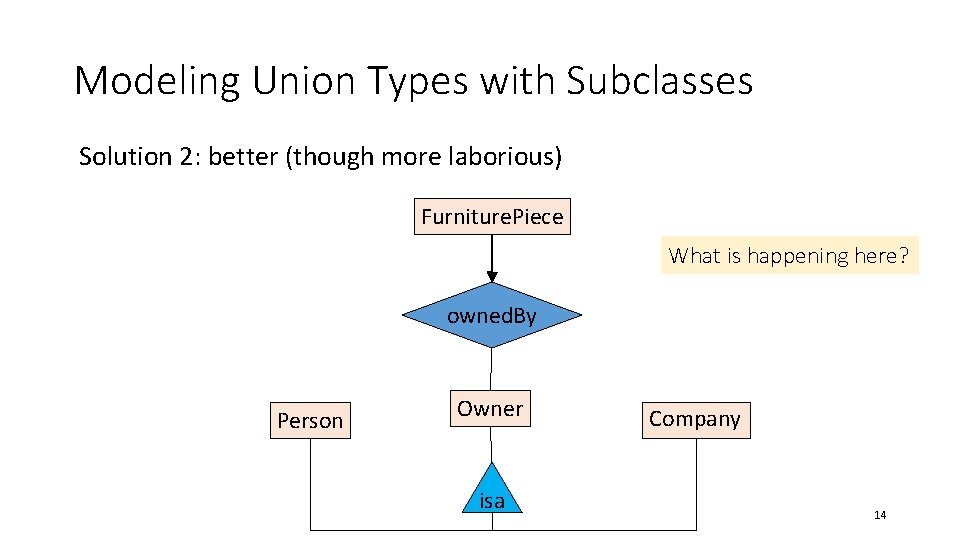
Modeling Union. Types With Subclasses Person Furniture. Piece Company Suppose each piece of furniture is owned either by a person, or by a company. How do we represent this? 12
Modeling Union Types with Subclasses Say: each piece of furniture is owned either by a person, or by a company Solution 1. Acceptable, but imperfect (What’s wrong ? ) Person Furniture. Piece owned. By. Person Company owned. By. Comp 13
Modeling Union Types with Subclasses Solution 2: better (though more laborious) Furniture. Piece What is happening here? owned. By Person Owner isa Company 14
Constraints in E/R Diagrams • Finding constraints is part of the E/R modeling process. Commonly used constraints are: • Keys: Implicit constraints on uniqueness of entities • Ex: An SSN uniquely identifies a person • Single-value constraints: • Ex: an NFL player can only belong to one team at any moment • Referential integrity constraints: Referenced entities must exist • Ex: if you work for a company, it must exist in the database • Other constraints: • Ex: peoples’ ages are between 0 and 150 Recall FOREIGN KEYs! 15
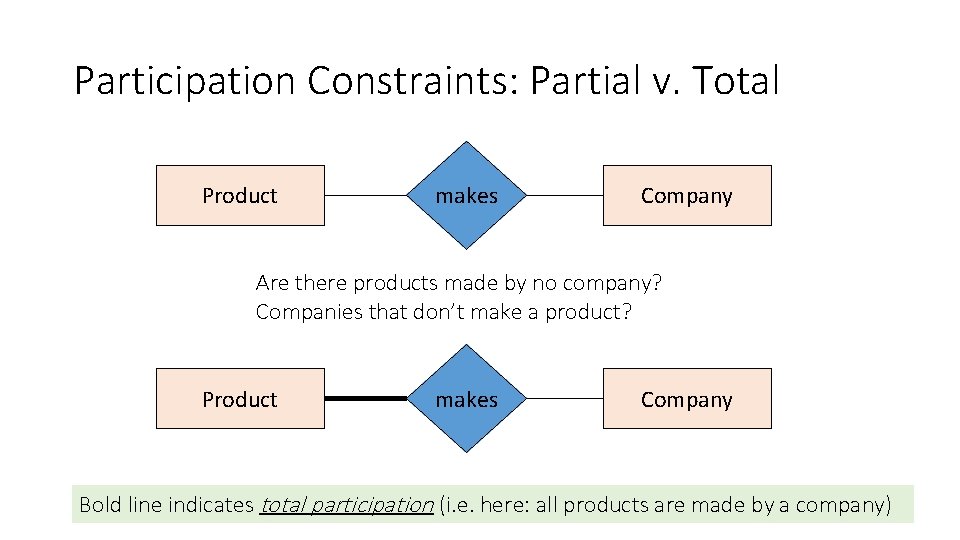
Participation Constraints: Partial v. Total Product makes Company Are there products made by no company? Companies that don’t make a product? Product makes Company Bold line indicates total participation (i. e. here: all products are made by a company) 16
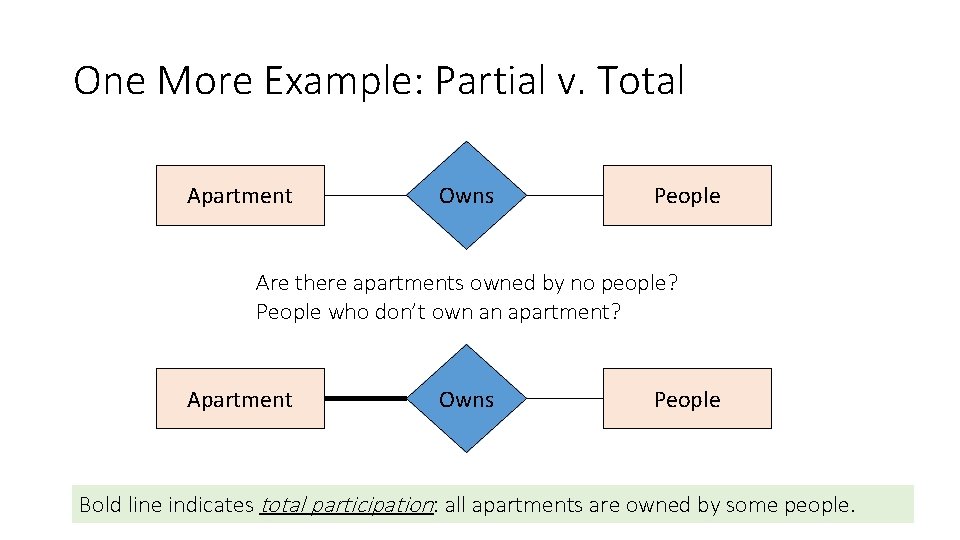
One More Example: Partial v. Total Apartment Owns People Are there apartments owned by no people? People who don’t own an apartment? Apartment Owns People Bold line indicates total participation: all apartments are owned by some people. 17
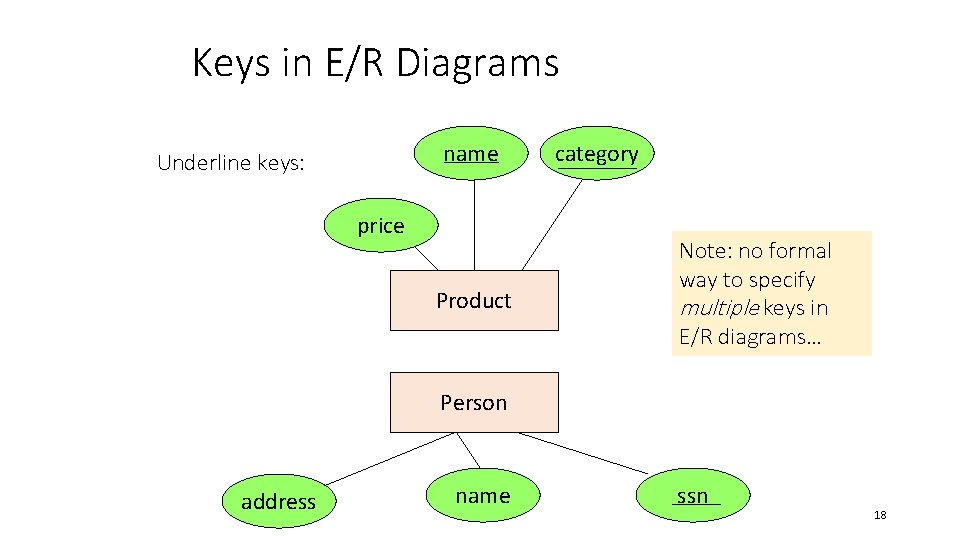
Keys in E/R Diagrams name Underline keys: price Product category Note: no formal way to specify multiple keys in E/R diagrams… Person address name ssn 18
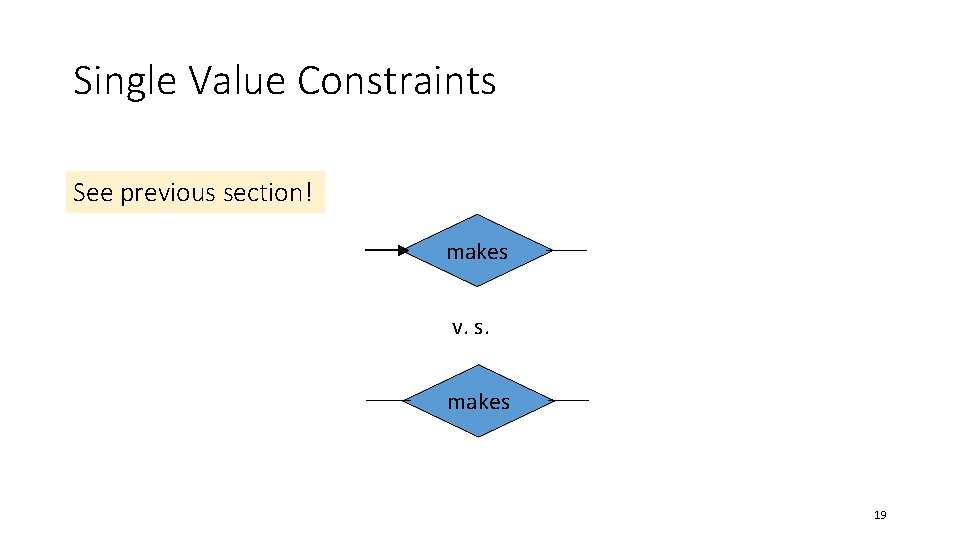
Single Value Constraints See previous section! makes v. s. makes 19
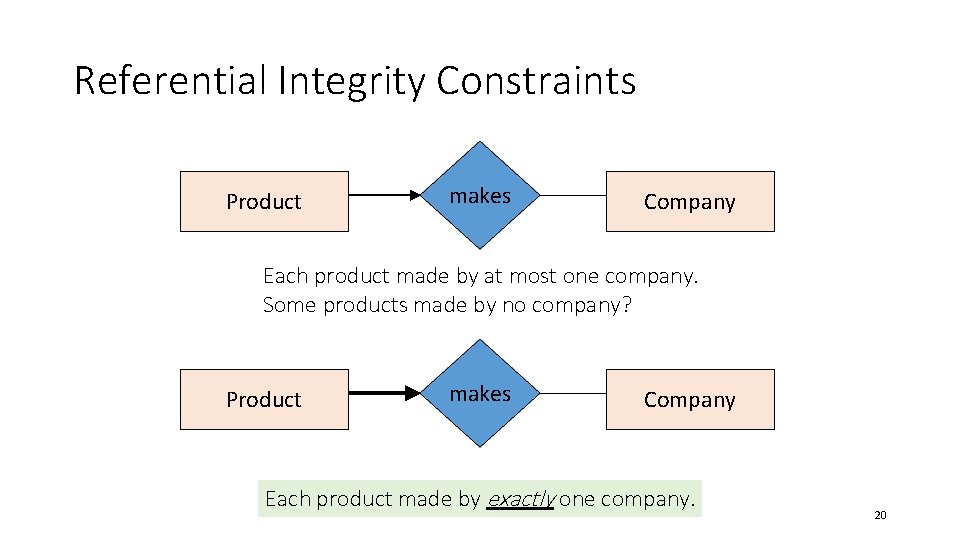
Referential Integrity Constraints Product makes Company Each product made by at most one company. Some products made by no company? Product makes Company Each product made by exactly one company. 20
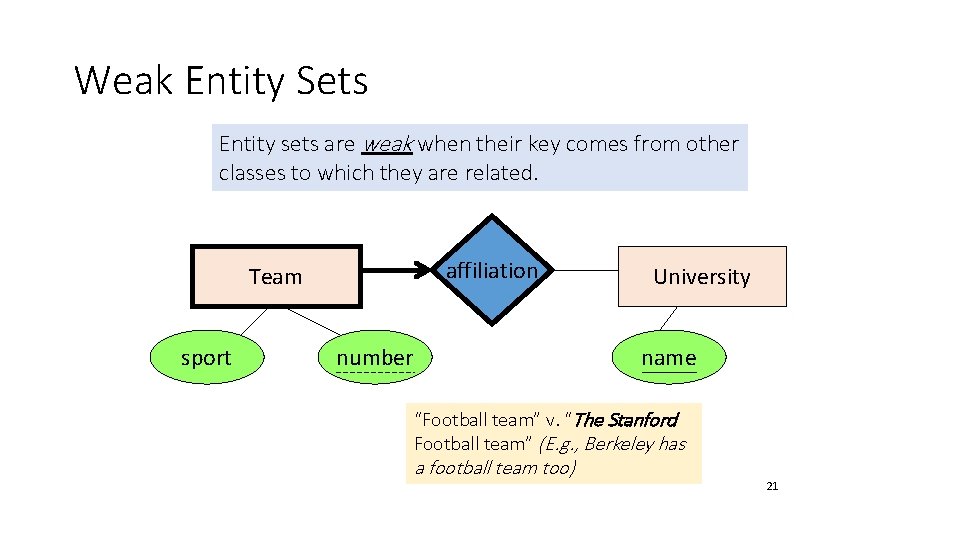
Weak Entity Sets Entity sets are weak when their key comes from other classes to which they are related. affiliation Team sport number University name “Football team” v. “The Stanford Football team” (E. g. , Berkeley has a football team too) 21
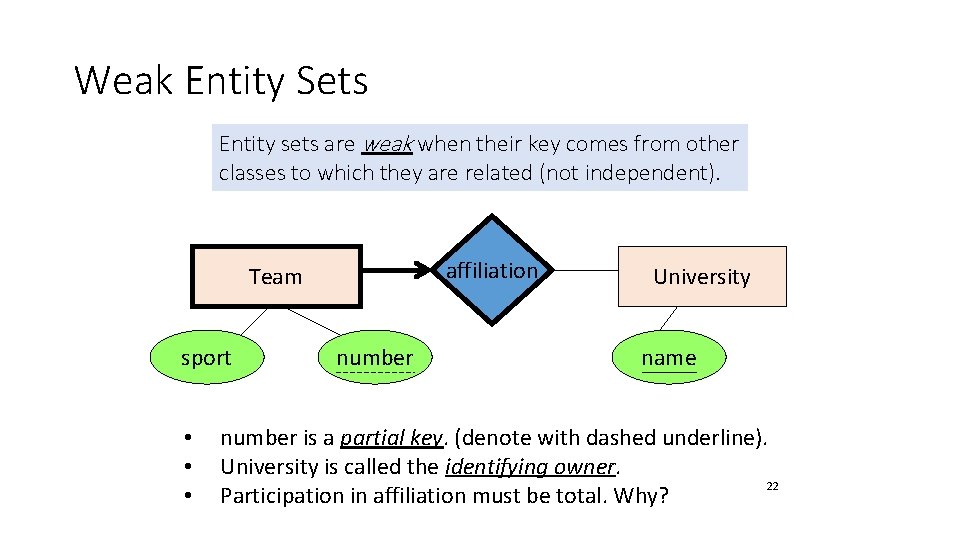
Weak Entity Sets Entity sets are weak when their key comes from other classes to which they are related (not independent). affiliation Team sport • • • number University name number is a partial key. (denote with dashed underline). University is called the identifying owner. 22 Participation in affiliation must be total. Why?
E/R Summary • E/R diagrams are a visual syntax that allows technical and non-technical people to talk • For conceptual design • Basic constructs: entity, relationship, and attributes • A good design is faithful to the constraints of the application, but not overzealous 23
Activity 4 -3: Weak entities, constraints
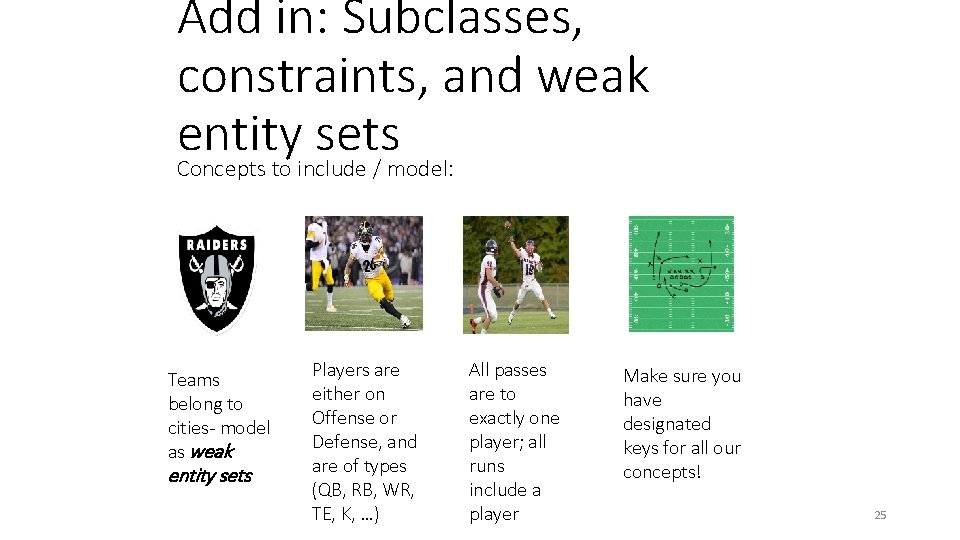
Add in: Subclasses, constraints, and weak entity sets Concepts to include / model: Teams belong to cities- model as weak entity sets Players are either on Offense or Defense, and are of types (QB, RB, WR, TE, K, …) All passes are to exactly one player; all runs include a player Make sure you have designated keys for all our concepts! 25