
Lecture 10 Superconductivity Superconducting RF Superconducting Magnets J
![LHC Nb. Ti Wire Jc [A/mm 2] Courtesy L. Boturra of CERN T=1. 9](https://slidetodoc.com/presentation_image_h/c498133f2c26478301650895c06aa6c5/image-12.jpg "LHC Nb. Ti Wire Jc [A/mm 2] Courtesy L. Boturra of CERN T=1. 9")
- Slides: 70
Lecture 10 Superconductivity, Superconducting RF & Superconducting Magnets J. G. Weisend II
Goals • Describe the basic physics behind superconductivity (mainly low TC ) • Describe the requirements of practical superconducting materials • Describe how superconducting materials are turned into practical conductors for applications • Discuss superconducting magnets including stability, protection and show an example • Discuss superconducting radiofrequency systems (SCRF) • Touch briefly on Hi. TC superconductivity Jan 2017 Lecture 10 |Superconductivity, SRF and SC Magnets - J. G. Weisend II Slide 2
Introduction • As we’ve seen, superconductivity is a major motivating factor for the use of cryogenics – particularly in accelerators but also in commercial systems such as MRI • Cryogenic engineers will frequently be called upon to design systems to cool and keep cold superconducting equipment • Thus, understanding the requirements of superconductors is an important part of the training of a cryogenic engineer. • What is a superconductor? – A superconductor is a material that conducts DC electrical current with zero resistive losses under certain specific conditions • When in the superconducting state the resistive loss is identically zero not just vanishingly small but zero Jan 2017 Lecture 10 |Superconductivity, SRF and SC Magnets - J. G. Weisend II Slide 3
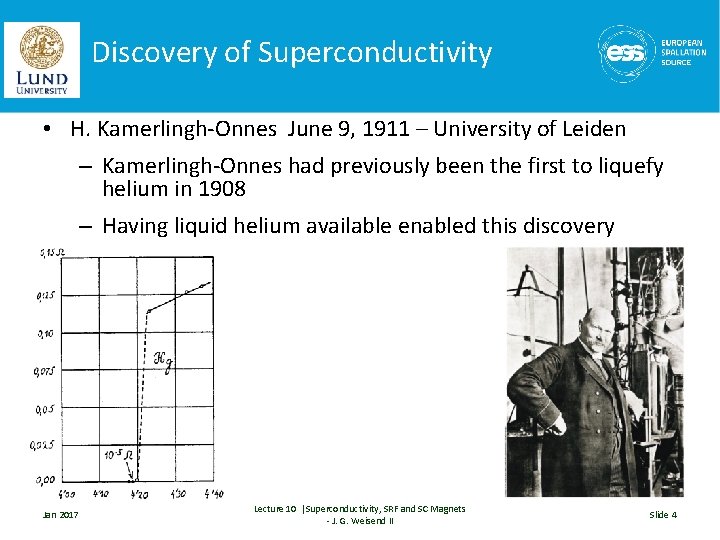
Discovery of Superconductivity • H. Kamerlingh-Onnes June 9, 1911 – University of Leiden – Kamerlingh-Onnes had previously been the first to liquefy helium in 1908 – Having liquid helium available enabled this discovery Jan 2017 Lecture 10 |Superconductivity, SRF and SC Magnets - J. G. Weisend II Slide 4
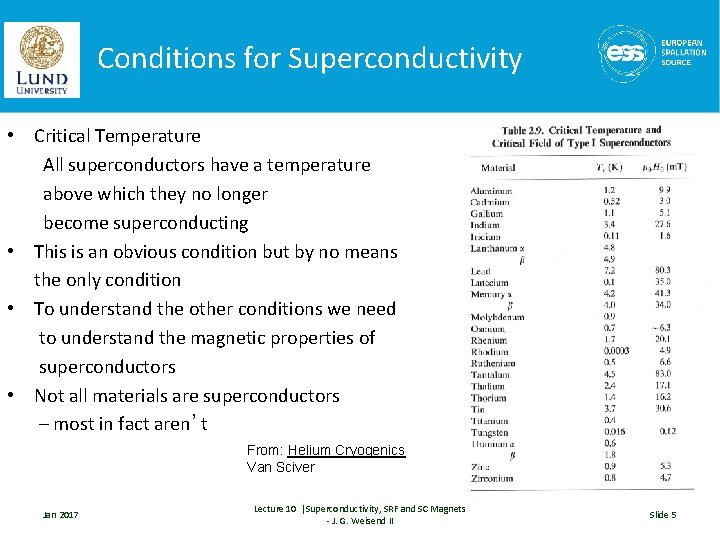
Conditions for Superconductivity • Critical Temperature All superconductors have a temperature above which they no longer become superconducting • This is an obvious condition but by no means the only condition • To understand the other conditions we need to understand the magnetic properties of superconductors • Not all materials are superconductors – most in fact aren’t From: Helium Cryogenics Van Sciver Jan 2017 Lecture 10 |Superconductivity, SRF and SC Magnets - J. G. Weisend II Slide 5
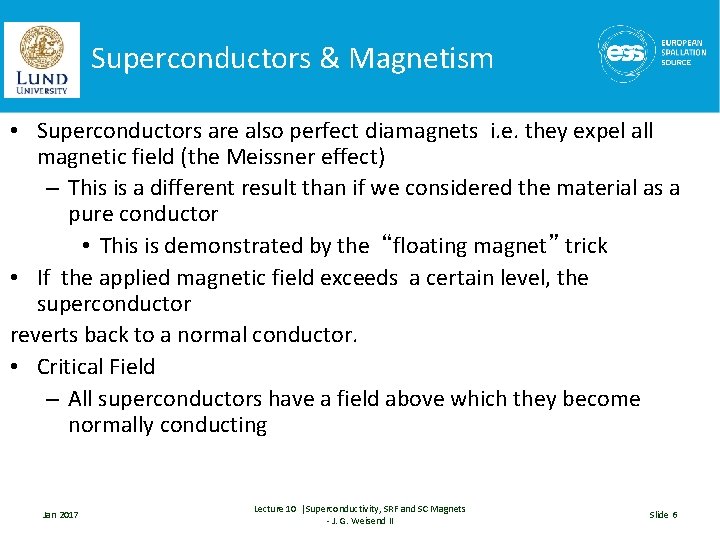
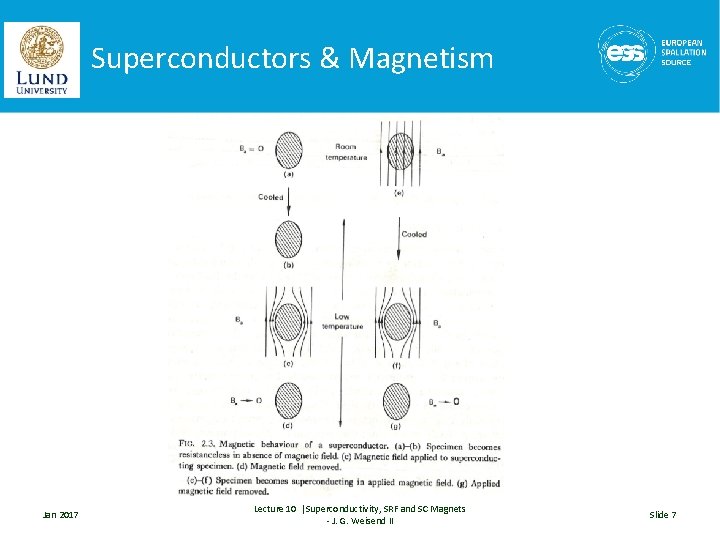
Superconductors & Magnetism • Superconductors are also perfect diamagnets i. e. they expel all magnetic field (the Meissner effect) – This is a different result than if we considered the material as a pure conductor • This is demonstrated by the “floating magnet” trick • If the applied magnetic field exceeds a certain level, the superconductor reverts back to a normal conductor. • Critical Field – All superconductors have a field above which they become normally conducting Jan 2017 Lecture 10 |Superconductivity, SRF and SC Magnets - J. G. Weisend II Slide 6
Superconductors & Magnetism Jan 2017 Lecture 10 |Superconductivity, SRF and SC Magnets - J. G. Weisend II Slide 7
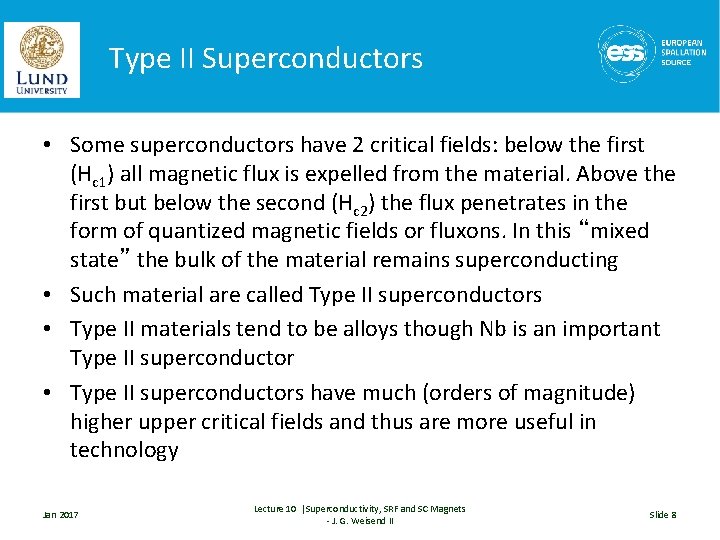
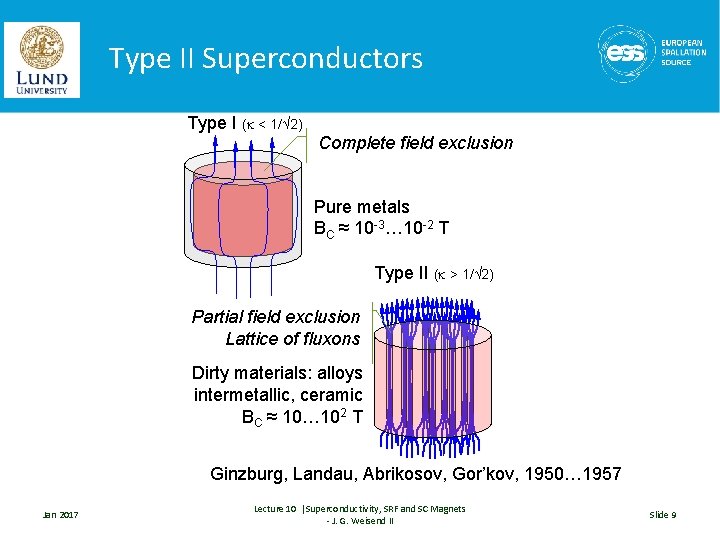
Type II Superconductors • Some superconductors have 2 critical fields: below the first (Hc 1) all magnetic flux is expelled from the material. Above the first but below the second (Hc 2) the flux penetrates in the form of quantized magnetic fields or fluxons. In this “mixed state” the bulk of the material remains superconducting • Such material are called Type II superconductors • Type II materials tend to be alloys though Nb is an important Type II superconductor • Type II superconductors have much (orders of magnitude) higher upper critical fields and thus are more useful in technology Jan 2017 Lecture 10 |Superconductivity, SRF and SC Magnets - J. G. Weisend II Slide 8
Type II Superconductors Type I ( < 1/√ 2) Complete field exclusion Pure metals BC ≈ 10 -3… 10 -2 T Type II ( > 1/√ 2) Partial field exclusion Lattice of fluxons Dirty materials: alloys intermetallic, ceramic BC ≈ 10… 102 T Ginzburg, Landau, Abrikosov, Gor’kov, 1950… 1957 Jan 2017 Lecture 10 |Superconductivity, SRF and SC Magnets - J. G. Weisend II Slide 9
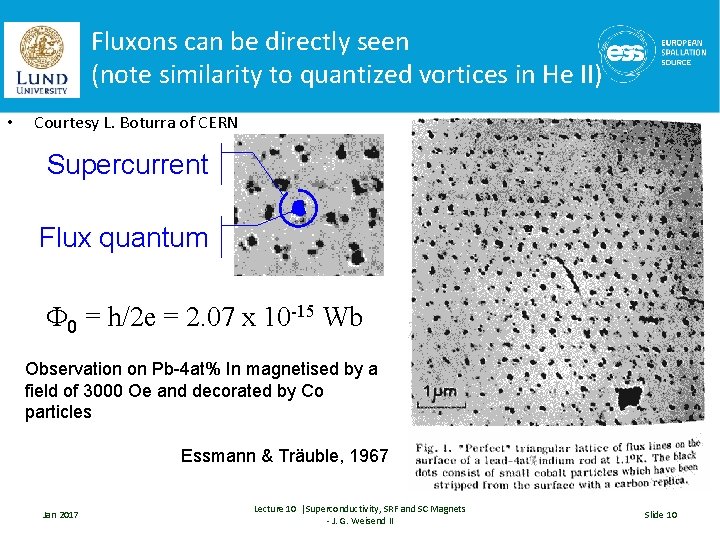
Fluxons can be directly seen (note similarity to quantized vortices in He II) • Courtesy L. Boturra of CERN Supercurrent Flux quantum 0 = h/2 e = 2. 07 x 10 -15 Wb Observation on Pb-4 at% In magnetised by a field of 3000 Oe and decorated by Co particles Essmann & Träuble, 1967 Jan 2017 Lecture 10 |Superconductivity, SRF and SC Magnets - J. G. Weisend II Slide 10
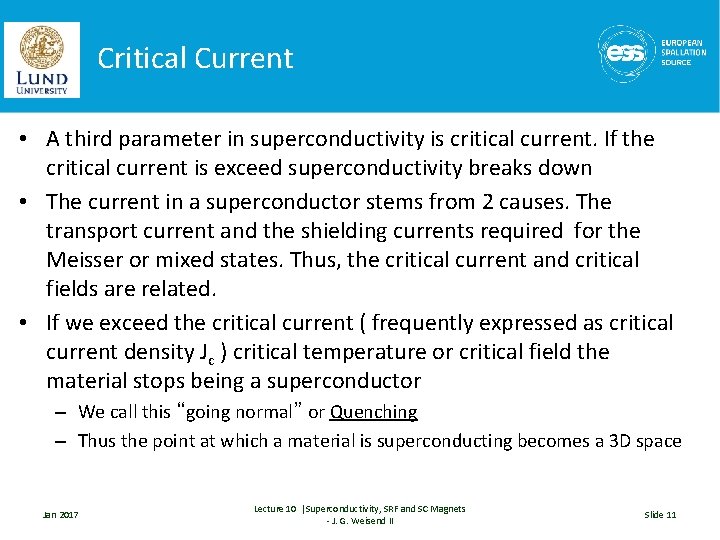
Critical Current • A third parameter in superconductivity is critical current. If the critical current is exceed superconductivity breaks down • The current in a superconductor stems from 2 causes. The transport current and the shielding currents required for the Meisser or mixed states. Thus, the critical current and critical fields are related. • If we exceed the critical current ( frequently expressed as critical current density Jc ) critical temperature or critical field the material stops being a superconductor – We call this “going normal” or Quenching – Thus the point at which a material is superconducting becomes a 3 D space Jan 2017 Lecture 10 |Superconductivity, SRF and SC Magnets - J. G. Weisend II Slide 11
LHC Nb. Ti Wire Jc [A/mm 2] Courtesy L. Boturra of CERN T=1. 9 K T=4. 2 K B = 5 [T] Note Improvement in B and Jc @ T = 1. 9 K 100, 000 1, 000 B [T] 100 T [K] Jc (5 T, 4. 2 K) ≈ 3000 Jan 2017 A/mm 2 5 Lecture 10 |Superconductivity, SRF and SC Magnets - J. G. Weisend II 5 10 15 10 Slide 12
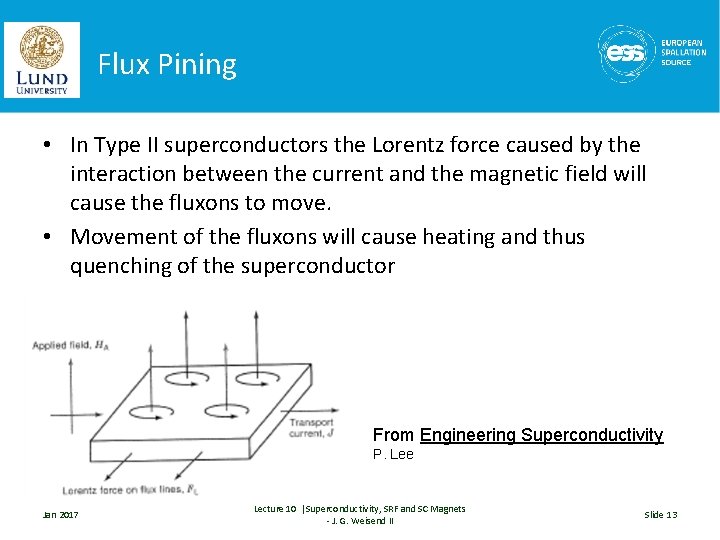
Flux Pining • In Type II superconductors the Lorentz force caused by the interaction between the current and the magnetic field will cause the fluxons to move. • Movement of the fluxons will cause heating and thus quenching of the superconductor From Engineering Superconductivity P. Lee Jan 2017 Lecture 10 |Superconductivity, SRF and SC Magnets - J. G. Weisend II Slide 13
Flux Pining • In practical superconductors the fluxons are pined to prevent movement – this allows higher current densities. • Pinning sites are created by complicated metallurgical processes (heat treatments, cold work and alloying) • This development over the last 30 years has been a major victory in developing practical superconductors for applications Jan 2017 Lecture 10 |Superconductivity, SRF and SC Magnets - J. G. Weisend II Slide 14
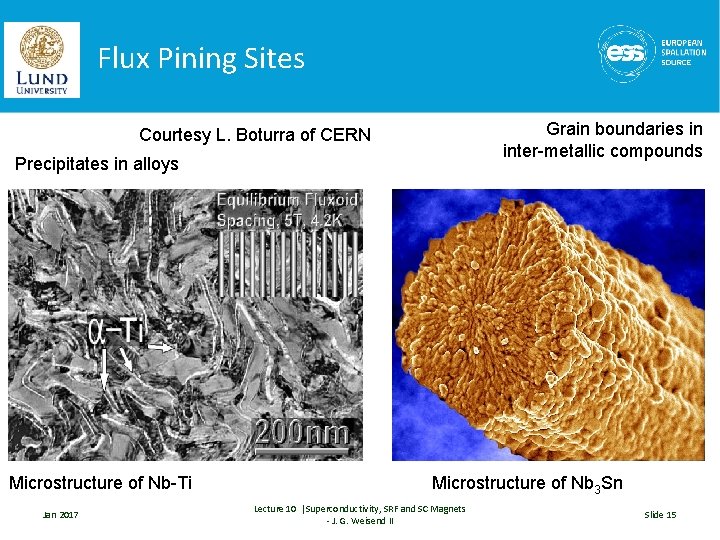
Flux Pining Sites Grain boundaries in inter-metallic compounds Courtesy L. Boturra of CERN Precipitates in alloys Microstructure of Nb-Ti Jan 2017 Microstructure of Nb 3 Sn Lecture 10 |Superconductivity, SRF and SC Magnets - J. G. Weisend II Slide 15
But Wait! What Causes Superconductivity? • The following is a very hand waving explanation of the origin of low temperature superconductivity • There is a very elegant, accurate and complicated description of low temperature superconductivity: – This is the Bardeen-Cooper- Schrieffer theory or BCS theory • Simply put – Electrons in the material are linked together into Cooper pairs via an attractive force that comes from the oscillations of the (positively charged) lattice – These Cooper pairs now act more like bosons and in a sense undergo a Bose. Einstein condensation similar to that seen in He II – This “condensate” in effect acts as one “unit” you can not scatter or change the energy of a single electron without changing the energy of all of them • There is thus an energy gap and unless the energy of interactions exceeds this value there is no scattering and thus no resistance • BCS theory explains and predicts observable behavior in low Tc superconductors Jan 2017 Lecture 10 |Superconductivity, SRF and SC Magnets - J. G. Weisend II Slide 16
Another Way to Model Superconductivity is via the “Two Fluid Model” • This imagines superconducting materials as being composed of two kinds of electrons : Those in Cooper pairs and those not in Cooper pairs – Above TC there are no Cooper pairs – At absolute zero all electrons are in Cooper pairs • In DC applications the Cooper pairs carry all the electric current and thus there is zero resistance • But in AC (i. e. RF) applications the oscillating electric field affects both the Cooper pairs & the non paired electrons & the movement of the non paired electrons result in resistance. – Thus there is always electrical loss in AC superconductivity • A similar model is also used to describe He II Jan 2017 Lecture 10 |Superconductivity, SRF and SC Magnets- J. G. Weisend II 17
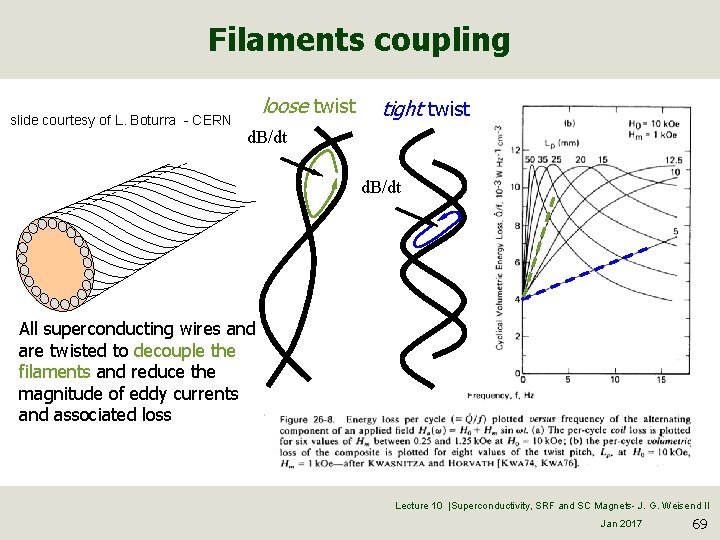
Impact of Changing Currents • In addition to the intrinsic losses caused by AC currents in superconductors. There additional AC losses that can be reduced via superconductor design • They are broadly speaking 2 major sources of additional AC losses in superconductors: hysteresis (caused by flux jumping) and losses caused by AC coupling between adjacent filaments. • See Backup slides for additional details Jan 2017 Lecture 10 |Superconductivity, SRF and SC Magnets - J. G. Weisend II Slide 18
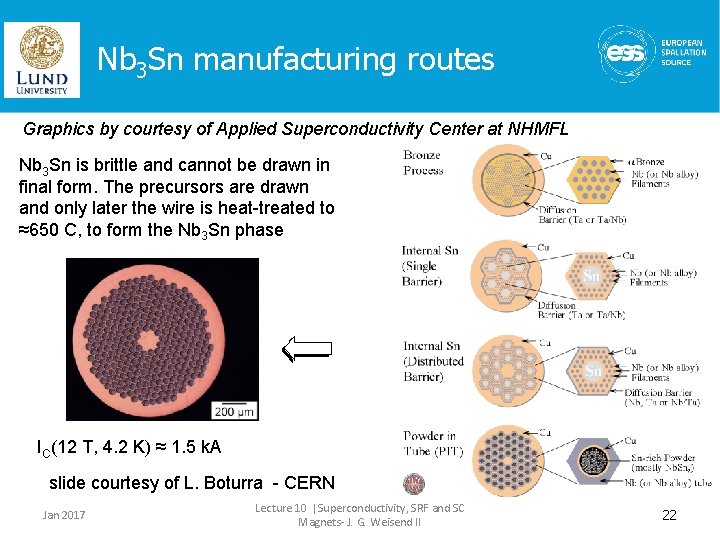
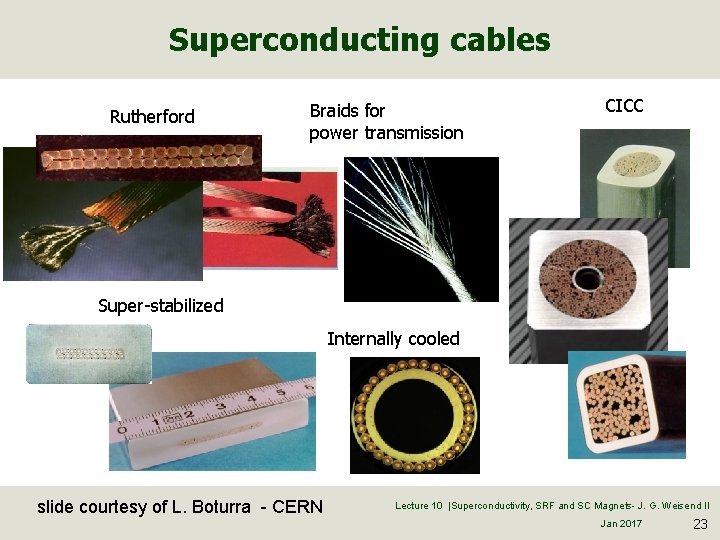
Practical Superconductors • Superconductors are relatively poor conductors when normal • Superconductors do have resistive losses when the current is varied • Superconductors can’t generally be used as a bulk material. They are divided into filaments (tens of m in DIA) housed in a good conductor (known as a stabilizer) matrix. This: – Prevents flux jumping and resultant heating – Increases stability • Groups of filaments themselves are also twisted into a cable to reduce coupling and resulting AC losses in the cables • AC fields also induce eddy current losses in the good conductor within which the superconducting filaments are housed • The two workhorse practical low Tc superconductors are: – Nb Ti (ductile) – Nb 3 Sn ( higher Jc and Hc but a brittle inter metallic compound) Jan 2017 Lecture 10 |Superconductivity, SRF and SC Magnets - J. G. Weisend II Slide 19
Practical Superconductors • It’s important to note that while superconductivity was discovered in 1911, practical high current density superconducting materials were developed until the 1960 s and weren’t suitable for wide spread technological applications (understanding flux pining, manufacturing techniques ) until the 1980’s • This has implications for applications using the much more complicated Hi. Tc superconductors • How do we create superconducting wire? Jan 2017 Lecture 10 |Superconductivity, SRF and SC Magnets - J. G. Weisend II Slide 20
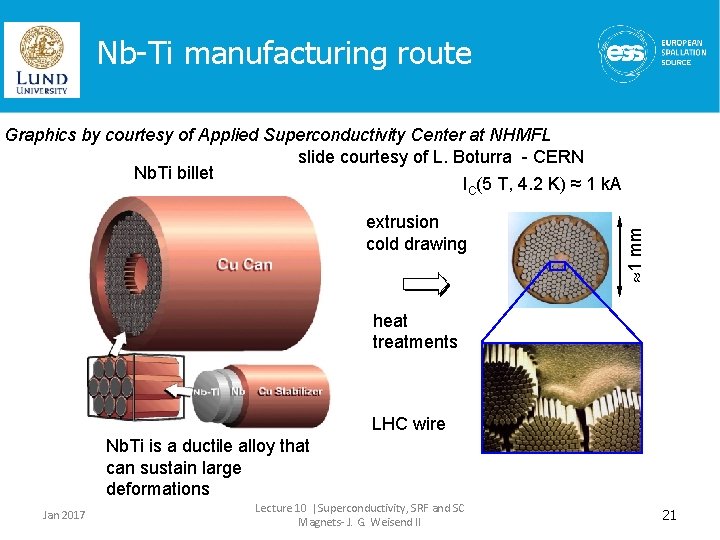
Nb-Ti manufacturing route extrusion cold drawing 1 mm Graphics by courtesy of Applied Superconductivity Center at NHMFL slide courtesy of L. Boturra - CERN Nb. Ti billet IC(5 T, 4. 2 K) ≈ 1 k. A heat treatments LHC wire Nb. Ti is a ductile alloy that can sustain large deformations Jan 2017 Lecture 10 |Superconductivity, SRF and SC Magnets- J. G. Weisend II 21
Nb 3 Sn manufacturing routes Graphics by courtesy of Applied Superconductivity Center at NHMFL Nb 3 Sn is brittle and cannot be drawn in final form. The precursors are drawn and only later the wire is heat-treated to ≈650 C, to form the Nb 3 Sn phase IC(12 T, 4. 2 K) ≈ 1. 5 k. A slide courtesy of L. Boturra - CERN Jan 2017 Lecture 10 |Superconductivity, SRF and SC Magnets- J. G. Weisend II 22
Superconducting cables Rutherford Braids for power transmission CICC Super-stabilized Internally cooled slide courtesy of L. Boturra - CERN Lecture 10 |Superconductivity, SRF and SC Magnets- J. G. Weisend II Jan 2017 23
Superconducting Radio Frequency Cavities • From the 70’s to the 90’s the principle application of superconductivity in particle accelerators was in the area of s/c magnets (Tevatron, HERA, LHC) • Since then, for a variety of reasons ( e. g. technical advances in SRF and the growth of linac applications) the use of SRF cavities for particle acceleration has become increasingly important and in many cases is the primary application of superconductivity & cryogenics in accelerator designs Jan 2017 Lecture 10 |Superconductivity, SRF and SC Magnets- J. G. Weisend II 24
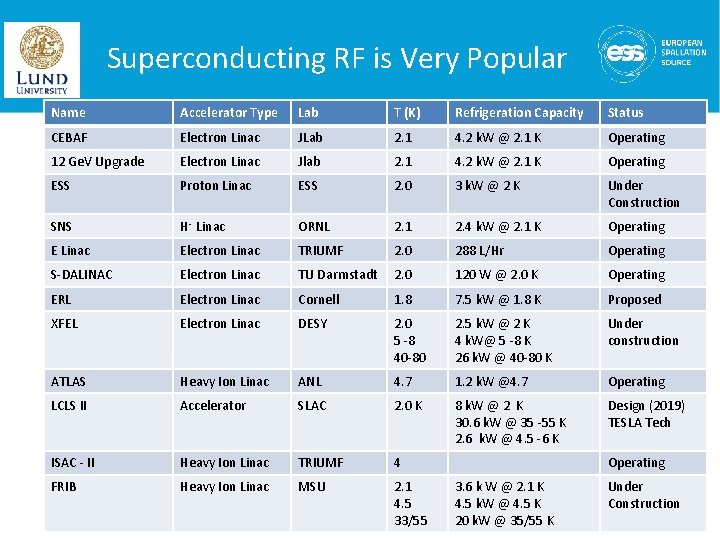
Superconducting RF is Very Popular Name Accelerator Type Lab T (K) Refrigeration Capacity Status CEBAF Electron Linac JLab 2. 1 4. 2 k. W @ 2. 1 K Operating 12 Ge. V Upgrade Electron Linac Jlab 2. 1 4. 2 k. W @ 2. 1 K Operating ESS Proton Linac ESS 2. 0 3 k. W @ 2 K Under Construction SNS H- Linac ORNL 2. 1 2. 4 k. W @ 2. 1 K Operating E Linac Electron Linac TRIUMF 2. 0 288 L/Hr Operating S-DALINAC Electron Linac TU Darmstadt 2. 0 120 W @ 2. 0 K Operating ERL Electron Linac Cornell 1. 8 7. 5 k. W @ 1. 8 K Proposed XFEL Electron Linac DESY 2. 0 5 -8 40 -80 2. 5 k. W @ 2 K 4 k. W@ 5 -8 K 26 k. W @ 40 -80 K Under construction ATLAS Heavy Ion Linac ANL 4. 7 1. 2 k. W @4. 7 Operating LCLS II Accelerator SLAC 2. 0 K 8 k. W @ 2 K 30. 6 k. W @ 35 -55 K 2. 6 k. W @ 4. 5 -6 K Design (2019) TESLA Tech ISAC - II Heavy Ion Linac TRIUMF 4 FRIB Heavy Ion Linac MSU Jan 2017 2. 1 3. 6 k W @ 2. 1 K 4. 5 SRF and SC 4. 5 k. W @ 4. 5 K Lecture 10 |Superconductivity, 33/55 20 k. W @ 35/55 K Magnets- J. G. Weisend II Operating Under Construction 25
Basics of SRF Cavities • SRF cavities deserve their own course. (see suggested reading list) • This will be a brief overview of the basics of SRF cavities. • Practical cavity material is pure Niobium • Cavities have beam vacuum on the inside (usually separate from insulation vacuum) and are surrounded and cooled by a bath of saturated Lhe • Cavities come in all shapes and frequencies (~ 80 MHz – 3. 9 GHz) depending on the accelerator design) Jan 2017 Lecture 10 |Superconductivity, SRF and SC Magnets- J. G. Weisend II 26
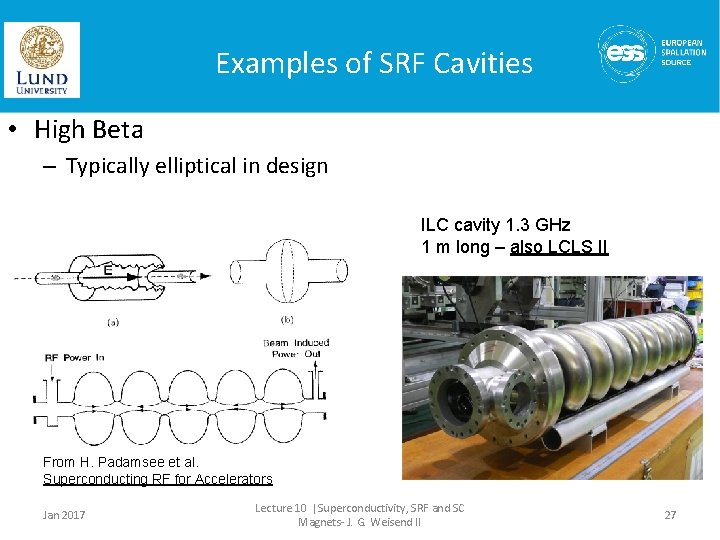
Examples of SRF Cavities • High Beta – Typically elliptical in design ILC cavity 1. 3 GHz 1 m long – also LCLS II From H. Padamsee et al. Superconducting RF for Accelerators Jan 2017 Lecture 10 |Superconductivity, SRF and SC Magnets- J. G. Weisend II 27
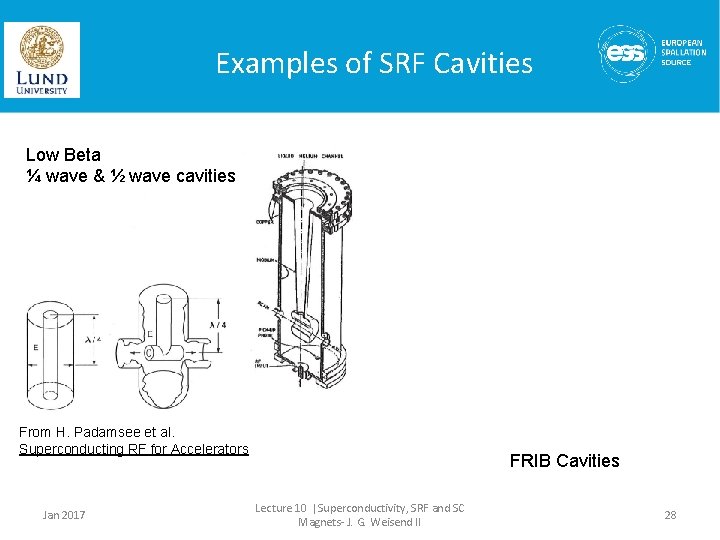
Examples of SRF Cavities Low Beta ¼ wave & ½ wave cavities From H. Padamsee et al. Superconducting RF for Accelerators Jan 2017 FRIB Cavities Lecture 10 |Superconductivity, SRF and SC Magnets- J. G. Weisend II 28
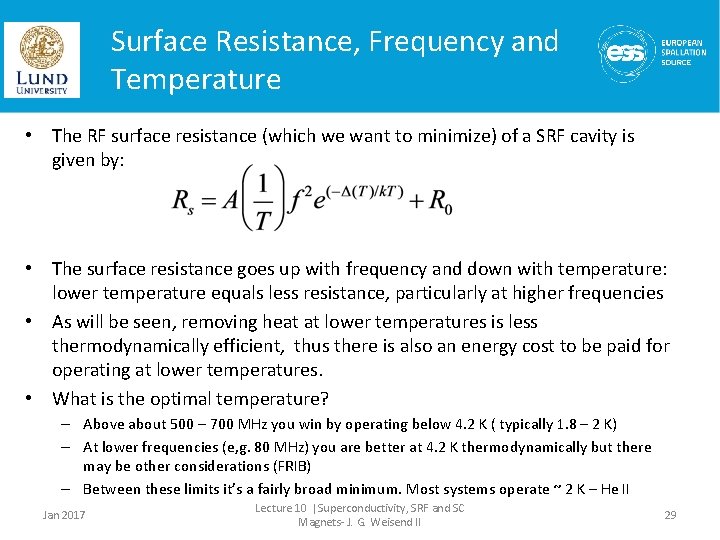
Surface Resistance, Frequency and Temperature • The RF surface resistance (which we want to minimize) of a SRF cavity is given by: • The surface resistance goes up with frequency and down with temperature: lower temperature equals less resistance, particularly at higher frequencies • As will be seen, removing heat at lower temperatures is less thermodynamically efficient, thus there is also an energy cost to be paid for operating at lower temperatures. • What is the optimal temperature? – Above about 500 – 700 MHz you win by operating below 4. 2 K ( typically 1. 8 – 2 K) – At lower frequencies (e, g. 80 MHz) you are better at 4. 2 K thermodynamically but there may be other considerations (FRIB) – Between these limits it’s a fairly broad minimum. Most systems operate ~ 2 K – He II Jan 2017 Lecture 10 |Superconductivity, SRF and SC Magnets- J. G. Weisend II 29
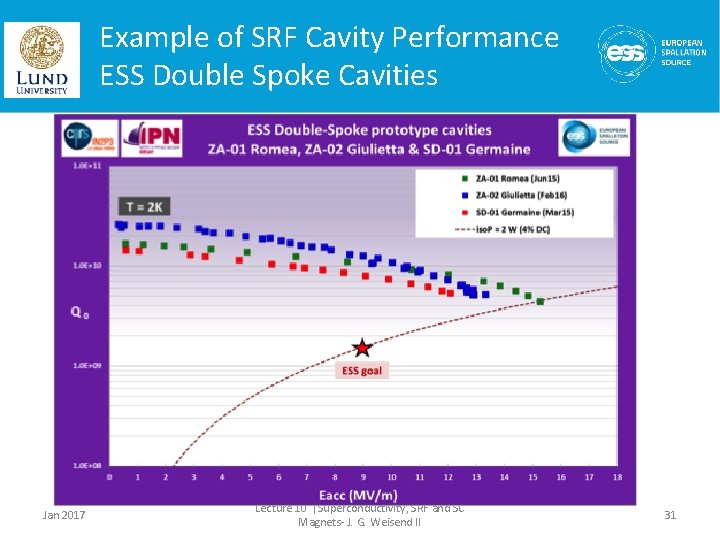
Cavity Performance • Two of the main parameters for describing Cavity performance are the accelerating gradient Eacc ( MV/m) and the cavity quality factor Q 0 • Q 0 is defined as the energy stored in the cavity divided by the energy lost in one RF period – Q 0 is related to the surface resistance. The lower the surface resistance the higher the Q 0 and the lower the energy deposited into the cavity wall and cryogenic system Thus the higher the Qo the better Jan 2017 Lecture 10 |Superconductivity, SRF and SC Magnets- J. G. Weisend II 30
Example of SRF Cavity Performance ESS Double Spoke Cavities Jan 2017 Lecture 10 |Superconductivity, SRF and SC Magnets- J. G. Weisend II 31
Cavity Performance Can Be Degraded By a Number of Phenomena • Quenching or thermal break down – normal ( non superconducting) zones develop in the cavity • Field Emission – electrons are pulled off the surface of the cavity and accelerated by the RF field (degrades Q 0) • Local Magnetic Fields Jan 2017 Lecture 10 |Superconductivity, SRF and SC Magnets- J. G. Weisend II 32
Cavity Processing • Research has shown that both Field Emission and Thermal Breakdown can be significantly reduced by proper processing of the cavities. This processing consists of an intricate set of steps involving: – Cavity surface cleaning by chemicals (buffered chemical processing) or by electropolishing – Cavity surface cleaning by High Pressure Rising with ultrapure water – Various heat treatments • Major progress in this area has made SRF cavities much more useful – CEBAF ( 1980’s) designed for 5 MV/m (actual performance was better) CEBAF 12 Ge. V upgrade (2000’s) specified & met 19. 2 MV/m – ILC cavity specification is 35 MV/m Jan 2017 Lecture 10 |Superconductivity, SRF and SC Magnets- J. G. Weisend II 33
Cavity Cleanliness • Once processed, the RF surface i. e. the beam vacuum surface of the cavities must be kept extremely clean to maintain performance. This results in: – Assembly of cavity strings in cleanrooms – Connection of beam tube vacuums within local cleanrooms during cryomodule installation – Very strict vacuum and particle free requirements for cavity systems – Presence of fast acting valves to subdivide beam vacuum in the case of accidents Jan 2017 Lecture 10 |Superconductivity, SRF and SC Magnets- J. G. Weisend II 34
Other Aspects of SRF Cavities • Q Disease – related to interstitial hydrogen in the niobium. – Can be treated via heat treatments or may set limits on cavity cool down and warm up rates • Local magnetic fields ( including the Earth’s) degrade cavity performance – Result is that cavities are designed with passive and sometimes active magnetic shields. Use of magnetic materials near cavities must be carefully examined • Cavities are resonant structures that require tuning frequently at cryogenic temperatures Jan 2017 Lecture 10 |Superconductivity, SRF and SC Magnets- J. G. Weisend II 35
Other Aspects of SRF Cavities • Vibrations (microphonics) can detune cavities depending on cavity stiffness and design – This may put strict limits on vibrations near cavities – Use of He II ( see later lecture) prevents bulk boiling in the helium bath that may affect the cavity tune Jan 2017 Lecture 10 |Superconductivity, SRF and SC Magnets- J. G. Weisend II 36
High Temperature Superconductivity • First Discovered in 1986 in Yttrium Barium Copper Oxide (YBa 2 Cu 3 O 7 -x), referred to commonly as YBCO - Tc ~92 K • Many other similar ceramic materials soon followed such as Bi 2 Sr 2 Ca 2 Cu 3 O 6 (Bi 2223) – Tc ~ 110 K and Hg. Ba 2 Cu 3 O 8 (Hg-1223) – Tc ~ 134 K • This lead to the so-called “Woodstock of Physics” at the 1987 APS March Meeting in NYC • Despite the initial excitement technical progress has been slow and Hi. Tc superconductors have a number of issues: – – While the Tc is high the critical current was (at least initially) is quite low These materials are anisotropic (performance depends on their orientation) These materials are brittle ceramics and thus very hard to turn into wires BCS theory doesn’t explain the presence of superconductivity in these materials – no good theory exists though some type of coherent phenomena must be behind it. Jan 2017 Lecture 10 |Superconductivity, SRF and SC Magnets - J. G. Weisend II Slide 37
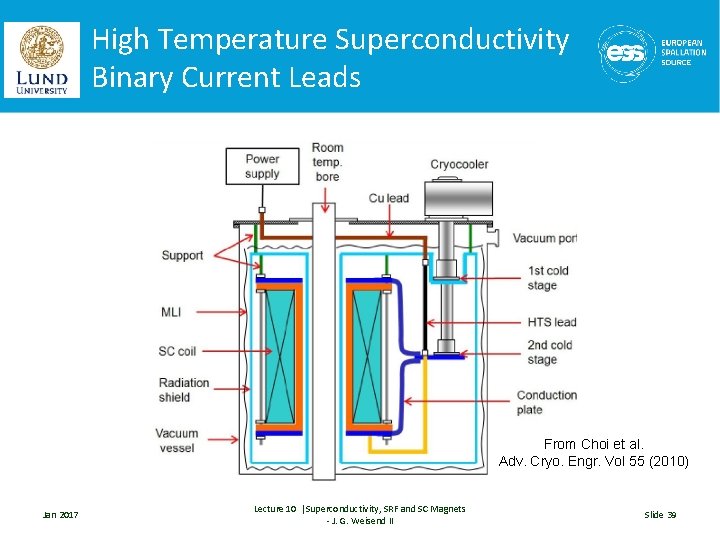
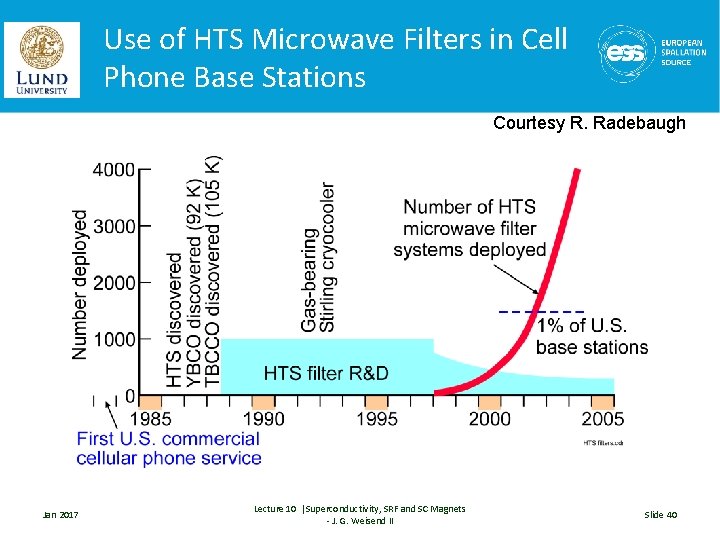
High Temperature Superconductivity • But don’t despair ! – Remember superconductivity was discovered in 1911 but practical low Tc superconductors really didn’t arrive until the 80’s • There are commercial niche applications of Hi. Tc superconductors even today • Hi. Tc current leads for providing current to low Tc s/c magnets – These leads allow superconductivity up to about 50 – 80 K and serve to reduce the overall heat leak into the LHe space since Hi. Tc materials are poor thermal conductors • Superconducting electronics in the form of low noise microwave filters for use in cell phone towers operating at about 50 K • Note also the temperature range for Hi. Tc superconductors ( ~ 50 – 200 K ) ties in nicely with the performance range for small cryocoolers – The development of small cryocoolers and rise of HTS applications have gone hand in hand Jan 2017 Lecture 10 |Superconductivity, SRF and SC Magnets - J. G. Weisend II Slide 38
High Temperature Superconductivity Binary Current Leads From Choi et al. Adv. Cryo. Engr. Vol 55 (2010) Jan 2017 Lecture 10 |Superconductivity, SRF and SC Magnets - J. G. Weisend II Slide 39
Use of HTS Microwave Filters in Cell Phone Base Stations Courtesy R. Radebaugh Jan 2017 Lecture 10 |Superconductivity, SRF and SC Magnets - J. G. Weisend II Slide 40
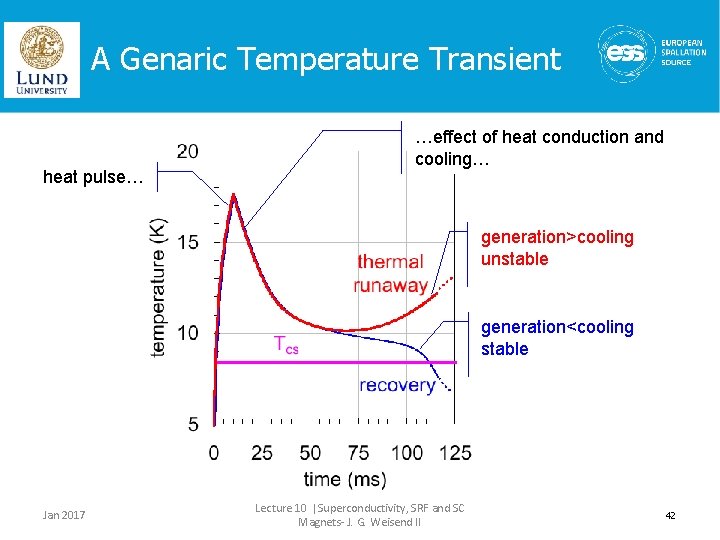
Stability of Superconducting Magnets • When a wire in a s/c magnet undergoes a temperature rise, there are 2 possibilities: – It can cool back down and remain superconducting – It can warm up above Tc and “quench” (become normally conducting in all or most of the magnet) • Which one occurs depends on the amount of heat generation and cooling Jan 2017 Lecture 10 |Superconductivity, SRF and SC Magnets - J. G. Weisend II Slide 41
A Genaric Temperature Transient heat pulse… …effect of heat conduction and cooling… generation>cooling unstable generation<cooling stable Jan 2017 Lecture 10 |Superconductivity, SRF and SC Magnets- J. G. Weisend II 42
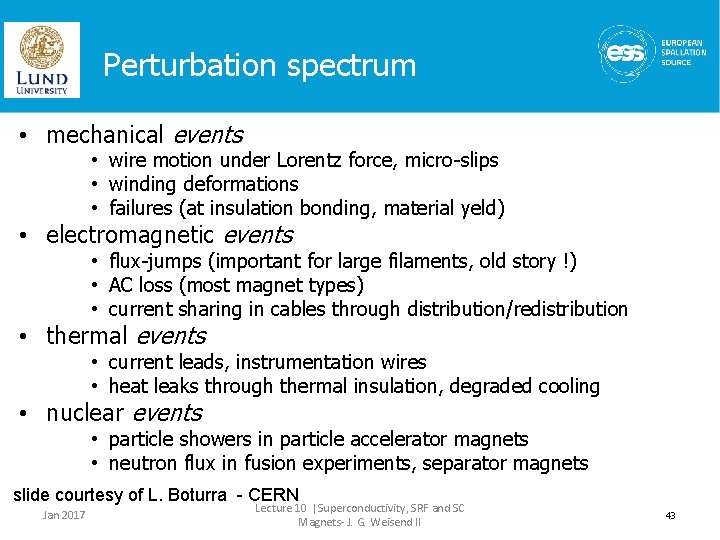
Perturbation spectrum • mechanical events • wire motion under Lorentz force, micro-slips • winding deformations • failures (at insulation bonding, material yeld) • electromagnetic events • flux-jumps (important for large filaments, old story !) • AC loss (most magnet types) • current sharing in cables through distribution/redistribution • thermal events • current leads, instrumentation wires • heat leaks through thermal insulation, degraded cooling • nuclear events • particle showers in particle accelerator magnets • neutron flux in fusion experiments, separator magnets slide courtesy of L. Boturra - CERN Jan 2017 Lecture 10 |Superconductivity, SRF and SC Magnets- J. G. Weisend II 43
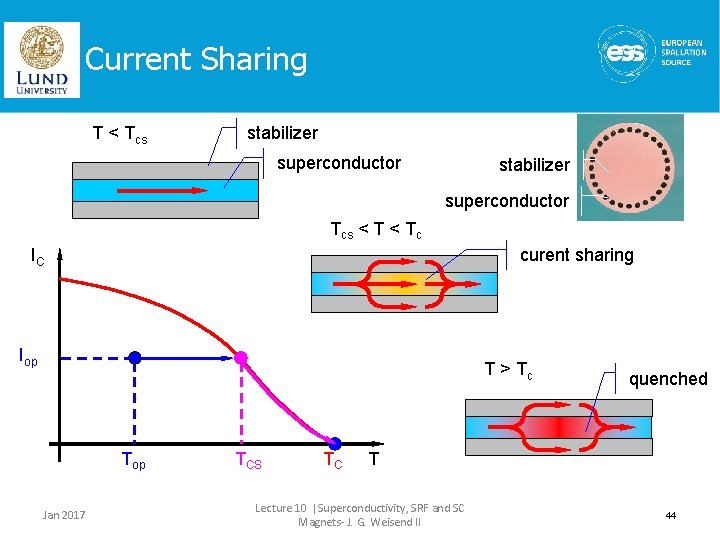
Current Sharing T < Tcs stabilizer superconductor Tcs < Tc IC curent sharing Iop T > Tc Top Jan 2017 TCS TC quenched T Lecture 10 |Superconductivity, SRF and SC Magnets- J. G. Weisend II 44
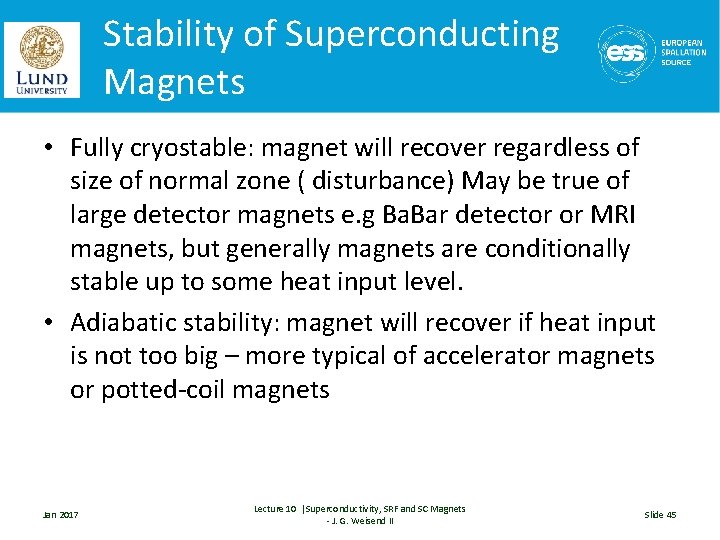
Stability of Superconducting Magnets • Fully cryostable: magnet will recover regardless of size of normal zone ( disturbance) May be true of large detector magnets e. g Ba. Bar detector or MRI magnets, but generally magnets are conditionally stable up to some heat input level. • Adiabatic stability: magnet will recover if heat input is not too big – more typical of accelerator magnets or potted-coil magnets Jan 2017 Lecture 10 |Superconductivity, SRF and SC Magnets - J. G. Weisend II Slide 45
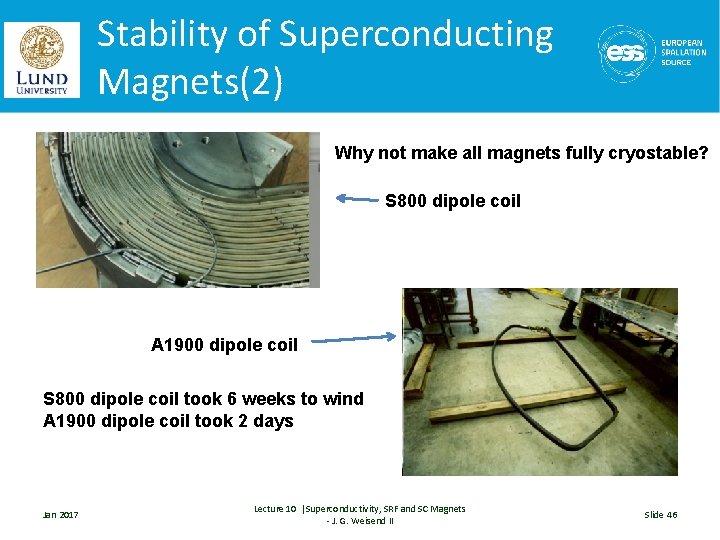
Stability of Superconducting Magnets(2) Why not make all magnets fully cryostable? S 800 dipole coil A 1900 dipole coil S 800 dipole coil took 6 weeks to wind A 1900 dipole coil took 2 days Jan 2017 Lecture 10 |Superconductivity, SRF and SC Magnets - J. G. Weisend II Slide 46
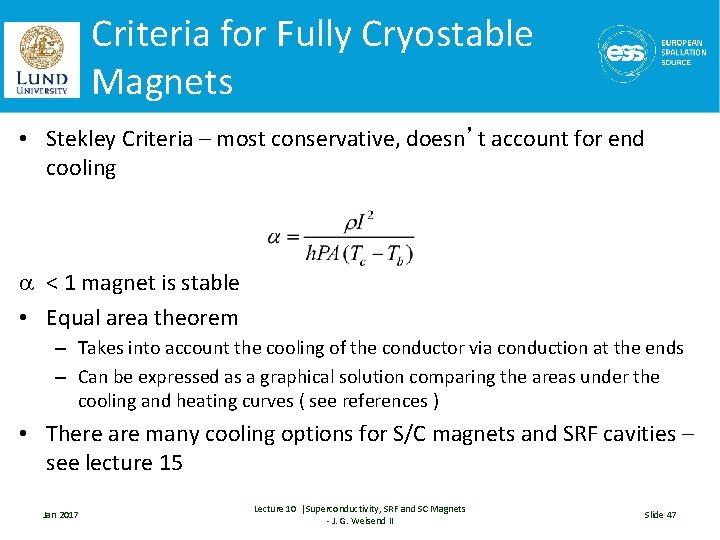
Criteria for Fully Cryostable Magnets • Stekley Criteria – most conservative, doesn’t account for end cooling a < 1 magnet is stable • Equal area theorem – Takes into account the cooling of the conductor via conduction at the ends – Can be expressed as a graphical solution comparing the areas under the cooling and heating curves ( see references ) • There are many cooling options for S/C magnets and SRF cavities – see lecture 15 Jan 2017 Lecture 10 |Superconductivity, SRF and SC Magnets - J. G. Weisend II Slide 47
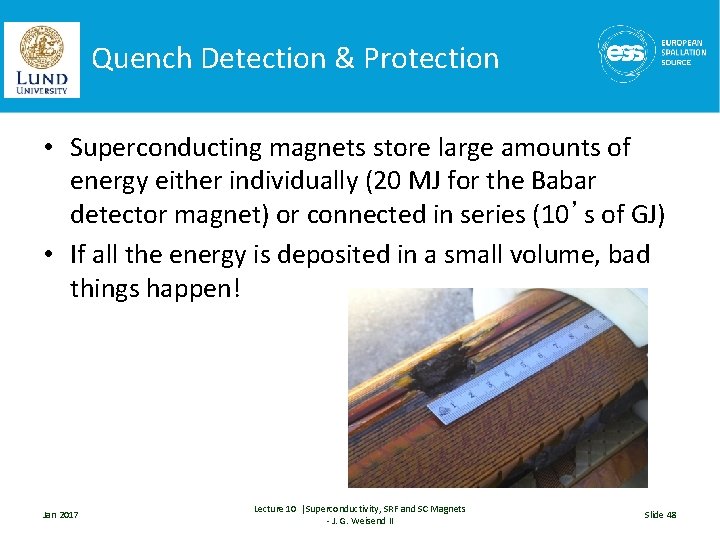
Quench Detection & Protection • Superconducting magnets store large amounts of energy either individually (20 MJ for the Babar detector magnet) or connected in series (10’s of GJ) • If all the energy is deposited in a small volume, bad things happen! Jan 2017 Lecture 10 |Superconductivity, SRF and SC Magnets - J. G. Weisend II Slide 48
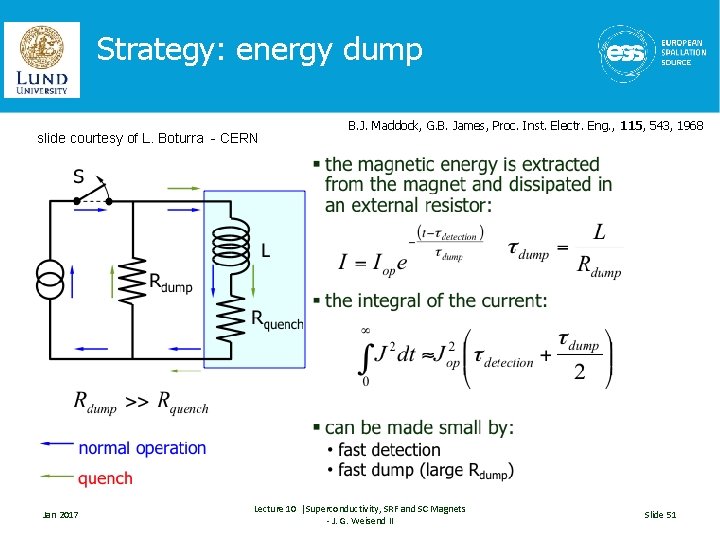
Quench Detection & Protection • The goal is to rapidly and accurately detect the quench and safely dispose of the energy – – Spread throughout the magnet In an external dump resistor In a coupled secondary In magnet strings, bypass the energy of the other s/c magnets away from the quenching one • Remember it’s the stored energy in the magnet(s) not the power supply that’s problem (S/C magnet power supplies are low voltage, high current, so increased resistance in a quenched magnet prevent further power input) Jan 2017 Lecture 10 |Superconductivity, SRF and SC Magnets - J. G. Weisend II Slide 49
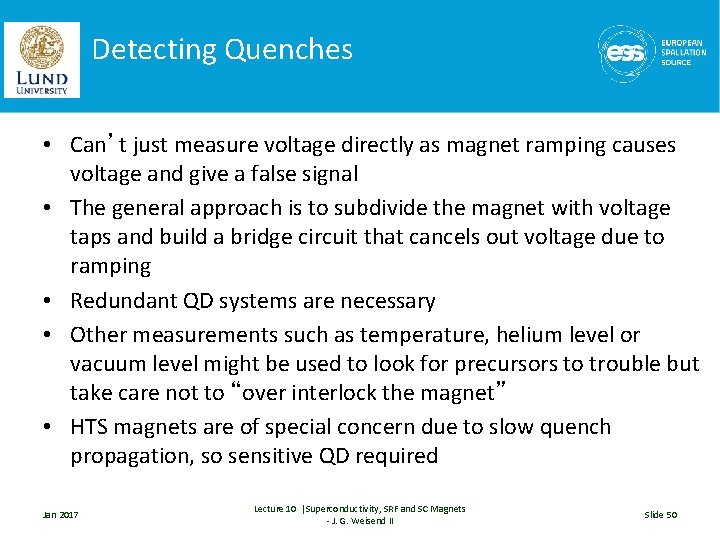
Detecting Quenches • Can’t just measure voltage directly as magnet ramping causes voltage and give a false signal • The general approach is to subdivide the magnet with voltage taps and build a bridge circuit that cancels out voltage due to ramping • Redundant QD systems are necessary • Other measurements such as temperature, helium level or vacuum level might be used to look for precursors to trouble but take care not to “over interlock the magnet” • HTS magnets are of special concern due to slow quench propagation, so sensitive QD required Jan 2017 Lecture 10 |Superconductivity, SRF and SC Magnets - J. G. Weisend II Slide 50
Strategy: energy dump slide courtesy of L. Boturra - CERN Jan 2017 B. J. Maddock, G. B. James, Proc. Inst. Electr. Eng. , 115, 543, 1968 Lecture 10 |Superconductivity, SRF and SC Magnets - J. G. Weisend II Slide 51
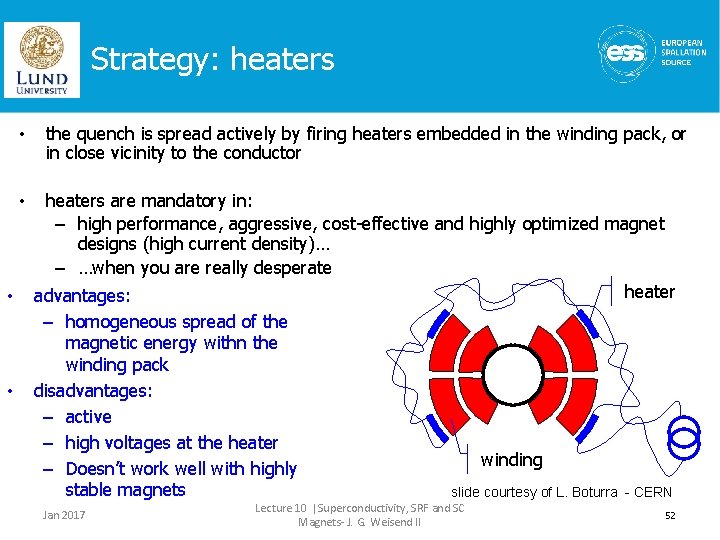
Strategy: heaters • • the quench is spread actively by firing heaters embedded in the winding pack, or in close vicinity to the conductor heaters are mandatory in: – high performance, aggressive, cost-effective and highly optimized magnet designs (high current density)… – …when you are really desperate heater advantages: – homogeneous spread of the magnetic energy withn the winding pack disadvantages: – active – high voltages at the heater – Doesn’t work well with highly stable magnets Jan 2017 winding slide courtesy of L. Boturra - CERN Lecture 10 |Superconductivity, SRF and SC Magnets- J. G. Weisend II 52
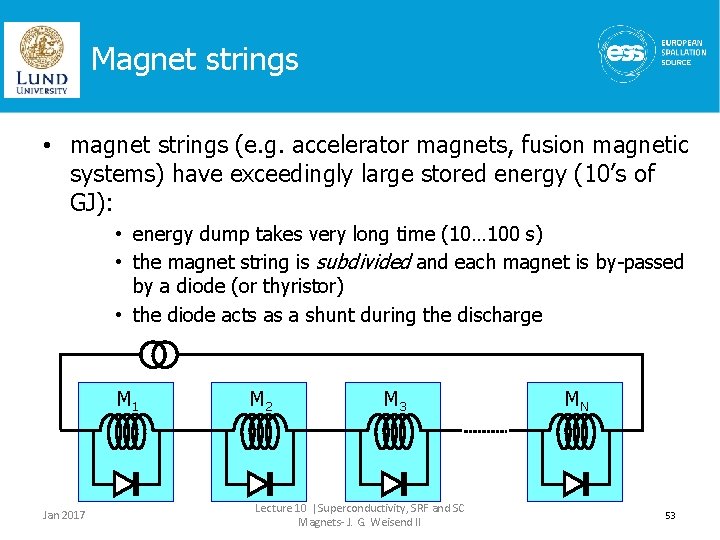
Magnet strings • magnet strings (e. g. accelerator magnets, fusion magnetic systems) have exceedingly large stored energy (10’s of GJ): • energy dump takes very long time (10… 100 s) • the magnet string is subdivided and each magnet is by-passed by a diode (or thyristor) • the diode acts as a shunt during the discharge M 1 Jan 2017 M 2 M 3 Lecture 10 |Superconductivity, SRF and SC Magnets- J. G. Weisend II MN 53
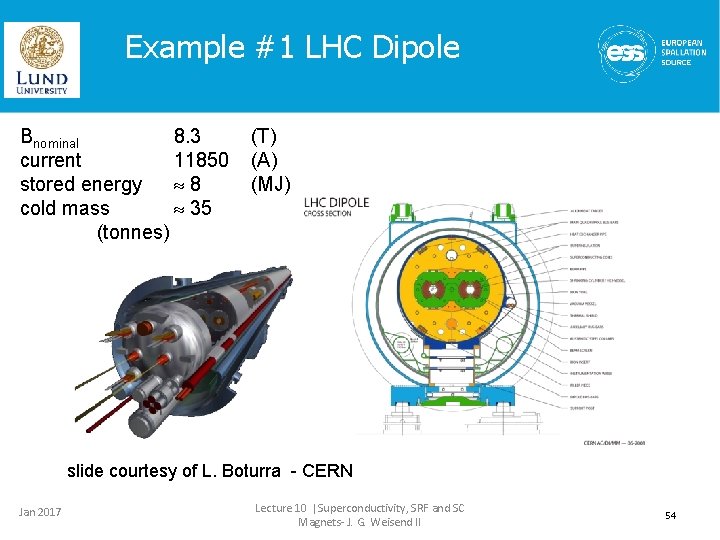
Example #1 LHC Dipole Bnominal 8. 3 current 11850 stored energy 8 cold mass 35 (tonnes) (T) (A) (MJ) slide courtesy of L. Boturra - CERN Jan 2017 Lecture 10 |Superconductivity, SRF and SC Magnets- J. G. Weisend II 54
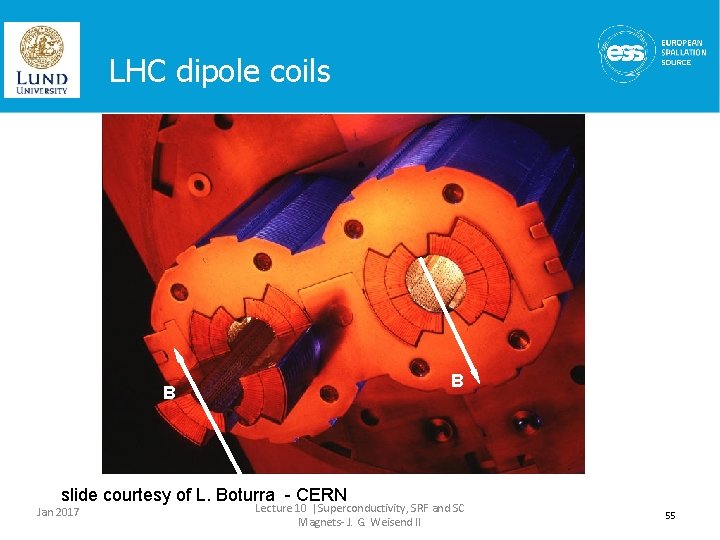
LHC dipole coils B B slide courtesy of L. Boturra - CERN Jan 2017 Lecture 10 |Superconductivity, SRF and SC Magnets- J. G. Weisend II 55
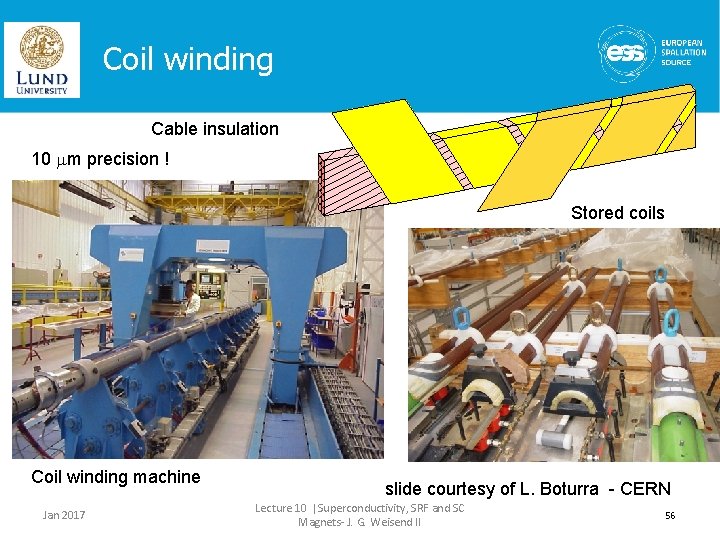
Coil winding Cable insulation 10 m precision ! Stored coils B Coil winding machine Jan 2017 B slide courtesy of L. Boturra - CERN Lecture 10 |Superconductivity, SRF and SC Magnets- J. G. Weisend II 56
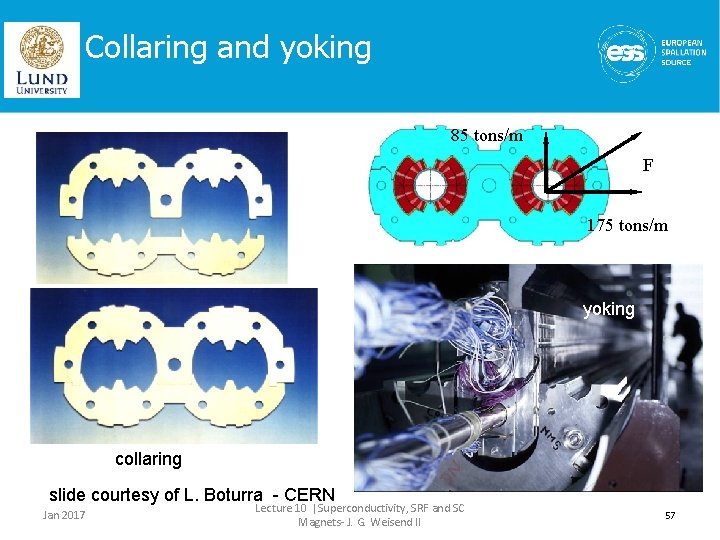
Collaring and yoking 85 tons/m F 175 tons/m yoking collaring slide courtesy of L. Boturra - CERN Jan 2017 Lecture 10 |Superconductivity, SRF and SC Magnets- J. G. Weisend II 57
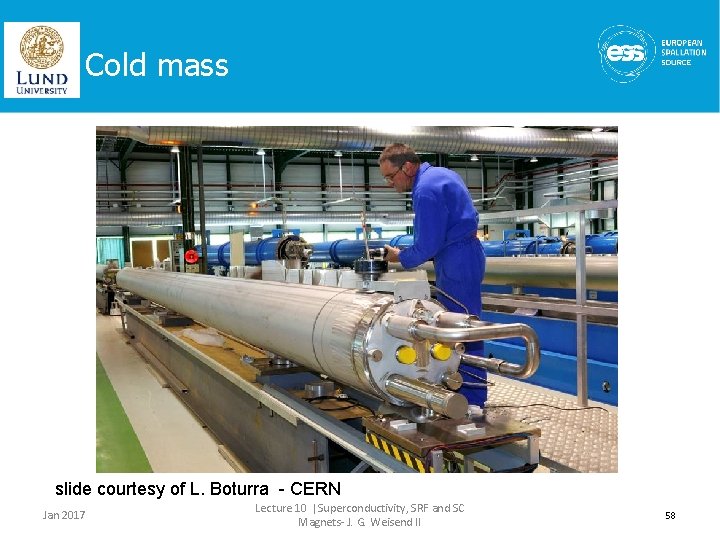
Cold mass slide courtesy of L. Boturra - CERN Jan 2017 Lecture 10 |Superconductivity, SRF and SC Magnets- J. G. Weisend II 58
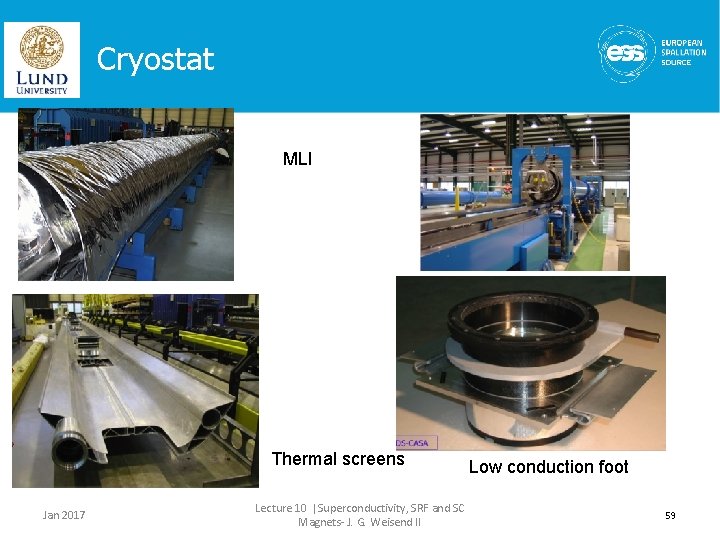
Cryostat MLI Thermal screens Jan 2017 Lecture 10 |Superconductivity, SRF and SC Magnets- J. G. Weisend II Low conduction foot 59
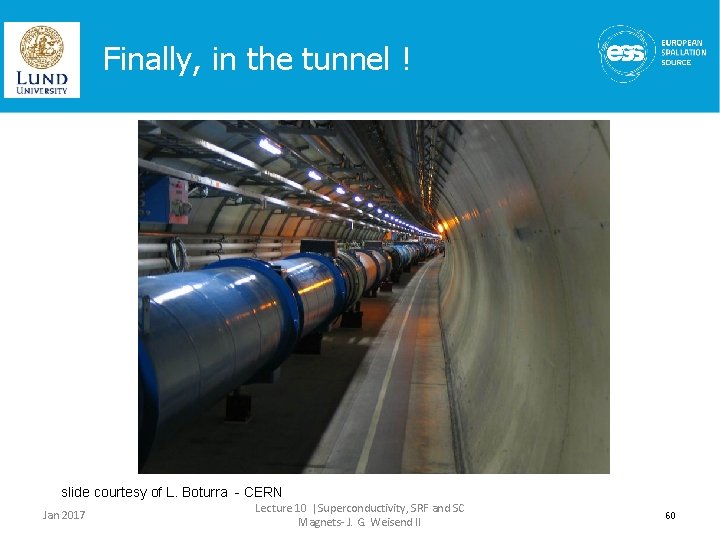
Finally, in the tunnel ! slide courtesy of L. Boturra - CERN Jan 2017 Lecture 10 |Superconductivity, SRF and SC Magnets- J. G. Weisend II 60
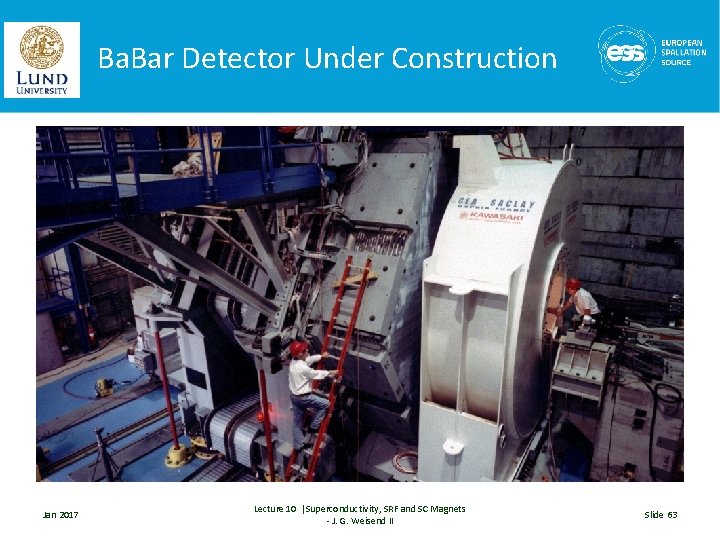
Example #2 Ba. Bar Detector S/C Solenoid • Provided background field for particle identification for the Ba. Bar detector at SLAC • Physics requirements dictated a relatively thin solenoid Jan 2017 Lecture 10 |Superconductivity, SRF and SC Magnets - J. G. Weisend II 61
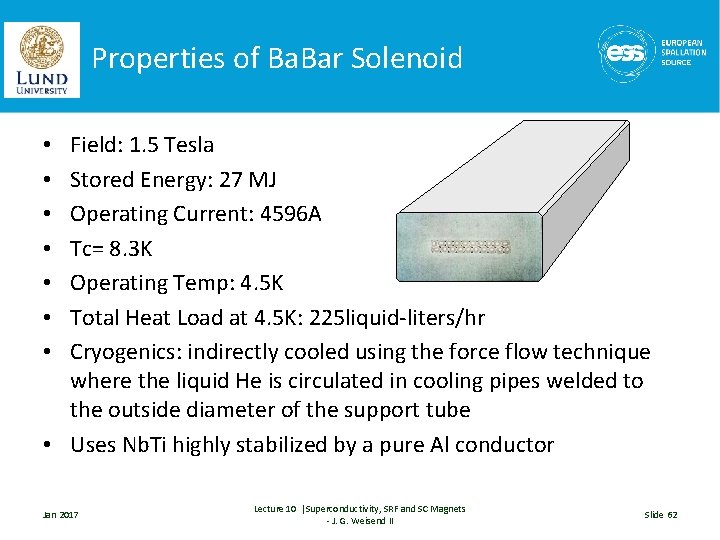
Properties of Ba. Bar Solenoid Field: 1. 5 Tesla Stored Energy: 27 MJ Operating Current: 4596 A Tc= 8. 3 K Operating Temp: 4. 5 K Total Heat Load at 4. 5 K: 225 liquid-liters/hr Cryogenics: indirectly cooled using the force flow technique where the liquid He is circulated in cooling pipes welded to the outside diameter of the support tube • Uses Nb. Ti highly stabilized by a pure Al conductor • • Jan 2017 Lecture 10 |Superconductivity, SRF and SC Magnets - J. G. Weisend II Slide 62
Ba. Bar Detector Under Construction Jan 2017 Lecture 10 |Superconductivity, SRF and SC Magnets - J. G. Weisend II Slide 63
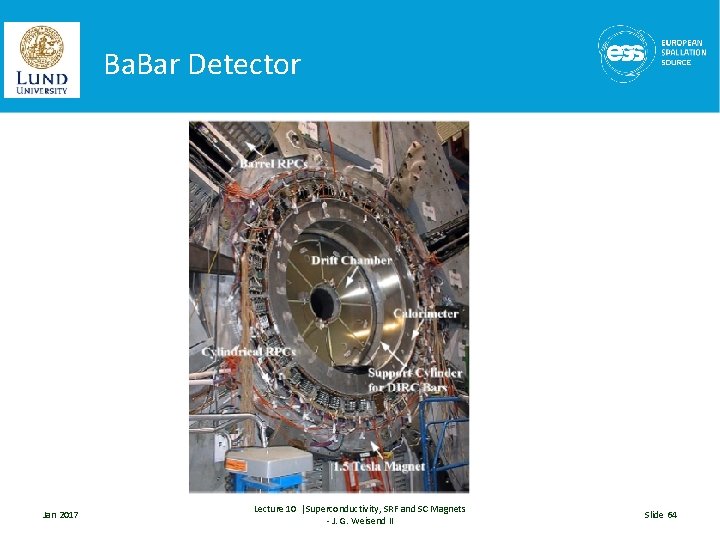
Ba. Bar Detector Jan 2017 Lecture 10 |Superconductivity, SRF and SC Magnets - J. G. Weisend II Slide 64
Ba. Bar Solenoid • Operated almost continuously for ~ 10 years • Was very stable – only discharged due to loss of power, controls or cooling – Availability was > 96% from the start and better than 98% during final 3 years • Improvement due mainly to removing unnecessary interlocks and adding additional utility backups Jan 2017 Lecture 10 |Superconductivity, SRF and SC Magnets - J. G. Weisend II Slide 65
Conclusions • Superconducting magnets & SRF Cavities make possible modern accelerators : LHC, ILC, ESS, FAIR, SNS, JLAB, LCLS II • Superconducting magnet design involves detailed engineering on a scale from the microscopic (flux pinning) to the immense (multi ton, GJ magnets) • Superconducting magnet design involves a wide range of disciplines: materials science, electrical engineering, mechanical design, cryogenics etc. • Superconducting magnet requirements have driven and enabled many advances in s/c materials, wire and ancillary systems • HTS are still under development but significant niche markets are appearing Jan 2017 Lecture 10 |Superconductivity, SRF and SC Magnets - J. G. Weisend II Slide 66
Back Up Slides Lecture 10 |Superconductivity, SRF and SC Magnets- J. G. Weisend II Jan 2017 Slide 67
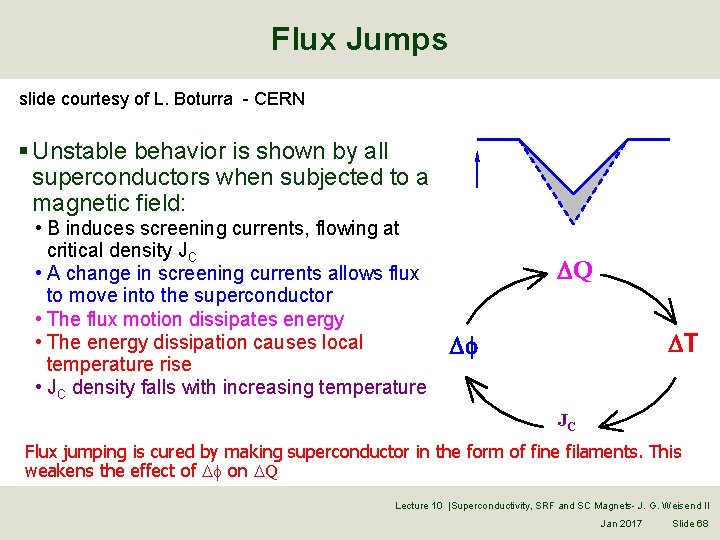
Flux Jumps slide courtesy of L. Boturra - CERN § Unstable behavior is shown by all superconductors when subjected to a magnetic field: • B induces screening currents, flowing at critical density JC • A change in screening currents allows flux to move into the superconductor • The flux motion dissipates energy • The energy dissipation causes local temperature rise • JC density falls with increasing temperature DQ DT Df JC Flux jumping is cured by making superconductor in the form of fine filaments. This weakens the effect of on Q Lecture 10 |Superconductivity, SRF and SC Magnets- J. G. Weisend II Jan 2017 Slide 68
Filaments coupling slide courtesy of L. Boturra - CERN loose twist tight twist d. B/dt All superconducting wires and are twisted to decouple the filaments and reduce the magnitude of eddy currents and associated loss Lecture 10 |Superconductivity, SRF and SC Magnets- J. G. Weisend II Jan 2017 69
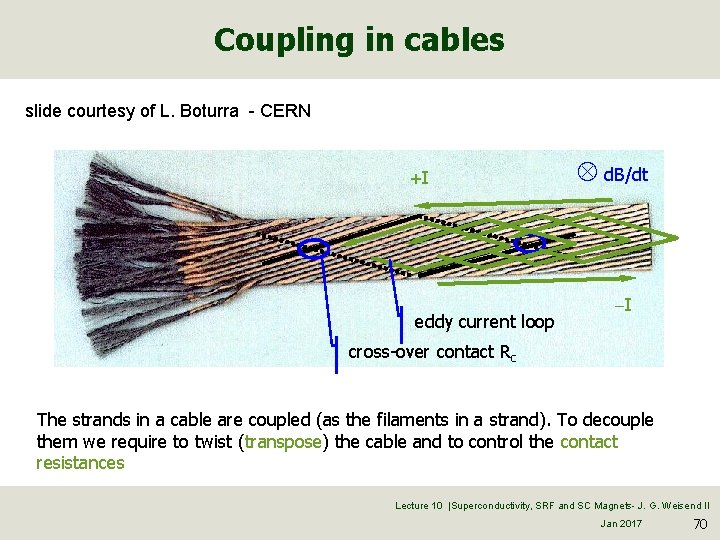
Coupling in cables slide courtesy of L. Boturra - CERN +I eddy current loop d. B/dt I cross-over contact Rc The strands in a cable are coupled (as the filaments in a strand). To decouple them we require to twist (transpose) the cable and to control the contact resistances Lecture 10 |Superconductivity, SRF and SC Magnets- J. G. Weisend II Jan 2017 70