
Lecture 10 SnoopingBased Cache Coherence Parallel Computer Architecture
Lecture 10: Snooping-Based Cache Coherence Parallel Computer Architecture and Programming CMU 15 -418/15 -618, Spring 2020 1
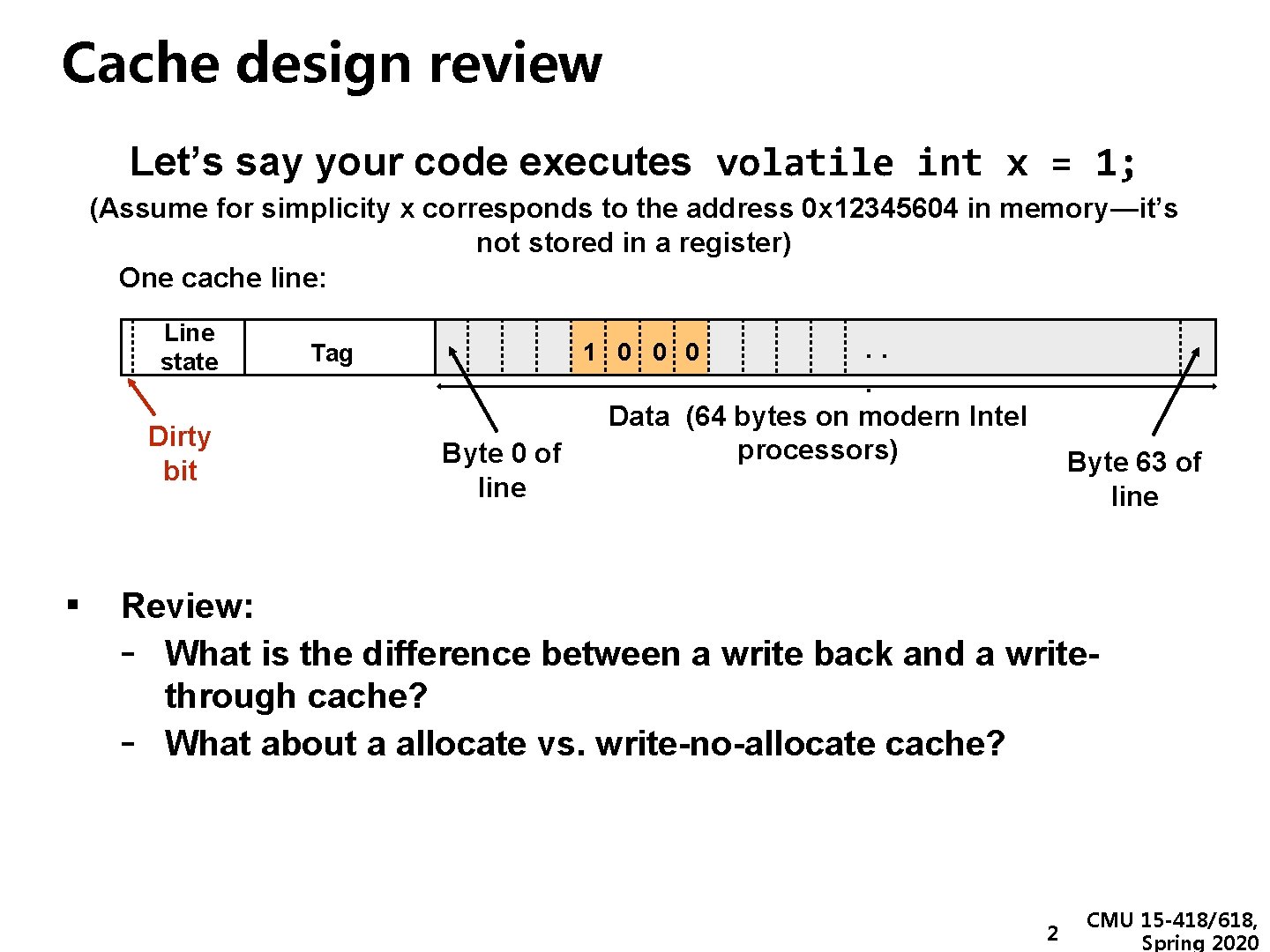
Cache design review Let’s say your code executes volatile int x = 1; (Assume for simplicity x corresponds to the address 0 x 12345604 in memory—it’s not stored in a register) One cache line: Line state Dirty bit . . . Data (64 bytes on modern Intel processors) 1 0 0 0 Tag Byte 0 of line Byte 63 of line ▪ Review: - What is the difference between a write back and a writethrough cache? What about a allocate vs. write-no-allocate cache? 2 CMU 15 -418/618, Spring 2020
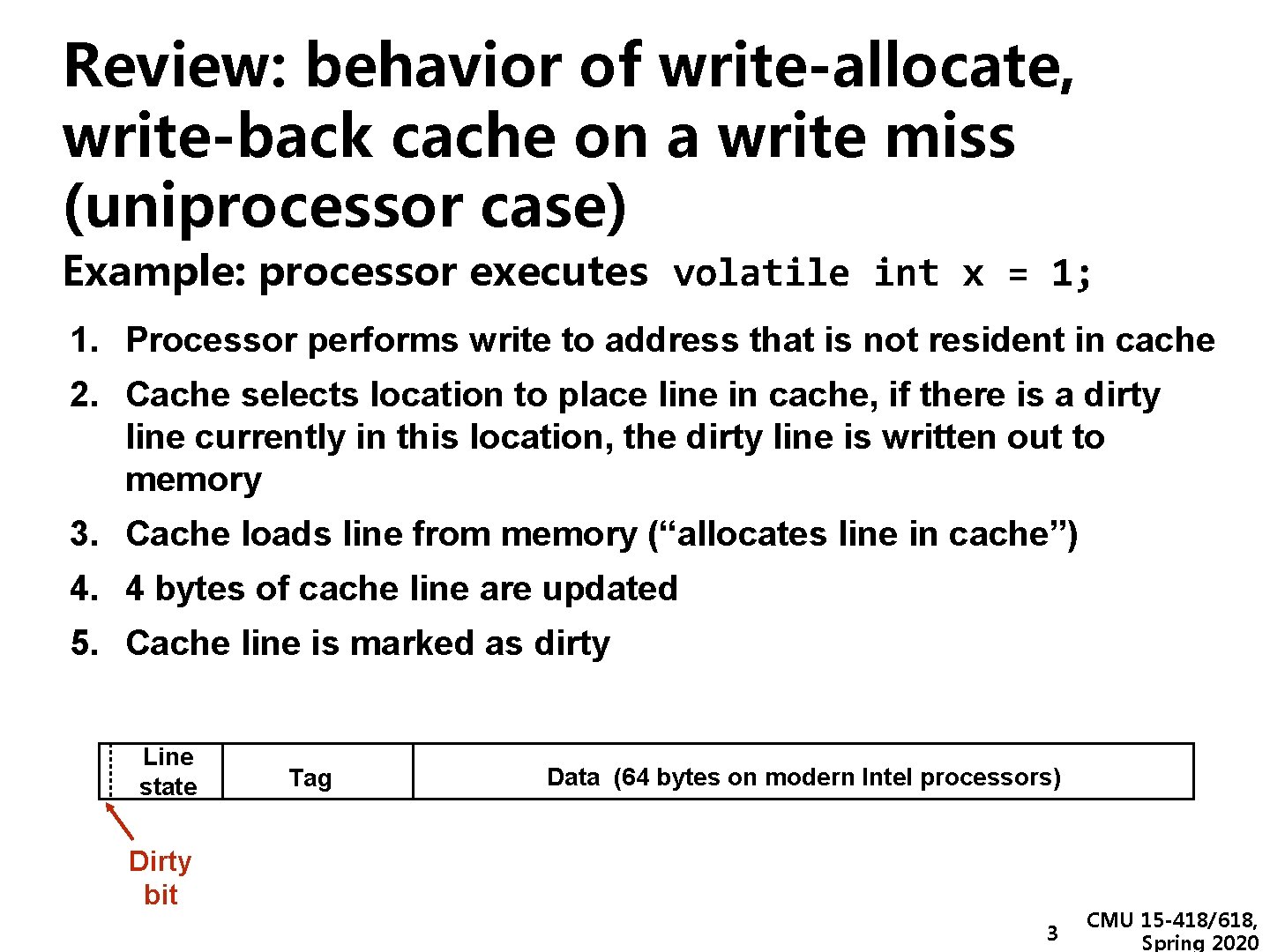
Review: behavior of write-allocate, write-back cache on a write miss (uniprocessor case) Example: processor executes volatile int x = 1; 1. Processor performs write to address that is not resident in cache 2. Cache selects location to place line in cache, if there is a dirty line currently in this location, the dirty line is written out to memory 3. Cache loads line from memory (“allocates line in cache”) 4. 4 bytes of cache line are updated 5. Cache line is marked as dirty Line state Tag Data (64 bytes on modern Intel processors) Dirty bit 3 CMU 15 -418/618, Spring 2020
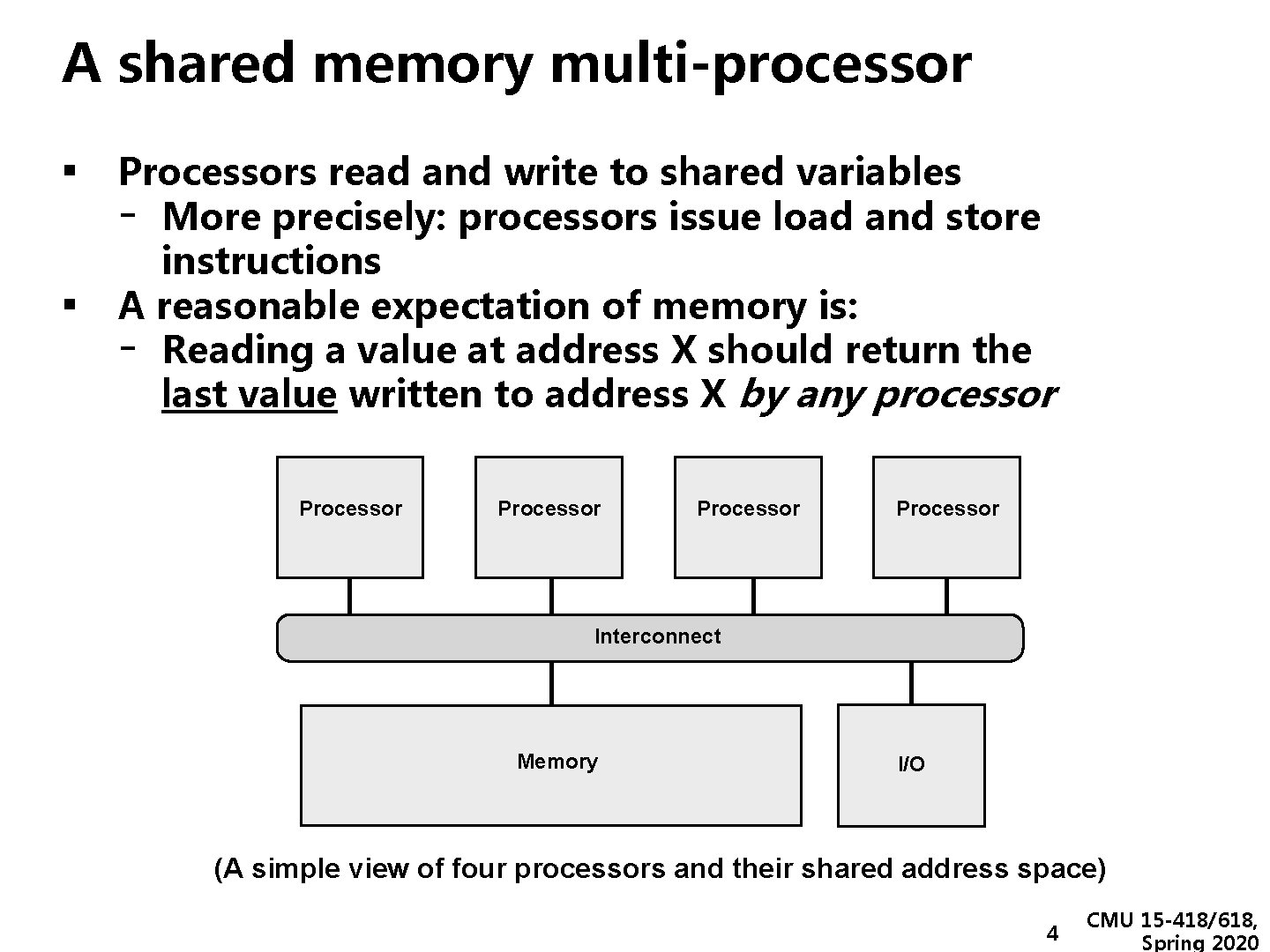
A shared memory multi-processor ▪ Processors read and write to shared variables - ▪ More precisely: processors issue load and store instructions A reasonable expectation of memory is: - Reading a value at address X should return the last value written to address X by any processor Processor Interconnect Memory I/O (A simple view of four processors and their shared address space) 4 CMU 15 -418/618, Spring 2020
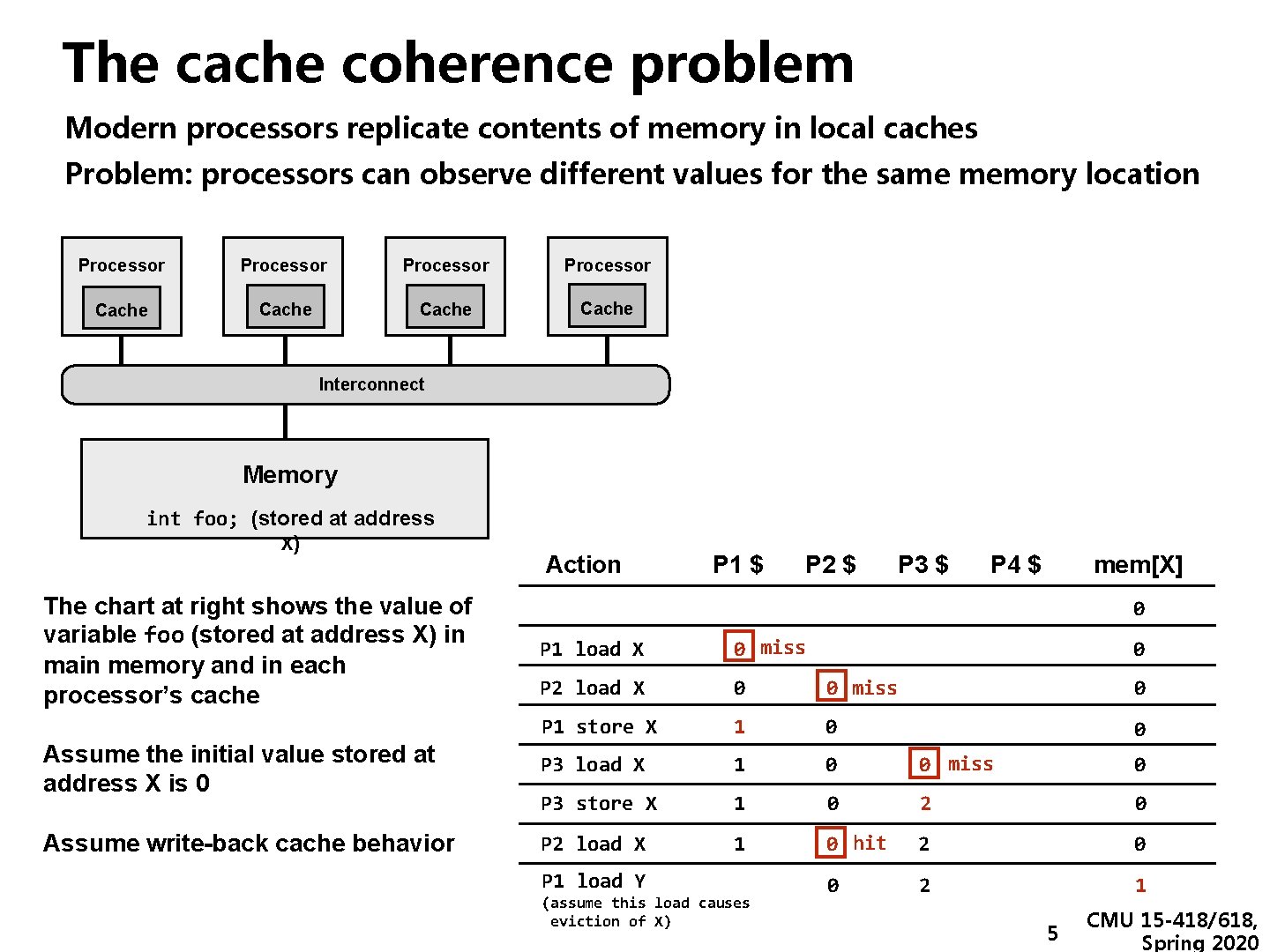
The cache coherence problem Modern processors replicate contents of memory in local caches Problem: processors can observe different values for the same memory location Processor Cache Interconnect Memory int foo; (stored at address X) The chart at right shows the value of variable foo (stored at address X) in main memory and in each processor’s cache Action P 1 $ P 2 $ P 3 $ P 4 $ mem[X] 0 P 1 load X 0 miss P 2 load X 0 0 miss 0 P 1 store X 1 0 Assume the initial value stored at address X is 0 0 P 3 load X 1 0 0 miss 0 P 3 store X 1 0 2 0 Assume write-back cache behavior P 2 load X 1 0 hit 2 0 0 2 1 P 1 load Y (assume this load causes eviction of X) 0 5 CMU 15 -418/618, Spring 2020
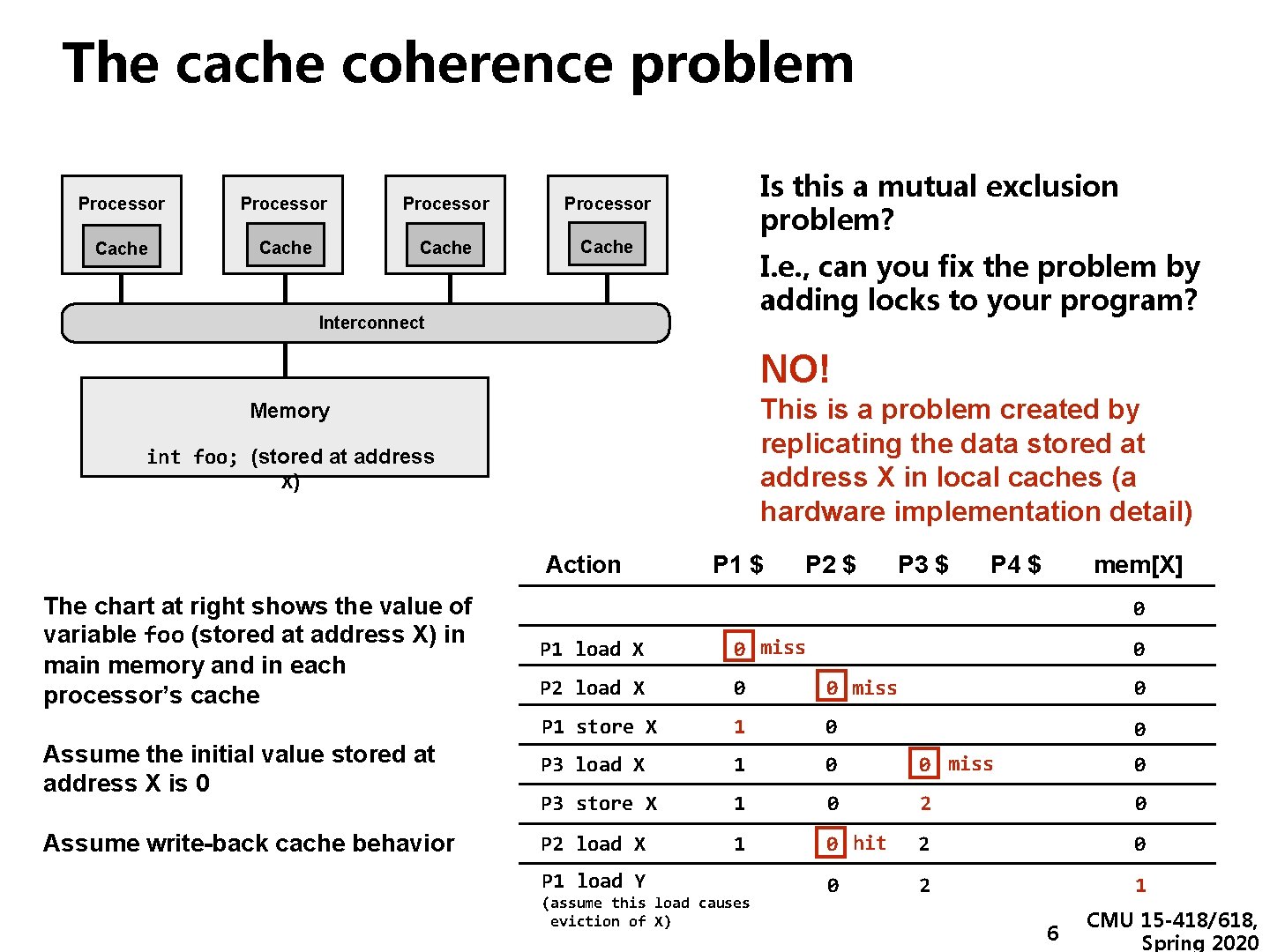
The cache coherence problem Processor Cache Is this a mutual exclusion problem? I. e. , can you fix the problem by adding locks to your program? Interconnect NO! This is a problem created by replicating the data stored at address X in local caches (a hardware implementation detail) Memory int foo; (stored at address X) Action The chart at right shows the value of variable foo (stored at address X) in main memory and in each processor’s cache P 1 $ P 2 $ P 3 $ P 4 $ mem[X] 0 P 1 load X 0 miss P 2 load X 0 0 miss 0 P 1 store X 1 0 Assume the initial value stored at address X is 0 0 P 3 load X 1 0 0 miss 0 P 3 store X 1 0 2 0 Assume write-back cache behavior P 2 load X 1 0 hit 2 0 0 2 1 P 1 load Y (assume this load causes eviction of X) 0 6 CMU 15 -418/618, Spring 2020
The cache coherence problem ▪ Intuitive behavior for memory system: reading value at address X should return the last value written to address X by any processor. ▪ Cache coherence problem exists because there is both global storage (main memory) and per-processor local storage (processor caches) implementing the abstraction of a single shared address space. 7 CMU 15 -418/618, Spring 2020
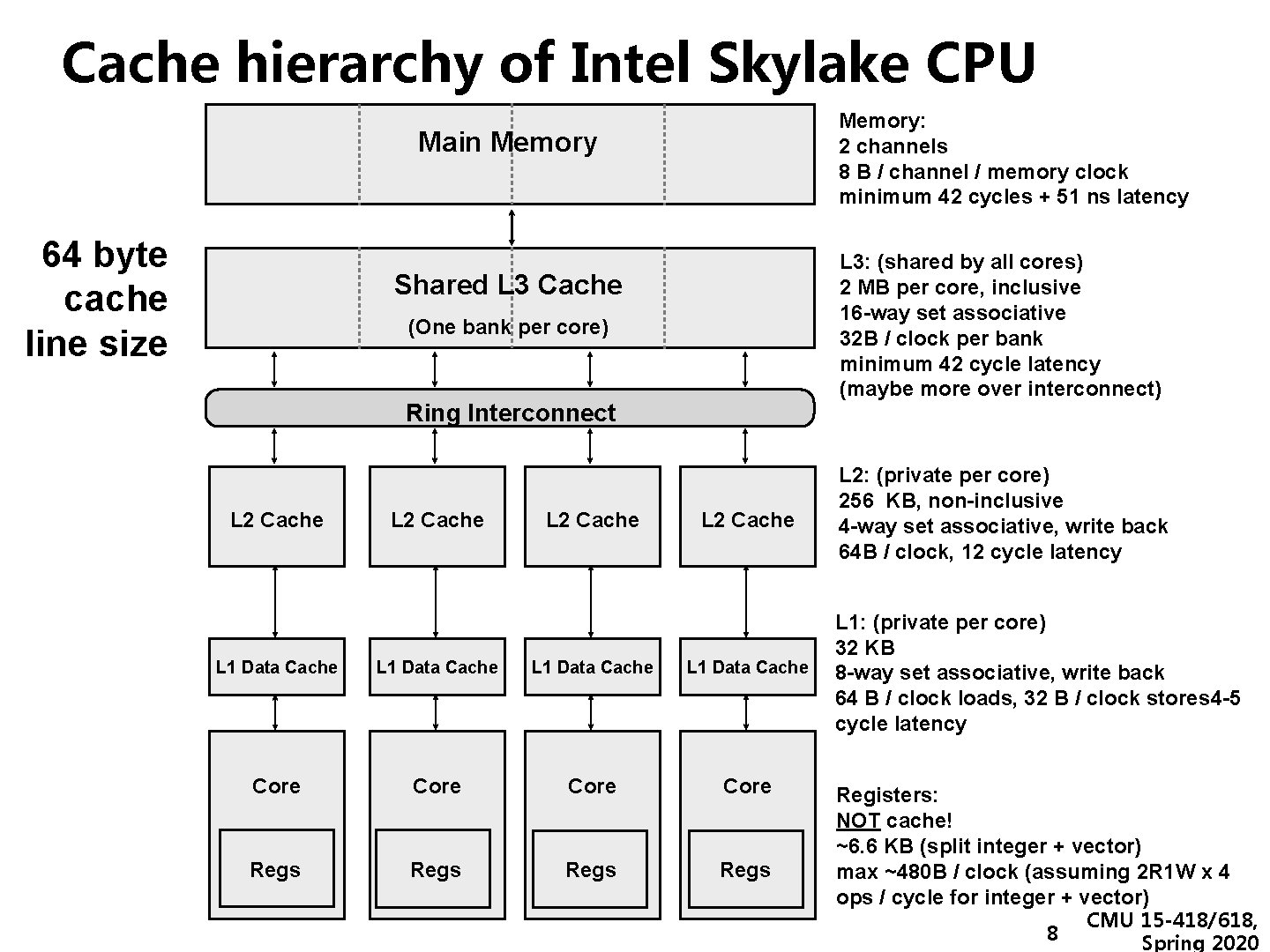
Cache hierarchy of Intel Skylake CPU Memory: 2 channels 8 B / channel / memory clock minimum 42 cycles + 51 ns latency Main Memory 64 byte cache line size L 3: (shared by all cores) 2 MB per core, inclusive 16 -way set associative 32 B / clock per bank minimum 42 cycle latency (maybe more over interconnect) Shared L 3 Cache (One bank per core) Ring Interconnect L 2 Cache L 1 Data Cache Core Regs L 2: (private per core) 256 KB, non-inclusive 4 -way set associative, write back 64 B / clock, 12 cycle latency L 1: (private per core) 32 KB 8 -way set associative, write back 64 B / clock loads, 32 B / clock stores 4 -5 cycle latency Registers: NOT cache! ~6. 6 KB (split integer + vector) max ~480 B / clock (assuming 2 R 1 W x 4 ops / cycle for integer + vector) 8 CMU 15 -418/618, Spring 2020
Intuitive expectation of shared memory ▪ Intuitive behavior for memory system: reading value at address X should return the last value written to address X by any processor. ▪ On a uniprocessor, providing this behavior is fairly simple, since writes typically come from one client: the processor - Caveat: Loads must examine all pending stores in store buffer Exception: device I/O via direct memory access (DMA) 9 CMU 15 -418/618, Spring 2020
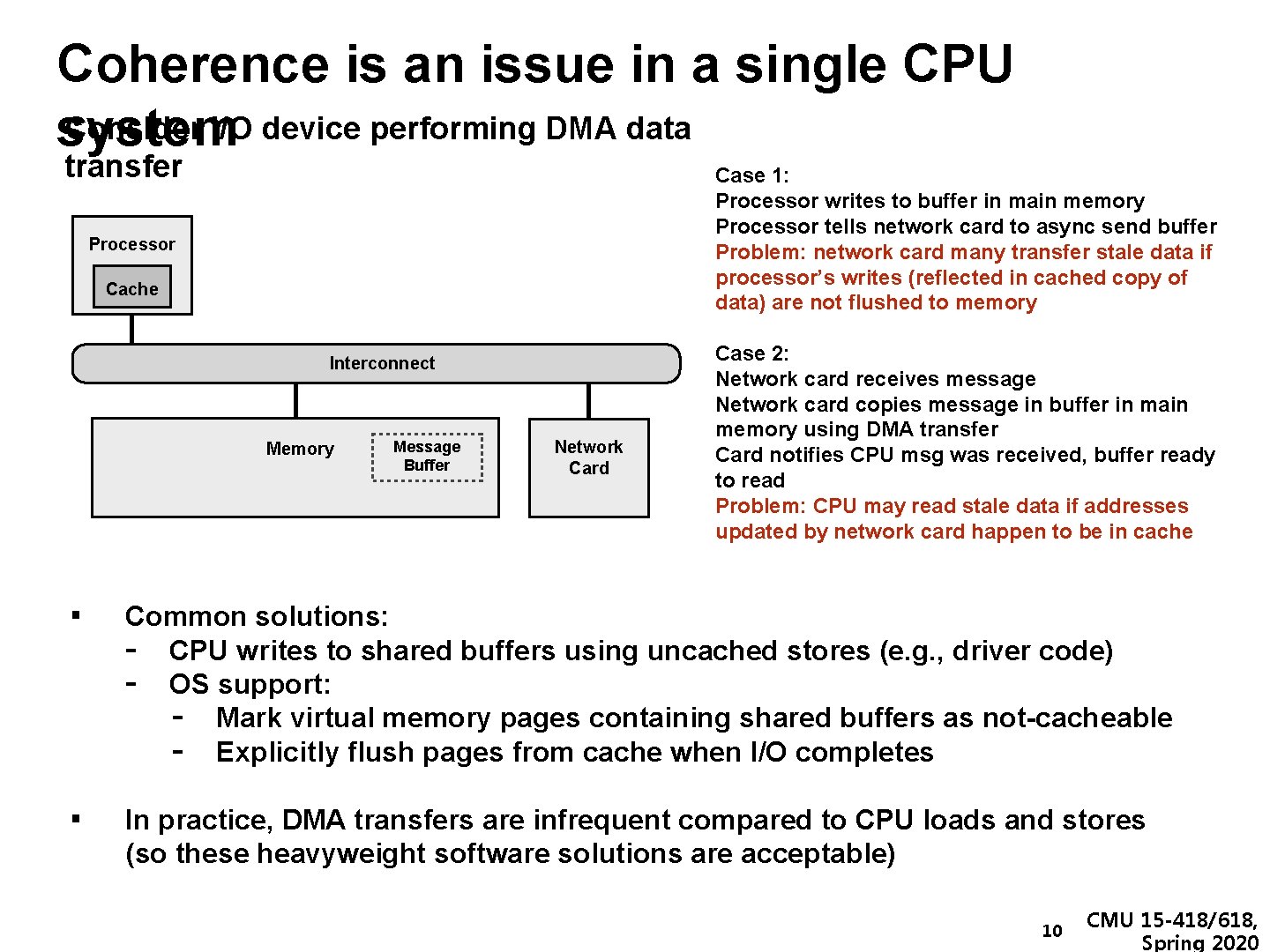
Coherence is an issue in a single CPU Consider I/O device performing DMA data system transfer Case 1: Processor writes to buffer in main memory Processor tells network card to async send buffer Problem: network card many transfer stale data if processor’s writes (reflected in cached copy of data) are not flushed to memory Processor Cache Interconnect Memory Message Buffer Network Card Case 2: Network card receives message Network card copies message in buffer in main memory using DMA transfer Card notifies CPU msg was received, buffer ready to read Problem: CPU may read stale data if addresses updated by network card happen to be in cache ▪ Common solutions: - CPU writes to shared buffers using uncached stores (e. g. , driver code) - OS support: - Mark virtual memory pages containing shared buffers as not-cacheable - Explicitly flush pages from cache when I/O completes ▪ In practice, DMA transfers are infrequent compared to CPU loads and stores (so these heavyweight software solutions are acceptable) 10 CMU 15 -418/618, Spring 2020
Problems with the intuition ▪ Intuitive behavior: reading value at address X should return the last value written to address X by any processor. ▪ What does “last” mean? - What if two processors write at the same time? What if a write by P 1 is followed by a read from P 2 so close in time that it is impossible to communicate the occurrence of the write to P 2 in time? ▪ In a sequential program, “last” is determined by program order (not time) - Holds true within one thread of a parallel program But we need to come up with a meaningful way to describe order across threads in a parallel program 11 CMU 15 -418/618, Spring 2020
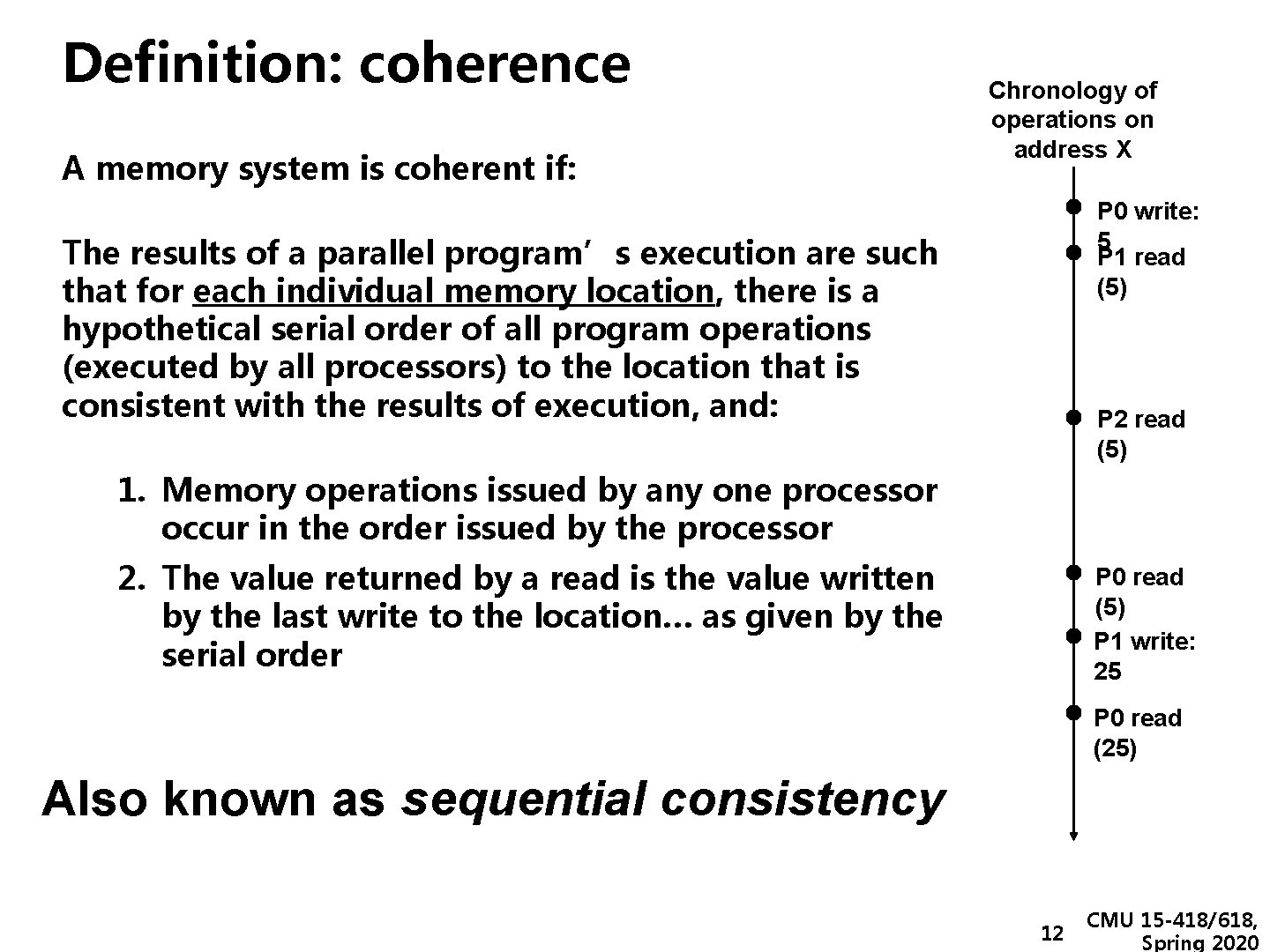
Definition: coherence A memory system is coherent if: Chronology of operations on address X P 0 write: 5 P 1 read (5) The results of a parallel program’s execution are such that for each individual memory location, there is a hypothetical serial order of all program operations (executed by all processors) to the location that is consistent with the results of execution, and: P 2 read (5) 1. Memory operations issued by any one processor occur in the order issued by the processor 2. The value returned by a read is the value written by the last write to the location… as given by the serial order P 0 read (5) P 1 write: 25 P 0 read (25) Also known as sequential consistency 12 CMU 15 -418/618, Spring 2020
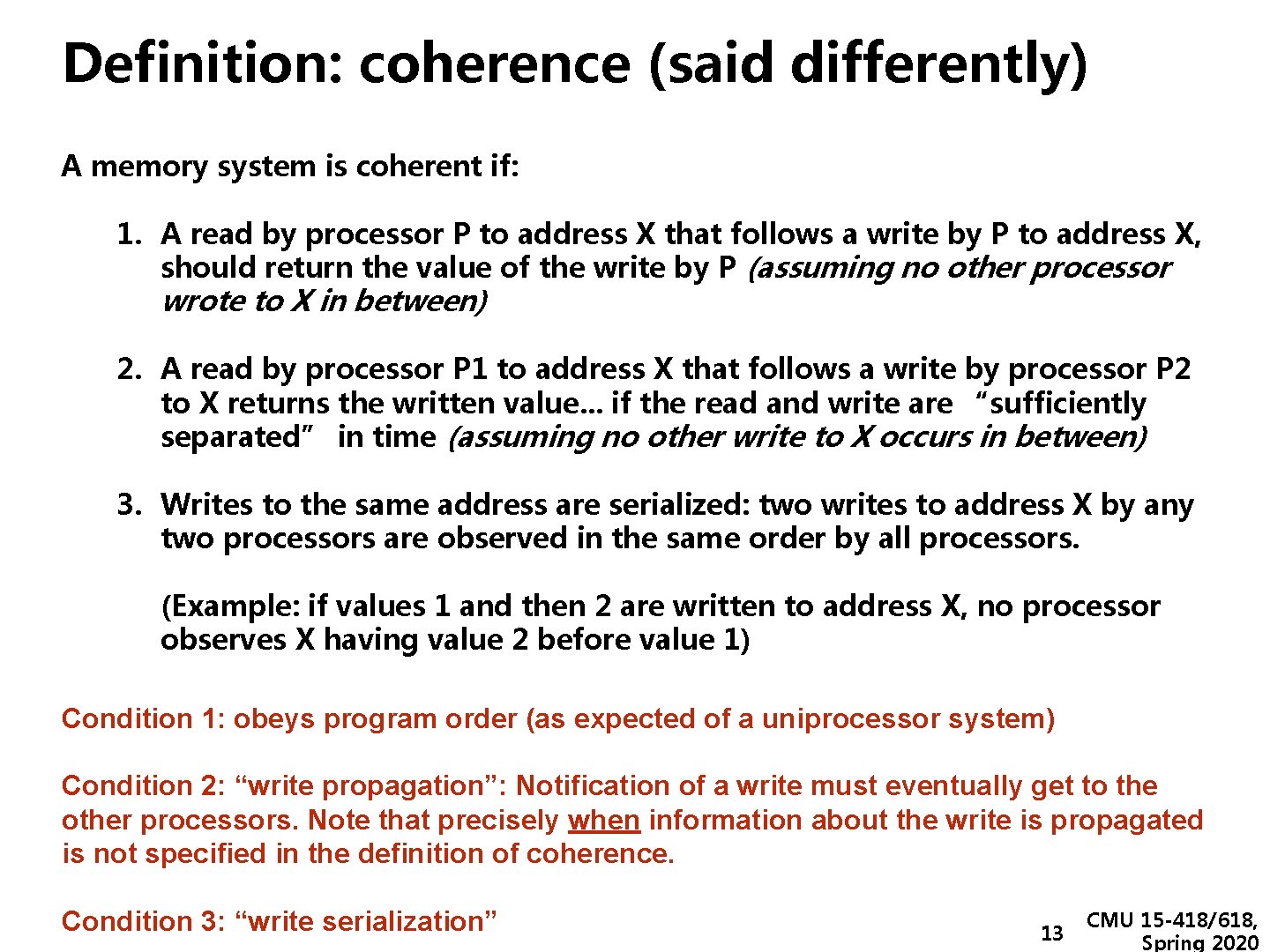
Definition: coherence (said differently) A memory system is coherent if: 1. A read by processor P to address X that follows a write by P to address X, should return the value of the write by P (assuming no other processor wrote to X in between) 2. A read by processor P 1 to address X that follows a write by processor P 2 to X returns the written value. . . if the read and write are “sufficiently separated” in time (assuming no other write to X occurs in between) 3. Writes to the same address are serialized: two writes to address X by any two processors are observed in the same order by all processors. (Example: if values 1 and then 2 are written to address X, no processor observes X having value 2 before value 1) Condition 1: obeys program order (as expected of a uniprocessor system) Condition 2: “write propagation”: Notification of a write must eventually get to the other processors. Note that precisely when information about the write is propagated is not specified in the definition of coherence. Condition 3: “write serialization” 13 CMU 15 -418/618, Spring 2020
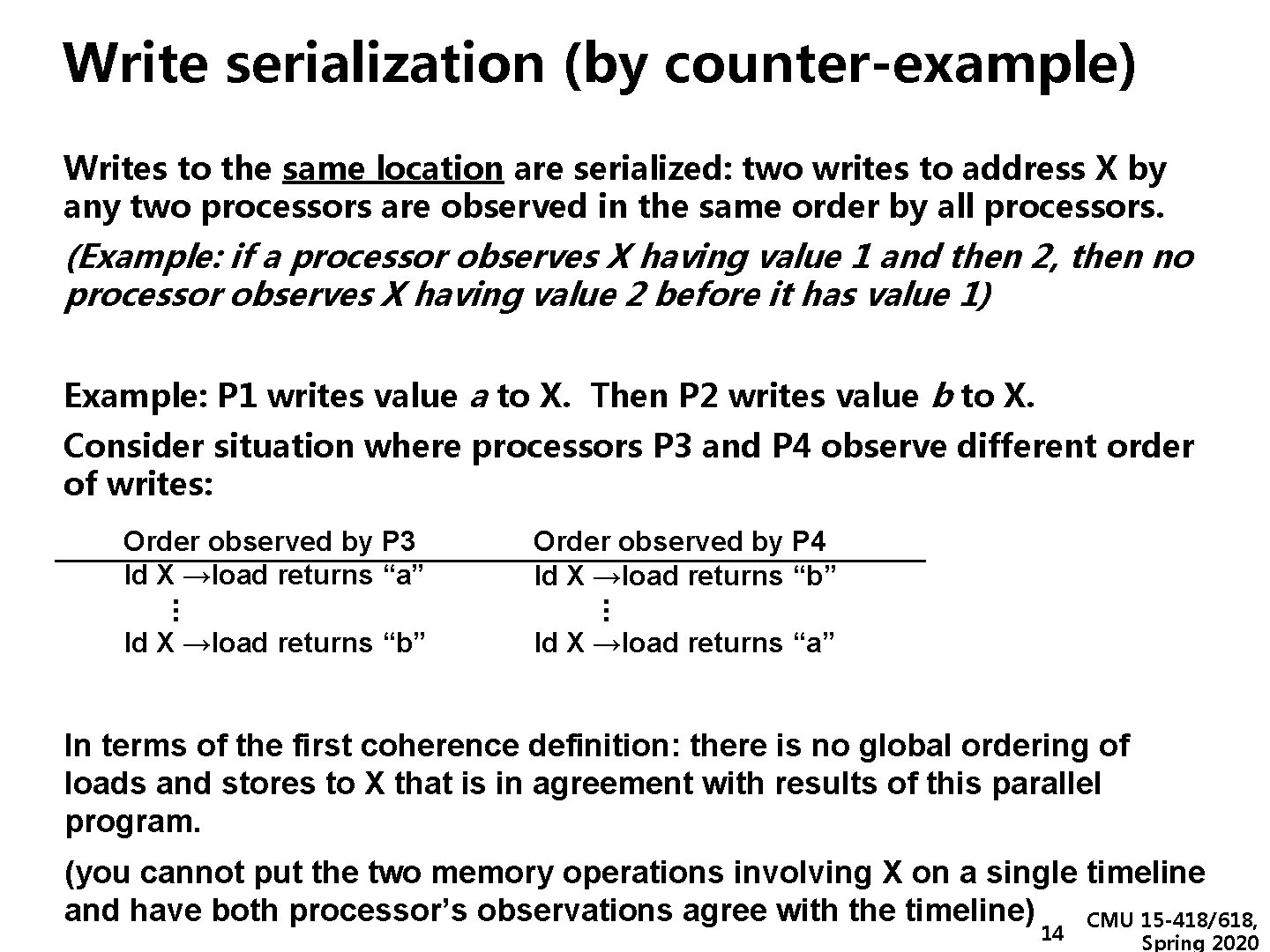
Write serialization (by counter-example) Writes to the same location are serialized: two writes to address X by any two processors are observed in the same order by all processors. (Example: if a processor observes X having value 1 and then 2, then no processor observes X having value 2 before it has value 1) Example: P 1 writes value a to X. Then P 2 writes value b to X. Consider situation where processors P 3 and P 4 observe different order of writes: ld X →load returns “b” Order observed by P 4 ld X →load returns “b” . . . Order observed by P 3 ld X →load returns “a” In terms of the first coherence definition: there is no global ordering of loads and stores to X that is in agreement with results of this parallel program. (you cannot put the two memory operations involving X on a single timeline and have both processor’s observations agree with the timeline) CMU 15 -418/618, 14 Spring 2020
Implementing coherence ▪ Software-based solutions - OS uses page-fault mechanism to propagate writes - Careful use of special “cache flush” instructions to writeback dirty data at synchronization boundaries - Can be used to implement memory coherence without hardware support (e. g. , over clusters of workstations) - We won’t discuss these solutions ▪ Hardware-based solutions - “Snooping”-based coherence implementations (today) - Directory-based coherence implementations (next week) 15 CMU 15 -418/618, Spring 2020
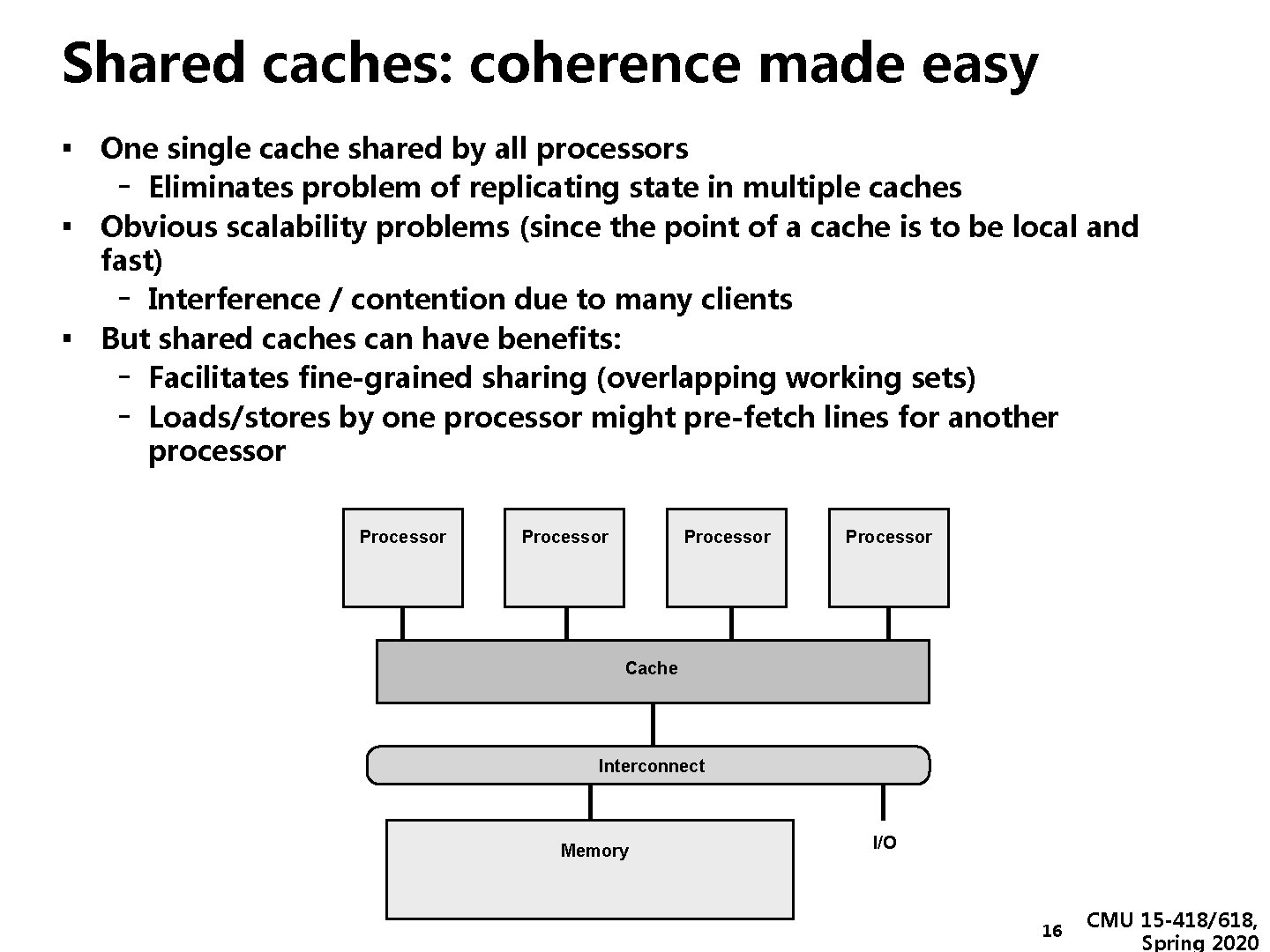
Shared caches: coherence made easy ▪ One single cache shared by all processors ▪ ▪ - Eliminates problem of replicating state in multiple caches Obvious scalability problems (since the point of a cache is to be local and fast) - Interference / contention due to many clients But shared caches can have benefits: - Facilitates fine-grained sharing (overlapping working sets) - Loads/stores by one processor might pre-fetch lines for another processor Processor Cache Interconnect Memory I/O 16 CMU 15 -418/618, Spring 2020
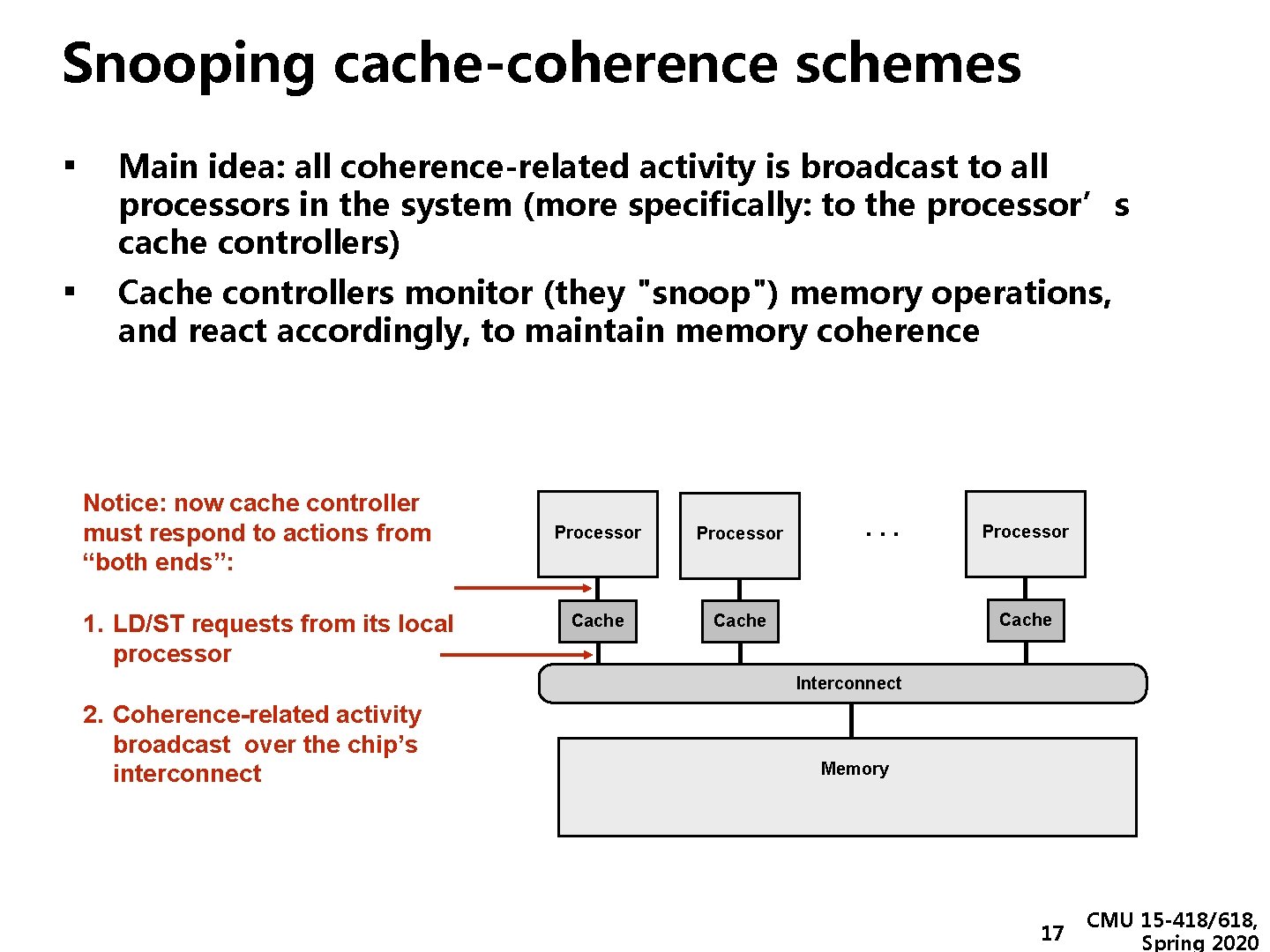
Snooping cache-coherence schemes ▪ Main idea: all coherence-related activity is broadcast to all processors in the system (more specifically: to the processor’s cache controllers) ▪ Cache controllers monitor (they "snoop") memory operations, and react accordingly, to maintain memory coherence Notice: now cache controller must respond to actions from “both ends”: 1. LD/ST requests from its local processor Processor Cache . . . Processor Cache Interconnect 2. Coherence-related activity broadcast over the chip’s interconnect Memory 17 CMU 15 -418/618, Spring 2020
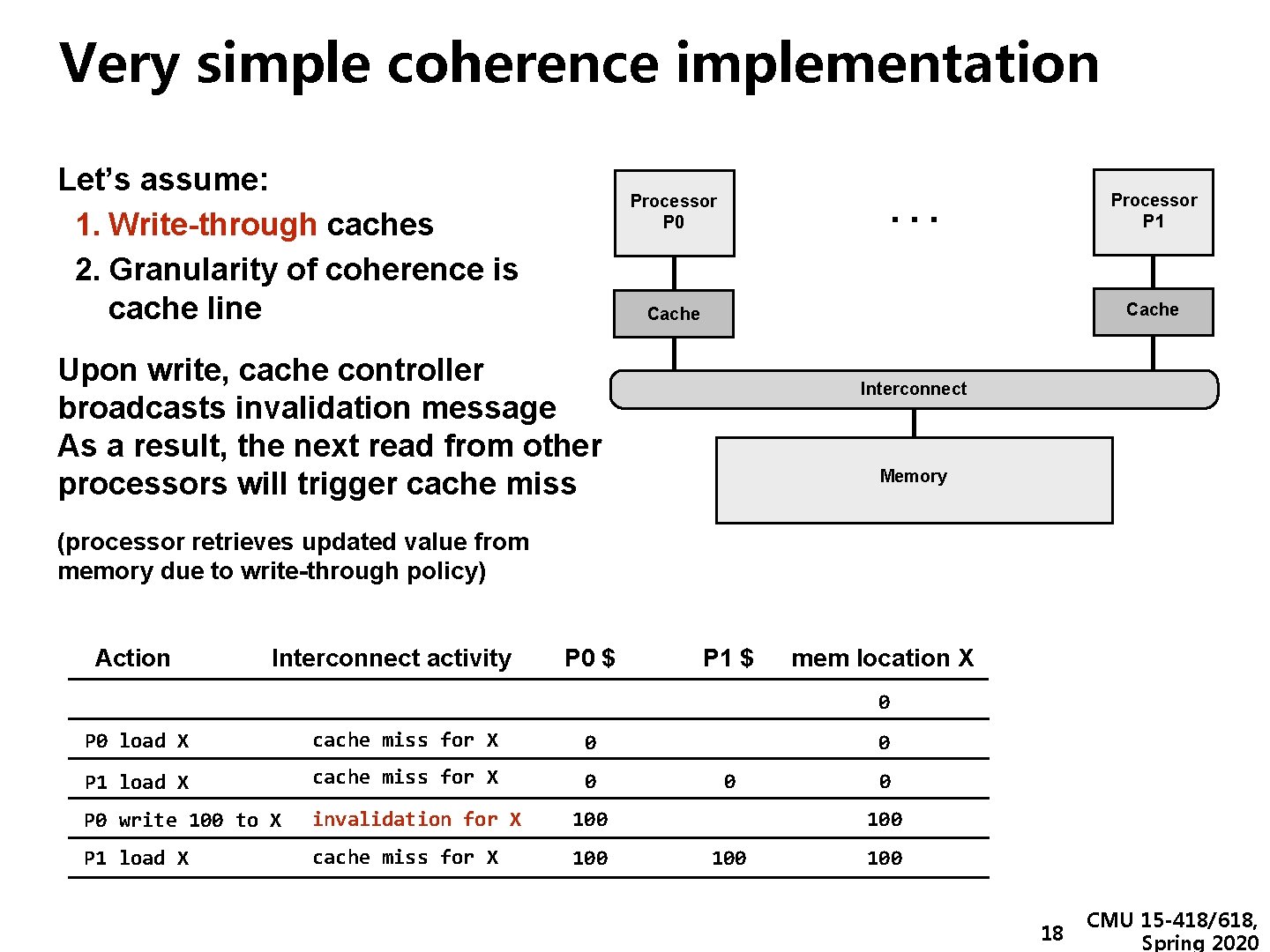
Very simple coherence implementation Let’s assume: 1. Write-through caches 2. Granularity of coherence is cache line . . . Processor P 0 Processor P 1 Cache Upon write, cache controller broadcasts invalidation message As a result, the next read from other processors will trigger cache miss Interconnect Memory (processor retrieves updated value from memory due to write-through policy) Action Interconnect activity P 0 $ P 1 $ mem location X 0 P 0 load X cache miss for X 0 P 1 load X cache miss for X 0 P 0 write 100 to X invalidation for X 100 P 1 load X cache miss for X 100 0 100 100 18 CMU 15 -418/618, Spring 2020
A clarifying note ▪ The logic we are about to describe is performed by each processor’s cache controller in response to: - Loads and stores by the local processor - Messages it receives from other caches ▪ If all cache controllers operate according to this described protocol, then coherence will be maintained - The caches “cooperate” to ensure coherence is maintained ▪ Cache controller tracks the status of each line in its cache 19 CMU 15 -418/618, Spring 2020
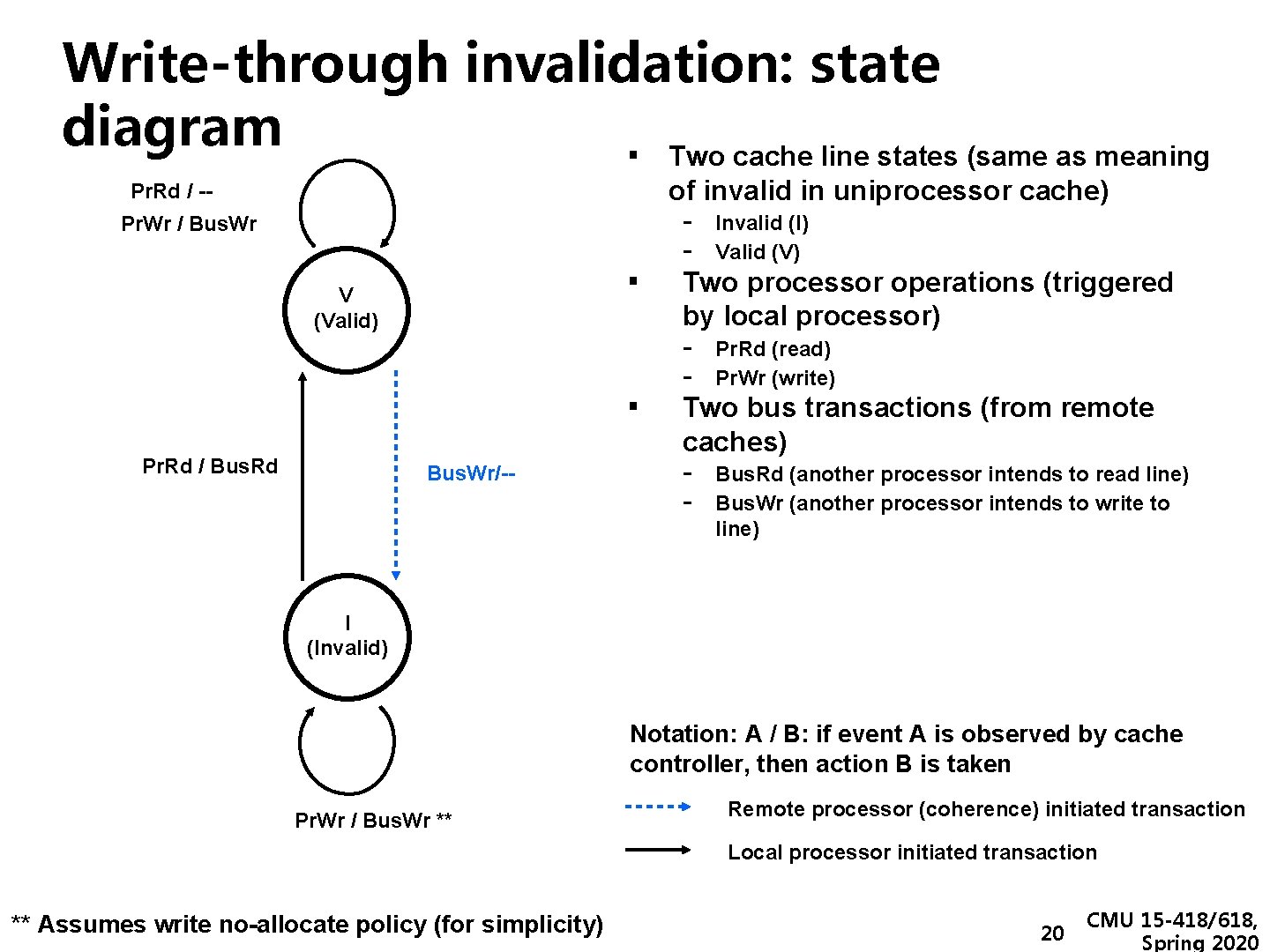
Write-through invalidation: state diagram ▪ Two cache line states (same as meaning Pr. Rd / -Pr. Wr / Bus. Wr ▪ V (Valid) ▪ Pr. Rd / Bus. Rd Bus. Wr/-- of invalid in uniprocessor cache) - Invalid (I) - Valid (V) Two processor operations (triggered by local processor) - Pr. Rd (read) - Pr. Wr (write) Two bus transactions (from remote caches) - Bus. Rd (another processor intends to read line) - Bus. Wr (another processor intends to write to line) I (Invalid) Notation: A / B: if event A is observed by cache controller, then action B is taken Pr. Wr / Bus. Wr ** Remote processor (coherence) initiated transaction Local processor initiated transaction ** Assumes write no-allocate policy (for simplicity) 20 CMU 15 -418/618, Spring 2020
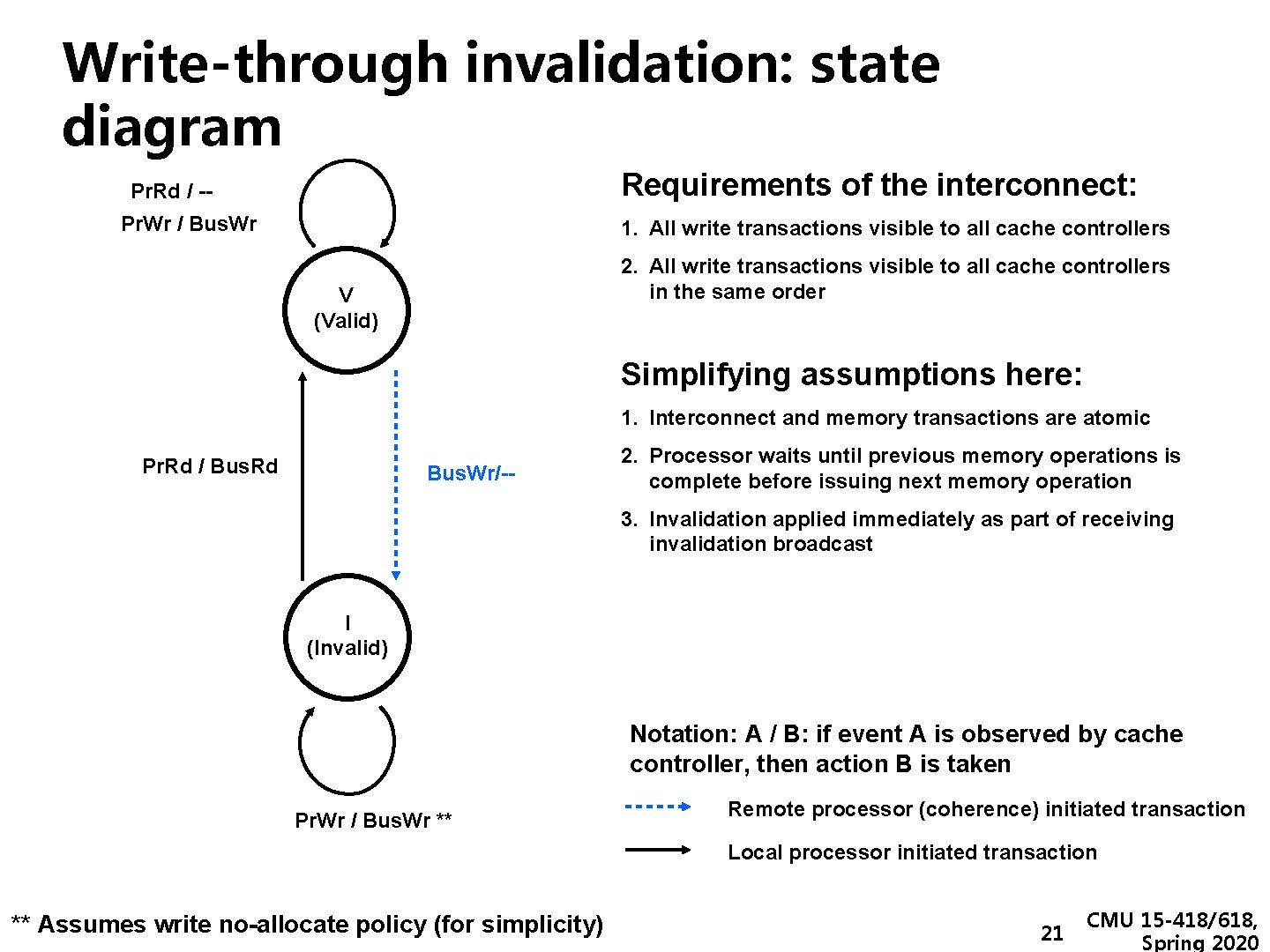
Write-through invalidation: state diagram Requirements of the interconnect: Pr. Rd / -Pr. Wr / Bus. Wr 1. All write transactions visible to all cache controllers 2. All write transactions visible to all cache controllers in the same order V (Valid) Simplifying assumptions here: 1. Interconnect and memory transactions are atomic Pr. Rd / Bus. Rd Bus. Wr/-- 2. Processor waits until previous memory operations is complete before issuing next memory operation 3. Invalidation applied immediately as part of receiving invalidation broadcast I (Invalid) Notation: A / B: if event A is observed by cache controller, then action B is taken Pr. Wr / Bus. Wr ** Remote processor (coherence) initiated transaction Local processor initiated transaction ** Assumes write no-allocate policy (for simplicity) 21 CMU 15 -418/618, Spring 2020
Write-through policy is inefficient ▪ Every write operation goes out to memory - Very high bandwidth requirements ▪ Write-back caches absorb most write traffic as cache hits - Significantly reduces bandwidth requirements - But how do we ensure write propagation/serialization? - This requires more sophisticated coherence protocols 22 CMU 15 -418/618, Spring 2020

Recall cache line state bits Line state Tag Data (64 bytes on modern Intel processors) Dirty bit 23 CMU 15 -418/618, Spring 2020
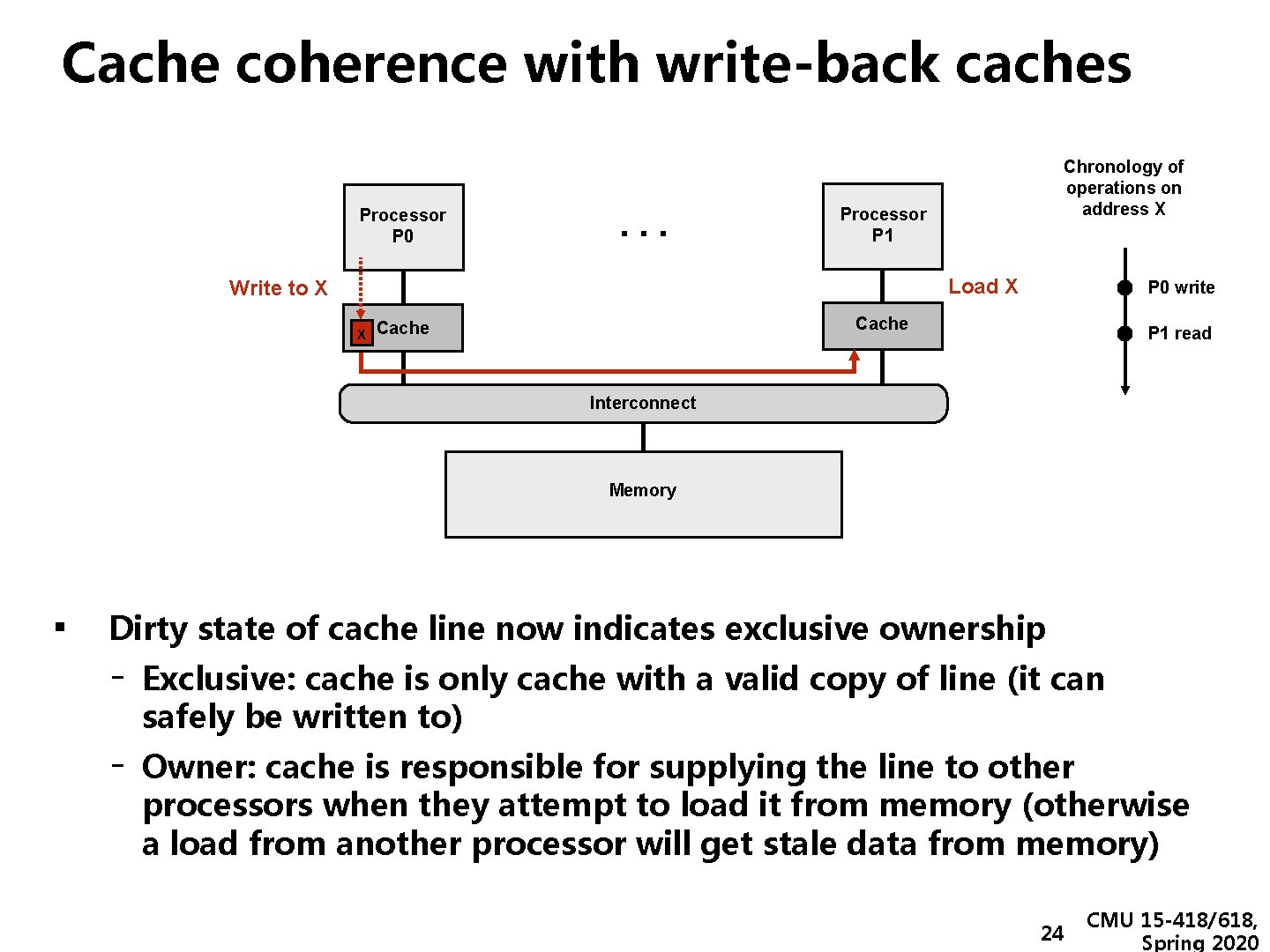
Cache coherence with write-back caches Processor P 0 . . . Chronology of operations on address X Processor P 1 Load X Write to X P 0 write Cache X Cache P 1 read Interconnect Memory ▪ Dirty state of cache line now indicates exclusive ownership - Exclusive: cache is only cache with a valid copy of line (it can safely be written to) Owner: cache is responsible for supplying the line to other processors when they attempt to load it from memory (otherwise a load from another processor will get stale data from memory) 24 CMU 15 -418/618, Spring 2020
Invalidation-based write-back protocol Key ideas: ▪ A line in the “exclusive” state can be modified without notifying the other caches ▪ Processor can only write to lines in the exclusive state - So they need a way to tell other caches that they want exclusive access to the line They will do this by sending messages to all the other caches ▪ When cache controller observes (via snooping) a request for exclusive access to line it contains - It must invalidate the line in its own cache What if the line is dirty? 25 CMU 15 -418/618, Spring 2020
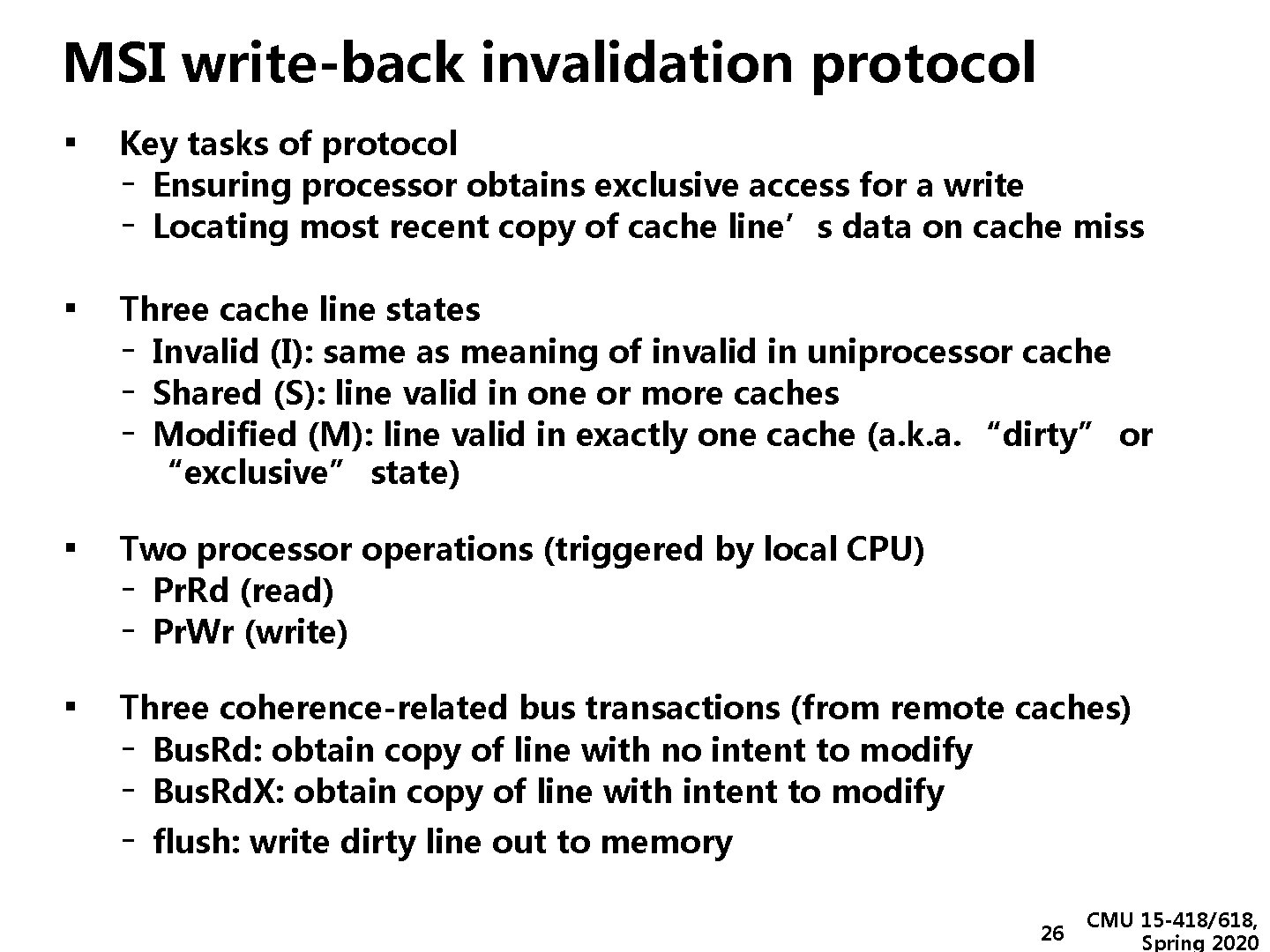
MSI write-back invalidation protocol ▪ Key tasks of protocol - Ensuring processor obtains exclusive access for a write - Locating most recent copy of cache line’s data on cache miss ▪ Three cache line states - Invalid (I): same as meaning of invalid in uniprocessor cache - Shared (S): line valid in one or more caches - Modified (M): line valid in exactly one cache (a. k. a. “dirty” or “exclusive” state) ▪ Two processor operations (triggered by local CPU) - Pr. Rd (read) - Pr. Wr (write) ▪ Three coherence-related bus transactions (from remote caches) - Bus. Rd: obtain copy of line with no intent to modify - Bus. Rd. X: obtain copy of line with intent to modify - flush: write dirty line out to memory 26 CMU 15 -418/618, Spring 2020
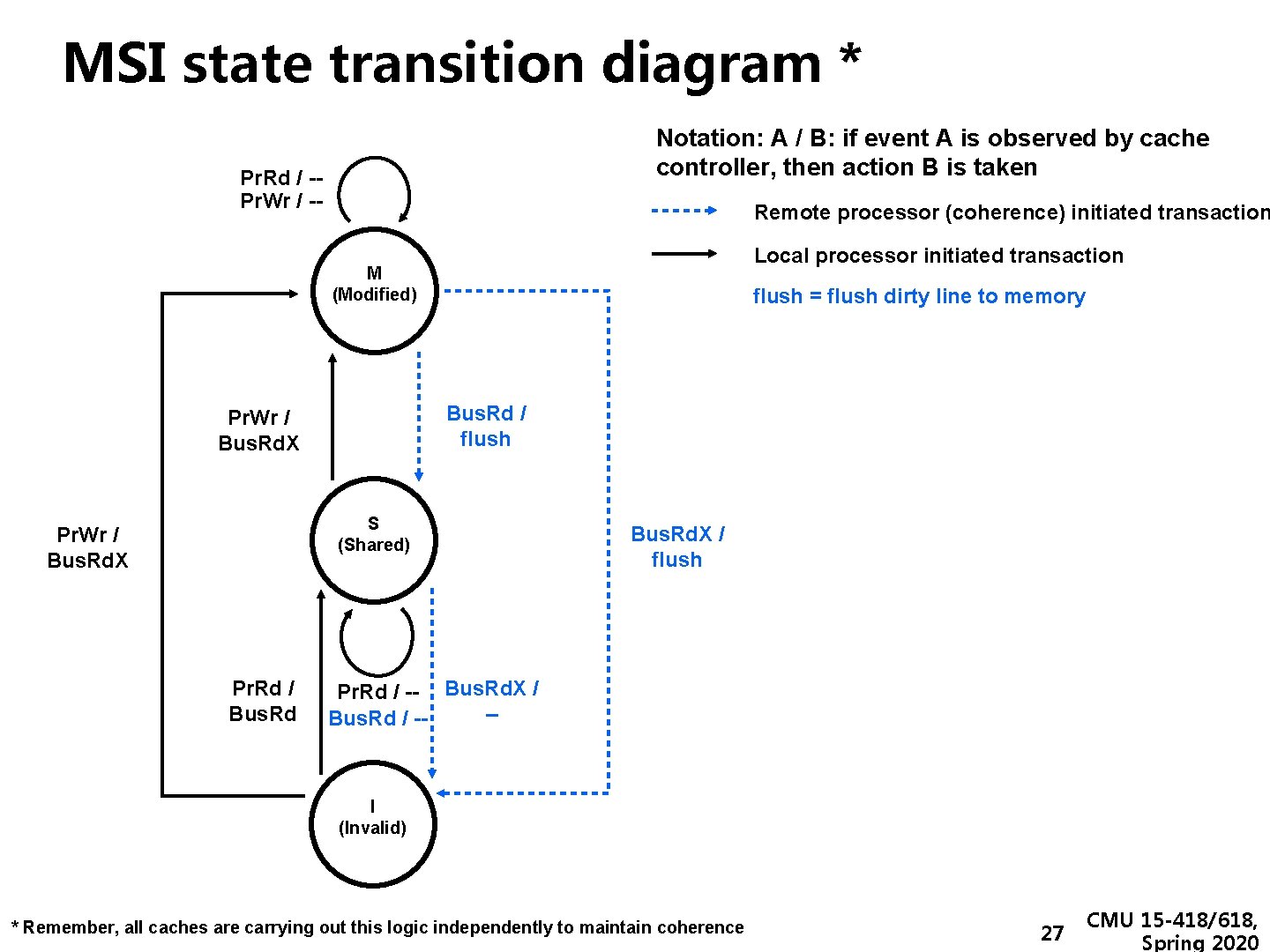
MSI state transition diagram * Notation: A / B: if event A is observed by cache controller, then action B is taken Pr. Rd / -Pr. Wr / -- Remote processor (coherence) initiated transaction Local processor initiated transaction M (Modified) flush = flush dirty line to memory Bus. Rd / flush Pr. Wr / Bus. Rd. X S (Shared) Pr. Wr / Bus. Rd. X Pr. Rd / Bus. Rd. X / flush Pr. Rd / -- Bus. Rd. X / -Bus. Rd / -- I (Invalid) * Remember, all caches are carrying out this logic independently to maintain coherence 27 CMU 15 -418/618, Spring 2020
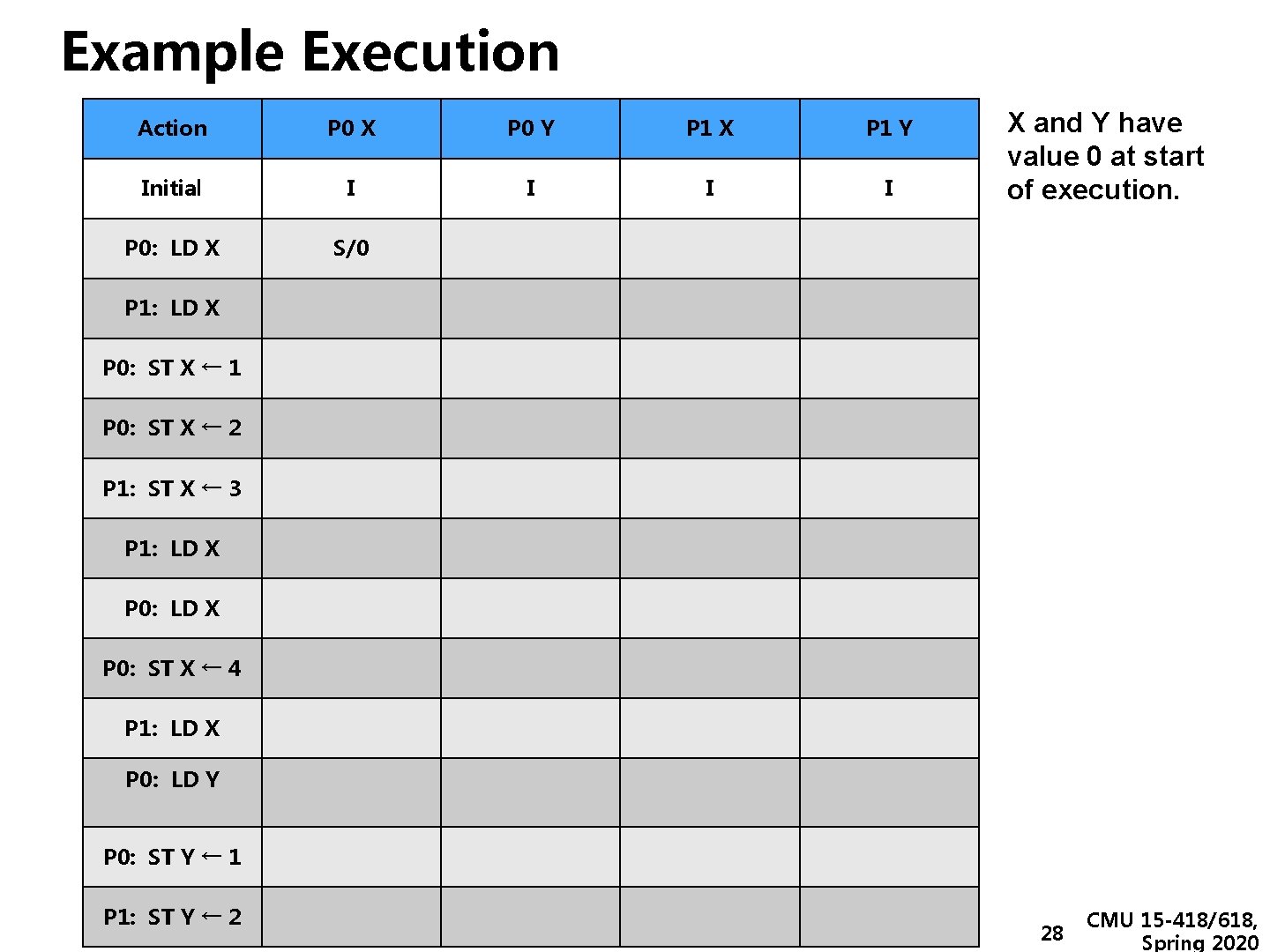
Example Execution Action P 0 X P 0 Y P 1 X P 1 Y Initial I I P 0: LD X S/0 X and Y have value 0 at start of execution. P 1: LD X P 0: ST X ← 1 P 0: ST X ← 2 P 1: ST X ← 3 P 1: LD X P 0: ST X ← 4 P 1: LD X P 0: LD Y P 0: ST Y ← 1 P 1: ST Y ← 2 28 CMU 15 -418/618, Spring 2020
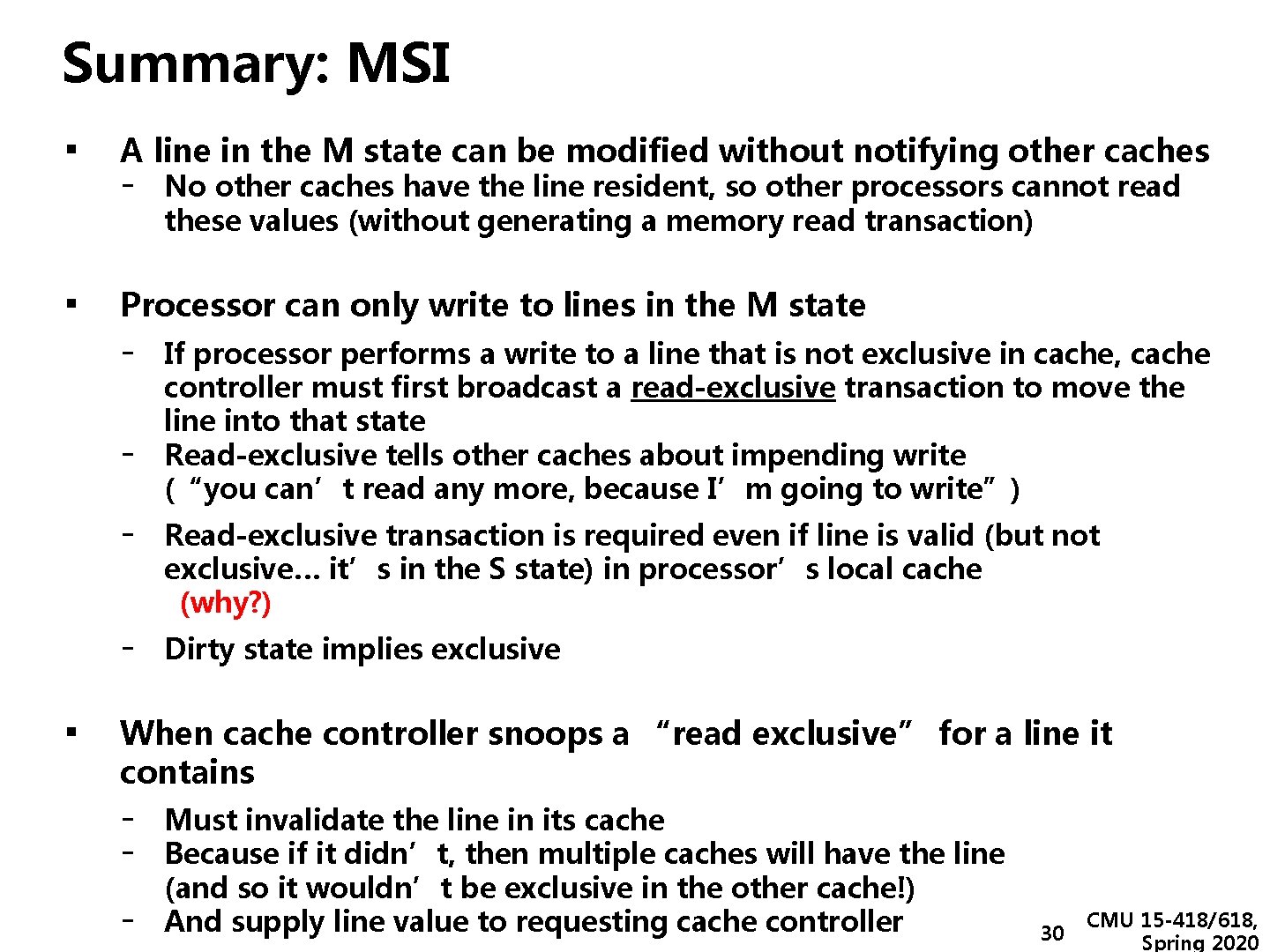
Summary: MSI ▪ A line in the M state can be modified without notifying other caches ▪ Processor can only write to lines in the M state - - ▪ No other caches have the line resident, so other processors cannot read these values (without generating a memory read transaction) If processor performs a write to a line that is not exclusive in cache, cache controller must first broadcast a read-exclusive transaction to move the line into that state Read-exclusive tells other caches about impending write (“you can’t read any more, because I’m going to write”) Read-exclusive transaction is required even if line is valid (but not exclusive… it’s in the S state) in processor’s local cache (why? ) Dirty state implies exclusive When cache controller snoops a “read exclusive” for a line it contains - Must invalidate the line in its cache Because if it didn’t, then multiple caches will have the line (and so it wouldn’t be exclusive in the other cache!) And supply line value to requesting cache controller 30 CMU 15 -418/618, Spring 2020
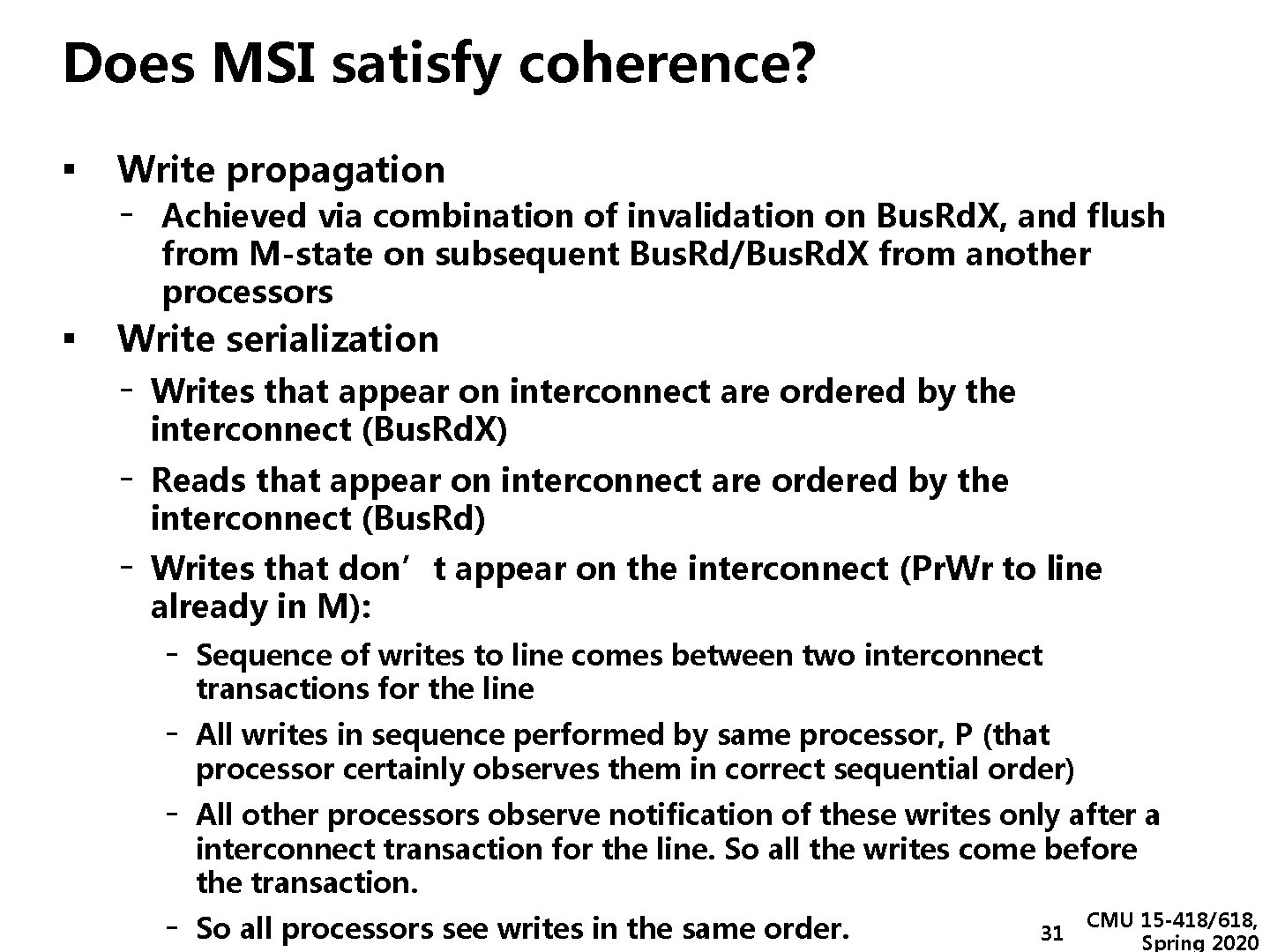
Does MSI satisfy coherence? ▪ Write propagation - Achieved via combination of invalidation on Bus. Rd. X, and flush from M-state on subsequent Bus. Rd/Bus. Rd. X from another processors ▪ Write serialization - Writes that appear on interconnect are ordered by the - interconnect (Bus. Rd. X) Reads that appear on interconnect are ordered by the interconnect (Bus. Rd) Writes that don’t appear on the interconnect (Pr. Wr to line already in M): - Sequence of writes to line comes between two interconnect transactions for the line All writes in sequence performed by same processor, P (that processor certainly observes them in correct sequential order) All other processors observe notification of these writes only after a interconnect transaction for the line. So all the writes come before the transaction. So all processors see writes in the same order. 31 CMU 15 -418/618, Spring 2020
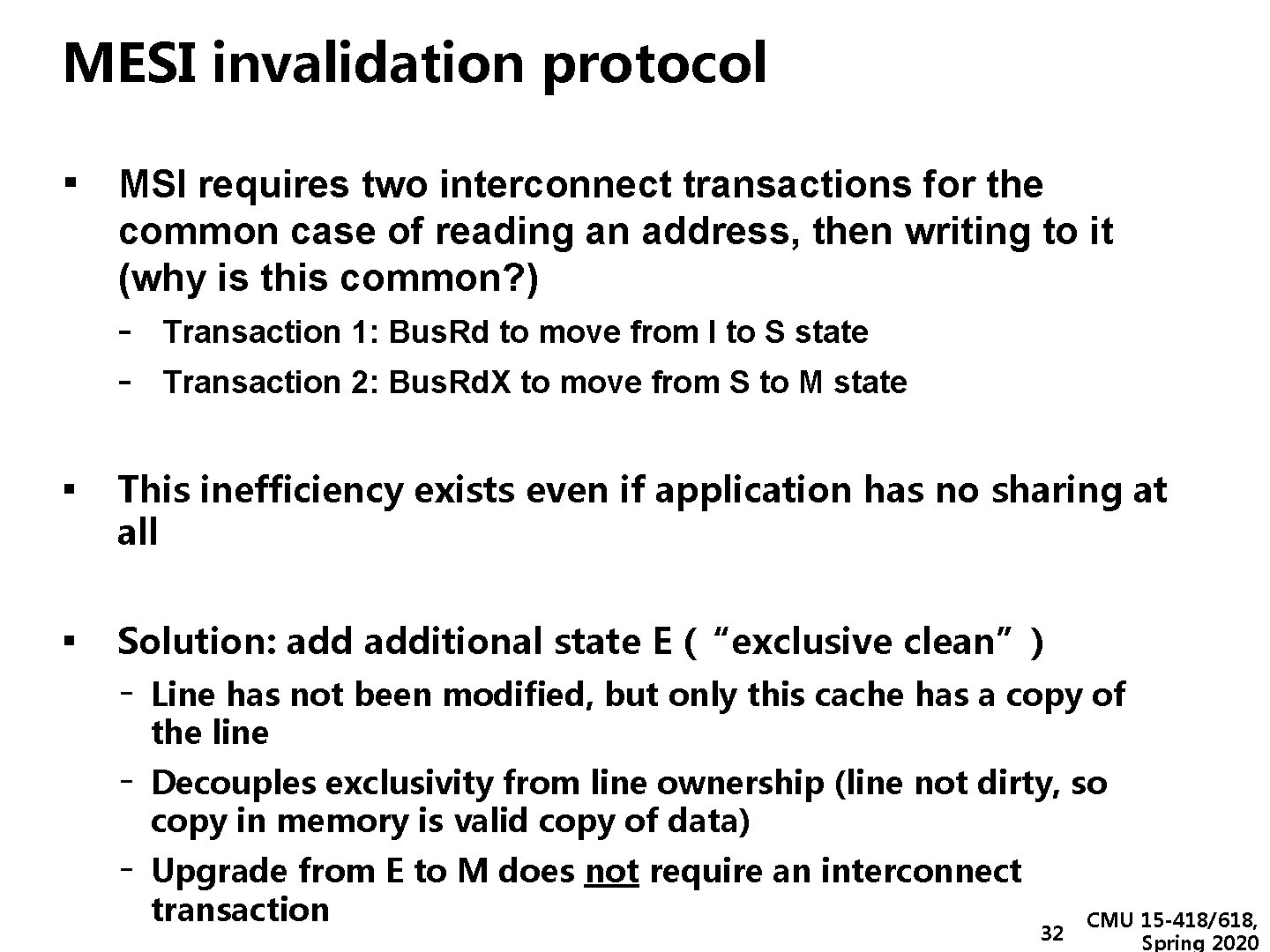
MESI invalidation protocol ▪ MSI requires two interconnect transactions for the common case of reading an address, then writing to it (why is this common? ) - Transaction 1: Bus. Rd to move from I to S state Transaction 2: Bus. Rd. X to move from S to M state ▪ This inefficiency exists even if application has no sharing at all ▪ Solution: additional state E (“exclusive clean”) - Line has not been modified, but only this cache has a copy of - the line Decouples exclusivity from line ownership (line not dirty, so copy in memory is valid copy of data) Upgrade from E to M does not require an interconnect transaction 32 CMU 15 -418/618, Spring 2020
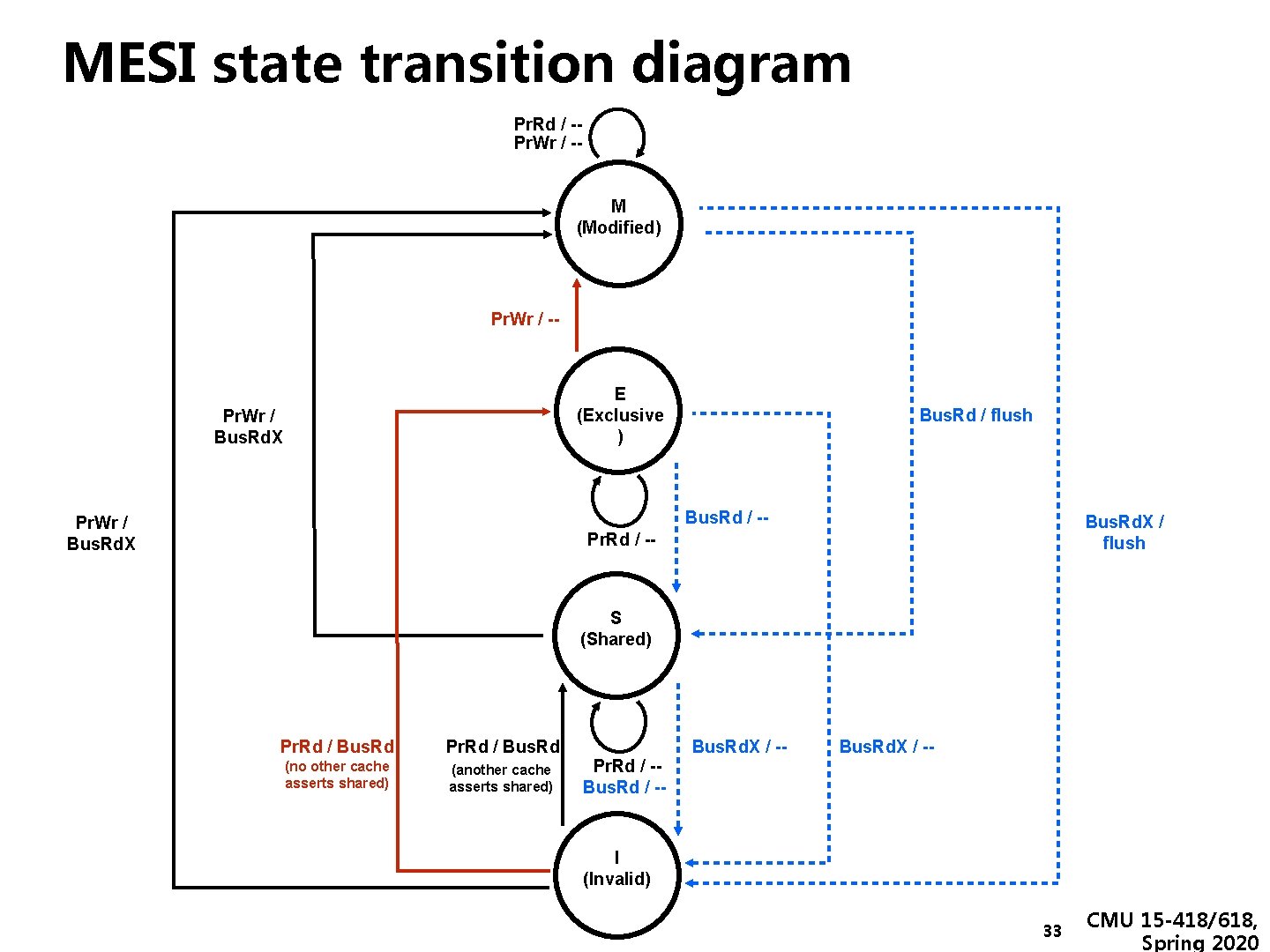
MESI state transition diagram Pr. Rd / -Pr. Wr / -- M (Modified) Pr. Wr / -- E (Exclusive ) Pr. Wr / Bus. Rd. X Bus. Rd / flush Bus. Rd / -- Pr. Wr / Bus. Rd. X / flush Pr. Rd / -- S (Shared) Pr. Rd / Bus. Rd (no other cache asserts shared) (another cache asserts shared) Pr. Rd / -Bus. Rd / -- Bus. Rd. X / -- I (Invalid) 33 CMU 15 -418/618, Spring 2020
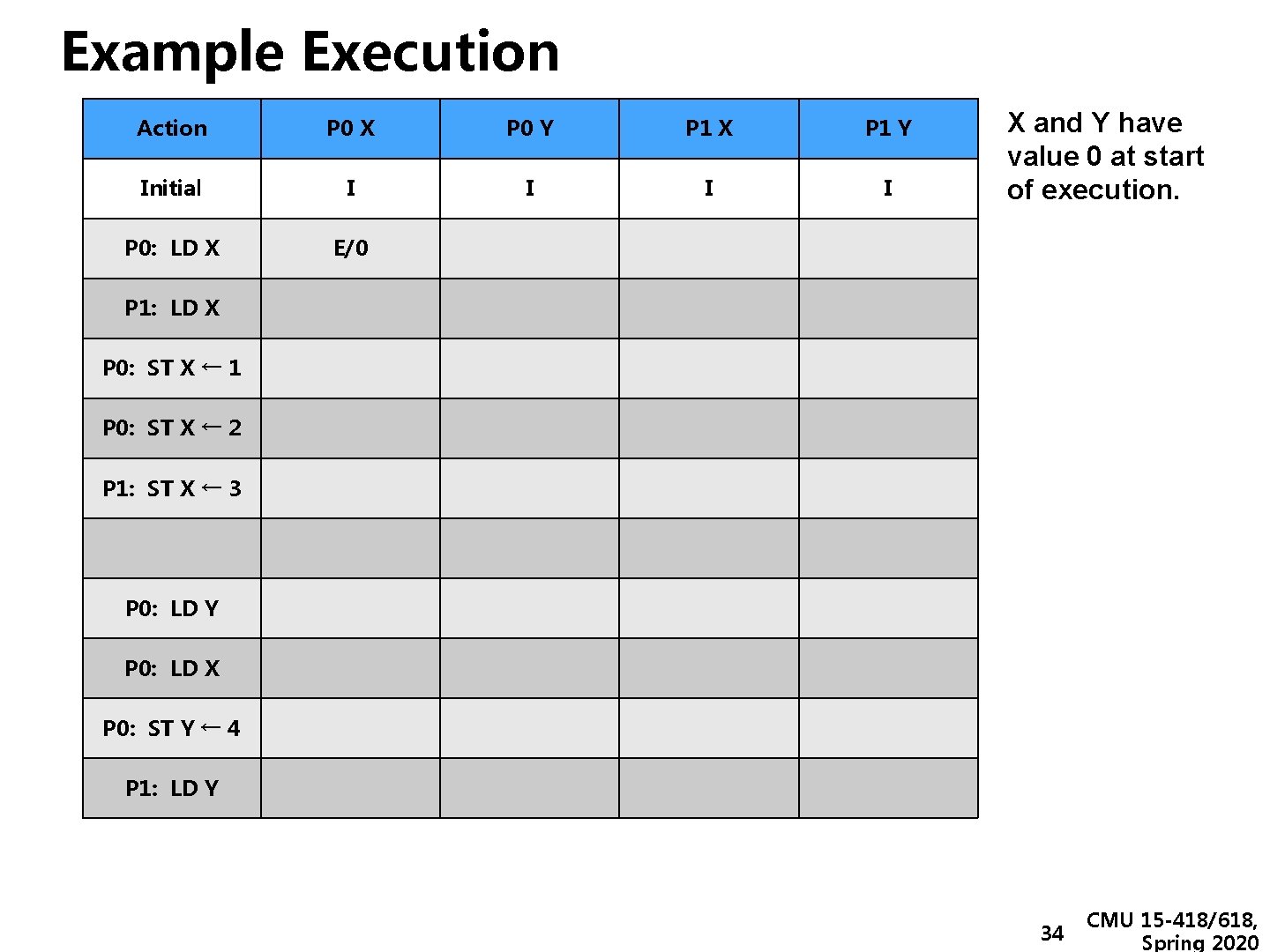
Example Execution Action P 0 X P 0 Y P 1 X P 1 Y Initial I I P 0: LD X E/0 X and Y have value 0 at start of execution. P 1: LD X P 0: ST X ← 1 P 0: ST X ← 2 P 1: ST X ← 3 P 0: LD Y P 0: LD X P 0: ST Y ← 4 P 1: LD Y 34 CMU 15 -418/618, Spring 2020
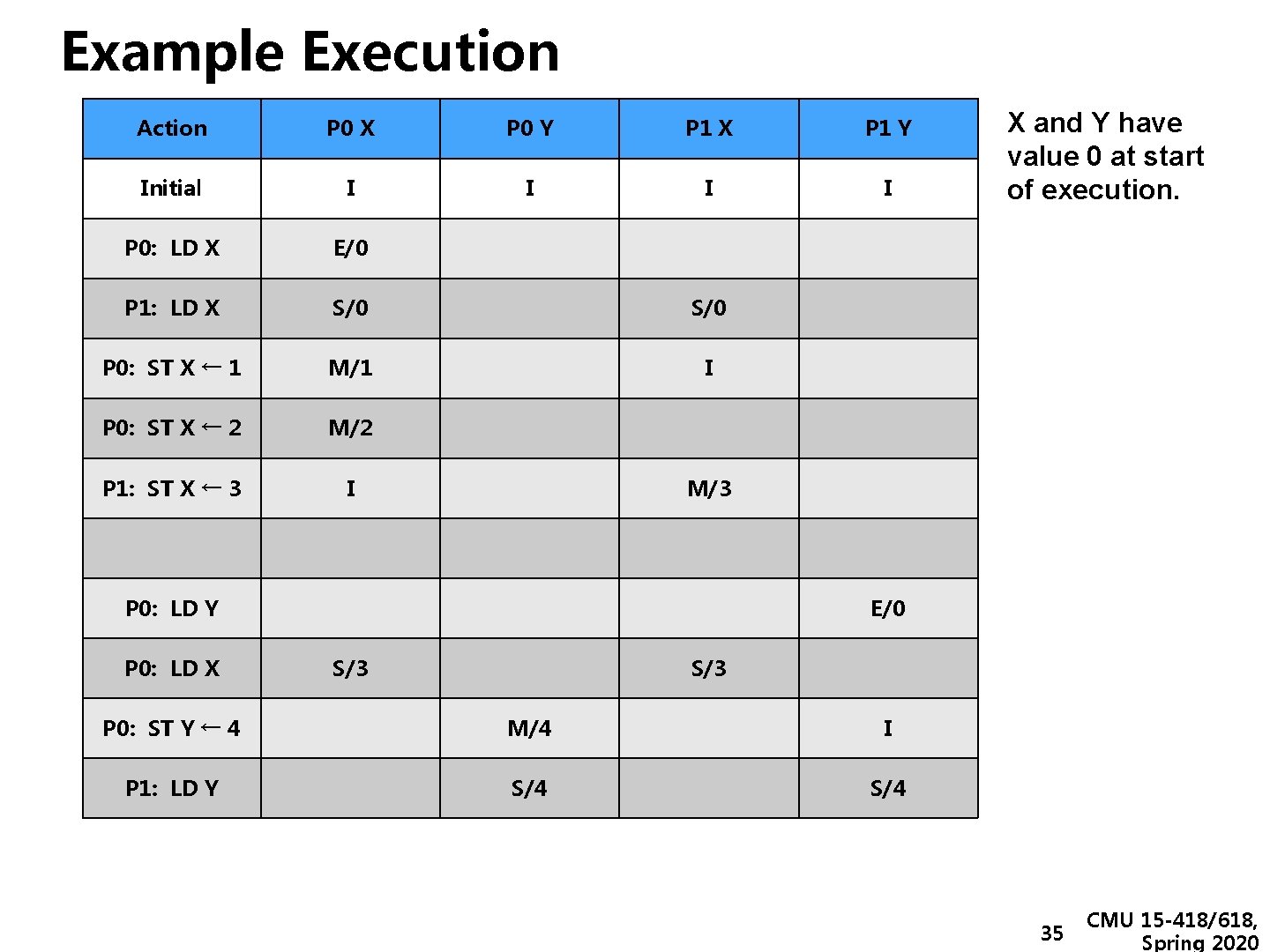
Example Execution Action P 0 X P 0 Y P 1 X P 1 Y Initial I I P 0: LD X E/0 P 1: LD X S/0 P 0: ST X ← 1 M/1 I P 0: ST X ← 2 M/2 P 1: ST X ← 3 I M/3 P 0: LD Y P 0: LD X X and Y have value 0 at start of execution. E/0 S/3 P 0: ST Y ← 4 M/4 I P 1: LD Y S/4 35 CMU 15 -418/618, Spring 2020
Lower-level choices ▪ Who should supply data on a cache miss when line is in the E or S state of another cache? - Can get cache line data from memory or can get data from another cache - If source is another cache, which one should provide it? ▪ Cache-to-cache transfers add complexity, but commonly used to reduce both latency of data access and reduce memory bandwidth required by application - Recall that caches are much faster + higher bandwidth than memory 36 CMU 15 -418/618, Spring 2020
Increasing efficiency (and complexity) ▪ MESIF (5 -state invalidation-based protocol) - Like MESI, but one cache holds shared line in F state rather than S - (F=”forward”) Cache with line in F state services miss Simplifies decision of which cache should provide block on miss (basic MESI: all caches respond) - Used by Intel processors ▪ MOESI (5 -state invalidation-based protocol) - In MESI protocol, transition from M to S requires flush to memory - Instead transition from M to O (O=”owned, but not exclusive”) - and do not flush to memory Other processors maintain shared line in S state, one processor maintains line in O state Data in memory is stale, so cache with line in O state must service cache misses Used in AMD Opteron 37 CMU 15 -418/618, Spring 2020
Invalidation-based vs. Update-based Protocols ▪ Invalidation-based protocol - To write to a line, cache must obtain exclusive access to it All other caches must invalidate their copies (All of the examples we have considered so far) ▪ Update-based protocol - Can write to shared copy by broadcasting update to all other copies ▪ Why is this a useful idea? 38 CMU 15 -418/618, Spring 2020
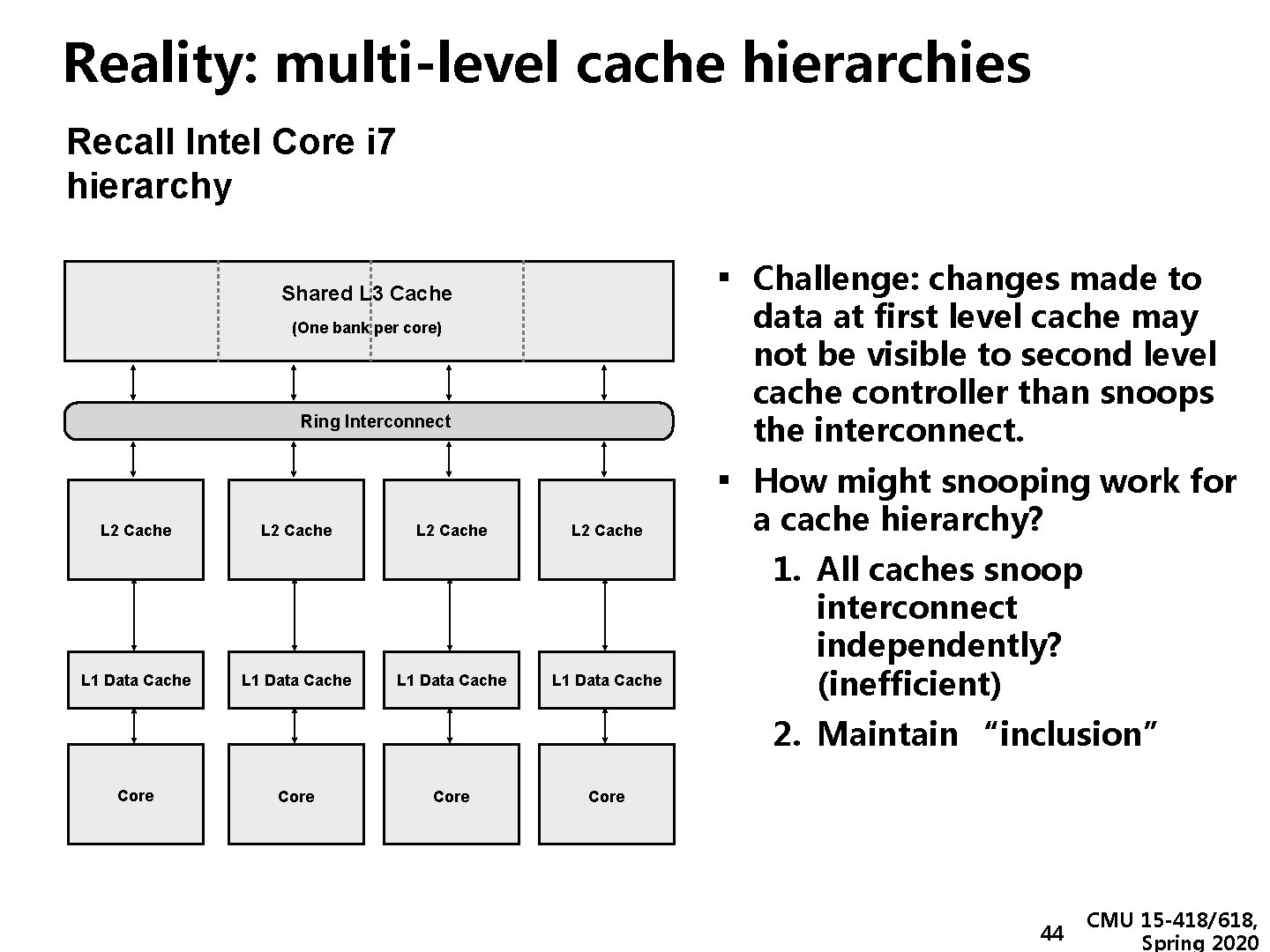
Reality: multi-level cache hierarchies Recall Intel Core i 7 hierarchy ▪ Challenge: changes made to Shared L 3 Cache data at first level cache may not be visible to second level cache controller than snoops the interconnect. (One bank per core) Ring Interconnect ▪ How might snooping work for L 2 Cache L 1 Data Cache a cache hierarchy? 1. All caches snoop interconnect independently? (inefficient) 2. Maintain “inclusion” Core 44 CMU 15 -418/618, Spring 2020
![Inclusion property of caches ▪ All lines in closer [to processor] cache are also](http://slidetodoc.com/presentation_image_h2/87b67e638ac814e4783fbcec8dbb815f/image-39.jpg "Inclusion property of caches ▪ All lines in closer [to processor] cache are also")
Inclusion property of caches ▪ All lines in closer [to processor] cache are also in farther [from processor] cache - e. g. , contents of L 1 are a subset of contents of L 2 - Thus, all transactions relevant to L 1 are also relevant to L 2, so it is sufficient for only the L 2 to snoop the interconnect ▪ If line is in owned state (M in MSI/MESI) in L 1, it must also be in M state in L 2 - Allows L 2 to determine if a bus transaction is requesting a modified cache line in L 1 without requiring information from L 1 45 CMU 15 -418/618, Spring 2020
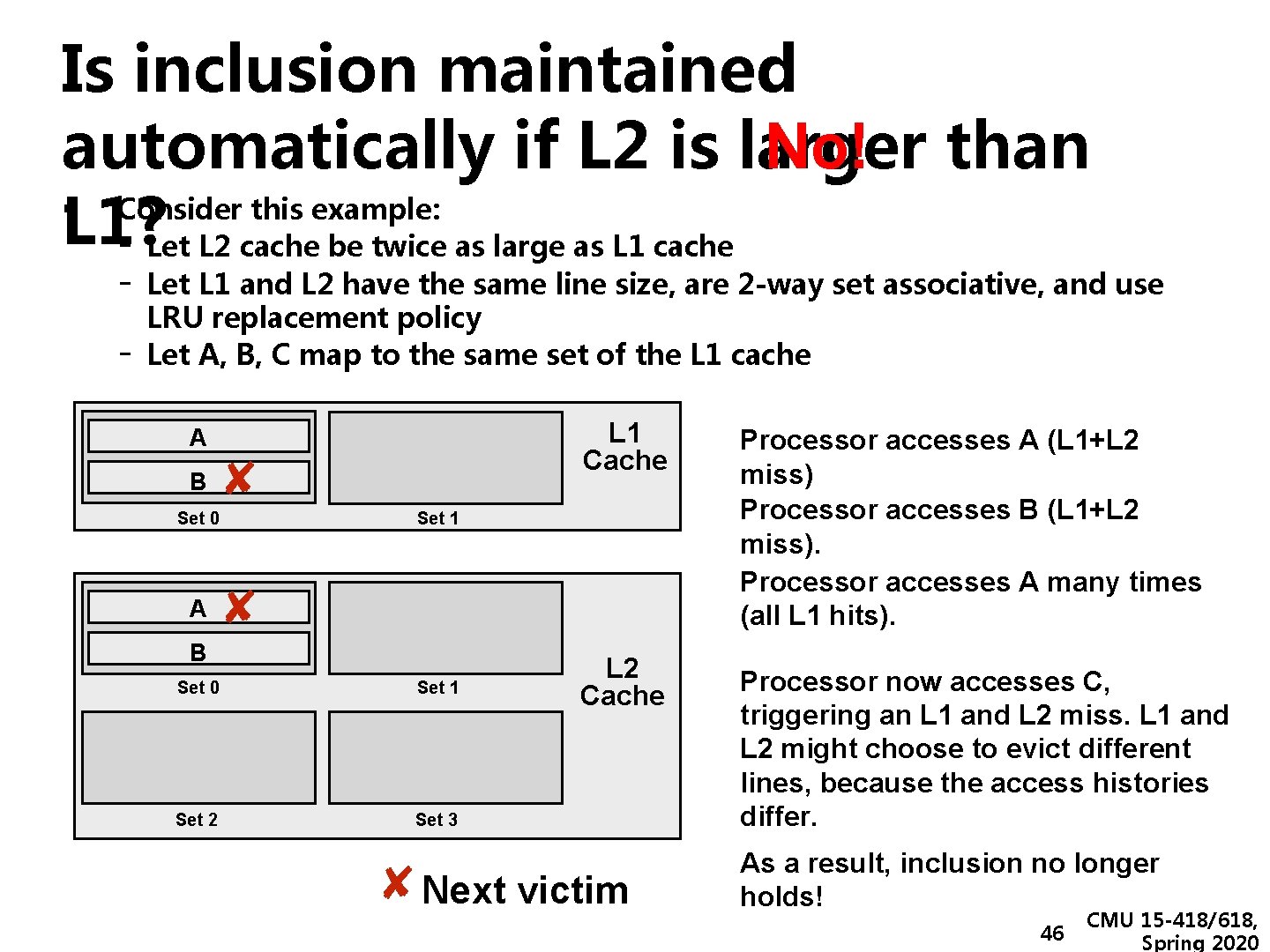
Is inclusion maintained automatically if L 2 is larger No! than ▪ Consider this example: L 1? - Let L 2 cache be twice as large as L 1 cache - Let L 1 and L 2 have the same line size, are 2 -way set associative, and use LRU replacement policy Let A, B, C map to the same set of the L 1 cache A B ✘ Set 0 A L 1 Cache Processor accesses A (L 1+L 2 miss) Processor accesses B (L 1+L 2 miss). Processor accesses A many times (all L 1 hits). L 2 Cache Processor now accesses C, triggering an L 1 and L 2 miss. L 1 and L 2 might choose to evict different lines, because the access histories differ. Set 1 ✘ B Set 0 Set 1 Set 2 Set 3 ✘Next victim As a result, inclusion no longer holds! 46 CMU 15 -418/618, Spring 2020
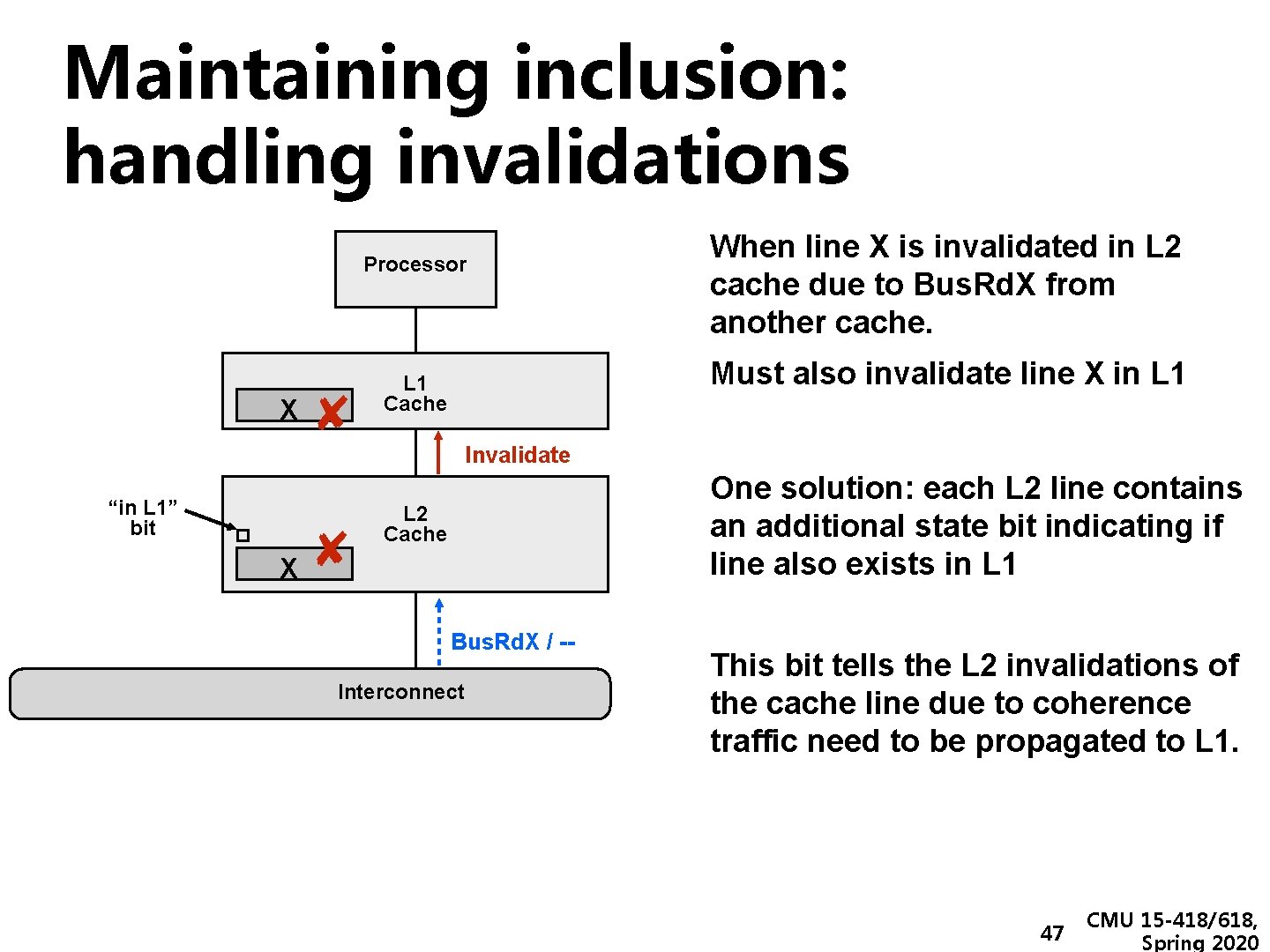
Maintaining inclusion: handling invalidations Processor X ✘ When line X is invalidated in L 2 cache due to Bus. Rd. X from another cache. Must also invalidate line X in L 1 Cache Invalidate “in L 1” bit ✘ X One solution: each L 2 line contains an additional state bit indicating if line also exists in L 1 L 2 Cache Bus. Rd. X / -Interconnect This bit tells the L 2 invalidations of the cache line due to coherence traffic need to be propagated to L 1. 47 CMU 15 -418/618, Spring 2020
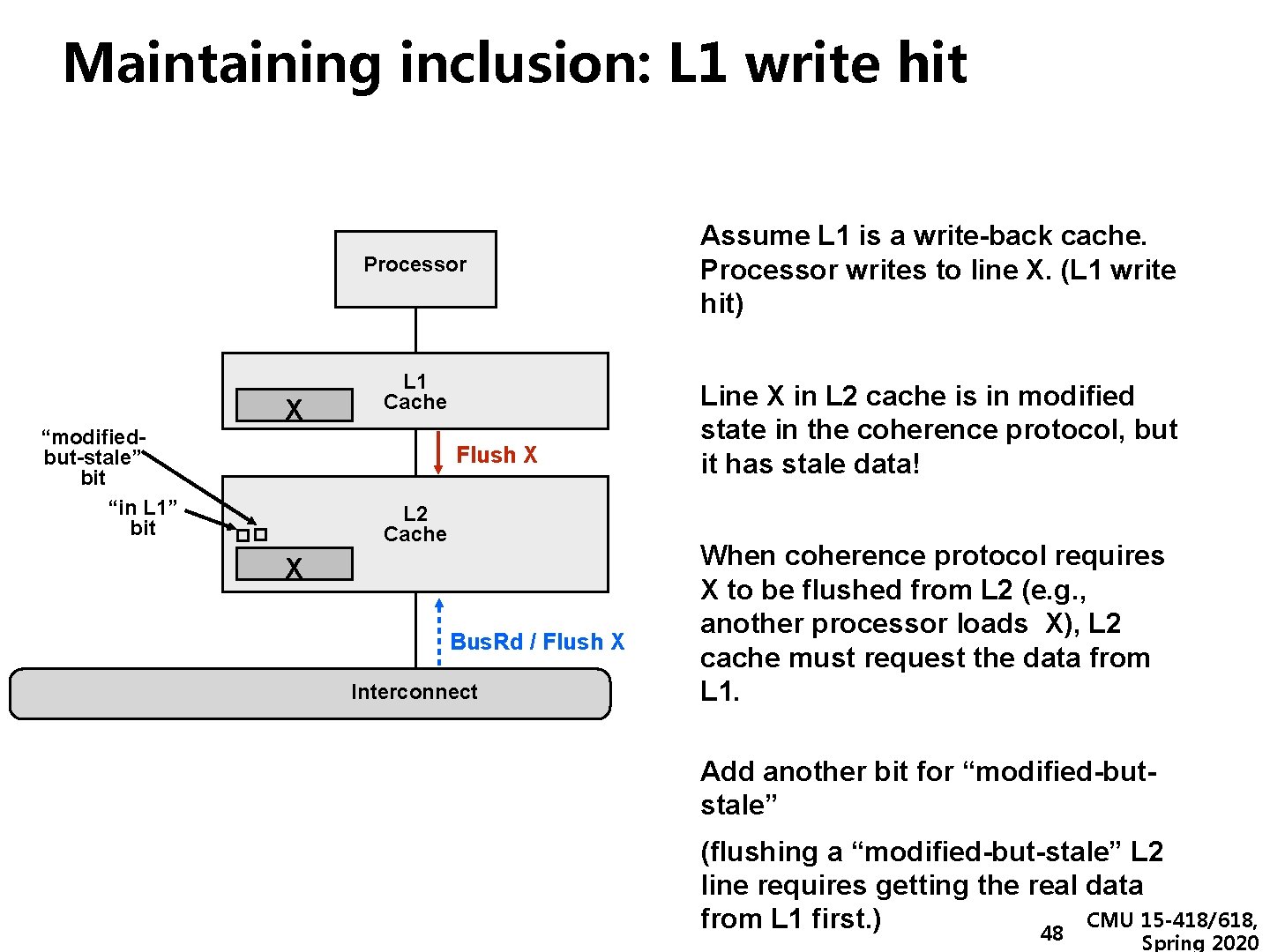
Maintaining inclusion: L 1 write hit Processor “modifiedbut-stale” bit “in L 1” bit X L 1 Cache Flush X L 2 Cache X Bus. Rd / Flush X Interconnect Assume L 1 is a write-back cache. Processor writes to line X. (L 1 write hit) Line X in L 2 cache is in modified state in the coherence protocol, but it has stale data! When coherence protocol requires X to be flushed from L 2 (e. g. , another processor loads X), L 2 cache must request the data from L 1. Add another bit for “modified-butstale” (flushing a “modified-but-stale” L 2 line requires getting the real data CMU 15 -418/618, from L 1 first. ) 48 Spring 2020
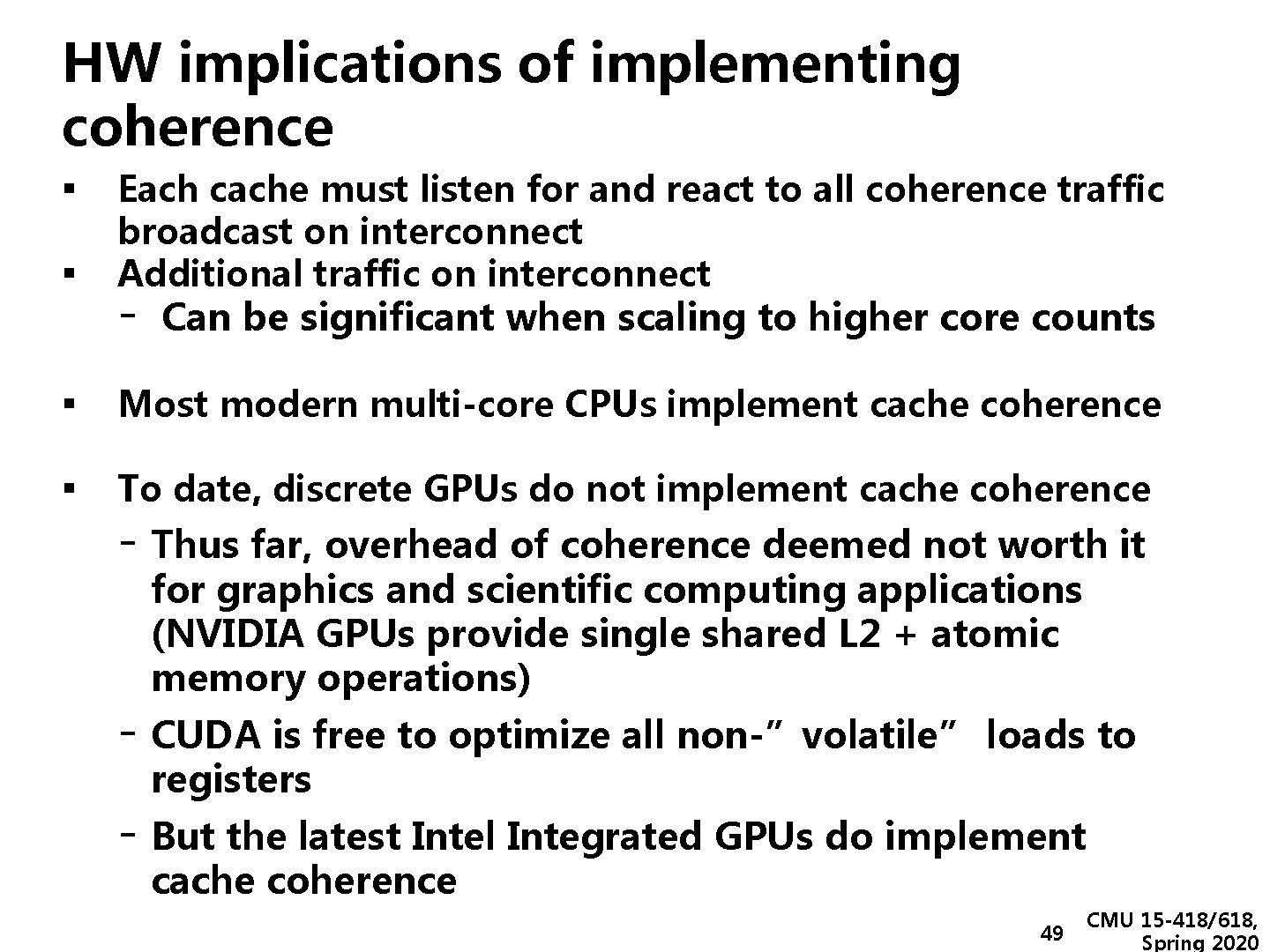
HW implications of implementing coherence ▪ Each cache must listen for and react to all coherence traffic ▪ broadcast on interconnect Additional traffic on interconnect - Can be significant when scaling to higher core counts ▪ Most modern multi-core CPUs implement cache coherence ▪ To date, discrete GPUs do not implement cache coherence - Thus far, overhead of coherence deemed not worth it for graphics and scientific computing applications (NVIDIA GPUs provide single shared L 2 + atomic memory operations) - CUDA is free to optimize all non-”volatile” loads to registers - But the latest Intel Integrated GPUs do implement cache coherence 49 CMU 15 -418/618, Spring 2020
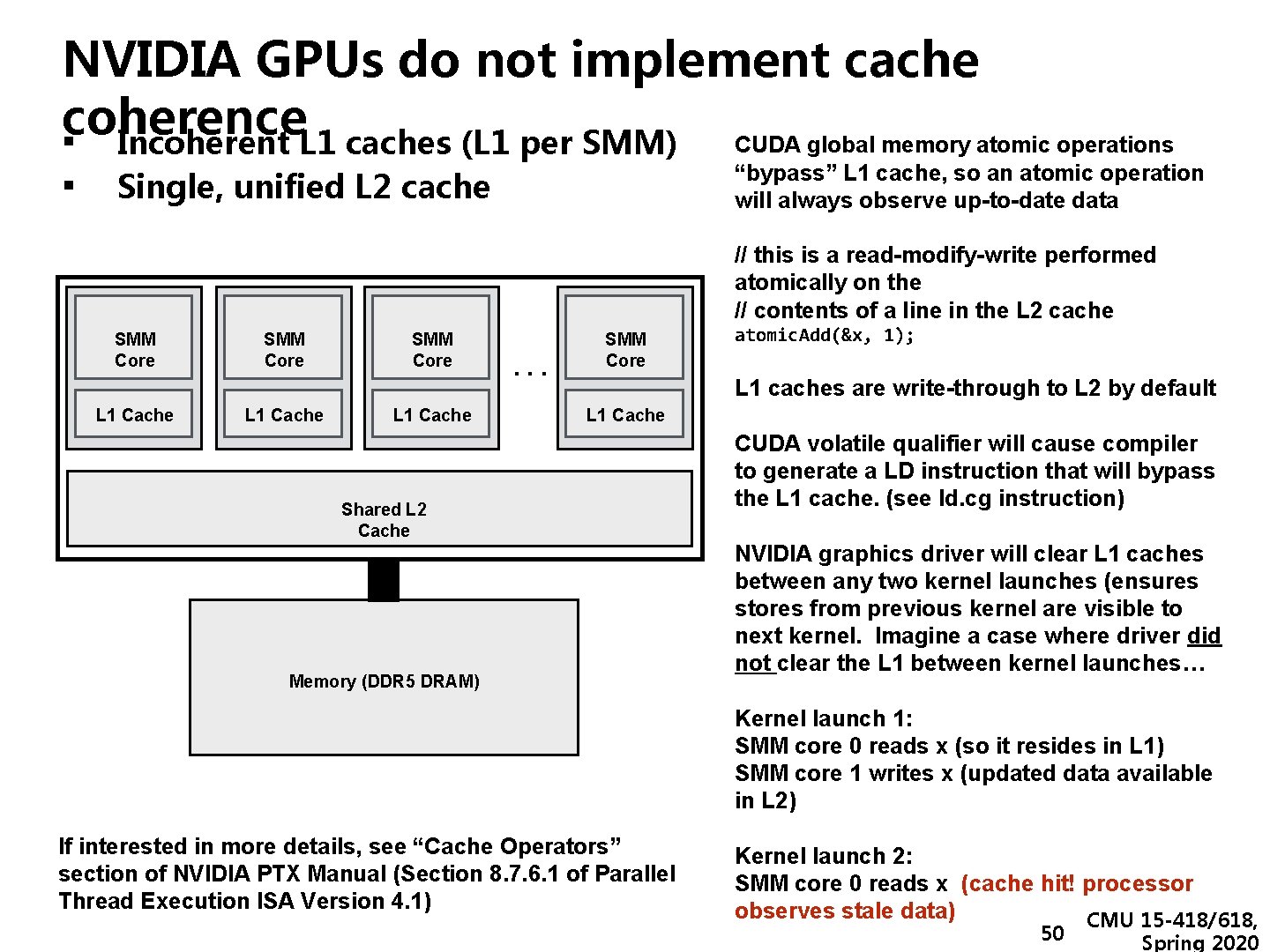
NVIDIA GPUs do not implement cache coherence ▪ Incoherent L 1 caches (L 1 per SMM) CUDA global memory atomic operations ▪ “bypass” L 1 cache, so an atomic operation will always observe up-to-date data Single, unified L 2 cache // this is a read-modify-write performed atomically on the // contents of a line in the L 2 cache SMM Core L 1 Cache . . . SMM Core atomic. Add(&x, 1); L 1 caches are write-through to L 2 by default L 1 Cache Shared L 2 Cache Memory (DDR 5 DRAM) CUDA volatile qualifier will cause compiler to generate a LD instruction that will bypass the L 1 cache. (see ld. cg instruction) NVIDIA graphics driver will clear L 1 caches between any two kernel launches (ensures stores from previous kernel are visible to next kernel. Imagine a case where driver did not clear the L 1 between kernel launches… Kernel launch 1: SMM core 0 reads x (so it resides in L 1) SMM core 1 writes x (updated data available in L 2) If interested in more details, see “Cache Operators” section of NVIDIA PTX Manual (Section 8. 7. 6. 1 of Parallel Thread Execution ISA Version 4. 1) Kernel launch 2: SMM core 0 reads x (cache hit! processor observes stale data) CMU 15 -418/618, 50 Spring 2020
Implications of cache coherence to the programmer 51 CMU 15 -418/618, Spring 2020
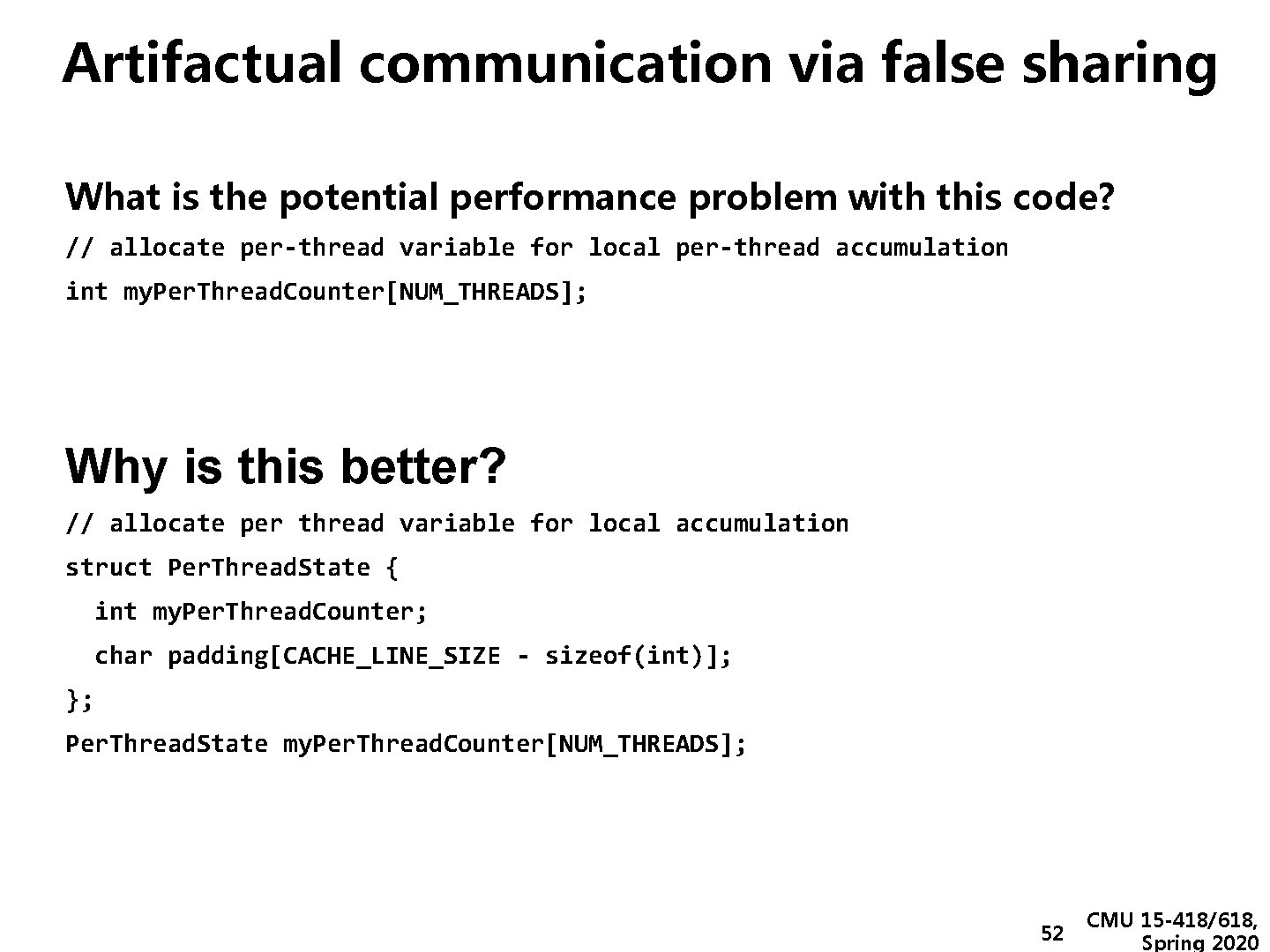
Artifactual communication via false sharing What is the potential performance problem with this code? // allocate per-thread variable for local per-thread accumulation int my. Per. Thread. Counter[NUM_THREADS]; Why is this better? // allocate per thread variable for local accumulation struct Per. Thread. State { int my. Per. Thread. Counter; char padding[CACHE_LINE_SIZE - sizeof(int)]; }; Per. Thread. State my. Per. Thread. Counter[NUM_THREADS]; 52 CMU 15 -418/618, Spring 2020
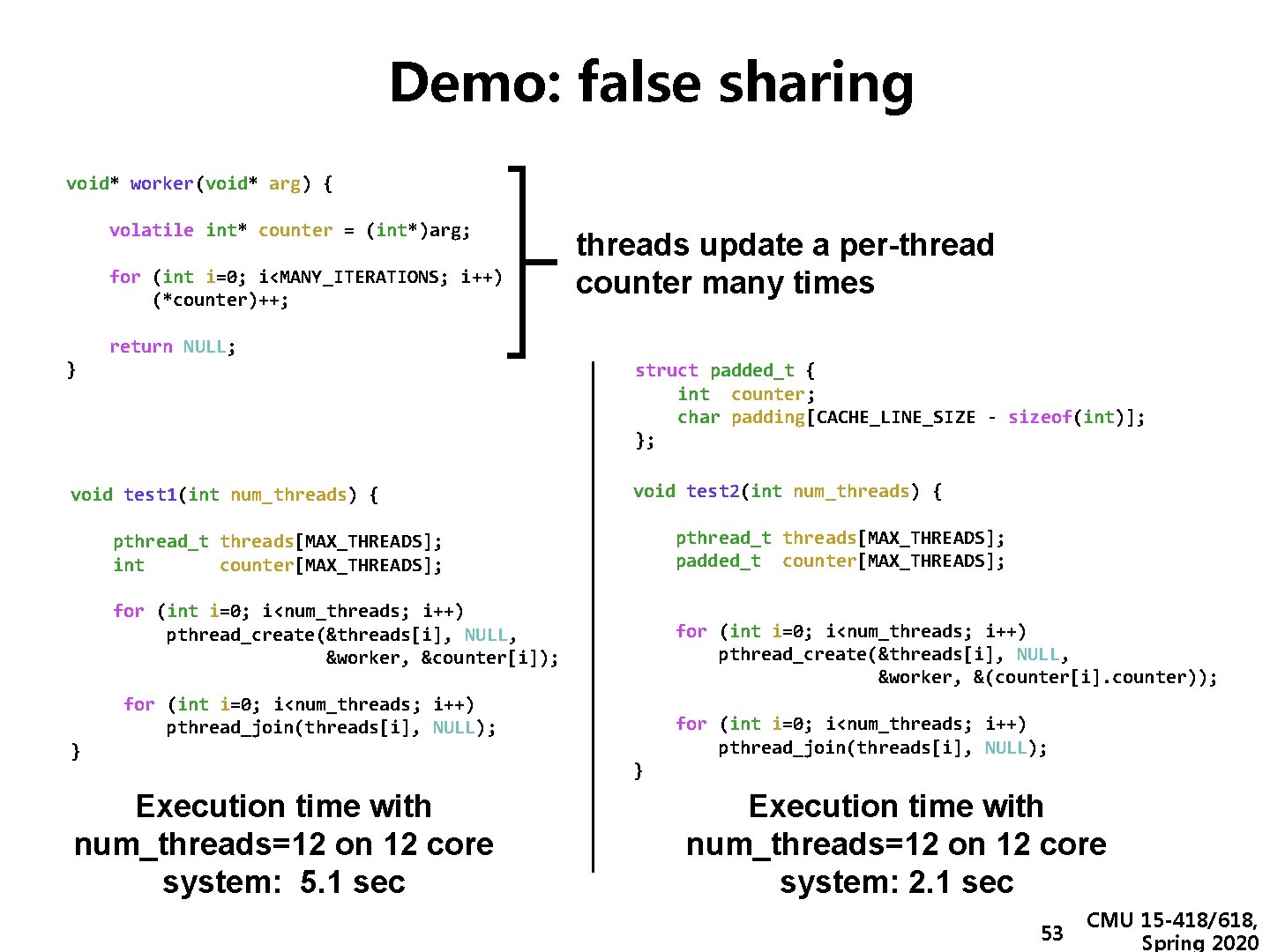
Demo: false sharing void* worker(void* arg) { volatile int* counter = (int*)arg; for (int i=0; i<MANY_ITERATIONS; i++) (*counter)++; threads update a per-thread counter many times return NULL; } struct padded_t { int counter; char padding[CACHE_LINE_SIZE - sizeof(int)]; }; void test 1(int num_threads) { void test 2(int num_threads) { pthread_t threads[MAX_THREADS]; padded_t counter[MAX_THREADS]; pthread_t threads[MAX_THREADS]; int counter[MAX_THREADS]; for (int i=0; i<num_threads; i++) pthread_create(&threads[i], NULL, &worker, &counter[i]); for (int i=0; i<num_threads; i++) pthread_create(&threads[i], NULL, &worker, &(counter[i]. counter)); for (int i=0; i<num_threads; i++) pthread_join(threads[i], NULL); } Execution time with num_threads=12 on 12 core system: 5. 1 sec for (int i=0; i<num_threads; i++) pthread_join(threads[i], NULL); } Execution time with num_threads=12 on 12 core system: 2. 1 sec 53 CMU 15 -418/618, Spring 2020
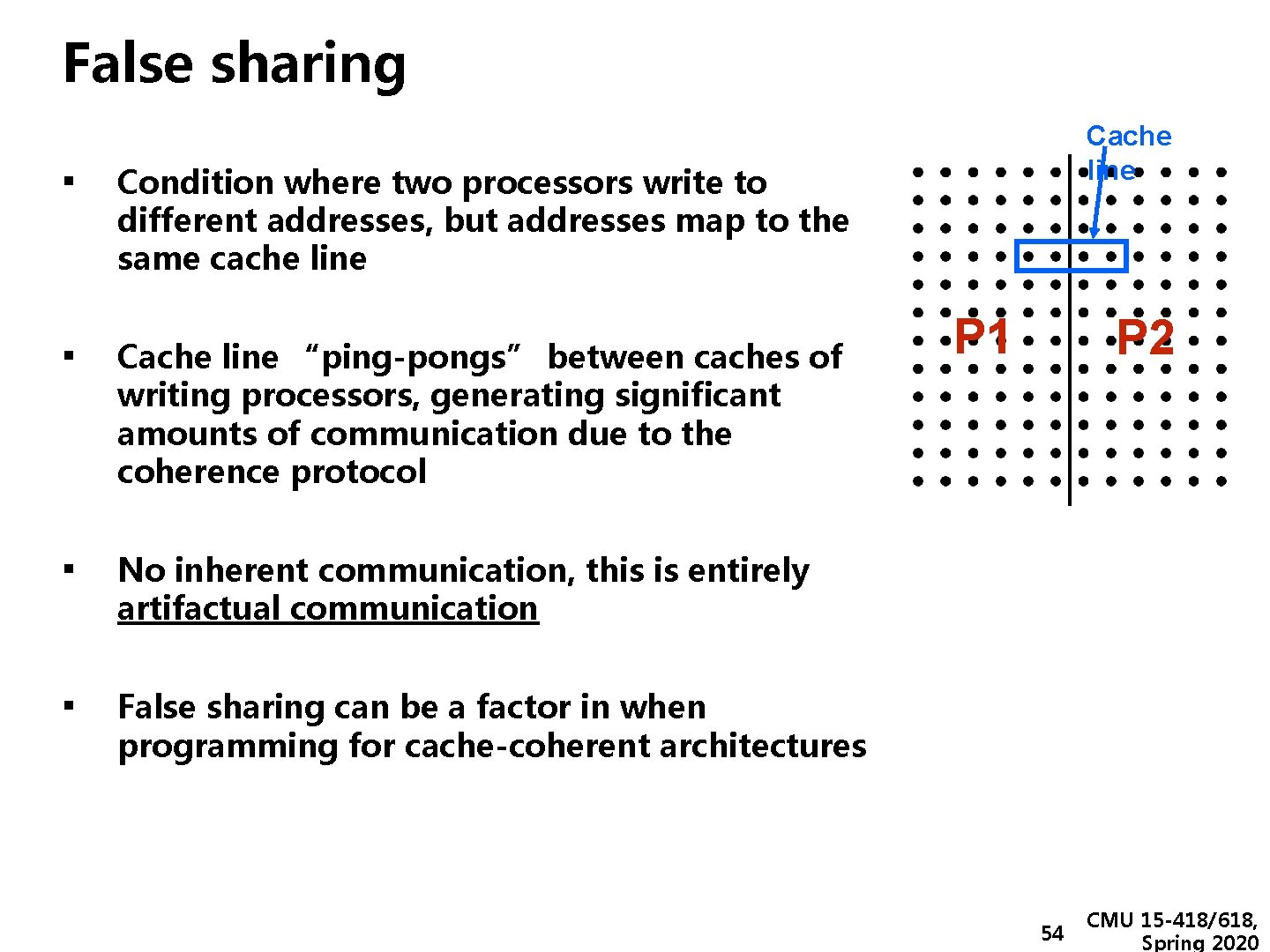
False sharing ▪ Cache line Condition where two processors write to different addresses, but addresses map to the same cache line ▪ Cache line “ping-pongs” between caches of writing processors, generating significant amounts of communication due to the coherence protocol ▪ No inherent communication, this is entirely artifactual communication ▪ False sharing can be a factor in when programming for cache-coherent architectures P 1 P 2 54 CMU 15 -418/618, Spring 2020
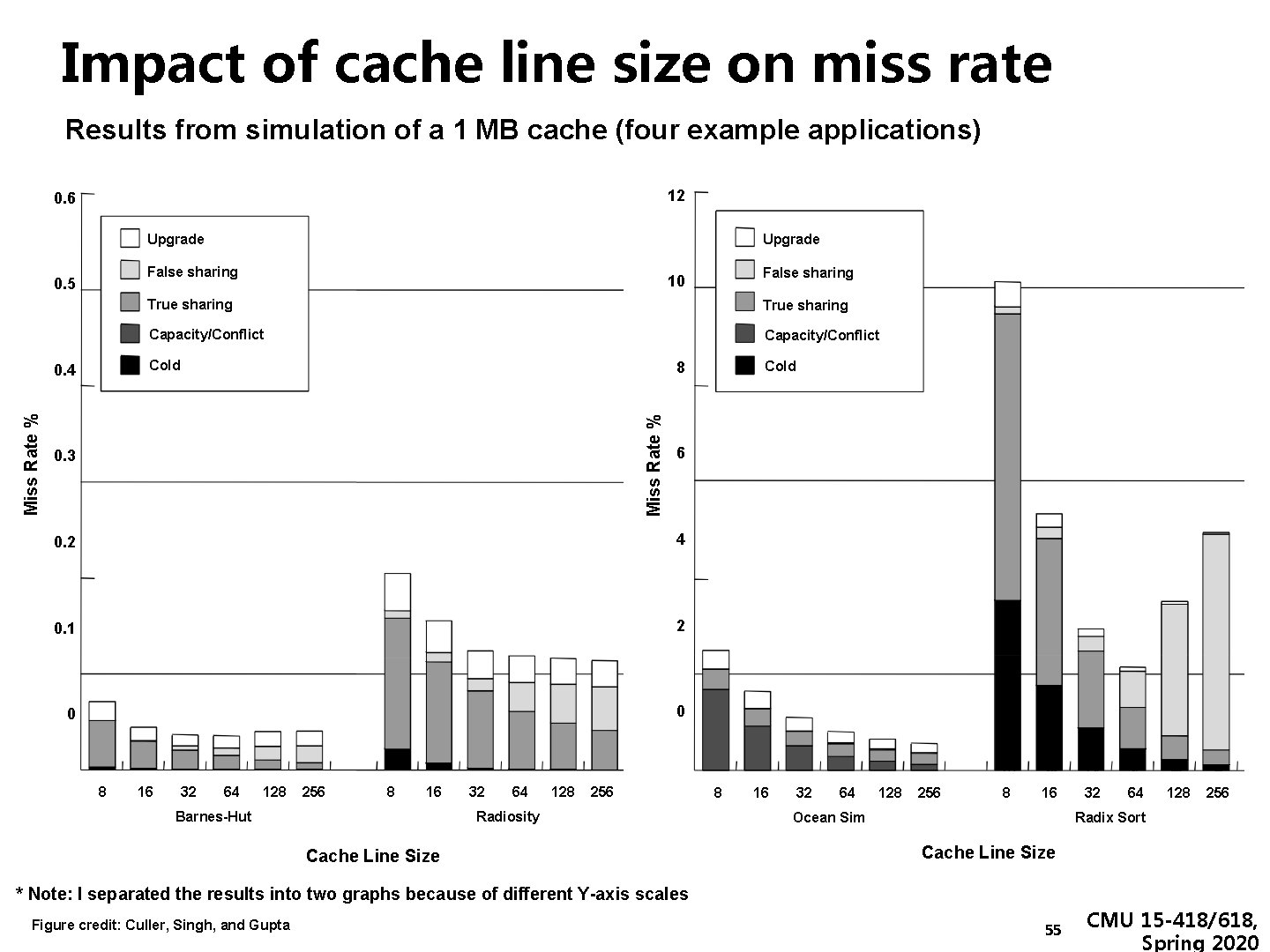
Impact of cache line size on miss rate Results from simulation of a 1 MB cache (four example applications) 12 0. 6 Upgrade False sharing 0. 5 True sharing Capacity/Conflict Miss Rate % 6 0. 2 4 0. 1 2 0 0 16 Cold 8 0. 3 8 False sharing 10 Cold 0. 4 Miss Rate % Upgrade 32 64 128 256 8 16 Barnes-Hut 32 64 128 256 Radiosity Cache Line Size 8 16 32 64 128 256 8 16 Ocean Sim 32 64 128 256 Radix Sort Cache Line Size * Note: I separated the results into two graphs because of different Y-axis scales Figure credit: Culler, Singh, and Gupta 55 CMU 15 -418/618, Spring 2020
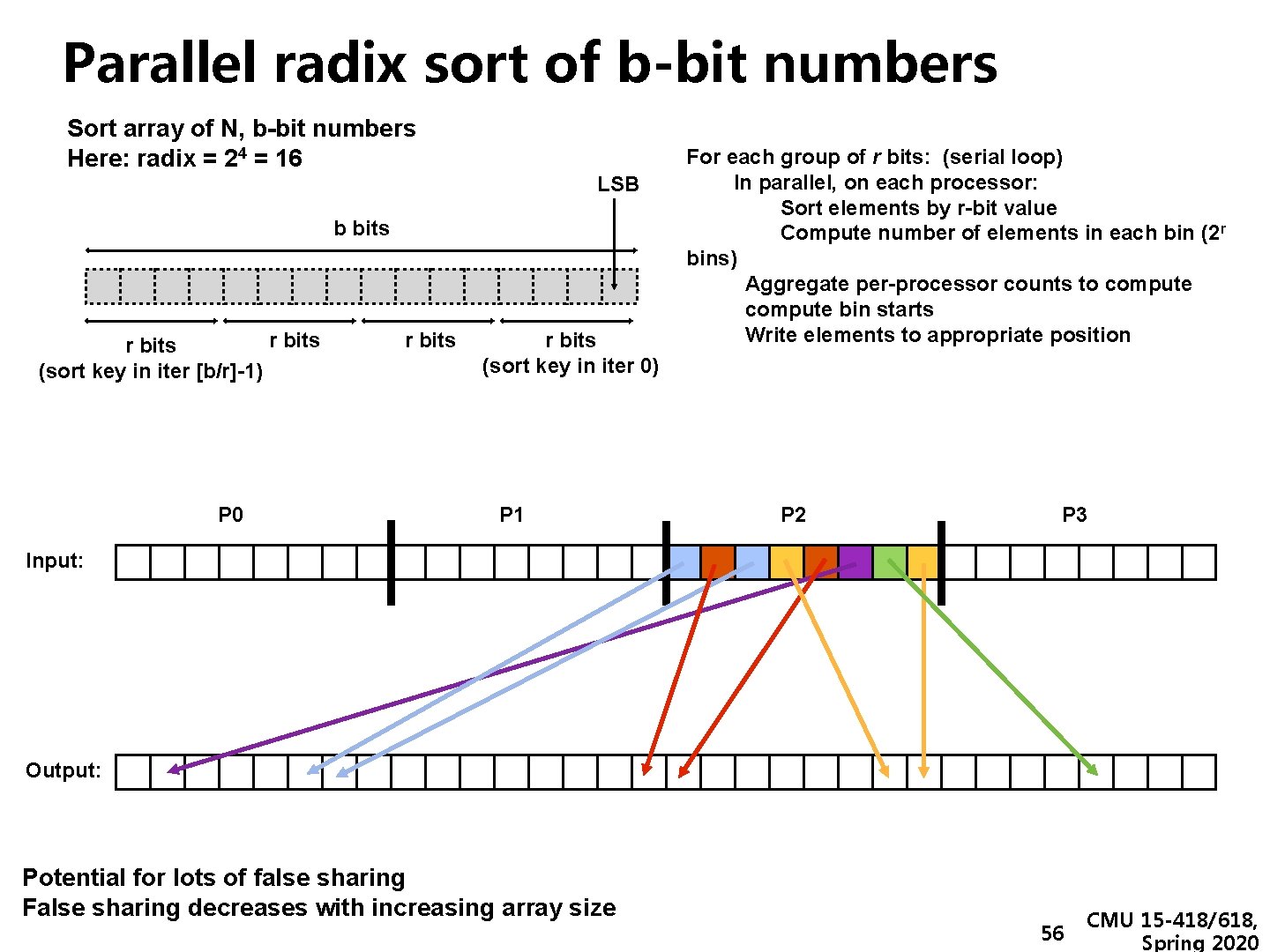
Parallel radix sort of b-bit numbers Sort array of N, b-bit numbers Here: radix = 24 = 16 LSB b bits r bits (sort key in iter [b/r]-1) P 0 r bits (sort key in iter 0) P 1 For each group of r bits: (serial loop) In parallel, on each processor: Sort elements by r-bit value Compute number of elements in each bin (2 r bins) Aggregate per-processor counts to compute bin starts Write elements to appropriate position P 2 P 3 Input: Output: Potential for lots of false sharing False sharing decreases with increasing array size 56 CMU 15 -418/618, Spring 2020
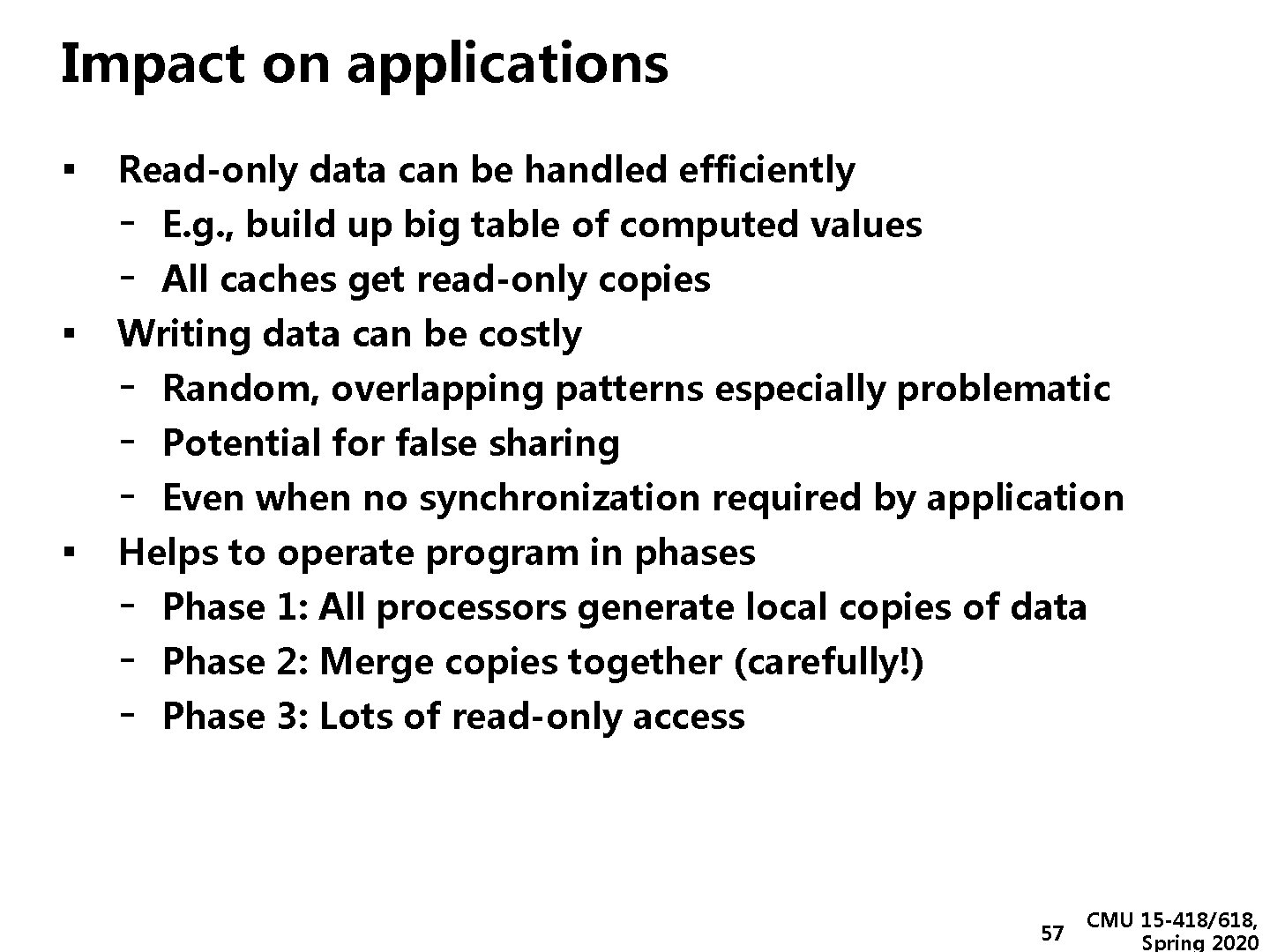
Impact on applications ▪ Read-only data can be handled efficiently - E. g. , build up big table of computed values All caches get read-only copies ▪ Writing data can be costly - Random, overlapping patterns especially problematic Potential for false sharing Even when no synchronization required by application ▪ Helps to operate program in phases - Phase 1: All processors generate local copies of data Phase 2: Merge copies together (carefully!) Phase 3: Lots of read-only access 57 CMU 15 -418/618, Spring 2020
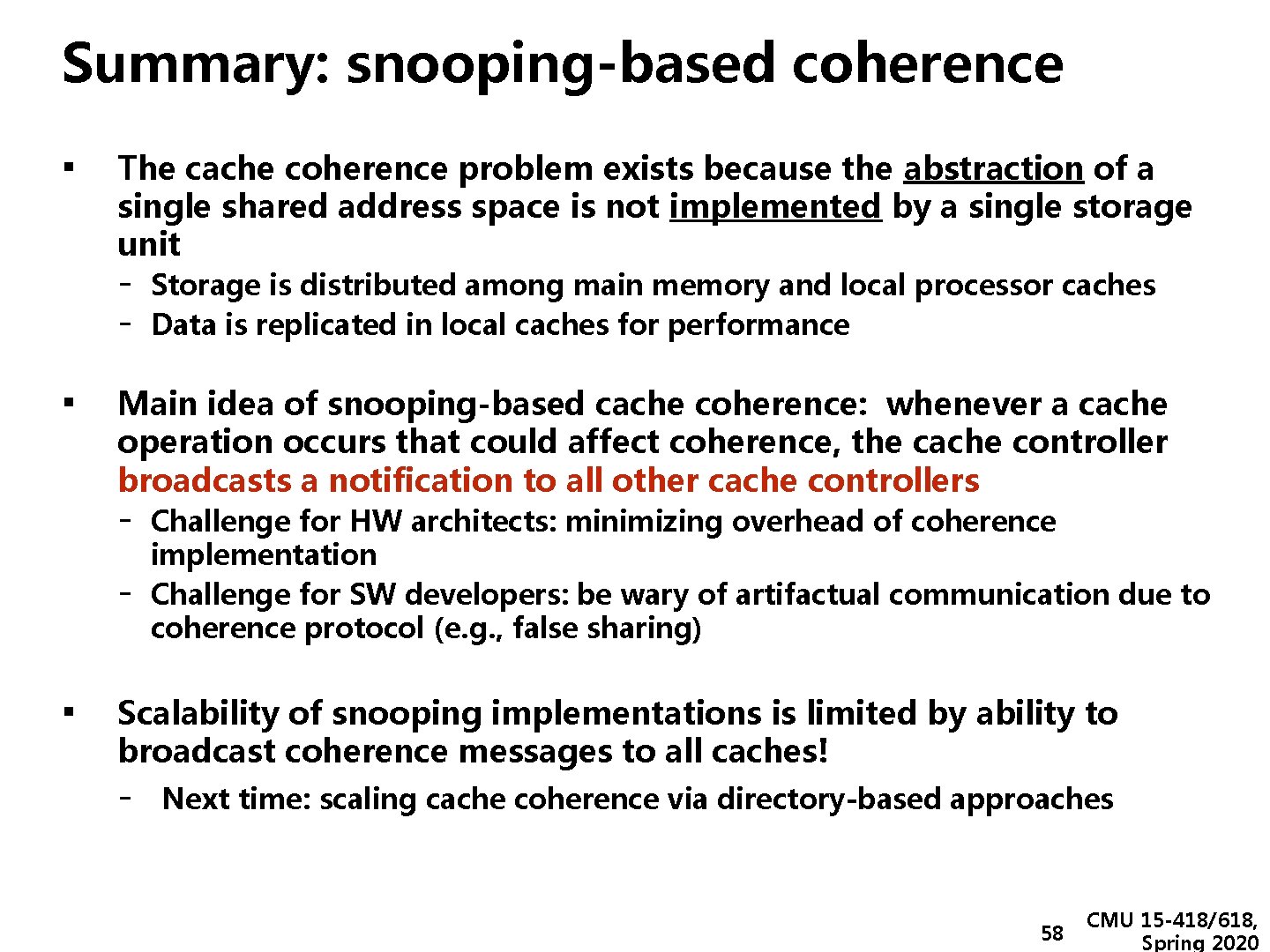
Summary: snooping-based coherence ▪ The cache coherence problem exists because the abstraction of a single shared address space is not implemented by a single storage unit - ▪ Main idea of snooping-based cache coherence: whenever a cache operation occurs that could affect coherence, the cache controller broadcasts a notification to all other cache controllers - ▪ Storage is distributed among main memory and local processor caches Data is replicated in local caches for performance Challenge for HW architects: minimizing overhead of coherence implementation Challenge for SW developers: be wary of artifactual communication due to coherence protocol (e. g. , false sharing) Scalability of snooping implementations is limited by ability to broadcast coherence messages to all caches! - Next time: scaling cache coherence via directory-based approaches 58 CMU 15 -418/618, Spring 2020
- Slides: 52