
Lecture 10 Power Supply Filters and Capacitor Filter
- Slides: 8
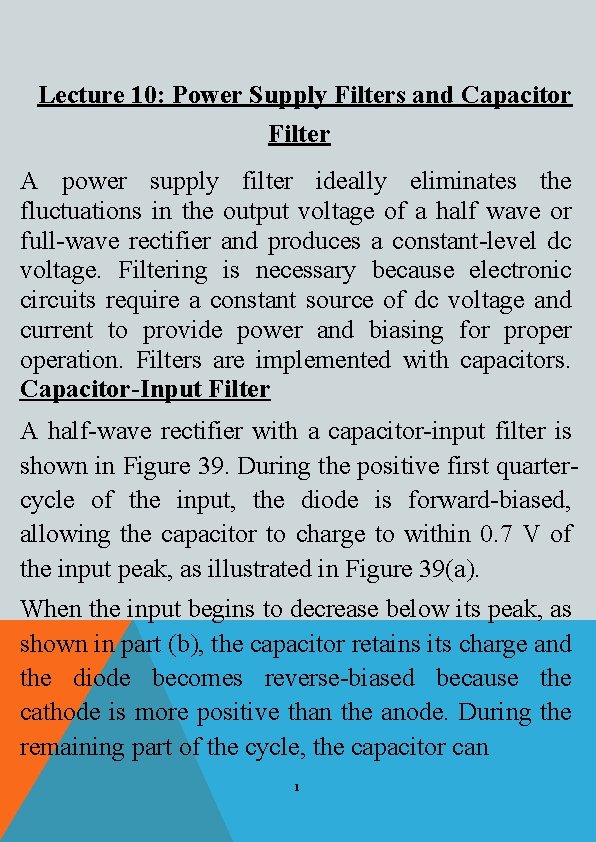
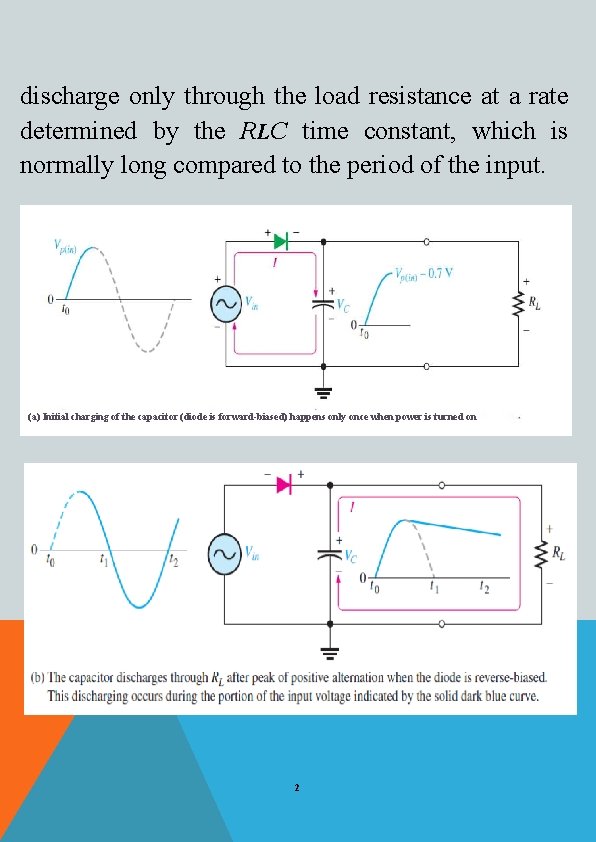
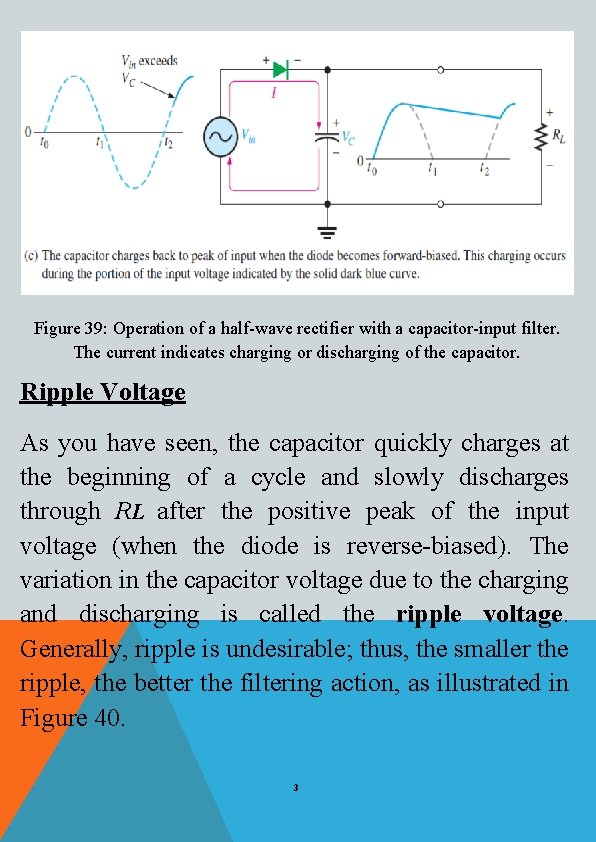
Lecture 10: Power Supply Filters and Capacitor Filter A power supply filter ideally eliminates the fluctuations in the output voltage of a half wave or full-wave rectifier and produces a constant-level dc voltage. Filtering is necessary because electronic circuits require a constant source of dc voltage and current to provide power and biasing for properation. Filters are implemented with capacitors. Capacitor-Input Filter A half-wave rectifier with a capacitor-input filter is shown in Figure 39. During the positive first quartercycle of the input, the diode is forward-biased, allowing the capacitor to charge to within 0. 7 V of the input peak, as illustrated in Figure 39(a). When the input begins to decrease below its peak, as shown in part (b), the capacitor retains its charge and the diode becomes reverse-biased because the cathode is more positive than the anode. During the remaining part of the cycle, the capacitor can 1
discharge only through the load resistance at a rate determined by the RLC time constant, which is normally long compared to the period of the input. (a) Initial charging of the capacitor (diode is forward-biased) happens only once when power is turned on 2
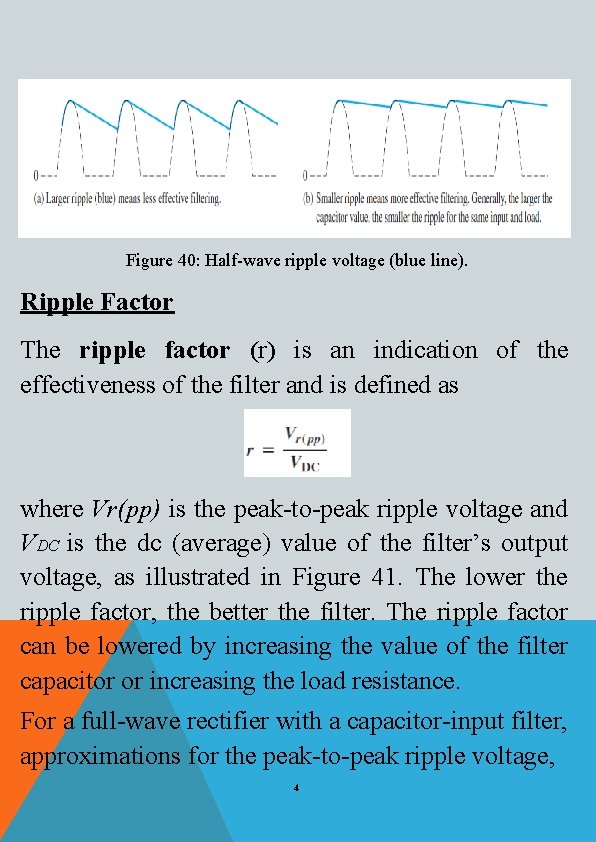
Figure 39: Operation of a half-wave rectifier with a capacitor-input filter. The current indicates charging or discharging of the capacitor. Ripple Voltage As you have seen, the capacitor quickly charges at the beginning of a cycle and slowly discharges through RL after the positive peak of the input voltage (when the diode is reverse-biased). The variation in the capacitor voltage due to the charging and discharging is called the ripple voltage. Generally, ripple is undesirable; thus, the smaller the ripple, the better the filtering action, as illustrated in Figure 40. 3
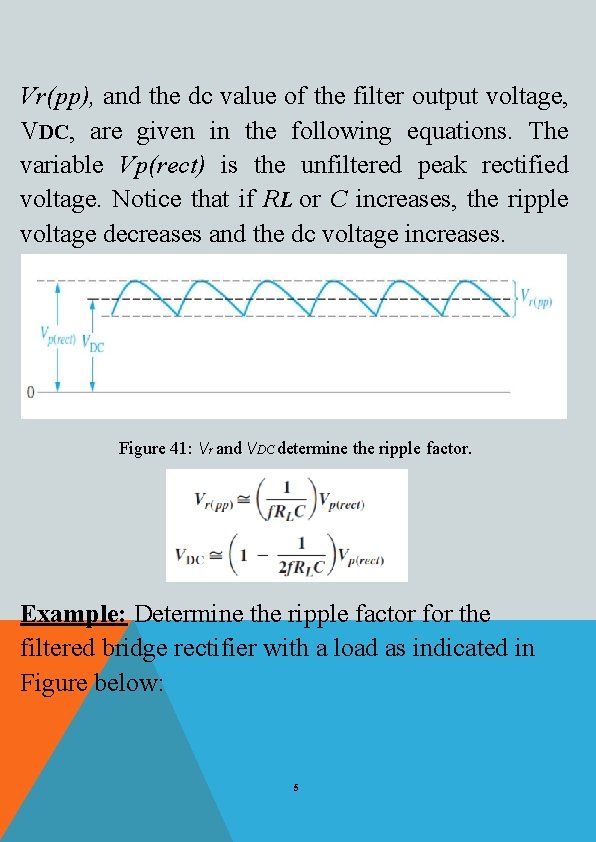
Figure 40: Half-wave ripple voltage (blue line). Ripple Factor The ripple factor (r) is an indication of the effectiveness of the filter and is defined as where Vr(pp) is the peak-to-peak ripple voltage and VDC is the dc (average) value of the filter’s output voltage, as illustrated in Figure 41. The lower the ripple factor, the better the filter. The ripple factor can be lowered by increasing the value of the filter capacitor or increasing the load resistance. For a full-wave rectifier with a capacitor-input filter, approximations for the peak-to-peak ripple voltage, 4
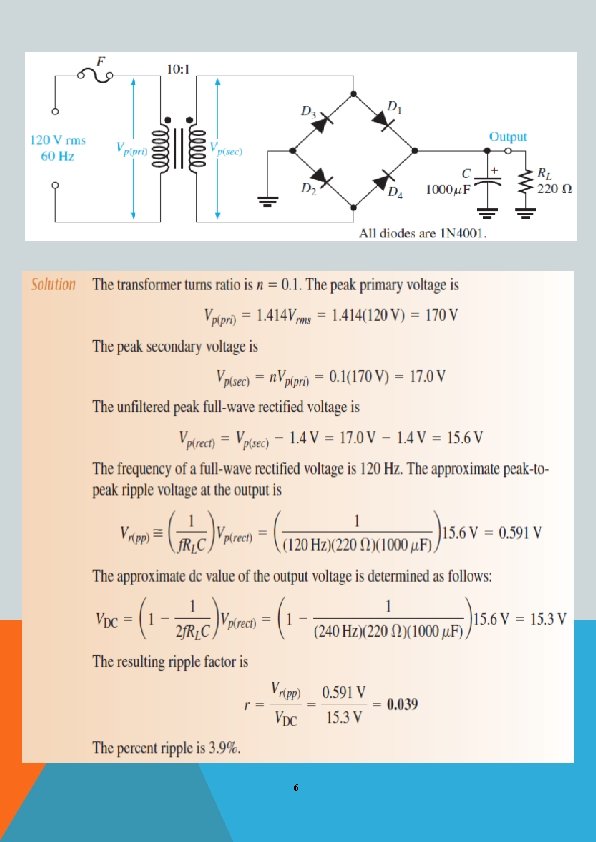
Vr(pp), and the dc value of the filter output voltage, VDC, are given in the following equations. The variable Vp(rect) is the unfiltered peak rectified voltage. Notice that if RL or C increases, the ripple voltage decreases and the dc voltage increases. Figure 41: Vr and VDC determine the ripple factor. Example: Determine the ripple factor for the filtered bridge rectifier with a load as indicated in Figure below: 5
6
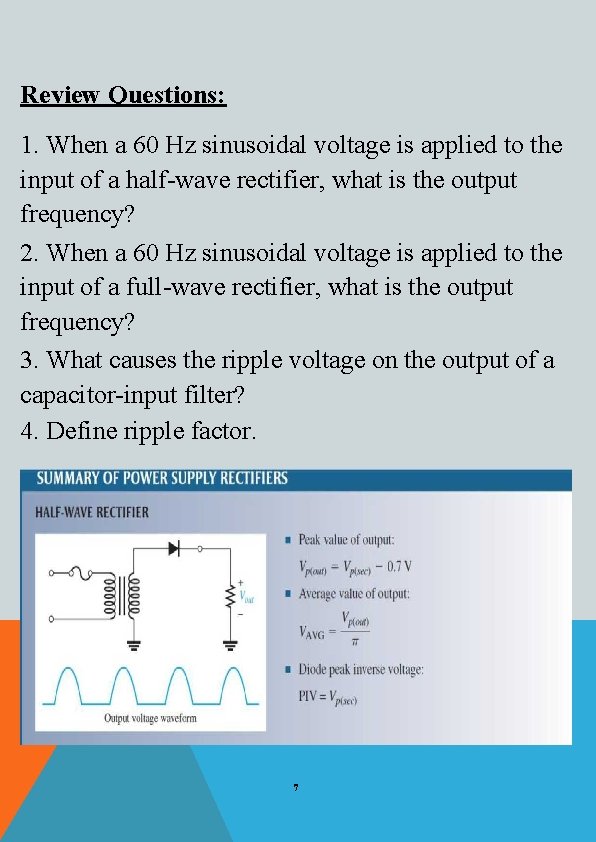
Review Questions: 1. When a 60 Hz sinusoidal voltage is applied to the input of a half-wave rectifier, what is the output frequency? 2. When a 60 Hz sinusoidal voltage is applied to the input of a full-wave rectifier, what is the output frequency? 3. What causes the ripple voltage on the output of a capacitor-input filter? 4. Define ripple factor. 7
8