
Lecture 10 Nucleosynthesis During Helium Burning and the
Lecture 10 Nucleosynthesis During Helium Burning and the s-Process
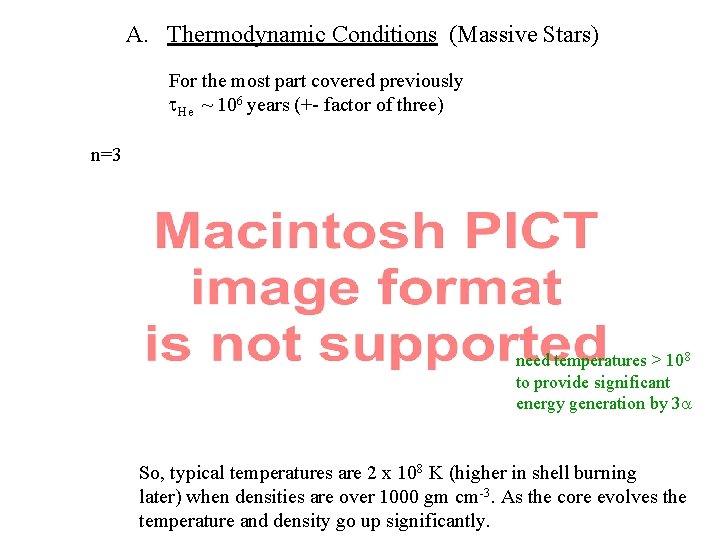
A. Thermodynamic Conditions (Massive Stars) For the most part covered previously He ~ 106 years (+- factor of three) n=3 need temperatures > 108 to provide significant energy generation by 3 So, typical temperatures are 2 x 10⁸ K (higher in shell burning later) when densities are over 1000 gm cm-3. As the core evolves the temperature and density go up significantly.
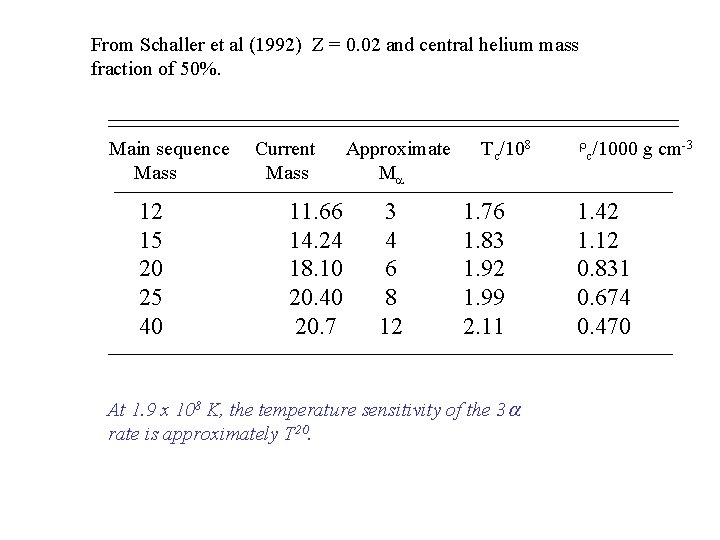
From Schaller et al (1992) Z = 0. 02 and central helium mass fraction of 50%. Main sequence Mass 12 15 20 25 40 Current Mass 11. 66 14. 24 18. 10 20. 40 20. 7 Approximate M 3 4 6 8 12 Tc/108 1. 76 1. 83 1. 92 1. 99 2. 11 At 1. 9 x 10⁸ K, the temperature sensitivity of the 3 rate is approximately T 20. c/1000 1. 42 1. 12 0. 831 0. 674 0. 470 g cm-3
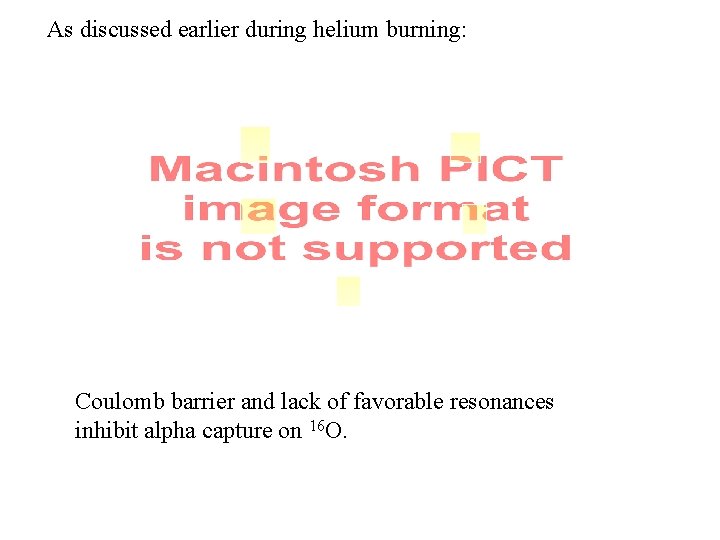
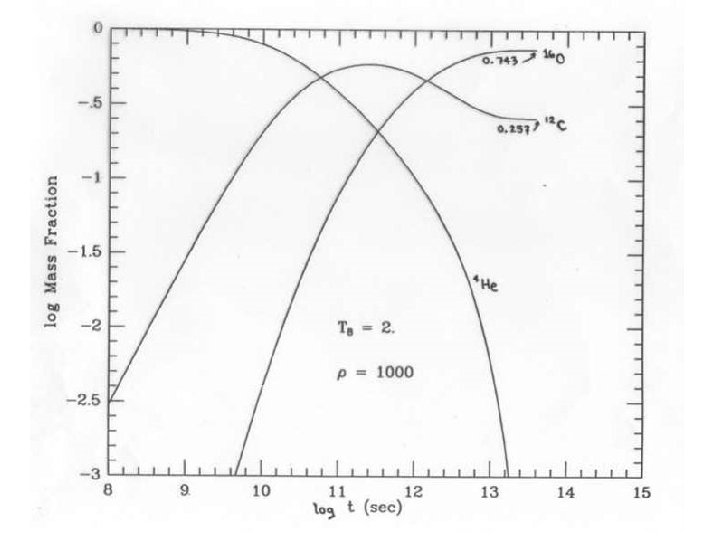
As discussed earlier during helium burning: Coulomb barrier and lack of favorable resonances inhibit alpha capture on 16 O.

Several general features: • 12 C production favored by large density; oxygen by lower density • 12 C produced early on, 16 O later • last few alpha particles burned most critical in setting ratio 12 C/16 O • Energy generation larger for smaller 12 C/16 O.
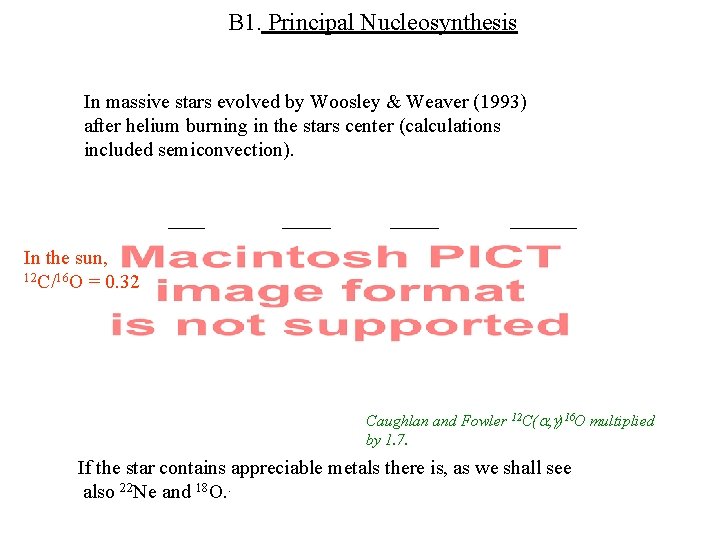
B 1. Principal Nucleosynthesis In massive stars evolved by Woosley & Weaver (1993) after helium burning in the stars center (calculations included semiconvection). In the sun, 12 C/16 O = 0. 32 Caughlan and Fowler 12 C( , g)16 O multiplied by 1. 7. If the star contains appreciable metals there is, as we shall see also 22 Ne and 18 O. .
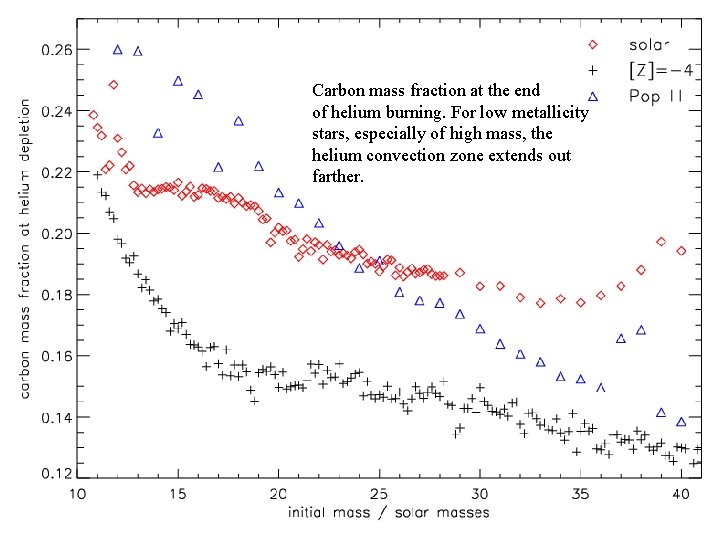
Carbon mass fraction at the end of helium burning. For low metallicity stars, especially of high mass, the helium convection zone extends out farther.
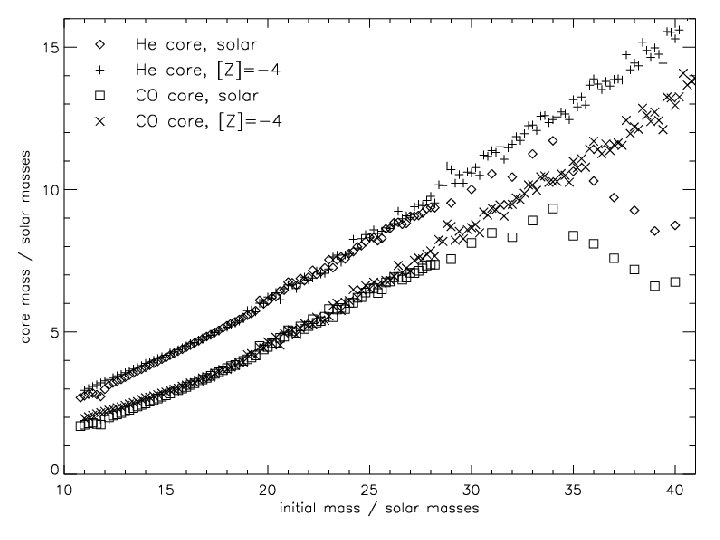
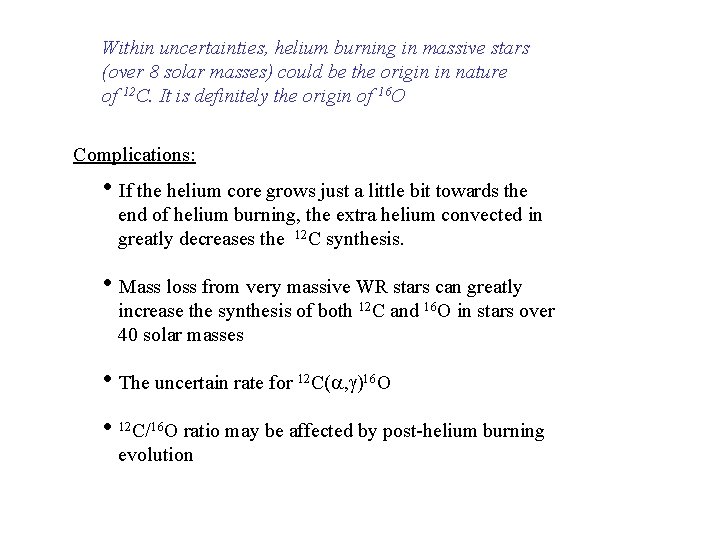
Within uncertainties, helium burning in massive stars (over 8 solar masses) could be the origin in nature of 12 C. It is definitely the origin of 16 O Complications: • If the helium core grows just a little bit towards the end of helium burning, the extra helium convected in greatly decreases the 12 C synthesis. • Mass loss from very massive WR stars can greatly increase the synthesis of both 12 C and 16 O in stars over 40 solar masses • The uncertain rate for 12 C( )16 O • 12 C/16 O ratio may be affected by post-helium burning evolution


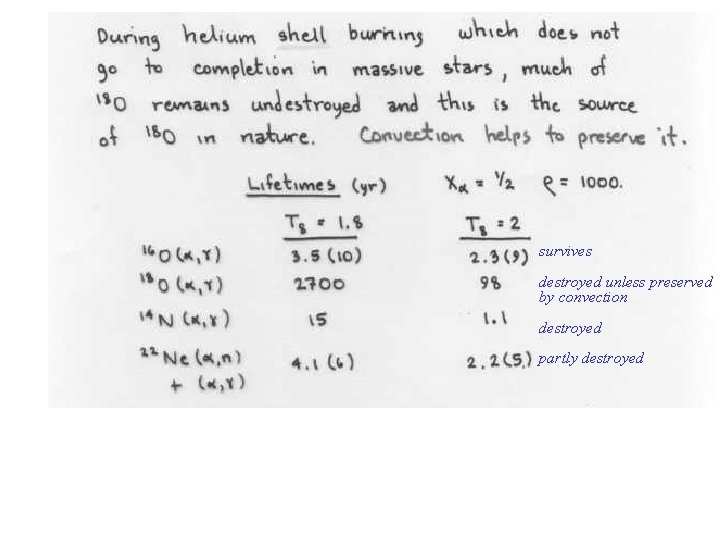
survives destroyed unless preserved by convection destroyed partly destroyed
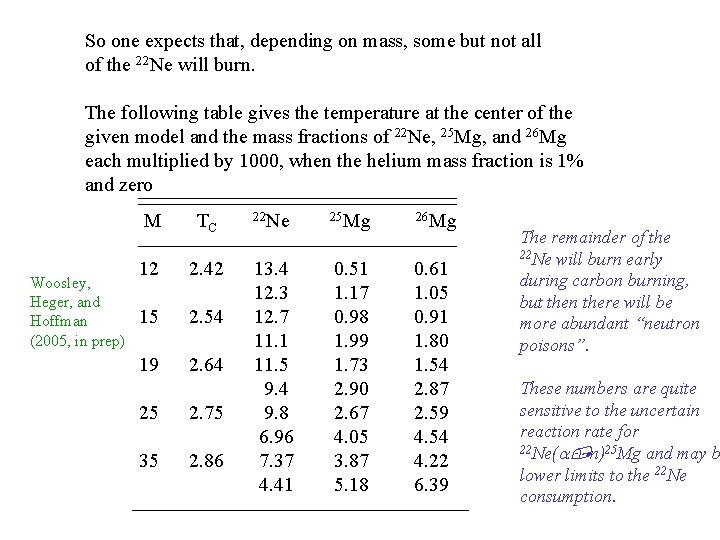
So one expects that, depending on mass, some but not all of the 22 Ne will burn. The following table gives the temperature at the center of the given model and the mass fractions of 22 Ne, 25 Mg, and 26 Mg each multiplied by 1000, when the helium mass fraction is 1% and zero Woosley, Heger, and Hoffman (2005, in prep) M TC 22 Ne 25 Mg 12 2. 42 15 2. 54 19 2. 64 13. 4 12. 3 12. 7 11. 1 11. 5 9. 4 9. 8 6. 96 7. 37 4. 41 0. 51 1. 17 0. 98 1. 99 1. 73 2. 90 2. 67 4. 05 3. 87 5. 18 25 2. 75 35 2. 86 26 Mg 0. 61 1. 05 0. 91 1. 80 1. 54 2. 87 2. 59 4. 54 4. 22 6. 39 The remainder of the 22 Ne will burn early during carbon burning, but then there will be more abundant “neutron poisons”. These numbers are quite sensitive to the uncertain reaction rate for 22 Ne( , n)25 Mg and may b lower limits to the 22 Ne consumption.
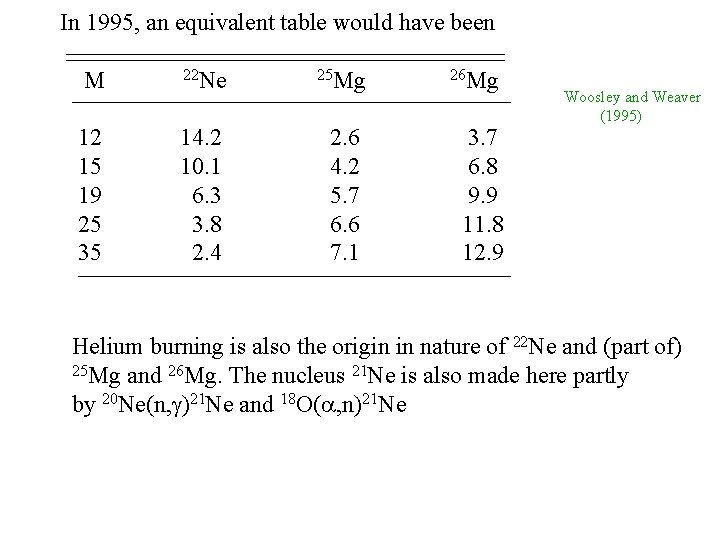
In 1995, an equivalent table would have been M 22 Ne 25 Mg 12 15 19 25 35 14. 2 10. 1 6. 3 3. 8 2. 4 2. 6 4. 2 5. 7 6. 6 7. 1 26 Mg 3. 7 6. 8 9. 9 11. 8 12. 9 Woosley and Weaver (1995) Helium burning is also the origin in nature of 22 Ne and (part of) 25 Mg and 26 Mg. The nucleus 21 Ne is also made here partly by 20 Ne(n, )21 Ne and 18 O( , n)21 Ne
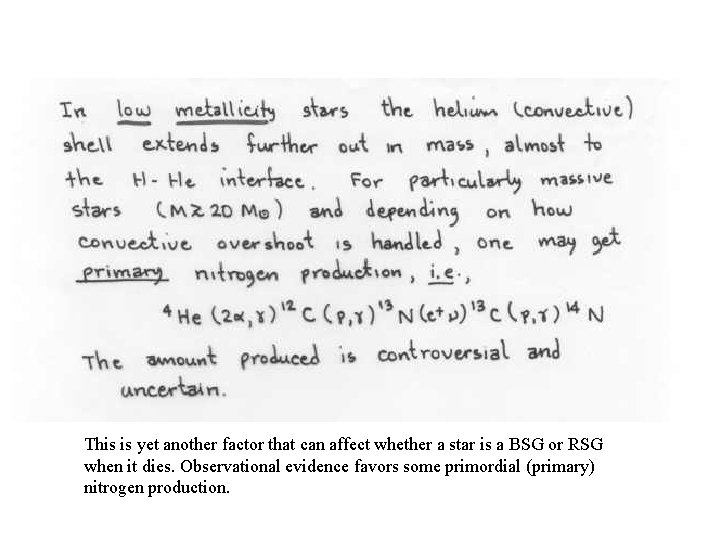
This is yet another factor that can affect whether a star is a BSG or RSG when it dies. Observational evidence favors some primordial (primary) nitrogen production.
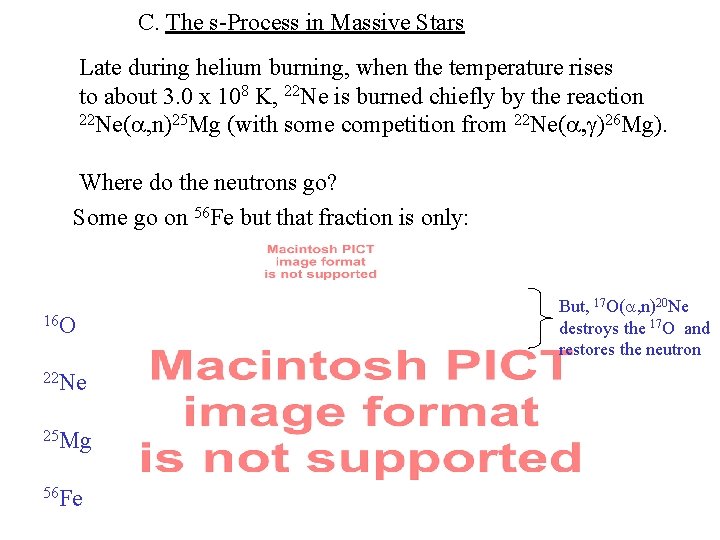
C. The s-Process in Massive Stars Late during helium burning, when the temperature rises to about 3. 0 x 108 K, 22 Ne is burned chiefly by the reaction 22 Ne( , n)25 Mg (with some competition from 22 Ne( )26 Mg). Where do the neutrons go? Some go on 56 Fe but that fraction is only: 16 O 22 Ne 25 Mg 56 Fe But, 17 O( , n)20 Ne destroys the 17 O and restores the neutron
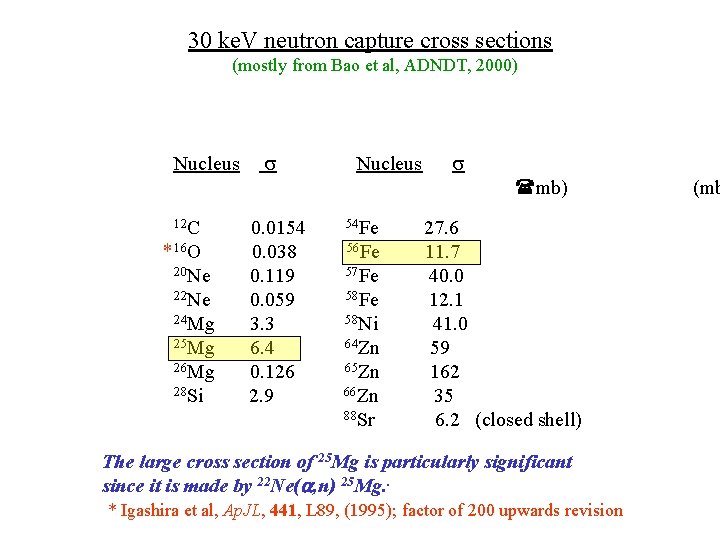
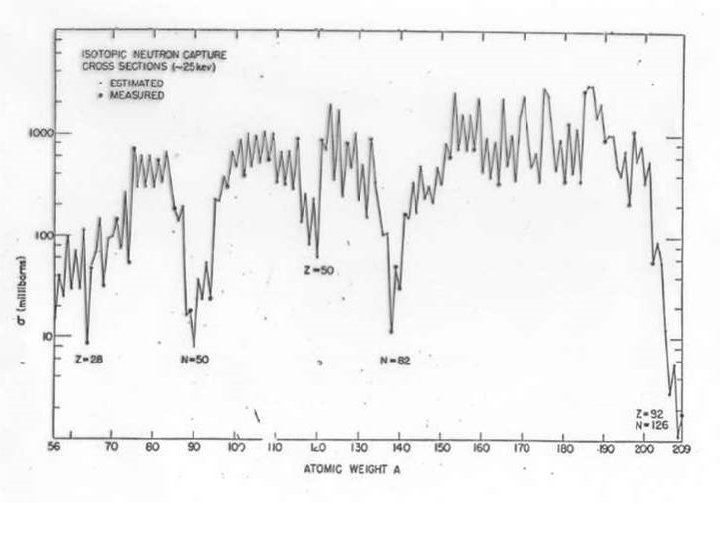
30 ke. V neutron capture cross sections (mostly from Bao et al, ADNDT, 2000) Nucleus (mb) 12 C * 16 O 20 Ne 22 Ne 24 Mg 25 Mg 26 Mg 28 Si 0. 0154 0. 038 0. 119 0. 059 3. 3 6. 4 0. 126 2. 9 54 Fe 56 Fe 57 Fe 58 Ni 64 Zn 65 Zn 66 Zn 88 Sr 27. 6 11. 7 40. 0 12. 1 41. 0 59 162 35 6. 2 (closed shell) The large cross section of 25 Mg is particularly significant since it is made by 22 Ne( , n) 25 Mg. . * Igashira et al, Ap. JL, 441, L 89, (1995); factor of 200 upwards revision (mb

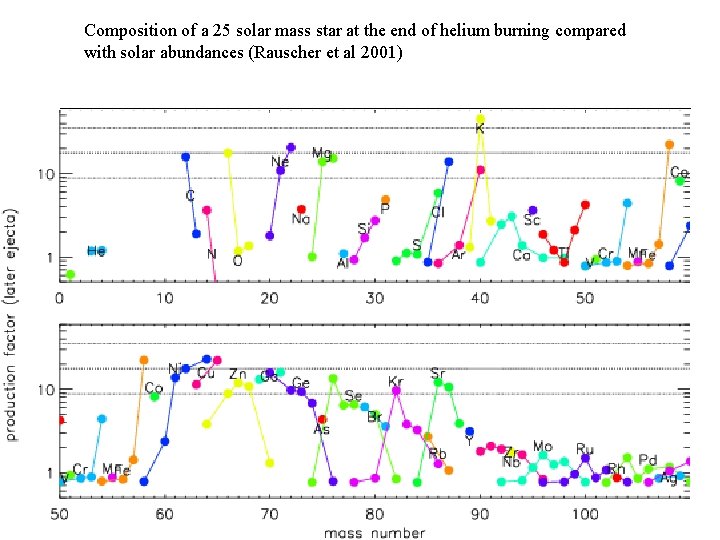
Composition of a 25 solar mass star at the end of helium burning compared with solar abundances (Rauscher et al 2001)
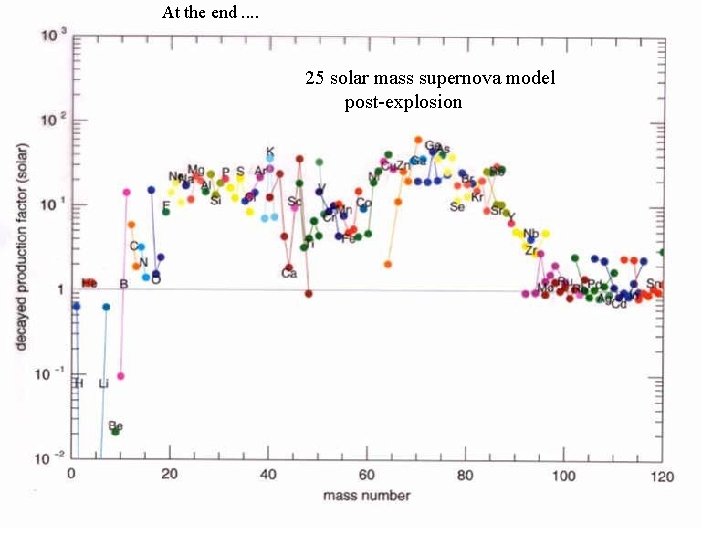
At the end. . 25 solar mass supernova model post-explosion
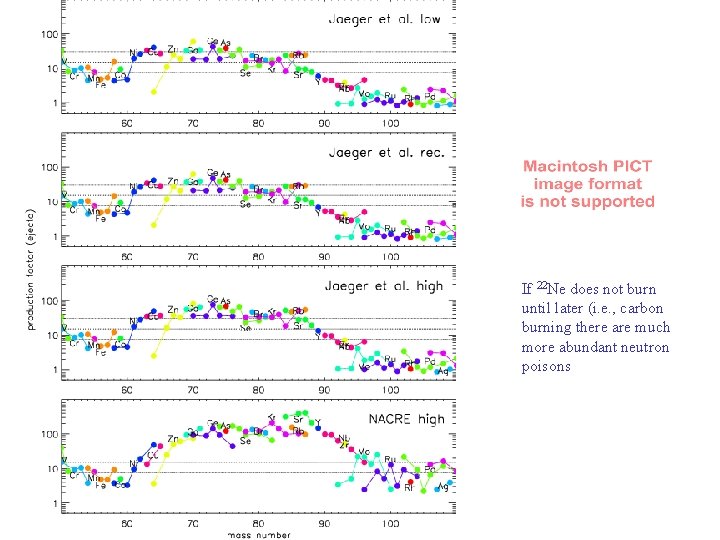
If 22 Ne does not burn until later (i. e. , carbon burning there are much more abundant neutron poisons
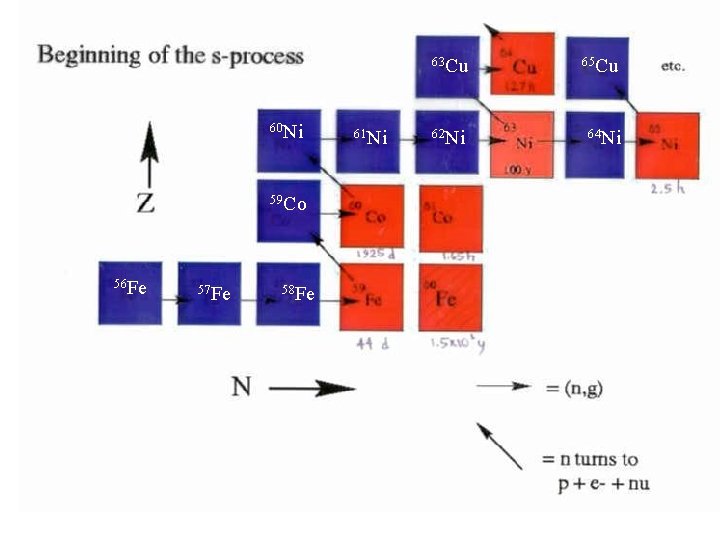
60 Ni 59 Co 56 Fe 57 Fe 58 Fe 61 Ni 63 Cu 65 Cu 62 Ni 64 Ni

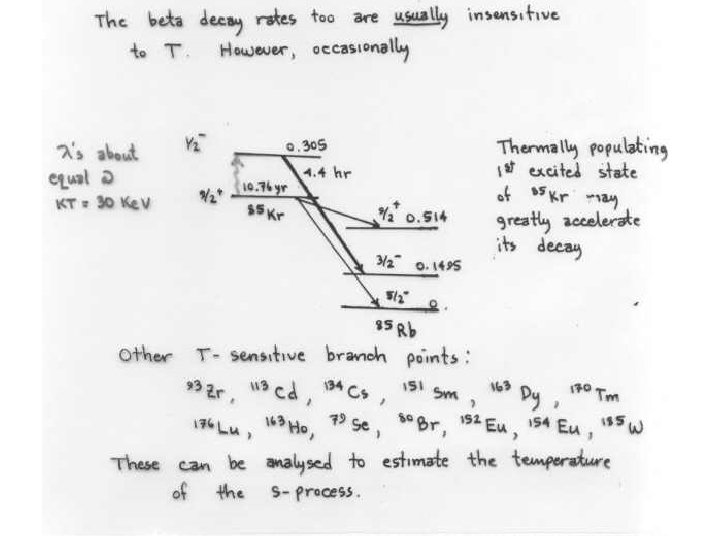
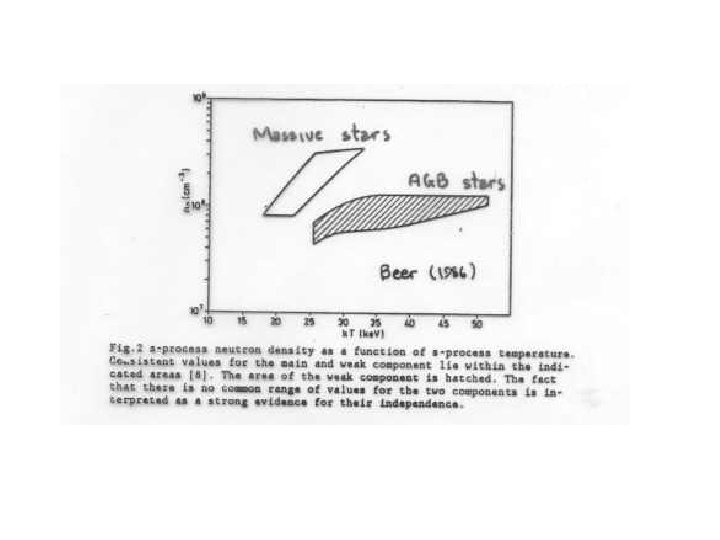
Most of the s-process takes place around T 8 = 2. 5 - 3, so the neutron density is about 109 - 1010 cm-3 (depends on uncertain rate for ( , n) on 22 Ne and on how much 22 Ne has burned).
At these neutron densities the time between capture, even for heavy elements with bigger cross sections than iron, is days. For 56 Fe itself it is a few years
Reaction Rates (n, ): Either measured (Bao et al, ADNDT, 76, 70, 2000) or calculated using Hauser-Feshbach theory (Woosley et al. , ADNDT, 22, 371, (1976) Holmes et al. , ADNDT, 18, 305, (1976); Rauscher et al. ADNDT, 75, 1, (2000)) The calculations are usually good to a factor of two. For heavy nuclei within k. T ~ 30 ke. V of Qng there are very many resonances. Occasionally, for light nuclei or near closed shells, direct capture is important: e. g. , 12 C, 20, 22 Ne, 16 O, 48 Ca
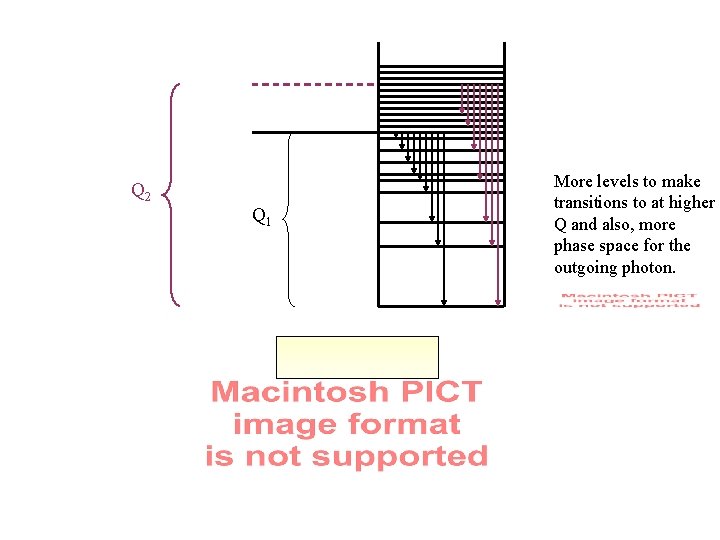
Q 2 Q 1 More levels to make transitions to at higher Q and also, more phase space for the outgoing photon.
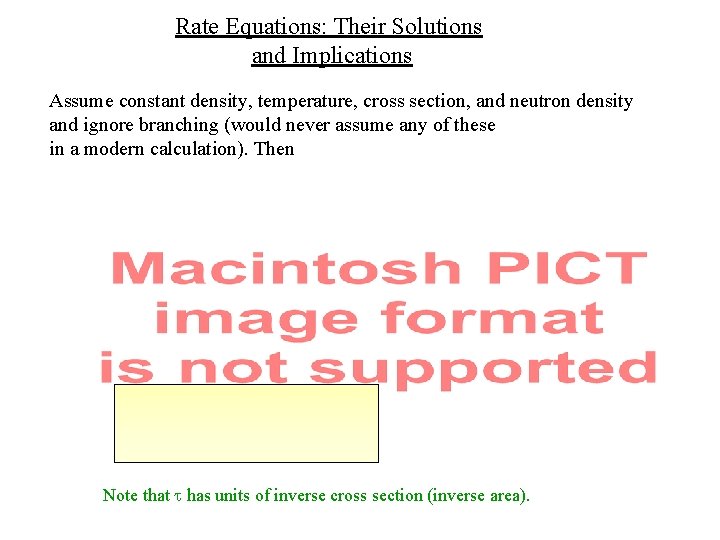
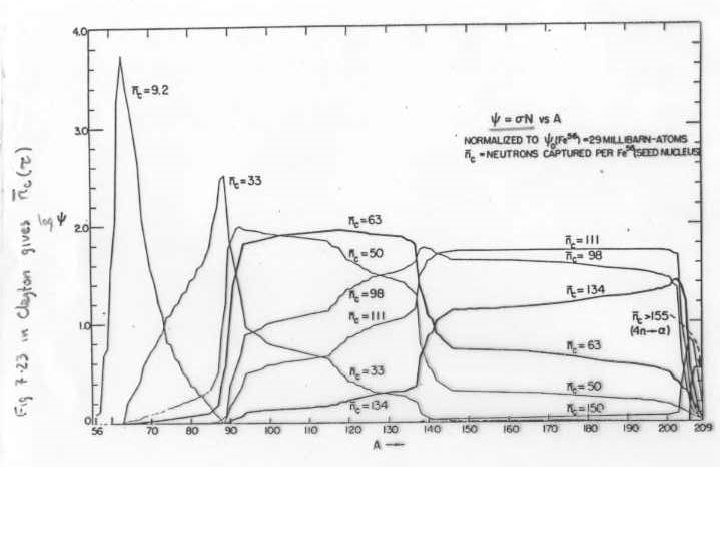
Rate Equations: Their Solutions and Implications Assume constant density, temperature, cross section, and neutron density and ignore branching (would never assume any of these in a modern calculation). Then Note that has units of inverse cross section (inverse area).
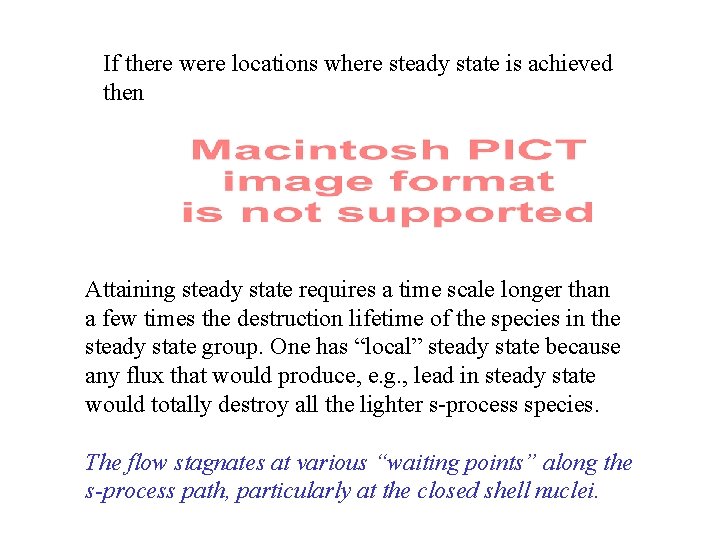
If there were locations where steady state is achieved then Attaining steady state requires a time scale longer than a few times the destruction lifetime of the species in the steady state group. One has “local” steady state because any flux that would produce, e. g. , lead in steady state would totally destroy all the lighter s-process species. The flow stagnates at various “waiting points” along the s-process path, particularly at the closed shell nuclei.
As a results nuclei with large cross sections will be in steady state while those with small ones are not. This is especially so in He shell flashes in AGB stars where the time scale for a flash may be only a few decades.
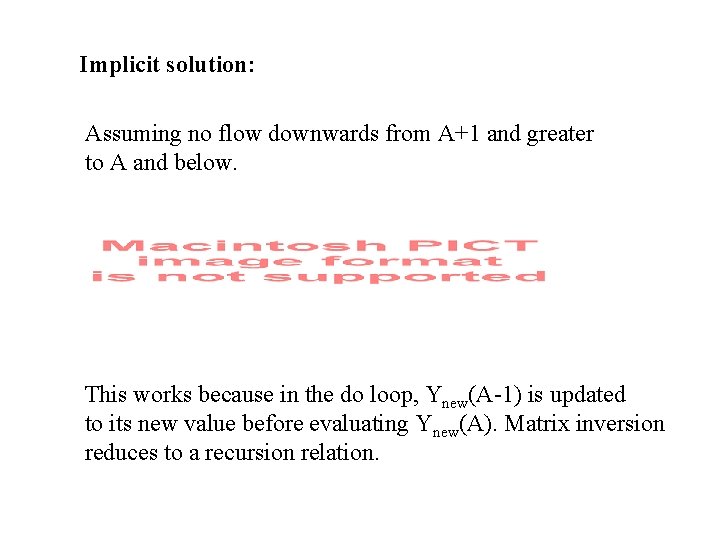
Implicit solution: Assuming no flow downwards from A+1 and greater to A and below. This works because in the do loop, Ynew(A-1) is updated to its new value before evaluating Ynew(A). Matrix inversion reduces to a recursion relation.
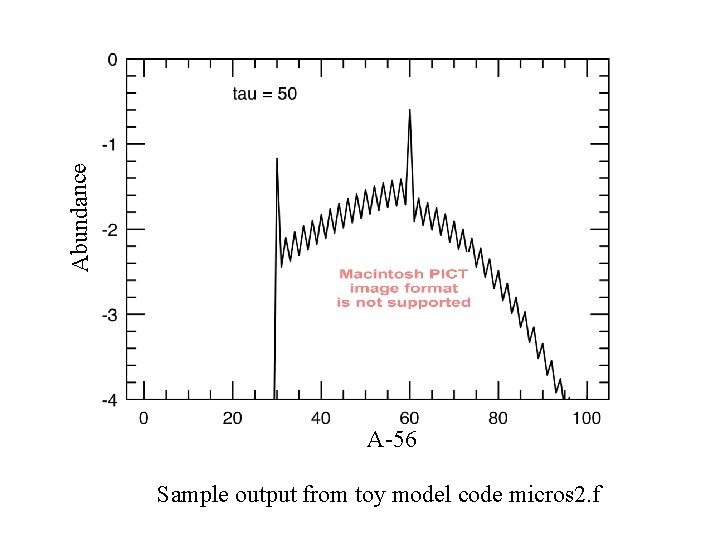
Abundance A-56 Sample output from toy model code micros 2. f
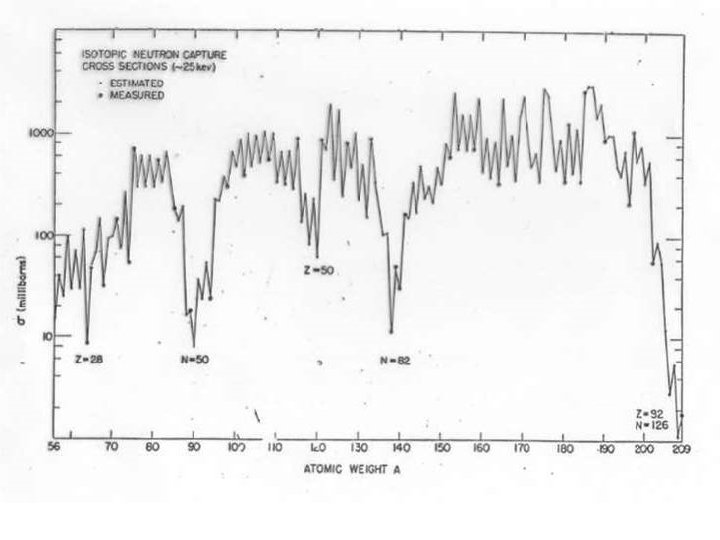
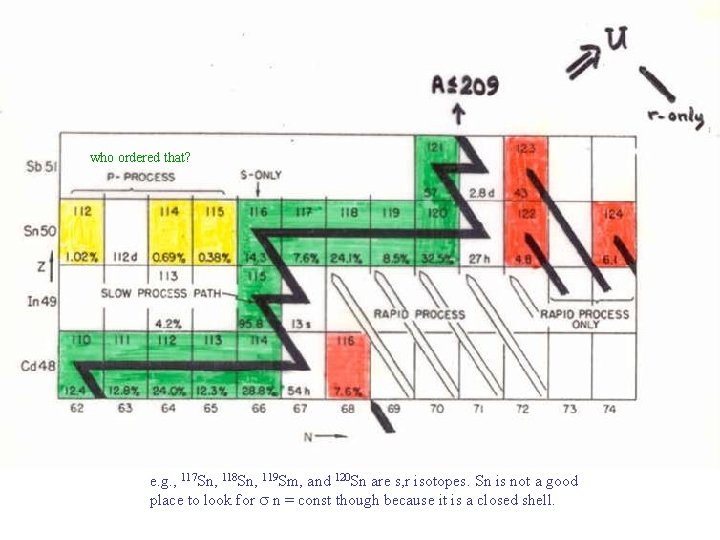
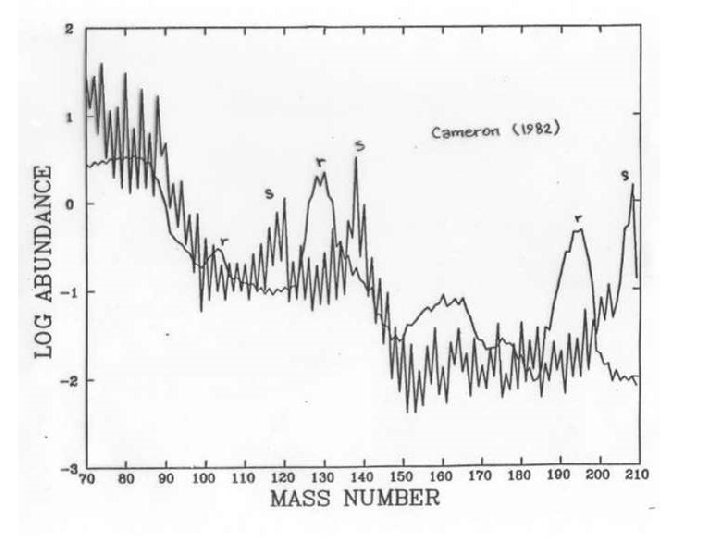
who ordered that? e. g. , 117 Sn, 118 Sn, 119 Sm, and 120 Sn are s, r isotopes. Sn is not a good place to look for n = const though because it is a closed shell.
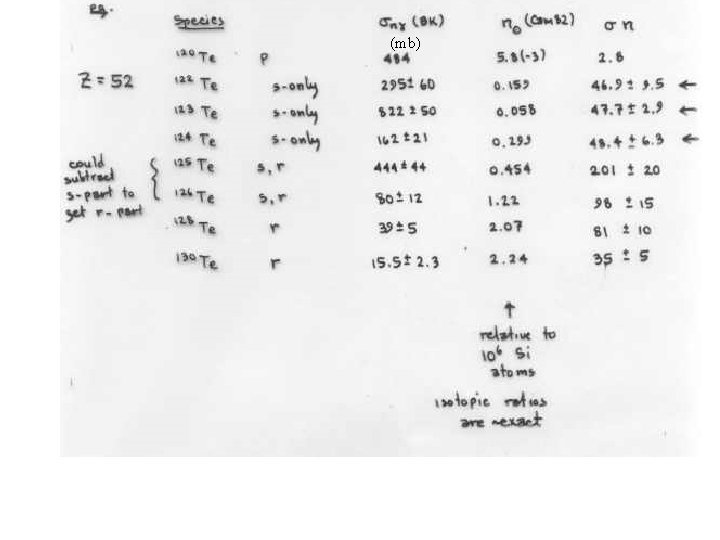
(mb)
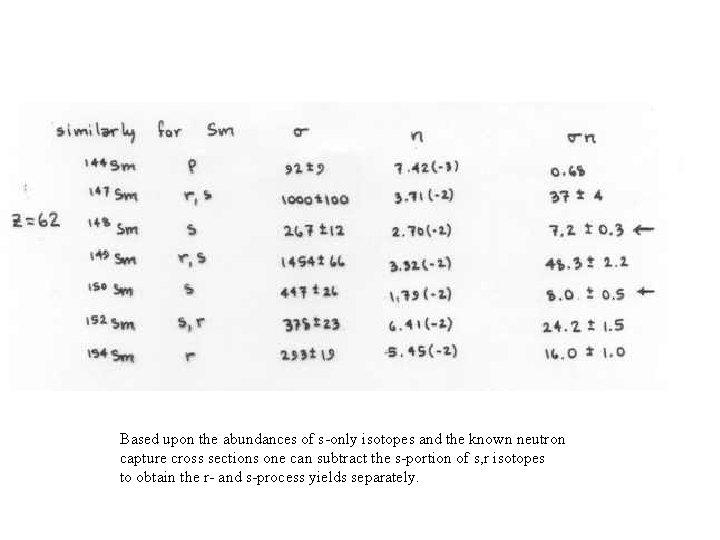
Based upon the abundances of s-only isotopes and the known neutron capture cross sections one can subtract the s-portion of s, r isotopes to obtain the r- and s-process yields separately.
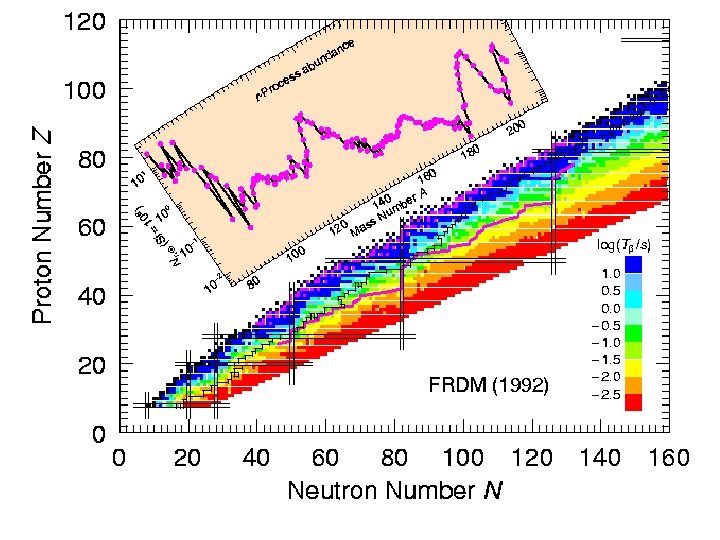
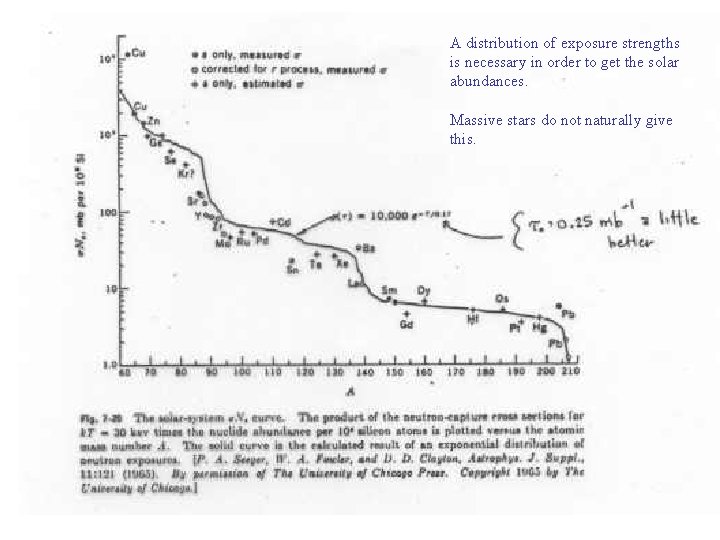
A distribution of exposure strengths is necessary in order to get the solar abundances. Massive stars do not naturally give this.
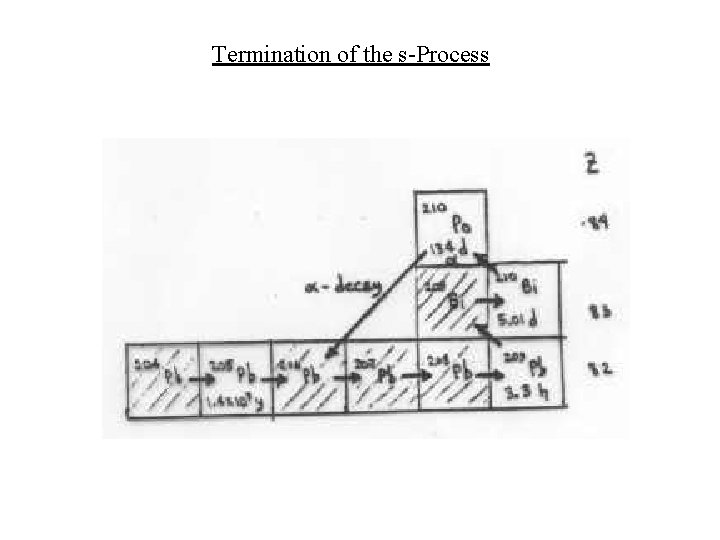
Termination of the s-Process
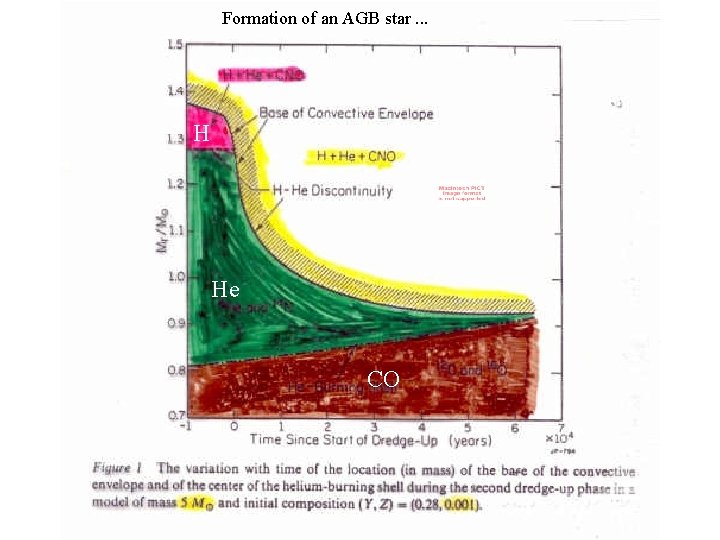
Formation of an AGB star. . . H He CO
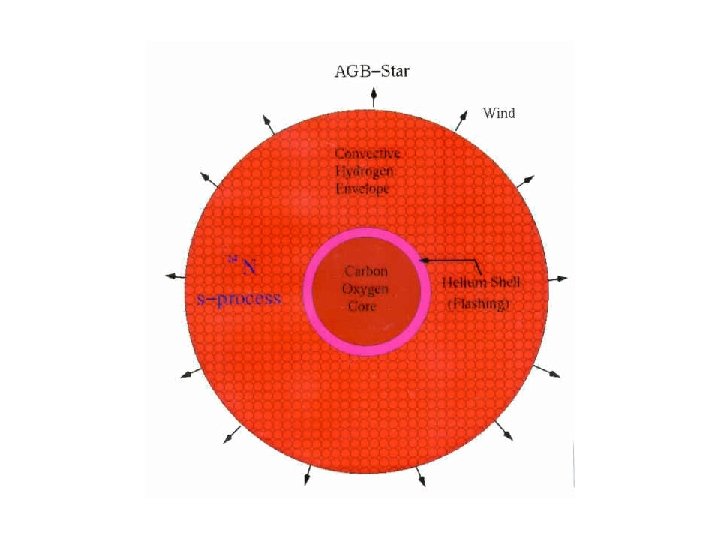
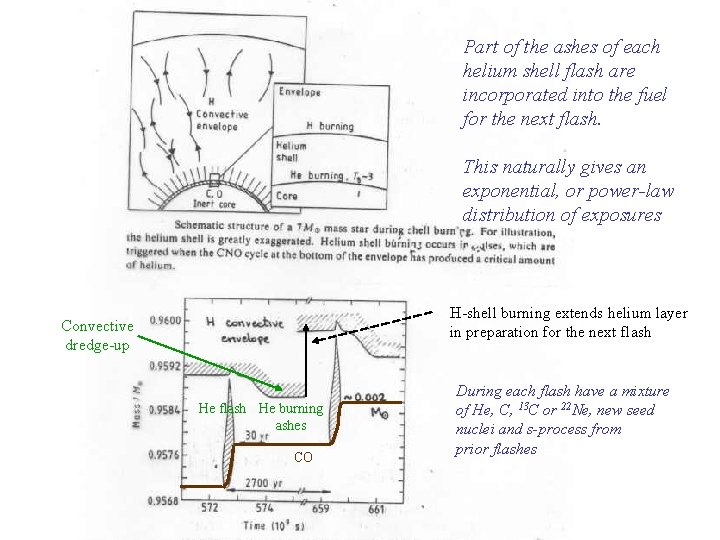
Part of the ashes of each helium shell flash are incorporated into the fuel for the next flash. This naturally gives an exponential, or power-law distribution of exposures H-shell burning extends helium layer in preparation for the next flash Convective dredge-up He flash He burning ashes CO During each flash have a mixture of He, C, 13 C or 22 Ne, new seed nuclei and s-process from prior flashes
Important nuclear physics modification: s-process giants derived from AGB stars in the solar neighborhood do not show the large 26 Mg excesses one would expect if the neutron source were 22 Ne(a, n)25 Mg [as it surely is in massive stars]. Moreover these stars are too low in mass for 22 Ne(a, n)25 Mg to function efficiently. A different way of making neutrons is required. Probably with the protons coming from mixing between the helium burning shell and the hydrogen envelope. Each p mixed in becomes an n. Mc. William and Lambert, MNRAS, 230, 573 (1988) and Malaney and Boothroyd, Ap. J, 320, 866 (1987) Hollowell and Iben, Ap. JL, 333, L 25 (1988); Ap. J, 340, 966, (1989) many more since then
The metallicity history of the s-process can be quite complicated. In the simplest case in massive stars with a 22 Ne neutron source it is independent of metallicity until quite low values of Z. At very low Z things can become complicated because of the effect of neutron poisons, 12 C and 16 O, and primary nitrogen production in massive stars. In AB stars the mixing between H and He shells is Z dependent. Some very metal poor stars are actually very s-process rich.
![Thompson et al, Ap. J, 677, 566, (2008) Carbon enhanced metal poor star ([Fe/H]](http://slidetodoc.com/presentation_image/e460c079b1dfd31584b1103d128e6b83/image-52.jpg "Thompson et al, Ap. J, 677, 566, (2008) Carbon enhanced metal poor star ([Fe/H]")
Thompson et al, Ap. J, 677, 566, (2008) Carbon enhanced metal poor star ([Fe/H] = -2. 62, in binary in halo)
- Slides: 52