
Lecture 10 Introduction to Probability II John Rundle
Lecture 10 Introduction to Probability - II John Rundle Econophysics PHYS 250
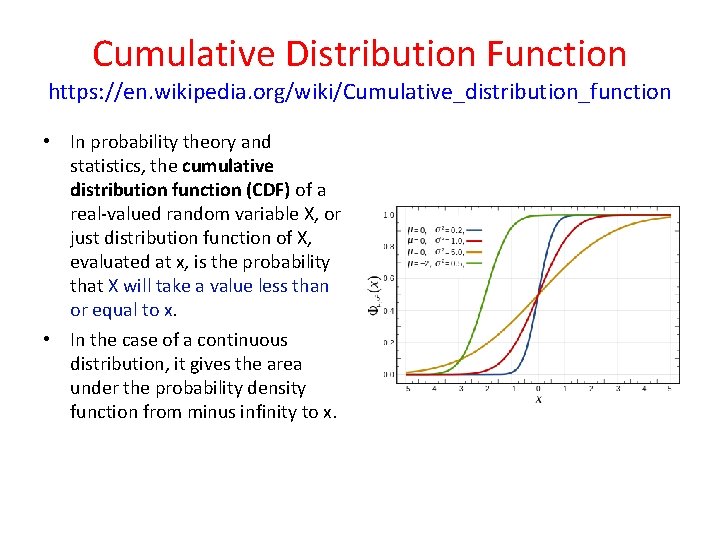
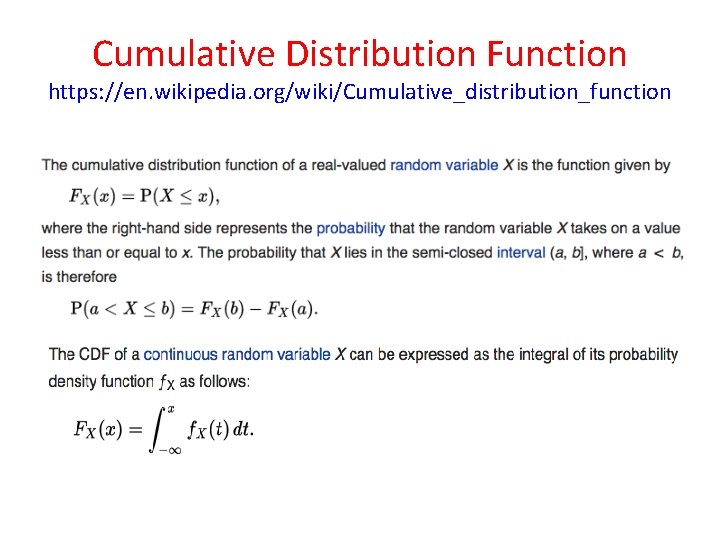
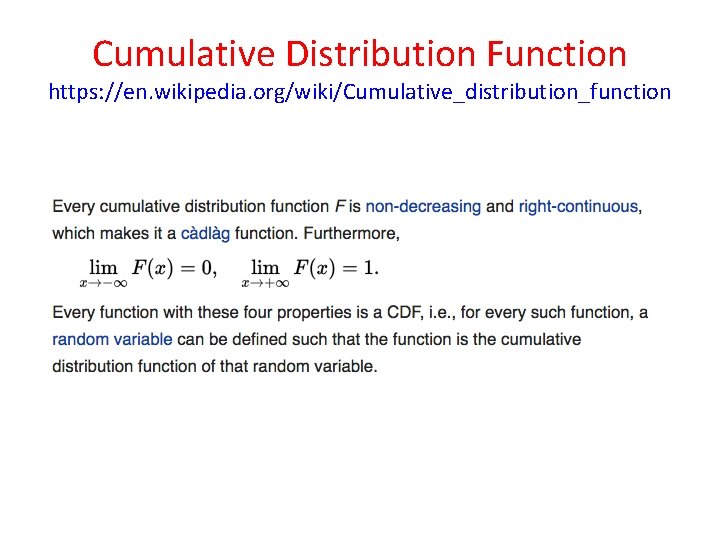
Cumulative Distribution Function https: //en. wikipedia. org/wiki/Cumulative_distribution_function • In probability theory and statistics, the cumulative distribution function (CDF) of a real-valued random variable X, or just distribution function of X, evaluated at x, is the probability that X will take a value less than or equal to x. • In the case of a continuous distribution, it gives the area under the probability density function from minus infinity to x.
Cumulative Distribution Function https: //en. wikipedia. org/wiki/Cumulative_distribution_function
Cumulative Distribution Function https: //en. wikipedia. org/wiki/Cumulative_distribution_function
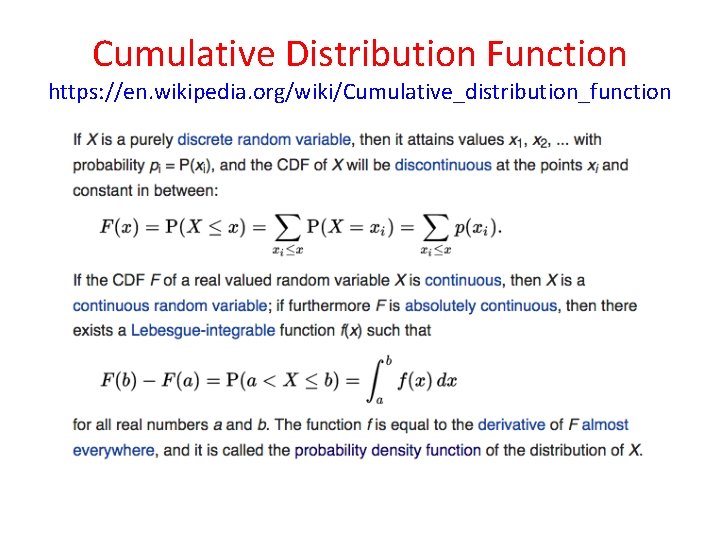
Cumulative Distribution Function https: //en. wikipedia. org/wiki/Cumulative_distribution_function
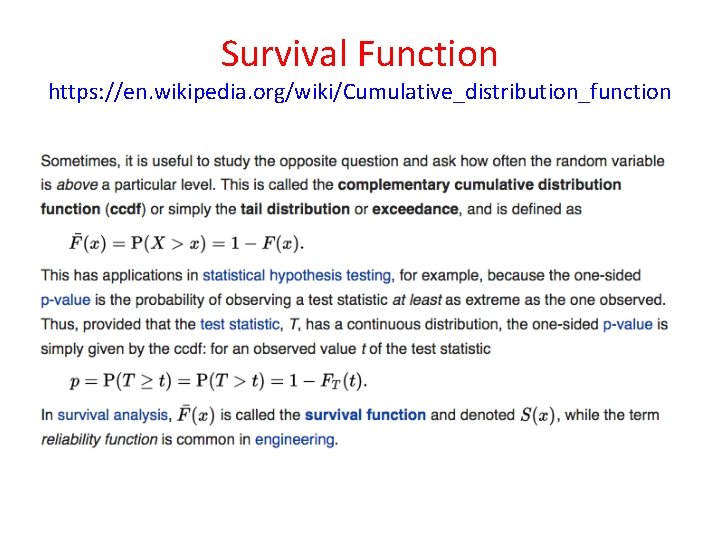
Survival Function https: //en. wikipedia. org/wiki/Cumulative_distribution_function
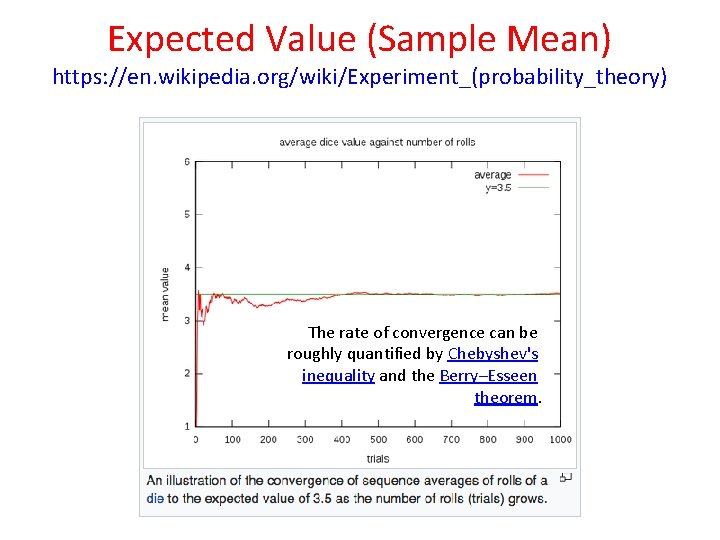
Expected Value (Sample Mean) https: //en. wikipedia. org/wiki/Experiment_(probability_theory) The rate of convergence can be roughly quantified by Chebyshev's inequality and the Berry–Esseen theorem.
Chebyshev’s Inequality https: //en. wikipedia. org/wiki/Chebyshev's_inequality • In probability theory, Chebyshev’s rule guarantees that, for a wide class of probability distributions, "nearly all" values are close to the mean—the precise statement being that no more than 1/k 2 of the distribution's values can be more than k standard deviations away from the mean. • The rule is often called Chebyshev's theorem, about the range of standard deviations around the mean, in statistics. • The inequality has great utility because it can be applied to any probability distribution in which the mean and variance are defined. • For example, it can be used to prove the weak law of large numbers.
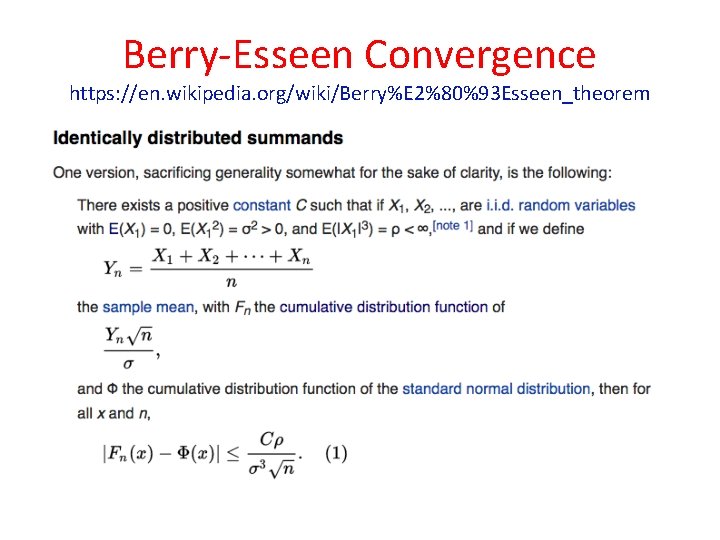
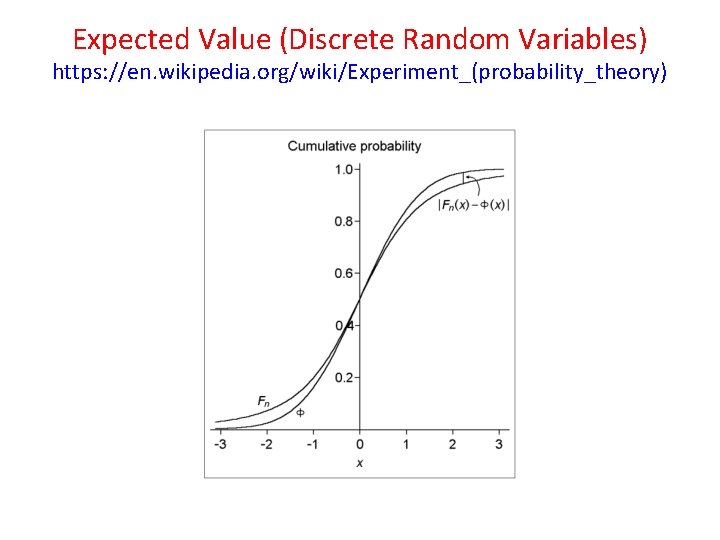
Berry-Esseen Convergence https: //en. wikipedia. org/wiki/Berry%E 2%80%93 Esseen_theore m • In probability theory, the central limit theorem states that, under certain circumstances, the probability distribution of the scaled mean of a random sample converges to a normal distribution as the sample size increases to infinity. • Under stronger assumptions, the Berry–Esseen theorem, or Berry–Esseen inequality, gives a more quantitative result • It also specifies the rate at which this convergence takes place by giving a bound on the maximal error of approximation between the normal distribution and the true distribution of the scaled sample mean.
Berry-Esseen Convergence https: //en. wikipedia. org/wiki/Berry%E 2%80%93 Esseen_theorem
Expected Value (Discrete Random Variables) https: //en. wikipedia. org/wiki/Experiment_(probability_theory)

Variance https: //en. wikipedia. org/wiki/Variance
Variance https: //en. wikipedia. org/wiki/Variance
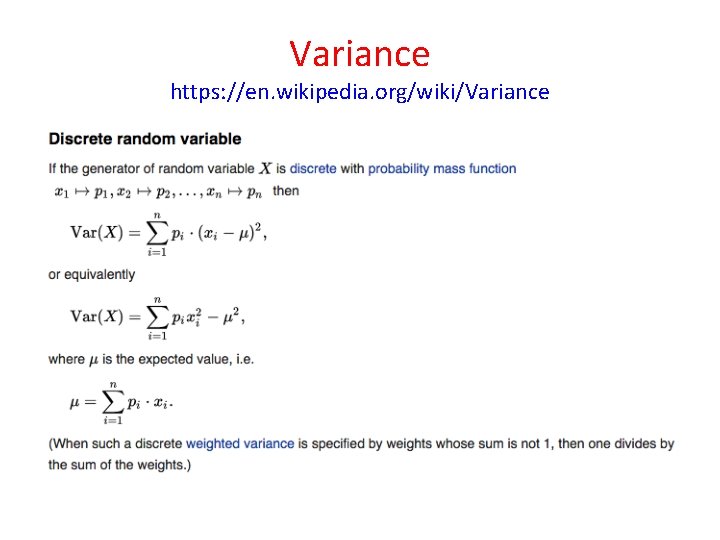
Variance https: //en. wikipedia. org/wiki/Variance
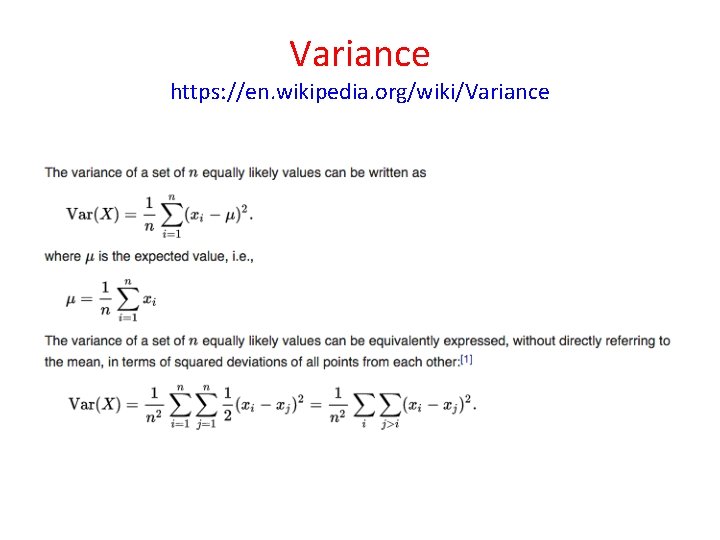
Variance https: //en. wikipedia. org/wiki/Variance
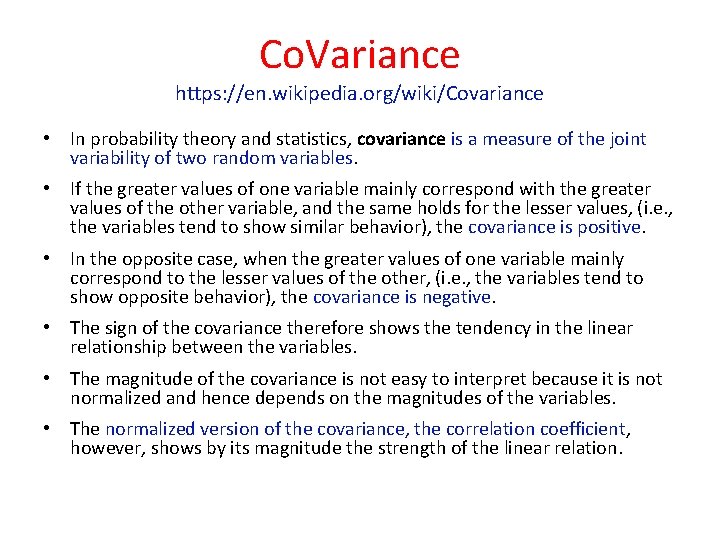
Co. Variance https: //en. wikipedia. org/wiki/Covariance • In probability theory and statistics, covariance is a measure of the joint variability of two random variables. • If the greater values of one variable mainly correspond with the greater values of the other variable, and the same holds for the lesser values, (i. e. , the variables tend to show similar behavior), the covariance is positive. • In the opposite case, when the greater values of one variable mainly correspond to the lesser values of the other, (i. e. , the variables tend to show opposite behavior), the covariance is negative. • The sign of the covariance therefore shows the tendency in the linear relationship between the variables. • The magnitude of the covariance is not easy to interpret because it is not normalized and hence depends on the magnitudes of the variables. • The normalized version of the covariance, the correlation coefficient, however, shows by its magnitude the strength of the linear relation.
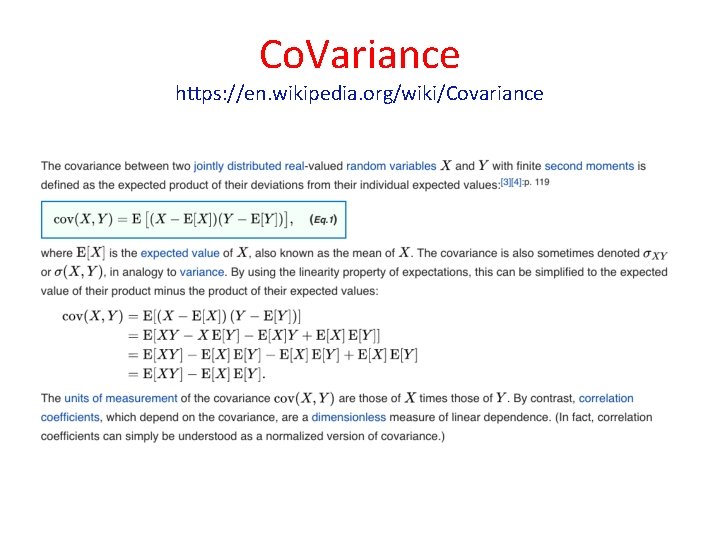
Co. Variance https: //en. wikipedia. org/wiki/Covariance
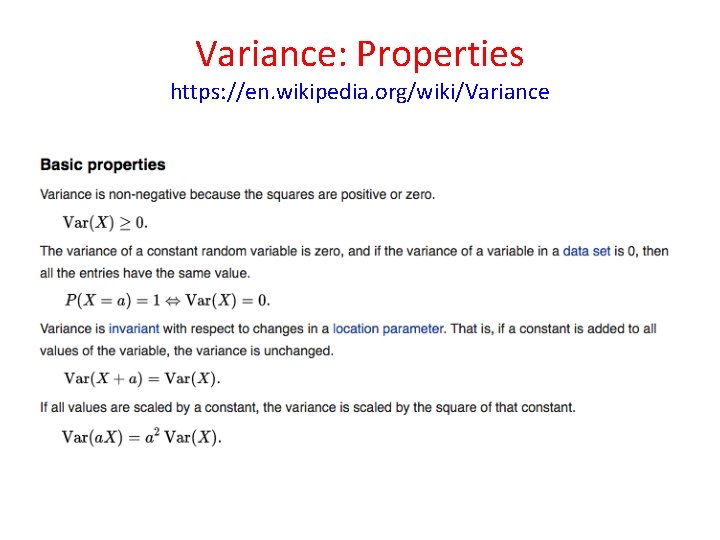
Variance: Properties https: //en. wikipedia. org/wiki/Variance
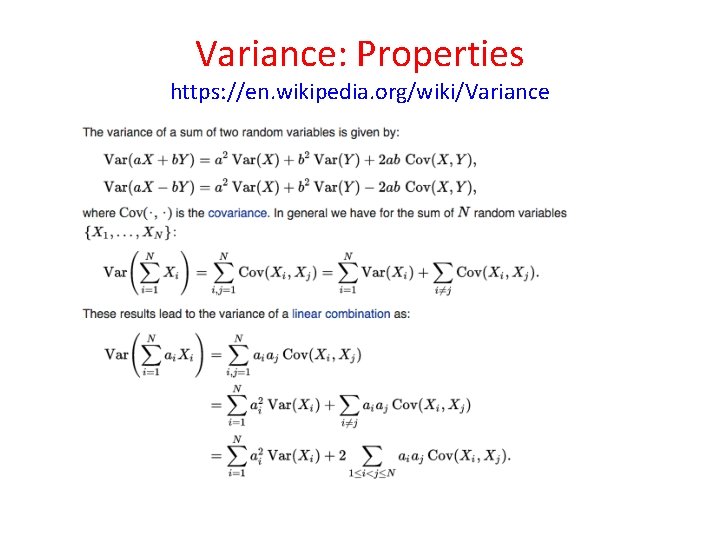
Variance: Properties https: //en. wikipedia. org/wiki/Variance
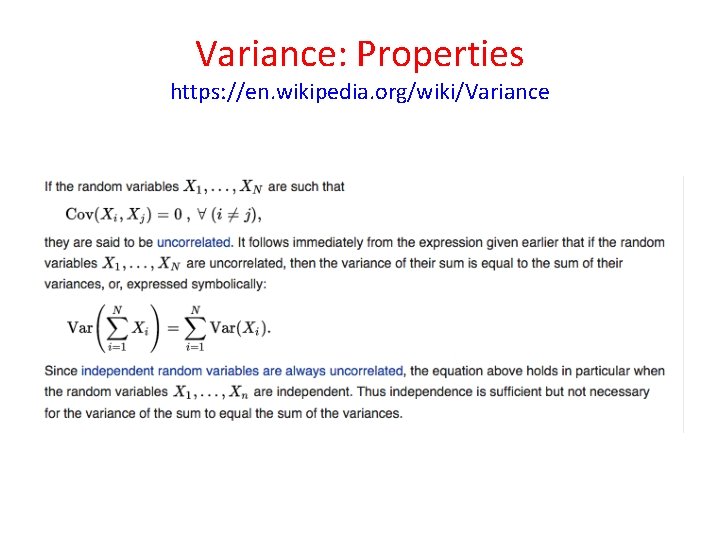
Variance: Properties https: //en. wikipedia. org/wiki/Variance
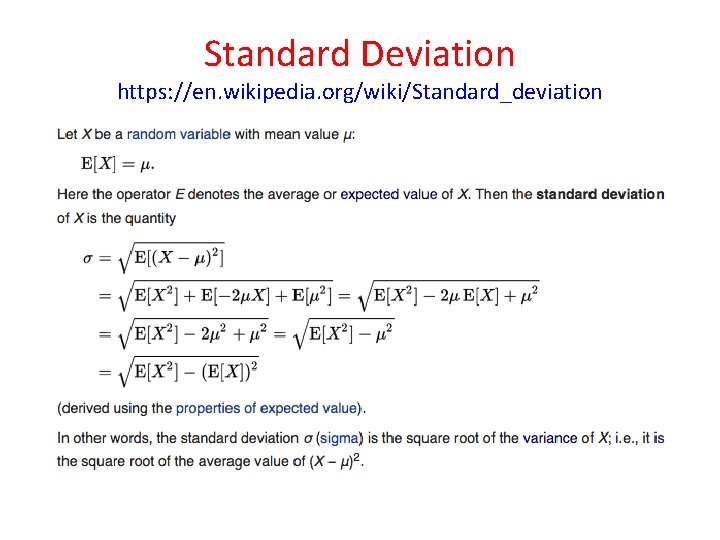
Standard Deviation https: //en. wikipedia. org/wiki/Standard_deviation
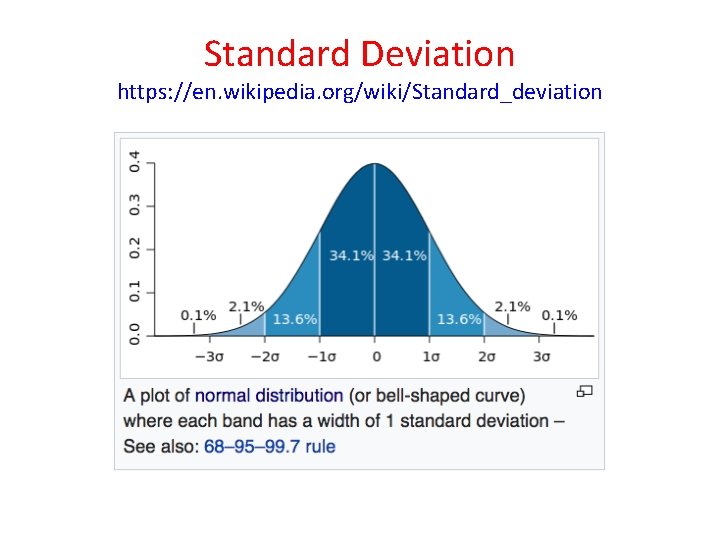
Standard Deviation https: //en. wikipedia. org/wiki/Standard_deviation
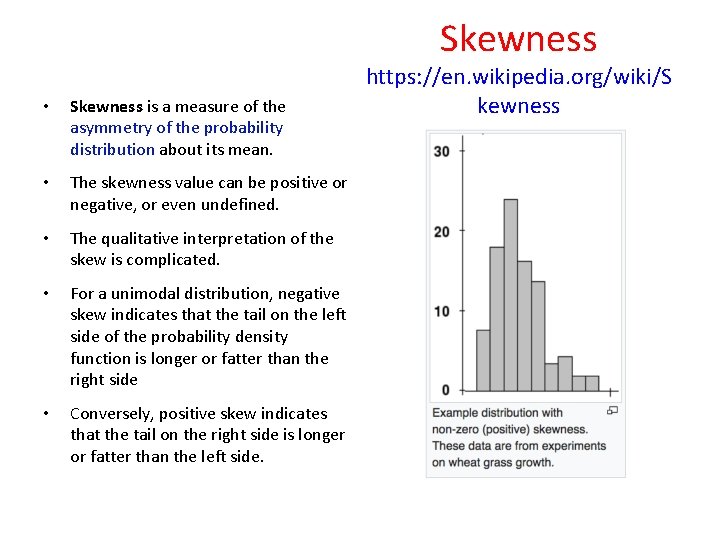
Skewness • Skewness is a measure of the asymmetry of the probability distribution about its mean. • The skewness value can be positive or negative, or even undefined. • The qualitative interpretation of the skew is complicated. • For a unimodal distribution, negative skew indicates that the tail on the left side of the probability density function is longer or fatter than the right side • Conversely, positive skew indicates that the tail on the right side is longer or fatter than the left side. https: //en. wikipedia. org/wiki/S kewness
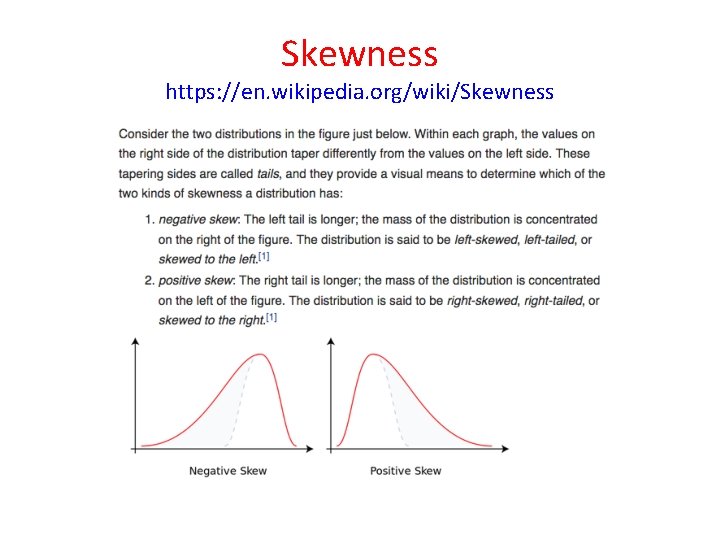
Skewness https: //en. wikipedia. org/wiki/Skewness
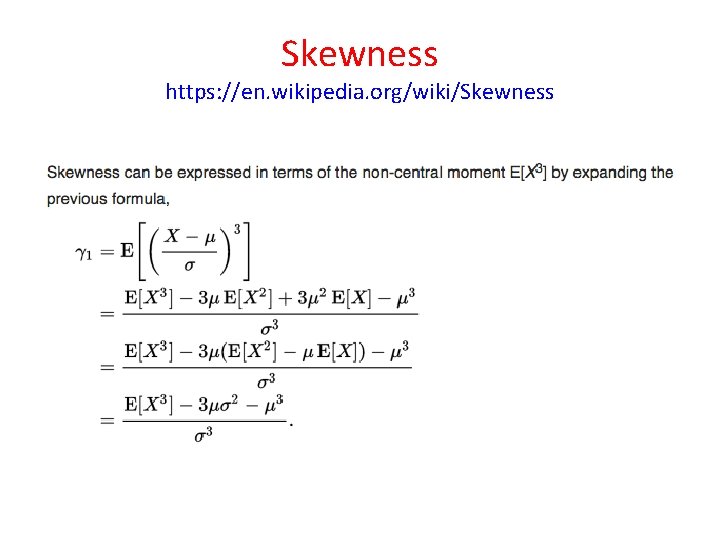
Skewness https: //en. wikipedia. org/wiki/Skewness
Kurtosis https: //en. wikipedia. org/wiki/Kurtosis • In probability theory and statistics, kurtosis (is a measure of the "tailedness" of the probability distribution of a real-valued random variable. • In a similar way to the concept of skewness, kurtosis is a descriptor of the shape of a probability distribution • Just as for skewness, there are different ways of quantifying it for a theoretical distribution and corresponding ways of estimating it from a sample from a population. • Depending on the particular measure of kurtosis that is used, there are various interpretations of kurtosis, and of how particular measures should be interpreted.
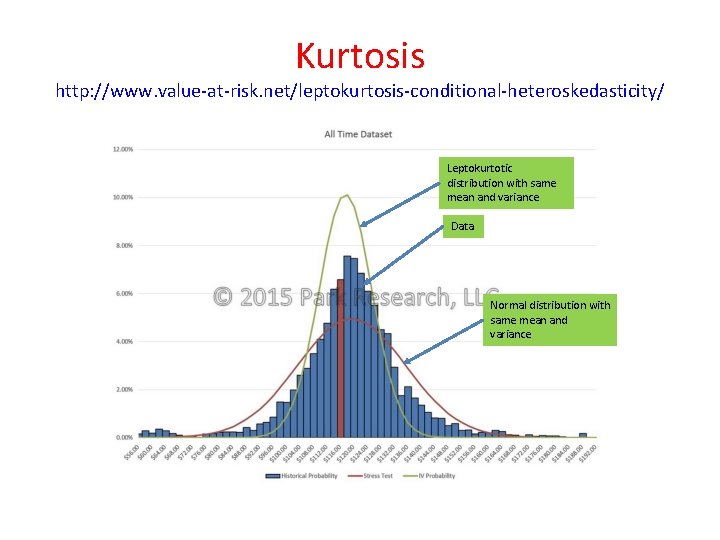
Kurtosis http: //www. value-at-risk. net/leptokurtosis-conditional-heteroskedasticity/ Leptokurtotic distribution with same mean and variance Data Normal distribution with same mean and variance
Kurtosis https: //en. wikipedia. org/wiki/Kurtosis • The standard measure of kurtosis, originating with Karl Pearson, is based on a scaled version of the fourth moment of the data or population. • This number measures heavy tails, and not peaked-ness • Thus the historical "peaked-ness" definition is wrong. • For this measure, higher kurtosis means more of the variance is the result of infrequent extreme deviations, as opposed to frequent modestly sized deviations.
Platykurtosis and Leptokurtosis https: //en. wikipedia. org/wiki/Kurtosis • • The kurtosis of any univariate normal distribution is 3. It is common to compare the kurtosis of a distribution to this value. The term “Excess Kurtosis” is used when the value of kurtosis is greater than 3 Distributions with kurtosis less than 3 are said to be platykurtic, although this does not imply the distribution is "flat-topped" as sometimes reported. Rather, it means the distribution produces fewer and less extreme outliers than does the normal distribution. An example of a platykurtic distribution is the uniform distribution, which does not produce outliers. Distributions with kurtosis greater than 3 are said to be leptokurtic. An example of a leptokurtic distribution is the Laplace distribution, or the Lorentz distribution, both of which have tails that asymptotically approach zero more slowly than a Gaussian, and therefore produce more outliers than the normal distribution.
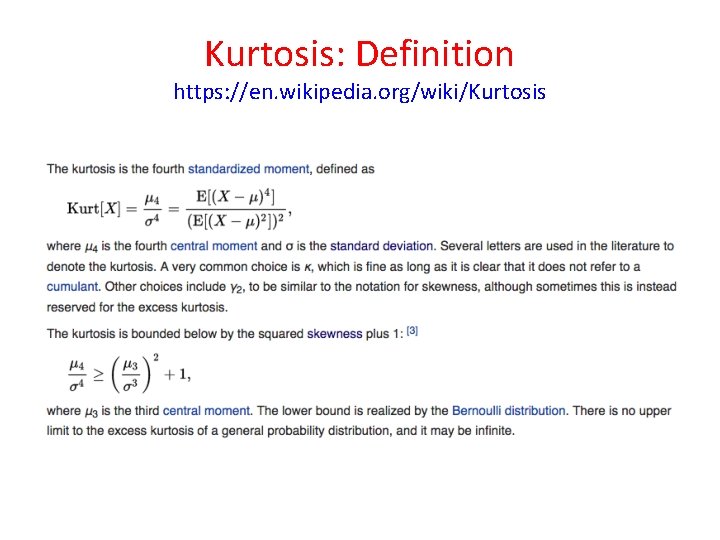
Kurtosis: Definition https: //en. wikipedia. org/wiki/Kurtosis
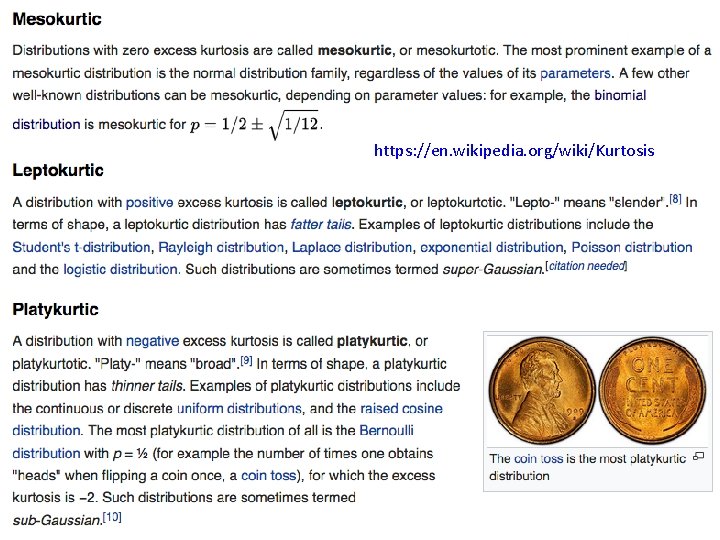
https: //en. wikipedia. org/wiki/Kurtosis
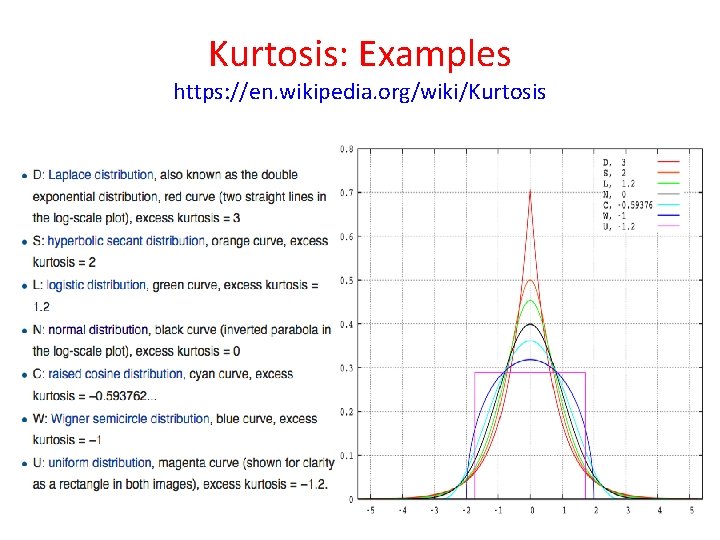
Kurtosis: Examples https: //en. wikipedia. org/wiki/Kurtosis
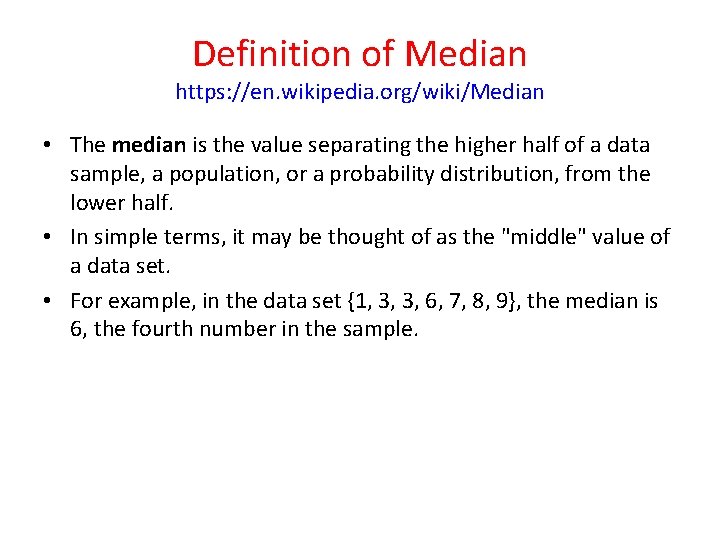
Definition of Median https: //en. wikipedia. org/wiki/Median • The median is the value separating the higher half of a data sample, a population, or a probability distribution, from the lower half. • In simple terms, it may be thought of as the "middle" value of a data set. • For example, in the data set {1, 3, 3, 6, 7, 8, 9}, the median is 6, the fourth number in the sample.
Definition of Mode https: //en. wikipedia. org/wiki/Mode_(statistics) • The mode is the value that appears most often in a set of data. • The mode of a discrete probability distribution is the value x at which its probability mass function takes its maximum value. • In other words, it is the value that is most likely to be sampled. • Like the statistical mean and median, the mode is a way of expressing, in a (usually) single number, important information about a random variable or a population. • The numerical value of the mode is the same as that of the mean and median in a normal distribution, and it may be very different in highly skewed distributions.
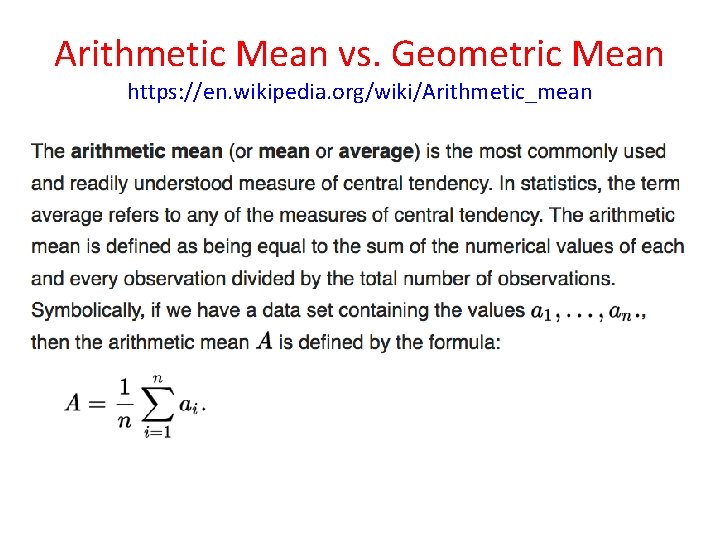
Arithmetic Mean vs. Geometric Mean https: //en. wikipedia. org/wiki/Arithmetic_mean
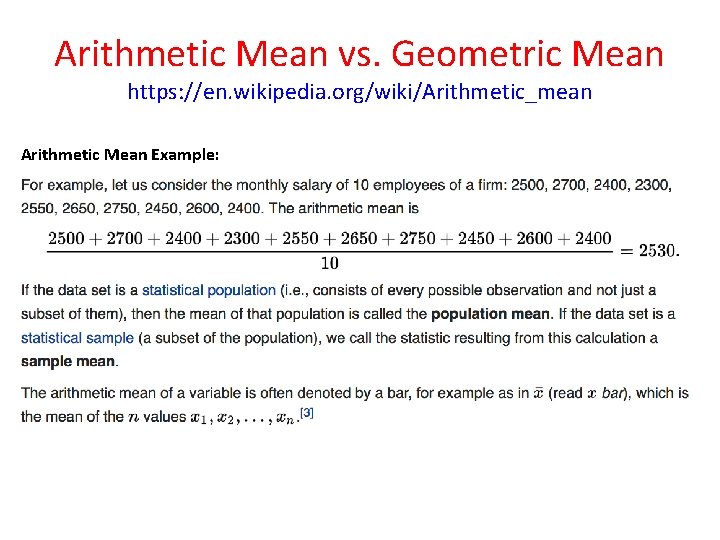
Arithmetic Mean vs. Geometric Mean https: //en. wikipedia. org/wiki/Arithmetic_mean Arithmetic Mean Example:
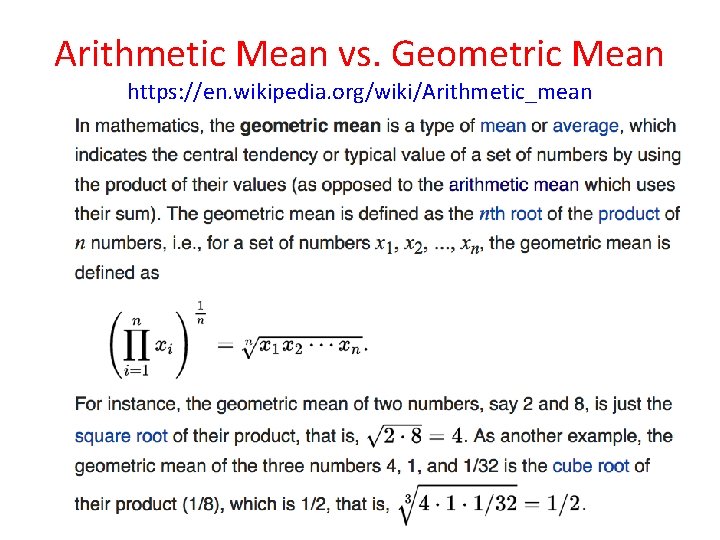
Arithmetic Mean vs. Geometric Mean https: //en. wikipedia. org/wiki/Arithmetic_mean
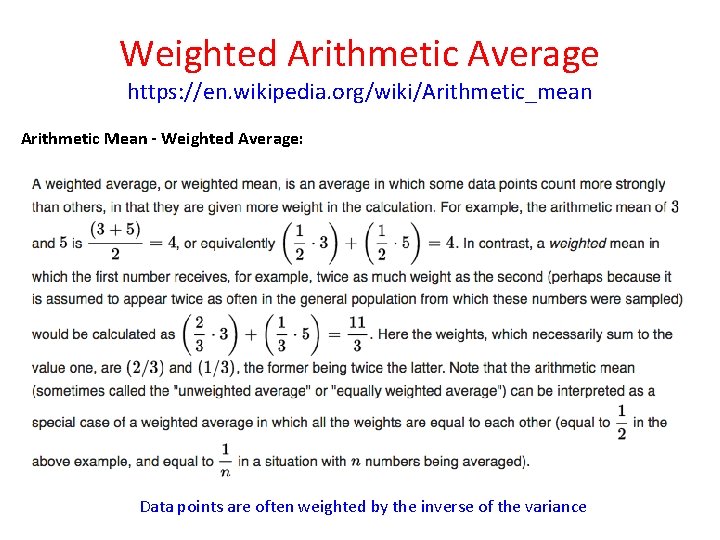
Weighted Arithmetic Average https: //en. wikipedia. org/wiki/Arithmetic_mean Arithmetic Mean - Weighted Average: Data points are often weighted by the inverse of the variance
- Slides: 38