
Lecture 10 INTERNATIONAL FINANCE Review Domestic International Money
- Slides: 22
Lecture 10 INTERNATIONAL FINANCE
Review • Domestic & International Money Market • Standardization of Banking Regulations • Single European Act – Basel Accord II • Syndicated Loans • International Credit Market – International Bond Markets
Lecture 10 INTERNATIONAL FINANCIAL MARKETS & EXCHANGE RATE DETERMINATION
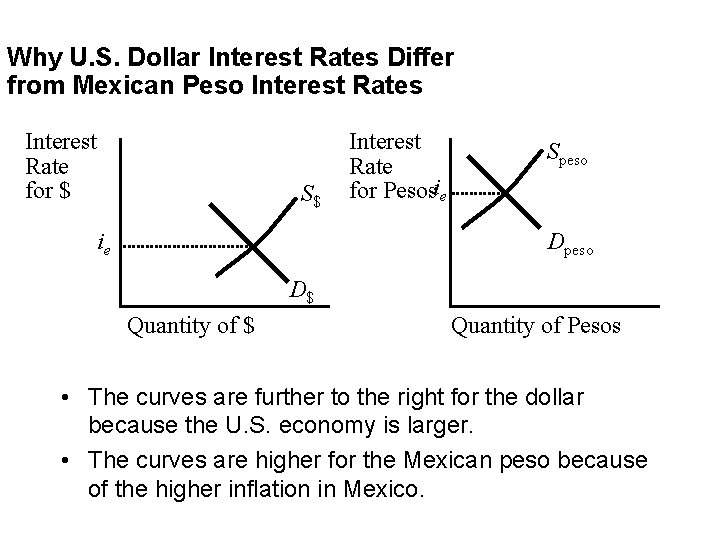
Comparing Interest Rates Among Currencies • Interest rates are crucial because they affect the MNC’s cost of financing. • The interest rate for a specific currency is determined by the demand for and supply of funds in that currency. • As the demand supply schedules for a specific currency change over time, the equilibrium interest rate will also change.
Why U. S. Dollar Interest Rates Differ from Mexican Peso Interest Rates Interest Rate for $ S$ ie Interest Rate for Pesosie Speso D$ Quantity of Pesos • The curves are further to the right for the dollar because the U. S. economy is larger. • The curves are higher for the Mexican peso because of the higher inflation in Mexico.
Interest Rates • The demand schedule for loanable funds is downward sloping for any currency • Quantity of funds demanded at any point of time is inversely related to the interest rate level. • The total amount of loanable funds demanded (borrowed) at a given point in time is higher if the cost of borrowing is lower.
Interest Rates • The supply schedule of loanable funds denominated in a given currency is upward sloping • It means that total amount of loanable funds supplied (such as savings by individuals) at a given point in time is positively related to interest rate • The total amount of loanable funds supplied to the market is higher if the interest rate offered on savings accounts is higher.
International Stock Markets • In addition to issuing stock locally, MNCs can also obtain funds by issuing stock in international markets. • This will enhance the firms’ image and name recognition, and diversify their shareholder base. • A stock offering may also be more easily digested when it is issued in several markets.
International Stock Markets • Stock issued in the U. S. by non-U. S. firms or governments are called Yankee stock offerings. • Many of such recent stock offerings resulted from privatization programs in Latin America and Europe.
International Stock Markets • The locations of an MNC’s operations can influence the decision about where to place its stock, in view of the cash flows needed to cover dividend payments. • Market characteristics are important too. Stock markets may differ in size, trading activity level, and proportion of individual versus institutional share ownership.
Comparison of International Financial Markets • The foreign cash flow movements of a typical MNC can be classified into: Foreign trade – exports and imports Direct foreign investment (DFI) – acquisition of foreign real assets Short-term investment or financing in foreign securities Longer-term financing in the international bond or stock markets
How Financial Markets Affect an MNC’s Value • Since interest rates commonly vary among countries, an MNC may use the international financial markets to reduce its cost of capital, thereby achieving a higher valuation.
Background on International Stock Market • The international trading of stocks has grown over time but has been limited by three barriers: • Transaction Costs • Information Costs • Exchange Rate Risk
Reduction in Transaction Costs • Most countries tend to have their own stock exchanges, where the stocks of local publicly held companies are traded. • In recent years, exchanges have been consolidated within a country, which has increased efficiency and reduced transaction costs. • Some European stock exchanges now have extensive cross-listings so that investors in a given European country can easily purchase stocks of companies based in other European countries.
Reduction in Transaction Costs • The details of the orders, such as the name of the stock, the number of shares to be bought or sold, and the price at which the investor is willing to buy or sell, are fed into a computer system. • The system matches buyers and sellers and then sends information confirming the transaction to the financial institution • The financial institution then informs the investor that the transaction is completed.
Reduction in Transaction Costs • In recent years, electronic communications networks (ECNs) have been created in many countries to match orders between buyers and sellers. • Like the Swiss stock exchange, ECNs do not have a visible trading floor: the trades are executed by a computer network. • Thus, all parts of the trading process from the placement of the order to the confirmation that the transaction has been executed are conducted by computer.
Reduction in Transaction Costs • The ease with which such orders can occur, regardless of the locations of the investor and the stock exchange. • It is sure to increase the volume of international stock transactions in the future.
Reduction in Information Costs • The Internet provides investors with access to much information about foreign stocks, enabling them to make more informed decisions without having to purchase information about these stocks. • Consequently, investors should be more comfortable assessing foreign stocks. Although differences in accounting rules still limit the degree to which data can be interpreted or compared. • There is some momentum toward making accounting standards uniform across some countries.
Exchange Rate Risk • When investing in a foreign stock that is denominated in a foreign currency, investors are subject to the possibility that the currency denominating the stock may depreciate against the investor’s currency over time. • The potential for a major decline in the stock’s value simply because of a large degree of depreciation is more likely for emerging markets, such as Indonesia or Russia, where the local currency can change by 10 percent or more on a single day.
International Stock Diversification • Investors in stocks can benefit by diversifying internationally. • The stocks of most firms are highly influenced by the countries where those firms reside (although some firms are more vulnerable to economic conditions than others). • Since stock markets partially reflect the current and/or forecasted state of their countries’ economies, they do not move in cycle.
International Stock Diversification • Thus, particular stocks of the various markets are not expected to be highly correlated. • This contrasts with a purely domestic portfolio in which most stocks often move in the same direction and by a somewhat similar magnitude. • The risk of a stock portfolio can be measured by its volatility. Investors prefer a stock portfolio that has a lower degree of volatility because the future returns of a less volatile portfolio are subject to less uncertainty.
Review • Demand schedule for loanable funds • Supply schedule for loanable funds • International Stock Markets – Transaction Costs – Information Costs – Exchange Rate Risk • International Stock Diversification Source: Adopted from South Western/Thomson Learning, 2006