
Lecture 10 Global Production Outsourcing and Logistics Introduction
Lecture 10 Global Production, Outsourcing and Logistics
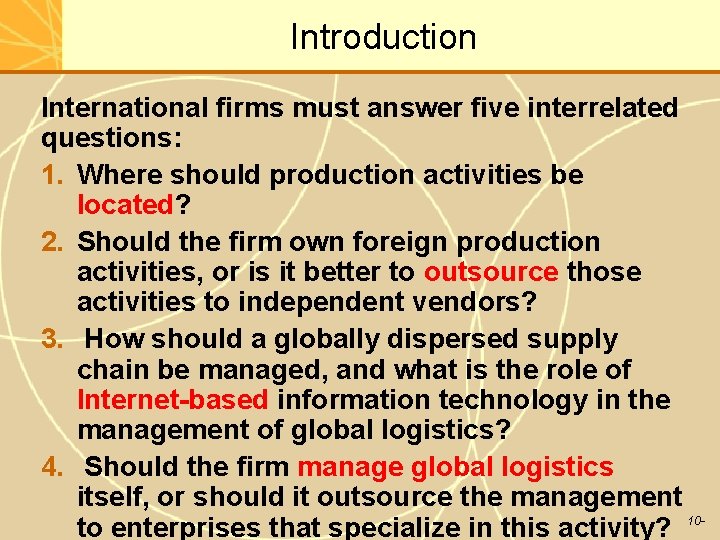
Introduction International firms must answer five interrelated questions: 1. Where should production activities be located? 2. Should the firm own foreign production activities, or is it better to outsource those activities to independent vendors? 3. How should a globally dispersed supply chain be managed, and what is the role of Internet-based information technology in the management of global logistics? 4. Should the firm manage global logistics itself, or should it outsource the management to enterprises that specialize in this activity? 10 -
Learning objective We try to understand: v. Where to produce? v. Outsourcing : Make-or-buy Decisions? v. How to manage a global supply chain? 10 -
Opening case v. What kind of considerations did Li & Fung have when disperse its different productive activities to manufacture located in different countries? v. What are the main strength of Li & Fung to organize the business globally perfectly? v. What is the key point in an efficient logistic system? v. Is production in home country better than in oversea plant? Why or why not? 10 -
10. 1 Strategy, Production, And Logistics Firms need to identify how production and logistics can be conducted internationally to: vlower the costs of value creation vadd value by better serving customer needs v. Production refers to activities involved in creating a product v. Logistics refers to the procurement and physical transmission of material through the supply chain, from suppliers to customers (物流:指控制材料通过供应链从供应商到消费者的传递过程) vsupply chain (供应链) 10 -

10. 1 Strategy, Production, And Logistics 10 -
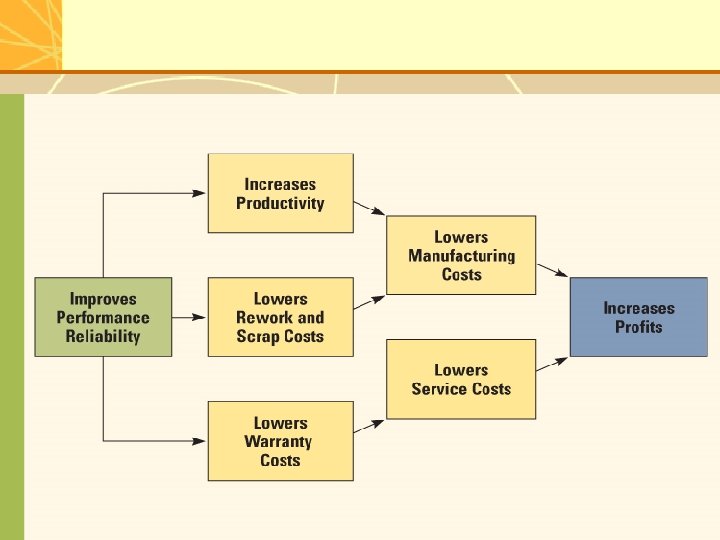
10. 1 Strategy, Production, And Logistics The functions of manufacturing and logistic: (1) To lower costs, firms can: vdisperse production to those locations where activities can be performed most efficiently vmanage the global supply chain efficiently to better match supply and demand (2) To improve quality, firms can: veliminate defective products from the supply chain and the manufacturing process. v. Improved quality will also reduce costs 10 -
10 -
10. 1 Strategy, Production, And Logistics Some Approaches of Quality control: v. Total quality management (TQM) v. Six Sigma : To increase product quality, most firms today use the Six Sigma program which aims to reduce defects, boost productivity, eliminate waste, and cut costs throughout a company v. ISO 9000 : In the European Union, firms must meet the standards set forth by ISO 9000 before the firm is allowed access to the European marketplace 10 -
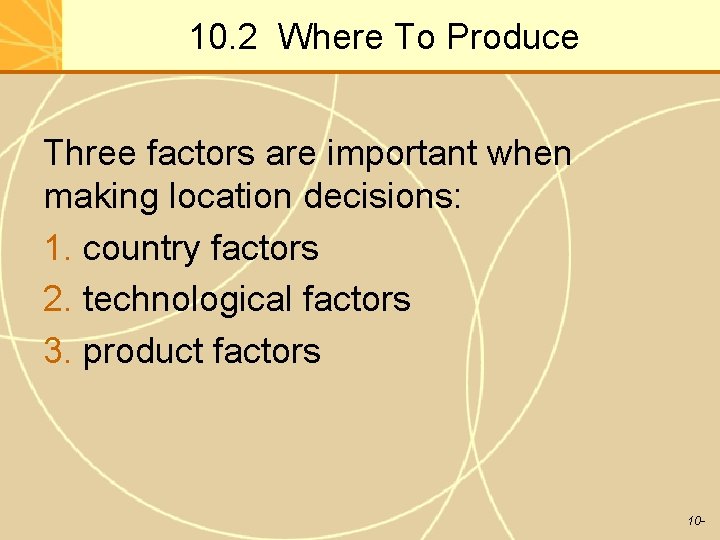
10. 2 Where To Produce Three factors are important when making location decisions: 1. country factors 2. technological factors 3. product factors 10 -
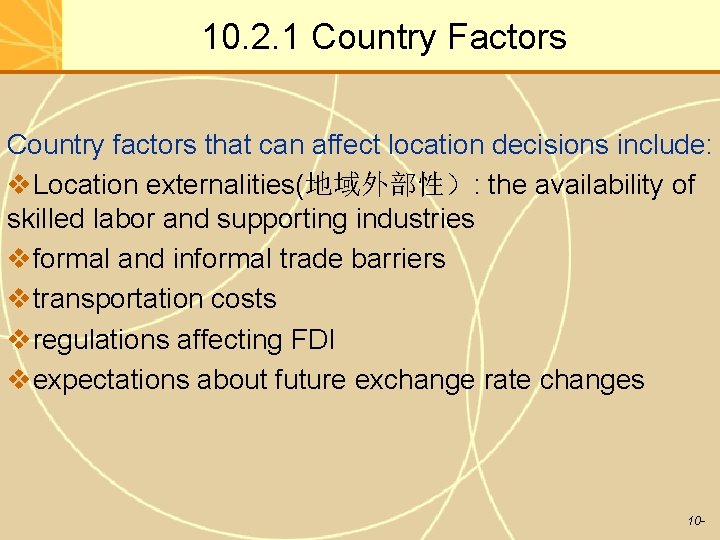
10. 2. 1 Country Factors Country factors that can affect location decisions include: v. Location externalities(地域外部性): the availability of skilled labor and supporting industries vformal and informal trade barriers vtransportation costs vregulations affecting FDI vexpectations about future exchange rate changes 10 -
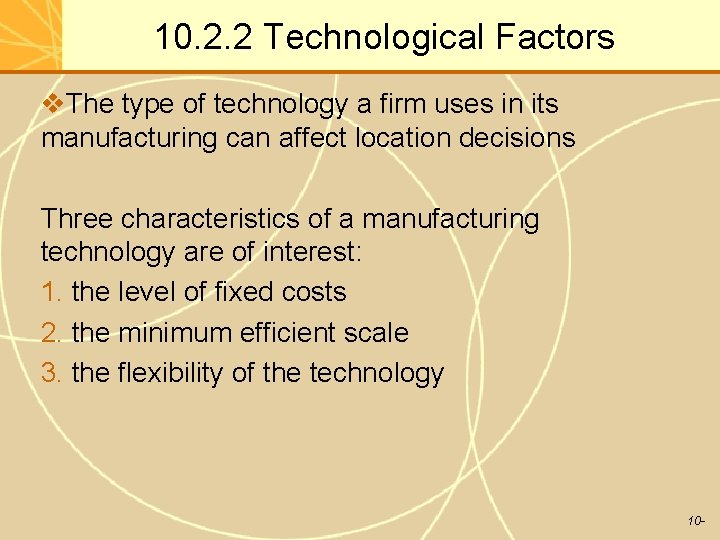
10. 2. 2 Technological Factors v. The type of technology a firm uses in its manufacturing can affect location decisions Three characteristics of a manufacturing technology are of interest: 1. the level of fixed costs 2. the minimum efficient scale 3. the flexibility of the technology 10 -
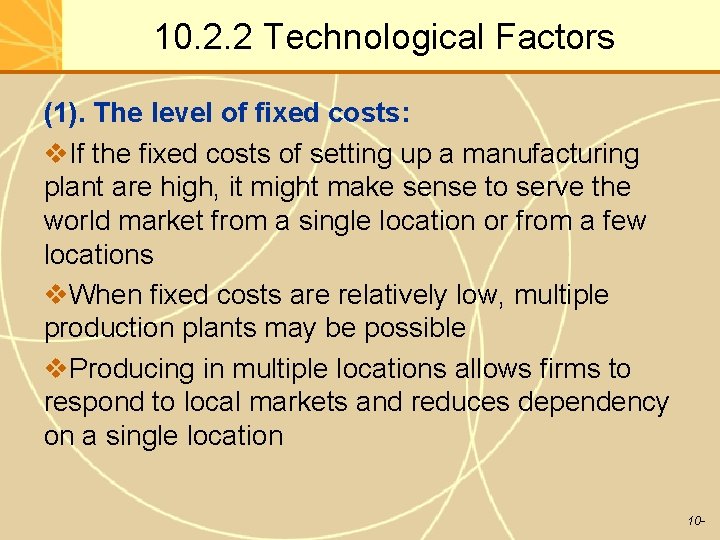
10. 2. 2 Technological Factors (1). The level of fixed costs: v. If the fixed costs of setting up a manufacturing plant are high, it might make sense to serve the world market from a single location or from a few locations v. When fixed costs are relatively low, multiple production plants may be possible v. Producing in multiple locations allows firms to respond to local markets and reduces dependency on a single location 10 -

10. 2. 2 Technological Factors (2). The minimum efficient scale: v. The larger the minimum efficient scale of a plant, the more likely centralized production in a single location or a limited number of locations makes sense vminimum efficient scale :the level of output at which most plant-level scale economies are exhausted 使得规模经济效应不能再增加的最小产出水平 v. A low minimum efficient scale allows the firm to respond to local market demands and hedge against currency risk by operating in multiple locations 10 -
10. 2. 2 Technological Factors (3). The flexibility of the technology(柔性技术): flexible manufacturing technology (柔性生产技术) or lean production(精益生产) covers a range of manufacturing technologies that are designed to: vreduce set up times for complex equipment vincrease the utilization of individual machines through better scheduling vimprove quality control at all stages of the manufacturing process 10 -
10. 2. 2 Technological Factors v. Firms using flexible manufacturing technologies can produce a wide variety of end products at a unit cost that at one time could only be achieved through the mass production of a standardized output v. Mass customization(规模定制) implies that a firm may be able to customize its product range to meet the demands of local markets yet still control costs v. Flexible machine cells(柔性机器单元) allow firms to increase efficiency by improving capacity utilization and reducing work-in-progress 10 -
Or: v. Mass customization (�模定制) : the production of variety of ends products at a unit cost the could once be achieved only through mass production of a standardized output. v. Flexible machine cell(柔性机器�元) : flexible manufacturing technology in which a group of various machine types, a common materials handler, and a centralized cell controller produce a family of product. 10 -
10. 2. 2 Technological Factors Concentrating production at a few choice locations makes sense when: vfixed costs are substantial vthe minimum efficient scale of production is high vflexible manufacturing technologies are available Production in multiple locations makes sense when: vboth fixed costs and the minimum efficient scale of production are relatively low vappropriate flexible manufacturing technologies are not available 10 -
10. 2. 3 Product Factors Two product factors impact location decisions: 1. the product's value-to-weight ratio: v. If the value-to-weight ratio is high, it is practical to produce the product in a single location and export it to other parts of the world v. If the value-to-weight ratio is low, there is greater pressure to manufacture the product in multiple locations across the world 2. whether the product serves universal needs: v. When products serve universal needs, the need for local responsiveness falls, increasing the attractiveness of concentrating manufacturing in a central location 10 -
10. 2. 4 Locating Production Facilities There are two basic strategies for locating manufacturing facilities: 1. concentrating them in the optimal location and serving the world market from there 2. decentralizing them in various regional or national locations that are close to major markets 10 -

Locating Production Facilities 10 -
10. 3 The Strategic Role Of Foreign Factories Case study: HP in Singapore v. What’s the initial strategic role of foreign factories and the strategic advantage of a particular location ? v. What are the changes about this role? What are the main reasons ? 10 -
10. 3 The Strategic Role Of Foreign Factories v. Factories initially established to take advantage of low cost labor can evolve into facilities with advanced design capabilities v. Improvement in a facility comes from two sources: 1. pressure to lower costs or respond to local markets 2. an increase in the availability of advanced factors of production 10 -
The Strategic Role Of Foreign Factories v. Many companies now see foreign factories as globally dispersed centers of excellence v. This philosophy supports the development of a transnational strategy v. A major aspect of a transnational strategy is a belief in global learning, or the idea that valuable knowledge does not reside just in a firm’s domestic operations, it may also be found in its foreign subsidiaries v. This implies that firms are less likely to switch production to new locations simply because some underlying variable like wage rates has changed 10 -
10. 4 Outsourcing Production: Make-or-Buy Decisions v. Should an international business make or buy the component parts to go into their final product? v. Make-or-buy decisions are important factors in many firms' manufacturing strategies: To choose which activities to outsource and which to keep inhouse v. Make-or-buy decisions involving international markets are more complex than those involving domestic markets. 10 -
10. 4. 1 The Advantages Of Make Vertical integration (making component parts in-house) can: 1. lower costs - if a firm is more efficient at that production activity than any other enterprise, it may pay the firm to continue manufacturing a product or component part inhouse 2. facilitate investments in highly specialized assets internal production makes sense when substantial investments in specialized assets (assets whose value is contingent upon a particular relationship persisting) are required to manufacture a component 10 -
3. protect proprietary technology - a firm might prefer to make component parts that contain proprietary technology in-house in order to maintain control over the technology 4. facilitate the scheduling of adjacent processes the weakest argument for vertical integration is that the resulting production cost savings make planning, coordination, and scheduling of adjacent processes easier 10 -
10. 4. 2 The Advantages Of Buy Outsourcing: To buy the products and services from other companies, which have less negative influences on its own core competence. The Advantages Of Buy: 1. gives the firm greater flexibility vmaintain its flexibility, switching orders between suppliers as circumstances dictate v. This is particularly important when changes in exchange rates and trade barriers alter the attractiveness of various supply sources over time 10 -
The Advantages Of Buy 2. helps drive down the firm's cost structure Firms that buy components from independent suppliers avoid: v the challenges involved with coordinating and controlling the additional subunits that are associated with vertical integration (部门组织成本) vthe lack of incentive associated with internal suppliers(降 低成本的动力不足) vthe difficulties with setting appropriate transfer prices(内部 定价难) 3. helps the firm capture orders from international customers v. Outsourcing can help firms capture more orders from suppliers’ countries 10 -
10. 4. 3 Trade-Offs The benefits of manufacturing components in-house are greatest when: vhighly specialized assets are involved vvertical integration is necessary for protecting proprietary technology vthe firm is more efficient than external suppliers at performing a particular activity 10 -
10. 4. 4 Strategic Alliances With Suppliers forming long-term strategic alliances with key suppliers Benefits: v. Benefit from vertical integration; v. No associated organization problem; v. Suppliers can share the growth and success of their clients Costs vmay limit strategic flexibility; v. Risks of losing key technology 10 -
10. 5 Managing A Global Supply Chain The objectives of logistics: v. To manage a global supply chain at the lowest possible cost and in a way that best serves customer needs v. To help the firm establish a competitive advantage through superior customer service 10 -
10. 5. 1 The Role Of Just-in-Time Inventory just-in-time (JIT) systems is to economize on inventory holding costs by having materials arrive at a manufacturing plant just in time to enter the production process. vcost savings: from reduced warehousing and inventory holding costs (+) vspot defective parts and take them out of the manufacturing process to boost product quality(+) vwith no buffer stock of inventory, risks to meet unexpected demand or supply changes (-) 10 -
10. 5. 2 The Role Of Information Technology And The Internet v. Web-based information systems play a crucial role in materials management v. They allow firms to optimize production scheduling according to when components are expected to arrive Electronic Data Interchange (EDI): vfacilitates the tracking of inputs vallows the firm to optimize its production schedule vlets the firm and its suppliers communicate in real time veliminates the flow of paperwork between the firm and its suppliers 10 -
- Slides: 34