
LECTURE 10 COMPETENCYBASED STRATEGIC HR MANAGEMENT Mike Nxele
LECTURE 10 COMPETENCY-BASED STRATEGIC HR MANAGEMENT Mike Nxele Cairo, 25 th – 28 th June 2007 1
OUTLINE l CORE-COMPETENCY- BASED CORPORATE STRATEGY FORMULATION l TYPES OF COMPETENCIES l COMPETENCIES AND THEIR APPLICATION l FROM COMPETENCIES TO HR STRATEGIES AND PROGRAMS 2

INTERNAL ANALYSIS AND CORECOMPETENCIES The Core Competencies Model of Hamel and Prahalad(1990) l This is an inside-out Corporate Strategy model that starts the strategy process by thinking about the core strengths of an organisation l Whereas the outside-in approach (eg. Porter’s Five Forces) places the market, the competition and the customer at the starting point of the strategy, the core competence model does the opposite l 3
Core Competence “DOING WHAT YOU ARE BLOODY GOOD AT” Prof John De Figiuredo (MIT) 4
CORE COMPETENCE The set of organisational skills that potentially makes the organisation effective in certain activities 5
FOUR TESTS OF CORE COMPETENCE A bundle of skills and Technologies which are critical for organisational success. l A managerial asset which sets the organisation apart from competitors. l Makes a disproportionate contribution to what customers perceive as “added value”. l Provides competitive advantage l 6
The essential thing is that it must be something that is peculiar to your organisation and which others cannot copy. 7
Organizational Capabilities The set of competencies needed to effectively compete in Knowledge Economy (Dave Ulrich) These sets of competencies (capabilities)need to be identified and sourced. But more importantly, success lies with developing and applying them and matching them to opportunities. Our HR Competencies are developed from they are Source of your Business Strategy. 8
Source of Organisational Capabilities: Human Capital-skills, experience, know-how and capabilities of individuals in the organisation. Ø Structural Capital-Organisational architecture, business processes, culture, decision making, patents, trademarks. (Intellectual Capital). Ø Relationship Capital-internal and external interconnectedness, Value Chain Management, Image promotion and development Ø 9
HRM can increase its contribution to the organisations’ effectiveness by playing key role in creating value in each of the components of strategic capability. Through sound HR Policies, Programs and Practices HR should be involved in the identification of Key Competencies that are needed to exploit existing Organization Capabilities; Developing Competencies to achieve organization's strategy. l 10
What is the Link with HR? There is a relationship among the different types of Intangible Capital – Human Capital drives Structural, and Relationship and Capital – Without Talented and Skillful people, the patents, processes, professional relationships and channels, would not exist. 11
Ø HR Input into Strategy Formulation is more critical with the CORE-Competency Approach). ; Ø Organisational Skills that constitute its core competencies are usually embedded in its people. (Human Capital) 12
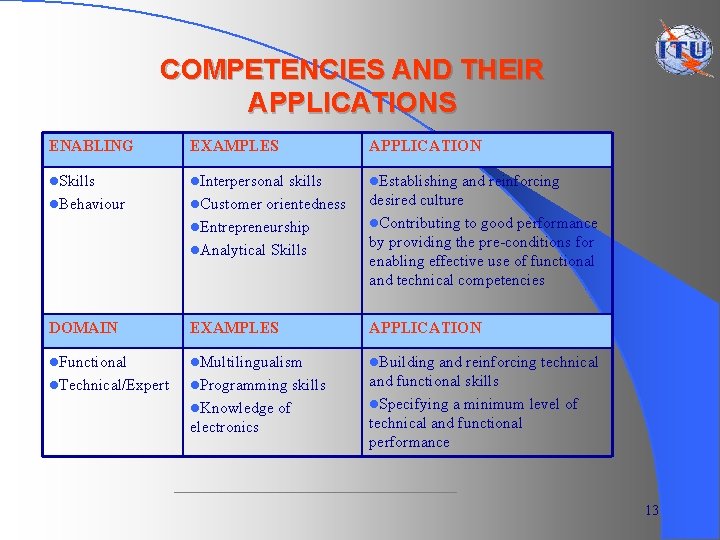
COMPETENCIES AND THEIR APPLICATIONS ENABLING EXAMPLES APPLICATION l. Skills l. Interpersonal skills l. Customer orientedness l. Entrepreneurship l. Analytical Skills l. Establishing DOMAIN EXAMPLES APPLICATION l. Functional l. Multilingualism l. Building l. Technical/Expert l. Programming l. Behaviour l. Knowledge electronics of skills and reinforcing desired culture l. Contributing to good performance by providing the pre-conditions for enabling effective use of functional and technical competencies and reinforcing technical and functional skills l. Specifying a minimum level of technical and functional performance 13
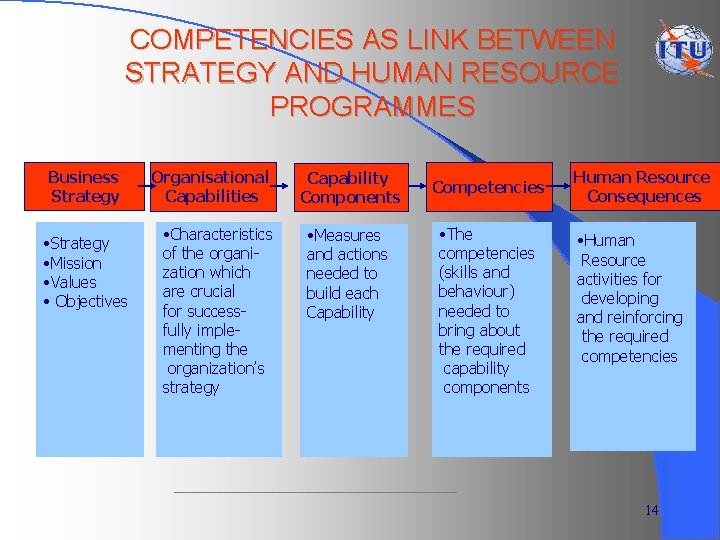
COMPETENCIES AS LINK BETWEEN STRATEGY AND HUMAN RESOURCE PROGRAMMES Business Strategy • Strategy • Mission • Values • Objectives Organisational Capabilities • Characteristics of the organization which are crucial for successfully implementing the organization’s strategy Capability Components • Measures and actions needed to build each Capability Competencies • The competencies (skills and behaviour) needed to bring about the required capability components Human Resource Consequences • Human Resource activities for developing and reinforcing the required competencies 14
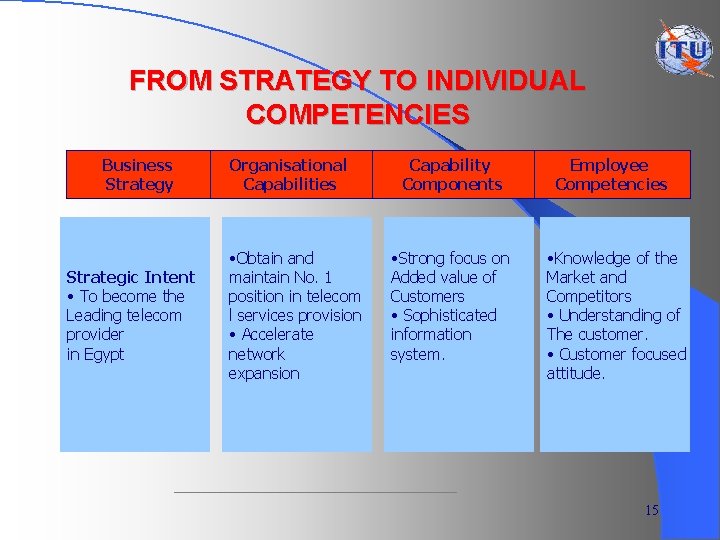
FROM STRATEGY TO INDIVIDUAL COMPETENCIES Business Strategy Strategic Intent • To become the Leading telecom provider in Egypt Organisational Capabilities • Obtain and maintain No. 1 position in telecom l services provision • Accelerate network expansion Capability Components • Strong focus on Added value of Customers • Sophisticated information system. Employee Competencies • Knowledge of the Market and Competitors • Understanding of The customer. • Customer focused attitude. 15
Ø The HR Manager needs to have an audit of the skills and capabilities of the Organisation’s Human Resources; match these against the organisation’s Mission and Objectives and develop a plan to fill any identified gaps. 16
Based on this, HR can develop: l Recruitment policies; l Training Policies l Skills and Competency Profiles l Reward Systems 17
HR needs skills and tools for competency tracking and management for the individuals and teams within an organisation. Such tracking helps in Skills Gap analysis. These processes can now be assisted by standardised data formats, which can be automated. 18
v Competencies begin to play a central role in the formulation of an HR strategy; v This is an HR strategy that is directly aligned to the business strategy 19
The End 20
- Slides: 20