
Lecture 10 Coherence Transactional Memory Topics coherence wrapup
- Slides: 24
Lecture 10: Coherence, Transactional Memory • Topics: coherence wrap-up, coherence vs. message-passing, lazy TM implementations 1
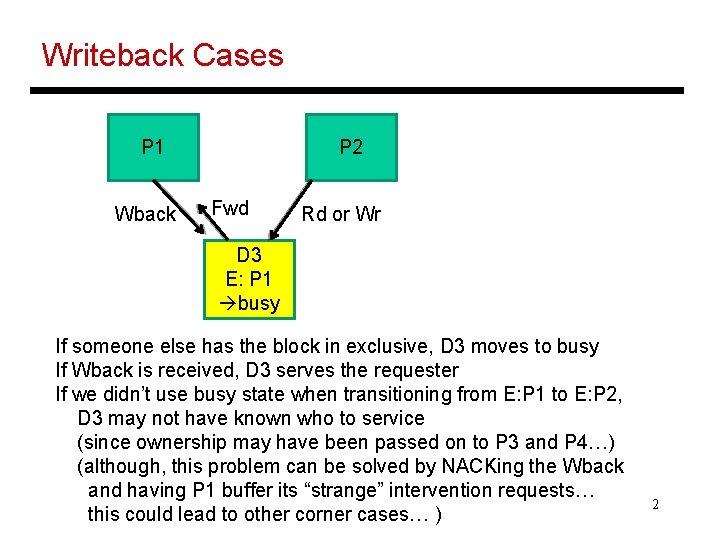
Writeback Cases P 1 Wback P 2 Fwd Rd or Wr D 3 E: P 1 busy If someone else has the block in exclusive, D 3 moves to busy If Wback is received, D 3 serves the requester If we didn’t use busy state when transitioning from E: P 1 to E: P 2, D 3 may not have known who to service (since ownership may have been passed on to P 3 and P 4…) (although, this problem can be solved by NACKing the Wback and having P 1 buffer its “strange” intervention requests… this could lead to other corner cases… ) 2
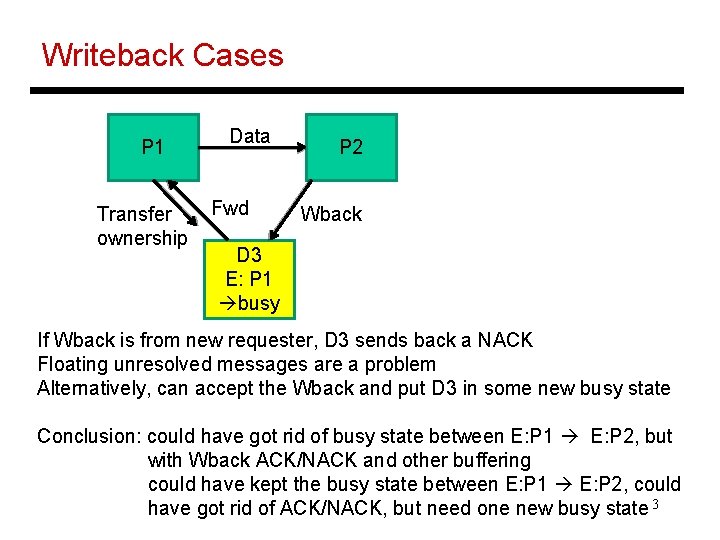
Writeback Cases P 1 Transfer ownership Data Fwd P 2 Wback D 3 E: P 1 busy If Wback is from new requester, D 3 sends back a NACK Floating unresolved messages are a problem Alternatively, can accept the Wback and put D 3 in some new busy state Conclusion: could have got rid of busy state between E: P 1 E: P 2, but with Wback ACK/NACK and other buffering could have kept the busy state between E: P 1 E: P 2, could have got rid of ACK/NACK, but need one new busy state 3
Future Scalable Designs • Intel’s Single Cloud Computer (SCC): an example prototype • No support for hardware cache coherence • Programmer can write shared-memory apps by marking pages as uncacheable or L 1 -cacheable, but forcing memory flushes to propagate results • Primarily intended for message-passing apps • Each core runs a version of Linux • Barrelfish-like OSes will likely soon be mainstream 4
Scalable Cache Coherence • Will future many-core chips forego hardware cache coherence in favor of message-passing or sw-managed cache coherence? • It’s the classic programmer-effort vs. hw-effort trade-off … traditionally, hardware has won (e. g. ILP extraction) • Two questions worth answering: will motivated programmers prefer message-passing? , is scalable hw cache coherence do-able? 5
Message Passing • Message passing can be faster and more energy-efficient • Only required data is communicated: good for energy and reduces network contention • Data can be sent before it is required (push semantics; cache coherence is pull semantics and frequently requires indirection to get data) • Downsides: more software stack layers and more memory hierarchy layers must be traversed, and. . more programming effort 6
Scalable Directory Coherence • Note that the protocol itself need not be changed • If an application randomly accesses data with zero locality: Ø long latencies for data communication Ø also true for message-passing apps • If there is locality and page coloring is employed, the directory and data-sharers will often be in close proximity • Does hardware overhead increase? See examples in last class… the overhead is ~2 -10% and sharing can be tracked at coarse granularity… hierarchy can also be employed, with snooping-based coherence among a group of nodes 7
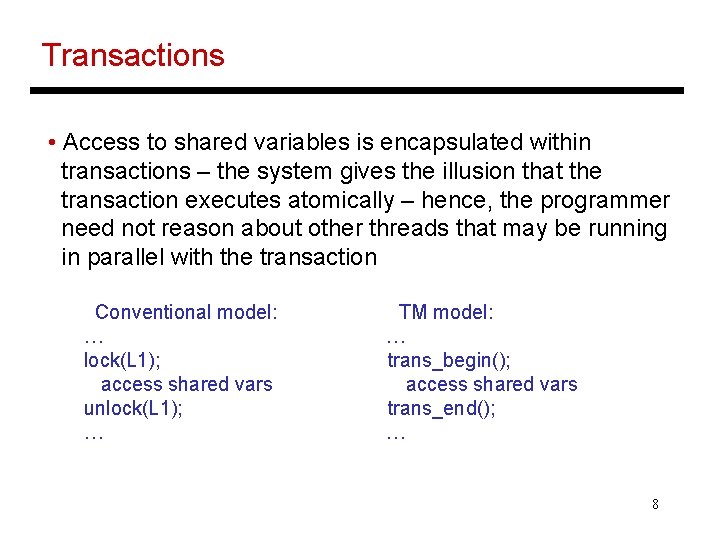
Transactions • Access to shared variables is encapsulated within transactions – the system gives the illusion that the transaction executes atomically – hence, the programmer need not reason about other threads that may be running in parallel with the transaction Conventional model: … lock(L 1); access shared vars unlock(L 1); … TM model: … trans_begin(); access shared vars trans_end(); … 8
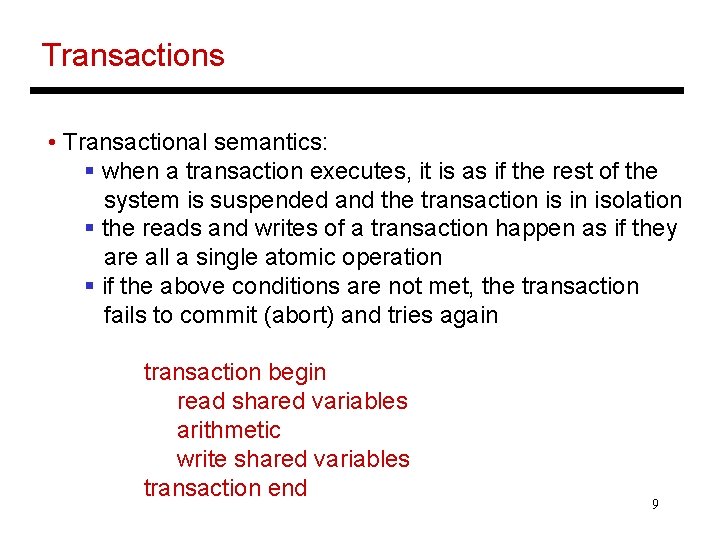
Transactions • Transactional semantics: § when a transaction executes, it is as if the rest of the system is suspended and the transaction is in isolation § the reads and writes of a transaction happen as if they are all a single atomic operation § if the above conditions are not met, the transaction fails to commit (abort) and tries again transaction begin read shared variables arithmetic write shared variables transaction end 9
Why are Transactions Better? • High performance with little programming effort Ø Transactions proceed in parallel most of the time if the probability of conflict is low (programmers need not precisely identify such conflicts and find work-arounds with say fine-grained locks) Ø No resources being acquired on transaction start; lesser fear of deadlocks in code Ø Composability 10
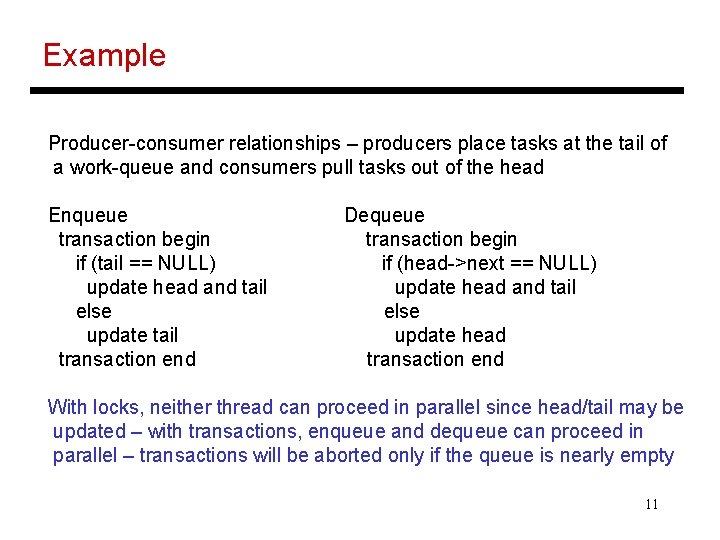
Example Producer-consumer relationships – producers place tasks at the tail of a work-queue and consumers pull tasks out of the head Enqueue transaction begin if (tail == NULL) update head and tail else update tail transaction end Dequeue transaction begin if (head->next == NULL) update head and tail else update head transaction end With locks, neither thread can proceed in parallel since head/tail may be updated – with transactions, enqueue and dequeue can proceed in parallel – transactions will be aborted only if the queue is nearly empty 11
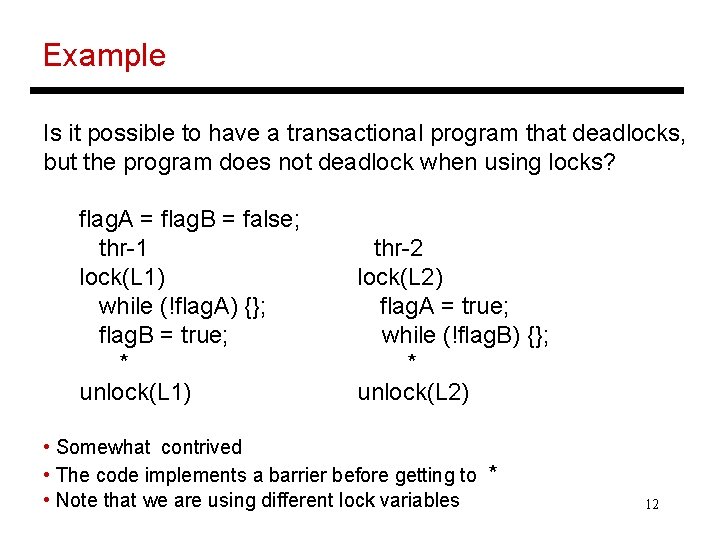
Example Is it possible to have a transactional program that deadlocks, but the program does not deadlock when using locks? flag. A = flag. B = false; thr-1 lock(L 1) while (!flag. A) {}; flag. B = true; * unlock(L 1) thr-2 lock(L 2) flag. A = true; while (!flag. B) {}; * unlock(L 2) • Somewhat contrived • The code implements a barrier before getting to * • Note that we are using different lock variables 12
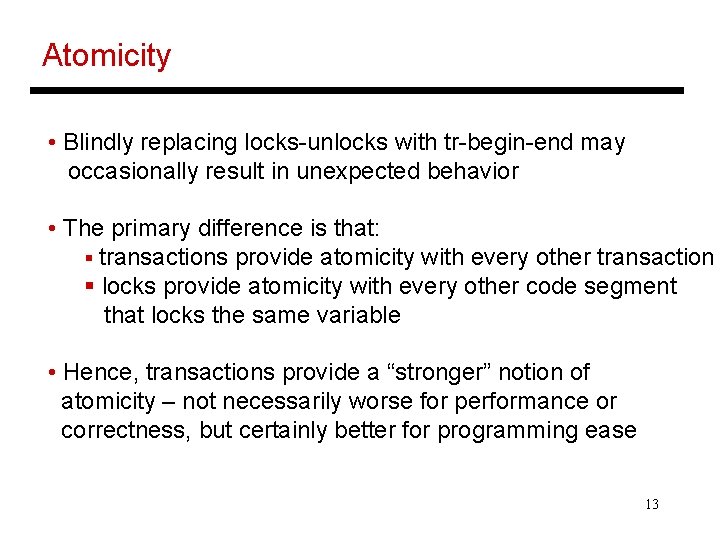
Atomicity • Blindly replacing locks-unlocks with tr-begin-end may occasionally result in unexpected behavior • The primary difference is that: § transactions provide atomicity with every other transaction § locks provide atomicity with every other code segment that locks the same variable • Hence, transactions provide a “stronger” notion of atomicity – not necessarily worse for performance or correctness, but certainly better for programming ease 13
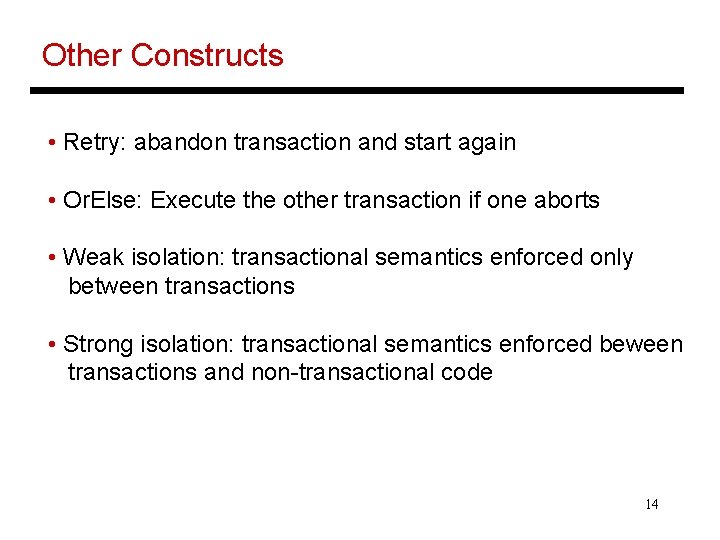
Other Constructs • Retry: abandon transaction and start again • Or. Else: Execute the other transaction if one aborts • Weak isolation: transactional semantics enforced only between transactions • Strong isolation: transactional semantics enforced beween transactions and non-transactional code 14
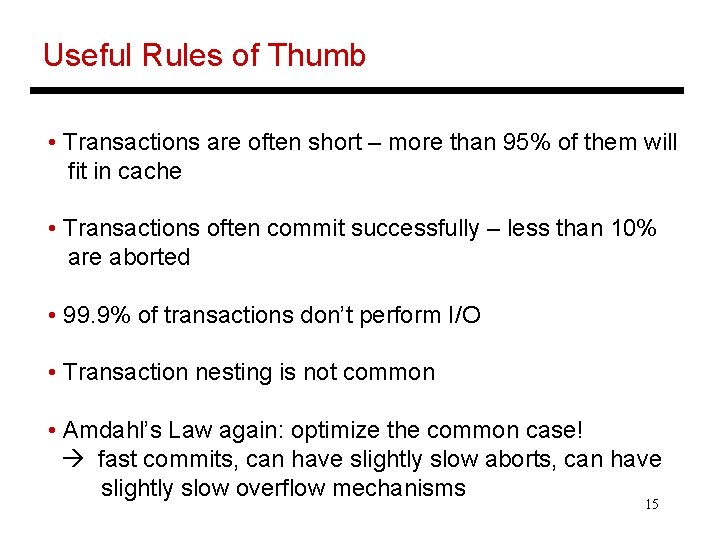
Useful Rules of Thumb • Transactions are often short – more than 95% of them will fit in cache • Transactions often commit successfully – less than 10% are aborted • 99. 9% of transactions don’t perform I/O • Transaction nesting is not common • Amdahl’s Law again: optimize the common case! fast commits, can have slightly slow aborts, can have slightly slow overflow mechanisms 15
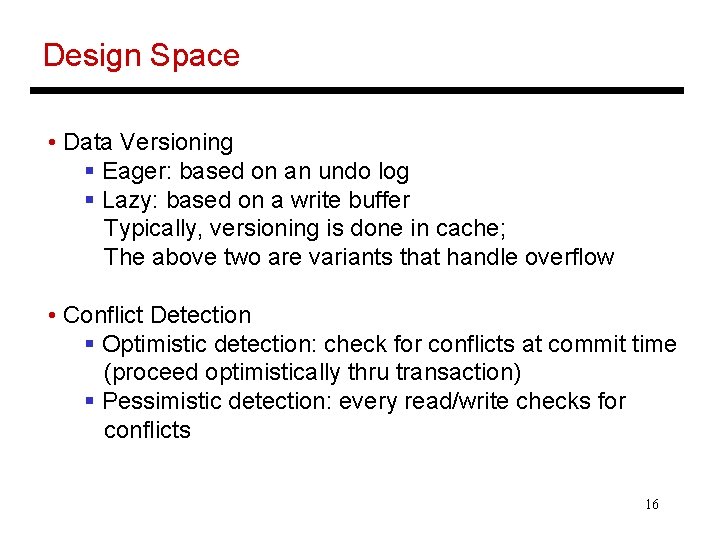
Design Space • Data Versioning § Eager: based on an undo log § Lazy: based on a write buffer Typically, versioning is done in cache; The above two are variants that handle overflow • Conflict Detection § Optimistic detection: check for conflicts at commit time (proceed optimistically thru transaction) § Pessimistic detection: every read/write checks for conflicts 16
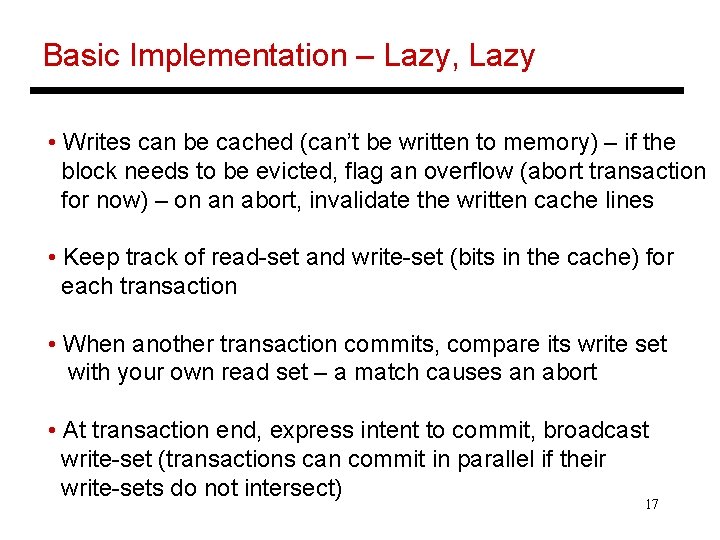
Basic Implementation – Lazy, Lazy • Writes can be cached (can’t be written to memory) – if the block needs to be evicted, flag an overflow (abort transaction for now) – on an abort, invalidate the written cache lines • Keep track of read-set and write-set (bits in the cache) for each transaction • When another transaction commits, compare its write set with your own read set – a match causes an abort • At transaction end, express intent to commit, broadcast write-set (transactions can commit in parallel if their write-sets do not intersect) 17
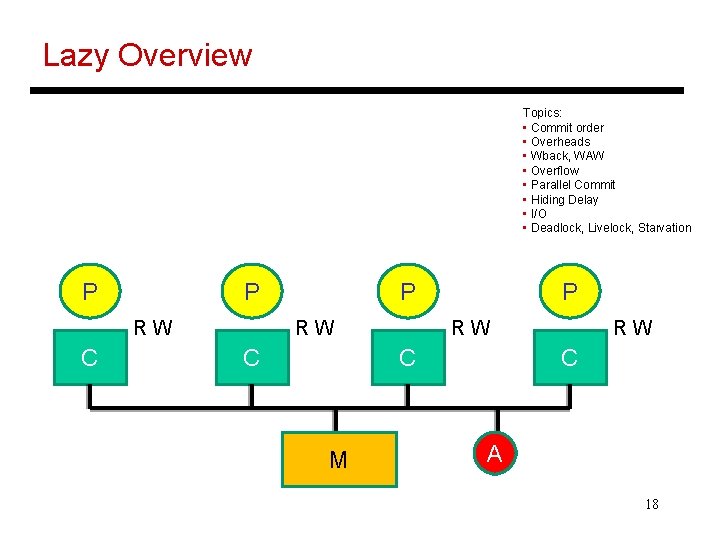
Lazy Overview Topics: • Commit order • Overheads • Wback, WAW • Overflow • Parallel Commit • Hiding Delay • I/O • Deadlock, Livelock, Starvation P P RW C M RW C A 18
“Lazy” Implementation (Partially Based on TCC) • An implementation for a small-scale multiprocessor with a snooping-based protocol • Lazy versioning and lazy conflict detection • Does not allow transactions to commit in parallel 19
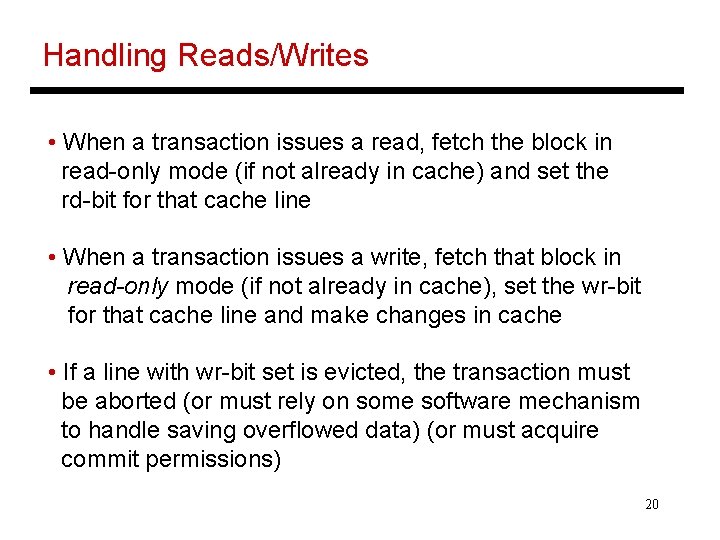
Handling Reads/Writes • When a transaction issues a read, fetch the block in read-only mode (if not already in cache) and set the rd-bit for that cache line • When a transaction issues a write, fetch that block in read-only mode (if not already in cache), set the wr-bit for that cache line and make changes in cache • If a line with wr-bit set is evicted, the transaction must be aborted (or must rely on some software mechanism to handle saving overflowed data) (or must acquire commit permissions) 20
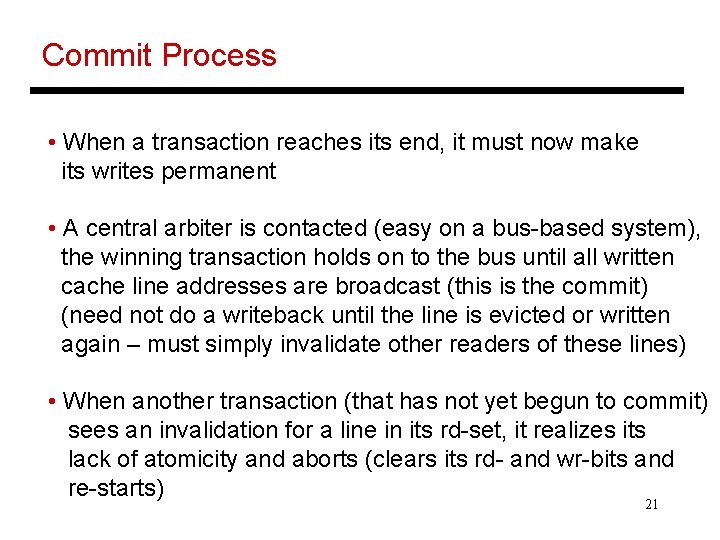
Commit Process • When a transaction reaches its end, it must now make its writes permanent • A central arbiter is contacted (easy on a bus-based system), the winning transaction holds on to the bus until all written cache line addresses are broadcast (this is the commit) (need not do a writeback until the line is evicted or written again – must simply invalidate other readers of these lines) • When another transaction (that has not yet begun to commit) sees an invalidation for a line in its rd-set, it realizes its lack of atomicity and aborts (clears its rd- and wr-bits and re-starts) 21
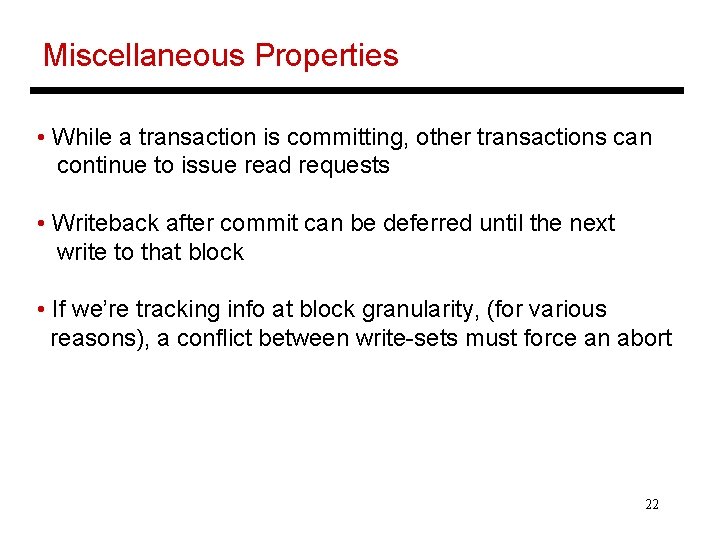
Miscellaneous Properties • While a transaction is committing, other transactions can continue to issue read requests • Writeback after commit can be deferred until the next write to that block • If we’re tracking info at block granularity, (for various reasons), a conflict between write-sets must force an abort 22
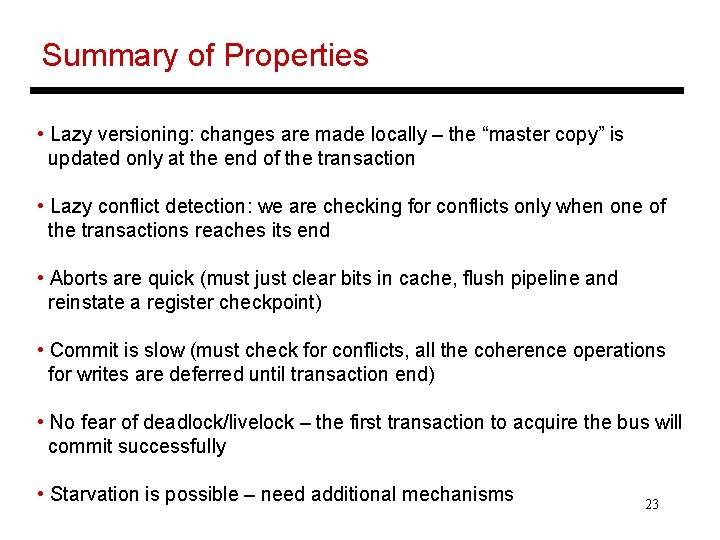
Summary of Properties • Lazy versioning: changes are made locally – the “master copy” is updated only at the end of the transaction • Lazy conflict detection: we are checking for conflicts only when one of the transactions reaches its end • Aborts are quick (must just clear bits in cache, flush pipeline and reinstate a register checkpoint) • Commit is slow (must check for conflicts, all the coherence operations for writes are deferred until transaction end) • No fear of deadlock/livelock – the first transaction to acquire the bus will commit successfully • Starvation is possible – need additional mechanisms 23
Title • Bullet 24