
Lecture 10 Bipolar Junction Transistor BJT BJT 1

Lecture 10 Bipolar Junction Transistor (BJT) BJT 1 -1
Outline q Continue BJT v Continue DC analysis • More examples v Introduction to AC signal analysis BJT 1 -2
Example (1) q A bipolar transistor having IS = 5× 10 -16 A is biased in the forward active region with VBE =750 m. V. If the current gain (or β) varies from 50 to 200 due to manufacturing variations, calculate the minimum and maximum terminal currents of the device. BJT 1 -3
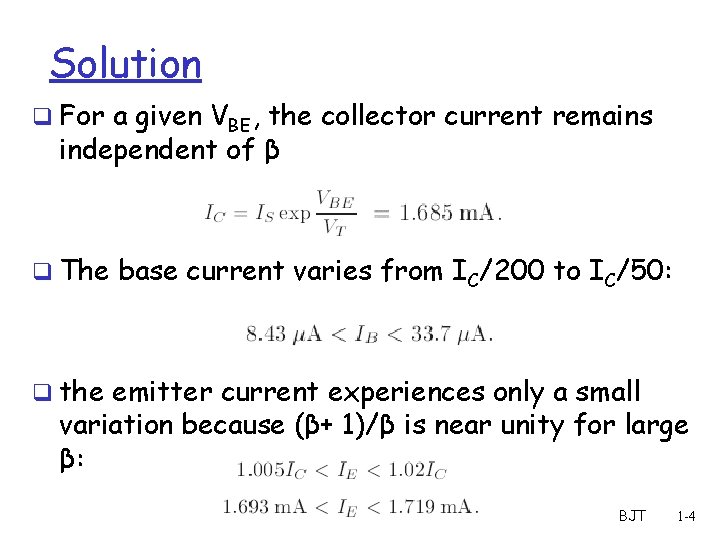
Solution q For a given VBE, the collector current remains independent of β q The base current varies from IC/200 to IC/50: q the emitter current experiences only a small variation because (β+ 1)/β is near unity for large β: BJT 1 -4
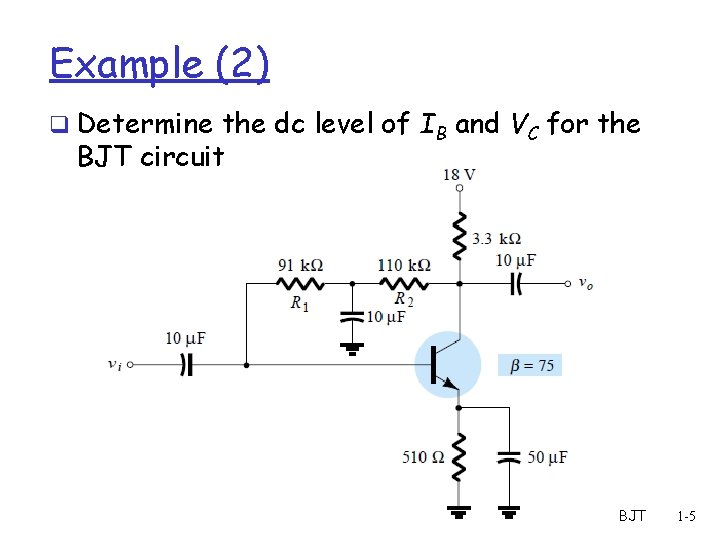
Example (2) q Determine the dc level of IB and VC for the BJT circuit BJT 1 -5
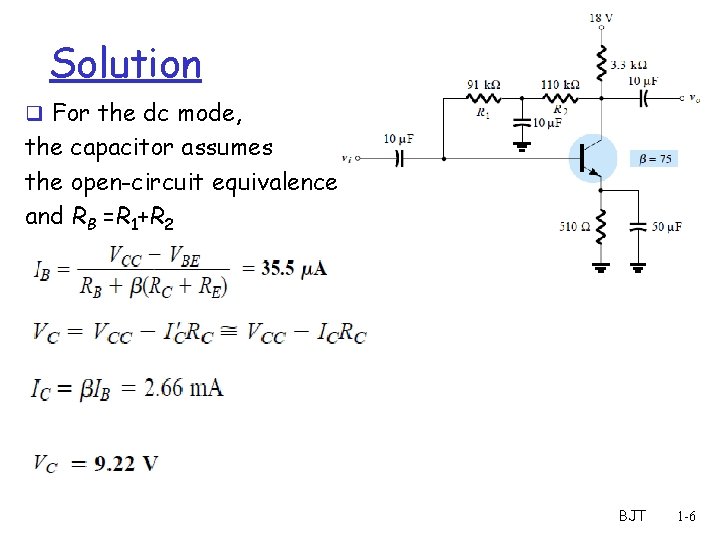
Solution q For the dc mode, the capacitor assumes the open-circuit equivalence and RB =R 1+R 2 BJT 1 -6
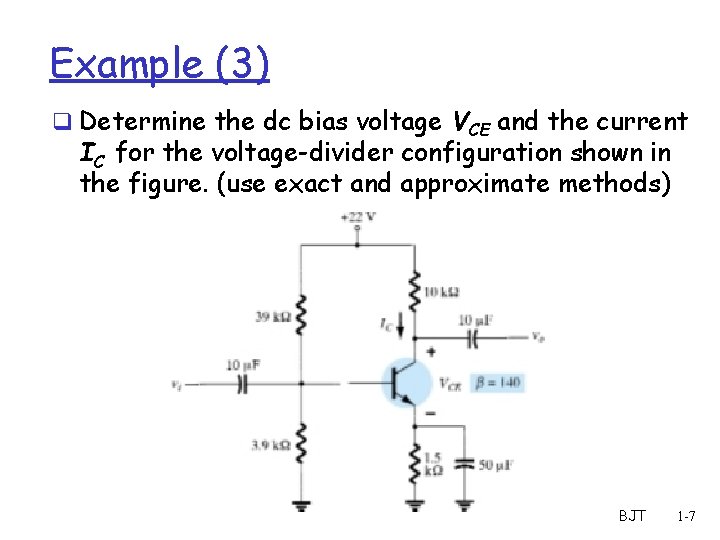
Example (3) q Determine the dc bias voltage VCE and the current IC for the voltage-divider configuration shown in the figure. (use exact and approximate methods) BJT 1 -7
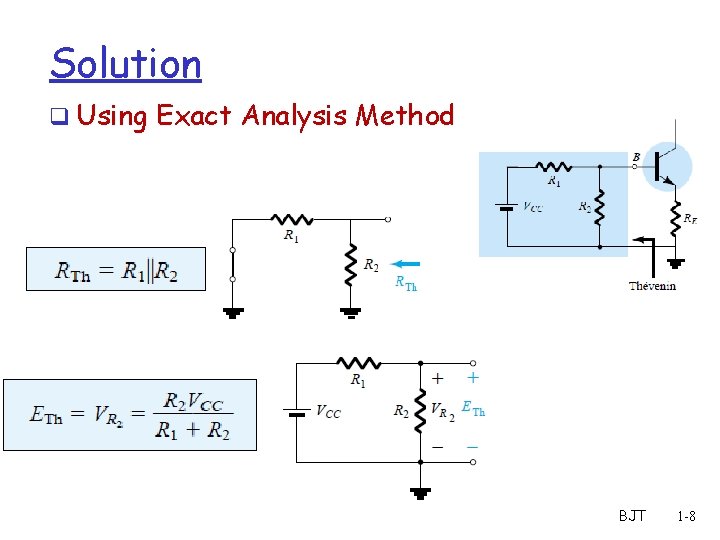
Solution q Using Exact Analysis Method BJT 1 -8
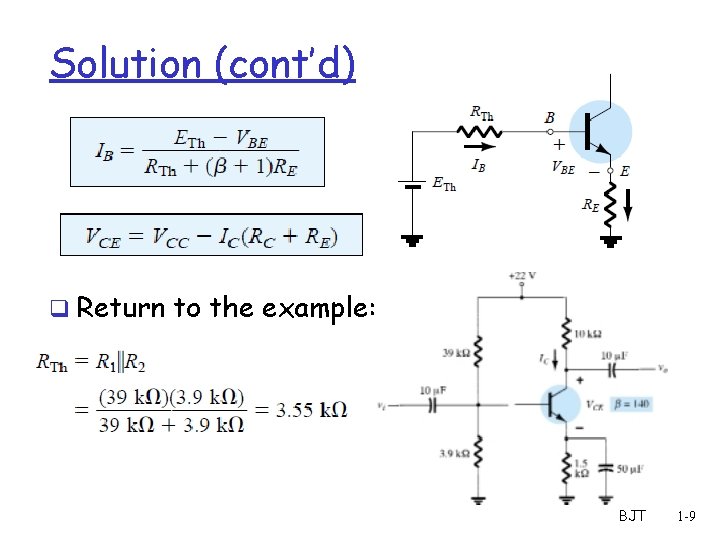
Solution (cont’d) q Return to the example: BJT 1 -9
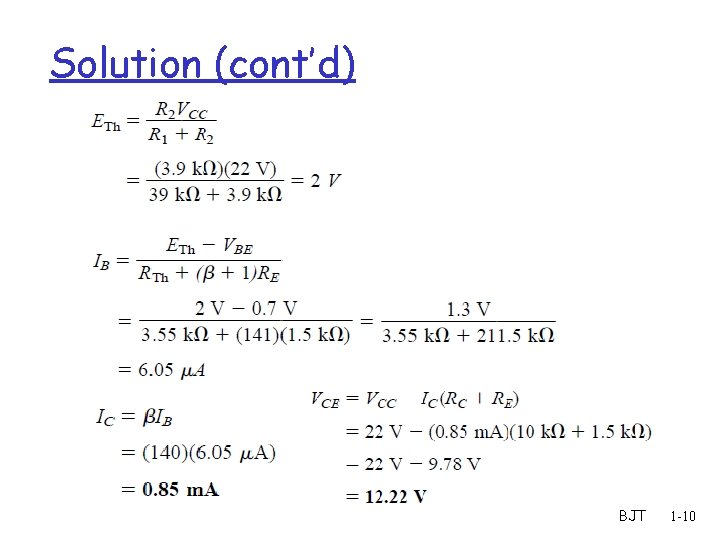
Solution (cont’d) BJT 1 -10
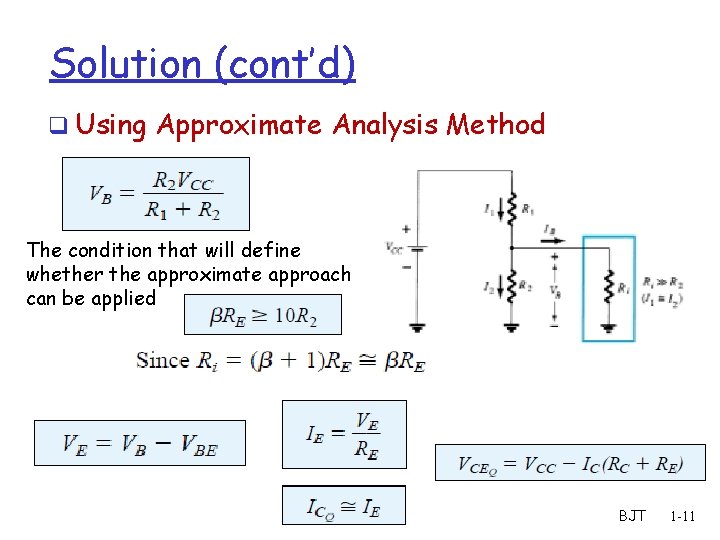
Solution (cont’d) q Using Approximate Analysis Method The condition that will define whether the approximate approach can be applied BJT 1 -11
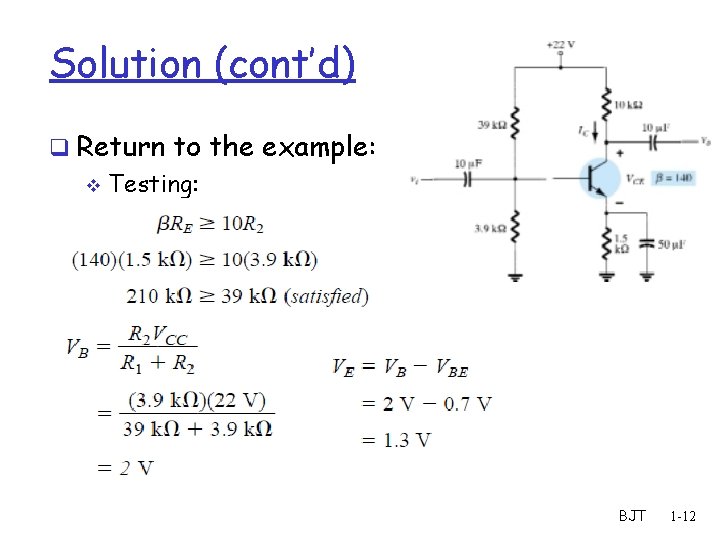
Solution (cont’d) q Return to the example: v Testing: BJT 1 -12
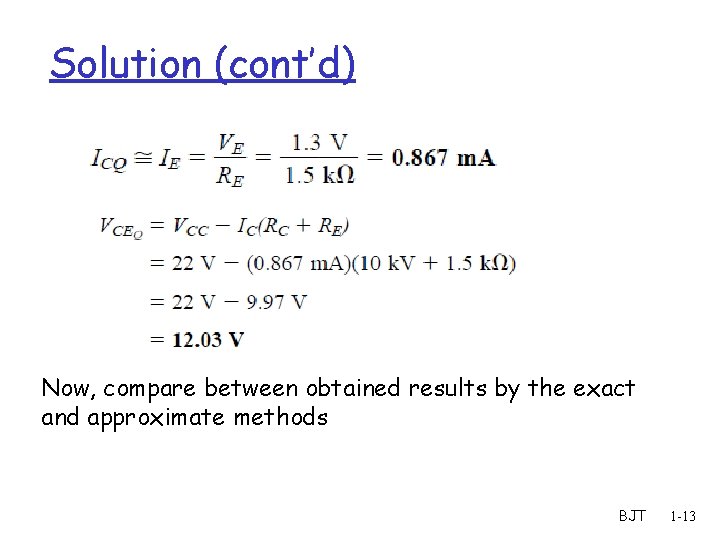
Solution (cont’d) Now, compare between obtained results by the exact and approximate methods BJT 1 -13
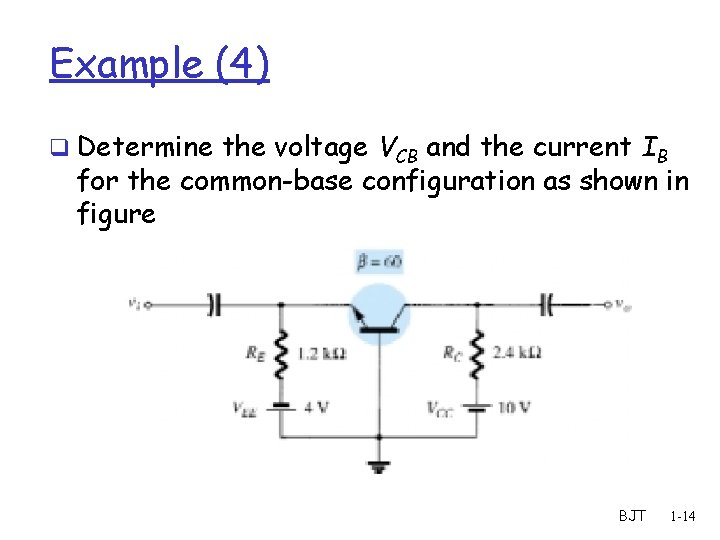
Example (4) q Determine the voltage VCB and the current IB for the common-base configuration as shown in figure BJT 1 -14
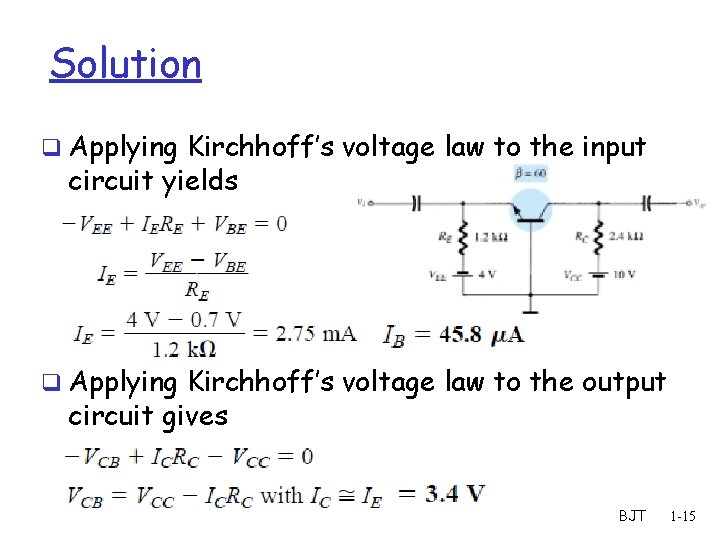
Solution q Applying Kirchhoff’s voltage law to the input circuit yields q Applying Kirchhoff’s voltage law to the output circuit gives BJT 1 -15
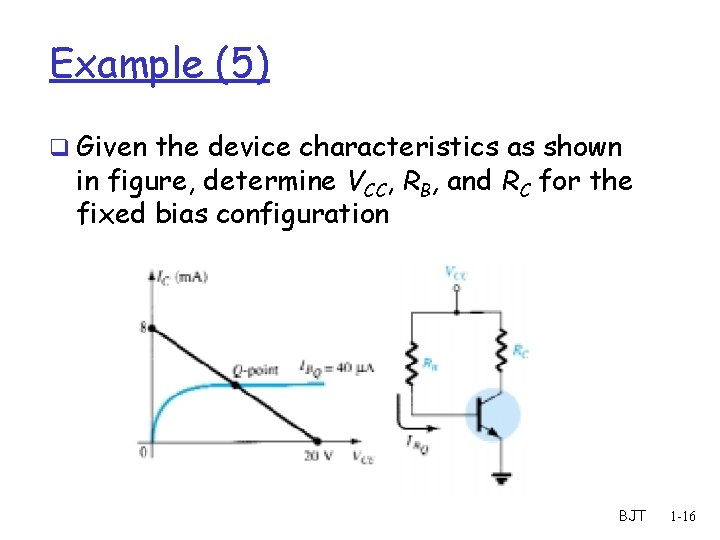
Example (5) q Given the device characteristics as shown in figure, determine VCC, RB, and RC for the fixed bias configuration BJT 1 -16
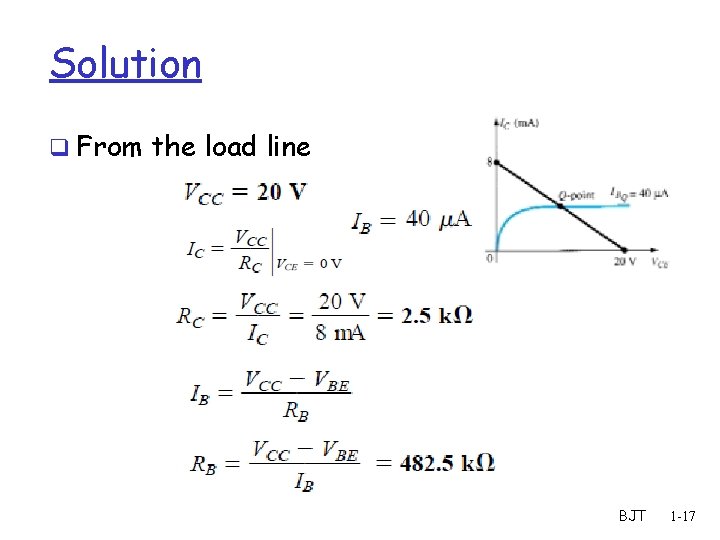
Solution q From the load line BJT 1 -17
BJT Transistor Modeling q A model is an equivalent circuit that represents the AC characteristics of the transistor q A model uses circuit elements that approximate the behavior of the transistor q There are two models commonly used in small signal AC analysis of a transistor: v re model v Hybrid equivalent model BJT 1 -18
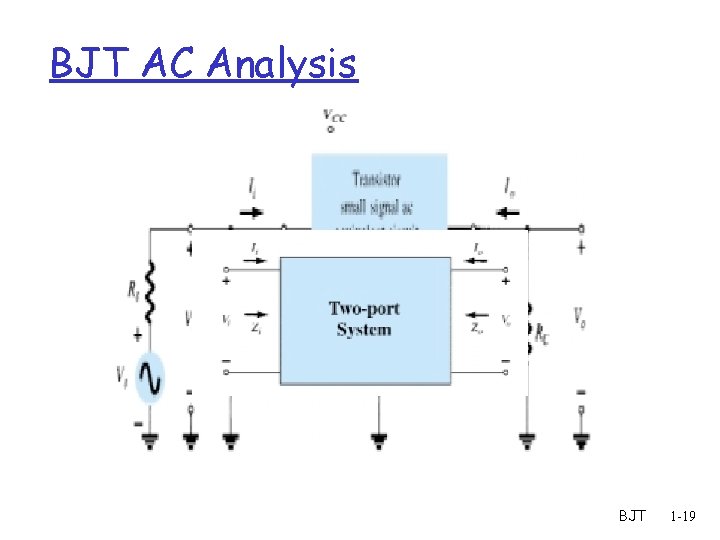
BJT AC Analysis BJT 1 -19
The re Transistor Model q BJTs are basically current-controlled devices; therefore the re model uses a diode and a current source to duplicate the behavior of the transistor v Recall (from lecture 5): the ac resistance of a diode can be determined by the equation r = 26 m. V/ID, where ID is the dc current through the diode at the Q (quiescent) point ac q One disadvantage to this model is its sensitivity to the DC level. This model is designed for specific circuit conditions BJT 1 -20
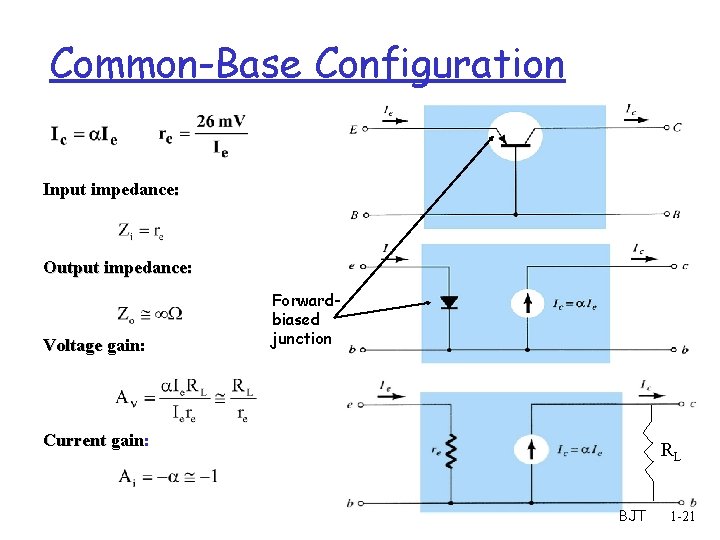
Common-Base Configuration Input impedance: Output impedance: Voltage gain: Forwardbiased junction Current gain: RL BJT 1 -21
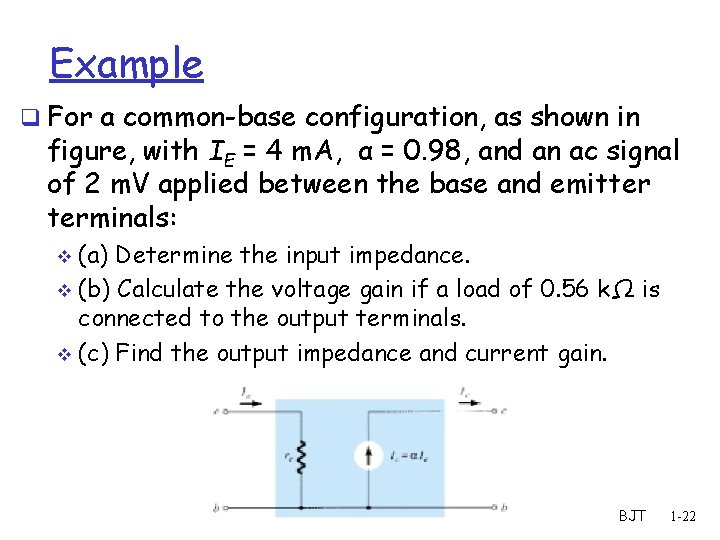
Example q For a common-base configuration, as shown in figure, with IE = 4 m. A, α = 0. 98, and an ac signal of 2 m. V applied between the base and emitter terminals: (a) Determine the input impedance. v (b) Calculate the voltage gain if a load of 0. 56 kΩ is connected to the output terminals. v (c) Find the output impedance and current gain. v BJT 1 -22
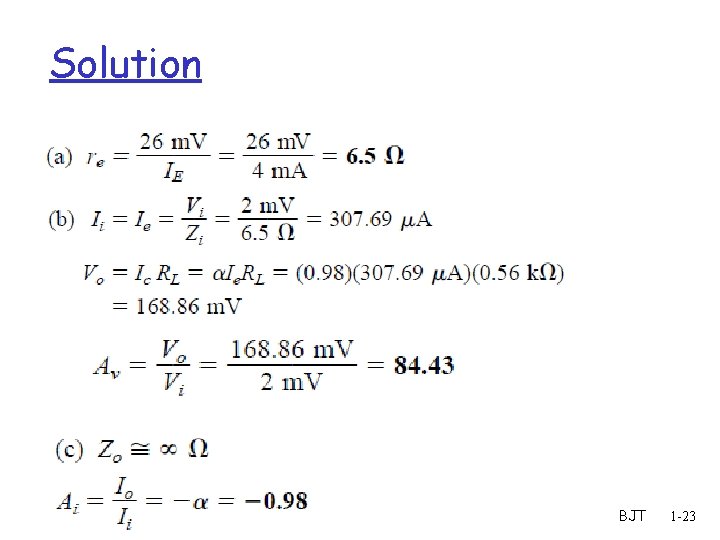
Solution BJT 1 -23
Lecture Summary Covered material q Continue BJT v DC analysis • More examples v Introduction to AC signal analysis Material to be covered next lecture q Continue BJT analysis with AC signal BJT 1 -24
- Slides: 24