
Lecture 10 b A Network Competition Model Laffont
Lecture 10 b: A Network Competition Model Laffont, Tirole, & Rey (1998 a, b) RAND Journal of Economics
Outline of Model • Demand system in which individuals are distributed according to their preferences over networks. • Consumers have two choices: which network to join and how many calls to make. • Prices chosen by the firms affect network affiliation, as well as the number of calls. • Model formalizes pricing game between the competing firms and analyzes the effect of changes in termination fees on the equilibrium prices.
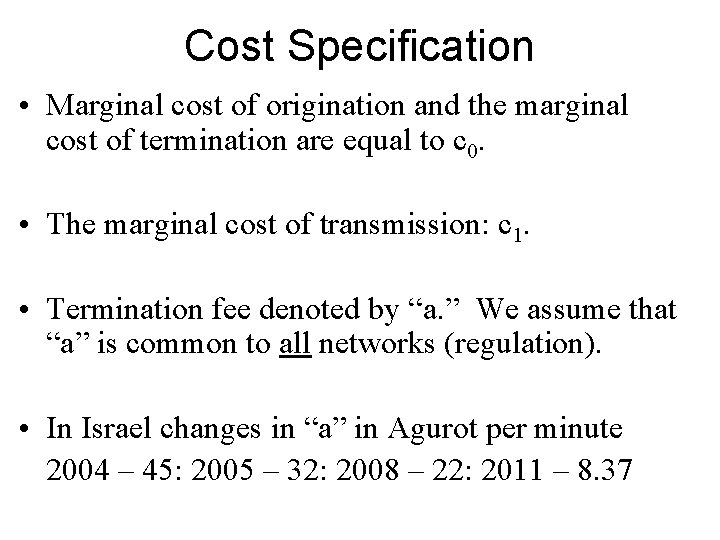
Cost Specification • Marginal cost of origination and the marginal cost of termination are equal to c 0. • The marginal cost of transmission: c 1. • Termination fee denoted by “a. ” We assume that “a” is common to all networks (regulation). • In Israel changes in “a” in Agurot per minute 2004 – 45: 2005 – 32: 2008 – 22: 2011 – 8. 37
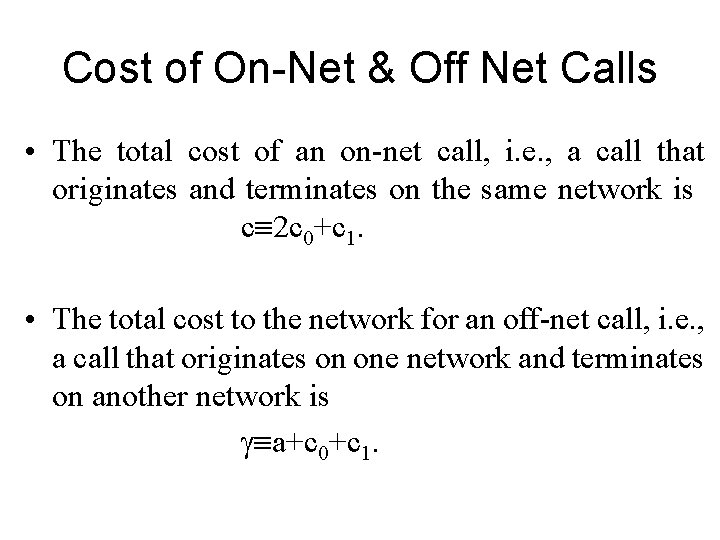
Cost of On-Net & Off Net Calls • The total cost of an on-net call, i. e. , a call that originates and terminates on the same network is c 2 c 0+c 1. • The total cost to the network for an off-net call, i. e. , a call that originates on one network and terminates on another network is a+c 0+c 1.
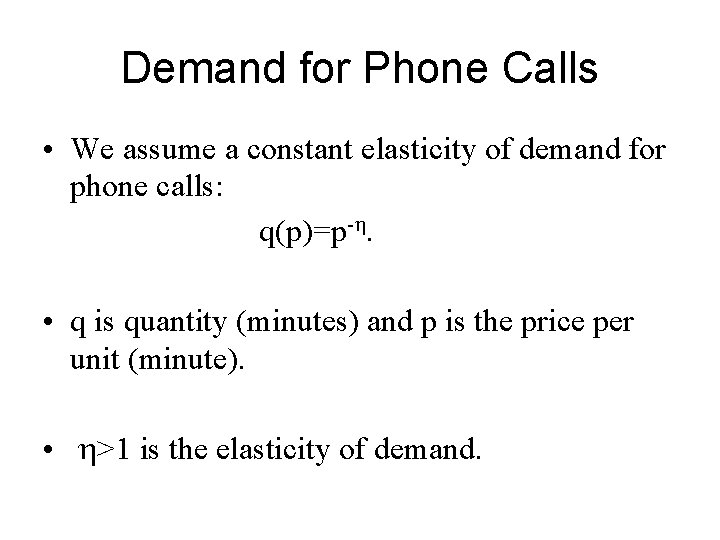
Demand for Phone Calls • We assume a constant elasticity of demand for phone calls: q(p)=p-. • q is quantity (minutes) and p is the price per unit (minute). • >1 is the elasticity of demand.

Demand for Calls Continued • We assume that the price of “on-net” and “off-net” calls are the same denoted by p. • Consumer’s net surplus from calls is given by v(p)= p-( -1)/( -1).
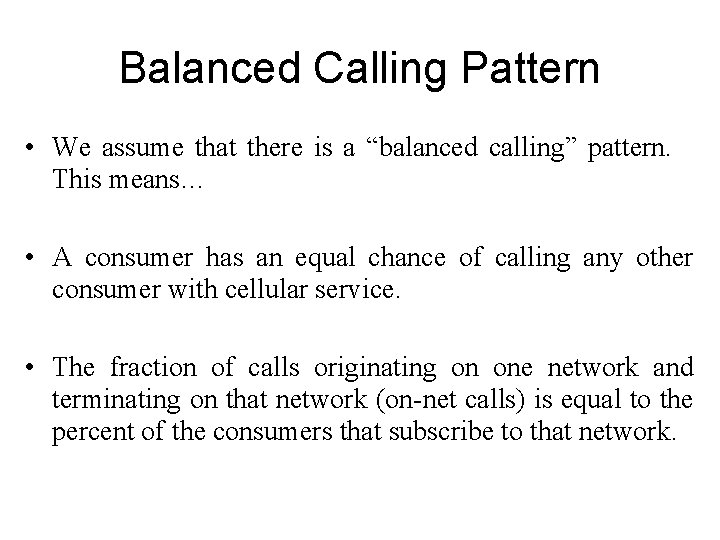
Balanced Calling Pattern • We assume that there is a “balanced calling” pattern. This means… • A consumer has an equal chance of calling any other consumer with cellular service. • The fraction of calls originating on one network and terminating on that network (on-net calls) is equal to the percent of the consumers that subscribe to that network.
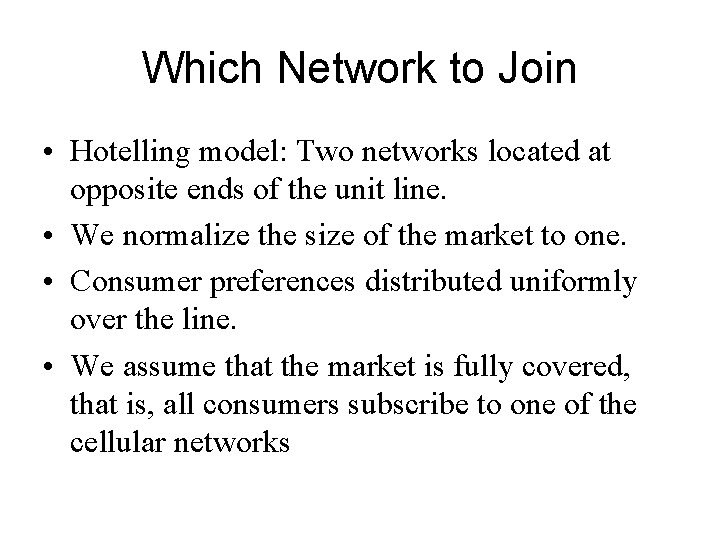
Which Network to Join • Hotelling model: Two networks located at opposite ends of the unit line. • We normalize the size of the market to one. • Consumer preferences distributed uniformly over the line. • We assume that the market is fully covered, that is, all consumers subscribe to one of the cellular networks
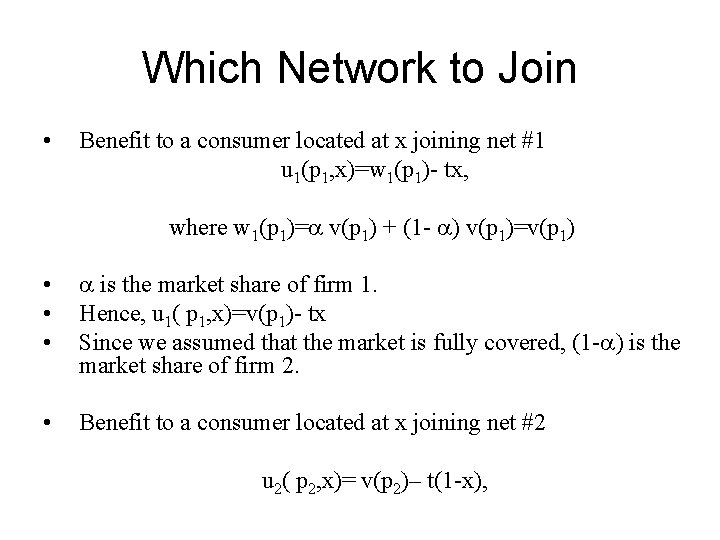
Which Network to Join • Benefit to a consumer located at x joining net #1 u 1(p 1, x)=w 1(p 1)- tx, where w 1(p 1)= v(p 1) + (1 - ) v(p 1)=v(p 1) • • • is the market share of firm 1. Hence, u 1( p 1, x)=v(p 1)- tx Since we assumed that the market is fully covered, (1 - ) is the market share of firm 2. • Benefit to a consumer located at x joining net #2 u 2( p 2, x)= v(p 2)– t(1 -x),
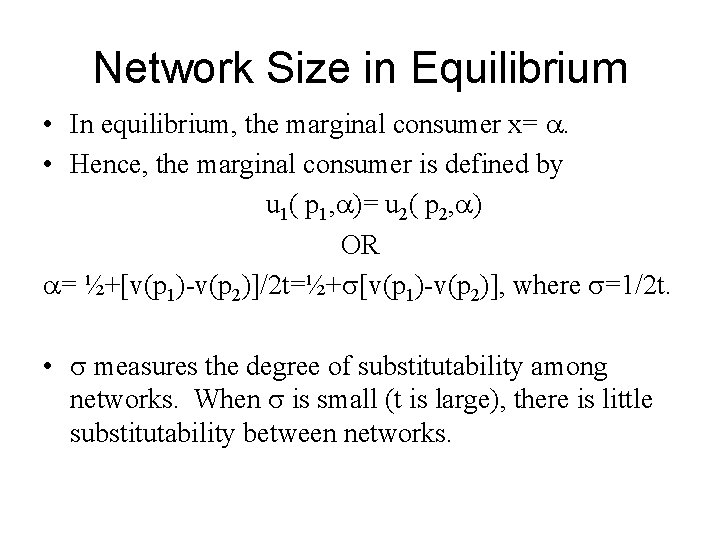
Network Size in Equilibrium • In equilibrium, the marginal consumer x= . • Hence, the marginal consumer is defined by u 1( p 1, )= u 2( p 2, ) OR = ½+[v(p 1)-v(p 2)]/2 t=½+ [v(p 1)-v(p 2)], where =1/2 t. • measures the degree of substitutability among networks. When is small (t is large), there is little substitutability between networks.
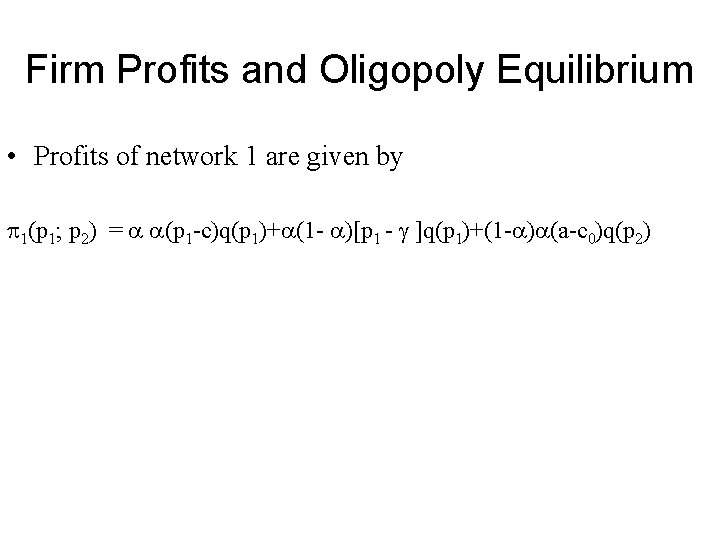
Firm Profits and Oligopoly Equilibrium • Profits of network 1 are given by 1(p 1; p 2) = (p 1 -c)q(p 1)+ (1 - )[p 1 - ]q(p 1)+(1 - ) (a-c 0)q(p 2)
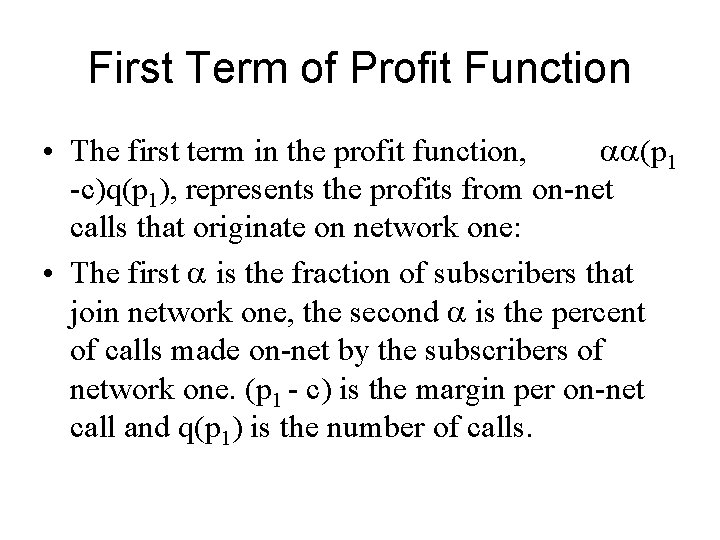
First Term of Profit Function • The first term in the profit function, (p 1 -c)q(p 1), represents the profits from on-net calls that originate on network one: • The first is the fraction of subscribers that join network one, the second is the percent of calls made on-net by the subscribers of network one. (p 1 - c) is the margin per on-net call and q(p 1) is the number of calls.
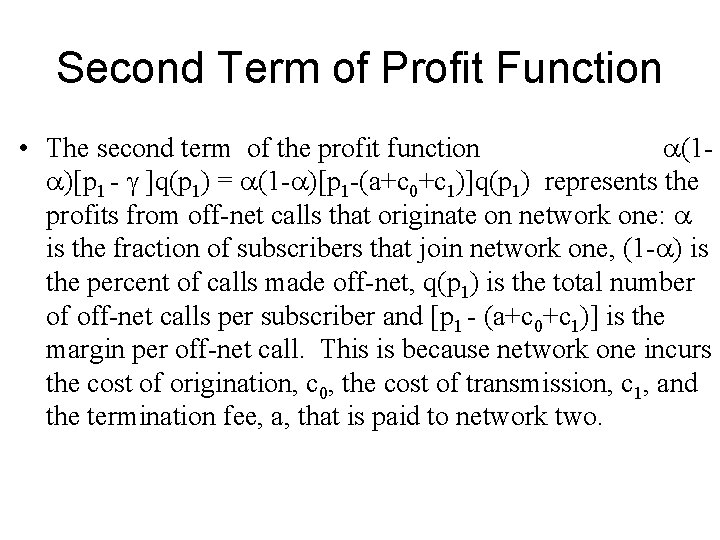
Second Term of Profit Function • The second term of the profit function (1 )[p 1 - ]q(p 1) = (1 - )[p 1 -(a+c 0+c 1)]q(p 1) represents the profits from off-net calls that originate on network one: is the fraction of subscribers that join network one, (1 - ) is the percent of calls made off-net, q(p 1) is the total number of off-net calls per subscriber and [p 1 - (a+c 0+c 1)] is the margin per off-net call. This is because network one incurs the cost of origination, c 0, the cost of transmission, c 1, and the termination fee, a, that is paid to network two.
Third Term of Profit Function · The third term, (1 - ) (a-c 0)q(p 2), represents revenue from calls that originate on network two and terminate on network one. (1 - ) is the fraction of subscribers that join network two, is the percent of calls made off-net (to network one) and q(p 2) is the total number of off-net calls per subscriber, and (a-c 0) is the margin per call. This is because the revenue per call is “a” and the cost of terminating the call that originates on network two is c 0.
Equilibrium Prices • Equilibrium prices are found by differentiating the profit functions with respect to p 1 and p 2 and setting these equations equal to zero. • If a stable, symmetric equilibrium exists (p 1*=p 2*=p*), • p* increases in a. (Thus, when a falls, p* falls) • Thus, the access charge is an instrument of tacit collusion. • Why? See next slide!
Intuition for Result 1(p 1; p 2) = (p 1 -c)q(p 1)+ (1 - )[p 1 - ]q(p 1)+(1 - ) (a-c 0)q(p 2) But second term can be written: (1 - )[p 1 -(a+c 0+c 1)+(c 0 -c 0)]q(p 1)= (1 - )[p 1 -c] q(p 1)- (1 - )[a-c 0]q(p 1) Thus, 1(p 1; p 2) = (p 1 -c)q(p 1) + (1 - ) (a-c 0)[q(p 2)-q(p 1)] 1(p 1; p 2) = Retail profit + access ‘revenue/deficit’ term Note: If p 1> p 2, firm 1 has positive revenue from access. And when a is well above a-c 0, this provides a strong incentive not to lower prices
- Slides: 16