
Lecture 1 week 1 Power Transmission and Distribution
Lecture 1 (week 1) Power Transmission and Distribution Introduction By Engr. Bilal Ahmad B. Tech (Electrical)
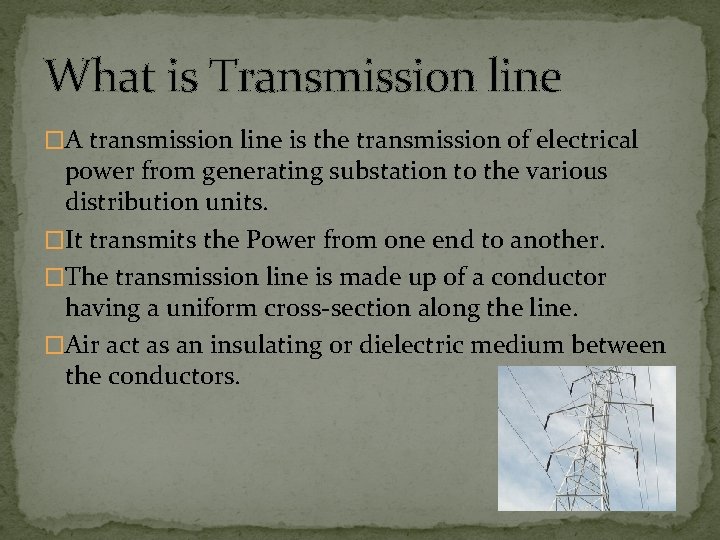
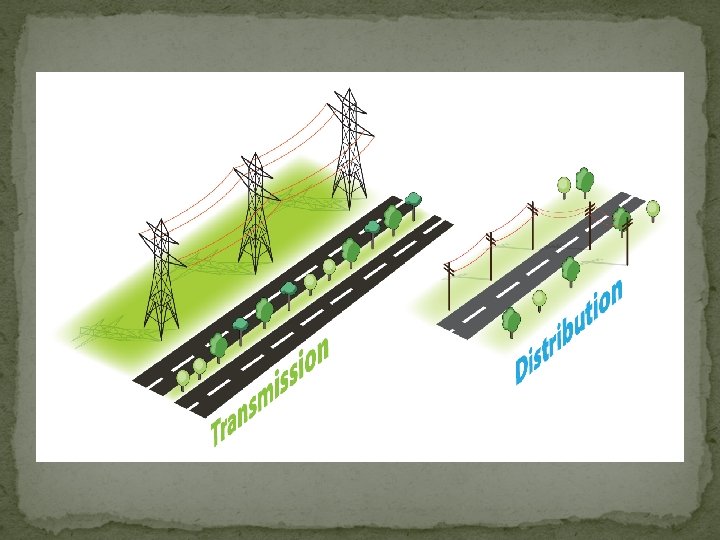
What is Transmission line �A transmission line is the transmission of electrical power from generating substation to the various distribution units. �It transmits the Power from one end to another. �The transmission line is made up of a conductor having a uniform cross-section along the line. �Air act as an insulating or dielectric medium between the conductors.
What is Distribution Line �A distribution line is a line or system for distributing power from a transmission system to the consumer or to the load center. �Distribution line is a electric voltage line, wire or cable including supporting structures, which delivers electricity to the user or consumer.
Types of Transmission & Distribution Lines The transmission and distribution network maybe grouped as given below. Transmission Lines 1) Primary Transmission 2) Secondary Transmission Distribution Lines 1) Primary Distribution 2) Secondary Distribution

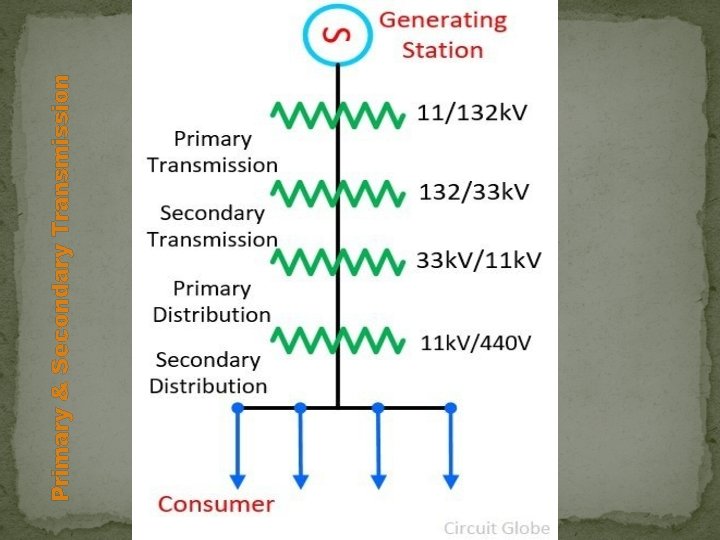
Primary Transmission: �The Transmission lines from Power generation to substation are known as Primary Transmission. �These are High voltage lines like 132 k. V 220 k. V and 500 k. V. �Primary Transmission Lines are used Overhead 3 phase 3 wire system for transmitting power from Power Plant to Substation (gird).
Secondary Transmission: �Some load areas are far away from main substation so we transmit power by another transmission lines from main substation to small substation. These another transmission lines are known as secondary transmission. �For Secondary transmission 66 k. V or 33 k. V lines are used. �Secondary Transmission Lines are also used Overhead 3 phase 3 wire system.

Primary Distribution �Primary distribution systems consist of feeders that deliver power from distribution substations to distribution transformers are known as Primary Distribution. �Distribution Transformer are Step down transformer which step down High Voltage level to 11 k. V. �These 11 k. V lines are 3 phase 3 wire system which are connected to step down transformer of primary side.

Secondary Distribution �Secondary Distribution is a part of electric power distribution which carries electric energy from distribution transformers to electricity meters of end customers. �Secondary networks are operated at a low voltage level. �Most modern secondary networks are operated at AC rated voltage of 100– 120 or 230– 240 volts, at the frequency of 50 or 60 hertz. �Operating voltage, required number of phases threephase or single-phase system.
Primary & Secondary Transmission

…Thanks….
- Slides: 11