
Lecture 1 The History and Evolution of Psychology


- Slides: 13
Lecture #1: The History and Evolution of Psychology
Questions to Consider u What is the History of Psychology? u How has Psychology evolved? u What were the early “schools” of thought in Psychology?
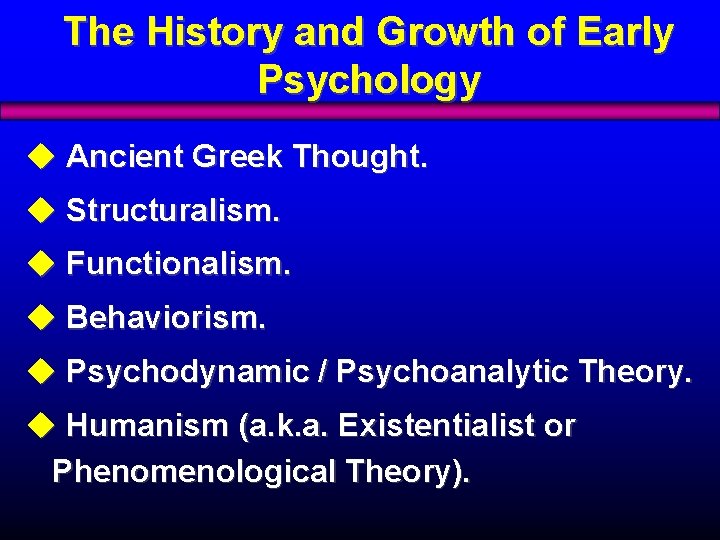
The History and Growth of Early Psychology u Ancient Greek Thought. u Structuralism. u Functionalism. u Behaviorism. u Psychodynamic / Psychoanalytic Theory. u Humanism (a. k. a. Existentialist or Phenomenological Theory).
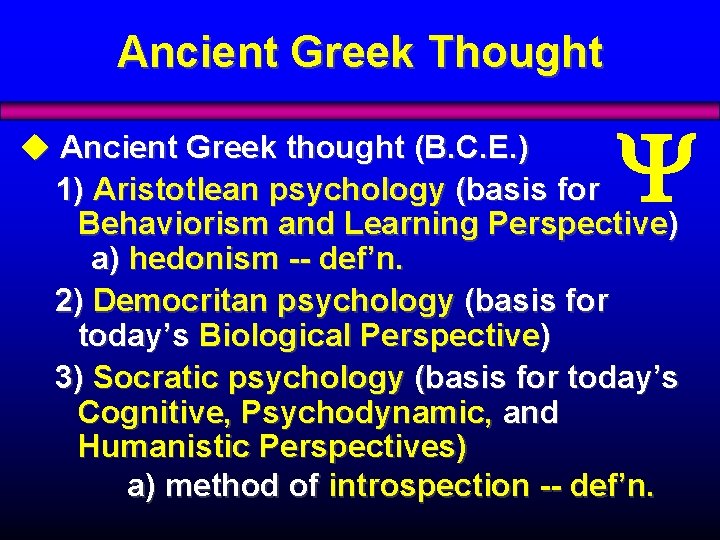
Ancient Greek Thought u Ancient Greek thought (B. C. E. ) 1) Aristotlean psychology (basis for Behaviorism and Learning Perspective) a) hedonism -- def’n. 2) Democritan psychology (basis for today’s Biological Perspective) 3) Socratic psychology (basis for today’s Cognitive, Psychodynamic, and Humanistic Perspectives) a) method of introspection -- def’n.
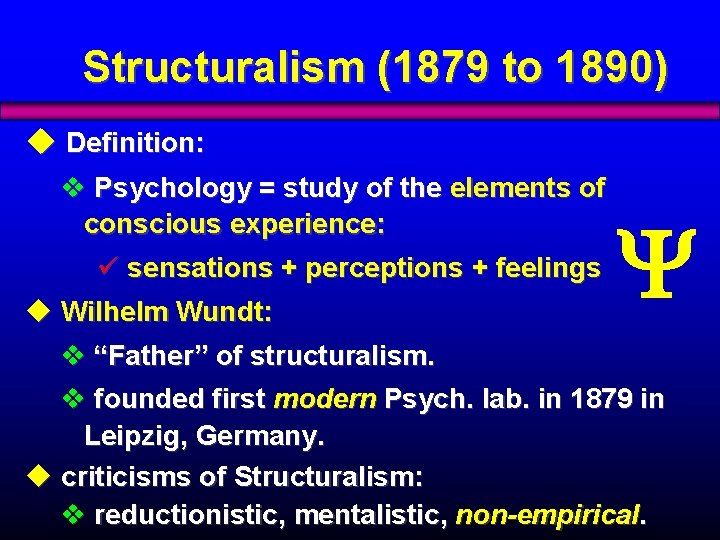
Structuralism (1879 to 1890) u Definition: v Psychology = study of the elements of conscious experience: ü sensations + perceptions + feelings u Wilhelm Wundt: v “Father” of structuralism. v founded first modern Psych. lab. in 1879 in Leipzig, Germany. u criticisms of Structuralism: v reductionistic, mentalistic, non-empirical.
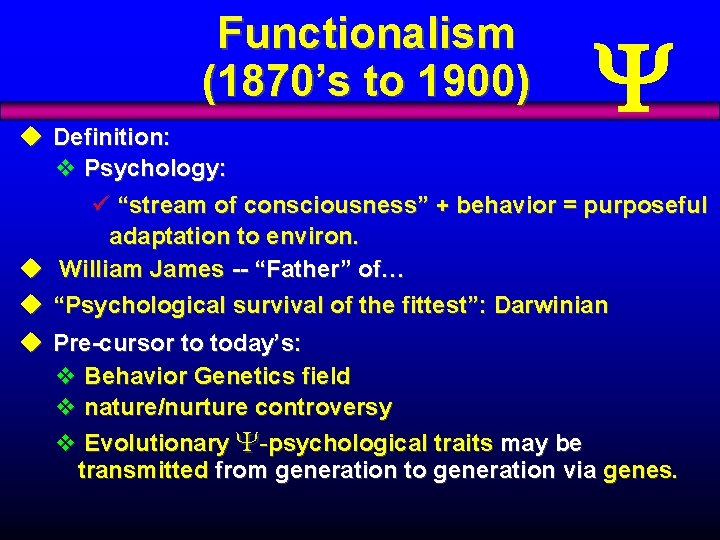
Functionalism (1870’s to 1900) u Definition: v Psychology: ü “stream of consciousness” + behavior = purposeful adaptation to environ. u William James -- “Father” of… u “Psychological survival of the fittest”: Darwinian u Pre-cursor to today’s: v Behavior Genetics field v nature/nurture controversy v Evolutionary -psychological traits may be transmitted from generation to generation via genes.
Behaviorism (1910’s to 1960’s) u Definition: v the scientific study of observable behavior and v how behavior is “learned” or “conditioned”. u Conditioning = learning for the Behaviorist. v No mental processes in learning of behavior b/c: ü mental processes are non-empirical. ü behaviors ARE empirical, observable.
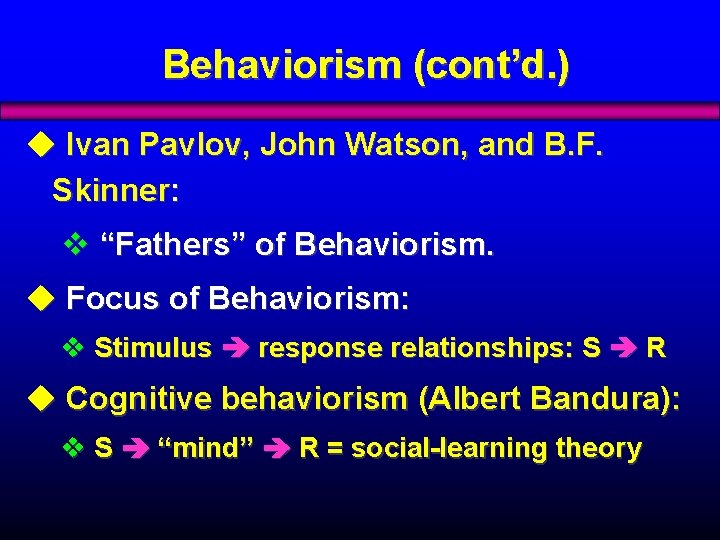
Behaviorism (cont’d. ) u Ivan Pavlov, John Watson, and B. F. Skinner: v “Fathers” of Behaviorism. u Focus of Behaviorism: v Stimulus response relationships: S R u Cognitive behaviorism (Albert Bandura): v S “mind” R = social-learning theory
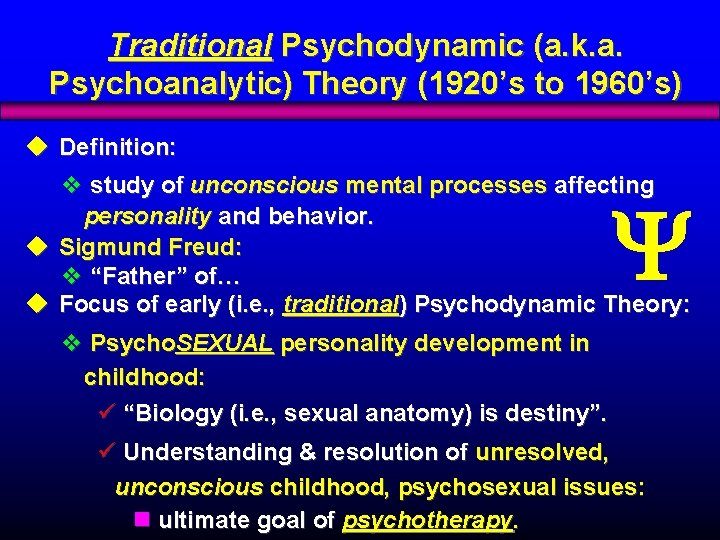
Traditional Psychodynamic (a. k. a. Psychoanalytic) Theory (1920’s to 1960’s) u Definition: v study of unconscious mental processes affecting personality and behavior. u Sigmund Freud: v “Father” of… u Focus of early (i. e. , traditional) Psychodynamic Theory: v Psycho. SEXUAL personality development in childhood: ü “Biology (i. e. , sexual anatomy) is destiny”. ü Understanding & resolution of unresolved, unconscious childhood, psychosexual issues: n ultimate goal of psychotherapy.
Traditional Psychodynamic Theory (cont’d. ) u Understanding unresolved childhood, psychosexual issues via: v Psychoanalysis of: n id (unconscious pleasure) n ego (conscious reality, defense mech. ) n superego (conscience, moral guardian) v Psychoanalysis occurs via: ü the “talking cure” and dream analysis. ü Today, called psychotherapy (> eclectic).
Humanism (1950’s to 1970’s) u Definitions and assumptions: v The basis of all human behavior is: ü Self, self-awareness, conscious choice, responsibility for choice, selfactualization, self-esteem, and locus of control (internal vs. external locus). u Roots: structuralism, functionalism, psychodynamic theory, Socratic introspection, and cognitive . u Abraham Maslow, Carl Rogers: “Fathers” of. . .
Modern Psychodynamic Theory u Modern psychodynamic perspective: v “Socio-cultural upbringing (i. e. , relationships w/ family, friends, peers) is destiny”. v a. k. a. neo-Freudian . v emphasis is on psycho. SOCIAL personality development; v not psycho. SEXUAL.