
Lecture 1 Sentences Verbs Grammar is defined as
Lecture 1 Sentences Verbs
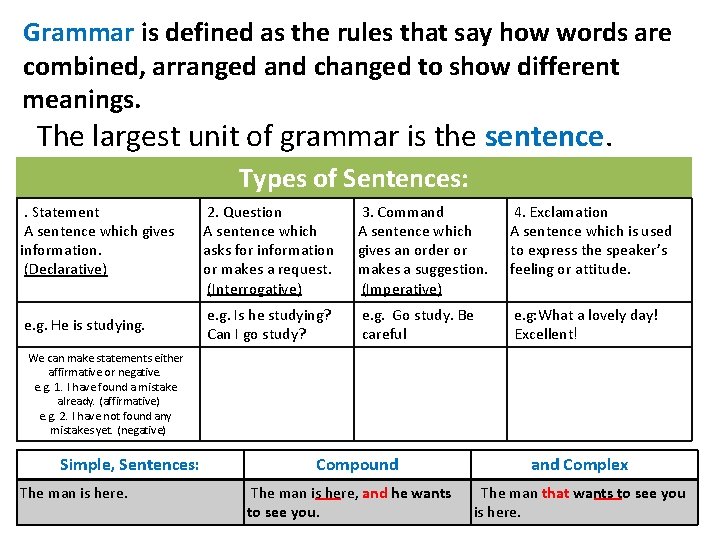
Grammar is defined as the rules that say how words are combined, arranged and changed to show different meanings. The largest unit of grammar is the sentence. Types of Sentences: . Statement A sentence which gives information. (Declarative) e. g. He is studying. 2. Question A sentence which asks for information or makes a request. (Interrogative) 3. Command A sentence which gives an order or makes a suggestion. (Imperative) 4. Exclamation A sentence which is used to express the speaker’s feeling or attitude. e. g. Is he studying? Can I go study? e. g. Go study. Be careful e. g: What a lovely day! Excellent! We can make statements either affirmative or negative. e. g. 1. I have found a mistake already. (affirmative) e. g. 2. I have not found any mistakes yet. (negative) Simple, Sentences: The man is here. Compound The man is here, and he wants to see you. and Complex The man that wants to see you is here.
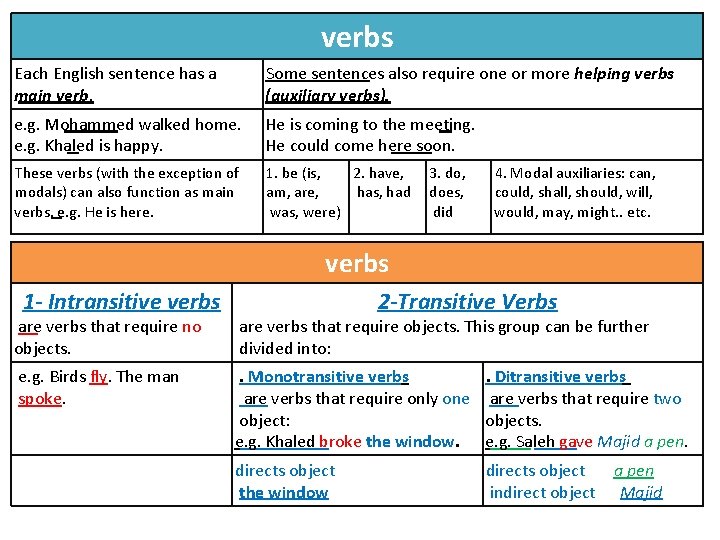
verbs Each English sentence has a main verb. Some sentences also require one or more helping verbs (auxiliary verbs). e. g. Mohammed walked home. e. g. Khaled is happy. He is coming to the meeting. He could come here soon. These verbs (with the exception of modals) can also function as main verbs. e. g. He is here. 1. be (is, 2. have, am, are, has, had was, were) 3. do, does, did 4. Modal auxiliaries: can, could, shall, should, will, would, may, might. . etc. verbs 1 - Intransitive verbs 2 -Transitive Verbs are verbs that require no objects. are verbs that require objects. This group can be further divided into: e. g. Birds fly. The man spoke. . Monotransitive verbs. Ditransitive verbs are verbs that require only one are verbs that require two object: objects. e. g. Khaled broke the window. e. g. Saleh gave Majid a pen. directs object the window directs object indirect object a pen Majid
Lecture 2 (NP) nouns
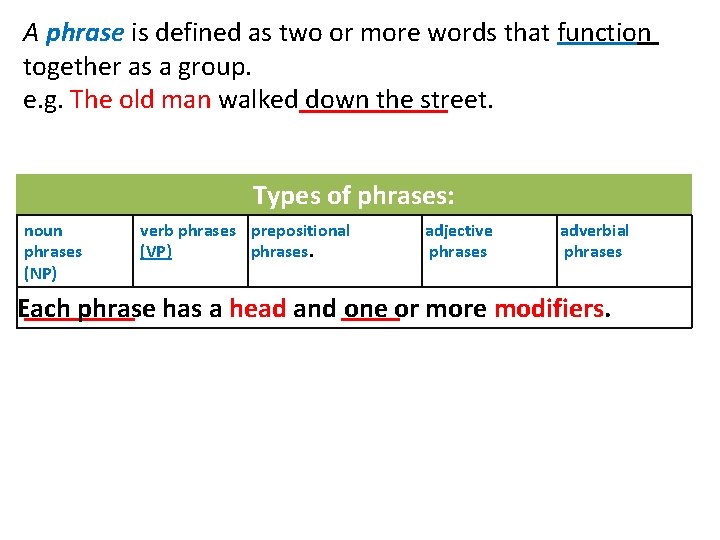
A phrase is defined as two or more words that function together as a group. e. g. The old man walked down the street. Types of phrases: noun phrases (NP) verb phrases prepositional (VP) phrases. adjective phrases adverbial phrases Each phrase has a head and one or more modifiers.
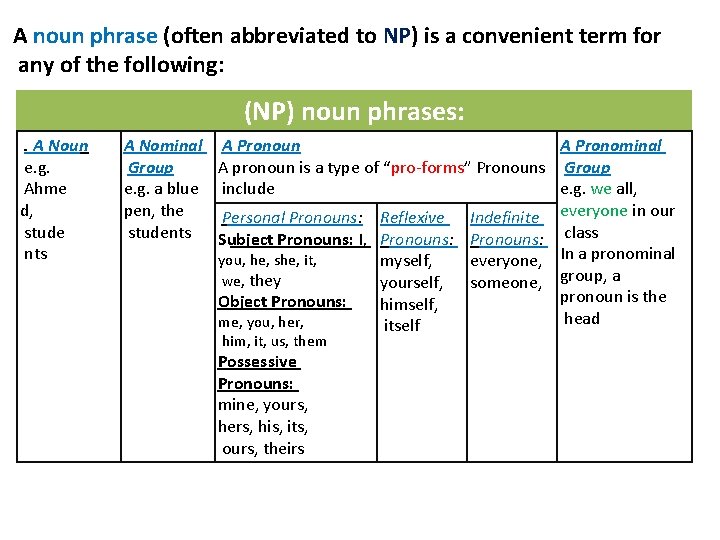
A noun phrase (often abbreviated to NP) is a convenient term for any of the following: (NP) noun phrases: . A Noun e. g. Ahme d, stude nts A Nominal A Pronoun Group A pronoun is a type of “pro-forms” Pronouns e. g. a blue include pen, the Personal Pronouns: Reflexive Indefinite students Subject Pronouns: I, Pronouns: you, he, she, it, myself, everyone, we, they yourself, someone, Object Pronouns: himself, me, you, her, itself him, it, us, them Possessive Pronouns: mine, yours, hers, his, its, ours, theirs A Pronominal Group e. g. we all, everyone in our class In a pronominal group, a pronoun is the head
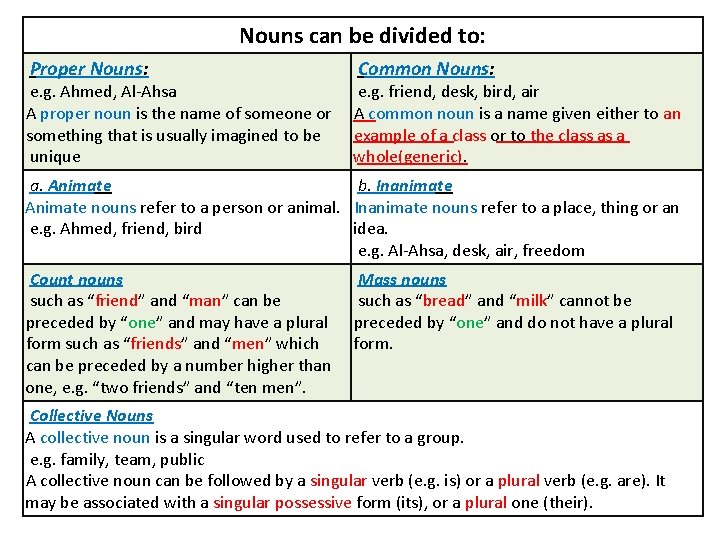
Nouns can be divided to: Proper Nouns: e. g. Ahmed, Al-Ahsa A proper noun is the name of someone or something that is usually imagined to be unique Common Nouns: e. g. friend, desk, bird, air A common noun is a name given either to an example of a class or to the class as a whole(generic). a. Animate b. Inanimate Animate nouns refer to a person or animal. Inanimate nouns refer to a place, thing or an e. g. Ahmed, friend, bird idea. e. g. Al-Ahsa, desk, air, freedom Count nouns such as “friend” and “man” can be preceded by “one” and may have a plural form such as “friends” and “men” which can be preceded by a number higher than one, e. g. “two friends” and “ten men”. Mass nouns such as “bread” and “milk” cannot be preceded by “one” and do not have a plural form. Collective Nouns A collective noun is a singular word used to refer to a group. e. g. family, team, public A collective noun can be followed by a singular verb (e. g. is) or a plural verb (e. g. are). It may be associated with a singular possessive form (its), or a plural one (their).
Lecture 3 Modifiers Determiners Person, Number and Gender
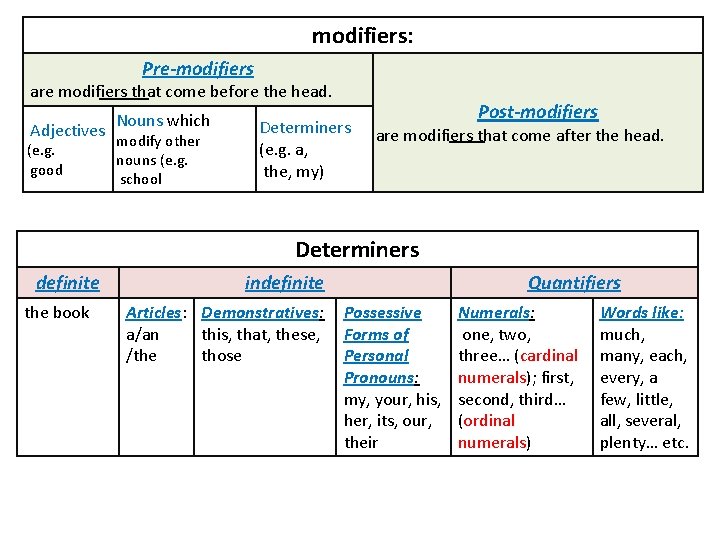
modifiers: Pre-modifiers are modifiers that come before the head. Adjectives (e. g. good Nouns which modify other nouns (e. g. school Determiners (e. g. a, the, my) Post-modifiers are modifiers that come after the head. Determiners definite the book indefinite Articles: Demonstratives: a/an this, that, these, /the those Quantifiers Possessive Forms of Personal Pronouns: my, your, his, her, its, our, their Numerals: one, two, three… (cardinal numerals); first, second, third… (ordinal numerals) Words like: much, many, each, every, a few, little, all, several, plenty… etc.
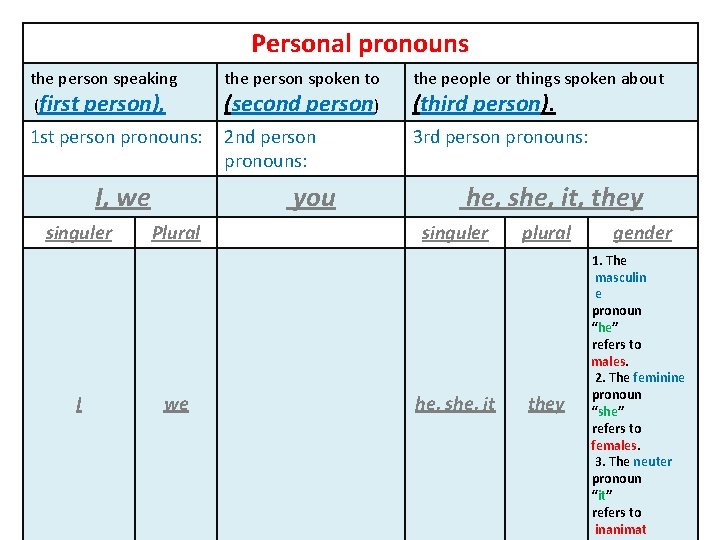
Personal pronouns the person speaking the person spoken to the people or things spoken about 1 st person pronouns: 2 nd person pronouns: 3 rd person pronouns: (first person), I, we singuler I (second person) you Plural we (third person). he, she, it, they singuler he, she, it plural they gender 1. The masculin e pronoun “he” refers to males. 2. The feminine pronoun “she” refers to females. 3. The neuter pronoun “it” refers to inanimat
Lecture 4 What is a clause? Verb Phrase (VP) Finite Verbs Non-finite verbs Finite vs. Non-finite Clauses
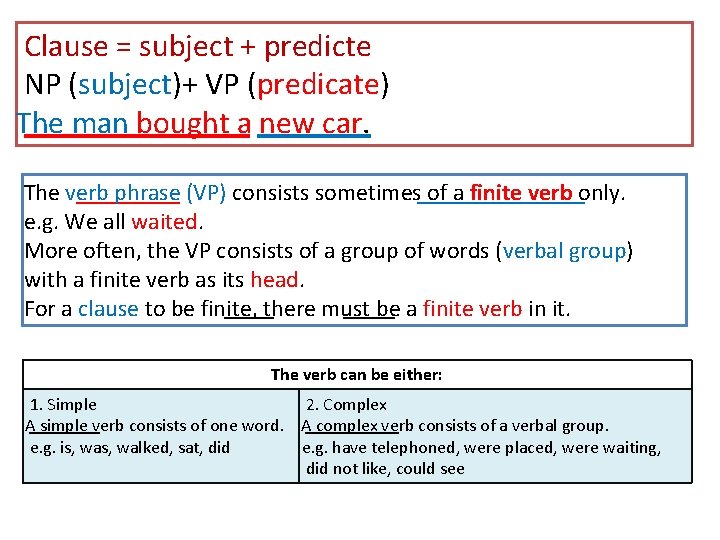
Clause = subject + predicte NP (subject)+ VP (predicate) The man bought a new car. The verb phrase (VP) consists sometimes of a finite verb only. e. g. We all waited. More often, the VP consists of a group of words (verbal group) with a finite verb as its head. For a clause to be finite, there must be a finite verb in it. The verb can be either: 1. Simple 2. Complex A simple verb consists of one word. A complex verb consists of a verbal group. e. g. is, walked, sat, did e. g. have telephoned, were placed, were waiting, did not like, could see
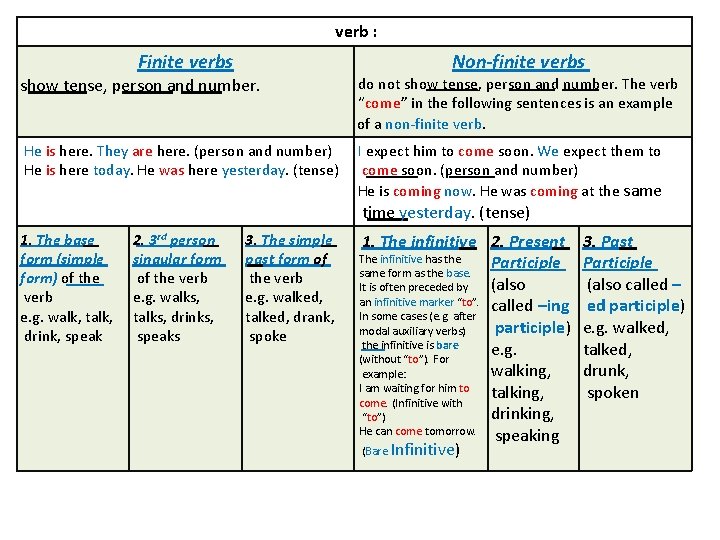
verb : Finite verbs Non-finite verbs show tense, person and number. do not show tense, person and number. The verb “come” in the following sentences is an example of a non-finite verb. He is here. They are here. (person and number) He is here today. He was here yesterday. (tense) I expect him to come soon. We expect them to come soon. (person and number) He is coming now. He was coming at the same time yesterday. (tense) 1. The base form (simple form) of the verb e. g. walk, talk, drink, speak 2. 3 rd person singular form of the verb e. g. walks, talks, drinks, speaks 3. The simple past form of the verb e. g. walked, talked, drank, spoke 1. The infinitive 2. Present The infinitive has the Participle same form as the base. (also It is often preceded by an infinitive marker “to”. called –ing In some cases (e. g. after participle) modal auxiliary verbs) the infinitive is bare e. g. (without “to”). For walking, example: I am waiting for him to talking, come. (Infinitive with drinking, “to”) He can come tomorrow. speaking (Bare Infinitive) 3. Past Participle (also called – ed participle) e. g. walked, talked, drunk, spoken
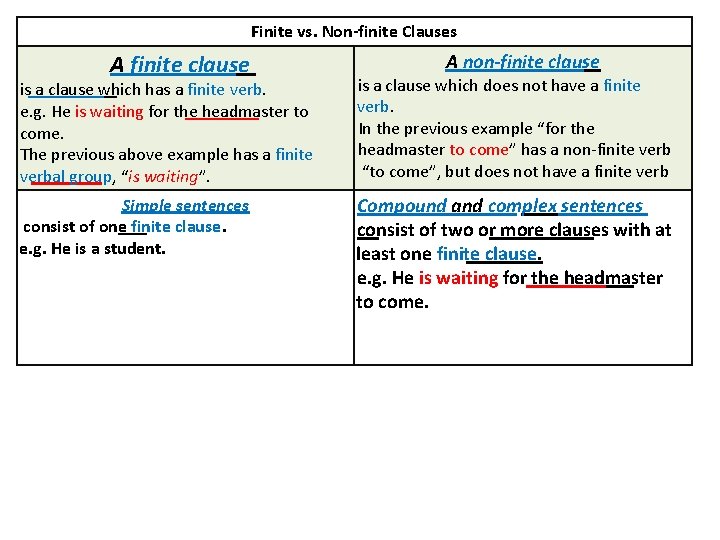
Finite vs. Non-finite Clauses A finite clause A non-finite clause is a clause which has a finite verb. e. g. He is waiting for the headmaster to come. The previous above example has a finite verbal group, “is waiting”. is a clause which does not have a finite verb. In the previous example “for the headmaster to come” has a non-finite verb “to come”, but does not have a finite verb Simple sentences consist of one finite clause. e. g. He is a student. Compound and complex sentences consist of two or more clauses with at least one finite clause. e. g. He is waiting for the headmaster to come.
Lecture 5 Verbal Groups Operators
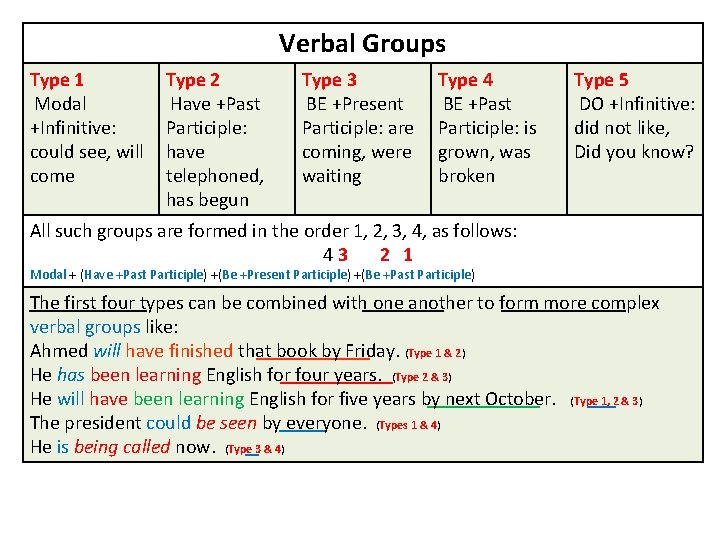
Verbal Groups Type 1 Modal +Infinitive: could see, will come Type 2 Have +Past Participle: have telephoned, has begun Type 3 BE +Present Participle: are coming, were waiting Type 4 BE +Past Participle: is grown, was broken Type 5 DO +Infinitive: did not like, Did you know? All such groups are formed in the order 1, 2, 3, 4, as follows: 43 2 1 Modal + (Have +Past Participle) +(Be +Present Participle) +(Be +Past Participle) The first four types can be combined with one another to form more complex verbal groups like: Ahmed will have finished that book by Friday. (Type 1 & 2) He has been learning English for four years. (Type 2 & 3) He will have been learning English for five years by next October. (Type 1, 2 & 3) The president could be seen by everyone. (Types 1 & 4) He is being called now. (Type 3 & 4)
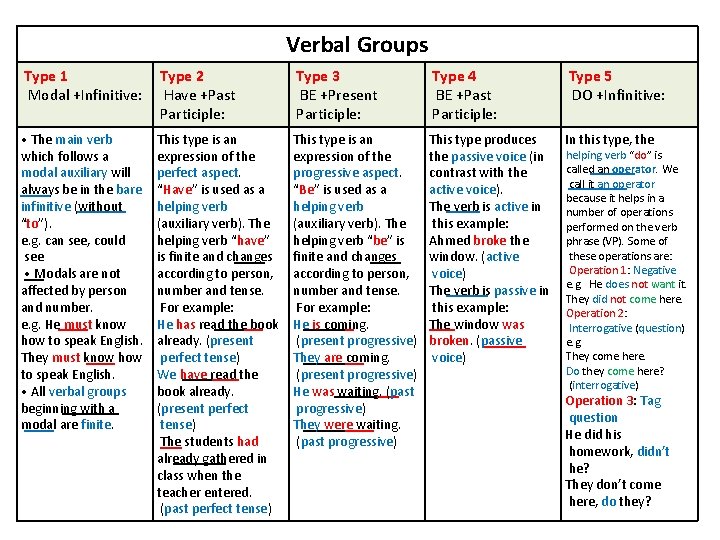
Verbal Groups Type 1 Modal +Infinitive: Type 2 Have +Past Participle: Type 3 BE +Present Participle: Type 4 BE +Past Participle: Type 5 DO +Infinitive: • The main verb which follows a modal auxiliary will always be in the bare infinitive (without “to”). e. g. can see, could see • Modals are not affected by person and number. e. g. He must know how to speak English. They must know how to speak English. • All verbal groups beginning with a modal are finite. This type is an expression of the perfect aspect. “Have” is used as a helping verb (auxiliary verb). The helping verb “have” is finite and changes according to person, number and tense. For example: He has read the book already. (present perfect tense) We have read the book already. (present perfect tense) The students had already gathered in class when the teacher entered. (past perfect tense) This type is an expression of the progressive aspect. “Be” is used as a helping verb (auxiliary verb). The helping verb “be” is finite and changes according to person, number and tense. For example: He is coming. (present progressive) They are coming. (present progressive) He was waiting. (past progressive) They were waiting. (past progressive) This type produces the passive voice (in contrast with the active voice). The verb is active in this example: Ahmed broke the window. (active voice) The verb is passive in this example: The window was broken. (passive voice) In this type, the helping verb “do” is called an operator. We call it an operator because it helps in a number of operations performed on the verb phrase (VP). Some of these operations are: Operation 1: Negative e. g. He does not want it. They did not come here. Operation 2: Interrogative (question) e. g. They come here. Do they come here? (interrogative) Operation 3: Tag question He did his homework, didn’t he? They don’t come here, do they?
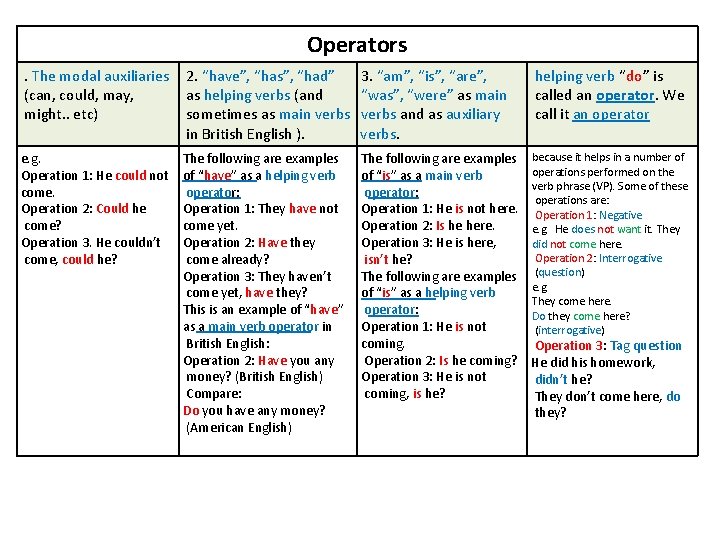
Operators. The modal auxiliaries (can, could, may, might. . etc) 2. “have”, “has”, “had” as helping verbs (and sometimes as main verbs in British English ). e. g. The following are examples Operation 1: He could not of “have” as a helping verb come. operator: Operation 2: Could he Operation 1: They have not come? come yet. Operation 3. He couldn’t Operation 2: Have they come, could he? come already? Operation 3: They haven’t come yet, have they? This is an example of “have” as a main verb operator in British English: Operation 2: Have you any money? (British English) Compare: Do you have any money? (American English) 3. “am”, “is”, “are”, “was”, “were” as main verbs and as auxiliary verbs. helping verb “do” is called an operator. We call it an operator The following are examples of “is” as a main verb operator: Operation 1: He is not here. Operation 2: Is he here. Operation 3: He is here, isn’t he? The following are examples of “is” as a helping verb operator: Operation 1: He is not coming. Operation 2: Is he coming? Operation 3: He is not coming, is he? because it helps in a number of operations performed on the verb phrase (VP). Some of these operations are: Operation 1: Negative e. g. He does not want it. They did not come here. Operation 2: Interrogative (question) e. g. They come here. Do they come here? (interrogative) Operation 3: Tag question He did his homework, didn’t he? They don’t come here, do they?
- Slides: 18